SHORT COMMUNICATION
Development of a Small-Scale Variant of the Rapid Mix Test
Experimental Bread Baking
Tibor SEDLÁČEK and Pavel HORČIČKA
SELTON Research Centre, Sibřina, Czech Republic
Abstract: To determine wheat quality, an experimental 80 g variant (mini-RMT) of the standard 1050 g Rapid Mix Test (RMT) was developed. Ten samples of wheat flour with known RMT values were analysed using the method. Results showed a strong correlation between RMT and mini-RMT values (r = 0.96). Mini-RMT bread volumes were smaller on average by 47.4 ml. A regression equation was constructed allowing the mini-RMT to be used in place of the RMT in wheat breeder laboratories. Anyway, these results are of limited plausibility due to the limited sample numbers and have to be verified on a larger sample set.
Keywords: experimental bread baking; quality; rapid mix test; wheat
As the basic part of nutrition, bread is of great significance and its quality has been the focus of extensive research (Dobraszczyk & Salmano-wicz 2008; Mondal & Datta 2008; Liu et al. 2009; Singh et al. 2009; Tanács et al. 2010; Purlis 2011, and others). Bread quality is determined mainly using protein fractions, a procedure which is well documented (Pomerancz 1988; Kasarda 1989; MacRitchie 1992; Tronsmo et al. 2003). This offers a description of protein quality related to the composition of glutenin subunits (Payne et al. 1987; Shewry et al. 1992), gliadins (Sontag-Strohm et al. 1996) and relations between protein classes (Kasarda 1989; Singh et al. 1990). Starch properties (Patel et al. 2005), non-starch polysac-charides (Maeda & Morita 2003; Migliori & Gabriele 2010) and lipids (Agyare et al. 2005; Finnie et al. 2010) also play an important role in bread quality. All components affecting the bread quality were summarized in Goasaert et al. (2005).
and normalized in ICC 131. In most of the European Union, Rapid Mix Test (RMT) experimental bak-ing is used on the basis of EEC Directive 2062/81. The RMT is a variant of the Chorleywood baking method, optimized by Seibel et al. (1987) and is still employed in this form today. Unfortunately, the RMT cannot be used for early generations in plant breeding because of the large amount of flour it demands (1050 g at least). In addition, the equipment needed to carry out the RMT is quite expensive. A micro-baking version of the RMT (micro-RMT) was developed by Kieffer et al. (1993) when 10 g of flour are used. A strong correlation was obtained between the micro-RMT and the standard RMT (r = 0.9). However, like in the case of the standard RMT, the equipment necessary to carry out the micro-RMT is expensive and measurement error is substantial. The avail-ability of a small-scale variant (more or less than 100 g) of the standard RMT would therefore be highly valuable for wheat breeding and research. The aim of this paper was to develop just such a small-scale variant, the mini-RMT, using equip-ment which is routinely available.
Grain samples of ten winter wheat varieties (RW Nadal, Bodyček, Brentano, Briliant, Aladin, Manager, Nikol, Samanta, Elly and Graindor) were obtained from trials of the Institute for Supervision
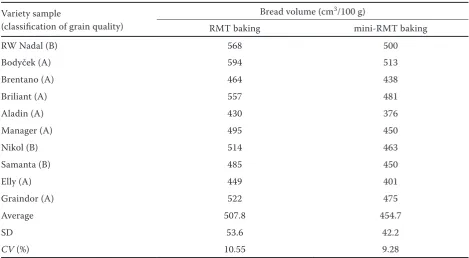
and Testing in Agriculture of the Czech Republic (Lípa testing location, harvest year 2009). The of-ficial classification of bread-making quality of the examined wheat varieties is available in Table 1.
RMT was carried out at the Institute for Super-vision and Testing in Agriculture of the Czech Republic during wheat variety registration trials. Flour for the baking test was milled on a laboratory-scale Buhler MLU202 test mill (Buhler-Miag, Uzwil, Switzerland). RMT was carried out as prescribed by Seibel et al. (1987). Bread volume was measured using rapeseed displacement.
[image:2.595.62.532.480.738.2]Mini-RMT was carried out as follows: flour for the baking test was milled on a laboratory-scale Yucebas WWGM test mill (Yucebas Makine, Izmir, Turkey). Flour moisture and water absorp-tion were determined using an NIR Infratec 1241 Grain Analyzer (Foss, Hillerød, Denmark). 80 g of flour (14% water content), Diasta malt powder (KåKå CZ, Středokluky, Czech Republic) to ob-tain a falling number of 250 s, distilled water in keeping with the water absorption value (reduced by 5%), 4 g of Linco yeast (F.X. Wiennger, Passau, Germany), 1.2 g of salt, 0.8 g of saccharose, 850 μl of melted (40°C) pork lard and 16 μl of 0.01% ascorbic acid were mixed using an RT-150 kitchen mixer (Fagor Electrodomésticos, Mondragón, Spain) in two phases. Initial mixing took place
Table 1. Bread volumes for RMT and mini-RMT baking
Variety sample
(classification of grain quality)
Bread volume (cm3/100 g)
RMT baking mini-RMT baking
RW Nadal (B) 568 500
Bodyček (A) 594 513
Brentano (A) 464 438
Briliant (A) 557 481
Aladin (A) 430 376
Manager (A) 495 450
Nikol (B) 514 463
Samanta (B) 485 450
Elly (A) 449 401
Graindor (A) 522 475
Average 507.8 454.7
SD 53.6 42.2
CV (%) 10.55 9.28
for 30 sec. The mixer lid was then cleaned and mixing was performed for another 30 sec. The dough was then removed, formed by hand into a sphere and put into the fermentation device on a tray (the fermentation device must maintain a temperature of 32°C and minimum 80% moisture value). A Memmert WNB 10 water bath (Mem-mert, Schwabach, Germany) was used for the study. Initial fermentation was for 20 min. The dough was then removed from the fermentation device and allowed to rest for 10 min at labora-tory temperature (20–24°C) covered with a tray. The dough was then weighed and divided into three equal sections using scissors. Each piece of dough was covered with a tray. The pieces of dough were rounded using a dough rounder (Ska-Tec, Prague, Czech Republic). Each rounded piece of dough was placed on a 10 cm Petri dish bottomed with nonstick baking foil (Tescoma, Zlin, Czech Republic) and covered with a tray. When all pieces had been rounded, the trays were removed and the Petri dishes with the rounded dough were placed into the fermentation device. The second fermentation round lasted for 25 min. Petri dishes with leavened dough were put into a Memmert kiln (Memmert, Schwabach, Germany) pre-heated to 205°C, then immediately steamed using 25 ml of distilled water (the bottom of the baking kiln was filled with 3 kg of lava stone and the water was poured over the stones). Baking took place for 30 min. The Petri dishes with the baked bread were then removed from the kiln and allowed to cool for one hour. The volume (in ml) of each loaf of bread was measured using rapeseed displacement, and the resulting values were summarized and recomputed on the basis of bread volume per 100 g of flour.
Bread volumes observed for the RMT and mini-RMT are summarized in Table 1. The correlation analysis of RMT and mini-RMT showed a sig-nificant positive correlation (r = 0.96; P < 0.01). The linear regression line (Figure 1) with the equation RMT (ml/100g) = –47.39 + 1.221 × mini-RMT (ml/100g) (R2 = 0.925 and mean absolute error of 12.41 ml) was constructed. Since the
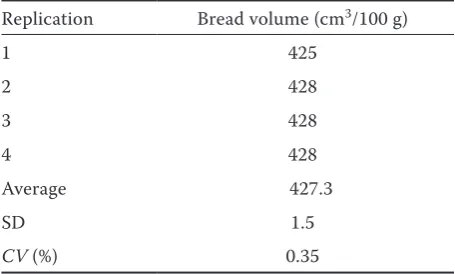
P-value for the model was less than 0.01, there is a statistically significant relationship between RMT and mini-RMT at the 99.0% confidence level. To determine the level of repeatability for the method, the mini-RMT was performed four times using identical flour (Nikol variety). The results are summarized in Table 2.
Bread volumes obtained using the mini-RMT correlated strongly with those of the standard RMT but were lower on average by 47.4 ml. This bias may have been caused by differences in the formula and baking process, with the addition of water being the most probable factor. Relations between samples were maintained. In Kieffer et al. (1998), results of repeated micro-RMT tests indicated a coefficient of variation of ±5 % for bread volume, while the original RMT has a coefficient of variation of ±2 % for bread volume (Pelshenke
[image:3.595.303.528.84.255.2]et al., 2007). In the present experiment, results of repeated micro-RMT tests indicated a coefficient of variation ±0.35 %. Due to the limited amount of material the tests for repeatability could not be performed on a full-scale, so the repeatability of mini-RMT is of limited plausibility and has to be verified on a larger sample set. It can be presumed
Table 2. Bread volumes from repeated baking of Nikol variety
Replication Bread volume (cm3/100 g)
1 425
2 428
3 428
4 428
Average 427.3
SD 1.5
CV (%) 0.35
[image:3.595.304.532.602.739.2]SD – standard deviation; CV – coefficient of variation Figure 1. Linear regression model of RMT bread volume on mini-RMT bread volume (99% confidence limits)
RMT (
cm
3 /100 g)
Mini-RMT (cm3/100 g)
370 400 430 460 490 520 610
580
550
520
490
460
that RMT, micro-RMT and mini-RMT have similar repeatability.
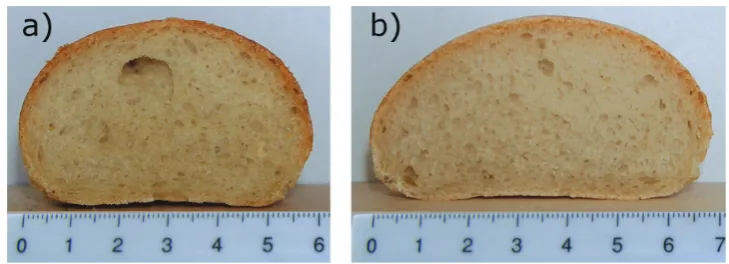
Other characteristics are also employed to evalu-ate the bread. These include loaf structure, elas-ticity, browning and taste. These characteristics were not used in the present study to compare the standard RMT with the mini-RMT, since they are subjective and therefore strongly dependent upon the person doing the evaluation. Figure 2 demonstrates the possibility of using the mini-RMT for such an evaluation.
The presented mini-RMT has a potential for use in wheat breeder laboratories, although the results obtained in this work are of limited plausibility due to the limited sample numbers and have to be verified on a larger sample set, including the study of repeatability and reproducibility.
Acknowledgements. The author wishes to thank the
Institute for Supervision and Testing in Agriculture of the Czech Republic for providing experimental resources.
References
AACC (1999a): Basic Straight-Dough Bread-Making Meth-od – Long Fermentation. MethMeth-od 10-09.01. Approved Methods of Analysis. 11th Ed., AACC International, St. Paul. Approved November 8, 1995, Re-approval No-vember 3, 1999.
AACC (1999b): Optimized Straight-Dough Bread-Mak-ing Method. Method 10-10.03. Approved Methods of Analysis, 11th Ed., AACC International, St. Paul. Ap-proved November 8, 1995, Re-approval November 3, 1999.
AACC (1999c): Baking Quality of Bread Flour – Sponge-Dough, Pound-Loaf Method. Method 10-11.01.
Approved Methods of Analysis, 11th Ed., AACC In-ternational, St. Paul. Approved November 8, 1995, Re-approval November 3, 1999.
Agyare K.K., Addo K., Xiong Y.L., Akoh C.C. (2005): Effect of structured lipid on alveograph characteris-tics, baking and textural qualities of soft wheat flour. Journal of Cereal Science, 42: 309–316.
Dobraszczyk B.J., Salmaniwicz B.P. (2008): Com-parison of predictions of baking volume using large deformation rheological properties. Journal of Cereal Science, 47: 292–301.
Finnie S.M., Jeannote R., Morris C.F., Giroux M.J., Faubion J.M. (2010): Variation in polar lipids located on the surface of wheat starch. Journal of Cereal Sci-ence, 51: 73–80.
Giannou V., Kessoglou V., Tzia C. (2003): Quality and safety characteristics of bread made from frozen dough. Trends in Food Science and Technology, 14: 99–108.
Goasaert H., Brijs K., Veraverbeke W.S., Courtin C.M., Gebruers K., Delcour J.A. (2005): Wheat flour constituents: how they impact bread quality, and how to impact their functionality. Trends in Food Science & Technology, 16: 12–30.
International Association for Cereal Science and Technol-ogy, Standard Methods of the ICC, Method 131. Method for Test Baking of Wheat Flours. Approved 1980. Kasarda D.D. (1989): Glutenin structure in relation
to wheat quality. In: Pomeranz Y. (ed.): Wheat is Unique: Structure, Composition, Processing, End-use Properties and Products. American Association of Cereal Chemists, St. Paul, 277–302.
Kieffer R., Belitz H.D., Zweir M., Ipfelkofer R., Fischbeck G. (1993): Der rapid-mix-test als 10-g-mikrobackversuch. Zeitschrift f�r Lebensmittelunter-Zeitschrift f�r Lebensmittelunter-suchung und Forschung A, 197: 134–136.
[image:4.595.127.492.82.214.2]mance of wheat flour with rheological measurements on a micro-scale. Journal of Cereal Science, 27: 53–60. Liu L., He Z.H., Ma W.J., Liu J.J., Xia X.C., Peña R.J.
(2009): Allelic variation at the Glu-D3 locus in Chinese bread wheat and effects on dough properties, pan bread and noodle qualities. Cereal Research Com-munications, 37: 57–64.
MacRitchie F. (1992): Physiochemical properties of wheat proteins in relation to functionality. In: Kin-sella J.E. (ed.): Advances in Food and Nutrition Re-search. Academic Press, London, 1–87.
Maeda T., Morita N. (2003): Flour quality and penot-san prepared by polishing wheat grain on bread mak-ing. Food Research International, 36: 603–610. Magnus E.M., Bråthen E., Sahlström S., Fægestad
E.M., Ellekjær M.R. (1997): Effects of wheat variety and processing conditions in experimental bread bak-ing studied by univariate and multivariate analyses. Journal of Cereal Science, 25: 289–301.
Migliori M., Gabriele D. (2010): Effect of pentosan addition on dough rheological properties. Food Re-search International, 43: 2315–2320.
Mondal A., Datta A.K. (2008): Bread baking – a re-view. Journal of Food Engineering, 86: 465–474. Patel B.K., Waniska R.D., Seetharaman K. (2005):
Impact of different baking processes on bread firm-ness and starch properties in bread crumb. Journal of Cereal Science, 42: 173–184.
Payne P.I., Nightingale M.A., Krattiger A.F., Holt L.M. (1987): The relationship between HMW glutenin subunit composition and the bread-making quality of British-grown wheat varieties. Journal of the Science of Food and Agriculture, 40: 51–65.
Pelshenke P.F., Schulz A., Stephan H. (2007): Rap-id-Mix-Test (RMT) Standard-Backversuch f�r Wei-zenmehle der Type 550. Merkblatt 62, 3. Auflage, Merkblatt der Arbeitsgemeinschaft Getreideforschung e.V., Detmold. Available at www.agfdt.de/loads/merk-blat/mb62a.pdf.
Pomerancz Y. (1988): Composition and functionality of wheat flour components. In: Pomerancz Z. (ed.):
Wheat: Chemistry and Technology. American Asso-ciation of Cereal Chemists, St. Paul, 219–370. Purlis E. (2011): Bread baking: technological
consid-erations based on process modelling and simulation. Journal of Food Engineering, 103: 92–102.
Seibel W., Pfeilsticker K., Schrader B. (1987): Analytical, dough rheology and baking studies for optimization of the wheat baking test, the Rapid-Mix-Test. I. Development of the optimized Rapid-Mix-Test (RMT). Getreide, Mehl und Brot, 39: 174–178. Shewry P.R., Halford N.G., Tatham A.S. (1992): High
molecular weight subunits of wheat glutenin. Journal of Cereal Science, 15: 105–120.
Singh N.K., Donovan R., MacRitchie F. (1990): Use of sonication and size-exclusion high-performance liquid chromatography in the study of wheat flour pro-teins. II. Relative quantity of glutenin as a measure of bread-making quality. Cereal Chemistry, 67: 161–170. Singh R., Tiwari R., Priyamvada, Gupta R.K., Sh-oran J., Mishra B. (2009): 1RS.1BL translocation and grain yield as well as bread loaf volume in In-dian wheats. Cereal Research Communications, 37: 441–448.
Sontag-Strohm T., Payne P.I., Salovaara H. (1996): Effect of allelic variation of glutenin subunits and glia-dins on baking quality in the progeny of two biotypes of bread wheat cv. Ulla. Journal of Cereal Science, 24: 115–124.
Tanács L., Gregová E., Bodnár K., Lantos F., Mon-ostori T. (2010): Effects of fertilizers and fungicides applied in various doses and combinations on baking characteristics of wheat. Cereal Research Communica-tions, 38: 597–588.
Tronsmo K.M., Fægestad E.M., Schofield J.D., Mag-nus E.M. (2003): Wheat protein quality in relation to baking performance evaluated by the Chorleywood bread process and a hearth bread baking test. Journal of Cereal Science, 38: 205–215.
Received for publication May 19, 2011 Accepted after corrections August 5, 2011
Corresponding author: