1762
http://dx.doi.org/10.1107/S2056989016017485 Acta Cryst.(2016). E72, 1762–1767research communications
Received 20 October 2016 Accepted 1 November 2016
Edited by H. Ishida, Okayama University, Japan
Keywords:crystal structure; bromoarenes;Z0; hydrogen bond; molecular symmetry.
CCDC references:1513710; 1513709; 1513708; 1513707
Supporting information:this article has supporting information at journals.iucr.org/e
Crystal structures of
p
-substituted derivatives of
2,6-dimethylbromobenzene with
12
Z
000
4
Ange´lica Navarrete Guite´rrez,aGerardo Aguirre Herna´ndeza* and Sylvain Berne`sb
aCentro de Graduados e Investigacio´n en Quı´mica, Instituto Tecnolo´gico de Tijuana, Apartado Postal 1166, 222000
Tijuana, B.C., Mexico, andbInstituto de Fı´sica, Beneme´rita Universidad Auto´noma de Puebla, Av. San Claudio y 18 Sur, 72570 Puebla, Pue., Mexico. *Correspondence e-mail: [email protected]
The crystal structures of four bromoarenes based on 2,6-dimethylbromobenzene are reported, which are differentiated according the functional groupXplaced parato the Br atom:X= CN (4-bromo-3,5-dimethylbenzonitrile, C9H8BrN), (1), X= NO2(2-bromo-1,3-dimethyl-5-nitrobenzene, C8H8BrNO2), (2),X= NH2 (4-bromo-3,5-dimethylaniline, C8H10BrN), (3) and X = OH (4-bromo-3,5-dimethylphenol, C8H9BrO), (4). The content of the asymmetric unit is different in each crystal,Z0=12(X= CN),Z
0
= 1 (X= NO2),Z0= 2 (X= NH2), andZ0= 4 (X = OH), and is related to the molecular symmetry and the propensity ofXto be involved in hydrogen bonding. In none of the studied compounds does the crystal structure feature other non-covalent interactions, such as–, C—H
or C—Br Br contacts.
1. Chemical context
Our group is interested in the design of chemical model systems for studying polar–interactions (Cozziet al., 2008). In order to achieve this objective, it is necessary to prepare a variety of arylboronic esters as suitable substrates for Suzuki– Miyaura cross-coupling reactions (Ishiyamaet al., 1995; Kotha et al., 2002). We obtained these boronic derivatives starting from functionalized bromoarenes. The present communica-tion is about the synthesis and crystallography of a series of such bromoarenes, namely,para-substituted derivatives of 2,6-dimethylbromobenzene, for which thep-substituent isX= CN (1),X= NO2(2),X= NH2(3), orX= OH (4).
The crystallized molecules are closely related to one another from the chemical and structural points of view. However, very different crystal structures were obtained, with different compositions for the asymmetric units. Once again, this evidences that small chemical modifications for a given compound may induce dramatic changes in its crystal struc-ture, even in the case of hydrogen/deuterium exchange, which is the smallest possible modification of a molecule (Vasylyeva
et al., 2010). As a consequence, the blind tests of organic crystal-structure prediction hosted by the CCDC (Reillyet al., 2016) certainly have a bright future ahead of them.
2. Structural commentary
No unusual bond lengths or angles are observed in the four molecules (Figs. 1–4). For example, the C—Br bond lengths span a narrow range, from 1.900 (4) to 1.910 (2) A˚ . The substituentXin the positionparato the C—Br bond thus has no influence on the geometry of the bromobenzene core, even if very differentXgroups are used, namely, strongly electron-withdrawing groups (X = CN, NO2) and strongly electron-donating groups (X= NH2, OH). Another structural invariant over the studied series is the minimization of steric crowding effects between the Br atom and the methyl groups inortho positions. The methyl groups are systematically rotated in such a way that the C—Br bond is staggered with a CH2fragment of
the methyl group. As a consequence, the endocyclic angle at the Br-bearing C atom is always the largest one in the benzene ring, varying from 121.8 (3) in (3) to 123.9 (4) in (1).
The point of interest regarding the molecular structures is that four different values of Z0 are obtained for the four
compounds. Molecule (1) (X= CN) has the highest potential molecular symmetry,C2v, assuming a linear C—C N group. Omitting H atoms, this symmetry is actually reached, with the C—Br and C—C N fragments lying on the mirror plane in space groupP21/m(Fig. 1). The asymmetric unit then contains a half-molecule, andZ0=12. In (2), withX= NO2, the latent symmetry C2v is broken because the nitro group is tilted
research communications
Acta Cryst.(2016). E72, 1762–1767 Navarrete Guite´rrezet al. C
[image:2.610.329.550.72.303.2] [image:2.610.97.245.73.252.2]9H8BrN, C8H8BrNO2, C8H10BrN and C8H9BrO
1763
Figure 2
The molecular structure of (2), with displacement ellipsoids for non-H atoms at the 50% probability level.
Figure 3
The asymmetric unit of compound (3), with displacement ellipsoids for non-H atoms at the 30% probability level.
Figure 4
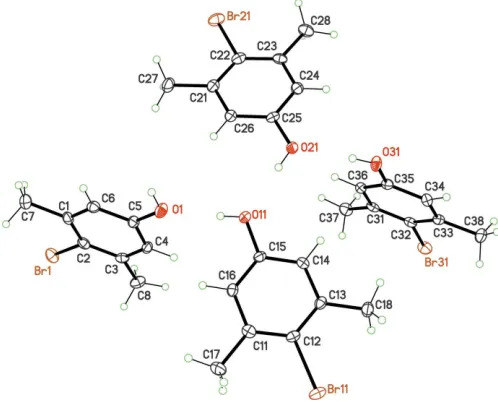
The asymmetric unit of compound (4), with displacement ellipsoids for non-H atoms at the 50% probability level.
Figure 1
The molecular structure of (1), with displacement ellipsoids for non-H atoms at the 50% probability level. Unlabelled atoms are generated by the symmetry operation (x,3
[image:2.610.314.563.518.719.2] [image:2.610.93.247.550.721.2]slightly with respect to the benzene ring by an angle of 13.0 (4). For this crystal, Z0= 1 in space group P1 (Fig. 2).
Finally, for (3) and (4), which are isoelectronic molecules [X= NH2, (3) andX= OH, (4)], despite the molecular symmetry being close toC2v, the asymmetric units contain more than one molecule:Z0= 2 for (3) (Fig. 3) andZ0= 4 for (4) (Fig. 4), in
space groupsP21/nandPbca, respectively.
The increasing size of the asymmetric unit, reflected in the increasing value ofZ0, may be rationalized on the basis of two
key parameters. First, a higher molecular symmetry obviously favours the crystallization of lowZ0crystals, as in (
1). This has been observed in many symmetrically substituted benzene derivatives, for example, in 4-bromo-benzonitrile in space group Cm (Brittonet al., 1977; see also Desiraju & Harlow, 1989), or 2,6-dibromo-4-chlorobenzonitrile in space group P21/m(Britton, 2005). The standard asymmetric unit withZ0= 1 is obtained for (2), for which the molecular symmetry is lowered to C1. Secondly, the introduction of efficient donor groups for hydrogen bonding, such as NH2and OH groups, is an enabling factor for crystal structures having Z0 > 1, as
observed for (3) and (4). A search in the organic subset of the CSD (Groomet al., 2016) reflects such a trend: for example, comparing nitrobenzene and aniline derivatives, the former class is characterized by 12.5% of crystals withZ0> 1, and this
fraction is increased to 15.6% in the latter. In the same way, phenol derivatives withZ0= 4 are not uncommon (Deyet al.,
2005; Mukherjee & Desiraju, 2011).
3. Supramolecular features
As expected, compound (1) is featureless regarding the packing of the molecules. No short contacts such as halogen bonds are formed, and–interactions are insignificant, the shortest separation between benzene ring being defined by cell translations along the short cell axis,a= 4.0382 (1) A˚ .
For (2), two pairs of weak C—H O hydrogen bonds link the molecules to form two centrosymmetric first-level ring motifs of R22(10), with the participation of the nitro group as acceptor (Table 1). The nitro group participates with two contacts to two rings, generating a chain of R motifs along
[110] (Fig. 5). As for (1), slipped-stacking interactions are insignificant, the benzene-to-benzene distance being, again, determined by the cell axisa= 4.0502 (5) A˚ .
Although compounds (3) and (4) are isoelectronic, they present different crystal structures. This is because their donor groups for hydrogen bonding are of a different nature: the N— H bond is a poorer donor compared to the O—H bond, on the basis of the polarity of these bonds, estimated with the differences of electronegativityNH= 0.84 andOH= 1.24 (Pauling’s scale is used for). Moreover, the NH2group is potentially involved in two hydrogen bonds, while the OH group is expected to form a single, stronger contact, at least as long as bifurcated hydrogen bonds are not considered.
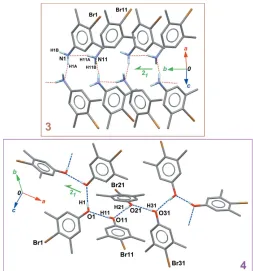
Both compounds (3) and (4) have a supramolecular struc-ture based on chains oriented along a screw 21axis (Fig. 6). For (3), two discrete contacts D(2) are formed between the two independent molecules (Table 2). These contacts involve only one N—H bond for a given NH2group, and the acceptor atom is the N site of the connected molecule, with the N—H N
1764
Navarrete Guite´rrezet al. C9H8BrN, C8H8BrNO2, C8H10BrN and C8H9BrO Acta Cryst.(2016). E72, 1762–1767
research communications
Table 1
Hydrogen-bond geometry (A˚ ,) for (2).
D—H A D—H H A D A D—H A
C4—H4A O1i 0.93 2.51 3.377 (5) 156
C6—H6A O2ii 0.93 2.55 3.351 (5) 144
[image:3.610.312.565.416.687.2]Symmetry codes: (i)xþ1;yþ1;z; (ii)x;yþ2;z.
Figure 5
[image:3.610.48.294.575.697.2]Part of the crystal structure of (2), showing C—H O hydrogen bonds (dashed lines) formingRmotifs in the crystals. Hydrogen bondsa(green) andb(red) correspond to entries 1 and 2 in Table 1. Atoms belonging to the asymmetric unit are labelled.
Figure 6
contact oriented toward the lone pair of the acceptor N atom. A second level motif C2
2(4) is formed using the discrete contacts, and the chain of connected molecules runs along [010] (Fig. 6, top).
A similar framework ofDandCmotifs appears in (4), this time starting from a Z0 = 4 asymmetric unit: three discrete
motifs D(2) are formed within the asymmetric unit, and a fourth D(2) motif connects the first independent molecule with a symmetry-related molecule in the crystal (Table 3). As a consequence,C4
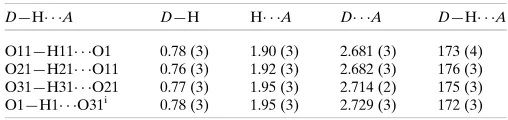
4(8) chains are formed, propagating parallel to [100] (Fig. 6, bottom). As mentioned above, the hydrogen bonds in (4) are much more efficient than those observed in (3): all O—H O bonds have short H O distances of ca 1.9 A˚ and O—H O angles are close to 180 (Table 3).
It is worth noting that none of the observed 1D supra-molecular structures in (2)–(4) include – or C—H
contacts, nor C—Br Br halogen bonds. The arrangement of the molecules in the crystal over the studied series of compounds is thus mainly determined by the absence of, the presence of weak, or strong hydrogen bonds, respectively, in (1), (2) and (3), or (4).
4. Database survey
Polysubstituted benzene systems are ubiquitous in the crys-tallographic literature. Limiting a survey to 2,6-dimethyl-bromobenzene, only two derivatives closely related to the series we have studied may be found, withX=tBu (Fieldet al., 2003) andX= I (Liuet al., 2008), which do not present obvious supramolecular features. Both formZ0=1
2crystals, as for (1).
5. Synthesis and crystallization
Compound (3) was purchased from Oakwood Chemical Co. and was the starting material for the synthesis of (2) by oxidation with m-CPBA, and (1) and (4) via a Sandmeyer reaction. Single crystals of (3) were obtained by slow evaporation of a CH2Cl2solution.
Compound (1) was prepared by modification of the reported procedure (Xu et al., 2000). A solution of NaNO2
(0.36 g, 5.2 mmol) in water (5 ml) was added dropwise to a suspension of 4-bromo-3,5-dimethylaniline (1 g, 5 mmol) in aqueous HCl (2 ml, 12 M), and water (2 ml) at 273 K. The mixture was stirred at 273 K for 30 min and then neutralized with NaHCO3. Separately, a solution of CuCN (0.54 g, 6 mmol), and KCN (0.81 g, 12 mmol) in water (10 ml) was heated at 343 K. This solution was added dropwise to the diazotization solution previously prepared. The mixture was kept at 343 K for 30 min with stirring and then cooled at room temperature. The product was extracted with toluene (3 30 ml). The combined organic layers were dried over anh. Na2SO4and concentrated under reduced pressure. The crude product was purified by silica gel column chromatography (petroleum ether/EtOAc, 95:5) to obtain compound (1) as orange needles (0.77 g, 73%); m.p. 408–410 K; IR: 3022 (C—H Ar), 2354 (C N), 1498 (C C) cm1; 1H NMR (400 MHz, CDCl3): 7.34 (s, 2H), 2.44 (s, 6H) p.p.m.;
13
C NMR (100 MHz, CDCl3) : 140.0, 133.2, 131.1, 118.4, 110.7, 23.8 p.p.m.; GC–MS (EI):m/z= 209 (100%) [M+], 211 (97%) [M++ 2] amu. Single crystals suitable for X-ray analysis were obtained by slow evaporation of a CH2Cl2solution.
Compound (2) was prepared by modification of the reported procedure (Gilbert & Borden, 1979). A solution of 4-bromo-3,5-dimethylaniline and 3-chloroperoxybenzoic acid (4 g, 23 mmol) in CH2Cl2(35 ml) was heated at 323 K for 2 h. After cooling at room temperature, the precipitate was filtered off and the liquid phase was washed with NaOH (1M, 3 50 ml). The organic layer was dried over anh. Na2SO4 and concentrated under reduced pressure. The residue was dissolved in glacial acetic acid (10 ml), and a solution of H2O2 (5 ml, 33% aq. solution) and glacial acetic acid (5 ml) was added at room temperature. Then, conc. HNO3(0.5 ml) was slowly added and the mixture was heated to 363 K for 4 h. After cooling, the crude was treated with water (50 ml), and was extracted with CH2Cl2(350 ml). The combined organic layers were dried over anh. Na2SO4and concentrated under reduced pressure. The crude was purified on a silica gel column chromatography (petroleum ether) to give compound (2) as bright-yellow crystals (0.51 g, 44%); m.p. 478–483 K; IR: 2988 (C—H Aliph), 1558, 1340 (N—O) cm1; 1H NMR (400 MHz, CDCl3): 7.92 (s, 2H), 2.51 (s, 6H) p.p.m.; 13
C NMR (100 MHz, CDCl3):146.3, 140.1, 134.8, 122.5, 24.1 p.p.m.; GC–MS (EI): m/z = 229 (100%) [M+], 231 (97%) [M++2] amu. Crystals suitable for single crystal X-ray diffraction were obtained by slow evaporation of an ether solution.
Preparation of (4): A solution of 4-bromo-3,5-dimethyl-aniline (1 g, 5 mmol) in conc. H2SO4(25 ml) and water (5 ml) was cooled to 273 K. Then a solution of NaNO2 (0.35 g, 5 mmol) in water (10 ml) was added dropwise under stirring. After additional 30 min the solution was refluxed for 30 min. The mixture was cooled and extracted with EtOAc (3 50 ml). The combined organic phases were dried over anh. Na2SO4and concentrated under reduced pressure. The crude was purified by silica gel column chromatography (petroleum ether/EtOAc, 9:1) to provide the product (4) as pale-orange crystals (0.56 g, 55%); m.p. 386–388 K; IR: 3620 (O—H), 2987
research communications
Acta Cryst.(2016). E72, 1762–1767 Navarrete Guite´rrezet al. C
9H8BrN, C8H8BrNO2, C8H10BrN and C8H9BrO
1765
Table 2
Hydrogen-bond geometry (A˚ ,) for (3).
D—H A D—H H A D A D—H A
N1—H1A N11i 0.88 (2) 2.41 (3) 3.212 (6) 152 (5) N11—H11A N1ii 0.90 (2) 2.52 (3) 3.365 (6) 157 (4)
Symmetry codes: (i)xþ1 2;yþ
1 2;zþ
1
[image:4.610.43.297.178.238.2]2; (ii)xþ1;y;z.
Table 3
Hydrogen-bond geometry (A˚ ,) for (4).
D—H A D—H H A D A D—H A
O11—H11 O1 0.78 (3) 1.90 (3) 2.681 (3) 173 (4) O21—H21 O11 0.76 (3) 1.92 (3) 2.682 (3) 176 (3) O31—H31 O21 0.77 (3) 1.95 (3) 2.714 (2) 175 (3) O1—H1 O31i 0.78 (3) 1.95 (3) 2.729 (3) 172 (3)
Symmetry code: (i)x1
(C—H aliph), 1590 (C C Ar), 1120 (C—O) cm1;1H NMR (400 MHz, CDCl3): 6.57 (s, 2H), 4.99 (s, 1H), 2.34 (s, 6H) p.p.m.; 13C NMR (100 MHz, CDCl
3): 153.9, 139.5, 118.3, 115.2, 23.8 p.p.m.; GC–MS (EI):m/z= 200 (100%) [M+], 202 (97%) [M+ + 2] amu. Crystals suitable for diffraction were obtained by slow evaporation of an EtOAc solution.
6. Refinement
Crystal data, data collection and structure refinement details are summarized in Table 4. At room temperature, compound (3) decomposes after a few minutes under MoKirradiation, but is stable for hours under CuKirradiation. For compound (3), H atoms of NH2 groups were located in a difference Fourier map and were refined with restraints of N—H = 0.89 (2) A˚ and H H = 1.52 (2) A˚ . For (4), H atoms of OH groups were found in a difference map and refined freely. All other H atoms in (1)–(4) were refined as riding.
Acknowledgements
We gratefully acknowledge support for this project by the Direccio´n General de Educacio´n Superior Tecnolo´gica
(DGEST grants 5637.15-P) and CONACyT: Proyecto Infra-2014-224405.
References
Britton, D. (2005).Acta Cryst.E61, o1726–o1727.
Britton, D., Konnert, J. & Lam, S. (1977).Cryst. Struct. Commun.6, 45–48.
Cozzi, F., Annunziata, R., Benaglia, M., Baldridge, K. K., Aguirre, G., Estrada, J., Sritana-Anant, Y. & Siegel, J. S. (2008).Phys. Chem. Chem. Phys.10, 2686–2694.
Desiraju, G. R. & Harlow, R. L. (1989).J. Am. Chem. Soc.111, 6757– 6764.
Dey, A., Kirchner, M. T., Vangala, V. R., Desiraju, G. R., Mondal, R. & Howard, J. A. K. (2005).J. Am. Chem. Soc.127, 10545–10559. Field, J. E., Hill, T. J. & Venkataraman, D. (2003).J. Org. Chem.68,
6071–6078.
Gilbert, K. E. & Borden, W. T. (1979).J. Org. Chem.44, 659–661. Groom, C. R., Bruno, I. J., Lightfoot, M. P. & Ward, S. C. (2016).Acta
Cryst.B72, 171–179.
Ishiyama, T., Murata, M. & Miyaura, N. (1995).J. Org. Chem. 60, 7508–7510.
Kotha, S., Lahiri, K. & Kashinath, D. (2002).Tetrahedron,58, 9633– 9695.
Liu, R., Wu, W.-Y., Li, Y.-H., Deng, S.-P. & Zhu, H.-J. (2008).Acta Cryst.E64, o280.
1766
Navarrete Guite´rrezet al. C [image:5.610.47.565.93.440.2]9H8BrN, C8H8BrNO2, C8H10BrN and C8H9BrO Acta Cryst.(2016). E72, 1762–1767
research communications
Table 4
Experimental details.
(1) (2) (3) (4)
Crystal data
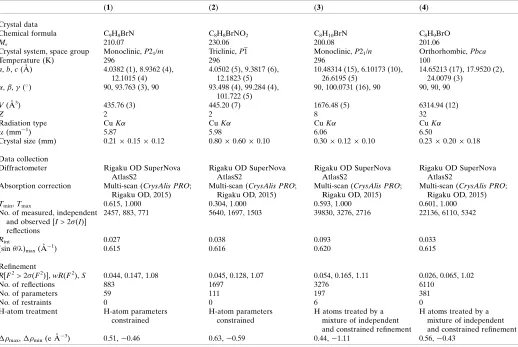
Chemical formula C9H8BrN C8H8BrNO2 C8H10BrN C8H9BrO
Mr 210.07 230.06 200.08 201.06
Crystal system, space group Monoclinic,P21/m Triclinic,P1 Monoclinic,P21/n Orthorhombic,Pbca
Temperature (K) 296 296 296 100
a,b,c(A˚ ) 4.0382 (1), 8.9362 (4), 12.1015 (4)
4.0502 (5), 9.3817 (6), 12.1823 (5)
10.48314 (15), 6.10173 (10), 26.6195 (5)
14.65213 (17), 17.9520 (2), 24.0079 (3)
,,() 90, 93.763 (3), 90 93.498 (4), 99.284 (4),
101.722 (5)
90, 100.0731 (16), 90 90, 90, 90
V(A˚3) 435.76 (3) 445.20 (7) 1676.48 (5) 6314.94 (12)
Z 2 2 8 32
Radiation type CuK CuK CuK CuK
(mm1) 5.87 5.98 6.06 6.50
Crystal size (mm) 0.210.150.12 0.800.600.10 0.300.120.10 0.230.200.18
Data collection
Diffractometer Rigaku OD SuperNova
AtlasS2
Rigaku OD SuperNova AtlasS2
Rigaku OD SuperNova AtlasS2
Rigaku OD SuperNova AtlasS2
Absorption correction Multi-scan (CrysAlis PRO; Rigaku OD, 2015)
Multi-scan (CrysAlis PRO; Rigaku OD, 2015)
Multi-scan (CrysAlis PRO; Rigaku OD, 2015)
Multi-scan (CrysAlis PRO; Rigaku OD, 2015)
Tmin,Tmax 0.615, 1.000 0.304, 1.000 0.593, 1.000 0.601, 1.000
No. of measured, independent and observed [I> 2 (I)] reflections
2457, 883, 771 5640, 1697, 1503 39830, 3276, 2716 22136, 6110, 5342
Rint 0.027 0.038 0.093 0.033
(sin/)max(A˚
1
) 0.615 0.616 0.620 0.615
Refinement
R[F2> 2 (F2)],wR(F2),S 0.044, 0.147, 1.08 0.045, 0.128, 1.07 0.054, 0.165, 1.11 0.026, 0.065, 1.02
No. of reflections 883 1697 3276 6110
No. of parameters 59 111 197 381
No. of restraints 0 0 6 0
H-atom treatment H-atom parameters constrained
H-atom parameters constrained
H atoms treated by a mixture of independent and constrained refinement
H atoms treated by a mixture of independent and constrained refinement
max,min(e A˚
3) 0.51,0.46 0.63,0.59 0.44,1.11 0.56,0.43
Macrae, C. F., Bruno, I. J., Chisholm, J. A., Edgington, P. R., McCabe, P., Pidcock, E., Rodriguez-Monge, L., Taylor, R., van de Streek, J. & Wood, P. A. (2008).J. Appl. Cryst.41, 466–470.
Mukherjee, A. & Desiraju, G. R. (2011).Cryst. Growth Des.11, 3735– 3739.
Reilly, A. M., Cooper, R. I., Adjiman, C. S., Bhattacharya, S., Boese, A. D., Brandenburg, J. G., Bygrave, P. J., Bylsma, R., Campbell, J. E., Car, R., Case, D. H., Chadha, R., Cole, J. C., Cosburn, K., Cuppen, H. M., Curtis, F., Day, G. M., DiStasio, R. A. Jr, Dzyabchenko, A., van Eijck, B. P., Elking, D. M., van den Ende, J. A., Facelli, J. C., Ferraro, M. B., Fusti-Molnar, L., Gatsiou, C.-A., Gee, T. S., de Gelder, R., Ghiringhelli, L. M., Goto, H., Grimme, S., Guo, R., Hofmann, D. W. M., Hoja, J., Hylton, R. K., Iuzzolino, L., Jankiewicz, W., de Jong, D. T., Kendrick, J., de Klerk, N. J. J., Ko, H.-Y., Kuleshova, L. N., Li, X., Lohani, S., Leusen, F. J. J., Lund, A. M., Lv, J., Ma, Y., Marom, N., Masunov, A. E., McCabe, P., McMahon, D. P., Meekes, H., Metz, M. P., Misquitta, A. J., Mohamed, S., Monserrat, B., Needs, R. J., Neumann, M. A., Nyman,
J., Obata, S., Oberhofer, H., Oganov, A. R., Orendt, A. M., Pagola, G. I., Pantelides, C. C., Pickard, C. J., Podeszwa, R., Price, L. S., Price, S. L., Pulido, A., Read, M. G., Reuter, K., Schneider, E., Schober, C., Shields, G. P., Singh, P., Sugden, I. J., Szalewicz, K., Taylor, C. R., Tkatchenko, A., Tuckerman, M. E., Vacarro, F., Vasileiadis, M., Vazquez-Mayagoitia, A., Vogt, L., Wang, Y., Watson, R. E., de Wijs, G. A., Yang, J., Zhu, Q. & Groom, C. R. (2016).Acta Cryst.B72, 439–459.
Rigaku OD (2015).CrysAlis PRO. Rigaku Americas Corporation, The Woodlands, TX, USA.
Sheldrick, G. M. (2008).Acta Cryst.A64, 112–122. Sheldrick, G. M. (2015a).Acta Cryst.A71, 3–8. Sheldrick, G. M. (2015b).Acta Cryst.C71, 3–8.
Vasylyeva, V., Kedziorski, T., Metzler-Nolte, N., Schauerte, C. & Merz, K. (2010).Cryst. Growth Des.10, 4224–4226.
Xu, Z., Kiang, Y.-H., Lee, S., Lobkovsky, E. B. & Emmott, N. (2000). J. Am. Chem. Soc.122, 8376–8391.
research communications
Acta Cryst.(2016). E72, 1762–1767 Navarrete Guite´rrezet al. C
supporting information
sup-1 Acta Cryst. (2016). E72, 1762-1767
supporting information
Acta Cryst. (2016). E72, 1762-1767 [https://doi.org/10.1107/S2056989016017485]
Crystal structures of
p
-substituted derivatives of 2,6-dimethylbromobenzene
with ½
≤
Z
′
≤
4
Ang
é
lica Navarrete Guit
é
rrez, Gerardo Aguirre Hern
á
ndez and Sylvain Bern
è
s
Computing details
For all compounds, data collection: CrysAlis PRO (Rigaku OD, 2015); cell refinement: CrysAlis PRO (Rigaku OD, 2015); data reduction: CrysAlis PRO (Rigaku OD, 2015); program(s) used to solve structure: SHELXT (Sheldrick, 2015a); program(s) used to refine structure: SHELXL2014 (Sheldrick, 2015b); molecular graphics: XP in SHELXTL
(Sheldrick, 2008) and Mercury (Macrae et al., 2008); software used to prepare material for publication: CifTab
(Sheldrick, 2008).
(1)
Crystal data
C9H8BrN
Mr = 210.07
Monoclinic, P21/m
a = 4.0382 (1) Å
b = 8.9362 (4) Å
c = 12.1015 (4) Å
β = 93.763 (3)°
V = 435.76 (3) Å3
Z = 2
F(000) = 208
Dx = 1.601 Mg m−3
Melting point: 408 K
Cu Kα radiation, λ = 1.54184 Å Cell parameters from 1415 reflections
θ = 3.7–71.2°
µ = 5.87 mm−1
T = 296 K Needle, orange 0.21 × 0.15 × 0.12 mm
Data collection
Rigaku OD SuperNova AtlasS2 diffractometer
Radiation source: micro-focus sealed X-ray tube, SuperNova (Cu) X-ray Source Mirror monochromator
Detector resolution: 5.1980 pixels mm-1
φ and ω scans
Absorption correction: multi-scan (CrysAlis PRO; Rigaku OD, 2015)
Tmin = 0.615, Tmax = 1.000
2457 measured reflections 883 independent reflections 771 reflections with I > 2σ(I)
Rint = 0.027
θmax = 71.4°, θmin = 3.7°
h = −3→4
k = −10→10
l = −14→13
Refinement
Refinement on F2
Least-squares matrix: full
R[F2 > 2σ(F2)] = 0.044
wR(F2) = 0.147
S = 1.08 883 reflections 59 parameters
0 restraints 0 constraints
Primary atom site location: structure-invariant direct methods
supporting information
sup-2 Acta Cryst. (2016). E72, 1762-1767
Hydrogen site location: inferred from neighbouring sites
H-atom parameters constrained
w = 1/[σ2(F
o2) + (0.0947P)2 + 0.0077P]
where P = (Fo2 + 2Fc2)/3
(Δ/σ)max < 0.001
Δρmax = 0.51 e Å−3
Δρmin = −0.46 e Å−3
Fractional atomic coordinates and isotropic or equivalent isotropic displacement parameters (Å2)
x y z Uiso*/Ueq
Br1 0.11810 (14) 0.7500 0.05285 (4) 0.0896 (4) C2 0.3504 (11) 0.7500 0.1947 (4) 0.0588 (10) C3 0.4270 (8) 0.6133 (4) 0.2438 (3) 0.0616 (8) C4 0.6007 (9) 0.6158 (3) 0.3467 (3) 0.0615 (7) H4A 0.6616 0.5261 0.3814 0.074* C5 0.6843 (12) 0.7500 0.3980 (4) 0.0592 (10) C6 0.8701 (14) 0.7500 0.5047 (4) 0.0697 (12) N7 1.0181 (16) 0.7500 0.5880 (5) 0.0920 (15) C8 0.3447 (12) 0.4662 (5) 0.1894 (4) 0.0890 (12) H8A 0.4147 0.4671 0.1151 0.133* H8B 0.1095 0.4499 0.1878 0.133* H8C 0.4573 0.3873 0.2305 0.133*
Atomic displacement parameters (Å2)
U11 U22 U33 U12 U13 U23
Br1 0.0749 (5) 0.1338 (7) 0.0588 (5) 0.000 −0.0053 (3) 0.000 C2 0.053 (2) 0.072 (3) 0.052 (2) 0.000 0.0056 (17) 0.000 C3 0.0654 (18) 0.0579 (17) 0.0622 (18) −0.0049 (13) 0.0085 (14) −0.0070 (13) C4 0.0739 (19) 0.0499 (15) 0.0613 (17) 0.0023 (13) 0.0087 (14) 0.0037 (12) C5 0.067 (3) 0.058 (2) 0.053 (2) 0.000 0.006 (2) 0.000 C6 0.077 (3) 0.075 (3) 0.056 (3) 0.000 −0.001 (2) 0.000 N7 0.104 (4) 0.104 (4) 0.066 (3) 0.000 −0.012 (3) 0.000 C8 0.107 (3) 0.068 (2) 0.092 (3) −0.015 (2) 0.007 (2) −0.026 (2)
Geometric parameters (Å, º)
Br1—C2 1.902 (5) C5—C6 1.450 (7) C2—C3 1.384 (4) C6—N7 1.138 (7)
C3—C4 1.389 (5) C8—H8A 0.9600
C3—C8 1.498 (5) C8—H8B 0.9600
C4—C5 1.383 (4) C8—H8C 0.9600
C4—H4A 0.9300
C3i—C2—C3 123.9 (4) C4—C5—C6 119.8 (2)
supporting information
sup-3 Acta Cryst. (2016). E72, 1762-1767
C5—C4—H4A 119.6 H8A—C8—H8C 109.5 C3—C4—H4A 119.6 H8B—C8—H8C 109.5 C4i—C5—C4 120.3 (4)
C3i—C2—C3—C4 −2.2 (7) C2—C3—C4—C5 1.6 (5)
Br1—C2—C3—C4 179.1 (3) C8—C3—C4—C5 179.1 (4) C3i—C2—C3—C8 −179.6 (4) C3—C4—C5—C4i −1.1 (7)
Br1—C2—C3—C8 1.8 (5) C3—C4—C5—C6 −179.1 (4)
Symmetry code: (i) x, −y+3/2, z.
(2) 2-Bromo-1,3-dimethyl-5-nitrobenzene
Crystal data
C8H8BrNO2
Mr = 230.06
Triclinic, P1
a = 4.0502 (5) Å
b = 9.3817 (6) Å
c = 12.1823 (5) Å
α = 93.498 (4)°
β = 99.284 (4)°
γ = 101.722 (5)°
V = 445.20 (7) Å3
Z = 2
F(000) = 228
Dx = 1.716 Mg m−3
Melting point: 478 K
Cu Kα radiation, λ = 1.54184 Å Cell parameters from 2941 reflections
θ = 3.7–71.5°
µ = 5.98 mm−1
T = 296 K
Block, pale yellow 0.80 × 0.60 × 0.10 mm
Data collection
Rigaku OD SuperNova AtlasS2 diffractometer
Radiation source: micro-focus sealed X-ray tube, SuperNova (Cu) X-ray Source Mirror monochromator
Detector resolution: 5.1980 pixels mm-1
φ and ω scans
Absorption correction: multi-scan (CrysAlis PRO; Rigaku OD, 2015)
Tmin = 0.304, Tmax = 1.000
5640 measured reflections 1697 independent reflections 1503 reflections with I > 2σ(I)
Rint = 0.038
θmax = 71.7°, θmin = 3.7°
h = −4→4
k = −11→11
l = −14→14
Refinement
Refinement on F2
Least-squares matrix: full
R[F2 > 2σ(F2)] = 0.045
wR(F2) = 0.128
S = 1.07 1697 reflections 111 parameters 0 restraints 0 constraints
Primary atom site location: structure-invariant direct methods
Secondary atom site location: difference Fourier map
Hydrogen site location: inferred from neighbouring sites
H-atom parameters constrained
w = 1/[σ2(F
o2) + (0.0686P)2 + 0.2116P]
where P = (Fo2 + 2Fc2)/3
(Δ/σ)max < 0.001
Δρmax = 0.63 e Å−3
Δρmin = −0.59 e Å−3
Fractional atomic coordinates and isotropic or equivalent isotropic displacement parameters (Å2)
x y z Uiso*/Ueq
supporting information
sup-4 Acta Cryst. (2016). E72, 1762-1767
N1 0.2977 (9) 0.7622 (4) −0.0226 (3) 0.0628 (8) O1 0.4131 (11) 0.6691 (4) −0.0677 (3) 0.0899 (10) O2 0.2182 (11) 0.8634 (4) −0.0707 (3) 0.0947 (11) C1 0.1468 (9) 0.8635 (4) 0.2627 (3) 0.0565 (8) C2 0.1714 (9) 0.7332 (4) 0.3086 (3) 0.0534 (8) C3 0.2324 (9) 0.6117 (4) 0.2500 (3) 0.0548 (8) C4 0.2752 (9) 0.6237 (4) 0.1406 (3) 0.0530 (8) H4A 0.3211 0.5459 0.0991 0.064* C5 0.2495 (9) 0.7520 (4) 0.0932 (3) 0.0533 (8) C6 0.1846 (10) 0.8718 (4) 0.1517 (3) 0.0571 (8) H6A 0.1667 0.9564 0.1173 0.069* C7 0.0874 (12) 0.9962 (5) 0.3270 (4) 0.0779 (12) H7A −0.1068 0.9678 0.3630 0.117* H7B 0.0445 1.0676 0.2765 0.117* H7C 0.2867 1.0373 0.3824 0.117* C8 0.2502 (13) 0.4705 (5) 0.3008 (4) 0.0724 (11) H8A 0.4026 0.4907 0.3716 0.109* H8B 0.3335 0.4077 0.2517 0.109* H8C 0.0257 0.4232 0.3114 0.109*
Atomic displacement parameters (Å2)
U11 U22 U33 U12 U13 U23
Br1 0.0850 (4) 0.0998 (4) 0.0536 (3) 0.0207 (3) 0.0197 (2) 0.0041 (2) N1 0.073 (2) 0.0602 (17) 0.0567 (17) 0.0151 (15) 0.0126 (15) 0.0087 (14) O1 0.132 (3) 0.093 (2) 0.0637 (18) 0.051 (2) 0.0380 (19) 0.0117 (16) O2 0.147 (3) 0.084 (2) 0.071 (2) 0.049 (2) 0.031 (2) 0.0291 (17) C1 0.0481 (17) 0.060 (2) 0.059 (2) 0.0150 (15) 0.0028 (14) −0.0057 (16) C2 0.0472 (17) 0.066 (2) 0.0475 (17) 0.0139 (14) 0.0087 (13) 0.0035 (15) C3 0.0521 (18) 0.0584 (19) 0.0536 (18) 0.0132 (15) 0.0070 (14) 0.0044 (15) C4 0.0570 (19) 0.0500 (17) 0.0541 (19) 0.0158 (14) 0.0103 (14) 0.0044 (14) C5 0.0533 (18) 0.0539 (18) 0.0513 (18) 0.0103 (14) 0.0069 (14) 0.0040 (14) C6 0.061 (2) 0.0497 (18) 0.061 (2) 0.0169 (15) 0.0044 (16) 0.0045 (15) C7 0.084 (3) 0.072 (3) 0.078 (3) 0.027 (2) 0.010 (2) −0.016 (2) C8 0.090 (3) 0.068 (2) 0.064 (2) 0.023 (2) 0.016 (2) 0.0195 (19)
Geometric parameters (Å, º)
Br1—C2 1.900 (4) C4—C5 1.382 (5)
N1—O1 1.214 (4) C4—H4A 0.9300
N1—O2 1.217 (4) C5—C6 1.388 (5)
N1—C5 1.460 (5) C6—H6A 0.9300
C1—C6 1.389 (6) C7—H7A 0.9600
C1—C2 1.390 (5) C7—H7B 0.9600
C1—C7 1.512 (5) C7—H7C 0.9600
C2—C3 1.394 (5) C8—H8A 0.9600
C3—C4 1.379 (5) C8—H8B 0.9600
supporting information
sup-5 Acta Cryst. (2016). E72, 1762-1767
O1—N1—O2 122.2 (4) C6—C5—N1 118.9 (3) O1—N1—C5 119.0 (3) C5—C6—C1 118.9 (3) O2—N1—C5 118.7 (3) C5—C6—H6A 120.5 C6—C1—C2 117.7 (3) C1—C6—H6A 120.5 C6—C1—C7 118.6 (4) C1—C7—H7A 109.5 C2—C1—C7 123.7 (4) C1—C7—H7B 109.5 C1—C2—C3 123.8 (3) H7A—C7—H7B 109.5 C1—C2—Br1 117.9 (3) C1—C7—H7C 109.5 C3—C2—Br1 118.4 (3) H7A—C7—H7C 109.5 C4—C3—C2 117.4 (3) H7B—C7—H7C 109.5 C4—C3—C8 119.8 (3) C3—C8—H8A 109.5 C2—C3—C8 122.8 (4) C3—C8—H8B 109.5 C3—C4—C5 119.7 (3) H8A—C8—H8B 109.5 C3—C4—H4A 120.2 C3—C8—H8C 109.5 C5—C4—H4A 120.2 H8A—C8—H8C 109.5 C4—C5—C6 122.5 (3) H8B—C8—H8C 109.5 C4—C5—N1 118.6 (3)
C6—C1—C2—C3 0.2 (5) C3—C4—C5—C6 0.6 (6) C7—C1—C2—C3 −178.8 (4) C3—C4—C5—N1 179.7 (3) C6—C1—C2—Br1 −179.5 (3) O1—N1—C5—C4 −12.0 (5) C7—C1—C2—Br1 1.6 (5) O2—N1—C5—C4 167.5 (4) C1—C2—C3—C4 1.0 (5) O1—N1—C5—C6 167.1 (4) Br1—C2—C3—C4 −179.4 (3) O2—N1—C5—C6 −13.4 (5) C1—C2—C3—C8 −178.6 (4) C4—C5—C6—C1 0.6 (6) Br1—C2—C3—C8 1.1 (5) N1—C5—C6—C1 −178.5 (3) C2—C3—C4—C5 −1.3 (5) C2—C1—C6—C5 −0.9 (5) C8—C3—C4—C5 178.2 (3) C7—C1—C6—C5 178.1 (4)
Hydrogen-bond geometry (Å, º)
D—H···A D—H H···A D···A D—H···A
C4—H4A···O1i 0.93 2.51 3.377 (5) 156
C6—H6A···O2ii 0.93 2.55 3.351 (5) 144
Symmetry codes: (i) −x+1, −y+1, −z; (ii) −x, −y+2, −z.
(3)
Crystal data
C8H10BrN
Mr = 200.08
Monoclinic, P21/n
a = 10.48314 (15) Å
b = 6.10173 (10) Å
c = 26.6195 (5) Å
β = 100.0731 (16)°
V = 1676.48 (5) Å3
Z = 8
F(000) = 800
Dx = 1.585 Mg m−3
Melting point: 346 K
Cu Kα radiation, λ = 1.54184 Å Cell parameters from 14036 reflections
θ = 3.4–71.4°
supporting information
sup-6 Acta Cryst. (2016). E72, 1762-1767
T = 296 K Needle, colourless
0.30 × 0.12 × 0.10 mm
Data collection
Rigaku OD SuperNova AtlasS2 diffractometer
Radiation source: micro-focus sealed X-ray tube, SuperNova (Cu) X-ray Source Mirror monochromator
Detector resolution: 5.1980 pixels mm-1
φ and ω scans
Absorption correction: multi-scan (CrysAlis PRO; Rigaku OD, 2015)
Tmin = 0.593, Tmax = 1.000
39830 measured reflections 3276 independent reflections 2716 reflections with I > 2σ(I)
Rint = 0.093
θmax = 72.8°, θmin = 3.4°
h = −12→12
k = −7→7
l = −32→32
Refinement
Refinement on F2
Least-squares matrix: full
R[F2 > 2σ(F2)] = 0.054
wR(F2) = 0.165
S = 1.11 3276 reflections 197 parameters 6 restraints 0 constraints
Primary atom site location: structure-invariant direct methods
Secondary atom site location: difference Fourier map
Hydrogen site location: mixed
H atoms treated by a mixture of independent and constrained refinement
w = 1/[σ2(F
o2) + (0.0779P)2 + 1.0194P]
where P = (Fo2 + 2Fc2)/3
(Δ/σ)max < 0.001
Δρmax = 0.44 e Å−3
Δρmin = −1.11 e Å−3
Fractional atomic coordinates and isotropic or equivalent isotropic displacement parameters (Å2)
x y z Uiso*/Ueq
supporting information
sup-7 Acta Cryst. (2016). E72, 1762-1767
H11A 0.658 (4) 0.480 (5) 0.1713 (19) 0.098* H11B 0.536 (2) 0.356 (7) 0.1745 (18) 0.098* C11 0.5864 (3) −0.0934 (7) 0.07484 (15) 0.0681 (9) C12 0.6933 (3) −0.0488 (7) 0.05224 (13) 0.0652 (9) C13 0.7753 (3) 0.1285 (7) 0.06764 (13) 0.0652 (9) C14 0.7478 (4) 0.2596 (6) 0.10694 (14) 0.0648 (9) H14A 0.8018 0.3773 0.1180 0.078* C15 0.6412 (4) 0.2187 (7) 0.13007 (14) 0.0649 (9) C16 0.5626 (3) 0.0413 (7) 0.11379 (14) 0.0688 (10) H16A 0.4918 0.0122 0.1295 0.083* C17 0.4956 (5) −0.2818 (8) 0.0571 (2) 0.0917 (14) H17A 0.4340 −0.2971 0.0796 0.138* H17B 0.5447 −0.4147 0.0572 0.138* H17C 0.4507 −0.2530 0.0231 0.138* C18 0.8907 (5) 0.1869 (9) 0.04352 (18) 0.0884 (13) H18A 0.8643 0.1973 0.0072 0.133* H18B 0.9558 0.0755 0.0513 0.133* H18C 0.9254 0.3251 0.0567 0.133*
Atomic displacement parameters (Å2)
U11 U22 U33 U12 U13 U23
Br1 0.0617 (3) 0.1074 (5) 0.1481 (6) 0.0103 (2) 0.0348 (3) −0.0438 (3) N1 0.066 (2) 0.117 (3) 0.082 (2) 0.034 (2) 0.0268 (18) 0.008 (2) C1 0.0627 (19) 0.081 (2) 0.066 (2) −0.0104 (18) 0.0315 (16) −0.0087 (18) C2 0.0408 (14) 0.068 (2) 0.080 (2) 0.0016 (14) 0.0206 (14) −0.0159 (18) C3 0.0466 (16) 0.065 (2) 0.072 (2) −0.0036 (14) 0.0078 (14) 0.0020 (17) C4 0.0478 (16) 0.079 (2) 0.0569 (17) −0.0032 (15) 0.0185 (13) 0.0057 (17) C5 0.0479 (16) 0.079 (2) 0.0584 (18) 0.0061 (16) 0.0183 (14) −0.0009 (17) C6 0.071 (2) 0.077 (2) 0.0575 (19) 0.0061 (18) 0.0207 (16) 0.0090 (17) C7 0.122 (4) 0.118 (4) 0.093 (3) −0.022 (3) 0.070 (3) −0.009 (3) C8 0.099 (3) 0.079 (3) 0.104 (4) 0.014 (3) 0.008 (3) 0.018 (3) Br11 0.1085 (5) 0.1057 (5) 0.0899 (4) 0.0198 (3) 0.0326 (3) −0.0249 (3) N11 0.075 (2) 0.105 (3) 0.073 (2) 0.000 (2) 0.0369 (17) −0.018 (2) C11 0.0536 (17) 0.077 (2) 0.072 (2) 0.0145 (17) 0.0074 (15) 0.0043 (19) C12 0.0644 (19) 0.078 (2) 0.0551 (17) 0.0193 (18) 0.0154 (15) 0.0002 (17) C13 0.0575 (18) 0.086 (3) 0.0557 (18) 0.0144 (18) 0.0199 (15) 0.0073 (18) C14 0.059 (2) 0.081 (3) 0.059 (2) 0.0026 (16) 0.0219 (16) 0.0020 (17) C15 0.0562 (19) 0.085 (3) 0.0566 (18) 0.0134 (17) 0.0197 (15) 0.0017 (17) C16 0.0485 (17) 0.090 (3) 0.072 (2) 0.0096 (17) 0.0224 (15) 0.006 (2) C17 0.072 (3) 0.089 (3) 0.114 (4) −0.003 (2) 0.014 (3) −0.007 (3) C18 0.084 (3) 0.115 (4) 0.078 (3) 0.003 (3) 0.046 (2) 0.001 (3)
Geometric parameters (Å, º)
supporting information
sup-8 Acta Cryst. (2016). E72, 1762-1767
N1—H1B 0.886 (18) N11—H11B 0.884 (18) C1—C6 1.380 (5) C11—C16 1.380 (5) C1—C2 1.388 (6) C11—C12 1.389 (5) C1—C7 1.510 (5) C11—C17 1.514 (6) C2—C3 1.389 (5) C12—C13 1.398 (6) C3—C4 1.385 (5) C13—C14 1.387 (5) C3—C8 1.515 (6) C13—C18 1.508 (5) C4—C5 1.379 (5) C14—C15 1.390 (5)
C4—H4A 0.9300 C14—H14A 0.9300
C5—C6 1.382 (5) C15—C16 1.383 (6)
C6—H6A 0.9300 C16—H16A 0.9300
C7—H7A 0.9600 C17—H17A 0.9600
C7—H7B 0.9600 C17—H17B 0.9600
C7—H7C 0.9600 C17—H17C 0.9600
C8—H8A 0.9600 C18—H18A 0.9600
C8—H8B 0.9600 C18—H18B 0.9600
C8—H8C 0.9600 C18—H18C 0.9600
supporting information
sup-9 Acta Cryst. (2016). E72, 1762-1767
C3—C8—H8C 109.5 C13—C18—H18C 109.5 H8A—C8—H8C 109.5 H18A—C18—H18C 109.5 H8B—C8—H8C 109.5 H18B—C18—H18C 109.5
C6—C1—C2—C3 −2.1 (6) C16—C11—C12—C13 −0.6 (5) C7—C1—C2—C3 177.4 (4) C17—C11—C12—C13 178.3 (4) C6—C1—C2—Br1 178.4 (3) C16—C11—C12—Br11 −179.3 (3) C7—C1—C2—Br1 −2.1 (5) C17—C11—C12—Br11 −0.4 (5) C1—C2—C3—C4 2.1 (5) C11—C12—C13—C14 0.7 (5) Br1—C2—C3—C4 −178.4 (3) Br11—C12—C13—C14 179.3 (3) C1—C2—C3—C8 −176.8 (4) C11—C12—C13—C18 −178.5 (4) Br1—C2—C3—C8 2.6 (5) Br11—C12—C13—C18 0.2 (5) C2—C3—C4—C5 −0.2 (5) C12—C13—C14—C15 −0.8 (6) C8—C3—C4—C5 178.8 (4) C18—C13—C14—C15 178.4 (4) C3—C4—C5—C6 −1.7 (6) C13—C14—C15—C16 0.9 (6) C3—C4—C5—N1 174.7 (4) C13—C14—C15—N11 177.6 (4) C2—C1—C6—C5 0.1 (6) C12—C11—C16—C15 0.8 (6) C7—C1—C6—C5 −179.4 (4) C17—C11—C16—C15 −178.2 (4) C4—C5—C6—C1 1.7 (6) C14—C15—C16—C11 −0.9 (6) N1—C5—C6—C1 −174.6 (4) N11—C15—C16—C11 −177.5 (4)
Hydrogen-bond geometry (Å, º)
D—H···A D—H H···A D···A D—H···A
N1—H1A···N11i 0.88 (2) 2.41 (3) 3.212 (6) 152 (5)
N11—H11A···N1ii 0.90 (2) 2.52 (3) 3.365 (6) 157 (4)
Symmetry codes: (i) −x+1/2, y+1/2, −z+1/2; (ii) x+1, y, z.
(4) 4-Bromo-3,5-dimethylphenol
Crystal data
C8H9BrO
Mr = 201.06
Orthorhombic, Pbca a = 14.65213 (17) Å
b = 17.9520 (2) Å
c = 24.0079 (3) Å
V = 6314.94 (12) Å3
Z = 32
F(000) = 3200
Dx = 1.692 Mg m−3
Melting point: 386 K
Cu Kα radiation, λ = 1.54184 Å Cell parameters from 10448 reflections
θ = 3.7–71.4°
µ = 6.50 mm−1
T = 100 K Block, yellow
0.23 × 0.20 × 0.18 mm
Data collection
Rigaku OD SuperNova AtlasS2 diffractometer
Radiation source: micro-focus sealed X-ray tube, SuperNova (Cu) X-ray Source Mirror monochromator
Detector resolution: 5.1980 pixels mm-1
φ and ω scans
Absorption correction: multi-scan (CrysAlis PRO; Rigaku OD, 2015)
Tmin = 0.601, Tmax = 1.000
22136 measured reflections 6110 independent reflections 5342 reflections with I > 2σ(I)
Rint = 0.033
θmax = 71.6°, θmin = 3.7°
h = −17→13
k = −21→22
supporting information
sup-10 Acta Cryst. (2016). E72, 1762-1767
Refinement
Refinement on F2
Least-squares matrix: full
R[F2 > 2σ(F2)] = 0.026
wR(F2) = 0.065
S = 1.02 6110 reflections 381 parameters 0 restraints 0 constraints
Primary atom site location: structure-invariant direct methods
Secondary atom site location: difference Fourier map
Hydrogen site location: mixed
H atoms treated by a mixture of independent and constrained refinement
w = 1/[σ2(F
o2) + (0.031P)2 + 3.051P]
where P = (Fo2 + 2Fc2)/3
(Δ/σ)max = 0.002
Δρmax = 0.56 e Å−3
Δρmin = −0.43 e Å−3
Fractional atomic coordinates and isotropic or equivalent isotropic displacement parameters (Å2)
x y z Uiso*/Ueq
supporting information
sup-11 Acta Cryst. (2016). E72, 1762-1767
H17C 0.7105 0.9408 0.7563 0.034* C18 0.95504 (16) 0.78010 (15) 0.65044 (11) 0.0207 (5) H18A 0.9646 0.7475 0.6182 0.031* H18B 0.9810 0.7567 0.6838 0.031* H18C 0.9851 0.8281 0.6439 0.031* Br21 0.42678 (2) 0.47389 (2) 0.39094 (2) 0.02459 (7) O21 0.69191 (12) 0.69370 (10) 0.49124 (7) 0.0175 (4) H21 0.677 (2) 0.7063 (18) 0.5200 (13) 0.026* C21 0.47716 (16) 0.59328 (14) 0.46321 (10) 0.0167 (5) C22 0.51005 (17) 0.54353 (13) 0.42327 (10) 0.0175 (5) C23 0.60053 (17) 0.54233 (13) 0.40577 (10) 0.0167 (5) C24 0.66009 (17) 0.59418 (13) 0.42934 (10) 0.0163 (5) H24A 0.7221 0.5953 0.4179 0.020* C25 0.62964 (16) 0.64384 (13) 0.46920 (10) 0.0144 (5) C26 0.53944 (16) 0.64363 (13) 0.48600 (10) 0.0158 (5) H26A 0.5195 0.6782 0.5134 0.019* C27 0.37892 (17) 0.59441 (16) 0.48179 (11) 0.0233 (6) H27A 0.3712 0.6316 0.5113 0.035* H27B 0.3620 0.5452 0.4960 0.035* H27C 0.3397 0.6072 0.4501 0.035* C28 0.63566 (19) 0.48676 (14) 0.36405 (11) 0.0221 (5) H28A 0.6999 0.4974 0.3558 0.033* H28B 0.5998 0.4903 0.3297 0.033* H28C 0.6302 0.4364 0.3794 0.033* Br31 1.07251 (2) 0.46757 (2) 0.62030 (2) 0.02168 (7) O31 0.87558 (12) 0.69132 (10) 0.47660 (7) 0.0176 (4) H31 0.823 (2) 0.6897 (17) 0.4800 (13) 0.026* C31 0.91446 (17) 0.53218 (13) 0.57080 (10) 0.0154 (5) C32 1.00912 (17) 0.53671 (13) 0.57385 (10) 0.0155 (5) C33 1.06015 (16) 0.59008 (14) 0.54511 (10) 0.0158 (5) C34 1.01266 (16) 0.64133 (13) 0.51263 (10) 0.0152 (5) H34A 1.0451 0.6784 0.4925 0.018* C35 0.91818 (16) 0.63854 (13) 0.50948 (10) 0.0139 (5) C36 0.86927 (16) 0.58457 (13) 0.53791 (10) 0.0147 (5) H36A 0.8046 0.5832 0.5350 0.018* C37 0.86046 (18) 0.47289 (13) 0.60069 (11) 0.0200 (5) H37A 0.8724 0.4760 0.6408 0.030* H37B 0.8787 0.4237 0.5870 0.030* H37C 0.7952 0.4804 0.5937 0.030* C38 1.16258 (16) 0.59329 (15) 0.54722 (11) 0.0217 (5) H38A 1.1841 0.6362 0.5256 0.033* H38B 1.1879 0.5474 0.5314 0.033* H38C 1.1825 0.5984 0.5860 0.033*
Atomic displacement parameters (Å2)
U11 U22 U33 U12 U13 U23
supporting information
sup-12 Acta Cryst. (2016). E72, 1762-1767
O1 0.0138 (9) 0.0259 (10) 0.0191 (9) −0.0019 (7) −0.0014 (7) 0.0086 (7) C1 0.0150 (12) 0.0148 (11) 0.0187 (12) 0.0004 (9) 0.0032 (9) −0.0035 (9) C2 0.0195 (12) 0.0137 (11) 0.0155 (11) −0.0036 (9) 0.0044 (9) −0.0027 (9) C3 0.0212 (13) 0.0125 (11) 0.0139 (11) −0.0008 (9) −0.0033 (9) −0.0019 (9) C4 0.0115 (11) 0.0152 (11) 0.0187 (12) −0.0007 (9) −0.0012 (9) −0.0021 (9) C5 0.0134 (11) 0.0144 (11) 0.0156 (11) −0.0028 (9) 0.0013 (9) 0.0000 (9) C6 0.0189 (12) 0.0161 (12) 0.0141 (11) 0.0021 (9) −0.0019 (9) 0.0009 (9) C7 0.0162 (13) 0.0303 (15) 0.0238 (13) 0.0005 (11) 0.0036 (10) −0.0007 (11) C8 0.0244 (14) 0.0216 (13) 0.0198 (13) −0.0047 (10) −0.0062 (10) 0.0041 (11) Br11 0.02236 (14) 0.02426 (14) 0.02183 (14) −0.00606 (10) −0.00779 (10) −0.00253 (11) O11 0.0123 (9) 0.0369 (11) 0.0197 (9) −0.0031 (8) −0.0010 (7) −0.0103 (8) C11 0.0207 (13) 0.0113 (11) 0.0158 (11) 0.0024 (9) 0.0002 (9) 0.0014 (9) C12 0.0164 (12) 0.0145 (11) 0.0145 (11) −0.0021 (9) −0.0044 (9) 0.0016 (9) C13 0.0131 (12) 0.0169 (12) 0.0156 (11) −0.0007 (9) −0.0017 (9) 0.0033 (9) C14 0.0166 (12) 0.0189 (12) 0.0136 (11) 0.0009 (9) 0.0013 (9) −0.0036 (9) C15 0.0142 (12) 0.0157 (11) 0.0139 (11) −0.0030 (9) −0.0023 (9) −0.0004 (9) C16 0.0121 (11) 0.0150 (11) 0.0163 (11) 0.0013 (9) 0.0000 (9) 0.0019 (9) C17 0.0261 (14) 0.0223 (13) 0.0205 (13) 0.0005 (11) 0.0016 (11) −0.0068 (10) C18 0.0141 (12) 0.0274 (13) 0.0206 (13) 0.0002 (10) 0.0011 (10) 0.0021 (10) Br21 0.02642 (15) 0.02282 (14) 0.02452 (15) −0.00989 (11) −0.00721 (11) −0.00050 (11) O21 0.0134 (8) 0.0209 (9) 0.0182 (9) −0.0034 (7) 0.0007 (7) −0.0071 (7) C21 0.0153 (12) 0.0186 (12) 0.0163 (12) −0.0024 (9) −0.0006 (9) 0.0057 (10) C22 0.0196 (13) 0.0158 (11) 0.0170 (12) −0.0046 (9) −0.0050 (10) 0.0043 (9) C23 0.0235 (13) 0.0142 (11) 0.0122 (11) 0.0005 (10) −0.0019 (10) 0.0014 (9) C24 0.0164 (12) 0.0174 (12) 0.0151 (11) −0.0016 (9) 0.0005 (9) 0.0020 (9) C25 0.0157 (12) 0.0133 (11) 0.0142 (11) −0.0024 (9) −0.0050 (9) 0.0015 (9) C26 0.0145 (12) 0.0174 (11) 0.0156 (11) 0.0011 (9) −0.0008 (9) −0.0009 (9) C27 0.0140 (13) 0.0306 (14) 0.0252 (14) −0.0046 (10) 0.0000 (10) 0.0023 (11) C28 0.0299 (15) 0.0174 (12) 0.0191 (13) −0.0002 (11) 0.0006 (11) −0.0035 (10) Br31 0.02599 (15) 0.02241 (14) 0.01663 (13) 0.00797 (10) −0.00221 (10) 0.00384 (10) O31 0.0120 (8) 0.0197 (9) 0.0211 (9) 0.0029 (7) 0.0013 (7) 0.0071 (7) C31 0.0226 (13) 0.0134 (11) 0.0101 (11) −0.0013 (9) 0.0026 (9) −0.0020 (9) C32 0.0206 (12) 0.0155 (12) 0.0104 (11) 0.0045 (9) −0.0003 (9) −0.0011 (9) C33 0.0163 (12) 0.0178 (12) 0.0133 (11) 0.0002 (9) −0.0008 (9) −0.0031 (9) C34 0.0148 (12) 0.0147 (11) 0.0160 (11) 0.0003 (9) 0.0028 (9) 0.0002 (9) C35 0.0156 (12) 0.0142 (11) 0.0119 (11) 0.0009 (9) −0.0009 (9) −0.0001 (9) C36 0.0139 (12) 0.0168 (12) 0.0133 (11) −0.0010 (9) 0.0005 (9) −0.0006 (9) C37 0.0249 (14) 0.0173 (12) 0.0178 (12) −0.0030 (10) 0.0026 (10) 0.0033 (10) C38 0.0135 (12) 0.0265 (14) 0.0252 (14) 0.0020 (10) −0.0009 (10) −0.0016 (11)
Geometric parameters (Å, º)
supporting information
sup-13 Acta Cryst. (2016). E72, 1762-1767
C2—C3 1.399 (3) C22—C23 1.391 (4) C3—C4 1.391 (3) C23—C24 1.396 (3) C3—C8 1.506 (3) C23—C28 1.504 (3) C4—C5 1.381 (3) C24—C25 1.382 (3)
C4—H4A 0.9500 C24—H24A 0.9500
C5—C6 1.384 (3) C25—C26 1.382 (3)
C6—H6A 0.9500 C26—H26A 0.9500
C7—H7A 0.9800 C27—H27A 0.9800
C7—H7B 0.9800 C27—H27B 0.9800
C7—H7C 0.9800 C27—H27C 0.9800
C8—H8A 0.9800 C28—H28A 0.9800
C8—H8B 0.9800 C28—H28B 0.9800
C8—H8C 0.9800 C28—H28C 0.9800
Br11—C12 1.912 (2) Br31—C32 1.910 (2) O11—C15 1.375 (3) O31—C35 1.382 (3) O11—H11 0.78 (3) O31—H31 0.77 (3) C11—C12 1.385 (3) C31—C32 1.391 (3) C11—C16 1.399 (3) C31—C36 1.395 (3) C11—C17 1.506 (3) C31—C37 1.508 (3) C12—C13 1.393 (3) C32—C33 1.398 (3) C13—C14 1.391 (3) C33—C34 1.392 (3) C13—C18 1.502 (3) C33—C38 1.503 (3) C14—C15 1.386 (3) C34—C35 1.387 (3) C14—H14A 0.9500 C34—H34A 0.9500 C15—C16 1.387 (3) C35—C36 1.385 (3) C16—H16A 0.9500 C36—H36A 0.9500 C17—H17A 0.9800 C37—H37A 0.9800 C17—H17B 0.9800 C37—H37B 0.9800 C17—H17C 0.9800 C37—H37C 0.9800 C18—H18A 0.9800 C38—H38A 0.9800 C18—H18B 0.9800 C38—H38B 0.9800 C18—H18C 0.9800 C38—H38C 0.9800
supporting information
sup-14 Acta Cryst. (2016). E72, 1762-1767
supporting information
sup-15 Acta Cryst. (2016). E72, 1762-1767
C6—C1—C2—C3 0.3 (4) C26—C21—C22—C23 0.0 (4) C7—C1—C2—C3 179.6 (2) C27—C21—C22—C23 179.8 (2) C6—C1—C2—Br1 −177.41 (17) C26—C21—C22—Br21 −179.83 (17) C7—C1—C2—Br1 1.9 (3) C27—C21—C22—Br21 −0.1 (3) C1—C2—C3—C4 0.2 (4) C21—C22—C23—C24 −0.6 (4) Br1—C2—C3—C4 177.91 (17) Br21—C22—C23—C24 179.23 (17) C1—C2—C3—C8 −177.3 (2) C21—C22—C23—C28 178.0 (2) Br1—C2—C3—C8 0.4 (3) Br21—C22—C23—C28 −2.2 (3) C2—C3—C4—C5 −0.6 (3) C22—C23—C24—C25 1.0 (3) C8—C3—C4—C5 177.0 (2) C28—C23—C24—C25 −177.7 (2) C3—C4—C5—O1 −179.1 (2) C23—C24—C25—C26 −0.7 (4) C3—C4—C5—C6 0.6 (4) C23—C24—C25—O21 179.7 (2) C4—C5—C6—C1 0.0 (4) C24—C25—C26—C21 0.1 (4) O1—C5—C6—C1 179.6 (2) O21—C25—C26—C21 179.6 (2) C2—C1—C6—C5 −0.4 (3) C22—C21—C26—C25 0.3 (3) C7—C1—C6—C5 −179.7 (2) C27—C21—C26—C25 −179.5 (2) C16—C11—C12—C13 −2.2 (4) C36—C31—C32—C33 −1.0 (4) C17—C11—C12—C13 178.4 (2) C37—C31—C32—C33 178.1 (2) C16—C11—C12—Br11 178.05 (17) C36—C31—C32—Br31 178.17 (17) C17—C11—C12—Br11 −1.4 (3) C37—C31—C32—Br31 −2.7 (3) C11—C12—C13—C14 1.9 (4) C31—C32—C33—C34 0.8 (4) Br11—C12—C13—C14 −178.34 (18) Br31—C32—C33—C34 −178.28 (17) C11—C12—C13—C18 −176.2 (2) C31—C32—C33—C38 −178.1 (2) Br11—C12—C13—C18 3.6 (3) Br31—C32—C33—C38 2.7 (3) C12—C13—C14—C15 0.0 (4) C32—C33—C34—C35 0.0 (3) C18—C13—C14—C15 178.2 (2) C38—C33—C34—C35 179.0 (2) C13—C14—C15—O11 179.2 (2) C33—C34—C35—O31 179.8 (2) C13—C14—C15—C16 −1.6 (4) C33—C34—C35—C36 −0.7 (4) O11—C15—C16—C11 −179.5 (2) O31—C35—C36—C31 −179.9 (2) C14—C15—C16—C11 1.3 (4) C34—C35—C36—C31 0.6 (4) C12—C11—C16—C15 0.6 (3) C32—C31—C36—C35 0.2 (3) C17—C11—C16—C15 −180.0 (2) C37—C31—C36—C35 −178.9 (2)
Hydrogen-bond geometry (Å, º)
D—H···A D—H H···A D···A D—H···A
O11—H11···O1 0.78 (3) 1.90 (3) 2.681 (3) 173 (4) O21—H21···O11 0.76 (3) 1.92 (3) 2.682 (3) 176 (3) O31—H31···O21 0.77 (3) 1.95 (3) 2.714 (2) 175 (3) O1—H1···O31i 0.78 (3) 1.95 (3) 2.729 (3) 172 (3)