In wild birds it is difficult to study the pattern of oviposition in terms of sequence size and intrase-quence variation in egg quality because of, among other things, seasonal changes. In domestic birds the asynchronous cycle of ovulation and oviposi-tion has been well documented. A domestic hen produces a sequence of ovulations on successive days, occurring slightly later each day, until the total lag exceeds 8 to 10 h. At this stage no ovula-tion occurs, a pause day is introduced and the last ovulation becomes the terminal egg in the sequence (Johnston and Gous, 2003).
Laying hens are characterized by a greater number of eggs laid in longer sequences in com-parison with broiler breeder hens. Most often, 3- or 4-egg sequences separated by one-day intervals are
observed in broiler breeder hens (Gumulka and Kapkowska, 1996; Zuidhof et al., 2007).
To date, the time pattern of oviposition in a con-ventional photoperiod of 16 h light and 8 h dark and its various modifications has been analysed mainly in laying hens (Naito et al., 1989; Miyoshi et al., 1997; Johnston and Gous, 2003). Moreover, in laying hens the effect of genotype on oviposition time under the same photoperiod conditions was shown (Campo et al., 2007; Tůmová et al., 2007, 2009). There are few published data about the time pattern of oviposition in broiler breeder hens. Recently, Lewis et al. (2004) recorded the mean oviposition time for in-lay birds kept under differ-ent photoperiod conditions (8 h–16 h light) and revealed differences in oviposition time between
Laying pattern parameters in broiler breeder hens
and intrasequence changes in egg composition
M. Gumulka
1, E. Kapkowska
1, D. Maj
21Department of Poultry and Fur Animals Breeding and Animal Hygiene, University of Agriculture
in Krakow, Krakow, Poland
2Department of Genetics and Animal Breeding, University of Agriculture in Krakow, Krakow,
Poland
ABSTRACT: The aim of the study was to analyze the pattern of oviposition time in laying sequences in broiler breeder hens and to determine a relationship between egg position in the sequence and egg quality. The sequences were described using mean oviposition time (hour) within a sequence, mean lag of oviposi-tion time between successive oviposioviposi-tions, and mean and cumulative lag of oviposioviposi-tion for a sequence. Egg weight, percentage of egg components and shape index were determined for successive eggs in a sequence. The 2-, 3-, 4-, 5- to 6- and 7- to 9-egg sequences were considered. The light/dark regime was 16 h/8 h (05:00 a.m. to 09:00 p.m.). Hens laid the first egg in a sequence about 3.5 h after the beginning of the photoperiod. With increasing sequence length, the first egg was laid sooner after the beginning of the photoperiod and the intervals between successive ovipositions shortened. This suggests that when planning the frequency of egg collection in a flock of broiler breeder hens, one should account for changes in the egg sequence length during the production period. No significant relationship between egg position in the sequence and quality of egg components was observed.
laying hens and broiler breeders. Therefore, we decided to examine the oviposition time in broiler breeder hens. The data may be useful in practice, among other things for determining the frequency of egg collection. Moreover, individual variability in oviposition time in broiler breeders may have a cognitive aspect.
Some researchers demonstrated a relationship between egg position in the sequence and hatch-ability of eggs from broiler breeder hens (Robinson et al., 1991a; Fasenko et al., 1992). However, Zakaria et al. (2005, 2009) reported no effect of oviposition time on hatchability of fertile eggs.
In domestic fowl, the effect of oviposition time on egg quality parameters has been investigated main-ly in laying hens (Arafa et al., 1982; Yannakopoulos et al., 1994; Tůmová and Ebeid, 2005; Tůmová et al., 2007, 2009). In a few studies a relationship be-tween egg position in the sequence and egg weight and shell strength was determined (Abdallah and Harms, 1997; Lewis et al., 2004). Previous research on broiler breeder hens also examined the effect of egg position in the sequence on shell quality (Yannakopoulos et al., 1994; Gumulka et al., 2005), which significantly influenced hatchability. It would be interesting to determine whether the weight of egg and its components changes with egg sequence length in broiler breeders.
The aim of the study was to analyze the oviposi-tion time pattern in broiler breeder hens and to determine the relationship between egg position in the sequence and egg quality, as expressed by egg weight, egg components and shape index.
MATERIAL AND METHODS
Data were obtained from 86 Arbor Acres broil-er breedbroil-ers. Birds wbroil-ere purchased at the age of 19 weeks from a private owner of a breeding flock. During rearing and egg production periods micro-climate, feeding and photoperiod conditions rec-ommended by a primary breeding company for broiler breeder hens were applied.
The study was carried out at the Experimental Station of the Agricultural University in Krakow, Poland. Hens were housed in individual cages. Hen house climate conformed to the standards for broil-er breedbroil-er parent stocks.
A photoperiod of 8 h light: 16 h dark was used until 22 weeks of age and was increased to 15 h light at 25 weeks of age. From 30 weeks of age, a
pho-toperiod of 16 h light:8 h dark (05:00 a.m. to 09:00 p.m., 24 h light/dark cycle) was applied.
Birds were subjected to restricted feeding with daily administration of feed. At 19 weeks of age, the body weight of birds averaged 1 985.7 ± 22.0 g and was in accordance with the recommendations for Arbor Acres stock. Within the first week of bird purchase, 100 g feed/day was used. Then the ration was determined individually based on weight gains and laying percentage. Dietary ration was increased to the maximum ration (160 g at 32 weeks of age) by about 5 g feed/week, which was less than the recommended ration of 7.5 g/week. This was due to the individual cage housing system used. After this period, the diet was reduced by about 2 g per two weeks. From 54 weeks of age to the end of the productive period, hens had a mean daily intake of 142 g feed.
Hens started egg production at 27 weeks of age on average (189.9 ± 0.8 days) and had an average body weight of 3 136.9 ± 20.6 g.
Cages for hens were linked to a computer registra-tion system (Agroboss S.C., Poland). It contained a system recorder linked to reed relay sensors placed in cages. Oviposition was automatically recorded with information about cage number, day and time. Data on oviposition time were collected daily for individual hens from the beginning of laying period (27 weeks of age) up to 64 weeks of age. For the purpose of this paper only the records gathered during the peak of egg production are presented (31–38 weeks of age).
Based on the data recorded by the computer sys-tem, mean oviposition time (hour) within a sequence for sequences of different length was calculated. In addition, the mean lag of oviposition time between successive ovipositions and mean lag for sequences were calculated. Lag was defined as an interval (h) between successive ovipositions in the same egg sequence minus 24 h (Lillpers and Wilhelmson, 1993). Lag between the first and last oviposition in a sequence was defined as cumulative lag.
From the data, examples of egg sequences with oviposition outside the photoperiod, i.e. before the start (05:00 a.m.) or after the end (09:00 p.m.), were selected. The data were defined in the paper as out-of-lay rhythm. For these data, previously mentioned traits were calculated. The individual pattern of successive ovipositions for some hens is also presented.
and long diameters of the eggs were measured with a digital calliper (0.001 mm) to determine egg shape index. Moreover, egg weight (0.01 g) and weight of individual components (yolk, albumen and shell) were evaluated. Shell weight included shell mem-brane weight. The values obtained were used to calculate the percentage of egg components in egg weight as well as egg shape index. The formula for calculating the shape index was (breadth/length) × 100 (Yannakopoulos and Tservenigousi, 1986). Shell quality was also assessed. The results were presented in a paper by Gumulka et al. (2005).
We evaluated data for 63 hens in which ovipo-sition was recorded only during the photoperiod (05:00 a.m. to 09:00 p.m.) and in 2- and 2-plus egg sequences. The 2-, 3-, 4-, 5- to 6- and 7- to 9-egg sequences were considered. For the last two se-quences, the results were analyzed together for eggs laid 5th and 6th, and for those laid 7th, 8th and
9th. During the peak of egg production, 9-plus egg
sequences were recorded. These were not included in data analysis because of large differences in se-quence lengths and small number of sese-quences. The oviposition time for 190 egg sequences was assessed.
One-way analysis of variance (ANOVA) and Tukey’s test for comparison of means were used for statistical calculations (SAS Institute, 2001).
RESULTS AND DISCUSSION
Despite the fact that the rhythm of egg produc-tion in birds has been analysed in detail, there are few data for broiler breeder hens. During the rearing period, birds investigated in this study had similar weight gains to those recommended by a breeding stock producer and showed normal egg production. This leads us to suggest that they were suitable for studying the rhythm of egg production. Thus, the birds were reared and managed in a man-ner to closely simulate industry conditions and the results obtained would likely be comparable to an industry operation.
In the present experiment, the number of egg sequences noted for the whole production period of 37 weeks averaged 58.2 ± 2.0. A greater mean number of sequences (63.0) was recorded by the present authors in an earlier study (Gumulka and Kapkowska, 1996). The number of eggs laid in the longest sequence averaged 17.6 ± 2.0 eggs, with one 38-egg sequence being recorded. Literature data for
the longest sequence in broiler breeder hens range from 13.6 to 27.8 (Robinson et al., 1991b; Gumulka and Kapkowska, 1996; Zuidhof et al., 2007). Hens laid their first egg in a sequence about 3.5 h af-ter the beginning of the photoperiod (Table 1). In laying hens, Miyoshi et al. (1997) found that the first egg in a sequence was already laid about 1.5 h after lights on. Lewis et al. (2004) reported that in commercial crossbreeds of laying hens, the mean oviposition time was about 1 h earlier in compari-son with broiler breeder hens.
The present observations demonstrated that with increasing sequence length the first egg was laid increasingly sooner after lights on. Compared to 2-egg sequences, these eggs were laid 1.5 h earlier in 5- to 6-egg sequences and 2.3 h earlier in 7- to 9-egg sequences (Table 1). In long sequences, time intervals between subsequent ovipositions within the sequence were shortened. Mean oviposition lag was the highest for 2-egg sequences and tended to decrease with sequence length.
Miyoshi et al. (1997) observed an oviposition pattern in laying hens similar to that presented in this paper. However, the mean lag between succes-sive ovipositions in sequences was lower than that noted in our study, except for the last eggs in se-quences. In two Leghorn hen lines, Luc et al. (1996) estimated the mean lag for sequences as 1.04 and 1.32 h. In our experiment, mean lag for all sequenc-es exceeded 2 h but we did not consider very long sequences of more than 10 eggs. However, mean lag values for the sequences analyzed in this study were similar to those calculated by Johnston and Gous (2003) based on predicted ovulation times using a mathematical model of the ovulation cycle of the laying hen. Therefore, it may be appropriate to use a mathematical model of the ovulatory cycle of laying hens to estimate egg production in a flock of broiler breeder hens as well.
indi-viduals. According to the authors one of the reasons for the irregular laying pattern of some individuals is internal ovulation that is difficult to reveal in commercial production conditions. Despite the use of restricted feeding, disturbances in egg laying are more frequent in broiler breeder hens compared to laying hens. These include oviposition outside the photoperiod. In this study, for cognitive purposes, we characterized parameters of the sequences in which such events were observed (Tables 2 and 3). Some hens laid successive eggs in a sequence with high lag values. This more frequently concerned short (2- or 4-egg) sequences. For these sequences, high values of mean cumulative lag were recorded. Pyrzak and Siopes (1989) considered that
oviposi-tion time in long sequences and the last oviposioviposi-tion in the sequence are better controlled at the physi-ological level than for eggs laid in short sequences and at the start of sequence. The results lead us to conclude that egg collection at the initial period of reproduction in broiler breeder hens should pre-cede the beginning of the photoperiod. Egg collec-tion should be performed more often than in the second half of the reproductive period when the sequence length decreases.
[image:4.595.67.533.112.501.2]Egg weight variation with laying order and sequence length is typical of wild and domestic birds. In wild birds, intrasequence variation in egg weight could result from nutritional constraints such as breeding experience, year, territory quality (Vińuela, 1997) or Table 1. Mean time (h) of within sequence oviposition and lag (h) in broiler breeder hens under a 16L:8D photo-period (lights-on from 05:00 a.m. to 09:00 p.m.) (–x, (SD))
Position of egg
in sequence sequence (n) Number of Oviposition time (h) cessive ovipositions Lag between suc- Mean lag for sequence Cumulative lag 1
21 09:58 (1:40)
2 14:02 (1:47) 4:03 (1:26) 4:03 (1:26) 4:03 (1:45) 1
41
08:56 (0:29)
2 11:37 (1:20) 2:42 (1:06)
3 15:35 (1:04) 3:58 (0:56) 3:20 (1:11) 6:40 (1:07) 1
31
08:38 (0:42)
2 10:39 (0:51) 2:02 (0:40) 3 13:04 (1:15) 2:02 (1:02)
4 15:44 (1:06) 2:45 (1:00) 2:18 (0:57) 6:49 (0:46) 1
59
08:08 (1:14)
2 09:34 (1:09) 1:27 (0:37) 3 10:49 (1:09) 1:16 (0:36) 4 12:20 (1:16) 1:29 (0:45)
5–6 15:05 (1:45) 2:53 (0:58) 1:46 (0:59) 7:05 (0:24) 1
38
07:28 (1:01)
2 08:51 (1:14) 1:26 (0:59) 3 09:52 (1:04) 1:05 (0:47) 4 10:25 (2:09) 0:40 (0:24) 5 11:03 (1:07) 0:38 (0:23) 6 11:50 (1:29) 0:50 (0:20)
7–9 13:51 (2:08) 2:00 (1:22) 1:06 (0:56) 6:39 (1:03)
Table 2. Mean time (h) of within sequence oviposition and lag (h) in broiler breeder hens under a 16L:8D photo-period (lights-on from 05:00 a.m. to 09:00 p.m.) (–x, (SD))– out of laying rhythm
Position of egg
in sequence sequence (n) Number of Oviposition time (h) cessive ovipositions Lag between suc- Mean lag for sequence Cumulative lag 1
10 07:30 (4:17)
2 15:26 (5:09) 7:56 (3:46) 7:56 (3:46) 7:56 (3:46) 1
15
09:09 (2:10)
2 12:17 (2:28) 3:08 (1:37)
3 18:19 (2:31) 6:02 (2:42) 4:35 (2:38) 9:10 (2:29) 1
12
07:24 (2:28)
2 10:18 (2:10) 2:53 (1:04) 3 12:58 (2:34) 2:45 (1:44)
4 17:28 (2:45) 4:29 (3:09) 3:22 (2:11) 10:07 (3:07) 1
10
07:22 (2:19)
2 09:18 (2:09) 1:56 (0:42) 3 11:04 (2:14) 1:46 (0:47) 4 12:59 (2:34) 2:05 (1:06)
5–6 16:32 (2:58) 3:30 (1:52) 2:17 (1:22) 9:17 (1:21) 1
8
06:36 (1:34)
2 08:05 (1:36) 1:28 (0:59) 3 08:37 (1:17) 0:35 (0:58) 4 09:37 (1:25) 0:58 (0:43) 5 10:34 (2:07) 0:57 (0:29) 6 11:34 (2:28) 1:01 (0:22)
7–9 14:26 (3:29) 2:51 (1:58) 1:19 (0:59) 7:50 (0:56)
lag: oviposition interval – 24 h
Table 3. Individual pattern of successive ovipositions (h) in sequences of broiler breeder hens in which some eggs were laid during darkness (photoperiod 16L:8D – lights-on from 05:00 a.m. to 09:00 p.m.)
Position of ovipositions in sequence
Hens 1 2 3 4 5 6 7 8 9
A 00:54 12:23
B 09:11 09:58 21:45
C 07:22 10:14 11:50 21:49
D 04:23 06:03 08:54 12:53 14:18
E 04:01 06:05 08:05 08:14 12:00 17:40
F 05:46 08:12 08:04 08:29 09:55 11:01 20:29
G 04:51 05:58 08:28 09:09 09:35 09:37 09:58 11:44
[image:5.595.65.539.584.758.2]could be an adaptive trait (Williams et al., 1993). In some birds with sexual dimorphism, intrasequence variation in egg weight was associated with the sex of embryos (Blanco et al., 2003). In domestic fowl, the weight of eggs laid successively in a sequence was observed to decrease (Abdallah and Harms, 1997; Miyoshi et al., 1997). In the present experiment, eggs laid first were the heaviest for all sequences ana-lysed. However, the differences were not significant. Numerous studies have indicated that eggs laid in the morning were significantly heavier than those collected in the afternoon (Novo et al., 1997; Zakaria et al., 2005, 2009; Tůmová et al., 2007, 2009). As has been previously documented, the first eggs in a sequence are laid in the morning.
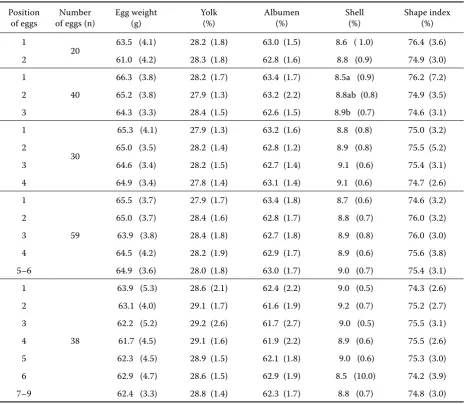
[image:6.595.67.534.101.505.2]In the present observations, no significant dif-ferences in the weight and percentage of yolk and albumen in egg weight in relation to the position of sequence were observed (Table 4). Only a tendency was noted, in which higher weight of the first eggs in a sequence was connected with higher weight and percentage of albumen. Higher yolk weight was also detected for eggs laid in short (2- to 3-egg) sequences. Likewise, Yannakopoulos et al. (1994) did not note a significant effect of daily oviposition time on yolk or albumen weight, but the analysis was performed on eggs from laying hens of the same weight. According to the authors, hen age is a factor markedly influencing the weight of internal egg components. On the other hand, in experiments Table 4. Percentage of eggs components laid in sequences in broiler breeder hens (–x, SD)
Position
of eggs of eggs (n)Number Egg weight (g) Yolk (%) Albumen (%) Shell (%) Shape index (%) 1
20 63.5 (4.1) 28.2 (1.8) 63.0 (1.5) 8.6 ( 1.0) 76.4 (3.6) 2 61.0 (4.2) 28.3 (1.8) 62.8 (1.6) 8.8 (0.9) 74.9 (3.0) 1
40
66.3 (3.8) 28.2 (1.7) 63.4 (1.7) 8.5a (0.9) 76.2 (7.2) 2 65.2 (3.8) 27.9 (1.3) 63.2 (2.2) 8.8ab (0.8) 74.9 (3.5) 3 64.3 (3.3) 28.4 (1.5) 62.6 (1.5) 8.9b (0.7) 74.6 (3.1) 1
30
65.3 (4.1) 27.9 (1.3) 63.2 (1.6) 8.8 (0.8) 75.0 (3.2) 2 65.0 (3.5) 28.2 (1.4) 62.8 (1.2) 8.9 (0.8) 75.5 (5.2) 3 64.6 (3.4) 28.2 (1.5) 62.7 (1.4) 9.1 (0.6) 75.4 (3.1) 4 64.9 (3.4) 27.8 (1.4) 63.1 (1.4) 9.1 (0.6) 74.7 (2.6) 1
59
65.5 (3.7) 27.9 (1.7) 63.4 (1.8) 8.7 (0.6) 74.6 (3.2) 2 65.0 (3.7) 28.4 (1.6) 62.8 (1.7) 8.8 (0.7) 76.0 (3.2) 3 63.9 (3.8) 28.4 (1.8) 62.7 (1.8) 8.9 (0.8) 76.0 (3.0) 4 64.5 (4.2) 28.2 (1.9) 62.9 (1.7) 8.9 (0.6) 75.6 (3.8) 5–6 64.9 (3.6) 28.0 (1.8) 63.0 (1.7) 9.0 (0.7) 75.4 (3.1)
1
38
63.9 (5.3) 28.6 (2.1) 62.4 (2.2) 9.0 (0.5) 74.3 (2.6) 2 63.1 (4.0) 29.1 (1.7) 61.6 (1.9) 9.2 (0.7) 75.2 (2.7) 3 62.2 (5.2) 29.2 (2.6) 61.7 (2.7) 9.0 (0.5) 75.5 (3.1) 4 61.7 (4.5) 29.1 (1.6) 61.9 (2.2) 8.9 (0.6) 75.5 (2.6) 5 62.3 (4.5) 28.9 (1.5) 62.1 (1.8) 9.0 (0.6) 75.3 (3.0) 6 62.9 (4.7) 28.6 (1.5) 62.9 (1.9) 8.5 (10.0) 74.2 (3.9) 7–9 62.4 (3.3) 28.8 (1.4) 62.3 (1.7) 8.8 (0.7) 74.8 (3.0)
with laying hens, Miyoshi et al. (1997) found that albumen weight was higher for the first egg in a se-quence and it decreased subsequently. In previous observations of Arafa et al. (1982), yolk weight was decreasing gradually in eggs laid by laying hens in the afternoon and the differences in the percentage of yolk between the eggs laid early in the morning and late in the afternoon were 1.5%. On the other hand, the authors did not find any trend for the weight or percentage of albumen. By contrast, in recent studies Tůmová et al. (2009) did not show the effect of oviposition time on yolk weight in three genetic groups of laying hens. Moreover, in albumen quality characteristics only Haugh units score declined significantly with egg collection time. However, in a study by Tůmová and Ebeid (2005) yolk percentage was lower in eggs laid in the afternoon and no significant effect of oviposition time on Haugh units was recorded.
In the present study, shell percentage in egg weight in 3- to 4- and 5- to 6-egg sequences was higher for the last egg in a sequence compared to the other eggs, but significant (P < 0.05) diffe- rences were found only for shell percentage in 3-egg sequences.
In the literature there are no data on the influ-ence of egg position in a sequinflu-ence on shape index. Our observations did not reveal any changes in the shape of eggs laid as the last in the sequence in comparison with the first. Similarly, in a report by Tůmová et al. (2009) the shape index of eggs laid by laying hens did not change with collection time. However, it was demonstrated (Arafa et al., 1982; Gumulka et al., 2005) that eggs laid in the afternoon were characterized by thicker shells and were less deformed.
CONCLUSIONS
Broiler breeder hens with good production laid the first egg in a sequence about 3.5 h after the be-ginning of the 16-h photoperiod. Moreover, mean lag for a sequence was the highest for the 2-egg se-quences and decreased as the sese-quences increased. When planning the frequency of egg collection in a flock of broiler breeder hens, one should account for changes in egg sequence length during the pro-duction period.
No relationship between egg position in a laying sequence and quality of egg components in broiler breeder hens was observed.
REFERENCES
Abdallah A.G., Harms R.H. (1997): Eggshell quality as influenced by clutch size in hens laying eggs with heavy or light shell weight. Journal of Applied Animal Re-search, 12, 113–120.
Arafa A.S., Harms R.H., Miles R.D., Cristmas R.B., Choi J.H. (1982): Quality characteristic of eggs from differ-ent strains of hens as related to time of oviposition. Poultry Science, 61, 842–847.
Blanco G., Martinez-Padilla J., Serrano D., Dávila A.J., Vińuela J. (2003): Mass provisioning to different-sex eggs within the laying sequence: consequences for ad-justment of reproductive effort in a sexually dimorphic bird. Journal of Animal Ecology, 72, 831–838.
Campo J.L., Gil M.G., Dávila S.G. (2007): Differences among white-, tinted-, and brown- egg laying hens for incidence od eggs laid on the floor and for oviposition time. Archűv fűr Geflűgelkunde, 71, 105–109. Fasenko G., Hardin R.T., Robinson F.E., Wilson J.L.
(1992): Relationship of hen age and egg sequence posi-tion with fertility, hatchability, viability, and preincuba-tion embryonic development in broiler breeders. Poultry Science, 71, 1374–1383.
Gumulka M., Kapkowska E. (1996): Oviposition rhythm in broiler breeders. Roczniki Naukowe Zootechniki, 24, 99–110. (in Polish)
Gumulka M., Kapkowska E., Maj D. (2005): Effect of egg position in the laying sequence on eggshell quality in broiler breeder hens. Roczniki Naukowe Zootechniki Suplement, 22, 101–104. (in Polish)
Johnston S.A., Gous R.M. (2003): An improved mathe-matical model of the ovulatory cycle of the laying hen. British Poultry Science, 44, 752–760.
Johnston S.A., Gous R.M. (2007): Extent of variation within a laying flock: attainment of sexual maturity, double- yolked and soft- shelled eggs, sequence lengths and con-sistency of lay. British Poultry Science, 48, 609–616. Lewis P.D., Backhouse D., Gous R.M. (2004): Photoperiod
and oviposition time in broiler breeders. British Poul-try Science, 45, 561–564.
Lillpers K., Wilhelmson M. (1993): Genetic and pheno-typic parameters for oviposition pattern traits in three selection lines of laying hens. British Poultry Science, 34, 297–308.
Luc K.M., Miyoshi S., Suzuki M., Mitsumoto T. (1996): Heritability estimates of some clutch traits in the laying hen. Japanese Poultry Science, 33, 23–28.
Naito M., Nirasawa K., Oishi T., Komiyama T. (1989): Selection experiment for increased egg production under 23 h and 24 h light-dark cycles in the domestic fowl. British Poultry Science, 30, 49–60.
Novo R.P., Gama L.T., Soares M.C. (1997): Effects of ovi-position time, hen age and extra dietary calcium on egg characteristics and hatchability. Journal of Applied Poultry Research, 6, 335–343.
Pyrzak R., Siopes T.D. (1989): Characteristics of oviposi-tion pattern of turkey hens and the influence of differ-ent wavelengths of light. British Poultry Science, 30, 151–160.
Robinson F.E., Hardin R.T., Robinson N.A, Williams B.J. (1991a): The influence of egg sequence position on fer-tility, embryo viability, and embryo weight in broiler breeders. Poultry Science, 70, 760–765.
Robinson F.E., Robinson N.A., Scott T.A. (1991b): Re-productive performance, growth rate and body com-position of full-fed versus feed restricted broiler breeder hens. Canadian Journal of Animal Science, 71, 549–556.
SAS Institute (2001): SAS User’s Guide: Statistics. Version 8.0 edition. SAS Institute Inc., Cary, NC.
Tůmová E., Ebeid T. (2005): Effect of time of oviposition on egg quality characteristics in cages and in a litter housing system. Czech Journal of Animal Science, 50, 129–134.
Tůmová E., Zita L., Hubený M., Skřivan M., Levinka Z. (2007): The effect of oviposition time and genotype on egg quality characteristics in egg type hens. Czech Journal of Animal Science, 52, 26–30.
Tůmová E., Skřivan M., Englmaierová M., Zita L. (2009): The effect of genotype, housing system and egg
collec-tion time on egg quality in egg type hens. Czech Jour-nal of Animal Science, 54, 17–23.
Vińuela J. (1997): Adaptation vs. Constraint: intraclutch egg-mass variation in birds. Journal of Animal Ecology, 66, 781–792.
Williams T.D., Lank D.B., Cooke F. (1993): Is intraclutch egg- size variation adaptive in the lesser snow goose? Oikos, 67, 250–256.
Yannakopoulos A.L., Tservenigousi A.S. (1986): Quality characteristics of quail eggs. British Poultry Science, 27, 171–176.
Yannakopoulos A.L., Tservenigousi A.S., Nikokyris P. (1994): Egg composition as influenced by time of ovi-position, egg weight and age of hens. Archüv für Ge-flügelkunde, 58, 206–213.
Zakaria A.H., Plumstead P.W., Romero-Sanchez H., Le-ksrisompong N., Osborne J., Brake J. (2005): Oviposi-tion pattern, egg weight, fertility and hatchability of young and old broiler breeders. Poultry Science, 84, 1505–1509.
Zakaria A.H., Plumstead P.W., Romero-Sanchez H., Le-ksrisompong N., Brake J. (2009): The effects of ovipo-sition time on egg weight loss during storage and incubation, fertility, and hatchability of broiler hatch-ing eggs. Poultry Science, 88, 2712–2717.
Zuidhof M.J., Renema R.A., Robinson F.E. (2007): Repro-ductive efficiency and metabolism of female broiler breeders as affected by genotype, feed allocation, and age at photostimulation. 3. Reproductive efficiency. Poultry Science, 86, 2278–2286.
Received: 2009–08–26 Accepted after corrections: 2009–12–17
Corresponding Author
Małgorzata Gumulka, Ph.D., Department of Poultry and Fur Animals Breeding and Animal Hygiene, Agricultural University in Krakow, Al. Mickiewicza 24/28, 30 059 Krakow, Poland