THEORETICAL BASIS AND PRESENTATION OBJECTIVE
Planning activity gives an idea of what, when and perhaps even how to do certain activities which are necessary in achieving the organisation’s tasks. However, it does not deal with the question of who will provide the planned activities and using which sources. The answer is in management activities – organizing which directly stems from the plan-ning activities.
Internal stimuli for an organisational change are based on empirically verified hypothesis, the ‘con-gruence theory’.
Congruence (consensus) expresses the basic con-dition of efficient functioning of an organization structure, i.e. achieving a close agreement between the situation factors and project parameters (congru-ence hypothesis).
Project parameters of organization structure
The project parameters are understood, in agree-ment with the congruence theory, as all regulated quantities through which the principles of coordina-tion, specialisation and work allocation are applied.
An important property of project parameters is their ability to influence or set their level of utilisation by managers.
Situation factors of an organisation
Unlike the project parameters, situation parameters cannot be regulated directly by any instruction (they emerge, more or less, spontaneously during the “life” of the organisation). The relationship of situation factors with the relevant parameters is shown in Figure 1.
The objective of the present paper is to show the principle of the congruent model production with a consistent check of the unambiguous partial project parameters. The output of the model then is a pro-posal of organisation changes stemming from the new setting of the level of project parameters.
METHODS AND PRESENTATION RESULTS
In most situations of enterprise behaviour there is a discrepancy between the situation where the organisation finds itself and its structural arrange-ment. This discrepancy is an effect of the theory of congruence which requires efficient structuring to be
Organisation equilibrium
Organizační rovnováha
J. HRON, T. MACÁK
Czech University of Agriculture, Prague, Czech Republic
Abstract: Parameters of structure should reflect the factors reflecting the situation, e.g. organisation age, size and type of production system (Mintzberg 1996). The present paper shows a way of achieving the equilibrium between the situation factors and the relevant project parameters of an organisation, the balance being based on a congruence approach.
Key words: structure, congruence hypothesis, configuration, situation factors and project parameters equilibrium
Abstrakt: Parametry struktury by měly korespondovat s faktory, které vyjasňují organizační situaci, např. stáří organizace, velikost a typ produkčního systému (Mintzberg 1996). Příspěvek ukazuje způsob, jakým je možné dosáhnout rovnováhy mezi situačními faktory, přičemž tato rovnováha je založena na kongruentním principu.
Klíčová slova: struktura, hypotéza kongruence, konfigurace, rovnováha situačních faktorů a projektovými parametry
in harmony with the value of the aggregated organi-sation parameter and its corresponding situation. To judge the discrepancy thereby emerged it is neces-sary to quantify the value of the deviation between the required level of the given project parameter and its actual level. To quantify the deviation it is first necessary to express the value of the compared constants, i.e. the concrete situation factor and a complex project parameter.
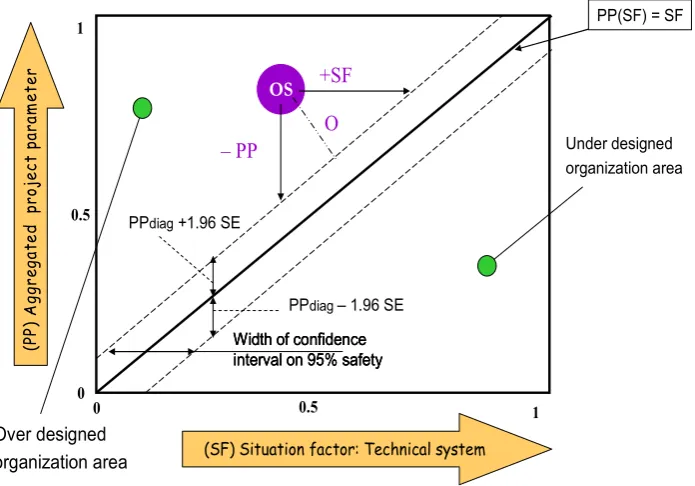
Figure 2 shows a situation where the project pa-rameter serving the organisation’s technical system
(the position of the aggregated project parameter in response to the situation factor being represented by point OS – organisation structure) has been over designed. The ideal situation is when the enterprise situation position is on the chart’s side diagonal, i.e. when the level of the organisation’s technical sys-tem is in agreement (equilibrium) with its expertise, formalisation and definition. A certain discrepancy between these constants is tolerated. The tolerance imagination is represented in the figure in the form of the width of the confidence interval. That means
Situations
factors
Organization
age
Organization
size
Technical
system + rate
of regulation
Organisation
environment
(dynamism,
complexity)
Project
parameters
Informal communication
Number of ad hoc decisions
Formal authority effect
limit
Specialisation rate
Relations formalisation
Size of average organization unit
Process formalization
Bureaucracy of subordinate management
Skill of staffs
Organic of structure
Decentralization of decision
[image:2.595.81.514.71.270.2]making
Figure 1. Relationship of situation factors and relevant project parameters
Organization Equilibrium
(SF) Situation factor: Technical system 0
1
0.5 0.5
OS
– PP
+SF
(P
P)
A
gg
re
ga
te
d
p
ro
je
ct
p
ar
am
et
er
1 Over designed
organization area
Under designed organization area
Width of confidence interval on 95% safety
PPdiag– 1.96 SE PPdiag+1.96 SE
PP(SF) = SF
O
0
[image:2.595.135.483.496.739.2]Width of confidence interval on 95% safety Width of confidence interval on 95% safety
that in the case of the organisation’s position rep-resented by the point OS within the 95% interval of congruent reliability, it can be assumed that in 20% of the measurements of the value of the technical system with only one incidence of a failure there will be an inadequate response from the side of the structure safety parameter. The Student’s t- division of probability with the compensatory t 0.025 is set by the conclusive deviation of a half of the width of the congruent reliability area from the side diagonal of the chart. This conclusive deviation SE is determined from the relationship:
(1)
Where:
s = selective standard deviation;
n = quantity of registered congruent failures over the past period.
PPdiag = diagonal value of the project parameter, for which it holds:
PPdiag = SF (2)
Depending on the degree of freedom – the minimum of the necessary information (i.e. n – 1), it is possible, from the Student’s division of probability, to set the value of the compensation coefficient t 0.025, and sub-stitute it into the relationship for the determination of the width of the congruent reliability bracket. If the reliability bracket is exceeded, i.e. the state of the project parameter
then the subject finds itself in the situation of or-ganisation structure over-designed. Such an excessive reserve results in wasting the financial and human resources, without the possibility of justification of such marginal expenses by the need of greater security in providing the coordination function. Coordination thereby becomes the organisation’s target rather than its need of existence.
If the reliability bracket is not reached, i.e. the state of the project parameter
then the subject finds itself in the situation of organisa-tion under-designed. Such an underestimaorganisa-tion of the structure’s coordination and adaptation ability results in the long run in the organisation dysfunction and in the ultimate case in its functional liquidation.
The following illustrative method shows the ap-plication of organisation equilibrium. The level of the technical system and the corresponding project parameters is disaggregated into its elements.
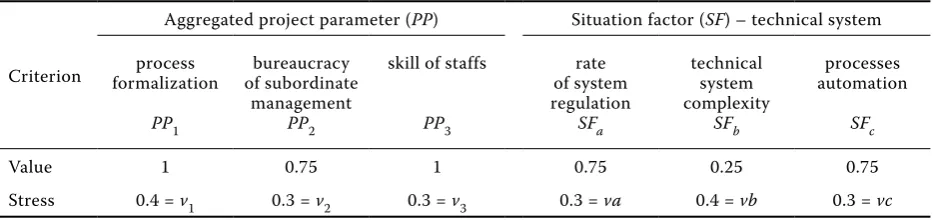
In order to be able to compare the separate criteria of different constants, their (absolutely or nominally) measured values must be transferred on the common basis. Here the basis is made up of the interval of values from 0 to 1. The higher values indicate a more serious influence of the attribute, in other words a need of higher resource investment into the given category of the source parameter. After coordinating the values with the individual constants, it is neces-sary to set the values of the relative factors’ intensi-ties. These intensities represent a sort of “weights” of importance of the individual factors. Their values with situation factors are determined in the ratios of the relative values of the resources spent, in other words in the cost-rate ratios of individual elements of the organisation output (Table 1).
The aggregated project parameter PP and the level of situation factor SF are determined by the valuable sum of their partial values with relevant stress.
(3)
(4)
After substituting the values from Table 1 into the formulae (3) and (4), it follows:
n s t SE� 0.025
PP > PPdiag + t0.025
n s
PP < PPdiag – t0.025
[image:3.595.65.532.657.767.2]n s
Table 1. Organisation constants values and their intensity
Criterion
Aggregated project parameter (PP) Situation factor (SF) – technical system process
formalization
PP1
bureaucracy of subordinate
management PP2
skill of staffs
PP3
rate of system regulation
SFa
technical system complexity
SFb
processes automation
SFc
Value 1 0.75 1 0.75 0.25 0.75
Stress 0.4 = v1 0.3 = v2 0.3 = v3 0.3 = va 0.4 = vb 0.3 = vc i
i PPi v
PP�
�
�� 3
1
j c
a j SFj v
SF�
�
�PP = 1 × 0.4 + 0.75 × 0.3 + 1 × 0.3 = 0.925 SF = 0.75 × 0.3 + 0.25 × 0.4 + 0.25 × 0.3 = 0.4
Now we must characterize the disharmony of the project parameter congruence with the situation factor. The absolute deviation AO is used, expressing the absolute difference of the two factors of organisa-tion. The geometrical character of the congruence disharmony represents the shortest distance of the position of the point of organisation structure OS from the side diagonal (Figure 2). The geometrical form of offset is called the congruent deviation and it can be obtained by the division of the absolute deviation by the square root of two.
AO = SF – PP = 0.4 – 0.925 = –0.525 (5)
(6)
Now we have to determine the new setting of the partial values of the project parameter elements so that its composition value is in harmony with the aggregated value of the technical system. There are two possible ways of solving the problem:
1. To construct two sets of equations and following the substitution for the two unknown values, the set it transformed into an equation of one unknown. 2. Analytical expression of individual components of
the project parameter depending on the technical system and the intensities of the importance of separate PP components:
(7)
In the latter, a set of three equations is written of which expressions for separate PP factors are ex-pressed explicitly in harmony with the organisation balance:
(1) PP1: PP2 : PP3= ν1 : ν2 : ν3 (8)
(2) PP = SF (9)
(3) SF = ν1 × PP1 + ν2 × PP2 + ν3 × PP3 (10)
Solving the set of equations will bring the values of project parameters sought:
(11)
After substituting the values into formulae (11), new values of the project parameter components are obtained:
PP1 = 0.4706 PP2 = 0.3529 PP3 = 0.3529
Verification:
PP = 0.4 × 0.4706 + 2 × (0.3 × 0.3529) = 0.4 = SF
DISCUSSION AND CONCLUSIONS
The necessity of a change of the organisational setting of parameters responds in inverse proportion to the positive trend of the growing productivity of an organisation. That is why it can be noted that the most favourable circumstances for the “testing” of a newly established organisation measure in an or-ganisation are in a situation when there are evident weaknesses in its strategic regions of coordinating policy. Paradoxically, the process of introduction or setting the new level of organisation factors is wel-come in a firm which has realised its unfavourable development in its efforts to eliminate the systems congruence errors. Unfortunately, such a subject has much less potential for the production of new successful organisation innovations as a result of the existence of unsuitable pre-conditions. Such absence of suitable conditions for the establishment of a con-cept of a positive organisation change is not due to the unwillingness of the workers to innovate but by the situation in which they found themselves due to the unfavourable development of the organisation situation. The employees of a firm in a bad economic situation must spend most of their energy to keep the organisation on the market and they do not have enough time to generate new positive changes nor have they enough financial resources. On the other hand, the best ideas emerge unexpectedly often in a situation of a poor economic result which has culmi-nated in a firm’s crisis. The workers are under stress and they often do their very best under such circum-stances. The analysis of the obstacles of the creation and implementation of an organisation innovation of business activities has revealed that a resistance
3712 . 0 2 2 2
: SF�PP�AO� o �o� BS�UZ � AO��
o 3712 . 0 2 2 2
: SF�PP�AO� o �o�BS�UZ �AO ��
o
REFERENCES
Mintzberg H. (1996): The Strategy Process, Concepts, Contexts, Case. Third Edition. Price Hall Interna-tional, Inc., New Jersey; ISBN 013853813. Kaplan S.R. (1999): Balanced Scorecard.
Transla-tion Strategy into AcTransla-tion. Harvard Business Press, Boston; ISBN 80-7261063-5.
Hala R., Whitlam P. (1997): Towards the Virtual Or-ganization. McGraw-Hill, Boston.
Hron J. (2004): Diagnostic of business health. Agri-cultural Economics – Czech, 50 (12): 535–542.
Arrived on 1st February 2006 to the expected positive change originates both in
successful firms and in firms in the situation of a failure. In a firm which has a positive result trend of its business efforts, the innovation implementation is an obstacle of such an innovation while in a firm whose ultimate business trend consists of growing failure, the major obstacle is the creation of in-novation. To summarize – a successful enterprise lacks innovation initiation while and unsuccessful firm lacks innovation ability.
Contact address:
Jan Hron, Tomáš Macák, Czech University of Agriculture Prague, Kamýcká 129, 165 21 Prague 6-Suchdol, Czech Republic