Fine-Grained Doubly Oriented Silicon Steel Sheets
and Mechanism of Cube Texture Development
*Toshiro Tomida, Shigeo Uenoya and Naoyuki Sano
Corporate Research & Development Laboratories, Sumitomo Metal Industries, Ltd., Amagasaki 660-0891, Japan
An attempt has been made to obtain strongly cube-textured sheet steels with fine grains employing oxide-separator-induced decarburization. The steels of the chemical compositions around Fe–3%Si–1%Mn–0.05%C were hot-rolled, twice cold-rolled with in-between annealing into 0.35 mm thickness and then subjected to the lamination annealing with separators containing SiO2, which promoted decarburization. During the lamination annealing in a ferrite and austenite two phase region of about 1350 K, the sheet materials were decarburized down to about 0.001% of carbon concentration. At the same time, the cube texture {100}h001iremarkably evolved in the columnar ferrite grains which grew inward from sheet surfaces. Cube-oriented nuclei emerged during the primary recrystallization prior to decarburization, and they selectively grew in the columnar grains. After complete decarburization, the sheet materials consisted of ferrite grains of about 0.4 mm diameter, more than 90% of which were well aligned with the cube orientation. The doubly oriented steel sheets thus obtained showed a large magnetic induction of 1.87 T at 800 A/m, a small core loss of 1.2 W/kg at 1.5 T and 60 Hz and a low magnetostriction of
2:5106at 1.9 T in both the rolling and transverse directions. It is likely that the cube texture component arises from a near-{410}h001i component present after intermediate annealing and preferentially grows by surface energy difference. The magnetization processes are also discussed.
(Received February 28, 2003; Accepted April 30, 2003)
Keywords: cube texture, decarburization, phase transformation, doubly oriented silicon steel, core loss, magnetostriction
1. Introduction
Cube texture {100}h001i develops relatively with ease upon annealing after rolling in fcc metals such as cupper, aluminum and Fe–Ni.1) However, it hardly evolves in bcc Fe–Si by ordinary rolling and annealing processes. This metallurgical nature has thrown obstacles on the basic as well as practical studies on cube texture, which have historically captured the interests of many researchers because of its symmetrical simplicity and the beneficial influence on magnetic properties. This article describes a process for the development of cube texture in Fe–3%Si–1%Mn sheets, the mechanism of texture development and the magnetic proper-ties of thus obtained materials.
Since the easiest principal directions for Fe–Si to magne-tize are h100i directions, the development of cube texture dramatically improves magnetic properties in two perpendi-cular directions in the plane of sheet materials, the rolling (RD) and transverse (TD) directions. Therefore, the inves-tigations relevant to the cube texture in Fe–Si have been mostly made in relation with the development of magnetic materials suitable for electrical transformers and other electro-magnetic operations. Such materials are so called doubly oriented electrical steel sheets, which are typically 0.3 mm thick and contain about 3% of silicon. Assumus et al.2)have first pointed out that a high temperature annealing of very thin Fe–3%Si sheets leads to a discontinuous or secondary growth of cube-oriented grains. This phenomenon was later proven to be a surface-energy-controlled process occurring when {100} planes had a lower surface energy than the average primary matrix3,4)However, since this selective driving force by surface energy difference decreases with increasing sheet thickness,5)it has been often found that the
cube-oriented growth is rather sluggish in thick materials and the increase in thickness for example to 0.3 mm results in either an incomplete secondary growth or an extremely large grain size more than 20 mm.
Taguchi and Sakakura6,7) have later found a different method based on alternate cold-rolling in two perpendicular directions (cross rolling), which provides Fe–3%Si sheets with a similar coarse-grained structure. In this method, silicon steel sheets containing AlN as a grain growth inhibitor are cross-rolled after hot-rolling, decarburized and then annealed at a high temperature for secondary recrystalliza-tion to occur. Except for the elaborate rolling in cross directions, this method is nearly identical to what is used for the commercial production of well-known Goss-textured {110}h001ielectrical steels. The driving force for this grain growth is due to grain boundary energy, and cube-oriented secondaries grow in a {632}h9 15 5i matrix.8) No other method proposed so far has provided as high a degree of cube texture to Fe–Si sheets as the abovementioned two methods. During the extension of the work due to Assumuset al., the drawbacks in magnetic properties of doubly oriented steels were found.9,10) Whereas the magnetic inductions at rela-tively high fields in easy magnetizing directions were enough large, magnetic core loss and magnetostriction were found to be unexpectedly high if compared to those of Goss-textured Fe–3%Si sheets. The large core loss has been related to the large grain size over 20 mm,10) which affects eddy current loss in the manner suggested by Pry and Bean,11)and related also to the movement of 90magnetic domain walls.12)The
high magnetostriction has been ascribed to the latter by which the domains in transverse directions to applied fields are created (or annihilated).10) It has been pointed out by Littmann9) that doubly oriented materials show a larger dependence of core loss on grain size than Goss-textured materials, suggesting that significantly better properties could be obtained by a large reduction in grain size.
*This Paper was Originally Published in Japanese in J. Japan Inst. Metals
66(2002) 950–957.
In the previous report,13) the decarburization of silicon steel sheets by SiO2 and the development of {100}h012i
texture have been described by one of the authors. As cold-rolled Fe–3%Si–1.1%Mn–0.05%C sheet steels were lami-nated with separators containing SiO2 and then annealed
under a reduced pressure, decarburization occurred due to the thermo-chemical reaction, 2C+SiO2 ! Si+2CO. At the
same time, {100}h012itexture developed to a high degree in the columnar grains which grew inward from sheet surfaces. While strongly textured, fully decarburized materi-als had a grain size of only about 0.6 mm. In this study, therefore, an attempt has been made to obtain doubly oriented silicon steel sheets with small grains by the oxide-separator-induced decarburization. Prior to decarburization, two stages of cold rolling were applied along with an in-between annealing to the materials of which chemical compositions were around Fe–3%Si–1%Mn–0.05%C. The influences of cold rolling and intermediate annealing on the preferred orientation of columnar grain growth and magnetic properties of thus obtained materials were then investigated. It is shown here that the preferred orientation lies in {100}h001i
orientation as an appropriate two-stage cold rolling is applied prior to decarburization. This texture development leads to as a high degree of cube texture as attained by secondary recrystallization, a considerably finer grain size and better magnetic properties. The mechanism of cube texture evolu-tion and the magnetizaevolu-tion processes in fine-grained doubly oriented materials are discussed.
2. Experimental Procedures
Ingots of vacuum melted steels of which compositions are listed in Table 1 and similar to that used in the previous study13)were processed to 3.0 mm thick plates by forging and hot rolling. They were then pickled and cold-rolled to intermediate thickness in the range between 0.6 and 1.5 mm. After annealing for 30 s at temperatures ranging from 1073 to 1323 K, they were again cold-rolled to the final thickness of 0.35 mm. Rolling was all operated in a single direction; no cross-rolling was applied.
The samples of 150150mm2 (sample A) or 180 500mm2 (sample B) in dimensions cut from cold-rolled sheets were laminated with oxide separators in the manner described below. In the case of steel A, a sheet-form ceramic material, which was about 0.5 mm in thickness and consisted of about 3mmdiameter fibrous oxides (52 mass% SiO2 and
48 mass% Al2O3), was used along with TiO2 powders
(Anatase type structure, 99% purity) as separators. The sheet form material was prepared by a papermaking process. Prior to the lamination, the sheet-form material was heat-treated in the atmosphere at 1273 K for 1 h to remove an organic binder that was necessary for the papermaking process. The TiO2
powder of an amount of 40 g/m2 was placed between two
pieces of the sheet-form material, and they were then together
inserted between the samples. This manner of lamination is the same as that used in the previous study.13)The samples of steel B were laminated with the sheet-form separators of about 0.3 mm in thickness, which were directly made by the papermaking process from the mixture of the above men-tioned fibrous oxides, TiO2 powder and a small amount of
organic binder; the organic binder was not removed prior to lamination in this case. The amounts of fibrous oxide, TiO2
powder and organic binder contained in this sheet-form separator were about 40, 30 and 8 g/m2, respectively.
The laminated samples were annealed in an=two phase region of either 1348 or 1373 K under a vacuum of about
103Pa as follows;and phases coexist at temperatures
ranging between 1000 and 1400 K in the present materials.13) The samples of steel A were heated to 1348 K at a rate of 1 K/ min and kept for time periods up to 16 h. On the other hand, the samples of steel B were first heated to 723 K at a rate of 1 K/min and kept for 5 h to remove the organic binder contained in the separators. They were then heated to 1373 K at a rate of 2 K/min and kept for 24 h. Some samples were halfway cooled during the heating processes.
The samples at every stage of the processing described above were examined in chemical composition, texture and microstructures. Textures were measured by X-ray diffrac-tometry with a cobalt or molybdenum target and EBSP (Electron Back Scattering Pattern) coupled to a scanning electron microscope. The measurements were made at specimen surfaces and 20 to 30mm below surfaces for X-ray diffractometry and EBSP respectively, unless mentioned otherwise. Microstructures were observed via optical micro-scopy and OIM (Orientation Imaging Micromicro-scopy) capability of EBSP. The sample surfaces for optical microscopy were polished and etched in Nital solution. Those for EBSP were electro-polished after mechanical polishing.
The samples after decarburization, of which carbon concentrations were reduced down to about 0.001%, were examined in magnetic properties. The strips of 100 30mm2in dimensions were cut from the decarburized sheets
at various angles with respect to RD and stress-relieved at 1173 K for 2 h in a vacuum. The magnetic induction and core loss of the strips were measured under alternating (sinusoi-dal) flux conditions at 50 or 60 Hz by a single strip tester (SST) with horizontal double yokes made by TOEI Industry Co., Japan. The magnetostriction of the same strips was measured at 50 Hz by a laser displacement meter coupled to the same type of SST (model TLVM made by TOEI Industry Co., Japan).
3. Experimental Results
3.1 Decarburization induced by oxide separators and columnar grain growth of ferrite
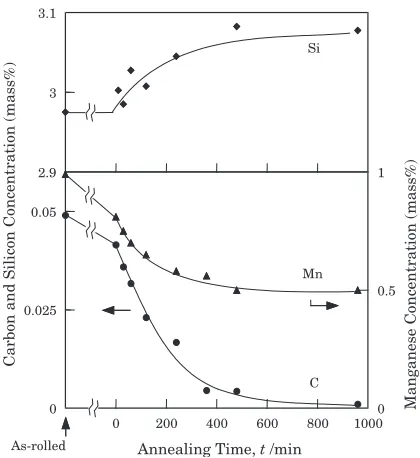
[image:2.595.43.291.742.786.2]The variation of chemical composition of steel A during lamination annealing at 1348 K is shown as a function of annealing time in Fig. 1. The decrease in carbon concentra-tion is observed to occur proporconcentra-tionally to annealing time in the early stages of annealing. Carbon concentration decreases by about 50% for first 4 h, and little carbon remains after an annealing for 16 h. At the same time, manganese concentra-tion decreases, and silicon concentraconcentra-tion slightly increases.
Table 1 Chemical compositions of steels used (mass%).
C Si Mn P S sol-Al
Steel A 0.049 2.97 1.0 0.0002 0.0005 0.0005
The variations in carbon and silicon concentrations are ascribed to the following thermo-chemical reaction between the oxide separators and the specimens,13)
2½C þ hSiO2i ¼ ½Si þ2ðCOÞ; ð1Þ
whereh i, [ ] and ( ) denote pure solids, solute in solids and gaseous states, respectively. The reaction consists of the deoxidization of SiO2, the dissolution of reduced silicon into
steels and the oxidation of carbon in steels to form CO gas. In accordance with this reaction, the decarburization of 0.05% carbon should lead to an increase of silicon concentration by 0.06%. Agreement between this estimation and the experi-mental observation on the silicon concentration variation is clearly seen in Fig. 1. The decrease in manganese concentra-tion is attributed to the vaporizaconcentra-tion of manganese, of which equilibrium vapor pressure is rather high at elevated temperatures.13)
With the original chemistry, the samples are composed of
and phases at the annealing temperature as mentioned earlier. However, due to the above chemistry variation, the phase transformation from tooccurs. It is seen in Fig. 2 that columnar grains of phase develop inward from both sheet surfaces induced by the phase transformation. Beyond the growth fronts of columnar grains, the mixed structure consisting ofphase and pearlite is observed to exist, which is the remnant of theand phases stable at the annealing temperature [see Figs. 2(a) to (c)]. The mixed structure disappears after 4 h of annealing, and then a more rapid growth ofgrains follows since the pinning effect due to the presence of = two phase structures disappears. Some grains grow until they penetrate sheets in thickness direc-tions, and the grain growth virtually stops. It is also seen in Fig. 2 that the diameter of columnar grains gradually increases maintaining the ratio between diameter and length of columnar grains being from 1 to 2. These variations in microstructures as well as chemical composition during lamination annealing were unchanged by the variation in
processing prior to the annealing, and they are in good agreement with those observed in the previous study.13)
3.2 Influence of two-stage cold rolling on preferred orientation
The influence of two-stage cold rolling with intermediate annealing on the development of preferred orientation upon decarburization was then studied. The samples cold-rolled and annealed in various conditions were fully decarburized at 1348 K for 12 h, and the magnetic induction at 800 A/m (B8)
in RD was measured.B8is known as a measure of the degree
of h100iaxis alignment in the direction of applied fields in Fe–Si. When single crystals are magnetized in h100i
directions, a B8 nearly equal to saturation magnetization
(2.03 T for Fe–3%Si14)) is observed, while aB8of about 70%
of the saturation is observed for polycrystalline materials without texture. The contour map of measuredB8 (ratios to
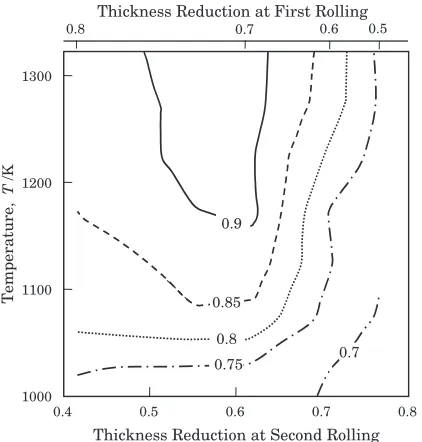
2.03 T) is shown in Fig. 3 as a function of thickness reduction of cold rolling and temperature of intermediate annealing; note that, given the reduction at the first rolling, the reduction at the second rolling is determined since total reduction is constant in this experiment. As the temperature of inter-mediate annealing is about 1000 K,B8 is only 70 to 75% of
the saturation magnetization and similar to those for materials without texture. However, when the intermediate
0 200 400 600 800 1000
Annealing Time, t /min
0 0.025 0.05
0 0.5 1
As-rolled 2.9
3 3.1
Carbon and Silicon Concentration (mass%)
C Mn
Si
Manganese Concentration (mass%)
Fig. 1 Variation in chemical composition during annealing at 1348 K for steel A.
[image:3.595.64.274.71.300.2] [image:3.595.319.533.71.441.2]annealing temperature is raised above 1200 K,B8 more than
90% of the saturation can be obtained under appropriate rolling conditions. The optimum thickness reductions upon rolling to attain high B8, i.e., a high degree of h100i axis
alignment with RD, are 70 to 75% for the first rolling and 50 to 60% for the second rolling.
Figure 4 displays the surface microstructure and texture of the sample of which B8 in RD is more than 90% of the
saturation magnetization. The sample was cold-rolled at a reduction of 75%, annealed at 1323 K, again cold-rolled at a reduction of 53%, and then decarburized at 1348 K for 16 h. A dramatically developed cube texture is observed. All of the 53 grains of which orientations have been determined by EBSP have {100} planes lying within 12with respect to the
sheet surface; the orientations of a few grains in Fig. 4 were not possible to be determined because of poor surface conditions. The average misorientation angle between the {100} planes and the sheet surface was about 4. Theh100i
axes lying in the sheet plane are also well aligned with either RD or TD so that the orientations of about 90% of grains lie within 10 of the exact cube orientation; the orientations of
98% of grains lie within 15 of the cube orientation. The
grain size is about 0.4 mm in diameter, which has been determined by EBSP including all the grain boundaries of more than 1 in boundary angles. The observation by an
optical microscope gave a slightly larger grain size because of poorer detectability on small angle boundaries.
3.3 Texture development process
The variation in texture throughout the processing in this experiment was investigated using the conditions under which cube texture markedly developed. In Fig. 5 is shown the texture after hot rolling, which has been measured at a depth of 0.1 mm below sheet surfaces. The presence of a diffuse Goss texture component is seen, which is known to emerge due to the shear deformation by the friction between samples and roll surfaces during hot rolling. Near the center layer of thickness, a {100}h011i texture component was observed as a major component instead of the Goss texture component. The deformation texture after the subsequent cold rolling at a reduction of 75% involved {100}, {111} and {211} components in the decreasing order of intensity. This type of cold rolling texture is also known to appear in Fe–Si and other low-alloyed steels.
After the intermediate annealing at 1323 K, the texture shown in Fig. 6 appeared near sheet surfaces. As seen in Fig. 6(a), although weak, the texture has a component in which
h100iaxes lie in RD and {100} planes are rotated from the rolling plane by about 15 about RD. This orientation lies
near {410}h001ias indicated in Fig. 6(b) which is the plots of the crystal orientation distribution densities in the range between cube and Goss orientations. The maximum of
0.4 0.5 0.6 0.7 0.8
Thickness Reduction at Second Rolling 1000
1100 1200 1300
Temperature
,
T
/K
Thickness Reduction at First Rolling 0.5 0.6 0.7
0.8
0.7 0.75
0.8 0.85
0.9
Fig. 3 Contour map of the ratio ofB8in the rolling direction to 2.03 T as a function of thickness reduction of cold rolling and temperature of intermediate annealing. The samples of steel A were decarburized at 1348 K for 12 h.
Fig. 4 Crystallographic orientation analyses by EBSP for a fully decar-burized sample of steel A by annealing at 1348 K for 16 h. (a) Stereogram of {100} poles of grains and (b) an OIM image for the analyzed area with 3-D vector representation of orientation of individual grains. The vectors represent the measured orientations ofh100iaxes of individual grains.
1.5
1.5
2
2.2 2
0.5 1
1.5
1
1
2.2
Goss Cube RD
TD
0.5 1
[image:4.595.65.276.73.294.2] [image:4.595.321.527.555.759.2] [image:4.595.49.288.557.719.2]distribution density is located between {410}h001i and {310}h001i. In contrast, the distribution density at cube orientation is small in this stage of the processing. In addition to the near {410}h001i texture component, a {111}h011i
[image:5.595.77.267.71.424.2]component was also observed.
Figure 7 shows the texture present after the final cold rolling at a reduction of 53% and those after lamination annealing. The deformation texture after the final cold rolling is similar to that observed after the first rolling. The difference is that the {111} component after the final rolling is stronger than that after the first rolling and the {100} component behaves vice versa. During the subsequent heating to about 900 K, recovery and then primary recrys-tallization ofphase occur so that the cold rolling texture is weakened. However, the {111} and {100} components again increase when temperature is raised to above 1200 K at which decarburization as well as columnar grain growth ofphase begins. Then the {100} component only continues to increase and becomes the strongest single component during dec-arburization at 1348 K. After 4 h of annealing, at which the growth fronts of columnar grains migrating from both sheet surfaces impinge at the thickness center (see Fig. 2), the intensity of the {100} component becomes more than 20 times the random intensity. The {100} component further evolves during the subsequent growth of grains at the
expense of all other components.
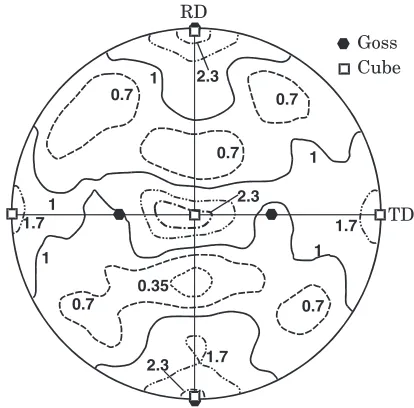
In Fig. 8 is displayed the {100} pole figure for the sample which has just undergone primary recrystallization by heating up to 923 K after final cold rolling. The sample was little decarburized and the size of recrystallizedgrains was about 10mm. A weak but distinct cube texture component is observed to be present. This means that the nuclei for the development of cube texture appear during the primary recrystallization prior to decarburization.
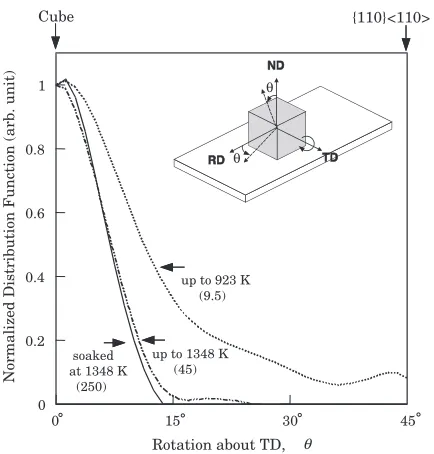
The evolution processes of cube texture are again shown in Figs. 9 to 11 as the variation in orientation distribution in close proximity to {100}h001i. The analyzed stages of texture development are the one in which samples have just undergone primary recrystallization after final cold rolling (the state just mentioned above), the beginning stage of columnar grain growth of phase in which the columnar
Fig. 6 (a) {100} pole figure and (b) crystal orientation distribution by EBSP for steel A after intermediate annealing at 1323 K. The distribution from {100}h001i to {110}h001i is displayed as multiples of random distribution.
at 1348 K (b)
(a)
700 900 1100 Temperature, T/K 0.01
0.1 1 10 100
Axis Density
<100> <111> <211> <210> <110>
As-rolled
0 200 400
Annealing Time, t /min
Fig. 7 Variation in axis density measured by X-ray diffractometry for steel A during (a) heating and (b) annealing at 1348 K. The density is displayed as multiples of random distribution.
1 0.7 2.3
0.35
1
1.7 1
Goss Cube RD
TD
1
1.7 1.7
0.7
2.3 1
0.7 0.7
0.7
2.3
[image:5.595.308.548.73.274.2] [image:5.595.321.528.554.758.2]grains are developed to the depth of 60mm(the sample heated up to 1348 K, see Fig. 2(a)), and the stage in which samples are fully decarburized. It is seen in Fig. 9 that the cube texture component that emerges during primary recrystallization is largely diffuse and widely spreads to Goss orientation. Then this diffuseness greatly and continuously lessens in the later stages in which the columnar grains grow due to decarbur-ization. In Fig. 10 that displays the distributions in the range
between {100}h001iand {110}h011i(a crystal rotation about TD), a similar behavior of the variation in diffuseness of cube texture is observed, although the diffuseness after primary recrystallization is somewhat smaller than that seen in Fig. 9. However a different behavior of the variation in diffuseness of texture is observed in the distributions in the range between {100}h001iand {100}h011i[a crystal rotation about the sheet normal (ND)] as shown in Fig. 11; note that {100} planes are maintained to be parallel to the sheet plane by the crystal rotation in this range. In the early stages of columnar grain growth, the diffuseness of cube texture in this range does not so lessen as that seen in Figs. 9 and 10. The density in the orientations far from cube orientation is unchanged or in part increases, as long as the {100} planes of crystals are parallel to the sheet plane. In the later stages, however, those misoriented components are depleted so that the cube texture is entirely sharpened.
3.4 Magnetic properties
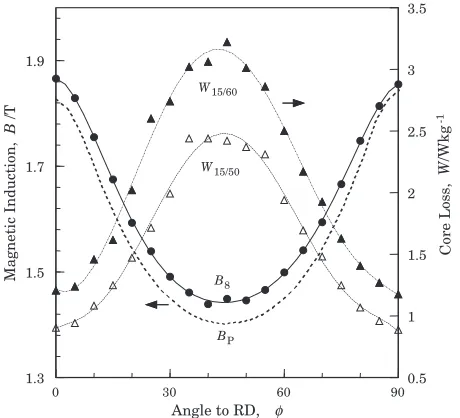
The magnetic properties of fully decarburized strips of steel B are presented in Fig. 12 as a function of the angle of applied fields to RD. The conditions of cold rolling and intermediate annealing for these samples are the same as those described in the section 3.3. The chemical composition after decarburization was Fe–2.9%Si–0.7%Mn–0.0007%C, and the resulting grain structure was similar to that shown in Fig. 4. The strips showed large magnetic induction and small core loss in RD and TD. In these directions B8 are about
1.87 T, and the 50 and 60 Hz losses at an induction of 1.5 T,
W15=50 andW15=60, are about 0.9 and 1.2 W/kg respectively.
These losses in easy directions are notably smaller than those for the previously reported doubly oriented Fe–3%Si strips with grains of 25 mm in diameter.9,10)TheW15=60for 0.3 mm
thick doubly oriented sheet materials, which were slightly thinner than the present materials and showed a comparable
soaked at 1348 K
(250)
up to 923 K (9.5)
up to 1348 K (45)
Goss Cube
0 15 30 45
Rotation about RD, φ 0
0.2 0.4 0.6 0.8 1
Normalized Distribution Function (arb. unit)
ND ND
RD
RD TDTD
φ φ
Fig. 9 Normalized orientation distribution functions for steel A in the range from {100}h001ito {110}h001i(rotation about RD) at the three stages of cube texture evolution. The samples were (dotted) heated up to 923 K, (dashed) heated up to 1348 K, and (solid) annealed for 16 h at 1348 K. The numbers within parentheses are the distribution densities at {100}h001ias multiples of random distribution.
soaked at 1348 K
(250)
up to 1348 K (45)
up to 923 K (9.5)
{110}<110>
Rotation about TD, θ 0
0.2 0.4 0.6 0.8 1
Normalized Distribution Function (arb. unit)
Cube
ND ND
RD
RD TDTD
θ
θ
[image:6.595.314.535.71.295.2]0 15 30 45
Fig. 10 Normalized orientation distribution functions for steel A in the range from {100}h001ito {110}h110i(rotation about TD) at the three stages of cube texture evolution. The samples used and manner of presentation of data are the same as those in Fig. 9.
Rotation about ND, ϕ1
ND ND
RD
RDϕ TDTD
ϕ
1
1
0 15 30 45
up to 1348 K (45) soaked
at 1348 K (250)
up to 923 K (9.5)
0 0.2 0.4 0.6 0.8 1
Normalized Distribution Function (arb. unit)
[image:6.595.62.283.71.303.2]{100}<011> Cube
[image:6.595.61.278.395.622.2]B8 of 1.86 T, was reported to be 1.74 W/kg;10) thinner
materials generally exhibit smaller core losses. It is also seen in Fig. 12 that the induction and core loss vary symmetrically with respect to the directions of applied fields, which is of course due to the cube texture present.
Magnetostriction of the abovementioned samples is shown in Fig. 13. The magnetostriction in easy magnetizing directions as well as in the direction of 45to RD is positive
regardless of magnetic induction. However, in the directions of 25and 65to RD, the magnetostriction becomes negative
below an induction of 1.5 T. It is of particular interest that the magnetostriction in easy directions is considerably smaller than that reported for the doubly oriented Fe–3%Si strips with large grains. Although the magnetostriction for our material is only2:5106at 1.9 T, Foster and co-workers10) reported that the 0.3 mm thick Fe–3%Si doubly oriented strips showed a DC magnetostriction of22:1106at 1.5 T.
4. Discussion
4.1 Driving force of cube texture evolution
The preferred orientation of columnar grain growth lay in {100}h001ias appropriate two-stage cold rolling was applied prior to the oxide-separator-induced decarburization. A cube-oriented component was observed to emerge during primary recrystallization after final cold rolling, and they selectively grew during columnar grain growth. Here, let us first discuss the mechanism of the selective growth.
In the previous study13)using the same oxide-separator-induced decarburization, the preferred orientation of colum-nar grain growth was observed to lie in {100}h012i as a single-stage cold rolling was applied before decarburization. This selective growth was related to the surface free energy difference between {100} and other planes of phase. It is clear that if the surface free energy of {100} planes is the lowest in all surface orientations, the {100}-oriented
particles or islands in = two phase structures tend to
preferentially grow at the expense of phase during decarburization-induced phase transformation until sheet surfaces are entirely covered withphase. Moreover, if the radial growth of columnar grains shown in Fig. 14 is possible to occur, the {100} texture may further develop by the surface energy difference. The alignment ofh012idirections along RD has been then ascribed to the recrystallization of cold-rolled structures, which takes place prior to decarbur-ization. It was postulated that a {100}h012i-oriented compo-nent might appear during the recrystallization and acted as nuclei for the selective growth in later processes.13) The results obtained in the present experiment, the {100}h001i -oriented component observed in the matrix after primary
0 30 60 90
Angle to RD, φ 1.3
1.5 1.7 1.9
Magnetic Induction,
B
/T
0.5 1 1.5 2 2.5 3 3.5
Core Loss,
W
/Wkg
-1
B8
W15/60
W15/50
[image:7.595.324.524.71.411.2]BP
Fig. 12 Magnetic induction and core loss of decarburized samples as a function of angle to the rolling direction. The 0.35 mm thick samples of steel B were decarburized at 1373 K for 20 h.Bpis the calculated induction based on the model described in the text.
2.5
0 0
0
0
0
Magnetic induction, B/ T
0 1 2
-2 -1
Magnetostriction,
λ
/10
RD Bm=1.9T
25 to RD Bm=1.7T
45 to RD Bm=1.5T
65 to RD Bm=1.7T
TD Bm=1.9T
[image:7.595.55.285.73.282.2]-6
Fig. 13 Magnetostriction loops for the same samples as shown in Fig. 12.
Growth in Axial Directions due to Decarburization
Growth in Radial Directions Low Surface Energy {100} Grain
Sheet Surface
α/γ Two Phase Structure R
t
[image:7.595.312.541.461.593.2]recrystallization as well as the development of cube texture, are consistent with the above texture mechanism based on surface energy difference. The sluggish sharpening of the cube texture component with respect to the rotation about ND shown in Fig. 11 is also reasonable if surface free energy is the main selective driving force.
Taking the effects of surface free energy into considera-tion, the driving force D for the radial growth of columnar grains shown in Fig. 14 may be written without the term for pinning effects as
D¼M½bð1=Rav1=RÞ þs=t; ð2Þ
whereMis the mobility of grain boundaries, andbands
are grain boundary energy and the difference in surface energy respectively. R is the radius of the grain under consideration, Rav is the average grain radius, and t is the
thickness of decarburized layers or the length of columnar grains. Since the dominant texture component due to the primary recrystallization after final cold rolling has been a {111} component, thesunder consideration should be the
free energy difference between {100} and {111} planes. Millset al.15)have reported for Fe–3%Si that thescan be
at most about 180 mJ/m2 under an atmosphere of a low
oxygen partial pressure at an elevated temperature, which is about 10% of the surface energy itself; Walter and Dunn16) reported a smaller surface energy difference of 70 mJ/m2 between {110} and {100} planes when the {110} planes had the lowest surface energy. The b for Fe–3%Si has been
reported to be about 470 mJ/m2.17)Therefore, letsandb
be 180 mJ/m2and 470 mJ/m2respectively. Assuming thatRav
is equal to the layer thickness t as observed in this experiment, the ratiorof the magnitude of driving force by surface energy [the second term in eq. (2)] to that by grain boundary energy [the first term in eq. (2)] is then described as
r¼0:38=j1Rav=Rj: ð3Þ
This ratio is larger than 1.0 as0:72Rav<R<1:62Ravand it
becomes infinite asRbecomesRav. It means that the selective
driving force by surface free energy on grain growth could be larger than the driving force by grain boundary energy in a relatively wide range of grain size. In other words, the {100} grains completely surrounded by {111} grains can grow unless the grain size is smaller than 72% of the average grain size. In contrast, the {111} grains totally surrounded by {100} grains cannot grow unless the grain size is larger than 162% of the average. Although this estimation is rather rough and perhaps gives the maximal possible contribution of surface energy, it is suggestive of a high plausibility of the texture mechanism by surface energy difference.
It is also evident from this estimation that the radial growth is, to a large extent, driven by grain boundary energy. As noted in the previous report,13) the influence of grain boundary energy may manifest itself in the later stages of columnar grain growth where the numbers of {100}-oriented grains considerably increases and the surface-energy-related mechanism is no longer effective. The likely relevant phenomenon is seen in Fig. 11 in which the cube texture component sharpens with respect to the crystal rotation about ND; i.e., the grains that have {100} planes parallel to the sheet plane but are largely misoriented from cube orientation
are gradually depleted. As {100}-oriented columnar grains impinge and grow further at the expense of neighboring {100}-oriented grains, such grain growth will proceed in the manner that high angle boundaries are preferentially depleted since they are in general of high energy. Since the {100}-oriented grains that are largely mis{100}-oriented from the true cube orientation are mostly surrounded by abundantly existing well-oriented cube grains, they are frequently surrounded by relatively high angle boundaries. It is therefore probable that such misoriented {100} grains are depleted in the later stages of decarburization to reduce grain boundary energy.
4.2 Emergence of cube texture component
The relation between the initial orientations of crystals and the orientations of recrystallized grains after cold rolling and annealing has been extensively studied for Fe–3%Si. Walter and Hibbard18) reported that a cube texture component appeared as single crystals of {210}h001i orientation were cold-rolled and recrystallized upon annealing. Detert19)and Aspden20) also suggested that the presence of the texture components with orientations from {100}h001i to {210}h001i before cold rolling was an important factor for the cube texture component to emerge during subsequent primary recrystallization. As seen in Fig. 6, a component with the orientation near {410}h001i, which lies between {100}h001i and {210}h001iand is away only by 10 from
{210}h001i, was observed after the intermediate annealing in this experiment. The occurrence of this component was then followed by the emergence of a cube texture component upon primary recrystallization after final cold reduction. Therefore the cube texture component is likely to arise from the near-{410}h001i component present after the intermediate an-nealing.
Also the near-{410}h001icomponent could be related to the diffuse Goss texture present after hot rolling (see Fig. 5). Varlakov and Romashov21) reported that cold rolling and annealing of polycrystalline sheets with a well-developed Goss texture resulted in the appearance of a {210}h001i
component in a primary recrystallized matrix. Haraseet al.22)
4.3 Magnetization processes in fine-grained doubly oriented steels
Using the crystallographic data by EBSP shown in Fig. 4, the magnetic induction B8 can be calculated. Becker and
Do¨ring23)have proposed that the domain distribution in Fe– Si sheets around the knee of magnetization curve is described as magnetic domains are distributed only among the three easy directions of magnetization closest to the applied field such that the net magnetization is parallel to the applied field. The knee of magnetization curve occurs around an applied field of 800 A/m,i.e., aroundB8. The magnetizationBpand
the fractions of domainPjin the three easy directions for a
single crystal are then described as
Bp¼Bs=ð1þ2þ3Þ
Pj¼j=ð1þ2þ3Þ ðj = 1, 2 and 3Þ;
which are called Kaya’s law.24) Here 1, 2 and3 are the
directional cosines of the three easy directions closest to the applied field with respect to the applied field and Bs is the
saturation magnetization. We may modify these equations for polycrystalline materials as follows,
Bp¼Bs
X
i
i=ð1;iþ2;iþ3;iÞ; ð4Þ
Pj¼
X
i
ij,i=ð1;iþ2;iþ2;iÞ; ð5Þ
where i denotes the i-th grain andiis the volume fractions of the i-th grain. There is an ambiguity in the definition ofPj
in eq. (5) since the directions of easy axes vary depending on grains. Therefore we redefine j’s (1, 2 and 3) to denote the easy directions closest to the applied field as well as closest to the fixed axes of the material, RD, TD and ND respectively. Putting the crystallographic orientation and fraction data for 53 grains in Fig. 4 into eq. (4), the magnetizationBpshown in
Fig. 12 has been obtained; we assume here thatBsis equal to
that for Fe–3%Si (2.03 T). The calculation is reasonably in good agreement with the measurement of B8, although the
observed B8 is somewhat larger than that calculated. A
similar tendency has been reported for {110}h001i oriented Fe–3%Si. Therefore it is obvious that the domain distribution around an applied field of 800 A/m is well described by the abovementioned state proposed by Becker and Do¨ring and the texture observed at the sheet surface shown in Fig. 4 well represents the texture of the entire material.
Apart from magnetic induction, the notable magnetic properties of doubly oriented materials found in the present experiment are small core loss and low magnetostriction in easy directions, which are considerably smaller than those reported for the doubly oriented Fe–3%Si sheets with large grains more than 20 mm. Except texture, the factors that need to be considered in respect of those properties are the spacing between main magnetic domain walls and the presence of magnetic domains in the direction perpendicular to applied fields. Core loss increases with increasing the domain wall spacing as suggested by Pry and Bean,11)since the velocity of domain wall motion upon magnetization is increased, resulting in a large increase in eddy current loss. Since the domain wall spacing generally decreases with decreasing grain size, reduced domain wall spacing may be the primary
reason for the decreased core loss observed in this experi-ment; the grain size of the present materials is smaller than that of the previous materials by a factor of about 60.
Magnetostriction is, on the other hand, directly related to the above second factor, the presence of transverse domains. As cube-textured Fe–Si is magnetized in easy directions, magnetostriction is observed if the magnetic domains in the directions perpendicular to applied fields are created or annihilated upon magnetization. Therefore the observed small magnetostriction in RD and TD should be ascribed to a domain structure for which the volume fraction of transverse domains is rather small.
Based on the calculation described above and the data on magnetostriction, the volume fraction of transverse domains in our materials may be deduced. Using eq. (5) and the data by EBSP shown in Fig. 4, the volume percentages of domains present at the knee of magnetization for our material have been obtained as 89.5% in RD, 6.4% in TD and 4.1% in ND, when magnetized in RD. Thus the volume percentage of transverse domains at an induction aroundB8is about 10.5%.
On the other hand, during the magnetization up to 1.9 T (aroundB8), our materials have showed a magnetostriction of
about2:5106 in RD. This value of strain is about 7% of 3100=2, the strain yielded by the domain transformation
from the [010] or [100] to the [001] in a single crystal;100is 23:7106 for Fe–3%Si.25)Therefore, if it is assumed that
entire samples are homogeneously strained with the volume-weighted average of strains and the imperfection of cube texture is ignored, the observed magnetostriction is explained as the annihilation of transverse domains of about 7% in volume fraction. Since the volume fraction of transverse domains aroundB8 is 10.5%, that in demagnetized states is
then estimated to be about 17.5 (7+10.5)%. This value is roughly one fourth of the volume fraction of transverse domains in the cube-textured material exhibiting a magne-tostriction of22:1106. The low-core-loss property shown
in Fig. 12 can also be related to this domain structure, in which magnetization would occur mostly by 180 domain
wall motion.
5. Conclusions
The texture development in silicon steel sheets by the oxide-separator-induced decarburization combined with two-stage cold rolling and the magnetic properties of thus obtained doubly oriented sheet materials have been studied. The study has led to the following conclusions.
(1) By lamination annealing with separators consisting of SiO2, TiO2and Al2O3 at about 1350 K, 0.35 mm thick
sheet steels with chemical compositions around Fe– 3%Si–1%Mn–0.05%C can be fully decarburized down to 0.001% of carbon concentration. Associated with decarburization, columnar grains of phase grow inward from sheet surfaces.
subsequent annealing at 1250 K for 30 s, and a final cold rolling at a reduction around 55%.
(3) Texture components near {110}h001i and {410}h001i
exist below sheet surfaces after hot rolling and inter-mediate annealing of two-stage cold rolling, respec-tively. Then a cube texture component emerges upon primary recrystallization after final cold rolling, pre-sumably originating from the near-{410}h001i compo-nent.
(4) The cube texture component develops during decarbur-ization resulting in a highly oriented grain structure of about 0.4 mm grain size, in which more than 90% grains are closely aligned with cube orientation. In the early stages of the cube texture evolution, the cube texture component develops in the manner that texture compo-nents with {100} planes away from the sheet plane are mainly depleted. Then, in the later stages of the evolution, the cube texture evolves at the expense of all the other texture components.
(5) The main selective driving force for cube texture evolution appears to be the orientation dependence of surface free energy, while the influence of grain boundary energy is also suggested by the behavior of texture evolution observed in the later stages.
(6) The doubly oriented sheet materials thus obtained show a large induction of 1.87 T at 800 A/m, a small core loss of 1.2 W/kg at 1.5 T and 60 Hz, and a low magnetos-triction of 2:5106 at 1.9 T in the rolling and
transverse directions. The observed small core loss appears to be due to small grain size by which magnetic domains are refined, while the low magnetostriction is related to a reduced volume fraction of transverse domains.
(7) The calculated induction based on the observed grain structure and the method proposed by Becker and Do¨ring is in good agreement with the observation of induction at 800 A/m. The volume fraction of transverse domains present in a demagnetized state, which has been deduced based on the above calculation and the observation of magnetostriction, is about 17.5%.
Acknowledgments
The authors gratefully acknowledge instructive discus-sions with Dr. Taiji Nishizawa (Professor Emeritus of Tohoku University), Dr. Shigeharu Hinotani, and Dr. Yasuhiro Maehara with R&D Laboratories of Sumitomo Metal Industries Ltd. They also wish to thank Dr. Sumio Kobayashi (the former director of the R&D Laboratories) and Mr. Yasuyuki Tozaki (the director of the R&D Laboratories) for their inevitable supervision throughout the research.
REFERENCES
1) G. Gottstein and K. Lu¨cke (ed.):Proc. 5th Int. Conf. on Textures of Materials, (Springer-Verlag, 1978).
2) F. Assmus, K. Detert and G. Ibe: Z. Metallk.48(1957) 344–349. 3) J. L. Walter: Acta Metall.7(1959) 424–426.
4) J. L. Walter: J. Appl. Phys.36(1965) 1213–1220.
5) K. Foster, J. J. Kramer and G. W. Wiener: Trans. Metall. AIME227 (1963) 185–188.
6) S. Taguchi and A. Sakakura: Acta Metall.14(1966) 405. 7) Kinzokubutsuri7(1961) 221–223.
8) J. Harase and R. Shimizu: J. Japan. Inst. Metals53(1989) 745–752. 9) M. F. Littmann: J. Appl. Phys.38(1967) 1104–1108.
10) K. Foster, J. Seidel and J. W. Shilling: Magn. Magn. Mater.2(1973) 971–975.
11) R. H. Pry and C. P. Bean: J. Appl. Phys.29(1958) 532–533. 12) G. W. Wiener, K. Foster and D. S. Shull: J. Appl. Phys.38(1967)
1102–1103.
13) T. Tomida: Mater. Trans.44(2003) 1096–1105.
14) R. M. Bozorth:Ferromagnetism, (D. Van Nostrand: New York, 1951) 77.
15) B. Mills, M. McLean and E. D. Hondros: Philos. Mag.27(1973) 361– 368.
16) J. L. Walter and C. G. Dunn: Trans. Metall. AIME215(1959) 465–471. 17) E. D. Hondros and L. E. Stuart: Philos. Mag.17(1968) 711–727. 18) J. L. Walter and W. R. Hibbard: Trans. Metall. AIME212(1958) 731. 19) K. Detert: Arch. Eisenhu¨ttenwesen35(1964) 75–83.
20) R. G. Aspden: Trans. Metall. Soc. AIME227(1963) 905–909. 21) V. P. Varlakov and V. M. Romashov: Fiz. Metal Metalloved.13(1962)
671–675.
22) J. Harase, Y. Ushigami and N. Takahashi: Mater. Sci. Forum157–162 (1994) 899–904.
23) R. Becker and W. Do¨ring: see J. W. Shilling and G. L. Houze, Jr., IEEE Trans. Magn.MAG-10(1974) 195–223.
24) S. Kaya: see S. Chikazumi, Physics of Ferromagnetism Vol. II, (Syokabo Tokyo, 1984) 232–233.