Environmental factors affecting variability in daily milk yield are widely documented in dairy cattle (Ng-Kwai-Hang et al., 1984; Schutz et al., 1990; Dědková and Němcová, 2003; Rekik et al., 2003), goats (Brežnik et al., 1997; Ciappesonni et al., 2004) and sheep (Gonzalo et al., 1994; Cappio-Borlino et al., 1997; Ploumi et al., 1998). Studies investigating environmental factors affecting total lactation or milking period yield in goats and sheep (Margetín et al., 1998; Margetín and Milerski, 2000; Čapistrák et al., 2002) were mostly conducted in Slovakia. New developments in modelling test-day records drew attention to the analyses of succes-sive daily measurements also in Slovakia as many advantages were shown (Swalve, 1998). Moreover, a need for replacing dairy sheep selection
pro-grammes by more sophisticated procedures that can distinguish between genetic and environmen-tal factors affecting daily milk traits resulted in the first attempts focused on the quantification of genetic and environmental variance parameters for Slovakian sheep (Oravcová et al., 2005). These analyses showed that the additive genetic effect accounted only for 10% (Improved Valachian) and 20% (Tsigai) of daily milk yield variability, whereas its largest portion (up to 90%) was affected by en-vironmental effects. Accordingly, it is necessary to determine the impact of environmental effects as accurately as possible.
The aim of the present study was to analyse the environmental factors which affect daily milk yield of Tsigai, Improved Valachian and Lacaune ewes
Supported by the Ministry of Agriculture of the Slovak Republic and by the Ministry of Agriculture of the Czech Republic (Project No. MZe 0002701401).
Factors affecting milk yield and ewe’s lactation curves
estimated with test-day models
M. Oravcová
1, M. Margetín
1, D. Peškovičová
1, J. Daňo
1, M. Milerski
2,
L. Hetényi
1, P. Polák
11Slovak Agricultural Research Centre, Nitra, Slovak Republic 2Research Institute of Animal Production, Prague, Czech Republic
AbstrAct: Test-day records of purebred Tsigai, Improved Valachian and Lacaune ewes were analysed with a
general linear model in order to investigate the effects of flock-test day, lactation number, days in milk, litter size and month of lambing. In total, 121 576 (Tsigai), 247 902 (Improved Valachian) and 2 196 (Lacaune) test-day records gathered over the period 1995–2005 were included in the analyses. Average daily milk yields were 0.604 ± 0.279 kg (Tsigai), 0.595 ± 0.243 kg (Improved Valachian) and 1.053 ± 0.475 kg (Lacaune). The significant (P < 0.05) or highly significant (P < 0.01) effects of flock-test day, lactation number (except for Lacaune), days in milk, litter size (except for Lacaune) and month of lambing (either fixed effects or covariates) tested by Fisher’s tests were shown. The model explained about 50% of daily milk yield variability, with coefficients of determination as follows: 0.479 for Improved Valachian; 0.487 for Tsigai; 0.537 for Lacaune. Differences in estimated least-squares means were tested using multiple-range Scheffe’s tests. A lower daily milk yield was found for the first lactation, single litter and lactations starting in March in comparison with daily milk yield for the second and third lactations (except for Lacaune), multiple litter and lactations starting in January and February (except for Improved Valachian). Ali-Schaeffer regression adopted for sheep was used for the fitting of lactation curve according to breed.
and to assess the differences in their lactation curves.
MAtErIAL AND MEtHODs
Data
Data from regular milk recording in nucleus and multiplier flocks, representing about 5% of the total number of ewes in Slovakia each year, (see Oravcová et al., 2005 for details on the ICAR reference meth-od applied) over the perimeth-od 1995–2005 (Tsigai and Improved Valachian) or 1999–2005 (Lacaune) were used in the analyses. There were 121 576 test-day records belonging to 17 202 purebred Tsigai ewes, 247 902 test-day records belonging to 36 548 pure-bred Improved Valachian ewes and 2 196 test-day records belonging to 362 purebred Lacaune ewes. The first test-day measurements were done mostly from the second to the fourth month after lamb-ing. Three to seven individual daily milk measure-ments per ewe were performed during lactation. The proportion of three daily milk measurements was low; it varied from 4% (Improved Valachian) to 10% (Tsigai and Lacaune). The proportion of four daily milk measurements was high; it varied from 81% (Tsigai) through 86% (Lacaune) to 91% (Improved Valachian). The remaining proportion of lactations was distributed over five to seven test days. Distribution of days in milk, in which indi-vidual test-day measurements were performed, was similar in the three breeds. About 80% of test-day measurements were performed between 60 and 180 days after lambing and were almost equally distributed (about 20%) over each 30-day-period. The remaining proportion of test-day measure-ments was performed before the 60th and after the
180th day in milk. The number of test-day
measure-ments over days in milk decreased proportionally with the increasing number of lactation. Average number of lactations across breeds varied from 1.5 (Lacaune) through 1.7 (Improved Valachian) to 1.8 (Tsigai) lactations per head. The number of flocks across breeds varied from six (Lacaune) through 47 (Tsigai) to 75 flocks (Improved Valachian).
In all three breeds, three levels of lactation num-ber (first, second and third), two levels of litter size (single and multiple birth) and three levels of month of lambing (January, February, March) were included in the general linear model used for the analyses. As a small number of lambings occurred in
December and April, these subclasses were merged with the subsequent or previous class of month of lambing. The flock-test day effect, used to model management and environmental conditions affect-ing each daily milk measurement, accounted for 96 (Lacaune), 1 034 (Tsigai) and 1 647 (Improved Valachian) levels. Distribution of records over flock-test day levels was unbalanced; it varied from ten records to 59 (Lacaune), 330 (Tsigai) and 577 (Im- proved Valachian) records. Stage of lactation was modelled by days in milk considered covariates nested within lactation. Ali-Schaeffer lactation sub-model (Ali and Schaeffer, 1987) adopted for sheep was employed in the analyses.
statistical model
General linear model (GLM procedure; SAS/ STAT 9.1, 2002–2003) was applied to study the in-fluence of factors affecting daily milk yield of ewes. Least-squares means and standard errors were cal-culated. Statistical significance of the differences between least-squares means was determined using Scheffe’s multiple-range tests.
The identical statistical model was considered for all three breeds:
DIMijklm
yijklm = µ + Li + Sj + Mk + FTDl+ b1i
( )
+ C DIMijklm 2 C C
+ b2i
( )
+ b3i ln( )
+ b4iln2( )
C DIMijklm
DIMijklm
+ eijklm
where:
yijklm = individual observation of daily milk yield (kg)
μ = intercept
Li = fixed effect of lactation number (i =1, 2 and 3)
Sj = fixed effect of litter size(j = 1 and 2+)
Mk = fixed effect of month of lambing (k = 1, 2 and 3)
FTDl = fixed effect of flock-test day (l = 1 to 1 034 for
Tsigai, 1 to 1 647 for Improved Valachian and 1 to 96 for Lacaune)
b1i, b2i,b3i, b4i = regression coefficients associated with
DIM (days in milk nested within lactation)
C = constant associated with standardised length of milking period in Slovakian sheep (150 days)
eijklm = random error, N (0, δ2
e
)
rEsULts AND DIscUssION
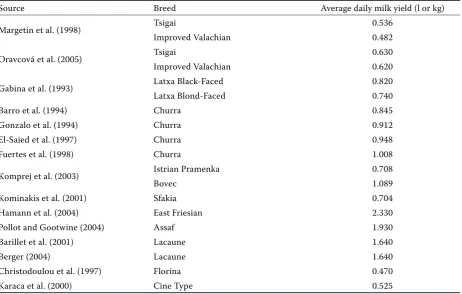
Breeds under study are dual-purpose breeds in the Slovakian sheep husbandry system with about the same income for milk and lamb meat. Mainly Tsigai and Improved Valachian produce lower milk yields than most breeds distributed over Europe and Israel (Table 1). Overall means and stand-ard deviations for daily milk yields calculated for Tsigai, Improved Valachian and Lacaune ewes were 0.604 ± 0.279 kg, 0.595 ± 0.243 kg and 1.053 ± 0.475 kg, respectively. In comparison with the study of Margetín et al. (1998) conducted in the period 1995–1996, the increase of average daily milk yield by 13% (Tsigai) and 24% (Improved Valachian) was observed. Differences were probably a result of different periods of covered and selection done (mainly before the year 2000). Contrariwise, small differences (only 4% for both breeds) observed when daily milk yields of Tsigai and Improved Valachian ewes were compared with previous analyses based on the test-day approach (Oravcová et al., 2005) indicate that the phenotype selection of the last years (since 2000) was not reflected in higher milk yields. Average daily milk yield of Tsigai and Improved Valachian breeds was much lower than daily milk yield of dairy breeds like East Friesian
(Hamann et al., 2004), Assaf (Pollot and Gootwine, 2004), Churra (Baro et al., 1994; Gonzalo et al., 1994; El-Saied et al., 1998; Fuertes et al., 1998), and also Bovec, Istrian Pramenka (Komprej et al., 2003), Black-Faced and Blond-Faced Latxa (Gabina et al., 1993), and Sfakia (Kominakis et al., 2001). On the contrary, it was higher in comparison with Florina (Christodoulou et al., 1997) and Cine Type sheep (Karaca et al., 2000) classified as multipur-pose breeds. Daily milk yield of Lacaune, although higher than daily milk yield of Tsigai and Improved Valachian, was lower than daily milk yield of com-parable breeds reported in the literature – East Friesian (Hamann et al., 2004), Assaf (Pollot and Gootwine, 2004) and Lacaune (Barillet et al., 2001; Berger, 2004). The lower milk yield of Lacaune kept in Slovakia is probably a result of different feed-ing level and insufficient adaptability to different management and environmental conditions that do not allow the outstanding genetic potential to be manifested.
[image:3.595.69.532.462.756.2]Following the values given in Table 2, the effects included in the statistical model: lactation number, litter size, month of lambing, flock-test day and, also, covariates associated with days in milk showed a statistically significant (P < 0.05) or statistically highly significant (P < 0.01) influence on daily milk
Table 1. Literature review of average daily milk yield in various sheep breeds
Source Breed Average daily milk yield (l or kg)
Margetin et al. (1998) Tsigai 0.536
Improved Valachian 0.482
Oravcová et al. (2005) Tsigai 0.630
Improved Valachian 0.620
Gabina et al. (1993) Latxa Black-Faced 0.820
Latxa Blond-Faced 0.740
Barro et al. (1994) Churra 0.845
Gonzalo et al. (1994) Churra 0.912
El-Saied et al. (1997) Churra 0.948
Fuertes et al. (1998) Churra 1.008
Komprej et al. (2003) Istrian Pramenka 0.708
Bovec 1.089
Kominakis et al. (2001) Sfakia 0.704
Hamann et al. (2004) East Friesian 2.330
Pollot and Gootwine (2004) Assaf 1.930
Barillet et al. (2001) Lacaune 1.640
Berger (2004) Lacaune 1.640
Christodoulou et al. (1997) Florina 0.470
yield, except for lactation number and litter size in Lacaune breed.
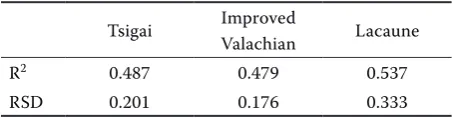
According to Table 3, an adjustment for consid-ered effects diminished the variability of daily milk yield by 28% (for Tsigai from 0.279 to 0.201 kg; for Improved Valachian from 0.243 to 0.176 kg) and 30% (for Lacaune from 0.475 to 0.333 kg). The statisti-cal model fitted well for the analyses of daily milk yield in all three breeds. Coefficients of determina-tion (R2s) were almost identical for the three breeds,
varying from 0.479 to 0.537. However, R2s reported
in the literature were mostly higher. In Sarda, Florina and Assaf sheep, Sanna et al. (1994), Christodoulou et al. (1997), and Gootwine and Pollot (2002) re-ported R2s from 0.55 through 0.57 to 0.75. In White
Shorthaired goats, Margetín and Milerski (2000) re-ported R2s from 0.65 to 0.79 (depending on either
herd and year or herd-year-season effects involved). Previous analyses of lactation milk yield in Tsigai and Improved Valachian breeds (Margetín et al., 1998) showed lower R2s (decrease by 10 and 29%). Studies
on Creole sheep (Peralta-Lailson et al., 2005) also showed lower R2s in comparison with the analyses
of Slovakian sheep (0.2701 up to 0.4019).
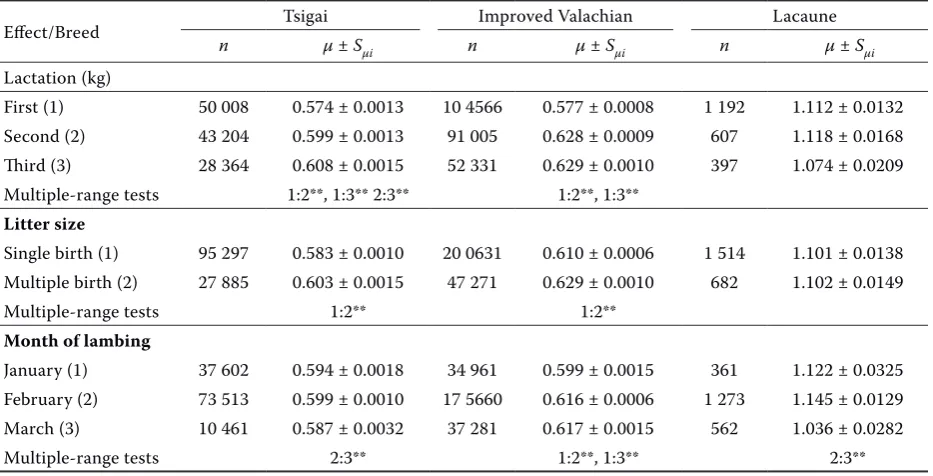
The extent to which the environmental effects influenced daily milk yield of analysed breeds is summarized in Table 4. Trends in least-squares means (LSMs) for the first, second and third lac-tation were similar (except for Lacaune) to those reported in literature with the significantly lowest daily milk yield of primiparous ewes that increased along with the increasing number of lambings (0.034 and 0.052 kg higher in the third lactation than in the first lactation for Tsigai and Improved Valachian, respectively). The findings for these two breeds agree with findings of Cappio-Borlino et al. (1997) and Ruiz et al. (2000). Lacaune breed showed a balanced milk yield over successive lac-tations with non-significant (P > 0.05) differences that were lower than 4%. Differences in the first three lactations found for the remaining two breeds (less than 10%) were in accordance with findings of Gonzalo et al. (1994), Christodoulou et al. (1997), El-Saied et al. (1998) and Margetín et al. (1998). However, Cappio-Borlino et al. (1997), Margetín and Milerski (2000) and Ciappesoni et al. (2004) found differences in the first three lactations be-tween 13 and 17% for Valle del Belice ewes; 11 and 15% and 18 and 25% for White Shorthaired goats kept in Slovakia and the Czech Republic.
[image:4.595.65.536.101.249.2]A lower daily milk yield was recorded in ewes lambing singles in comparison with ewes lamb-ing multiples (P < 0.01 for Tsigai and Improved Valachian; P > 0.05 for Lacaune). Differences in daily milk yield between the ewes lambing singles and multiples were 0.020 (Tsigai), 0.019 (Improved Valachian) and 0.001 kg (Lacaune) in favour of daily milk yield associated with multiples. These find-ings are in agreement with Gabina et al. (1993) and
Table 2. General linear model for daily milk yield according to breed
Tsigai Improved Valachian Lacaune
Effects DF MS DF MS DF MS
Lactation No. (L) 2 0.19* 2 0.17* 2 0.10
Litter size (S) 1 7.31** 1 11.32** 1 0.01
Month of lambing (M) 2 0.55** 2 2.77** 2 0.96**
Flock-test day (FTD) 1 033 2.59** 1 646 3.13** 95 1.41**
DIM/C 3 0.23** 3 0.10* 3 0.31*
(DIM/C)2 3 0.22** 3 0.17** 3 0.30*
ln(C/DIM) 3 0.19** 3 0.03 3 0.26
ln2(C/DIM) 3 0.23** 3 0.05 3 0.28*
DF = degrees of freedom; MS = means squares; DIM = days in milk; C = const = 150 *P < 0.05; **P < 0.01 (Fisher’s test)
Table 3. General linear model for daily milk yield accord-ing to breed – cont
Tsigai Improved
Valachian Lacaune
R2 0.487 0.479 0.537
RSD 0.201 0.176 0.333
R2 = coefficient of determination; RSD = residual standard
[image:4.595.64.291.326.385.2]Gonzalo et al. (1994) and reflect the stimulus of litter size. Breeds under study are of lower fertility; ewes mostly produce singles, and there occurred about 22 (Tsigai), 20 (Improved Valachian) and 31% (Lacaune) of lactations with multiple births.
As for the lambing month effect, Improved Valachian ewes with lactations starting in January and February produced daily milk yield (0.599 and 0.616 kg) which was lower than daily milk yield of ewes with lactations starting in March (0.617 kg). An opposite trend was observed for the remain-ing breeds (Tsigai and Lacaune). For Tsigai, a sig-nificant difference (P < 0.05) was found between lactations starting in February and March (0.599 vs. 0.587 kg). For Lacaune, there was a highly
signi-ficant (P < 0.01) difference between lactations start-ing in February and March (1.145 vs. 1.036 kg). A lower daily milk yield found for lactations starting in January and February (Improved Valachian) is in agreement with findings of Ciappesoni et al. (2004) for White Shorthaired goat, who explained this fact by poor quality feeding and change from winter to summer ration. An opposite trend in Tsigai and Lacaune (milk yield lower for lactations starting in March) is in agreement with findings of Cappio-Borlino et al. (1997) for Valle del Belice.
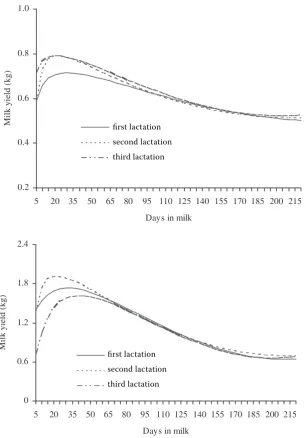
[image:5.595.66.533.102.340.2]Lactation curves according to breeds are given in Figure 1, 2 and 3. The peak of lactation curves occurred in about 20–40 days after lambing (except for the first lactation in Tsigai with the peak at an
Table 4. Least-squares means and standard errors for daily milk yield according to breed
Effect/Breed n Tsigaiµ ± S Improved Valachian Lacaune
µi n µ ± Sµi n µ ± Sµi
Lactation (kg)
First (1) 50 008 0.574 ± 0.0013 10 4566 0.577 ± 0.0008 1 192 1.112 ± 0.0132 Second (2) 43 204 0.599 ± 0.0013 91 005 0.628 ± 0.0009 607 1.118 ± 0.0168 Third (3) 28 364 0.608 ± 0.0015 52 331 0.629 ± 0.0010 397 1.074 ± 0.0209 Multiple-range tests 1:2**, 1:3** 2:3** 1:2**, 1:3**
Litter size
Single birth (1) 95 297 0.583 ± 0.0010 20 0631 0.610 ± 0.0006 1 514 1.101 ± 0.0138 Multiple birth (2) 27 885 0.603 ± 0.0015 47 271 0.629 ± 0.0010 682 1.102 ± 0.0149
Multiple-range tests 1:2** 1:2**
Month of lambing
January (1) 37 602 0.594 ± 0.0018 34 961 0.599 ± 0.0015 361 1.122 ± 0.0325 February (2) 73 513 0.599 ± 0.0010 17 5660 0.616 ± 0.0006 1 273 1.145 ± 0.0129 March (3) 10 461 0.587 ± 0.0032 37 281 0.617 ± 0.0015 562 1.036 ± 0.0282
Multiple-range tests 2:3** 1:2**, 1:3** 2:3**
*P < 0.05; **P < 0.01 (Scheffe’s test)
0 0.2 0.4 0.6 0.8 1 1.2 1.4
5 20 35 50 65 80 95 110 125 140 160 175 190 205 220
Days in milk
M
ilk
y
ie
ld
(k
g)
first lact. second lact. third lact.
Figure 1. Lactation curves estimated for Tsigai breed
[image:5.595.69.371.593.746.2]earlier stage). After the peak is achieved (more or less visible in dependence on the breed), the pattern with progressively decreasing daily milk yield until the end of lactation can be observed (see Alderman and Cottrill, 1995; Komprej et al., 2003; Peralta-Lailson et al., 2005, for a comparison with dairy and suckler cows, Slovene sheep and black variety of Creole sheep). Contrariwise, Carta et al. (1995) and Peralta-Lailson et al. (2005) reported only a decreasing shape of lactation curve for Sarda dairy sheep and White and Brown varieties of Creole sheep.
A decrease in daily milk yield between the begin-ning and the end of lactation differed in the par-ticular breeds (6% per 30-day-period for Improved Valachian; 10 to 13% for Tsigai and Lacaune). Smaller differences in lactation stages found for
Improved Valachian, built as a composite breed of former Valachian with Texel, Lincoln Longwool and Leicester Longwool, correspond with small differences in lactation stages in suckler cows (Alderman and Cottrill, 1995). Smaller differences in lactation stages, however, may also be associ-ated with the level of feeding. Improved Valachian breed is kept in hilly locations of northern Slovakia and fits well the less favourable environment of extensive production systems. Poor quality feed-ing, mainly at the beginning of lactation, may be responsible for relatively low milk yield on the first test days, although a lower amount of data is available for this stage of lactation (suckling period of about 54–55 days in the three breeds). On the other hand, pasture of higher quality dur-ing late sprdur-ing and summer may be responsible 0.2
0.4 0.6 0.8 1.0
5 20 35 50 65 80 95 110 125 140 155 170 185 200 215
Days in milk
M
ilk
y
ie
ld
(k
g)
first lact. second lact. third lact.
0 0.6 1.2 1.8 2.4
5 20 35 50 65 80 95 110 125 140 155 170 185 200 215
Days in milk
M
ilk
y
ie
ld
(k
g)
first lact. second lact. third lact.
[image:6.595.70.377.81.520.2]Figure 3. Lactation curves estimated for Lacaune breed
Figure 2. Lactation curves estimated for Improved Valachian breed
first lactation second lactation third lactation
for relatively high milk yield at the middle and end of lactation.
Almost identical milk yield at the end of lacta-tions in Improved Valachian (from 0.50 to 0.53 kg) and Tsigai (0.42 to 0.52 kg) may be caused by simi-larity in the production level of these breeds. With regard to the milk production level at the beginning of lactations, the shape of lactation curves brings the evidence of lower persistency in Lacaune breed (milk yield varying between 1.50 and 1.90 kg at the peak vs. milk yield varying between 0.64 and 0.69 kg at the end of lactation). Moreover, the shape of lactation curves in the three breeds showed that the ewes in the first lactation, although produc-ing at a lower level than older ewes, had higher persistency.
The analyses revealed that the structure of data in test-day measurements of Slovakian ewes is in-appropriate to produce solutions for more compli-cated models (days in milk modelled within litter size and month of lambing effects). The analyses also revealed that coefficients of determination and residual standard deviations showed stability and changed minimally with the models used. When the investigated effects were evaluated separately, the highest influence of flock-test day effect was proved. When variant combinations of effects were considered, their proportion in total variability of daily milk yield differed between the models used.
cONcLUsION
Results of the present study highlight the rel-evant factors affecting variability of daily milk yield and give useful information on its main features in various sheep breeds. Although the results did not confirm statistical significance of all environmental effects studied in milk yield of Lacaune, they provide reasonable findings about milk performance of this breed under Slovakian production conditions. Differences in the shapes of lactation curves between breeds are of particu-lar interest.
Acknowledgements
Thanks are due to Anna Machynová from the State Breeding Institute of Slovak Republic for mak-ing the data available.
rEFErENcEs
Alderman G., Cottrill B.R. (1995): Energy and Protein Requirements of ruminants. CAB International,Wal-lingford, UK. 159 pp.
Ali T.E., Schaeffer L. (1987): Accounting for covariances among test day milk yields in dairy cows. Can. J. Anim. Sci., 67, 637–644.
Barillet F., Marie C., Jacquin M., Lagriffoul G., Astruc J.M. (2001): The French Lacaune dairy sheep breed: use in France and abroad in the last 40 years. Livest. Prod. Sci., 71, 17–29.
Baro J.A., Carriedo J.A., San Primitivo F. (1994): Genetic parameters of test day measures for somatic cell count, milk yield, and protein percentage of milking ewes. J. Dairy Sci., 77, 2658–2662.
Berger Y.M. (2004): Breeds of sheep for commercial milk production. In: Proceedings of 10th Great Lake Dairy Sheep Symposium. Hudson, Wisconsin. University of Wisconsin-Madison. 14–20.
Brežnik S., Kovač M., Kompan D. (1997): Genetic and phenotypic parameters of test day for milk yield, fat, protein and lactose content of dairy goats. In: Proceed-ings of the 48th Annual Meeting of the EAAP, Vienna, Austria. 299.
Cappio-Borlino A., Portolano B., Todaro M., Macciotta N.P.P., Giaccone P., Pulina G. (1997): Lactation curves of Valle del Belice dairy for yields of milk, fat and pro-tein estimated with test day models. J. Dairy Sci., 80, 3023–3029.
Carta A., Sanna S.R., Casu S. (1995): Estimating lactation curves and seasonal effects for milk, fat and protein in Sarda dairy sheep with a test day model. Livest. Prod. Sci., 44, 37–44.
Ciappesoni G., Přibyl J., Milerski M., Mareš V. (2004): Factors affecting goat milk yield and its composition. Czech J. Anim. Sci., 49, 465–473.
Christodoulou V., Ploumi K., Giouzelyannis A., Vainas E., Katanos J. (1997): Performance analysis of the Flo-rina (Pelagonia) sheep for milk production. Živoč. Výr., 42, 241–246.
Čapistrák A., Margetín M., Apolen D., Špánik J. (2002): Production and content of basic components in sheep milk of Improved Valachian, Lacaune breeds and their crosses. J. Farm Anim. Sci., 35, 89–96.
Dědková L., Němcová E. (2003): Factors affecting the shape of lactation curves of Holstein cows in the Czech Republic. Czech J. Anim. Sci., 48, 395–402.
Fuertes J.A., Gonzalo C., Carriedo, A., San Primitivo F. (1998): Parameters of test day milk yields and milk components for dairy ewes. J. Dairy Sci., 81,1300– 1307.
Gabina D., Arrese F., Arranz J., Beltran de Heredia I. (1993): Average milk yields and environmental effects on Latxa sheep. J. Dairy Sci., 76, 1191–1198.
Gonzalo C., Carriedo J.A., Baro JA., San Primitivo F. (1994): Factors influencing variation of test day milk yield, somatic cell count, fat and protein in dairy sheep. J. Dairy Sci., 77, 1537–1542.
Gootwine E., Pollot G.E. (2002): Factors affecting the milk production of Assaf dairy sheep in Israel. In: Proceed-ings of 7th World Congr. on Genet. Appl. to Livest. Prod., Montpellier, France, CD-ROM Communication, No. 01–48.
Hamann H., Horstick A., Wessels A., Distl O. (2004): Estimation of genetic parameters for test day milk pro-duction, somatic cell count and litter size at birth in East Friesian ewes. Livest. Prod. Sci., 87, 153–160. Karaca O., Cemal I., Atay O. (2000): The performance
and repeatability estimation of litter size and milk yield traits in regional synthetic Cine Type sheep. In: Pro-ceedings of the 51st Annual Meeting of the EAAP, The Hague, Netherlands. 312.
Kominakis A., Volanis M., Rogdakis E. (2001): Genetic modelling of test day records in dairy sheep using or-thogonal Legendre polynomials. Small Rumin. Res., 39, 209–217.
Komprej A., Gorjanc G., Malovrh Š., Kompan D., Kovač M. (2003): Test day model and genetic parameters in Slovenian dairy sheep. In: Proceedings of the 54th An-nual Meeting of the EAAP, Rome, Italy. 351.
Margetín M., Milerski M. (2000): The effect of nongenetic factors on milk yield and composition in goats of Short-haired breed. Czech J. Anim. Sci., 45, 501–509. Margetín M., Hlavatý Š., Přibyl J. (1998): Effect of genetic
and non-genetic factors on milk production in ewes of Improved Valachian and Tsigai breeds. J. Farm Anim. Sci., 31, 21–28.
Ng-Kwai-Hang K.F., Hayes J.F., Moxley J.E., Monardes H.G. (1984): Variability of test-day milk production
and composition and relation of somatic cell counts with yield and compositional changes of bovine milk. J. Dairy Sci., 67, 361–367.
Oravcová M., Groeneveld E., Kovač M., Peškovičová D., Margetín M. (2005): Estimation of genetic and envi-ronmental parameters of milk production traits in Slovak purebred sheep using test day model. Small Ru-min. Res., 56, 113–120.
Peralta-Lailson M., Trejo-González A.Á., Pedraza-Vil-lagómez P., Berruecos-Villalobos J.M., Vasquez C.G. (2005): Factors affecting milk yield and lactation curve fitting in the Creole sheep of Chiapas-Mexico. Small Rumin. Res., 58, 265–273.
Ploumi K., Belibasaki,S., Triantaphyllidis,G. (1998): Some factors affecting daily milk yield and composition in a flock of Chios ewes. Small Rumin. Res., 28, 89–92. Pollot G.E., Gootwine E. (2004): Reproductive
perform-ance and milk production of Assaf sheep in an intensive management system. J. Dairy Sci., 87, 3690–3703. Rekik B., Ben Gara A., Ben Hamouda M., Hammami H.
(2003): Fitting lactation curves of dairy cattle in differ-ent types of herds in Tunisia. Livest. Prod. Sci., 83, 309–315.
Ruiz R., Oregui L.M., Herrero M. (2000): Comparison of models for describing the lactation curve of Latxa sheep and an analysis of factors affecting milk yield. J. Dairy Sci., 83, 2709–2719.
Sanna S.R., Carta A., Casu S., Moioli B. M., Pagnacco G. (1994): Valutazione genetica della razza ovina Sarda. 1. Effetti ambientali. Zoot. Nutr. Anim., 20, 217–222. SAS/STAT (2002–2003): Version 9.1. SAS Institute Inc.,
Cary, NC, USA.
Schutz M.M., Hansen L.B., Steuernagel G.R., Kuck A.L. (1990): Variation of milk, fat, protein, and somatic cells for dairy cattle. J. Dairy Sci., 67, 484–493.
Swalve H.H. (1998): Use of test day records for genetic evaluation. In: Proceedings of the 6th World Congr. on Genet. Appl. to Livest. Prod., Armidale, Australia. 23, 295–298.
Received: 2006–06–28 Accepted after corrections: 2006–09–22
Corresponding Author