Original citation:
Alpern, Steve and Chen, Bo. (2017) Who should cast the casting vote? Using sequential
voting to amalgamate information. Theory and Decision, 83 (2). pp. 259-282.
Permanent WRAP URL:
http://wrap.warwick.ac.uk/67632
Copyright and reuse:
The Warwick Research Archive Portal (WRAP) makes this work of researchers of the
University of Warwick available open access under the following conditions.
This article is made available under the Creative Commons Attribution 4.0 International
license (CC BY 4.0) and may be reused according to the conditions of the license. For more
details see: http://creativecommons.org/licenses/by/4.0/
A note on versions:
The version presented in WRAP is the published version, or, version of record, and may be
cited as it appears here.
DOI 10.1007/s11238-017-9593-0
Who should cast the casting vote? Using sequential
voting to amalgamate information
Steve Alpern1 · Bo Chen1
Published online: 7 March 2017
© The Author(s) 2017. This article is published with open access at Springerlink.com
Abstract In this study, we are concerned with how agents can best amalgamate their private information about a binary state of Nature. The agents are heterogeneous in their “ability”, the quality of their private information. The agents cannot directly communicate their private information but instead can only vote between the two states (say “Innocent” or “Guilty” on a criminal jury). We first describe possible methods of sequential majority voting, and then we analyze a particular one: the firstn−1 jurors vote simultaneously and, in the case of a tie, the remaining juror has the casting vote. We prove that whenn =3 (a common situation for a tribunal of three judges), the probability of a correct verdict is maximized when the agent of median ability has the casting vote.
Keywords Jury·Sequential voting·Casting vote·Group decision
1 Introduction
Beginning with the celebrated Jury Theorem of Condorcet (1785), the reliability of majority verdicts in secret (or simultaneous) ballots between two alternative states of Nature has been extensively analyzed. The states of Nature might be “Innocent” and “Guilty” in a trial context, or “In” and “Out” for a tennis refereeing team.Condorcet
(1785) showed that the reliability of the verdict, that is the probability that the verdict is correct, approaches one as the number of voters (called jurors) goes to infinity. With the notable exceptions ofDekel and Piccione(2000) andOttaviani and Sørensen
(2001), the case ofsequential votinghas not received similar attention. We consider
B
Bo Chenthe notion of sequential voting quite generally, as covering voting schemes where numbered jurors vote in order, with each voter aware of the votes of a given subset of the earlier voters. For example, in so-called roll-call voting, the given subset is simply all the earlier voters; while in secret or simultaneous ballots, the given subset of each voter is always the empty set. In the casting-vote scheme, extensively studied here, all but one juror announce their votes simultaneously and then the “casting voter” has the deciding vote in a tie. Here, the given subsets for the early voters are empty, whereas that of the casting voter consists of all earlier voters. The casting-vote scheme in action can be observed, for example, in the academic review process for a journal or conference, where often an Associate Editor has the casting vote if recommendations of the two independent referees are in opposite directions.
When theabilitiesof the jurors (to discern the true state of Nature) are heteroge-neous, the order of voting in terms of juror ability may well affect the reliability of the verdict. Here we assume that the abilities of the jurors are common knowledge, though the problem of determining these abilities has been considered byBaharad et al.(2012).
As discussed byOttaviani and Sørensen(2001), different approaches to this problem have been made over time. Taking the termseniority to denote higher ability, they contrast the anti-seniority rule (increasing ability order) of the ancient Sanhedrin court to the seniority rule (decreasing ability order) for debating order in the US Supreme court. Alpern and Chen(2017), using the same private information model as here, show numerically that for roll-call voting of three jurors, reliability is maximized for neither of these rules:it is always best for the juror of median ability to vote first.
To determine the optimal voting order, we need a strong model of private infor-mation and of juror ability: the former is determined by independent signals of real numbers in an interval which are correlated with the state of Nature; the latter is quan-tified by a number between 0 (no ability) and 1 (maximum ability) that determines the probability densities of these signals. Binary signals, which are common in the literature, are not sufficient to obtain our results.
In this paper, we introduce general sequential voting schemes with our main results centering on the casting-vote scheme of three voters. We show that for honest voting (for the alternative that appears more likely at the time of voting)reliability is max-imized when the median-ability juror has the casting vote. This contradicts common practice and accepted wisdom that gives the casting vote to the senior judge in a panel of three or gives the tennis umpiring post (with overrule or casting vote) to more senior people than to the linesmen. We also give some results for larger juries.
2 Examples and literature
Let us present some examples of casting-vote schemes with known abilities of the jurors and discuss the small literature on the subject. Throughout the paper, we use the terms “voter” and “juror” interchangeably.
know the referees by reputation and can bias her casting vote towards the one with more expertise in the area. For conference paper submissions, the expertise is made more explicit. For example the conference refereeing softwareEasyChairexplicitly asks each referee to indicate one of the five possible levels of relevant expertise.
There are numerous examples of three-member casting vote juries. The selection committee for the Master of the Rolls (a senior post in the United Kingdom) is man-dated as follows, with the President of the Supreme Court given the casting vote: “The selection panel comprises the President of the Supreme Court or his nominee as Chair, the Lord Chief Justice or his nominee, the Chairman of the JAC or their nominee and a lay member of the JAC. The Chairman of the panel has a casting vote in the event of a tie”.
In boxing, three-man juries are common. A famous example, reported by the BBC on February 20, 2000, was the following:
Marco Antonio Barrera, WBO super-bantamweight champion, and WBC champ Erik Morales squared up in Las Vegas for what will go down as one of the greatest fights in boxing history. Unfortunately, a fantastic contest was spoilt when Morales was handed a controversial split decision by the judges. One judge each voted for Morales and Barrera but the casting vote, of Dalby Shirley, was 115-113 in favour of the Tijuana man.
The literature on what we call jury voting goes back to the so-called Condorcet Jury Theorem (Condorcet 1785). We have not found any analytical work on the casting-vote scheme, but sequential (or roll-call) voting has received some attention. The principal papers in this area areDekel and Piccione(2000) andOttaviani and Sørensen(2001). The latter is similar to our model of honest voting because the jurors care about how their reputation will be affected by the correctness (established subsequently) of their opinions stated in debate. However, they do not know their own abilities. See also
Alpern and Chen(2017), which contains numerical work on optimal voting order in roll-call voting. For large juries, roll-call voting is clearly far from casting voting, as the firstn−1 jurors vote sequentially rather than simultaneously. Perhaps for a jury of three the similarities are stronger, as it is only the second juror who has different information in the two schemes. A general investigation of what we call jury voting is given inAli et al.(2008). Our work would fit into the information amalgamation portion of the survey ofDewan and Shepsle(2011). In discussing the work ofDekel and Piccione(2000), they observe that “because voters condition on the same event, namely that of being pivotal, it makes no difference whether they cast their votes sooner or later.” Our contrary results, where voting order matters, is due to the heterogenous abilities of our voters and the continuous nature of their private signals, and so it matters to the later, or casting, voter which early voters went for Aand which went for B. If those voting for A were overall of significantly higher abilities, then the casting voter might vote against his weak signal forB(assuming a tie vote).Dewan and Shepsle(2011) take account of this fact in a footnote where they say that “the individual with the casting vote conditions her vote on the set of observed actions.”
…if voters are endowedex antewith differential information (some voters can be better informed than other) knowing which voters voted in favor and which against can affect the choice of a later voter. It can be shown that, in a common-value and two signal environment (as in Sec. IIIC above), if the player’s signals are completely ordered (in the sense of Blackwell), then it is optimal to have the better informed vote earlier. This provides an interesting contrast to the findings of Ottaviani and Sørensen (1998) [subsequently published asOttaviani and Sørensen(2001)]. They obtain the opposite optimal order in an environment in which information providers care not about the outcome but about appearing to be well informed. It is not difficult, however, to construct examples in which having the best-informed voter vote first is not optimal. Hence it seems unlikely that general insights into this question can be obtained.
Our problem begins with a fixed set of jurors, and our questions are about their voting order. However, if the potential jurors have biases (towards the alternatives such as Innocent or Guilty), then there is a prior question of jury selection that has been analyzed byBrams and Davis(1978) and more generally byDeGroot and Kadane
(1980), in terms of so-called “challenges”. A related selection problem with vetoes is analyzed inAlpern et al.(2010). In our model, jurors are unbiased and differ only in their abilities to discern the true alternative. However, if we were to give potential jurors differing a priori subjective probabilities (biases) towards the alternatives, then the jury selection problem could be analyzed in terms of both biases and abilities, perhaps with challenges made by Defense, Prosecution and Judge.
We note thatKarger et al.(2014) consider an optimization problem that is somehow dual to our problem. Given a target reliability of answers to a number of queries (tasks), they assign (with a cost) to these tasks workers of various abilities from a pool, where a task can have multiple workers, and then combine the answers provided by the assigned workers in an appropriate manner (e.g., majority voting), so that the target reliability of the answers is achieved with minimum cost.
We note that our jurors receive their private information (signals) independently but vote dependently, in the sense that the casting voter knows the previous voting. The significance of dependence in such matters is considered byNitzan and Paroush
(1984). For theoretical work on voting, seeGrofman et al.(1983).
3 Sequential voting schemes
This section puts the casting-vote scheme into a more general framework of sequential voting. It can be read before or after the main body of the paper, as it is mainly motivational in approach and has no specific results to be used in the sequel.
3.1 General formalism and scheme counting
cannot have a cycle of voters, each of whom knows the vote of his predecessor. A directed graph with no cycles is called acyclic.
Definition 1 A Sequential Voting Scheme is a directed acyclic graph (DAG) on a finite number of nodes. The nodes correspond to voters and an arc from nodeito node
jindicates that voter jknows the vote of voteriwhen he votes.
An elementary property of any finite DAG is that all its nodes can be numbered so that any arc is from a lower numbered node to a higher numbered node (see, e.g.,
Kahn 1962). Therefore, a sequential voting scheme can be alternatively described as follows: Associated with each voteriof{1, . . . ,n}is setK(i)⊆ {1, . . . ,i−1}, such that when votericomes to vote he has knowledge of the votes of all voters jinK(i). The possibility of such a time-consistent ordering of the voters enables us to define honest voting in a recursive manner later in the paper.
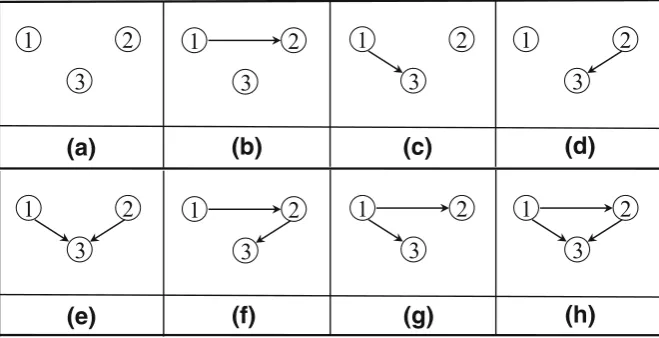
There are several ways of listing and counting finite DAGs. If the nodes are num-bered 1 ton, then the numberd(n)of DAGs has been calculated byRobinson(1973) with the recurrence formulad(n)=nk=1(−1)k−1kn2k(n−k)d(n−k)whered(0)= 1. Hence the first five numbers ared(1)=1,d(2)=3,d(3)=25,d(4)=543 and d(5)=29281. However, if we take the aforementioned time-consistent numbering of nodes, these counts can be significantly reduced. For example, in the case ofn =3, given that independent specifications ofK(1),K(2)andK(3)determine a sequential voting scheme and the fact that there are 2i−1possible subsets of{1, . . . ,i−1}for anyi ≥1, we have in total 1×2×4=8 possible sequential voting schemes, which we depict in Fig.1.
As can be seen in Fig.1, the three DAGs (b)–(d) are isomorphic. So in total there are six non-isomorphic voting schemes. Scheme (a) is secret ballot (or simultaneous voting), (h) is roll-call voting, while (e) is casting-vote scheme, which we analyze in detail later. The remaining three non-isomorphic schemes, which we do not explicitly
(a)
(b)
(c)
(d)
1
2
3
1
2
3
1
2
3
1
2
3
(e)
(f)
(g)
(h)
1
2
3
1
2
3
1
2
3
1
2
3
[image:6.439.54.384.412.581.2]name, look distinctly odd, as they do not appear in actual voting systems. However, we nonetheless keep them since the applicability of our analysis in the paper extends to cases where nodes do not have to represent usual jurors or voters, but might be sensors of locations in a neural network. Their “private information” might be the reading they take of their environment or their chemical surrounding.
3.2 Scheme complexity
For a given sequential voting scheme, letk(i)denote the number of voting histories that can be witnessed by voteriand that do not already determine a majority verdict. For each of these histories, he must have a potentially distinct strategy. For example, in secret votingk(i)=1 for every voteri, as he always observes the null voting history and needs only one strategy (which may of course depend on his private information). Consider roll-call voting forn =3. Here as for secret ballot,k(1)=1, but as voter 2 can see the vote of voter 1 (either Aor B), he has two possible voting histories, so k(2) =2. Finally, voter 3 can observe four histories A A,A B,B Aand B B, but of these only two (A BandB A) leave him with a verdict-relevant vote, so alsok(3)=2. Therefore, in analyzing roll-call voting of three voters, if each strategy is a threshold (in terms of his private information, which is a number in[0,1]), one must consider a total of 1+2+2=5 thresholds. We call thiscomplexity5, by defining more generally the complexityC(n)of a given sequential voting scheme ofnvoters as
C(n)=
n
i=1
k(i).
Thus for n = 3 the secret ballot has complexity 3, roll-call voting has complexity 5 and the casting-vote scheme has complexity 4. This explains in part why we are in this paper able to give an algebraic solution to the voting order problem for the casting-vote scheme while the similar analysis for roll-call voting can be carried out only with numerical analysis as inAlpern and Chen(2017).
4 The model
4.1 Signals and abilities
We assume two states of NatureAandB, considered as negation ofA, witha priori probability of Agiven by Pr(A)=θ0. To simplify the analysis we will assume the
equiprobable caseθ0=1/2, although our results are robust forθ0values around 1/2.
Individuals have private information about the state of Nature modeled as a signalsin thesignal interval[−1,+1]. Positive signals are indications ofA; negative signalsB. The signals=0 is neutral. Higher positive signals indicateAmore strongly; similarly for negative signals andB. Thus a better signal is one with a higher absolute value.
Individual jurors have an abilitya in theability interval[0,1], where individuals of higher ability are generally (but not always) able to make better guesses about the state of Nature. When Nature is in stateA(resp.B), jurors receive independent signals s ∈ [−1,1]with probability density given by fa(s)(resp.ga(s)) if they have ability a. We make the simplest nontrivial assumption on fa(s)andga(s), namely that they are linear ins. The slope of the density functions fa(s)andga(s)for a juror of ability ais proportional toa. Given that faandga(s)are density functions on[−1,+1], they
take the following form:
fa(s)=(1+as)/2, −1≤s≤ +1, when Nature isA; ga(s)=(1−as)/2, −1≤s≤ +1, when Nature isB.
It is easily checked that fa(·)andga(·)defined above are indeed density functions for anya ∈ [0,1]. The density functions for abilitya =1/2 are shown in Fig.2. The probability of a correct signal, that is positive when Nature isA, is the area under the f0.5line (and above thesaxis) to the right ofs = 0. Whena =0, such an area is
1/2, showing that a juror with abilitya=0 is just guessing (by flipping a fair coin to determine the state of Nature).
[image:8.439.93.345.401.591.2]The corresponding cumulative distributions of the signalswhen Nature isAorB are given by
Fa(s)=(s+1)(as−a+2)/4, −1≤s≤ +1, when Nature is A; Ga(s)=(s+1)(a−as+2)/4, −1≤s≤ +1,when Nature is B. (1)
Given prior probabilityθ0ofAand only his signals, a juror of abilityahas a posterior
probabilityθof A, as given by Bayes’ Law:
θ=Pr(A\s)= θ0fa(s)
θ0fa(s)+(1−θ0)ga(s) =
θ0+asθ0
2asθ0−as+1
= as+1
2 (ifθ0=1/2). (2)
Note that for a juror of ability 0, we haveθ=θ0for any received signals, reinforcing
our notion that ability 0 is no ability at all. A juror of ability 0 can do no more than guess. If we wish to view our juror of abilitya as a Condorcet juror, we would say that his probability of a correct signal (positive when Nature is Aor negative when Nature isB) is given by
1
0
fa(s)ds =(2+a)/4. (3)
In particular a juror of ability 0 has only a 50% probability of a correct sign signal, while a boffin of maximum ability 1 gets it right 75% of the time.
4.2 Threshold strategies and honest strategies
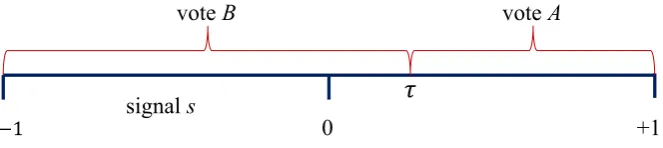
A strategy for a juror is a thresholdτ, depending on previous voting, if any, such that the juror votes Awith signals ≥τ andB with signals < τ (see Fig.3for an illustration). A strategy profile is a list of strategies for each juror. So in our model of three jurors, with a casting vote, the two first voters have single thresholdsx and y. (We can number the jurors by their voting order, although in our model the order of the firstn−1 is arbitrary.) The casting voter has two thresholdszA B(if the prior
voting wasA B) andzB A(if the prior voting wasB A). We can ignore the case of prior
voting A A or B B, because in that case the last vote does not matter. So a strategy profile is a four-tuple(x,y,zA B,zB A). We recall from Sect.3.2that this agrees with
the calculation of complexityC(3)=4 for the casting-vote scheme.
Now let us formally introduce the notion of voting behavior by first defining the most common or simplest one.
Definition 2 A strategy profile is saidhonest(ornaive) if the thresholds are such that every juror votes for the alternative that he believes is more likely, given thea priori probability ofA, his private signal, and any prior voting.
0
+1
vote
A
vote
B
signal
s
Fig. 3 Voting based on signal and threshold
θ0=1/2 we have by (2) that Pr(A/s)=1/2+as/2>1/2 if and only ifs>0. This
should be clear in any case from the symmetry of our model with respect to A and B. In other words, with honest voting early jurors (all but casting voter) each vote A with a positive signal andBwith a negative signal. The situation for the casting voter is a bit different. We may relabel the alternatives so that the higher-ability early juror voted Aand the lower-ability early juror voted B. If the casting voter gets a positive signal (for A) then obviously he votesAand that is the majority verdict. If however he agrees with the early voter of lower ability (he gets a negative signal), then his honest vote depends on the strength of his signal versus the ability discrepancy of the early voters. Given their abilities, he will have a negative thresholdτ <0. If his own signal is less thanτ (even more negative thanτ), he follows his signal and votesB. Otherwise he will base his vote on the fact that while the early voters split their votes, those of higher ability voted for Aand he will also vote A. This is the crux of the matter—the only case in which the casting voter will vote differently than if he had been voting simultaneously with the others.
4.3 Honest thresholds of the casting voter
In this section, we analyze the problem faced by the casting voter, who knows the voting, abilities and thresholds of the first two voters. What is his honest threshold? We assume the first two voters have abilitya with threshold x and ability b with thresholdy. We now determine the optimal threshold of the third juror of abilityc>0 (the case ofc=0 will be considered shortly after), under the assumption that thea prioriprobability of A(before the casting voter receives his signals) isθ, given the previous voting and thresholds. If the casting voter has signals, then his posteriori probability of Ais given byθas given by equation (2) witha replaced bycandθ0
byθ. Hence
θ= θ+csθ
2csθ−cs+1.
The honest thresholdzis the value ofsfor whichθ=1/2, or
1 2 =
[image:10.439.54.386.56.130.2]Solving forsand making this value the honest thresholdzgives
z=1−2θ
c . (4)
Of course, if(1−2θ)/c>1 this means always vote B(same as thresholdz =1), and if(1−2θ)/c<−1 this means always voteA(same as thresholdz= −1). Such phenomenon is known asherding behavior, where agents ignore their own private information and follow prior agents. We can take the limit asc → 0+to make the same arguments ifc=0.
Now let us consider how to determine the above value ofθgiven the prior voting sequence A B(i.e., the voter of abilitya votes Aand the voter of abilitybvotesB). This value is given by
θ=θ(A B)= θ0(1−Fa(x))Fb(y))
θ0(1−Fa(x))Fb(x)+(1−θ0)(1−Ga(x))Gb(y)
(5)
= (2+a+ax)(2+b(−1+y))
2(4+ab(1+x)(−1+y)) , (6)
where the second equality is due to (1) forθ0 =1/2. For the case of honest voting,
the thresholdsxandyof the early voters are 0, so (6) reduces to
θ=θ(A B)=(2+a)(2−b)
8−2ab . (7)
According to (4) we then have
zA B =
1−2θ(A B)
c =w(a,b,c)≡
2(b−a)
c(4−ab), (8)
and similarly
zB A= −zA B= −w(a,b,c)=
2(a−b)
c(4−ab). (9)
4.4 Reliability
We define thereliabilityof a voting scheme as the probability that the majority verdict is correct under this voting scheme. With equiprobable alternatives, a simple symmetry argument shows this is the same as the probability of majority verdictAwhen Nature is in state A. It is easy to calculate the reliability under honest voting where the early voters have abilitiesa1,a2, . . . ,an−1and the casting voter has abilityan. We ask the
simple question: Given a set ofnabilities, which one of these should have the casting vote if we wish to maximize the reliability of honest voting? For a jury of size three, we will show that honest-voting reliability is maximized when the juror of median ability has the casting vote. An alternative approach, also within the purview of our model, ascribes costs to each type of voting error (verdict Awhen Nature is B and vice versa) and minimizes the expected cost.
We now evaluate reliability Q(a,b,c), the probability of a correct verdict when
θ0=1/2, where the jurors have abilitiesa,bandc(in voting order) and the earlier
voter have honest thresholdsx = y=0. As the theoretical voting order of the early voters (who vote simultaneously) does not matter, we clearly have
Q(a,b,c)=Q(b,a,c), for all 0≤a,b,c≤1. (10)
LetqA(resp.qB) denote the probability of majority verdict A(resp.B) when Nature
is A(resp. B). Then for an arbitrarya priori probabilityθ0of A we have that the
reliabilityQ(a,b,c)is given by
Q(a,b,c)=θ0qA(a,b,c)+(1−θ0)qB(a,b,c).
Hence with neutral alternativesθ0=1/2, we have
Q(a,b,c)= 1
2(qA(a,b,c)+qB(a,b,c)),
and symmetry gives the simpler formula
q(a,b,c)=qA(a,b,c)=qB(a,b,c). (11)
From now on we assume the case of neutral alternatives. As long as|zA B|<1, the
formula forqA(a,b,c)is given by summing up the probabilities of voting patterns A A,A B AandB A Awhen Nature isA. Thus
qA(a,b,c)=(1−F(a,0))(1−F(b,0))+(1−F(a,0))F(b,0)(1−F(c,zA B))) +F(a,0)(1−F(b,0))(1−F(c,zB A))), (12)
with a similar formula forqB. Then according to (8), (9), and (11) provided|zA B|<1,
we haveQ(a,b,c)=q(a,b,c), where
q(a,b,c)≡qA(a,b,c)= 1 32
4(4+a+b)+4(a−b)
2
In the case|zA B| ≥1, the casting voter follows the vote of the early voter of maximum
ability, that is, the one of ability max{a,b}in our notation. We have calculated the probability that a juror gets the correct sign signal in (3). So in the above calculation of q(a,b,c), by replacingzA Bwith−1 and+1 respectively ifzA B ≤ −1 andzA B ≥ +1,
we get the more general reliability formula
Q(a,b,c)=
q(a,b,c), if|w(a,b,c)|<1;
(max{a,b} +2)/4, otherwise. (14)
This indicates the fact that in the case of|zA B| ≥1 the private signal of the early juror
of higher ability determines the verdict, as his vote will be copied by the casting voter. ThusQapplies even when the casting voter has extreme thresholds whereby he can vote without taking his private signal into account.
For example, suppose we partition the ability interval[0,1]into three subintervals of length 1/3, and take a jury with one juror in the middle of each of these subintervals. That is, we have a uniformly distributed jury of abilities 1/6,1/2 and 5/6. If the high-ability juror has the casting vote (c=5/6 in the above notation), thenzA B ≈0.204,
which lies within the signal interval[−1,1]and so reliability is given by the formula q(1/6,1/2,5/6)≈0.690. Similarly, if the juror of middle-ability 1/2 has the casting vote, thenzA B ≈0.691. As this is also in the signal interval, the reliability is given
byq(1/6,5/6,1/2)≈0.714. Finally, if the weakest juror has the casting vote, then |zA B| =48/43>1. This means that the casting voter follows the vote of the juror of
ability 5/6 =max{1/2,5/6}, who is correct with probability(2+5/6)/4 ≈0.708 by formula (14) or (3). So in this case we have calculated that giving the casting vote to the median-ability juror is best, to the lowest-ability voter is second best, and to the highest-ability voter is worst. This result about the median voter is generalized in Theorem1.
Note thatq(a,b,c)= (max{a,b} +2)/4 when|zA B| = 1 according to (8) and
(13). On the other hand, it is easy to verify that|w(x,y,z)| ≤ w(,1, ) =1 over {(x,y,z):≤x,y,z≤1}where=3−√7≈0.354. We obtain from (14) that
Q(a,b,c)=q(a,b,c) if≤a,b,c≤1. (15)
5 Mechanism design
that it was best for the juror of ability 1/2 to have the casting vote, with the juror of ability 1/6 second best. Here we will discuss the problem more generally.
To aid the intuition, we carry out a thought experiment where the casting-vote scheme is conducted in another equivalent way. We let all the jurors vote simultane-ously. If the verdict is close (2 to 1, or(n +1)/2 to(n −1)/2) we are allowed to pick one of the jurors and let him decide whether to change his vote after viewing the other votes (and with knowledge of everyone’s ability). If he voted with the minority, changing his vote will not affect the verdict, so we assume he voted with the majority, sayA. This means the others voted equally for AandB. He will only change his vote if he now thinksBis more likely thanA, despite his private positive signal forA. This will occur if one of the following two things occurs:
1. His positive signalsfor Ais weak (close 0).
2. The overall abilities of the B voters are significantly higher than that of the A voters.
We realize that the second condition is vague. Condition 1 is most likely to be satisfied when the juror has the smallest ability. This is because in our model small abilities are more likely to produce weak signals. Condition 2 is most likely, for a jury of three, when the abilities of the other two jurors are as far apart as possible. That is, when they have the two extreme abilities. This occurs when the selected juror has the middle ability. So this intuitive and qualitative analysis leads us to believe that in general the casting voter should have a low or middle signal. Our later analysis for larger juries indeed bears this out. Here we show that for a jury of three the forces (condition 2) favoring the middle- or median-ability juror outweigh the forces (condition 1) favoring the low ability juror. In particular we have our following main result.
Theorem 1 Under casting-vote scheme suppose that A and B are equiprobable and we have three honest jurors of abilities a,b,c with0 ≤ a ≤ b ≤ c≤ 1. Then the reliability Q is maximized when the juror of median ability b has the casting vote.
Proof The idea of our proof is simple: starting with the case where the juror of ability bhas the casting vote, we show that reliability cannot increase when he is replaced in that role by the juror of either higher abilitycor lower abilitya. LetS = {(a,b,c): 0≤a ≤b≤c≤1}. Denote
1(a,b,c)=Q(a,c,b)−Q(a,b,c); 2(a,b,c)=Q(a,c,b)−Q(b,c,a).
Then due to (10), our aforementioned simple idea is implemented by showing that
1(a,b,c)and2(a,b,c)are both non-negative for any(a,b,c)∈ S. First of all,
the following are straightforward according to definition (8) for any given(a,b,c)∈ S:
Depending on the magnitude ofw(a,c,b)≥0 for any given(a,b,c)∈ S, we consider two possible cases separately.
Case 1w(a,c,b)≥1. According to (14), we have
Q(a,c,b)=(c+2)/4. (19)
SinceP1(a,b,c)−P2(a,b,c)≥2(b−a)≥0, it follows from (16) and (17) that
w(a,c,b)≥1⇒w(b,c,a)≥1,
which together with (14) implies thatQ(b,c,a)=(c+2)/4, and hence2(a,b,c)=
Q(a,c,b)−Q(b,c,a)=0.
Next we prove the more difficult result1(a,b,c)≥0. According to (18) and (14)
we haveQ(a,b,c)=q(a,b,c). It follows from (19) that
1(a,b,c)=
c+2
4 −q(a,b,c)=
d3(a,b,c)
32c(4−ab),
where
d3(a,b,c)≡ −4a2+8ab−4b2−16ac−16bc
+4a2bc+4ab2c+16c2−a2b2c2.
So it remains only to establish that d3(a,b,c) ≥ 0 given the additional condition
2b≤c, which is implied by (17). In Sect. A.2 of the Appendix we show thatd3(a,b,c)
has a minimum of 0 over the setS∩ {(a,b,c):2b ≤c}, which is attained uniquely at the pointa=b=c=0.
Case 2w(a,c,b) <1.
According to (14), we have Q(a,c,b) = q(a,c,b), which together with (18) implies that
1(a,b,c)=q(a,c,b)−q(a,b,c)= (
c−b)d1(a,b,c)
8bc(4−ab)(4−ac),
where
d1(a,b,c)≡4a2−8ab+4b2−8ac+4bc
+2a2bc−ab2c+4c2−abc2.
By taking partial derivatives, we can easily see that d1(a,b,c) is monotonically
decreasing in b and c for all (a,b,c) ∈ S, which implies that d1(a,b,c) ≥
2(a,b,c)=q(a,c,b)−
c+2
4 =
(P2(a,b,c))2
32b(4−ac) ≥0.
If w(b,c,a) < 1 (note that we always have w(b,c,a) ≥ 0), with (14) we have Q(b,c,a)=q(b,c,a)and hence
2(a,b,c)=q(a,c,b)−q(b,c,a)= (
b−a)d2(a,b,c)
8ab(4−ac)(4−bc),
where
d2(a,b,c)≡ −4a2−4ab−4b2+8ac+8bc
+a2bc+ab2c−4c2−2abc2,
In Sect. A.1 of the Appendix we show that the minimum of d2(a,b,c) over the
intersection ofSand the set{(a,b,c):w(b,c,a)≤1}is 0. Hence2(a,b,c)≥0.
Remarks As we pointed out at the beginning of Sect.4.1, the result in Theorem1is robust forθ0(thea prioriprobability ofA) values around 1/2. However, ifθ0deviates
significantly from 1/2, the result in Theorem1is no longer true. As the following two examples show, unique optimality is achieved when the casting voter is either of the lowest (first example) or highest (second example) ability: Ifθ0 =7/10 and (a,b,c)=(2/5,3/5,4/5), then
Q(θ0,b,c,a) >0.76>Q(θ0,c,a,b) >0.75>Q(θ0,a,b,c).
On the other hand, ifθ0=4/5 and(a,b,c)=(1/5,2/5,3/5), then
Q(θ0,b,c,a)=Q(θ0,c,a,b)=4/5<33/40=Q(θ0,a,b,c).
5.1 Minimizing expected cost
Let us consider an alternative voting goal. Instead of maximizing the reliability, sup-pose we wish to minimize the expected cost of making both types of error: (I) verdict B when Nature is A(e.g., acquittal of a guilty defendant); and (II) verdict A when Nature isB(e.g., conviction of an innocent defendant). Similar to equation (12), we can calculate the probability of making either type of error, Pr[B/A]or Pr[A/B]. Recall that in Sect. 4.4we definedqA andqB as the probability of correct verdict
when Nature is in stateAandB, respectively. Therefore,
Pr[B/A] =1−qA, and Pr[A/B] =1−qB.
Letk1,k2≥0 denote the cost of type-I and type-II error, respectively. Then the total
expected cost of making both types of error under honest voting with voting order
K(a,b,c)=k1Pr[B/A] +k2Pr[A/B]
=k1(1−qA(a,b,c))+k2(1−qB(a,b,c))=(k1+k2)(1−q(a,b,c)),
where the last equality is due to (11), with which we have shown the following.
Proposition 1 For a three-member jury under honest voting, the voting order with maximum reliability also minimizes the expected cost of incorrect verdict, making both types of error.
5.2 Choosing referees for two articles
We have already mentioned the “jury” consisting of an editor and two honest referees in the context of a casting-vote scheme for evaluating an article submitted to an academic journal. Now assume that the editor is a fixed agent of abilityewho has to assign four referees of abilitiesa ≤b ≤c≤d ≤1 to two articles (two to each). For simplicity and practicality, we assumea ≥=3−√7≈0.354 (chosen referees are supposed to be experts in the relevant area of expertise). There are three ways to do this, with {a,b},{a,c}or{a,d}as the abilities of one refereeing team. The editor’s aim is to maximize the expected number of articles that receive a correct evaluation. According to (15), the three values of this expectation are given by
E1=q(a,b,e)+q(c,d,e),
E2=q(a,c,e)+q(b,d,e),
E3=q(a,d,e)+q(b,c,e),
where functionq(·,·,·)is given by (13). It turns out that the partition of referee abilities into middles{b,c}and extremes{a,d}produces the highest expectationE3.
Proposition 2 For any referee abilities ≤ a < b < c < d ≤ 1and any editor ability≤e≤1we have
E3>max{E1,E2}.
That is, to maximize expected number of correctly evaluated articles, the extreme-ability referees should be assigned to one article and the middle-extreme-ability referees to the other.
Proof LetT = {(a,b,c,d,e):≤a <b<c<d ≤1, ≤e≤1}. We first show thatE3−E2>0 onT. Note that
E3−E2=q(a,d,e)+q(b,c,e)−(q(a,c,e)+q(b,d,e))
=(q(b,c,e)−q(a,c,e))−(q(b,d,e)−q(a,d,e)).
E3−E2=
b
x=a
∂q(x,c,e)
∂x d x−
b
x=a
∂q(x,d,e)
∂x d x
=
b
x=a
∂
q(x,c,e)
∂x −
∂q(x,d,e)
∂x d x
= −
b
x=a
d
y=c
∂2q(x,y,e) ∂x∂y d x d y,
which is positive if
∂2q(x,y,z)
∂x∂y <0 (20)
for any(x,y,z)∈T. In fact, according to (13) we have
∂2q(x,y,z) ∂x∂y =
N(x,y,z)
32(x y−4)3z, (21)
where
N(x,y,z)=128−x3y3z2+4x3y+12x2y2z2−48x2+4x y3 −48x yz2+32x y−48y2+64z2.
Since the denominator in (21) is negative and the numerator
N(x,y,z)=128+z2(−x3y2+12x2y2−48x y+64) +4x y(8+x2+y2)−48(x2+y2)
≥128+(64−48−1)z2−2×48≥128−2×48=72,
we have shown that (20) holds and henceE3>E2onT. Similarly,
E3−E1=(q(a,d,e)+q(b,c,e))−(q(a,b,e)+q(c,d,e))
=(q(d,a,e)−q(b,a,e))−(q(d,c,e)−q(b,c,e))
= −
d
x=b
c
y=a
∂2q(x,y,e) ∂x∂y d x d y,
which is positive according to (20). HenceE3−E1>0 onT.
We can easily extend the above result to the problem faced by an editor of ability ewho hasmarticles to evaluate and a pool ofn =2mreferees of abilities≤a1<
· · ·<an≤1. (If there are more than 2mpotential referees, clearly it is best to ignore
those not in the top 2mabilities.) Any refereeing pairing is determined by a permutation
refereei) is paired with the one of abilityaπ(i). For a pairingπ, the expected number
of correctly evaluated articles is given by
E(π)= 1 2
n
i=1
q(ai,aπ(i),e), (22)
where the factor 1/2 is needed because each article appears twice in the sum.
Corollary 1 When an editor of ability e (≤e≤1) has n=2m referees of abilities
≤a1 <· · ·<an ≤1and m articles to be reviewed, the unique referee pairingπ
that maximizes the expected numberE(π)of correctly evaluated articles is given by ˆ
π(i)=n−i+1, with the associated referee pairings{1,n},{2,n−1}, . . . ,{m,m+1}. Proof Since this is a finite problem, it has an optimal referee pairing π. Suppose
π = ˆπ. Then there is a minimum j (1 ≤ j ≤ m) such thatπ(j)= ˆπ(j). Hence
π(i)= ˆπ(i)=n−i+1 fori=1, . . . ,j−1, which implies that all indices larger than ˆ
π(j)are paired with those smaller than j, which in turn implies thatπ(j) <π(ˆ j). The same reasoning concludes thatπ(ˆ j) =π(k), for somekwith j < k < π(ˆ j). Thus we have four indices j, π(j),π(ˆ j) = π(k)andk, with j < π(j) < π(ˆ j) and j <k <π(ˆ j). Of these four indices, the extreme indices (corresponding to the extreme abilities) are j andπ(ˆ j). Since these two are not paired byπ, it follows from Proposition 2 that the sum of the two terms in (22) (or four terms, counting duplication) containing the four relevant indices can be improved by re-pairing these four indices as{j,π(ˆ j)}and{π(j),k}. Thus the given pairingπ cannot maximize E(·), a contradiction. So the unique optimal pairing must beπˆ. One might think that our optimization objective of maximizing (22) is incompatible with the editor’s moral duty. Perhaps he should adopt a referee pairingπ¯that maximizes the minimum reliabilityr¯ given to the evaluation of any article. We claim that our solution πˆ has this maximin property. Suppose that in pairing πˆ the article with least reliability of evaluation is refereed by referees k andπ(ˆ k). So the minimum reliability of our pairing πˆ is q(ak,aπ(ˆ k),e) = ˆr. Suppose that inπ¯ referee k is
paired with referee j = ¯π(k). If j ≤ ˆπ(k)thenq(ak,aj,e)≤ q(ak,aπ(ˆ k),e) = ˆr
by monotonicity of q, indicating that the minimum reliability r¯ corresponding to pairingπ¯ cannot be higher thanrˆ, and we are done. So we can assume j >π(ˆ k). It follows that inπ¯ one of the refereesi =1, . . . ,k−1, say j, must be paired with a refereel = ¯π(j)withl ≤ ˆπ(k), since thesek−1 referees cannot all be paired with thek−2 referees{ ˆπ(k)+1 = n−k+2, . . . ,n}\{j}. Hence we now have ¯
r ≤ q(aj,al,e)≤q(ak,aπ(ˆ k),e)= ˆr because j <kandl ≤ ˆπ(k). It follows that ¯
r≤ ˆr.
For a different perspective on the reliability of the refereeing process relating to information that should be available to referees, seeBen-Yashar and Nitzan(2001).
6 Larger juries with uniformly distributed abilities
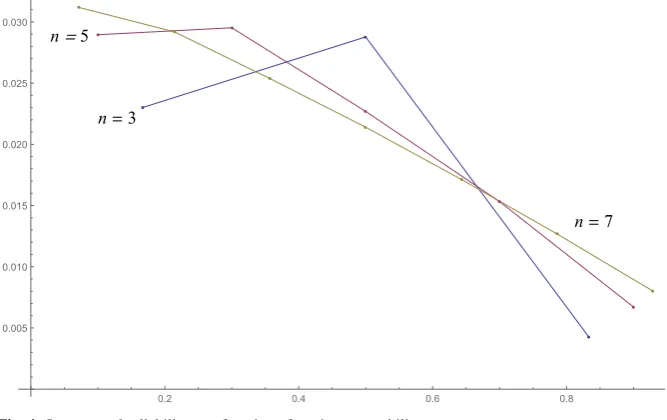
Fig. 4 Incremental reliability as a function of casting voter ability
abilities due to the complexityC(n)discussed in Sect.3.2. However, if we take a jury of sizen with uniformly distributed abilities, we can determine numerically which juror should be given the casting vote to maximize reliability under honest voting. We divide the ability interval[0,1]intonsubintervals of length 1/nand give one jurori the ability of the midpoint of theith interval, so thatai =(2i−1)/(2n)for theith
juror in the jury of sizen. As an example, whenn =5, the abilities of the five jurors are 0.1,0.3,0.5,0.7 and 0.9. For each jury of sizen, letQ¯ndenote the reliability of
simultaneous voting andQn[i]denote the reliability under the casting-vote scheme
with the casting vote given to theith juror, the one of abilityai. We then define the
non-negative quantities
δ(n,ai)=Qn[i] − ¯Qn
as the incremental reliability of casting voting. It turns out that calculatingδ(n,ai)is
easier than calculatingQn[i]directly. For fixedn, the reliability of giving the casting
vote to jurori is maximized whenδ(n,ai)is maximized overai. Figure4plots for
n =3,5,7 the incremental reliabilityδ(n,ai)when the casting vote on the jury of
sizenis given to the juror of abilityai,i =1, . . . ,n. For eachn, the plotted points
are connected by straight lines to make the plot easier to read.
[image:20.439.52.386.57.267.2]0.2 0.4 0.6 0.8 0.005
0.010 0.015 0.020 0.025 0.030
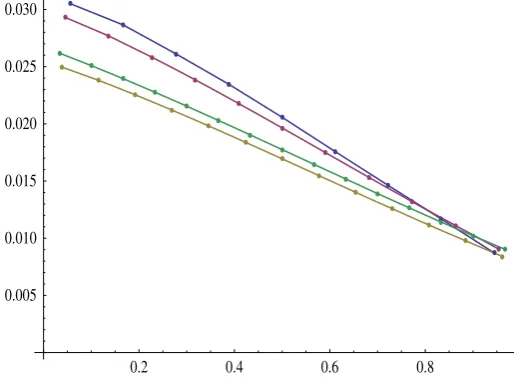
Fig. 5 Plots ofδ(n,·),n=9,11,13,15
Fig.5for juries of sizen =9,11,13,15, where incremental (or absolute) reliability is decreasing in the ability of the casting voter. To distinguish between the curves for different values ofn, note that at their left points, the curves aren = 9,11,15,13, counting from the top. Also observe that these figures are not useful for comparing reliability of different size juries, as they have different base pointsQ¯n. The idea that
larger juries have higher reliability goes back to Condorcet, but that is not our point of discussion here.
The mathematical analysis required to calculate the incremental reliabilities is pre-sented in Sect. A.3 of the Appendix.
7 Conclusions
[image:21.439.89.348.58.252.2]giving the casting vote to the juror of median ability maximizes the reliability of the majority verdict (i.e., the probability that the verdict is correct). For larger juries of uniformly distributed abilities, simulations have suggested that it is best to give the casting vote to the least able juror and it is worst to give the casting vote to the most able juror, results that are in stark contrast to the conventional wisdom (and practice) of giving the casting vote to the most able juror.
We believe our methods can be extended to solve the voting order problem for other sequential voting schemes, particularly roll-call voting. An important role in our technique is to model private signals and individual abilities not by binary variable but by real valued parameters in an interval.
In summary, as the main contribution of this paper, we have established that, for a three-member jury, it is best to give the median-ability juror the casting vote. However, this result does not hold for larger juries or for asymmetric binary alternatives. This paper considers only majority verdicts, as with the original Condorcet model. However, it raises an important question as to the comparative reliability of other decision rules such an requiring unanimous assent for a particular alternative or giving the last voter the deciding vote even when both early voters are in agreement. The question of optimal voting order for these other rules is also of interest.
Open Access This article is distributed under the terms of the Creative Commons Attribution 4.0 Interna-tional License (http://creativecommons.org/licenses/by/4.0/), which permits unrestricted use, distribution, and reproduction in any medium, provided you give appropriate credit to the original author(s) and the source, provide a link to the Creative Commons license, and indicate if changes were made.
Appendix
A.1: Proof ofd2(a,b,c)≥0 in Theorem1
For minimization of d2(a,b,c) subject to(a,b,c) ∈ S and P2(a,b,c) ≤ 0, the
Kuhn-Tucker conditions for potential minimizers are as follows:
2abc−8a+b2c−2bc2+λ1(bc−4)−4b+8c−λ2+λ3=0,
a2c+2abc−2ac2+λ1(ac−2)−4a−8b+8c−λ3+λ4=0,
a2b+ab2−4abc+λ1(ab+2)+8a+8b−8c−λ4+λ5=0, λ1(abc−4a−2b+2c)=0,
aλ2=0, λ3(b−a)=0, λ4(c−b)=0, (1−c)λ5=0. λ1, . . . , λ5≥0; (a,b,c)∈SandP2(a,b,c)≤0.
All solutions(a,b,c, λ1, . . . , λ5)of the above system projected to the(a,b,c)space
form the following setSmin:
Smin= {(0,b,b):0≤b≤1} ∪ {(aλ,aλ,aλ):0< λ≤3}
whereaλis the middle root of equationa(4−a2)=λ. Sinced2(a,b,c)=0 for any (a,b,c)∈Smin, all elements ofSminare minimizers ofd2(a,b,c).
A.2: Proof ofd3(a,b,c)≥0 in Theorem1
For minimization ofd3(a,b,c)subject to(a,b,c)∈ Sandc−2b ≥ 0, the
Kuhn-Tucker conditions for potential minimizers are as follows:
−2ab2c2+8abc−8a+4b2c+8b−16c−λ2+λ3=0,
−2a2bc2+4a2c+8abc+8a−8b−16c+2λ1−λ3=0,
−2a2b2c+4a2b+4ab2−16a−16b+32c−λ1+λ4=0, λ1(c−2b)=0, aλ2=0, λ3(b−a)=0, (1−c)λ4=0. λ1, . . . , λ4≥0; (a,b,c)∈ Sandc−2b≥0.
The above system has a unique solution of(0,0,0,0,0,0,0)andd3(0,0,0) = 0.
Hence we haved3(a,b,c)≥0.
A.3: Analysis of large juries for Sect.6
Here, we give the analysis of the casting-vote scheme for an arbitrary odd num-ber of jurors which is used to derive Figs. 4 and 5 in Sect. 6. Suppose we have n = 2m +1 jurors with abilities, in nondecreasing order, given as the n-vector
a = (a1,a2, . . . ,an). Let N = {1, . . . ,n}and Ni = N\{i}. If juror i has the
casting vote, then the jurors Ni who vote first are ordered as the (n −1)-vector
ai = (a1, . . . ,ai−1,ai+1, . . . ,an). LetSi denote the set of allm-subsets of Ni. A
setS ∈ Si can be interpreted as the set of jurors who vote for alternative Ain the first round when there is a tie vote and jurori has the casting vote. The conditional probability of Ain this case is denotedθS. IfθS =1/2 thenQ[i] = ¯Q, where Q¯ is the reliability of simultaneous voting (with abilitiesa) and Q[i]is the reliability of casting voting where jurori has the casting vote. Of course, we have Q[i] ≥ ¯Qfor alli ∈ N. IfθS>1/2 then for negative signals close to 0, the casting voteriwill still vote for A. The conditionθS >1/2 says roughly that thosemjurors who voted for Ahave collectively stronger abilities than thosemjurors who voted for B. For any j ∈ S, letrj =1−F(aj,0)be the individual reliability of juror j, the probability
that he gets a positive signal and hence votes Awhen Ais the state of Nature (or the probability that juror jgets a negative signal givenB). The probability that he gets a negative signal givenA(or a positive signal givenB) isF(aj,0)=1−rj. Therefore,
we have
θS=
j∈S
rj
k∈Ni\S (1−rk)
∈ rj
(1−rk)+
∈ (1−rj)
rk.
Consequently, the honest threshold for casting voteri, givenS, is
τi(S)= 1−2θS ai
[−1,1]
, (24)
where z|[−1,1] denotes the projection of z onto[−1,1]. We can also calculate the
probability that those voting Ain the first round constitute a particular set S ∈ Si, given Nature isA:
Pr(S/A)=
j∈S
rj
k∈Ni\S
(1−rk), forS∈Si. (25)
To evaluate Q[i] − ¯Q, we see that the verdict with casting voteri will be different from that of simultaneous voting only if both of the following two conditions hold: (i) a tie vote (i.e., those voting A,{j : sj > 0}, form a setS ∈ Si), and (ii) small
signal for casting voter (i.e.,jurori gets a signalsi between his thresholdτi(S)and
0). Taking equiprobable alternativesθ0 = 1/2 with jurori as the casting voter, let
S = {j ∈ Ni :sj >0}, those who voteAin the first round. Then the verdict is Aif
either|S|>mor|S| =mandsi ≥τi(S). Therefore, we have the following formula
for the reliability of voting with casting voteri:
Q[i] =
S⊂Ni,|S|≥m+1
Pr(S/A)+
S⊂Ni,|S|=m
Pr(S/A)(1−F(ai, τi(S))).
Similarly, for simultaneous voting we can separate out the voting of jurorito obtain the asymmetric formula for the reliabilityQ:¯
¯
Q=
S⊂Ni,|S|≥m+1
Pr(S/A)+
S⊂Ni,|S|=m
Pr(S/A)(1−F(ai,0)).
The difference between the above two formulae is that the latter involves only indi-vidual reliabilities, whereas the former takes into account linear density functions on the full signal distribution of the casting voter. In particular we have (noting that the conditionsS⊂Niand|S| =mare the same asS∈Si):
Q[i] − ¯Q=
S∈Si
Pr(S/A)((1−F(ai, τi))−(1−F(ai,0)))
=
S∈Si
Pr(S/A)(F(ai,0)−F(ai, τi(S))). (26)
In the case ofn=3 withi =3 having the casting vote anda1=a,a2=b,a3=c,
(withτ3({1})=zA B)
Q(a,b,c)=(1−F(a,0))(1−F(b,0))
+ [(1−F(a,0))(F(b,0))](1−F(c,zA B)) +((F(a,0))(1−F(b,0)))(1−F(c,zB A))
Note that the advantage of formula (26) is that we have fewer terms to evaluate to see which is the best jurori to have the casting vote.
References
Ali, S., Goeree, J., Kartik, N., & Palfrey, T. R. (2008). Information amalgamation by voting.American Economic Review: Papers & Proceedings,98(2), 181–186.
Alpern, S., & Chen, B. (2017). The importance of voting order for jury decisions made by sequential majority votes.European Journal of Operational Research,258(3), 1072–1081.
Alpern, S., Gal, S., & Solan, E. (2010). A sequential selection game with vetoes.Games and Economic Behavior,68(1), 1–14.
Baharad, E., Goldberger, J., Koppel, M., & Nitzan, S. (2012). Beyond Condorcet: Optimal aggregation rules using voting records.Theory and Decision,72(1), 113–130.
BBC. (2000).http://news.bbc.co.uk/1/hi/sport/649364.stm.
Ben-Yashar, R., & Nitzan, S. (2001). Are referees sufficiently informed about the editor’s practice?Theory and Decision,51(1), 1–11.
Brams, S. J., & Davis, M. D. (1978). Optimal jury selection: A game-theoretic model for the exercise of peremptory challenges.Operations Research,26(6), 966–991.
Condorcet, M. J. A. N. C. (1785).Essai sur l’Application de l’Analyse à la Prababilité des Decisions Rendues à la Pluralité des Voix(Impr. Royale, Paris); reprinted (1972) (Chelsea, New York). Courts & Tribunals Judiciary, United Kingdom. (2015).https://www.judiciary.gov.uk/about-the-judiciary/
who-are-the-judiciary/judicial-roles/judges/profile-mor/.
DeGroot, M. H., & Kadane, J. B. (1980). Optimal challenges for selection.Operations Research,28(4), 952–968.
Dekel, E., & Piccione, M. (2000). Sequential voting procedures in symmetric binary elections.Journal of Political Economy,108(1), 34–55.
Dewan, T., & Shepsle, K. A. (2011). Political economy models of elections.Annual Review of Political Science,14, 311–330.
Grofman, B., Owen, G., & Feld, S. L. (1983). Thirteen theorems in search of the truth.Theory and Decision, 15(3), 261–278.
Kahn, A. B. (1962). Topological sorting of large networks.Communications of the ACM,5(11), 558–562. Karger, D. R., Oh, S., & Shah, D. (2014). Budget-optimal task allocation for reliable crowdsourcing systems.
Operations Research,62(1), 1–24.
Nitzan, S., & Paroush, J. (1984). The significance of independent decisions in uncertain dichotomous choice situations.Theory and Decision,17(1), 47–60.
Ottaviani, M., & Sørensen, P. (2001). Information aggregation in debate: Who should speak first?Journal of Public Economics,81(3), 393–421.