
warwick.ac.uk/lib-publications
Original citation:Chang, Yanxun, Fan, Bingli, Feng, Tao, Holt, Derek F. and Ostergard, Patric. (2017)
Classification of Cyclic Steiner Quadruple Systems. Journal of Combinatorial Designs, 25 (3). pp. 103-121.
Permanent WRAP URL:
http://wrap.warwick.ac.uk/80062
Copyright and reuse:
The Warwick Research Archive Portal (WRAP) makes this work by researchers of the University of Warwick available open access under the following conditions. Copyright © and all moral rights to the version of the paper presented here belong to the individual author(s) and/or other copyright owners. To the extent reasonable and practicable the material made available in WRAP has been checked for eligibility before being made available.
Copies of full items can be used for personal research or study, educational, or not-for profit purposes without prior permission or charge. Provided that the authors, title and full bibliographic details are credited, a hyperlink and/or URL is given for the original metadata page and the content is not changed in any way.
Publisher’s statement:
"This is the peer reviewed version of the following article: Chang, Yanxun, Fan, Bingli, Feng, Tao, Holt, Derek F. and Ostergard, Patric. (2017) Classification of Cyclic Steiner Quadruple Systems. Journal of Combinatorial Designs, 25 (3). pp. 103-121. which has been published in final form at http://doi.org/10.1002/jcd.21530 This article may be used for non-commercial purposes in accordance with Wiley Terms and Conditions for Self-Archiving."
A note on versions:
The version presented here may differ from the published version or, version of record, if you wish to cite this item you are advised to consult the publisher’s version. Please see the ‘permanent WRAP URL’ above for details on accessing the published version and note that access may require a subscription.
Classification of Cyclic Steiner Quadruple
Systems
Yanxun Chang
∗, Bingli Fan, Tao Feng
†Institute of Mathematics
Beijing Jiaotong University
Beijing 100044, P. R. China
Derek F. Holt
Mathematics Institute
University of Warwick
Coventry CV4 7AL, United Kingdom
Patric R. J. ¨
Osterg˚
ard
‡Department of Communications and Networking
Aalto University School of Electrical Engineering
P.O. Box 13000, 00076 Aalto, Finland
Abstract
The problem of classifying cyclic Steiner quadruple systems (CSQSs) is considered. A computational approach shows that the number of isomorphism classes of such designs with orders 26 and 28 is 52170 and 1028387, respectively. It is further shown that CSQSs of order 2p, wherepis a prime, are isomorphic iff they are multiplier equivalent.
Moreover, no CSQSs of order less than or equal to 38 are isomorphic but not multiplier equivalent.
∗Supported by NSFC under grant 11271042. †Supported by NSFC under grant 11471032.
1
Introduction
A Steiner system S(t, k, v) is a pair (X,B), where X is a set of v points and
B is a set of k-subsets of X (called blocks) such that every t-subset of X is contained in a unique block. AnS(3,4, v) is called aSteiner quadruple system
of order v, or briefly an SQS(v). A survey of Steiner quadruple systems can be found in [20]. It is known [18] that an SQS(v) exists if and only if
v ≡2,4 (mod 6). (1)
Two Steiner systems (X,A) and (Y,B) are said to be isomorphic if there exists a bijection σ : X → Y such that {{σ(x) : x ∈ A} : A ∈ A} = B. Such a bijection from (X,A) to itself is called an automorphism. The set of all automorphisms of a Steiner system forms a group under composition, the
automorphism group of the system. Subgroups of the automorphism group are called groups of automorphisms.
A standard problem in design theory is that of classifying designs with specific parameters up to isomorphism [25]. Barrau [2] found the unique SQS(8) and SQS(10). Mendelsohn and Hung [34] showed that there are exactly four isomorphism classes of SQS(14)s, and Kaski, ¨Osterg˚ard and Pottonen [26] computed the 1054163 isomorphism classes of SQS(16)s. When
v >16, only the asymptotic behaviour of the number of isomorphism classes is known [10, 32].
As the problem of classifying SQS(v)s forv >16 does not seem feasible at the moment, one may consider the classification problem for a subset of those structures. An important class of Steiner systems (and designs in general) are the cyclic ones. A cyclic Steiner quadruple system, briefly CSQS(v), is an SQS (X,B) of order v and with a cyclic group of automorphisms that acts regularly on X; in the sequel, such a group is called a regular cyclic group. Typically one lets X ={0,1, . . . , v−1} and considers the group Zv,
earlier erroneous result in [8]. One aim of the current paper is to extend these classification results.
The paper is organized as follows. In Section 2, the structure of CSQS(v)s is discussed. An algorithm for classifying CSQS(v)s up to multiplier equiv-alence is considered in Section 3, which also contains the results obtained by applying this algorithm to the cases of v = 26 and v = 28. The num-ber of such structures is 52170 and 1028387, respectively. In Section 4, it is shown that there are no CSQS(2p)s, p prime, that are isomorphic but not multiplier equivalent. Using this result and computational results based on a classification of transitive permutation groups, it is shown that no CSQSs of order less than or equal to 38 are isomorphic but not multiplier equivalent. Finally, some related combinatorial structures and particular subclasses of cyclic Steiner quadruple systems are discussed in Section 5.
2
Preliminaries
Consider a Steiner quadruple system ({0,1, . . . , v−1},B) withZv as a group
of automorphisms. All blocks of this system are partitioned into orbits un-der the action of Zv, and the system is uniquely defined by taking one block,
called a base block, from each orbit. We know by the Orbit–Stabilizer Theo-rem that the cardinality of such an orbit divides v. If the cardinality of the orbit is v, then the orbit is called full, otherwise it is called short. In the current work, we encounter short orbits of length v/2 andv/4; we call these
half orbits and quarter orbits, respectively.
The normalizer of a subgroupH ≤G, denoted by NG(H), is defined as
NG(H) = {a∈G:aHa− 1
=H}.
When prescribing a group of automorphisms H of a design on v points, the normalizer of H in the symmetric group G=Sv captures the remaining
symmetries in the sense that elements ofNG(H) mapH-orbits ontoH-orbits
[25, Sect. 9.1].
The normalizer of Zv in Sv, NSv(Zv), is isomorphic to the semidirect
product Zv⋊Aut(Zv) [9, Corollary 4.2B]. The automorphism group of Zv is
the multiplicative group of units in the ring of integers modulo v, which, for eachs∈Zv fulfilling (s, v) = 1, consists of a permutationms :x7→sx. Such
Two multiplier equivalent cyclic Steiner quadruple systems are isomor-phic, but isomorphic systems are not necessarily multiplier equivalent. The general question of existence of set systems that are isomorphic but not mul-tiplier equivalent has been studied extensively.
Various sufficient condition for isomorphic structures to be multiplier equivalent have been obtained. For example, Bays [3] and Lambossy [31] showed that if p is a prime then isomorphic cyclic Steiner systems S(t, k, p) are multiplier equivalent (a more general result was later obtained by P´alfy [35]). Examples of structures that are isomorphic but not multiplier equiv-alent have also been published: Brand [4] presented the first example of isomorphic cyclic Steiner systems that are not multiplier equivalent by find-ing such a family of S(2,3, pn)s whenp≡1 (mod 6) is a prime andn ≥2 (a
simpler construction was later given by Phelps [37]).
For orders up to 22, for which the Steiner quadruple systems have been classified, isomorphic systems are multiplier equivalent [13, 36].
3
Classification Algorithm
An algorithm for classifying combinatorial structures consists of two main parts: constructing structures and removing isomorphs. We shall here discuss both parts and different approaches. For a general, in-depth consideration of these issues, see [25].
When a group of automorphisms has been prescribed, hereZv, one is
fac-ing the problem of selectfac-ing (all possible) sets of orbits under the action of the prescribed group that together form the desired structure. For designs with arbitrary parameters, this problem is conveniently formulated as a system of linear Diophantine equations (called the Kramer–Mesner method after the originators). The algorithm used in [13] is presented in this framework.
For Steiner systems, the following approach via instances of the exact cover problem is more specific than the Kramer–Mesner method and natu-rally leads to a state-of-the-art algorithm [28]. The algorithm discussed and used in [6, 36] for the classification of cyclic Steiner quadruple systems is essentially of this type (although considered in a somewhat different frame-work).
Given a setS and a collectionC of subsets ofS, the exact cover problem
asks for a partitioning ofSusing elements inC. To search for a Steiner system (X,B) with parameters S(t, k, v) and a prescribed group of automorphisms
G, we produce the following instance.
in C for each orbit K of k-element subsets ofX that fulfills
|{K ∈ K:Ti ⊆K}| ≤1
for alli, 1 ≤i≤m. If this condition is fulfilled, then we let the corresponding element (which itself is a set) of C consist of the t-element orbits for which
|{K ∈ K : Ti ⊆ K}| = 1. To find all possible solutions to instances of the
exact cover problem, the libexact software [27] can be used.
Isomorph rejection—considered with respect to multiplier equivalence or isomorphism—should be carried out amongst the systems constructed in the above mentioned way. Classifying cyclic Steiner quadruple systems up to multiplier equivalence is computationally more straightforward, but finding the isomorphism classes is usually the main goal. (For the structures and parameters considered in the current work, these turn out to coincide, but this can obviously not be assumed a priori.)
Isomorph rejection can also be used earlier in the search to prune the search tree. In [6, 36], isomorph rejection (with respect to multiplier equiv-alence) is carried out already after having added the first orbit of 4-element subsets to the set of orbits (which are chosen in a particular way).
Here, as in [36], we first construct all possible sets of short orbits in a CSQS, and carry out isomorph rejection (with respect to multiplier equiva-lence) amongst all such sets before completing the systems. We call a fixed set of short orbits a seed for the final search. Before going into the details of the classification of CSQS(26)s and CSQS(28)s, let us briefly state some known results on the occurrence of short orbits.
The possible short orbits of a CSQS(v) are the following: the half orbits are of the form {{i, j +i, v/2 + i, v/2 +j +i} : 0 ≤ i < v/2} for some j, 1≤ j < v/4 and the unique quarter orbit is {{i, v/4 +i, v/2 +i,3v/4 +i}: 0≤i < v/4}. We denote a half orbit with parameter j byOj.
Following Lindner and Rosa [33], we partition the admissible orders of CSQS(v)s into four classes:
A. v ≡2,10 (mod 24);
B. v ≡4,20 (mod 24);
C. v ≡14,22 (mod 24);
D. v ≡8,16 (mod 24).
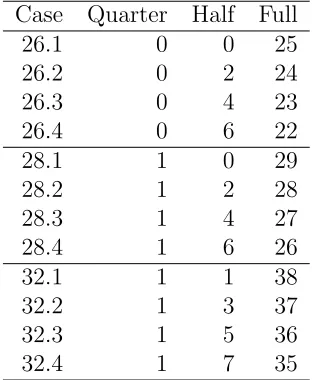
Table 1: Distributions of orbit lengths
Case Quarter Half Full
26.1 0 0 25
26.2 0 2 24
26.3 0 4 23
26.4 0 6 22
28.1 1 0 29
28.2 1 2 28
28.3 1 4 27
28.4 1 6 26
32.1 1 1 38
32.2 1 3 37
32.3 1 5 36
32.4 1 7 35
half orbits. The possible distributions of orbit lengths for the parameters considered here are shown in Table 1.
We shall next have a look at details of our classification of CSQS(26)s and CSQS(28)s. In the development of the approach, the cases of CSQS(20)s and CSQS(22)s were considered; our results corroborate those in [36] and [13] (mentioned in the Introduction). Classification with respect to multiplier equivalence is considered in Sects. 3.1 and 3.2, and isomorphism is treated in Sect. 4.
3.1
Classification of CSQS(26)s
A cyclic Steiner system CSQS(26) is in class A and therefore contains no quarter orbit and an even number of half orbits. Since there are⌊(26−1)/4⌋= 6 possible half orbits, there are 0, 2, 4, or 6 half orbits in a CSQS(26). See Table 1.
Fori= 0, 2, 4, and 6 there are clearly 6 i
ways to chooseiout of 6 orbits, that is, 1, 15, 15, and 1 ways, respectively. For v = 26, there are φ(26) = 12 multipliers, and 7 can be taken as a generator of the multiplicative group of units in the ring of integers modulo 26 (the group is cyclic as 26 is of the form 2pk, where pis an odd prime).
6, and 6, respectively. The complements of these orbits with respect to
{O1, O2, O3, O4, O5, O6} will obviously form three orbits of the 15 4-subsets
of half orbits. As representatives, we take{O1, O2, O3, O5},{O1, O2, O3, O4},
and {O1, O2, O3, O6} with orbit lengths 3, 6, and 6, respectively.
Running the exact cover algorithm for eight seed cases gave the numbers in Table 2, where we also list the orders of the multiplier automorphism groups of the seeds, |Stab|. This computation took just over 2 core-hours using a 3.1-GHz Intel i5-2400 processor.
Table 2: Number of completed CSQS(26)s
Seed |Stab| N
∅ 12 304578
{O1, O5} 4 17208 {O1, O2} 2 18338 {O1, O3} 2 16920 {O1, O2, O3, O5} 4 3560 {O1, O2, O3, O4} 2 3186 {O1, O2, O3, O6} 2 2466 {O1, O2, O3, O4, O5, O6} 12 10180
Theorem 1. There are exactly 622522 distinct CSQS(26)s.
Proof. From the numbers in Table 2 and the orbit lengths of the seeds, we get the total number 304578 + 3·17208 + 6·18338 + 6·16920 + 3·3560 + 6·3186 + 6·2466 + 10180 = 622522.
We next consider the task of finding the multiplier equivalence classes. Since a multiplier maps an orbit of blocks to another orbit of the same length, the systems coming from different seeds cannot be multiplier equiva-lent. Moreover, in this isomorph rejection, one need consider only multiplier automorphisms of the seeds (which clearly have size 12/i, whereiis the orbit length).
In some cases it is possible to use theoretical arguments.
Theorem 2. ACSQS(v)that has a half orbit cannot have −1as a multiplier automorphism.
block {0, a,−a, x}, which the multiplier −1 maps to {0, a,−a,−x}. Unless
x =−x, a triple is covered twice. The solutions to 2x= 0 are x= 0 (which is not possible) and v/2, so there must be a block {0, a, v/2,−a}. But this is not possible if the system has a half orbit Oa with 1≤a < v/4.
Corollary 1. A necessary condition for a CSQS(v) to have −1 as a
multi-plier automorphism is that v ≡2,4,10, or 20 (mod 24).
Corollary 2. ACSQS(26)that is constructed from any of the seeds{O1, O5}, {O1, O2}, {O1, O3}, {O1, O2, O3, O5}, {O1, O2, O3, O4}, and {O1, O2, O3, O6} cannot have nontrivial multiplier automorphisms.
Proof. The multiplier automorphism group of{O1, O5}and {O1, O2, O3, O5}
is a cyclic multiplicative group of order 4 with multipliers {1,5,21,25}. The multiplier automorphism group of {O1, O2},{O1, O3}, {O1, O2, O3, O4}, and {O1, O2, O3, O6}is a group of order 2 with multipliers{1,25}. Any nontrivial
subgroups of these two groups contain the multiplier 25 =−1, so the result follows from Theorem 2.
In general, carrying out isomorph rejection with respect to multiplier equivalence is straightforward. For each CSQS(26) constructed, one simply applies all possible multipliers (there are 12 in total here, but the multiplier 1 can obviously be ignored), and the original system is accepted whenever none of the systems produced is lexicographically smaller than the original one [7]. When starting the search from a seed, one should restrict to multiplier automorphisms of the seed. For accepted systems, the order of the multiplier automorphism group is given by the number of systems produced that are identical to the original one.
Theorem 3. There are exactly 52170 multiplier equivalence classes of
CSQS(26)s.
Proof. For the seeds ∅ and {O1, O2, O3, O4, O5, O6}, computer search shows
that there are, respectively, 25668 and 855 multiplier equivalence classes of CSQS(26)s amongst the constructed ones, so the total number is (utilizing Corollary 2) 25668 + 17208/4 + 18338/2 + 16920/2 + 3560/4 + 3186/2 + 2466/2 + 855 = 52170.
To gain confidence in the correctness of the isomorph rejection for the seeds ∅and {O1, O2, O3, O4, O5, O6}, we perform a consistency check that is
by 5), 15 admit a group of order 3 (generated by 3), 375 admit a group of order 2 (generated by 25), and the remaining 25161 systems have no nontrivial multiplier automorphisms. The Orbit–Stabilizer Theorem then gives 1·4 + 2·7 + 3·106 + 4·15 + 6·375 + 12·25161 = 304578, which coincides with the value in Table 2.
Similarly, amongst the systems obtained from{O1, O2, O3, O4, O5, O6}, 10
admit a multiplier automorphism group of order 3 (generated by 3) and the remaining 845 systems have no nontrivial multipliers. The Orbit–Stabilizer Theorem then gives 4·10 + 12·845 = 10180, which also coincides with the value in Table 2.
3.2
Classification of CSQS(28)s
The classification of CSQS(28)s follows the approach in Section 3.1, so we shall here just mention the details that are specific for the current case. The CSQS(28)s are in class B and therefore contain the unique quarter orbit and an even number of half orbits (out of ⌊(28−1)/4⌋= 6 possible ones). Also now we have four cases with 0, 2, 4, and 6 half orbits, respectively. See Table 1.
For v = 28, there are φ(28) = 12 multipliers, which form a noncyclic group. The group is generated by the multipliers 3 and 13 and is isomorphic to the group Z2×Z6.
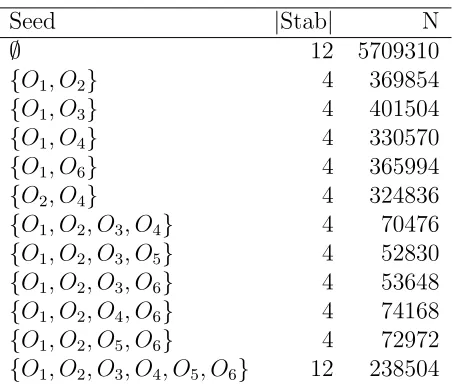
The seeds of the search, the orders of the multiplier automorphism groups of the seeds, |Stab|, and the number of completed systems in the computer search are shown in Table 3. The quarter orbit is included in all seeds. The computation took approximately 5 core-days using a 3.1-GHz Intel i5-2400 processor.
Using Table 3 and the Orbit–Stabilizer Theorem, we can now compute the total number of CSQS(28)s.
Theorem 4. There are exactly 12298370 distinct CSQS(28)s.
Proof. From the numbers in Table 3 and the orbit lengths of the seeds, we get the total number 5709310 + 3·(369854 + 401504 + 330570 + 365994 + 324836 + 70476 + 52830 + 53648 + 74168 + 72972) + 238504 = 12298370.
Analytic arguments can also here be used to find the number of equiva-lence classes with respect to multiplier equivaequiva-lence. We start with a result that is well known and easy to prove.
Lemma 1. Let P be a set of points fixed by a group of automorphisms of an
Table 3: Number of completed CSQS(28)s
Seed |Stab| N
∅ 12 5709310
{O1, O2} 4 369854 {O1, O3} 4 401504 {O1, O4} 4 330570 {O1, O6} 4 365994 {O2, O4} 4 324836 {O1, O2, O3, O4} 4 70476 {O1, O2, O3, O5} 4 52830 {O1, O2, O3, O6} 4 53648 {O1, O2, O4, O6} 4 74168 {O1, O2, O5, O6} 4 72972 {O1, O2, O3, O4, O5, O6} 12 238504
Lemma 2. There is a CSQS(v) with v/2 + 1 as a multiplier automorphism
only if there is a CSQS(v/2).
Proof. Since 2w(v/2 + 1) =vw+ 2w≡2w (mod v) and (2w+ 1)(v/2 + 1) =
vw+ 2w+ 1 +v/2 ≡ (2w+ 1) +v/2 (mod v), the multiplier v/2 + 1 fixes precisely the points with even labels, which induce an SQS(v/2) by Lemma 1. Since x7→x+ 2 is an automorphism of the CSQS(v), the SQS(v/2) must be cyclic.
Lemma 3. A CSQS(28) that is constructed from any of the seeds {O1, O3}, {O2, O4}, {O1, O2, O3, O4}, {O1, O2, O3, O6}, and {O1, O2, O5, O6} cannot have nontrivial multiplier automorphisms.
Proof. The multiplier automorphism group of all the listed seeds is iso-morphic to the Klein group of order 4 and contains the multipliers H =
{1,13,15,27}. Consequently, the elements of H are the only possible multi-pliers automorphisms of a CSQS(28) constructed from the seeds.
By Theorem 2, 27 = −1 is not a possible multiplier automorphism. As 15 = 28/2 + 1, it follows from the nonexistence of a CSQS(14) and Lemma 2 that 15 is not a possible multiplier automorphism either.
For the multiplier 13, we considerZ7×Z4, which is isomorphic to Z28via
of the forms
A: {(∗, a),(∗, a),(∗, a),(∗, a)}, B: {(∗, a),(∗, a),(∗, a),(∗, b)}, C: {(∗, a),(∗, a),(∗, b),(∗, b)}, D: {(∗, a),(∗, a),(∗, b),(∗, c)}, E: {(∗, a),(∗, b),(∗, c),(∗, d)},
where a, b, c, d are distinct. We denote the number of base blocks of these forms by x, y, z, u and w, respectively. All orbits of types A, B, and D are full. The quarter orbit is of type E and the half orbits are of types C (Ok,k
even) and E (Ok, k odd). Let z = z1+z2, where z1 and z2 are the number
of base blocks that have full and half orbits, respectively.
Consider orbits of types {(∗, a),(∗, a),(∗, a)} and {(∗, a),(∗, a),(∗, b)}, where a and b are distinct. All these orbits have length 28. For the for-mer type, there are 4 ways to choose a and 73
ways to choose the starred values, so the number of orbits is 7
3
·4/28 = 5. For the latter type, we similarly get 4· 7
2
·3·7/28 = 63 orbits.
When considering how triple orbits are covered by quadruple orbits, for the above mentioned two types of triple orbits we get the equations
4x+y= 5,
3y+ 4z1+ 2z2+ 2u= 63.
By combining these, we get that −6x+ 2z1 +z2 +u = 24, that is, z2 +u
must be even. We shall now show that u is odd, which implies thatz2 must
be odd (which is not the case for the five seeds listed in the theorem). Let Orb(S) denote the orbit of a set S ⊆ Z7 ×Z4 under the additive
action of (1,1). If (−1,1) stabilizes an orbit of typeD, then w.l.o.g.,
Orb({(0, a),(r, a),(s, b),(t, c)}) = Orb({(0, a),(−r, a),(−s, b),(−t, c)}) = Orb({(0, a),(r, a),(−s+r, b),(−t+r, c)}),
so −s +r = s and −t +r = t, that is, 2s = 2t = r, and consequently the orbit can be written as Orb({(0, a),(2s, a),(s, b),(s, c)}), a, b, c distinct. We shall count the number of orbits of type D stabilized by the multiplier (−1,1), which has the same parity as u. Let us now focus on triple orbits Orb({(0, a),(2s, a),(s, b)}(where we may havea=b). Note that these triple orbits are stabilized by the multiplier (−1,1).
(−1,1) act on this orbit, we get
Orb({(0, a),(−s, b),(−2s, a),(−r, c)}) = Orb({(0, a),(s, b),(2s, a),(−r+ 2s, c)}).
Since we have a quadruple system, we must haver =−r+ 2s, that is, r=s. Consequently, (1) if a = b, then for each s = 1,2,3, the system contains Orb({(0, a),(s, a),(2s, a),(s, c)}), which is of type B; (2) no matter whether
a = b, each triple orbit Orb({(0, a),(s, b),(2s, a)}) must be covered by an orbit of type B or D.
In total there are 9 orbits Orb({(0, a),(s, b),(2s, a)}),a 6=b, 3 of which are covered by orbits of type Orb({(0, a),(s, a),(2s, a),(s, b)}),a 6=b, and 9−3 = 6 of which are covered by orbits of type Orb({(0, a),(s, b),(2s, a),(s, c)}),
a, b, c distinct. Since each orbit of the latter type covers 2 such triple orbits, there are exactly 6/2 = 3 orbits of that type. This shows that u is odd and thereby completes the proof.
By using Lemma 3 and computer search, the following result is obtained.
Theorem 5. There are exactly 1028387 multiplier equivalence classes of
CSQS(28)s.
Proof. A computer search shows that amongst the designs constructed from the seeds∅,{O1, O2},{O1, O4},{O1, O6},{O1, O2, O3, O5},{O1, O2, O4, O6},
and {O1, O2, O3, O4, O5, O6}, there are, respectively, 478896, 92533, 82699,
91642, 13233, 18570, and 19955 multiplier equivalence classes of CSQS(28)s, so the total number is (utilizing Lemma 3 and Table 3) 478896 + 92533 + 401504/4 + 82699 + 91642 + 324836/4 + 70476/4 + 13233 + 53648/4 + 18570 + 72972/4 + 19955 = 1028387.
Now the validation using the Orbit–Stabilizer Theorem goes as follows (cf. Table 3).
Amongst the systems obtained from∅, 41 admit a group of order 6 (gen-erated by 3), 192 admit a group of order 3 (gen(gen-erated by 9), 5916 admit a group of order 2 (generated by 27), and the remaining 472747 systems have no nontrivial multipliers. The Orbit–Stabilizer theorem then gives 2 · 41 + 4 · 192 + 6 · 5916 + 12 · 472747 = 5709310. Amongst the sys-tems obtained from {O1, O2}, 139 admit a multiplier automorphism group
of order 2 (generated by 13), and 92394 have no nontrivial multipliers: 369854 = 2·139 + 4·92394. Amongst the systems obtained from{O1, O4},
Amongst the systems obtained from {O1, O6}, 287 admit a multiplier
auto-morphism group of order 2 (generated by 13), and 91355 have no nontrivial multipliers: 365994 = 2 ·287 + 4·91355. Amongst the systems obtained from {O1, O2, O3, O5}, 51 admit a multiplier automorphism group of order
2 (generated by 13), and 13182 have no nontrivial multipliers: 52830 = 2·51 + 4·13182. Amongst the systems obtained from {O1, O2, O4, O6}, 56
admit a multiplier automorphism group of order 2 (generated by 13), and 18514 have no nontrivial multipliers: 74168 = 2 ·56 + 4 ·18514. Finally, amongst the systems obtained from {O1, O2, O3, O4, O5, O6}, 8 admit a
mul-tiplier automorphism group of order 6 (generated by 5), 99 admit a multi-plier automorphism group of order 3 (generated by 9), 14 admit a multimulti-plier automorphism of order 2 (generated by 13), and 19834 have no nontrivial multipliers: 238504 = 2·8 + 4·99 + 6·14 + 12·19834.
4
Isomorphisms of Cyclic Steiner Quadruple
Systems
In Section 3, we enumerate all CSQS(v)s for v = 26,28 up to multiplier equivalence. In this section we continue with the task of determining the number of isomorphism classes.
P´alfy [35] proved that whenever v = 4 or gcd(v, φ(v)) = 1, isomorphic cyclic objects over a set of size v are multiplier equivalent. Unfortunately, from (1) and the fact thatφ(v) is even forv ≥3, it follows that P´alfy’s result is not applicable in the current work. Neither is the result by Huffman et al.
[22] that isomorphism of cyclic objects over a set of size p2
, wherep is a odd prime, can be checked using at most φ(p2
) permutations.
Consider cyclic objects over{0,1, . . . , pq−1}, where pand q are distinct primes andq < p. We further assume that gcd(pq, φ(pq))6= 1, so that P´alfy’s result cannot be used. Thenq|(p−1). In the current work, these conditions are fulfilled for q = 2 (in particular, 26 = 2·13). Huffman [21] derived a sufficient set of permutations for checking whether two cyclic objects with the given parameters are isomorphic. In the sequel, we fixqto 2 when describing the details of the approach. We introduce some definitions before proceeding:
T = (0 1 2 · · · 2p−1), σ0 = (0 2 4 · · · 2p−2),
σ1 = (1 3 5 · · · 2p−1).
Obviously T2
= σ0σ1. For 0 ≤ i ≤ 1, j 6≡ 0 (mod p), j ≡ 1 (mod 2), we
otherwise. The following result is [21, Theorem 1.1] for q = 2.
Theorem 6. Let (X,A) and (Y,B) be cyclic Steiner quadruple systems of
order 2p, pprime, and withT as an automorphism. If −1is not a multiplier for (X,A), then (X,A) and (Y,B) are isomorphic iff they are multiplier equivalent.
Theorem 6 already takes care of all but 4 + 7 + 106 + 375 = 492 of the multiplier equivalence classes of CSQS(26)s. We need some further definitions to proceed with the case when −1 is a multiplier. Let g be an element of order p −1 in the multiplicative group of units in the ring of integers modulo 2p, and let s be the unique solution to s ≡(p+ 1)/2 (mod p) when
s ∈ {1, g, g2
, . . . , gp−2
}. Further let ν0 =ms and ν1 =µ0,sµ1,−s.
Lemma 4. A CSQS(2p), p an odd prime, cannot have σ0 as an
automor-phism.
Proof. The permutation σ0 fixes exactly pelements. Those elements induce
an SQS(p) by Lemma 1. However, Steiner quadruple systems of odd order do not exist by (1).
We have the following useful result, based on the results of [21] and the presentation in [30].
Theorem 7. Let (X,A) and (Y,B) be cyclic Steiner quadruple systems of
order 2p, p prime, and with T as an automorphism. Assume that m−1 is a multiplier automorphism of (X,A), and let α be the smallest positive integer such that mα
g is a multiplier automorphism of (X,A). To determine isomor-phism of (X,A) and (Y,B), it suffices to let the following permutations act on (X,A) and check whether the result is (Y,B): mi
gνj, where 0 ≤ i < α,
0≤j ≤1. Moreover, σ−1
0 σ1 has to be an automorphism if j = 1.
Proof. In [21], the general case of order pq is considered and split into two cases, depending on whetherσ0 is an automorphism [21, Theorem 1.3] or not
[21, Theorem 1.2]. By Lemma 4 we know that σ0 is not an automorphism,
so the result is [21, Theorem 1.2] (and [30, Theorem 4.3]) for q = 2.
Theorem 8. Let (X,A)and (Y,B)be cyclic Steiner quadruple systems that both have order 2p, p prime, and T as an automorphism. Then (X,A) and
(Y,B) are isomorphic iff they are multiplier equivalent.
Proof. The permutations to test in Theorem 7 are multipliers ifj = 0, so we may focus on the permutations for j = 1. For j = 1, there is the condition that σ−1
0 σ1 be an automorphism of the CSQS (X,A). Consider a triple {a, b, c}, with a, b, and c even. This triple must be covered by some block
{a, b, c, d}.
Assume thatdis odd. Sinceσ−1
0 σ1 is an automorphism, {a−2, b−2, c−
2, d+ 2} must be a block, and since the system is cyclic this further implies that {a, b, c, d+ 4} is a block. Then, since d 6= d+ 4, {a, b, c} is covered by two blocks, which is not possible.
If all triples with even points are covered by blocks with only even points, then the even points induce a CSQS(p),pprime (Lemma 1; it is further clear that it must be cyclic). Such a design cannot exist by (1).
Theorem 8 handles the case of v = 26 in the current work, as well as corroborates the earlier result [13] that CSQS(22)s are isomorphic iff they are multiplier equivalent.
For the order v = 28, which is of the form pq2
, p, q primes, we do not have results as strong as Theorem 8, so some investigation of the constructed systems is needed. However, instead of trying to find isomorphisms between constructed systems, we take a different approach and attack the problem of finding isomorphic multiplier inequivalent systems separately from the main computer search.
For isomorphic multiplier inequivalent systems, the automorphism group must have regular cyclic subgroups that are not conjugate. This result occurs in various forms in many places in the literature, such as [1, Lemma 3.1], [30, Lemma 4.4], and [35, Lemma 0.1], and it actually played a central role already in work by Bays [3].
For a given orderv, the search now proceeds in the following way: for (i) each transitive permutation groupGof degreev, we (ii) check whether it has regular cyclic subgroups that are not conjugate, and, if so, (iii) exhaustively search for systems with automorphism group G.
In (i), it suffices to consider the groups up to conjugacy in Sv. The
finally we test the subgroups that they generate for conjugacy inG. If there is more than one conjugacy class in G of regular cyclic subgroups, then we proceed to (iii).
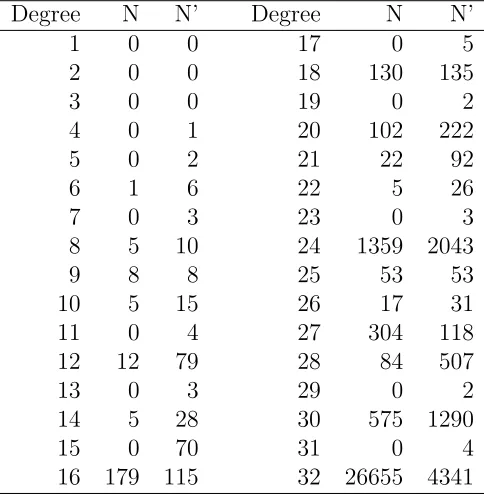
The number of permutation groups with nonconjugate regular cyclic sub-groups is given in column N of Table 4. In column N’, we further show the number of permutation groups with several conjugate regular cyclic sub-groups (but with no pair of nonconjugate such subsub-groups, that is, excluding the groups enumerated under N). For completeness, these numbers are listed for all degrees up to 32. Notice that N is 0 exactly when the degree d= 4 or
[image:17.595.176.418.320.567.2]d and ϕ(d) are coprime [35].
Table 4: Permutation groups with more than one regular cyclic subgroup
Degree N N’ Degree N N’
1 0 0 17 0 5
2 0 0 18 130 135
3 0 0 19 0 2
4 0 1 20 102 222
5 0 2 21 22 92
6 1 6 22 5 26
7 0 3 23 0 3
8 5 10 24 1359 2043
9 8 8 25 53 53
10 5 15 26 17 31
11 0 4 27 304 118
12 12 79 28 84 507
13 0 3 29 0 2
14 5 28 30 575 1290
15 0 70 31 0 4
16 179 115 32 26655 4341
If the automorphism group of an CSQS(v) is larger than its multiplier automorphism group, then the group has more than one regular cyclic sub-group. Phelps [36] pointed out that the automorphism group of the unique CSQS(10) is the projective general linear group PGL(2,9). In general, for
k > 0 there is an CSQS(3k+ 1) with PGL(2,3k) as the automorphism group.
(Automorphism groups are not studied further in this paper.)
subgroups fulfill the property that the number of fixed points be less than 3 or according to (1). This leaves 8 groups, which have the following num-bering amongst the transitive groups of degree 28 in GAP and Magma: 51, 91, 128, 131, 204, 205, 249, 326. For completeness, we list (generators of) the groups in the Appendix. An exhaustive search—which is fast as the groups are large—shows that there are no CSQS(28)s with such groups of automorphisms.
We now turn to the case of CSQS(32)s.
Theorem 9. A CSQS(8m) cannot have 4m−1 as a multiplier
automor-phism.
Proof. Let v = 8m. For the multiplier 4m−1 to fix a point 2w, we get by 2w(4m −1) = 8mw −2w ≡ −2w (mod 8m) that 4w ≡ 0 (mod 8m). Consequently, exactly the points 2w = 0 and 2w = 4m are fixed in this manner. On the other hand, for the multiplier 4m−1 to fix 2w+ 1, we get by (2w+ 1)(4m−1) = 8mw+ 4m−2w−1≡ −(2w+ 1) + 4m (mod 8m) that 2(2w+ 1)≡4m (mod 8m). This equation has no solution since 2w+ 1 is odd.
As (4m−1)(4m−1)≡1 (mod 8m) and the multiplier 4m−1 fixes exactly the points 0 and 4m, the derived triple system associated with 0 must have an automorphism of order 2 with 1 fixed point. A necessary condition for the existence of such triple systems, called reverse, on u points is that u ≡
1,3,9, or 19 (mod 24) [39]. See also [20, p. 213]. Hence 8m≡2,4,10, or 20 (mod 24), which is impossible.
The following result due to Phelps is mentioned without proof in [16].
Theorem 10. A CSQS(32) cannot have a nontrivial multiplier
automor-phism.
Proof. The units in the ring of integers modulo 32 are the odd numbers, and these form a multiplicative group of order 16 that is isomorphic to Z2×Z8.
Consequently, any nontrivial subgroup of this group has an element of order 2. This means that if the design has a nontrivial multiplier automorphism, then either 15, 17, or 31 is a multiplier automorphism.
The fact that multiplier automorphisms 15 and 31 =−1 are not possible is taken care of by Theorem 9 and Corollary 1, respectively. Finally, it follows from the nonexistence of a CSQS(16) and Lemma 2 that 17 is not a possible multiplier automorphism either.
An easy calculation in Magma shows that, in each of the 26655 groups
of order 32 are normalized by an element in G that induces a nontrivial automorphism of C. This can also be deduced from the even-easier-to-verify fact that these groups all have orders divisible by 64. So, in each case, C is properly contained in a Sylow 2-subgroup S of G [40, Theorems 4.12, 4.14] and then, by [40, Theorem 4.6], C is properly contained in its normalizer
NS(C) in S. But, as we observed in Section 2, the normalizer of C in the
symmetric group S32 is equal to the semidirect product C ⋊Aut(C). So
an element of NS(C)\C must induce a nontrivial automorphism of C. We
conclude that there are no isomorphic multiplier inequivalent CSQS(32)s. Theorem 8 takes care of the orders 34 and 38, so we now have the following result.
Theorem 11. There are no isomorphic multiplier inequivalent CSQS(v)s
for v ≤38.
The next orders to consider in a search for isomorphic multiplier inequiv-alent CSQS(v)s are v = 40, v = 44, and v = 50. Phelps [38] proved that isomorphic multiplier inequivalent cyclic designs exist for many parameters, including S(2, k, v)s for k ≥3 and infinitely many values of v. However, for
t = 3, the question remains open.
5
Related Designs
Since there are no isomorphic multiplier inequivalent CSQS(v)s with the pa-rameters considered in the current study, we need not separately address the issues of isomorphism and multiplier equivalence when discussing particular subsets of such systems.
There are several types of designs that are closely related to cyclic Steiner quadruple systems. One example of such designs are cyclic H-designs. The concept of H-designs originates from work by Hanani [19]. An H-design is a triple (X,G,B), where G is a partition of a set of points X into n subsets (called groups), each of cardinality g, and B is a collection of k-subsets of
X (called blocks), such that each block intersects any given group in at most one point, and each t-subset of X with points from distinct groups is contained in a unique block. An H-design with these parameters is denoted by H(n, g, k, t). An H-design is also known as a group divisible t-design.
Anautomorphism of anH-design (X,G,B) is a permutation onXleaving
G and B invariant. An H-design with n groups of cardinality g is said to be cyclic if it admits an automorphism consisting of a cycle of length gn. Without loss of generality, we may identify X with Zgn and G with {{i, n+
Let v ≡ 2,4 (mod 6) and A = {{0, j, v/2, v/2 +j} : 1 ≤ j ≤ ⌊v/4⌋}. Consider a cyclic H(v/2,2,4,3) with a set C of base blocks. It is readily checked that A ∪ C forms a set of base blocks of a CSQS(v) that has ⌊v/4⌋
short orbits. Conversely, by reversing the above process, a CSQS(v) having
⌊v/4⌋ short orbits yields a cyclic H(v/2,2,4,3). For example, the proofs of Theorems 3 and 5 can be utilized to classify cyclic H-designs corresponding to CSQS(26)s and CSQS(28)s.
We shall next prove a nonexistence result for H-designs. An H-design is said to be semi-cyclic if it admits an automorphism consisting ofn cycles of length g.
Theorem 12. There is no cyclic H(v/2,2,4,3) for v ≡14,22 (mod 24).
Proof. The strategy is to prove that there is no semi-cyclicH(v/2,2,4,3) for
v ≡14,22 (mod 24). If there is a cyclic H(v/2,2,4,3), then there is a semi-cyclic H(v/2,2,4,3), so nonexistence of semi-cyclic H(v/2,2,4,3)s implies nonexistence of cyclic H(v/2,2,4,3)s.
Let (X,G,B) be an H(n, g,4,3). We identify X with Zn ×Zg and G
with {{i} ×Zg : i ∈ Zn}. In this case the automorphism can be taken as
(i, x)7→(i, x+ 1).
Letv = 2n with n ≡7,11 (mod 12). Consider a semi-cyclic H(n,2,4,3) on Zn×Z2 with base blocks of the form {(i1,∗),(i2,∗),(i3,∗),(i4,∗)}. Note
thati1, i2, i3, i4 are distinct as we have anH-design. Assuming thati1 < i2 <
i3 < i4, each base block must be one of the following:
{(i1,0),(i2,0),(i3,0),(i4,0)}, {(i1,0),(i2,0),(i3,0),(i4,1)}, {(i1,0),(i2,0),(i3,1),(i4,0)}, {(i1,0),(i2,1),(i3,0),(i4,0)}, {(i1,1),(i2,0),(i3,0),(i4,0)}, {(i1,0),(i2,0),(i3,1),(i4,1)}, {(i1,0),(i2,1),(i3,0),(i4,1)}, {(i1,0),(i2,1),(i3,1),(i4,0)}.
Denote the number of base blocks of these forms byxj,j = 1,2, . . . ,8,
re-spectively. The number of triple orbits of the form Orb({(i,0),(i′,1),(i′′,0)}),
where i < i′ < i′′ are distinct, is now n
3
=n(n−1)(n−2)/6, which is odd. The number is also obtained as 2x3+ 2x4+ 2x7+ 2x8, which is even, so we
have a contradiction.
Corollary 3. There is no CSQS(v) for v ≡14,22 (mod 24) with (v−2)/4
half orbits.
Corollary 3 shows, for example, that no CSQS(22) with 5 half orbits exists.
exists only if v ≡ 2,10 (mod 24); see [12] and the references therein for more information on strictly cyclic Steiner quadruple systems. The proof of Theorem 3 establishes a complete classification of sSQS(26)s, which is the next open case after v = 10. The unique sSQS(10) was found already by Barrau [2].
Theorem 13. There are exactly 25668 isomorphism classes of sSQS(26)s.
A CSQS(v) with −1 as a multiplier automorphism is said to be R-cyclic, cf. [20]. The unique CSQS(10) is R-cyclic, and there are exactly 4 isomor-phism classes of R-cyclic CSQS(20)s [36].
Theorem 14. There are exactly 492 isomorphism classes of R-cyclic
CSQS(26)s and 5957 isomorphism classes of R-cyclic CSQS(28)s.
Proof. By the discussion after Theorem 3 and Theorem 5, the number of isomorphism classes of R-cyclic CSQS(26)s and CSQS(28)s are 4 + 7 + 106 + 375 = 492 and 41 + 5916 = 5957, respectively.
By Theorem 2, a CSQS(v) with a half orbit cannot have−1 as a multiplier automorphism, so CSQSs in Classes C and D cannot be R-cyclic. Thus
v ≡ 2,4,10,20 (mod 24) is a necessary condition for an R-cyclic SQS(v) to exist.
A CSQS(v) is said to be S-cyclic if the multiplier −1 fixes each block orbit. Obviously an S-cyclic system is R-cyclic. The following result is from [14].
Theorem 15. An S-cyclic CSQS(v) can exist only if v = 2n or 4n, where
every prime factor p of n satisfiesp≡1 or 5 (mod 12).
The unique CSQS(10) is S-cyclic. There is a unique S-cyclic SQS(20) [24]. By examining the 492 R-cyclic CSQS(26)s, we were able to corroborate the following result, originally published in [15].
Theorem 16. There are exactly 18 isomorphism classes of S-cyclic
CSQS(26)s.
Lemma 5. If there exists an affine-invariantCSQS(v)forv ≡4,20 (mod 24), then there exists an affine-invariant CSQS(v/2).
Proof. When v ≡4,20 (mod 24),v/2 + 1 is coprime with v. By Lemma 2, a CSQS(v) withv/2+1 as a multiplier automorphism implies a CSQS(v/2).
Lemma 6. Suppose that there exists an affine-invariant CSQS(v) for v ≡
2,10 (mod 24). Write v = 2pn, where p is an odd prime and n is an odd integer. Then there exists an affine-invariant CSQS(2n).
Proof. The triple orbit Orb({0, ap, bp}),a6=b, is covered by an orbit that has the general form Orb({0, ap, bp, α+βp}), where 0≤α < p and 0≤β <2n. It is readily checked that there exists a c satisfying gcd(1 + 2cn, v) = 1 and gcd(c, p) = 1 (take c = (p+ 1)/2 or c = (p−1)/2). Thus 1 + 2cn
can be taken as a multiplier automorphism and Orb({0, ap, bp, α+βp}) = Orb({0, ap, bp, α+βp+ 2cnα)}). Since we have a quadruple system, we must have 2cnα≡ 0 (mod 2pn), which implies α= 0. This procedure induces an affine-invariant CSQS(2n).
Theorem 17. An affine-invariant CSQS(v) can exist only if v = 2n or 4n, where every prime factor p of n satisfies p≡1 or 5 (mod 12).
Proof. By Theorem 2, a CSQS(v) that has a half orbit cannot have −1 as a multiplier automorphism. Thus if an affine-invariant CSQS(v) exists, then
v ≡2,4,10,20 (mod 24). A combination of Lemmas 5 and 6 completes the proof.
By Theorem 17, there is no affine-invariant CSQS(28) (which we already know from the discussion after Theorem 5). Theorem 10 implies that a CSQS(32) cannot be R-cyclic, and thereby it can be neither S-cyclic nor affine-invariant. It also follows from Theorems 15 and 17 that a CSQS(8n) can be neither S-cyclic nor affine-invariant. The similarity between Theorems 15 and 17 brings about the question whether an affine-invariant CSQS(v) is always S-cyclic. However, it turns out that none of the affine-invariant CSQS(26)s is S-cyclic.
Appendix
Number = 51 Order = 392 Generators:
(1,8,14,20,25,4,10,15,22,27,5,12,17,23,2,7,13,19,26,3,9,16,21,28,6,11,18,24), (1,25)(2,26)(3,7)(4,8)(5,21)(6,22)(9,17)(10,18)(11,27)(12,28)(15,24)(16,23).
Number = 91 Order = 784 Generators:
(1,6)(2,5)(7,14)(8,13)(9,12)(10,11)(15,28)(16,27)(17,25)(18,26)(19,23)(20,24), (1,11,7,4,14,10,6,2,12,8,3,13,9,5),
(1,21,14,24,12,25,9,28,7,15,6,17,3,20)(2,22,13,23,11,26,10,27,8,16,5,18,4,19).
Number = 128 Order = 1176 Generators:
(1,13,22,17,6,25)(2,14,21,18,5,26)(3,7,20,28,24,12)(4,8,19,27,23,11),
(1,27,21,15,17,23,2,28,22,16,18,24)(3,13,4,14)(5,20,9,11,26,7,6,19,10,12,25,8).
Number = 131 Order = 1176 Generators:
(1,8,18,3,6,27,21,24,9,19,26,15,13,11,2,7,17,4,5,28,22,23,10,20,25,16,14,12), (1,20,10,27,17,7,26,16,6,24,14,4,22,12,2,19,9,28,18,8,25,15,5,23,13,3,21,11), (1,25)(2,26)(3,12)(4,11)(5,21)(6,22)(9,17)(10,18)(15,28)(16,27)(19,23)(20,24).
Number = 204 Order = 2352 Generators:
(15,16)(17,18)(19,20)(21,22)(23,24)(25,26)(27,28),
(1,9,12)(2,10,11)(3,14,6)(4,13,5)(15,18,21,16,17,22)(19,25,23,20,26,24)(27,28), (1,13)(2,14)(3,11)(4,12)(5,9)(6,10)(7,8)(15,17)(16,18)(19,27)(20,28)(21,25)(22,26), (1,22,2,21)(3,23,4,24)(5,25,6,26)(7,27,8,28)(9,16,10,15)(11,17,12,18)(13,20,14,19).
Number = 205 Order = 2352 Generators:
(1,11,14,5,9,8)(2,12,13,6,10,7)(3,4)(15,24,21,25,17,20)(16,23,22,26,18,19),
Number = 249 Order = 3528 Generators:
(1,5)(2,6)(3,4)(7,23,20,27,12,16)(8,24,19,28,11,15)(9,26)(10,25)(13,21)(14,22)(17,18), (1,24,14,19,25,15,10,11,22,7,5,4,17,28,2,23,13,20,26,16,9,12,21,8,6,3,18,27).
Number = 326 Order = 7056 Generators:
(1,13)(2,14)(3,11)(4,12)(5,9)(6,10)(7,8)(17,21,20,28,24,25)(18,22,19,27,23,26), (1,22,7,26,14,16,6,19,12,23,3,27,9,18)(2,21,8,25,13,15,5,20,11,24,4,28,10,17), (1,26,6,19,14,22)(2,25,5,20,13,21)(3,16,9,27,7,23)(4,15,10,28,8,24)(11,17)(12,18).
References
[1] L. Babai, Isomorphism problem for a class of point-symmetric structures, Acta Math Acad Sci Hungar 29 (1977), 329–336.
[2] J. A. Barrau, Over de combinatorische opgave van Steiner, Kon Akad Wetensch Amst Verslag Wis- en Natuurk Afd 17 (1908), 318—326. (= On the combinatory problem of Steiner, Kon Akad Wetensch Amst Proc Sec Sci 11 (1908), 352–360.)
[3] S. Bays, Sur les syst`emes cycliques de triples de Steiner differents pour N premier (o`u puissance de nombre premier) de la forme 6n+1, I, Comment Math Helv 2 (1930), 294–305; II–VI, Comment Math Helv 3 (1931), 22-41, 122–147, 307–325.
[4] N. Brand, On the Bays–Lambossy theorem, Discrete Math 78 (1989), 217–222.
[5] J. J. Cannon and D. F. Holt, The transitive permutation groups of degree 32, Experiment Math 17 (2008), 307–314.
[6] C. J. Colbourn, M. J. Colbourn, and K. T. Phelps, Combinatorial algo-rithms for generating cyclic Steiner quadruple systems, Discrete Math-ematical Analysis and Combinatorial Computation, Proc Conf New Brunswick, Univ New Brunswick, Fredericton, N.B., 1980, pp. 25–39.
[7] M. J. Colbourn and R. A. Mathon, On cyclic Steiner 2-designs, Ann Discrete Math 7 (1980), 215–253.
[8] I. Diener, I, On cyclic Steiner systems S(3,4,22), Ann Discrete Math 7 (1980), 301–313.
[10] J. Doyen and M. Vandensavel, Non-isomorphic Steiner quadruple sys-tems, Bull Soc Math Belg 23 (1971), 393–410.
[11] T. Feng and Y. Chang, Constructions for cyclic 3-designs and improved results on cyclic Steiner quadruple systems, J Combin Des 19 (2011), 178–201.
[12] T. Feng, Y. Chang, and L. Ji, Constructions for strictly cyclic 3-designs and applications to optimal OOCs with λ = 2, J Combin Theory Ser A 115 (2008), 1527–1551.
[13] T. C. Frenz and D. L. Kreher, An algorithm for enumerating distinct cyclic Steiner systems, J Combin Math Combin Comput 11 (1992), 23– 32.
[14] M. J. Grannell and T. S. Griggs, On the structure of S-cyclic Steiner quadruple systems, Ars Combin 9 (1980), 51–58.
[15] M. J. Grannell and T. S. Griggs, An enumeration of S-cyclic SQS(26), Utilitas Math 20 (1981), 249–259.
[16] M. J. Grannell and T. S. Griggs, A cyclic Steiner quadruple system of order 32, Discrete Math 38 (1982), 109–111.
[17] M. Guregov´a and A. Rosa, Using the computer to investigate cyclic Steiner quadruple systems, Mat Casopis Sloven Akad Vied 18 (1968), 229–239.
[18] H. Hanani, On quadruple systems, Canad J Math 12 (1960), 145–157.
[19] H. Hanani, On some tactical configurations, Canad J Math 15 (1963), 702–722.
[20] A. Hartman and K. T. Phelps, Steiner quadruple systems, Contempo-rary Design Theory, J. H. Dinitz and D. R. Stinson (Editors), Wiley, New York, 1992, pp. 205–240.
[21] W. C. Huffman, The equivalence of two cyclic objects on pq elements, Discrete Math 154 (1996), 103–127.
[22] W. C. Huffman, V. Job, and V. Pless, Multipliers and generalized mul-tipliers of cyclic objects and cyclic codes, J Combin Theory Ser A 62 (1993), 183–215.
[23] A. Hulpke, Constructing transitive permutation groups, J Symbolic Comput 39 (2005), 1–30.
[24] R. K. Jain, On cyclic Steiner quadruple systems, M.Sc. Thesis, McMas-ter University, Hamilton, 1971.
[26] P. Kaski, P. R. J. ¨Osterg˚ard, and O. Pottonen, The Steiner quadruple systems of order 16, J Combin Theory Ser A 113 (2006), 1764–1770.
[27] P. Kaski and O. Pottonen, libexactuser’s guide, version 1.0, HIIT
Tech-nical Reports 2008-1, Helsinki Institute for Information Technology HIIT, 2008.
[28] D. E. Knuth, Dancing links, Millennial Perspectives in Computer Sci-ence, J. Davies, B. Roscoe, and J. Woodcock (Editors), Palgrave, Hound-mills, 2000, pp. 187–214.
[29] E. K¨ohler, Quadruple systems overZp admitting the affine group,
Com-binatorial Theory, D. Jungnickel and K. Vedder (Editors), LNM 969, Springer, Berlin, 1982, pp. 212–228.
[30] H. Koike, I. Kov´acs, and T. Pisanski, The number of cyclic configura-tions of type (v3) and the isomorphism problem, J Combin Des 22 (2014),
216–229.
[31] P. Lambossy, Sur une mani`ere de differencier les fonctions cycliques d’une forme donn´ee, Comment Math Helv 3 (1931), 69–102.
[32] H. Lenz, On the number of Steiner quadruple systems, Mitt Math Sem-inar Giessen 169 (1985), 55–71.
[33] C. C. Lindner and A. Rosa, Steiner quadruple systems—A survey, Dis-crete Math 22 (1978), 147–181.
[34] N. S. Mendelsohn and S. H. Y. Hung, On the Steiner systems S(3,4,14) and S(4,5,15), Util Math 1 (1972), 5–95.
[35] P. P. P´alfy, Isomorphism problem for relational structures with a cyclic automorphism, European J Combin 8 (1987), 35–43.
[36] K. T. Phelps, On cyclic Steiner systems S(3,4,20), Ann Discrete Math 7 (1980), 277–300.
[37] K. T. Phelps, A construction of cyclic Steiner triple systems of orderpn,
Discrete Math 67 (1987), 107–110.
[38] K. T. Phelps, Isomorphism problems for cyclic block designs, Ann Dis-crete Math 34 (1987), 385–391.
[39] A. Rosa, On reverse Steiner triple systems, Discrete Math 2 (1972), 61–71.
![Terminologi, arbeidsinstrukser og lagerstyring – om kodeuttrykk i fagspråk (Terminology, work instructions and inventory control – on coded expressions in jargon) [In Norwegian]](data:image/gif;base64,R0lGODlhAQABAIAAAP///wAAACH5BAEAAAAALAAAAAABAAEAAAICRAEAOw==)