Demand forecasting by temporal aggregation: using
optimal or multiple aggregation levels?
Nikolaos Kourentzesa,∗, Bahman Rostami-Tabarb, Devon K. Barrowc
aLancaster University Management School
Department of Management Science, Lancaster, LA1 4YX, UK bCardiff Business School, Cardiff University
Cardiff, CF10 3EU, UK
cSchool of Strategy and Leadership, Faculty of Business and Law Coventry University, Coventry, West Midlands, CV1 5FB, UK
Abstract
Recent advances have demonstrated the benefits of temporal aggregation for
demand forecasting, including increased accuracy, improved stock control
and reduced modelling uncertainty. With temporal aggregation a series is
transformed, strengthening or attenuating different elements and thereby
enabling better identification of the time series structure. Two different
schools of thought have emerged. The first focuses on identifying a single
optimal temporal aggregation level at which a forecasting model maximises
its accuracy. In contrast, the second approach fits multiple models at
mul-tiple levels, each capable of capturing different features of the data. Both
approaches have their merits, but so far they have been investigated in
iso-lation. We compare and contrast them from a theoretical and an empirical
perspective, discussing the merits of each, comparing the realised accuracy
∗Correspondance: N Kourentzes, Department of Management Science, Lancaster Uni-versity Management School, Lancaster, Lancashire, LA1 4YX, UK. Tel.: +44-1524-592911
gains under different experimental setups, as well as the implications for
business practice. We provide suggestions when to use each for maximising
demand forecasting gains.
Keywords: Forecasting, demand planning, temporal aggregation, model selection, exponential smoothing, MAPA
1. Introduction
Demand forecasting plays a crucial role in the operations of modern
or-ganisations (Fildes et al., 2008; Syntetos et al., 2016). It supports a variety
of business decisions, from operational, to tactical, to strategic level, such as
capacity planning (Miyaoka and Hausman, 2008), resource planning
(Bar-row, 2016; Jalal et al., 2016), advertising and promotional planning (Trapero
et al., 2014; Ma et al., 2016), demand planning (Trapero et al., 2012; Syntetos
et al., 2015), analysing competition effects (Merino and Ramirez-Nafarrate,
2016), tactical production planning (Sagaert et al., 2017), among others.
Accordingly, practitioners need to define the forecast objective in terms of
forecast horizon and time bucket (e.g. daily, weekly, monthly, etc.), so as to
support the appropriate decisions.
An important assumption is that the level of required forecasting matches
the level of available collected data. However, often this not true. For
ex-ample, in many organizations, managers from several departments are
in-volved in forecast generation and adjustment, that supports decisions for
pro-duction, inventory management, logistics, procurement, and others (Lapide,
2004); with each function having different decision horizons. For example,
in-ventory management, and refer to much longer horizons than the latter.
As a remedy the original data series can be aggregated over time
(tempo-ral aggregation, TA) to align the decision parameters with the forecast
mod-elling, or alternatively disaggregated. Recently there has been a resurgence
in researching TA for forecasting. In the past the research had mostly
fo-cused in modelling macroeconomic time series, but current work has
demon-strated its usefulness for forecasting business time series, and in particular for
the purpose of demand forecasting to support decision-making in operations
management (Babai et al., 2012; Kourentzes and Petropoulos, 2015; Boylan
and Babai, 2016). Using TA a time series is modelled at a pre-specified
ag-gregation level, instead of its original sampling frequency. Forecasts are then
created at the aggregate level, which may be disaggregated to the original
frequency, if so needed. The motivation for using TA is that it smooths the
original series, removing noise and even some of its component, simplifying
the generation of forecasts, which is desirable in itself (Green and Armstrong,
2015). The exact effects depend on the selected aggregation level, a critical
consideration for the effectiveness of TA.
To this end, the econometric literature has explored the effect of TA,
mainly on AutoRegressive Integrated Moving Average (ARIMA) processes
(Silvestrini and Veredas, 2008), providing some evidence of the benefits and
caveats of the practice, while more recent forecasting research has helped
identify analytically the optimal aggregation level for a small number of
processes, under specific modelling conditions (Rostami-Tabar et al., 2013,
2014). Nonetheless, general guidelines for how to best select the
modelling process. This has lead Kourentzes et al. (2014) to propose using
multiple TA levels instead of a single one. In this case, modelling happens
at multiple levels and the output is a combined forecast.
Therefore, although there is a strong theoretical and empirical evidence
that TA can be beneficial to forecasting, there is no consensus as to how best
perform it. The two alternative schools of thought recommend from the one
hand to use a single optimal TA level, and from the other hand to use multiple
levels, since the identification of a single level is problematic. The aim of this
paper is threefold: (i) we contrast the two approaches both from a theoretical
and empirical perspective; (ii) we benchmark these against heuristic based
alternatives; and (iii) provide additional evidence of the usefulness of TA
for demand forecasting over traditional time series modelling, at the original
sampling frequency.
We find that overall TA is beneficial for demand forecasting over
conven-tional time series modelling. Each school of thought offers different
advan-tages and has different limitations. The main limitation of identifying an
optimal single aggregation level is that it assumes knowledge of the demand
process at both the original and the aggregate level, with the obvious
impli-cations for practice. On the other hand, using multiple levels is particularly
robust to model uncertainty and is found to provide accuracy improvements
for wide number of cases. However, the forecast is suboptimal by design in
the strict sense of mean squared error fit. Finally, we translate these findings
to implications for business forecasting practice.
The rest of the paper is organised as follows: section 2 provides an
section 3 describes the two alternative approaches in using TA. Section 4
describes the datasets used and the setup of our evaluation, while section 5
presents the results, followed by concluding remarks in section 6.
2. Temporal aggregation in business forecasting
Non-overalapping TA can be seen as a filter of high-frequency components
of the time series. As we aggregate, low frequency components will dominate
and depending on the level of aggregation higher frequency components will
become weaker or vanish altogether. For example, consider a monthly
sea-sonal time series that is aggregated to an annual series. The high frequency
seasonal component is filtered, while the observed variance of the time series
will be mostly due to the trend/cycle component.
In the econometric literature TA has been researched for several decades
and the focus has mainly been on its effects on ARIMA processes. The
key theoretical results can be summarised as follows: (i) TA reduces the
number of available observations; hence causing loss of estimation efficiency;
(ii) the dynamics of the underlying ARIMA process become more
compli-cated, mainly due to the moving average component; and (iii) the identifiable
ARIMA converge to relatively simple IMA processes, often IMA(1,1) (Wei,
1978; Rossana and Seater, 1995). The literature provides evidence of
accu-racy gains of forecasting directly using temporally aggregated data, rather
than aggregating forecast from disaggregate series (Silvestrini and Veredas,
2.1. Temporal aggregation at a single level
More recently there has been substantial research on TA for business
forecasting and supply chain management. Nikolopoulos et al. (2011)
rec-ommend using TA for modelling and forecasting intermittent time series in
a supply chain context. Their main motivation is to avoid modelling the
intermittency at the sampling frequency directly and instead model the
se-ries with conventional forecasting methods, once the intermittency has been
reduced substantially. They demonstrate that on average TA provides
accu-racy improvements. This finding has been validated several times in the
con-text of intermittent demand forecasting (Babai et al., 2012; Petropoulos and
Kourentzes, 2014a). It is important to note that Nikolopoulos et al. (2011)
do not provide a conclusive solution with regards to the identification of the
appropriate TA level. Instead, they recommend a heuristic that is
mean-ingful for inventory management: aggregate to the level that corresponds to
the lead time plus review period. Petropoulos et al. (2016) demonstrate that
some intermittent demand forecasting methods, such as Croston’s method,
can be interpreted as special cases of TA and propose various alternative
setups of TA, which in turn can reduce the variability of the the non-zero
demand or the inter-demand intervals and demonstrate benefits for forecast
accuracy.
Spithourakis et al. (2011) extended the work by Nikolopoulos et al. (2011)
to fast moving demand data, validating that TA leads to forecast accuracy
improvements. Jin et al. (2015) utilise a large set of paired order and
point-of-sale data in a retail supply chain to examine the impact of TA on forecast
com-putational intensity of forecast generation. Luna and Ballini (2011) use TA
to predict daily time series of cash withdrawals and find similar or better
forecast accuracy to modelling the daily series directly.
Exploring further the impact of TA for demand forecasting
Rostami-Tabar et al. (2013) and Rostami-Rostami-Tabar et al. (2014) derive analytically the
optimal aggregation level when the underlying demand process follows
Au-toRegressive AR(1), Moving Average MA(1), AuAu-toRegressive Moving
Aver-age ARMA(1,1) and exponential smoothing is used to produce the forecasts.
The choice of forecasting model is motivated by the problem context, where
single exponential smoothing is the norm for producing demand forecasts
for non-trended and non-seasonal time series. They determine analytically
the conditions under which non-overlapping TA outperforms the traditional
modelling approach. Using the optimal TA levels, they demonstrate accuracy
improvements and show that TA’s superiority is a function of the demand
process parameters, forecasting method parameters, and aggregation levels.
However there are no expressions for more complex ARIMA forms or different
forecasting models. This is an important limitation given the prevalence of
seasonal and trended demand series in practice. Moreover, it should be noted
that the ARIMA type processes can only represent fast moving items. For
slow moving items, the consideration of other process such as Integer ARMA
(INARMA) processes is relevant (Mohammadipour and Boylan, 2012).
2.2. Multiple temporal aggregation levels
The majority of the aforementioned literature had taken the approach
(2014) argue that there are two concerns with this approach: (i) for the
majority of time series we do not have a way to identify the optimal TA
level; and (ii) even if there was one, due to sampling, there is a substantial
uncertainty about the underlying process and the appropriate model to apply
to a time series. Based on these, they recommend using multiple levels of
TA and combining the separate forecasts. This approach not only benefits
from managing the modelling risk, but also utilises the established gains
of forecast combination (Barrow and Kourentzes, 2016; Blanc and Setzer,
2016). Kourentzes et al. (2014) provide empirical evidence to demonstrate
gains over conventional forecasting. Since, modelling with multiple TA levels
has been used successfully to intermittent demand, promotional modelling
and inventory management (Petropoulos and Kourentzes, 2014a; Kourentzes
and Petropoulos, 2015; Barrow and Kourentzes, 2016). An advantage of this
approach is that it is not restricted to specific demand processes and allows
for a wider variety of forecasting models.
Although both approaches for using TA (single optimal and multiple
lev-els) have demonstrated forecasting gains, so far there is no comparative study
between the two. Arguably using multiple levels is suboptimal in the strict
sense (see section 3.2), yet more flexible and widely applicable. On the other
hand using a single optimal level is expected to provide better performance,
assuming that the identification of the underlying demand process is reliable.
3. Temporal aggregation approaches
In this section we briefly outline the two alternative approaches for using
with observations yt and t= 1, . . . , n, non-overlapping TA can be performed
as:
yi[k] =Xik
t=1+(i−1)kyt, (1)
where k is the aggregation level. We denote the temporally aggregated time
series with a superscript [k]. Eq. (1) implies that the firstn−bn/kck
observa-tions of the time series may be ignored in the construction of the aggregated
series, depending on k. Naturally, the resulting time series has less
observa-tions than the original one.
Note that Eq. (1) acts as a moving average on the original series, filtering
high frequency components. To exemplify the effect of this we illustrate it
in Figure 1. A series is sampled at a monthly frequency and exhibits a clear
repeating seasonal pattern and an outlier at the beginning of 2015. Both
outlier and seasonality are high-frequency components. As the series is
ag-gregated at a quarterly level (k= 3) the effect of the outlier is mitigated, but
the seasonality remains, although it is smoother. At the annual aggregation
level (k = 12) the seasonality is fully removed and a slight trend that is
present in the series becomes apparent. This trend was not observable at the
lower aggregation levels. The forecasting literature has taken advantage of
this effect of TA to improve the quality of forecasts (for example, Pedregal
and Trapero, 2010; Kourentzes et al., 2014).
3.1. Identifying the optimal temporal aggregation level
Rostami-Tabar et al. (2014) evaluate analytically the impact of
non-overlapping temporal on demand forecast accuracy. They assume that the
Monthly level
2013 2014 2015 2016 2017
800
1000
1200
Quarterly level
2013 2014 2015 2016
2500
3500
Annual level
2013.0 2013.5 2014.0 2014.5 2015.0 2015.5 2016.0
11500
[image:10.612.158.457.126.453.2]12500
Figure 1: Original time series sampled at a monthly frequency and aggregated at quarterly
and annual levels.
MA(1) that can be mathematically written in Eq. (2), Eq. (3) and Eq. (4)
respectively:
yt=C+φyt−1−θt−1+εt, (2)
yt=C+φyt−1+εt, (3)
yt=C−θt−1+εt, (4)
the moving average parameter and εt is an independent random variable for
underlying demand series in period t, normally distributed with zero mean
and variance σ2.
The forecasting method considered is the Single Exponential Smoothing
(SES). Using SES, the aggregate forecast of demand is calculated as follow
ˆ
yi[k]=αy[ik−1] + (1−α)ˆyi[k−1] , (5)
where 0< α <1 is the smoothing parameter used at the aggregated demand
series. Forecast accuracy of the aggregated demand series is calculated using
Mean Square Error (MSE):
MSE = Variancey[ik]−yˆ[ik]= 1
n n X
i=1
y[ik]−yˆi[k]2 (6)
The optimal aggregation level minimises the forecast MSE of the
ag-gregated demand for each demand process under consideration, when SES
is used as the forecasting method. These are analytically identified. The
aggregation level that leads to the most error reduction is determined by
comparing variances at the aggregate level. This approach works as follows:
first, buckets of aggregated demand are created at the aggregation level k,
using Eq. (1); then SES, Eq. (5), is applied to these aggregate series and
finally the variance of aggregated forecast error is calculated using Eq. (6).
According to Rostami-Tabar et al. (2014), the MSE of aggregate
processes:
MSEARM A =
2σ2k(1−2φθ+θ2) + (φ−θ) (1−φθ)Pk−1
i=1 2 (k−i)φ
i−1
(2−α) (1−φ2)
+
2σ2αPk i=1 iφ
(i−1)
+Pk
i=2(i−1)φ
(2k−i)(φ−θ) (1−φθ)
(2−α) (1−φk+αφk) (1−φ2)
,
(7)
MSEAR = 2σ2
k+Pk−1
i=1 2 (k−i)φ
i
(1−φ2) (2−α)
!
−
2σ2α
Pk i=1 iφ
(i−1)
+Pk
i=2(i−1)φ (2k−i)
(2−α) (1−φk+αφk) (1−φ2)
, (8)
MSEM A =
σ2(2k(1 +θ2)−2 (k−1)θ+ 2αθ)
2−α . (9)
In order to obtain the optimal aggregation level,k∗ for each process, the
first derivative of Eqs. (7), (8) and (9) need to be calculated. The calculation
of the first derivative of Eq. (9) with respect to k shows that MSEM A is
a decreasing function of k. A higher aggregation level results in a lower
MSEM A. Therefore, for MA(1) demand process the optimal aggregation
level is the highest value in the considered range.
However, the calculation of the first derivative for Eqs. (7) and (8) is
infeasible. Consequently, to determine the optimal aggregation level a
nu-merical investigation is conducted across the range of 2≤k≤K, whereK is
the maximum value of the considered aggregation levels, and the aggregation
level with the minimum value of MSE is selected.
3.2. Multiple aggregation prediction algorithm
The Multiple Aggregation Prediction Algorithm (MAPA) proposed by
better estimation of the various time series components. As TA strengthens
and attenuates different components of the series, the multiple views permit
capturing these better.
Modelling a time series with MAPA can be seen as a three step procedure.
In the first step, multiple aggregated series are constructed from the original
time series, creatingK different series. It is recommended to aggregate up to
the annual level, so as to filter any seasonal components fully, thus enabling
to better capture the cycle/trend (Petropoulos and Kourentzes, 2014b). To
avoid any complications introduced by changes in the scale of the aggregate
time series Eq. (1) is divided by k, changing the summation to an average.
In the second step, each series is modelled independently. Although in
theory one could use any forecasting method to this purpose, the authors
demonstrated MAPA with state space exponential smoothing. The idea is
that at each aggregation level, different components of the time series will be
easier to capture. The underlying structure of the time series is constant, yet
what is observable changes depending on the TA level we focus on.
Further-more, since modelling the time series does not depend on identifying a single
model, which may be appropriately done or not, MAPA mitigates modelling
uncertainty.
In the third step, the outputs of the various models are combined in a
single forecast. In contrast to conventional forecast combination, MAPA
pre-scribes to combine each state (or component) of the model separately. First,
the various fitted states are extrapolated into the future. Then these are all
oversampled appropriately to bring hem to the original sampling frequency.
(2,4), these will be returned to the original sampling frequency as: (2,2,4,4),
where each value is repeated k times. For the case of exponential
smooth-ing that states may interact in an additive or multiplicative way, Kourentzes
et al. (2014) provide formulas to transform them all to additive. Subsequently
all estimated versions of a state, across all TA levels, are linearly combined
and the combination may be weighted or not. For example, in the context
of exponential smoothing a trend state may be estimated at each TA level.
These are then linearly combined to a single trend state. When a trend state
is missing it is assumed to be zero. The reasoning behind this choice is that
if at an aggregation level no trend is estimated then this is evidence that
the estimate trends at other levels may be wrong and should be damped,
which is done through the combination. This is repeated for the remaining
states. An exception is done for any seasonal states, where these would be
impossible to estimate, for example when modelling annual data. Finally,
the combined states are added to provide the final forecast.
This counter-intuitive approach to combination is necessary due to the
different information that each state may encode. Consider for example
combining the forecasts of a seasonal model constructed on a monthly time
series and its non-seasonal counterpart constructed at an annual level series.
Simply combining the two forecasts would result in a seasonal part half that
is the size of what it should be. On the other hand, combining per state
overcomes this problem.
The final MAPA forecast reconciles information from all TA levels,
allow-ing the model to provide a more holistic representation of the high and low
a single level modelling focuses mostly at the components that capture most
of the variance of a time series. TA is therefore used as a device to transform
information available on the original time series in different ways.
MAPA will be by definition suboptimal for any single TA level and
ob-viously for the original time series in a mean squared fit error sense, as it
reconciles information from different levels. In conventional model building
one has to select the appropriate model and estimate its parameters. The
latter typically happens either with maximum likelihood estimation or by
minimising some relevant squared in-sample error (Gardner, 2006), so that
the resulting parameters are optimal for the given sample. Similarly the
model is selected so as to minimise some similar, typically penalised,
cri-terion, such as the Akaike Information Criterion that has been showed to
perform well for this task (Burnham and Anderson, 2002; Hyndman et al.,
2008). With TA the same process is applied at the aggregated time series,
and the resulting model is optimised for that view of the data. In the case of
MAPA, this is repeated at every aggregation level, and once the forecasts are
combined, the resulting final forecast is not optimal, in the sense described
above, for any individual aggregation level and under-fits to all of them.
Fur-thermore, as the selected model at each aggregation level may vary, there is
no guarantee that the combined final forecast will reflect the ‘best’ model for
any aggregation level. Hence, MAPA is suboptimal for any single TA level,
and instead attempts to provide a holistic forecast from all aggregation levels
(Petropoulos and Kourentzes, 2014b).
This has interesting implications for the choice of the appropriate
‘best’ model is chosen, under MAPA it is explicitly understood that none of
the fitted models is ‘best’ and the notion of model selection is only
appropri-ate locally for each TA level. A generalisation of MAPA has been proposed
by Athanasopoulos et al. (2017) that can operate even when the available
predictions are not the product of statistical models.
4. Empirical evaluation
In this section we outline the setup of the empirical evaluation which is
used to assess the performance of TA and of the two alternatives schools of
though for demand forecasting purposes.
4.1. Data
We conduct the empirical evaluation using both real and simulated time
series. The real time series have several advantages, capturing the complexity
of real applications and having realistic sample size, therefore permitting us to
draw direct conclusions for the usefulness of the TA approaches for business
forecasting. However, the underlying data generating process is unknown,
which can limit some aspects of the empirical evaluation. More specifically,
for the selection of the optimal TA level, as outlined in section 3.1, there are
derivations only for some types of data generating processes. By controlling
that with simulated data, we can assess the performance of the method when
the data generating process is correct, approximate or inappropriate for the
existing derivations. Therefore, using simulated time series, although any
insights are limited by the simplicity of the series, allows us to investigate
the performance of the competing TA approaches in a controlled setup and
the sensitivity of selecting a single optimal aggregation level when there are
deviations from the expected data generating process.
We use two real datasets.The first is from a major UK fast moving
con-sumer goods manufacturer and has 229 time series, of 173 weekly observations
each. From these the last 43 weeks are used as a test set. All time series
are non-seasonal. Forecasts for these time series are essential for inventory
management purposes. The second dataset contains 133 weekly time series
tracking call volumes of different types in a call centre of a major UK media
company. The series range from 108 to 169 weeks. The last 43 time series
are kept as a test set. Forecasts for this case are necessary for workforce
planning in the call centre.
For the manufacturer dataset the augmented Dickey-Fuller test finds that
90% of the time series are stationary, suggesting that ARIMA(p,0,q) is
ap-propriate, while for the remaining 10% of the series first differences are
ade-quate, therefore suggesting ARIMA(p,1,q), where p and q are the orders of
the autoregressive and moving average parts respectively. For the call centre
dataset the respective values are 26% and 74%. Note that for this particular
dataset any series that exhibited seasonality have been de-seasonalised prior
to the experiment. We mirror these ARIMA orders to the simulated time
series.
We simulate ARIMA(p,d,q) processes with p = (0,1,2), d = (0,1) and
q = (0,1,2). For each process we generate 500 series. Each time series is 100
observations long, from which 60 are used as fitting sample and the rest are
retained as a test set. The values of the autoregressive and moving average
while ensuring that any resulting process is stable and invertible.
Note that we restrict the empirical evaluation to non-seasonal time series.
This is done to facilitate the comparison between the two TA approaches,
as there are currently no analytical formulas to derive the single optimal
aggregation level for the methodology presented in section 3.1 for seasonal
time series. This is not a restriction when using multiple TA levels, as in this
case knowledge of the underlying process is not required.
4.2. Evaluation scheme and metrics
The forecast horizon is set to be h = 13 periods, reflecting a quarter in
weekly data. We use a rolling origin evaluation scheme. Using the complete
training set the first forecast is created for the first 13 periods of the test set.
Then we roll the forecast origin forward, including one additional observation
in the training set. Models are re-optimised and new forecasts are produced.
The process is repeated until forecasts are generated for the last 13 periods
of the test set. The rolling origin evaluation scheme has the advantage that
it permits sampling forecast errors multiple times and it mitigates the effect
of outliers in either the forecast origin or the test period (Tashman, 2000).
We assess the performance of each forecast using a bias and an accuracy
metric. Following the recommendations by Davydenko and Fildes (2013) we
use relative error metrics, due to their ease of interpretation, good statistical
properties and being scale independent, allowing us to summarise across
different time series.
(ARMAE, referred to as AvRelMAE by Davydenko and Fildes, 2013):
ARMAE = n s
YMAEi
MAEb
,
where n is the number of time series over which the summary metric is
calculated and MAEi is the Mean Absolute Error of forecasti, calculated as:
MAE =m−1 m X
t=1
|yt−yˆt|.
The MAE is calculated over m origins, for any given forecast horizon, and
yt and ˆyt are the actuals and forecasts respectively. MAEb is the benchmark
forecast, which in this case is the forecast produced on the original time
series, without using any TA.
Davydenko and Fildes (2013) argue conclusively why ARMAE should be
preferred over other accuracy metrics, such as the Mean Absolute Percentage
Error or the Mean Absolute Scaled Error that are biased. ARMAE has both
desirable statistical properties and is easy to interpret.
We define the Average Relative Absolute Mean Error (ARAME) to
mea-sure bias, as follows:
ARAME = n
s Y MEi MEb ,
ME = m−1 m X
t=1
(yt−yˆt).
ARAME is constructed following the arguments for ARMAE. Although it
removes the direction information of bias, as measured by ME, it retains the
be able to summarise across time series using the geometric mean, which is
appropriate for ratios. We avoid using bias metrics such as the Mean
Percent-age Error, because of the misleading interpretation it has due to calculation
induced bias.
Both metrics are easy to interpret. If their value is under one then forecast
i is more accurate, or has less bias, than the benchmark and vice-versa if
their value exceeds one. Alternatively, calculating the difference of ARMAE
or ARAME from 1 provides the percentage improvement over the benchmark
used in the denominator.
4.3. Methods
To satisfy the aims of this analysis we consider three alternatives in terms
of TA: (i) no aggregation, where modelling is done on the original time series;
(ii) single aggregation level, where modelling is done on a temporally
aggre-gated view of the series; and (iii) multiple aggregation levels, as prescribed
by MAPA.
When using a single TA level we consider two options to identify the
appropriate level. First, we use a simple heuristic proposed by
Nikolopou-los et al. (2011) that prescribes the aggregation level to match the forecast
horizon (more specifically that would be the lead time plus review period).
Second we use the formulas for identifying the optimal aggregation level
for AR(1), MA(1) and ARMA(1,1) processes (Rostami-Tabar et al., 2013,
2014). Obviously in a realistic situation the true model is always unknown.
Therefore, we can only approximately find the most likely model, subject to
sampling uncertainty. In practice we do this in the following way: initially
best is chosen using the Akaike Information Criterion corrected for sample
size (AICc, Burnham and Anderson, 2002). Subsequently we identify the
optimal TA level as described in section 3.1.
Finally, the forecasts are generated using the Single Exponential
Smooth-ing (SES, Hyndman et al., 2002):
ˆ
yt+1 =αyt+ (1−α)ˆyt,
where,αis a smoothing parameter between 0 and 1. Note that SES is
equiva-lent to ARIMA(0,1,1), but it is widely used to model any ‘level’ time series, as
defined in the exponential smoothing framework. This makes it appropriate
to model series without seasonality or persistent trends (trend exponential
smoothing is equivalent to ARIMA(0,2,2) model, Hyndman et al., 2008, with
higher order of differencing than any of the series in our datasets).
Further-more, SES is the most widely used statistical method for demand forecasting
(Gardner, 2006; Rostami-Tabar et al., 2013).
Combining the above, we obtain the following: (i) Orig-SES: using SES on the original time series; (ii) Heur-SES: using the heuristic to select the single aggregation level on which SES is fitted; (iii) Opt-SES: similar to Heur-SES, but at the optimal TA level; (iv) MAPA-SES: using MAPA, but restricted to use SES at all aggregation levels.
A main argument of MAPA is that the appropriate model for a time
series is unknown and difficult to identify by investigating a single view of
the time series. Furthermore, differences in the identified model are expected
across the TA levels. Therefore we also use an unrestricted MAPA, where
benchmark we also use exponential smoothing with model selection at the
original time series. The selection of the models is based on AICc (Hyndman
et al., 2008). This results in two additional forecasts over the four mentioned
above: (v) Orig-ETS; and (vi) MAPA. Note that currently there are no derived analytical formulas for identifying the optimal aggregation level for
other exponential smoothing forms than SES.
All forecasts are implemented in R (R Core Team, 2016) using the fore-cast package version 7.1 (Hyndman, 2016) and the MAPA package version 1.9.1 (Kourentzes and Petropoulos, 2016). Code for finding the optimal
ag-gregation level, as per section 3.1, is implemented in functionget.opt.k of the
TStools package (Kourentzes and Svetunkov, 2016).
5. Results
Tables 1 and 2 provide the summary ARMAE and ARAME figures
respec-tively. The summary values are geometric means across all origins, horizons
and series. Each row corresponds to a particular subset of time series and
the best performing forecast is highlighted in boldface. We also provide the
geometric mean values across all ARIMA with zero, first and any
differenc-ing order: ARIMA(∗,0,∗), ARIMA(∗,1,∗) and ARIMA(∗,∗,∗). The last three
rows refer to the results for the real datasets, with the last row being the
average performance across both manufacturing and call centre sets.
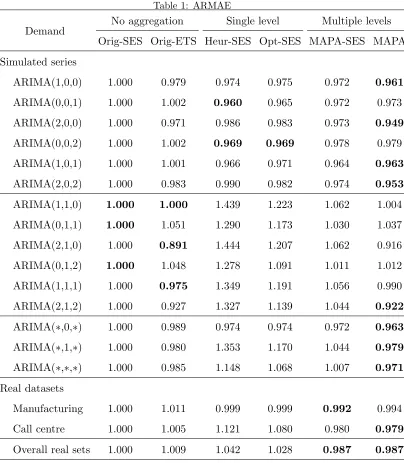
We first focus on table 1 that provides the forecast accuracy. Orig-SES is
used as the benchmark in the calculations and therefore has always an error
equal to 1. Considering the simulated time series with no differencing, there
Table 1: ARMAE
Demand No aggregation Single level Multiple levels Orig-SES Orig-ETS Heur-SES Opt-SES MAPA-SES MAPA
Simulated series
ARIMA(1,0,0) 1.000 0.979 0.974 0.975 0.972 0.961
ARIMA(0,0,1) 1.000 1.002 0.960 0.965 0.972 0.973
ARIMA(2,0,0) 1.000 0.971 0.986 0.983 0.973 0.949
ARIMA(0,0,2) 1.000 1.002 0.969 0.969 0.978 0.979
ARIMA(1,0,1) 1.000 1.001 0.966 0.971 0.964 0.963
ARIMA(2,0,2) 1.000 0.983 0.990 0.982 0.974 0.953
ARIMA(1,1,0) 1.000 1.000 1.439 1.223 1.062 1.004
ARIMA(0,1,1) 1.000 1.051 1.290 1.173 1.030 1.037
ARIMA(2,1,0) 1.000 0.891 1.444 1.207 1.062 0.916
ARIMA(0,1,2) 1.000 1.048 1.278 1.091 1.011 1.012
ARIMA(1,1,1) 1.000 0.975 1.349 1.191 1.056 0.990
ARIMA(2,1,2) 1.000 0.927 1.327 1.139 1.044 0.922
ARIMA(∗,0,∗) 1.000 0.989 0.974 0.974 0.972 0.963
ARIMA(∗,1,∗) 1.000 0.980 1.353 1.170 1.044 0.979
ARIMA(∗,∗,∗) 1.000 0.985 1.148 1.068 1.007 0.971
Real datasets
Manufacturing 1.000 1.011 0.999 0.999 0.992 0.994
Call centre 1.000 1.005 1.121 1.080 0.980 0.979
Overall real sets 1.000 1.009 1.042 1.028 0.987 0.987
the original time series. Initially let us restrict the discussion to SES based
forecasts. For ARIMA(1,0,0) the optimal aggregation level can be calculated.
than Opt-SES, if only marginally. We attribute this to the sampling
uncer-tainty that affects both the identification of the underlying process, but also
for the parameters estimation required to calculate the optimal aggregation
level. This is echoed in the results for ARIMA(0,0,1), where Opt-SES
per-forms worse than Heur-SES. Rostami-Tabar et al. (2013) showed that when
the time series follows MA(1) process it is beneficial to aggregate as much
as possible. Heur-SES does that, always aggregating to k = 13. On the
other hand, Opt-SES because of the sampling uncertainty at times
incor-rectly identifies lower aggregation levels as appropriate. Similar comments
can be made about ARIMA(1,0,1). In general for the remaining processes
that the optimal aggregation level is only approximately identified the
per-formance is similar to Heur-SES. This is reflected in the reported errors for
ARIMA(∗,0,∗).
When the unrestricted MAPA and Orig-ETS are considered, we see that
the former offers substantial gains in accuracy and overall performs best for
ARIMA(∗,0,∗).
When looking at the simulated time series with first order differencing,
it is evident that TA does not perform that well. However, this is to be
ex-pected as Orig-SES is optimal or approximately optimal for these time series,
while forecasts on the temporally aggregated series are produced using
sub-stantially fewer observations. This is particularly evident in the performance
of Heur-SES and Opt-SES. On the other hand, MAPA performs
compara-tively to the forecasts produced on the original time series. This is reflected
in the overall performance for ARIMA(∗,1,∗), where MAPA offers gains over
Across all simulated series, looking at the results for ARIMA(∗,∗,∗) we
observe that MAPA offers performance gains over both SES and
Orig-ETS, demonstrating that TA can be beneficial for demand forecasting
accu-racy. However, MAPA-SES that does not take full advantage of the multiple
views of the time series, being restricted to SES, is marginally worse that
Orig-SES, while both Heur-SES and Opt-SES underperform. Like before, we
attribute this to sampling uncertainties that make the estimation of the true
time series models very challenging.
Looking at the results for the real datasets we observe that the most
accurate forecasts are produced again by MAPA and MAPA-SES, both
out-performing the conventional Orig-SES and Orig-ETS. It is interesting to note
that for the real time series that the underlying process is both unknown,
but also more complex, Orig-ETS performs worse than Orig-SES. In this case
the model selection problem is more acute than for the simulated time series.
On the other hand the multiple time series views afforded by MAPA result
in minimal differences between MAPA and MAPA-SES.
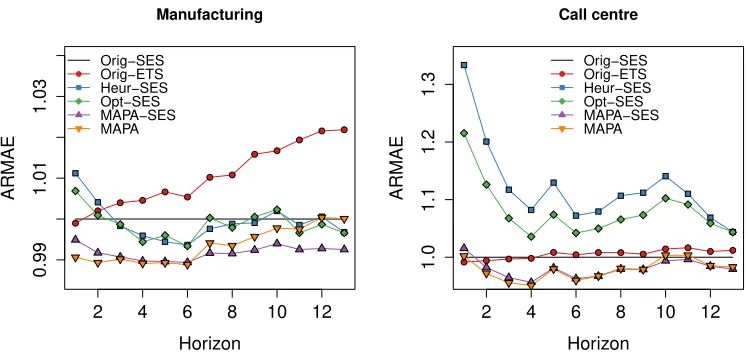
In Figs. 2 and 3 we provide the ARMAE per forecast horizon for the
simulated series, summarised as ARIMA(∗,0,∗) and ARIMA(∗,1,∗), and the
real time series respectively. The horizontal black line is the benchmark
Orig-SES, on which all other accuracies are calculated from.
Observe that for ARIMA(∗,0,∗) TA offers substantial gains. As the
fore-cast horizon increases the relative forefore-casting accuracy as measured by
AR-MAE increases. Notably as forecasts based on TA are build on aggregate
data their good performance for long horizons is to be expected.
fore-ARIMA(*,0,*)
Horizon
ARMAE
2 4 6 8 10 12
0.96 1.00 1.04 Orig−SES Orig−ETS Heur−SES Opt−SES MAPA−SES MAPA ARIMA(*,1,*) Horizon ARMAE
2 4 6 8 10 12
[image:26.612.112.484.138.316.2]1.0 1.4 1.8 2.2 Orig−SES Orig−ETS Heur−SES Opt−SES MAPA−SES MAPA
Figure 2: ARMAE per horizon for simulated ARIMA(∗,0,∗) and ARIMA(∗,1,∗).
casts for ARIMA(∗,1,∗) over the different forecast horizons. At shorter
hori-zons Orig-ETS dominates, but for longer forecast horihori-zons, as the uncertainty
increases, its performance becomes indistinguishable to Orig-SES. The
rela-tive performance of both Heur-SES and Opt-SES to Orig-SES improves as
the forecast horizon increases. This is attributed to the forecasts being
pro-duced at aggregated time series. Opt-SES performs better to Heur-SES over
all horizons, demonstrating that even though the calculation of the optimal
aggregation level is inappropriate, as no exact formulas have been derived for
ARIMA(∗,1,∗) processes, the existing analytical derivations still offer benefits
over Heur-SES, even when applied approximately. Finally the performance
of the two MAPA based forecasts improves over horizons, but as discussed
above, they do not offer benefits of the same magnitude as in the case of
ARIMA(∗,0,∗).
Manufacturing
Horizon
ARMAE
2 4 6 8 10 12
0.99 1.01 1.03 Orig−SES Orig−ETS Heur−SES Opt−SES MAPA−SES MAPA Call centre Horizon ARMAE
2 4 6 8 10 12
[image:27.612.111.485.135.313.2]1.0 1.1 1.2 1.3 Orig−SES Orig−ETS Heur−SES Opt−SES MAPA−SES MAPA
Figure 3: ARMAE per horizon for real datasets.
are both unknown and more complex, making SES suboptimal, demonstrate
the benefits of TA. For the manufacturing dataset all Heur-SES, Opt-SES,
MAPA-SES and MAPA perform better than Orig-SES at most forecast
hori-zons. In contrast, the relative accuracy of Orig-ETS degrades as the the
horizon increases. For the call centre dataset the Heur-SES and Opt-SES
perform worse than the benchmark Orig-SES and Orig-ETS, across all
hori-zons. We attribute this behaviour to the complexity of the original time
series. On the other hand, both MAPA-SES and MAPA, which do not
as-sume a specific underlying model for the series, perform better than the
benchmarks. Finally, we focus on the relative accuracy in the pairs
Orig-SES–MAPA-SES and Orig-ETS–MAPA, where similar shape of behaviour of
errors is observed across horizons, but with the TA based forecasts being in
both cases consistently and substantially better.
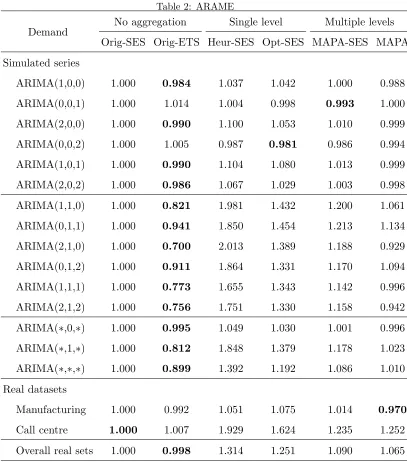
Table 2: ARAME
Demand No aggregation Single level Multiple levels Orig-SES Orig-ETS Heur-SES Opt-SES MAPA-SES MAPA
Simulated series
ARIMA(1,0,0) 1.000 0.984 1.037 1.042 1.000 0.988
ARIMA(0,0,1) 1.000 1.014 1.004 0.998 0.993 1.000
ARIMA(2,0,0) 1.000 0.990 1.100 1.053 1.010 0.999
ARIMA(0,0,2) 1.000 1.005 0.987 0.981 0.986 0.994
ARIMA(1,0,1) 1.000 0.990 1.104 1.080 1.013 0.999
ARIMA(2,0,2) 1.000 0.986 1.067 1.029 1.003 0.998
ARIMA(1,1,0) 1.000 0.821 1.981 1.432 1.200 1.061
ARIMA(0,1,1) 1.000 0.941 1.850 1.454 1.213 1.134
ARIMA(2,1,0) 1.000 0.700 2.013 1.389 1.188 0.929
ARIMA(0,1,2) 1.000 0.911 1.864 1.331 1.170 1.094
ARIMA(1,1,1) 1.000 0.773 1.655 1.343 1.142 0.996
ARIMA(2,1,2) 1.000 0.756 1.751 1.330 1.158 0.942
ARIMA(∗,0,∗) 1.000 0.995 1.049 1.030 1.001 0.996
ARIMA(∗,1,∗) 1.000 0.812 1.848 1.379 1.178 1.023
ARIMA(∗,∗,∗) 1.000 0.899 1.392 1.192 1.086 1.010
Real datasets
Manufacturing 1.000 0.992 1.051 1.075 1.014 0.970
Call centre 1.000 1.007 1.929 1.624 1.235 1.252
Overall real sets 1.000 0.998 1.314 1.251 1.090 1.065
observe that forecast built on the original time series are less biased than
those built on aggregate versions of them, with only some exceptions. On the
are modelled at the original time series, for which the fit will be unbiased. On
the other hand, the TA based forecasts will be unbiased for their respective
levels. This is in agreement with observations by Kourentzes et al. (2014).
For the real time series that the modelling uncertainty is much higher,
MAPA performs well, as it takes advantage of TA to mitigate this. In
con-trast, the processes in the simulated data are relatively simple and therefore
there is limited scope for MAPA to reduce the modelling uncertainty.
6. Conclusions
In this paper we investigated the use of TA for demand forecasting. More
specifically we contrasted two different school of thoughts for how forecasting
can be done using TA: (i) identifying and using a single optimal aggregation
level; and (ii) using multiple levels. Each approach is shown to have its
advantages.
Although theoretically using the optimal level would be advantageous, its
performance is inhibited by two factors. First, analytical derivations exist
only for a limited number of processes. Arguably this is not a substantial
limitation as Rostami-Tabar et al. (2013) has shown a methodology how to
develop the derivations for other processes. Nonetheless, with the available
derivations, currently this TA modelling approach excludes direct modelling
of seasonal time series, which can be important for some applications, and
requires some appropriate pre-processing. Second, identifying the optimal
level assumes knowledge of both the underlying process of the original time
series and of the process at the aggregate level, which both come at high
relatively short. Nonetheless, we demonstrate that there are benefits over a
simple heuristic to identify the aggregation level.
Using multiple TA levels is theoretically suboptimal, in the strict MSE
sense, as the derivations for the optimal levels demonstrate. However, using
multiple levels is particularly able at mitigating the modelling uncertainty.
This is shown to be very useful for real series. In both the manufacturing
and the call centre datasets using multiple temporal aggregation performed
consistently more accurate than the benchmarks, across all forecast
hori-zons. The two datasets exhibit substantial differences in terms of structure,
given the diverse real application they originate from, but also the augmented
Dickey-Fuller test results provided in section 4.1, and naturally the
appro-priate forecasting model is unknown. By using multiple TA levels to produce
the forecasts, we were able to mitigate modelling uncertainty, as compared
against the state-of-the-art selection approach for the exponential smoothing
benchmark, and provide consistently more accurate forecasts. The accuracy
gains are consistent with other application areas reported in the literature.
Irrespectively of which TA approach is used, aggregating a time series
filters elements of the data, thus requiring simpler forecasting models. This
is desirable in practice, as it is evident by the minimal use of complex
fore-casting methods (Weller and Crone, 2012), often attributed to the so called
‘algorithm aversion’ (Dietvorst et al., 2015). We provide further evidence
that this comes at no forecast accuracy costs. In fact, the opposite is true, as
highlighted by our empirical evaluation both on real supply chain data and
the simulated examples.
forecast-ing. The forecasts are by construction reconciled at different planning levels,
short-term corresponding to low levels of TA and long-term corresponding to
higher levels of TA, thus leading to aligned decisions. It is common in
organ-isations that predictions for different objectives and horizons are based on
different forecasting methods, which may result in substantial disagreements
between them. MAPA avoids this problem, providing reconciled forecasts to
support aligned decisions and limiting associated inefficiencies.
We conclude that using TA for demand forecasting is beneficial. There
is adequate evidence to support further research in identifying the optimal
aggregation level, however effort should be made to address the modelling
uncertainty challenge. With regards to MAPA based approaches, we find
them to be a practical approach for taking advantage of TA for forecasting
time series. Using multiple levels is a novel view of how to implement TA,
which has not been investigated in extensively in the forecasting literature
that has primarily looked at the effects of using a single level. We found that
it was at least as good at forecasting at the original time series, and in many
cases substantially more accurate. Therefore additional research should be
done to further develop the approach.
References
Athanasopoulos, G., Hyndman, R. J., Kourentzes, N., Petropoulos, F., et al.,
2017. Forecasting with temporal hierarchies. European Journal of
Opera-tional Research.
aggre-gation on stock control performance of intermittent demand estimators:
Empirical analysis. Omega 40 (6), 713–721.
Barrow, D. K., 2016. Forecasting intraday call arrivals using the seasonal
moving average method. Journal of Business Research 69 (12), 6088–6096.
Barrow, D. K., Kourentzes, N., 2016. Distributions of forecasting errors of
forecast combinations: implications for inventory management.
Interna-tional Journal of Production Economics 177, 24–33.
Blanc, S. M., Setzer, T., 2016. When to choose the simple average in forecast
combination. Journal of Business Research 69 (10), 3951–3962.
Boylan, J. E., Babai, M. Z., 2016. On the performance of overlapping and
non-overlapping temporal demand aggregation approaches. International
Journal of Production Economics.
Burnham, K. P., Anderson, D., 2002. Model selection and multi-model
infer-ence: A practical information-theoric approach. Springer.
Davydenko, A., Fildes, R., 2013. Measuring forecasting accuracy: The case
of judgmental adjustments to SKU-level demand forecasts. International
Journal of Forecasting 29 (3), 510–522.
Dietvorst, B. J., Simmons, J. P., Massey, C., 2015. Algorithm aversion:
Peo-ple erroneously avoid algorithms after seeing them err. Journal of
Experi-mental Psychology: General 144 (1), 114.
and operational research: a review. Journal of the Operational Research
Society 59 (9), 1150–1172.
Gardner, E. S., 2006. Exponential smoothing: The state of the art - part II.
International Journal of Forecasting 22 (4), 637–666.
Green, K. C., Armstrong, J. S., 2015. Simple versus complex forecasting:
The evidence. Journal of Business Research 68 (8), 1678–1685.
Hyndman, R. J., 2016. forecast: Forecasting functions for time series and
linear models. R package version 7.1.
URL http://github.com/robjhyndman/forecast
Hyndman, R. J., Koehler, A. B., Ord, J. K., Snyder, R. D., 2008. Forecasting
with Exponential Smoothing: The State Space Approach. Springer Verlag,
Berlin.
Hyndman, R. J., Koehler, A. B., Snyder, R. D., Grose, S., 2002. A state
space framework for automatic forecasting using exponential smoothing
methods. International Journal of Forecasting 18 (3), 439–454.
Jalal, M. E., Hosseini, M., Karlsson, S., 2016. Forecasting incoming call
volumes in call centers with recurrent neural networks. Journal of Business
Research.
Jin, Y., Williams, B. D., Tokar, T., Waller, M. A., et al., 2015.
Forecast-ing with temporally aggregated demand signals in a retail supply chain.
Kourentzes, N., Petropoulos, F., 2015. Forecasting with multivariate
tempo-ral aggregation: The case of promotional modelling. International Journal
of Production Economics.
Kourentzes, N., Petropoulos, F., 2016. MAPA: Multiple Aggregation
Predic-tion Algorithm. R package version 1.9.1.
URL https://CRAN.R-project.org/package=MAPA
Kourentzes, N., Petropoulos, F., Trapero, J. R., 2014. Improving forecasting
by estimating time series structural components across multiple
frequen-cies. International Journal of Forecasting 30 (2), 291–302.
Kourentzes, N., Svetunkov, I., 2016. TStools: Time Series Analysis Tools
and Functions. R package version 2.1.0.
URL https://github.com/trnnick/TStools
Lapide, L., 2004. Sales and operations planning part I: the process. The
Journal of business forecasting 23 (3).
Luna, I., Ballini, R., 2011. Top-down strategies based on adaptive fuzzy
rule-based systems for daily time series forecasting. International Journal
of Forecasting 27 (3), 708–724.
Ma, S., Fildes, R., Huang, T., 2016. Demand forecasting with high
dimen-sional data: The case of SKU retail sales forecasting with intra-and
inter-category promotional information. European Journal of Operational
Re-search 249 (1), 245–257.
competitive location in mexico. Journal of Business Research 69 (2), 445–
451.
Miyaoka, J., Hausman, W. H., 2008. How improved forecasts can degrade
decentralized supply chains. Manufacturing & Service Operations
Man-agement 10 (3), 547–562.
Mohammadipour, M., Boylan, J. E., 2012. Forecast horizon aggregation in
integer autoregressive moving average (INARMA) models. Omega 40 (6),
703–712.
Nikolopoulos, K., Syntetos, A. A., Boylan, J. E., Petropoulos, F.,
Assi-makopoulos, V., 2011. An aggregate–disaggregate intermittent demand
approach (ADIDA) to forecasting: an empirical proposition and analysis.
Journal of the Operational Research Society 62 (3), 544–554.
Pedregal, D. J., Trapero, J. R., 2010. Mid-term hourly electricity
forecast-ing based on a multi-rate approach. Energy Conversion and Management
51 (1), 105–111.
Petropoulos, F., Kourentzes, N., 2014a. Forecast combinations for
intermit-tent demand. Journal of the Operational Research Society 66 (6), 914–924.
Petropoulos, F., Kourentzes, N., 2014b. Improving forecasting via multiple
temporal aggregation. Foresight: The International Journal of Applied
Forecasting 2014 (34), 12–17.
Petropoulos, F., Kourentzes, N., Nikolopoulos, K., 2016. Another look at
R Core Team, 2016. R: A Language and Environment for Statistical
Com-puting. R Foundation for Statistical Computing, Vienna, Austria.
URL https://www.R-project.org/
Rossana, R. J., Seater, J. J., 1995. Temporal aggregation and economic time
series. Journal of Business & Economic Statistics 13 (4), 441–451.
Rostami-Tabar, B., Babai, M. Z., Syntetos, A., Ducq, Y., 2013. Demand
fore-casting by temporal aggregation. Naval Research Logistics (NRL) 60 (6),
479–498.
Rostami-Tabar, B., Babai, M. Z., Syntetos, A., Ducq, Y., 2014. A note on
the forecast performance of temporal aggregation. Naval Research Logistics
(NRL) 61 (7), 489–500.
Sagaert, Y. R., Aghezzaf, E.-H., Kourentzes, N., Desmet, B., 2017. Temporal
big data for tire industry tactical sales forecasting. Interfaces.
Silvestrini, A., Veredas, D., 2008. Temporal aggregation of univariate and
multivariate time series models: a survey. Journal of Economic Surveys
22 (3), 458–497.
Spithourakis, G. P., Petropoulos, F., Babai, M. Z., Nikolopoulos, K.,
As-simakopoulos, V., 2011. Improving the performance of popular supply
chain forecasting techniques. Supply Chain Forum: an international
jour-nal 12 (4), 16–25.
Syntetos, A. A., Babai, M. Z., Gardner, E. S., 2015. Forecasting intermittent
inventory demands: simple parametric methods vs. bootstrapping. Journal
Syntetos, A. A., Babai, Z., Boylan, J. E., Kolassa, S., Nikolopoulos, K.,
2016. Supply chain forecasting: Theory, practice, their gap and the future.
European Journal of Operational Research 252 (1), 1–26.
Tashman, L. J., 2000. Out-of-sample tests of forecasting accuracy: an
anal-ysis and review. International journal of forecasting 16 (4), 437–450.
Trapero, J. R., Kourentzes, N., Fildes, R., 2012. Impact of information
ex-change on supplier forecasting performance. Omega 40 (6), 738–747.
Trapero, J. R., Kourentzes, N., Fildes, R., 2014. On the identification of sales
forecasting models in the presence of promotions. Journal of the
Opera-tional Research Society 66 (2), 299–307.
Wei, W. W., 1978. Some consequences of temporal aggregation in seasonal
time series models. In: Seasonal analysis of economic time series. NBER,
pp. 433–448.
Weller, M., Crone, S. F., November 2012. Supply chain forecasting: Best
practices & benchmarking study. Tech. rep., Lancaster Centre for