warwick.ac.uk/lib-publications
Original citation:Jones, Glen R., Anastasaki, Athina, Whitfield, Richard, Engelis, Nikolaos, Liarou, Evelina and Haddleton, David M. (2018) Copper mediated reversible deactivation radical polymerization in aqueous media. Angewandte Chemie . doi:10.1002/ange.201802091
Permanent WRAP URL:
http://wrap.warwick.ac.uk/100715
Copyright and reuse:
The Warwick Research Archive Portal (WRAP) makes this work by researchers of the University of Warwick available open access under the following conditions. Copyright © and all moral rights to the version of the paper presented here belong to the individual author(s) and/or other copyright owners. To the extent reasonable and practicable the material made available in WRAP has been checked for eligibility before being made available.
Copies of full items can be used for personal research or study, educational, or not-for profit purposes without prior permission or charge. Provided that the authors, title and full bibliographic details are credited, a hyperlink and/or URL is given for the original metadata page and the content is not changed in any way.
Publisher’s statement:
This is the peer reviewed version of the following article: Jones, Glen R., Anastasaki, Athina, Whitfield, Richard, Engelis, Nikolaos, Liarou, Evelina and Haddleton, David M. (2018) Copper mediated reversible deactivation radical polymerization in aqueous media. Angewandte Chemie . doi:10.1002/ange.201802091. This article may be used for non-commercial purposes in accordance with Wiley Terms and Conditions for Self-Archiving.
A note on versions:
The version presented here may differ from the published version or, version of record, if you wish to cite this item you are advised to consult the publisher’s version. Please see the ‘permanent WRAP url’ above for details on accessing the published version and note that access may require a subscription.
Copper Mediated Reversible Deactivation Radical
Polymerization in Aqueous Media
Glen R. Jones*a, Dr Athina Anastasakib, Richard Whitfielda, Nikolaos Engelisa, Evelina
Liaroua, Professor David M. Haddleton*a
aUniversity of Warwick, Department of Chemistry, Library Road, Coventry, CV4 7AL
bMaterials Research Laboratory, University of California, Santa Barbara, California, 93106, USA
Contents
1. Introduction ... 2
2. General Considerations for Copper Mediated Polymerization in Aqueous Media ... 4
2.1. Desirable Qualities in Aqueous Polymerization Systems ... 4
2.2. Challenges in Conducting Copper Mediated Polymerization in Aqueous Media ... 5
3. Conventional ATRP in Aqueous Media ... 7
4. Activator Regeneration Methods in Aqueous Media... 10
4.1 Initiators for Continuous Activator Regeneration (ICAR) ATRP ... 10
4.2. Activators (Re)Generated by Electron Transfer (AGET/ARGET) ATRP ... 11
4.3 Electrochemically Mediated (eATRP) ... 13
4.4 Photoinduced ATRP ... 14
4.5 Supplemental Activator and Reducing Agent (SARA) ATRP ... 16
5. Aqueous RDRP in the Presence of Metallic Copper (Cu(0)-RDRP) ... 17
5.1 Externally added Cu(0)(wire and powder) ... 17
5.2 In-situ Generation of Cu(0) by Disproportionation of Cu(I) ... 18
5.3 In-situ Generation of Cu(0) by Reduction of Cu(II) ... 21
6. Monomer Scope of Aqueous Cu Mediated RDRP ... 21
6.1. Acrylates, methacrylates and acrylamides ... 21
6.2 Charged Monomers ... 22
6.3 Acidic Monomers... 24
6.4 Current Limitations of Aqueous Cu-mediated RDRP ... 26
7. Summary and Outlook ... 26
Author Information ... 27
Acknowledgments... 29
References ... 30
1. Introduction
Attaining a high degree of control over molecular weight, macromolecular architecture and
chemical functionality using radical polymerizations has been a long standing goal in polymer
deactivation radical polymerization (RDRP) techniques. Broadly speaking, the chemistry of an
RDRP is via a free radical propagating species which exists in an equilibrium with dormant
species. Whilst only a small proportion of chains are actively propagating at any one instant in
time, the interconversion between active and dormant states is relatively fast. This results in
the same probability of growth for each chain yielding polymers with narrow molecular weight
distributions (dispersity) and a number average molecular weight directly correlated with the
ratio between monomer and initiator/RDRP agent.
A particular advantage of RDRP is the ability to control polymerization of vinyl monomers in
aqueous media. The need for sustainable, high capacity and arguably environmentally friendly
chemical processes has led to an increase in the use of water as a reaction medium.[1] If a solvent
is to be used for a chemical reaction, water is inexpensive, non-toxic and readily available.
Water also has many unique properties which suit it to a wide range of chemistries and
substrates: its high specific heat capacity is ideal for reactions which are exothermic, the
solubility of salts allows for many additional effects such as salting-in or salting-out, pH can
be simply varied, solutions can be buffered, and co-solvents can be utilized to further increase
solubility and monomer scope. Crucially, the use of water as a reaction solvent is the ideal
medium for biologically oriented applications – water is the preferred solvent for natural
processes.
Scheme 1. Simplified mechanism of atom transfer radical polymerization (ATRP).
Three main techniques have emerged as the most viable for the polymerization of hydrophilic
monomers in aqueous media: nitroxide mediated polymerization (NMP),[2] reversible addition
fragmentation chain transfer (RAFT) polymerization,[3] and copper mediated polymerization
approaches (ATRP, scheme 1).[4] Both RAFT and NMP have been successfully reported to
proceed in aqueous media with relatively few restrictions, yielding well-defined polymers with
narrow molecular weight distributions and high end group fidelity. On the contrary, copper
mediated polymerization approaches have appeared to be much more sensitive under aqueous
conditions and for a long time were considered too challenging to achieve. However, owing to
polymerizations at very low temperatures and the facile functionalization of the halide end
group, significant attention has been drawn.
Numerous reviews cover ATRP in heterogeneous aqueous media (i.e. dispersed systems),[5]
but to the best of our knowledge none focus on the advances that have been made in copper
mediated RDRP in aqueous solution. This review will focus on the developments of copper
mediated RDRP in homogeneous aqueous media with emphasis given on how to produce
well-defined polymeric materials. Challenges and associated solutions encountered upon conducting
copper mediated polymerization in aqueous media will be critically discussed and evaluated.
The mechanism of this chemistry in aqueous media as well as Iron and Ruthenium Mediated
polymerization has been reviewed elsewhere and will not be the subject of this review.
2. General Considerations for Copper Mediated Polymerization in Aqueous Media
2.1. Desirable Qualities in Aqueous Polymerization Systems
A number of desirable qualities describe an ideal polymerization system in aqueous media.
Broadly speaking: low copper catalyst concentration, high monomer conversions (ideally
>90%), high end group fidelity and low temperatures have all been targets of recent
developments in the field.
Low catalyst concentration is of importance for two main reasons; to reduce cost and to avoid
metal contamination of the final material. Using less catalyst enables a more commercially
exploitable technique, with recent work reducing catalyst concentrations to parts per million
(ppm) levels in aqueous media.[6] Copper can discolour polymers green/brown (depending on
the ligands present) thus additional purification techniques to remove metal contamination
from polymeric products are required. High purity is also particularly required for electronic
and biologically orientated applications and a reduction in catalyst concentration can aid in the
facile preparation of these materials.[7] It is noted copper(II) salts are classified as GRAS
(Generally Regarded As Safe) by the FDA and listed as an essential trace element for most
plant and animal species.[8] However, despite the disadvantage of residual catalyst (including
metal and coordinating ligands), the most toxic component of a radical polymerization is the
monomer (usually activated vinyl monomers such as (meth)acrylates or (meth)acrylamides).
For this reason high monomer conversion is highly desirable as it allows for fewer or less
stringent purification procedures to be used which saves time, energy and reduces cost. Another
is the possibility of in-situ chain extensions to form complex macromolecular architectures. If
polymerization proceeds to high conversion with high end group fidelity (minimal loss of the
ω-end group functionality), the synthesis of well-defined block copolymers in a one pot process
can be achieved by iterative sequential monomer addition, eliminating the need for
intermediate purification steps and thus significantly speeding up the process.
Low temperature polymerization methods are of importance as they allow for the synthesis of
polymers that exhibit thermoresponsive behaviour above certain temperatures in aqueous
media (e.g. PNiPAm) as well as allowing for polymerization to occur in the presence of
biological molecules which could potentially be denatured at elevated temperatures (e.g.
enzymes and therapeutically relevant polypeptides.) Lower temperatures are also favourable in
a number of cases to suppress side reactions.[9] The tertiary alkyl halide initiators/propagating
chains in most Cu-mediated RDRP’s can also undergo side reactions such as hydrolysis or
elimination in aqueous media, resulting in loss of functionality, which is exacerbated at higher
temperatures. Chain-end hydrolysis is discussed in further detail in section 2.2.
Another more recent consideration in RDRP has been the potential to introduce external stimuli
to control the polymerization. Specifically, light, mechanical, and electrochemical stimuli have
been demonstrated to achieve impressive temporal control by switching the polymerization
“on” and “off” upon demand whilst maintaining narrow molecular weight distributions and
high end group functionality, as discussed in subsequent sections of this review.[10]
2.2. Challenges in Conducting Copper Mediated Polymerization in Aqueous Media
ATRP has been reported to have many limitations when carried out in aqueous media.
Reactions were generally found to be faster and exhibit a lower degree of control over chain
length and molecular weight distributions which was ascribed to higher radical concentration
leading to higher rates of radical-radical reaction and side reactions. A number of complex
processes and equilibria which fundamentally control the catalytic process, thereby altering
KATRP in water are shown in scheme 2: hydrolysis or elimination of the R-X or P-X bond,
disproportionation of Cu(I) species to Cu(0) and Cu(II), dissociation of the deactivating Cu(II)
Scheme 2. Mechanism of ATRP with potential side reactions and equilibria in aqueous media: blue: hydrolysis of alkyl halide chain end, red: radical-radical termination reactions, orange: disproportionation of Cu(I), green: dissociation of halide from Cu(II) complex.
Perhaps the most significant side reaction associated with ATRP and copper mediated RDRP
in aqueous media is the solvolytic displacement of halide ligands from deactivating Cu(II)
complexes. For a controlled radical polymerization to take place the concentration of radicals
must remain low in order to reduce radical-radical termination reactions, obviously second
order in [radical]. With ATRP the [radicals] is dictated by KATRP which can be expressed as kact
/ kdeact. kdeact (governed by the concentration of halide containing ‘deactivating’ Cu(II) species)
must be higher than kact in order to keep radical concentration low. In aqueous media a problem
arises because the highly polar nature of water aids the solvation of halide ions through the
formation of hydrogen bonds. This can result in a very high proportion of Cu(II) species,
depending on the ligands used, which cannot transfer a halide to a propagating polymer chain.
Electrochemical investigation of activation and deactivation rates in aqueous media for
common catalyst systems by Fantin et al. demonstrate that deactivation by dissociated complex
is in fact highly efficient, but is hampered by the weak Cu-X bond.[11] It has been suggested
that the free coordination site is then occupied by solvent[12] or by polar monomers.[11, 13]
Hydrolysis of the alkyl halide at the ω chain end can be a significant problem in aqueous media
which results in a loss of end group fidelity as the hydroxyl terminated polymer is unable to
participate in further chain growth. This results in dead chains and broadening of the molecular
weight distribution. The rate of hydrolysis in Cu-RDRP’s has been demonstrated to be
effectively independent of copper concentration,[14] indicating that copper mediated hydrolysis
is not significant, but is of course dependent on the halide (R-Br is more readily hydrolyzed
than R-Cl) and the nature of the monomer used (i.e. the nature of the alkyl halide polymer chain
it has been postulated that the nitrogen atom present in the penultimate monomer unit
undergoes an intramolecular substitution reaction with the polymer chain end, giving a cyclized
structure highly susceptible to hydrolysis.[15] Rapid disproportionation of Cu(I) to Cu(II) and
Cu(0) in water is a further factor that complicates aqueous Cu-RDRP. Although
disproportionation in many organic solvents e.g. toluene and acetonitrile is not appreciable, in
highly polar aqueous media and in the presence of many common ligands it can be significant.
Initially, disproportionation was presented as an undesirable side reaction which should be
avoided, however, recent work showed that it can in fact be beneficial under certain conditions
(see section 5.)
All of these processes can contribute to unbalancing the RDRP equilibrium, resulting in ‘dead’
chains from hydrolysis, altered activator and deactivator concentrations from
disproportionation, and loss of deactivating species from dissociation. The net effect of this is
often seen as a fast polymerization rate and poor control over molecular weight and molecular
weight distributions. Over the past 20 years different approaches to copper mediated RDRP
have been developed which overcome these issues, as described in sections 3, 4, and 5 of this
review.
3. Conventional ATRP in Aqueous Media
Conventional (or normal) ATRP is defined here as a process where Cu(I) is directly introduced
(and NOT generated in situ) in the reaction mixture before the beginning of the polymerization.
On many occasions, an additional amount of Cu(II) is also added in the reaction mixture. Early
work concerning conventional ATRP indicated that the process was not very tolerant to protic
media. A series of reviews discussing controlled/‘living’ polymerization from 2001 cite very
few successfully controlled ATRP processes in water.[5] One of the first reported examples is
the polymerization of hydroxyethyl acrylate (HEA) in the presence of 2,2-bipyridine (bpy), by
Matyjaszewski and coworkers in 1998.[16] Initial, experiments were carried out in bulk
furnishing conversions of ~90% with dispersity values as low as 1.15 measured by size
exclusion chromatography (SEC). When the same experiments were repeated in aqueous
solution (HEA:H2O, 1:1 v/v), broader molecular weight distributions (Đ > 1.30) were
obtained.[16]
In 1999, utilizing a similar system of bpy with Cu(I)Cl and Cu(I)Br, Armes and coworkers
reported the rapid polymerization of poly(ethylene glycol) methyl ether methacrylate
room temperature aqueous ATRP) and high conversions (>95%) were obtained in short time
periods (~20 minutes) with dispersities as low as 1.12.[18] Selected reactions carried out in bulk
were found to be significantly slower than analogous reactions in aqueous media. It was
postulated that differences in the formed copper complexes in water are the reason for the
observed rate acceleration. Similar conditions were also reported to control the polymerization
of sodium methacrylate (NaMA) and 2-(dimethylamino)ethyl methacrylate (DMAEMA),
albeit with significantly lower conversion and higher dispersities, attributed to loss of catalyst
activity through reactions with the functional monomer.[19]
Pyridyl methanimines, as developed by the Haddleton group, showed a number of advantages
over bpy in organic media such as being particularly effective for the polymerization of low kp
monomers such as methacrylates.[20] In a collaboration between Armes and Haddleton, ligands
of this type were used that formed soluble complexes with copper in aqueous solution.[21]
PEGMA was polymerized at 20 °C to high conversions (>90%) in a period of just 5 minutes,
with dispersities between 1.10-1.40. Although pyridyl methanimines might not be expected to
be stable to hydrolysis, the high rate of polymerization means that hydrolysis is negligible
within the timeframe of the reaction and no ligand hydrolysis was observed. This is further
supported by reactions carried out at higher temperatures, which exhibited faster rates but
broader molecular weight distributions.[21]
Poly(acrylamides) have proved to be much more difficult to synthesize by conventional ATRP
in aqueous media.[15, 22] In 2003 Jewrajka and Mandal reported the ATRP of acrylamide (AAm)
in aqueous and mixed aqueous/glycerol systems.[23] Both alkyl chloride and bromide initiators
with bpy both resulted in poor control over polymerization, with dispersities around 1.7 and
low molecular weight tailing evident in SEC chromatograms. A later report using PMDETA
as the ligand achieved a higher degree of control over polymerization (Đ as low as 1.24), albeit
at severely limited conversions (9% in 48 h).[24] Similar trends were also noted by Jiang et al.
using a tetramethylethylenediamine (TMEDA) ligand, with conversions below 20% in most
cases and dispersities between 1.2-1.6.[25] More recently, Broekhuis and coworkers reported
the polymerization of AAm and NiPAm using a Cu(I)X/tris[2-(dimethylamino)ethyl]amine
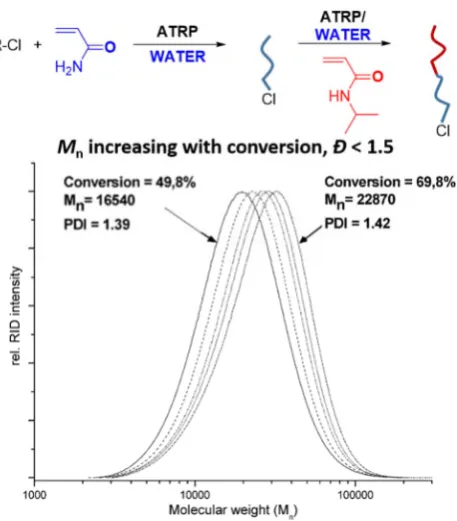
(Me6Tren) catalyst (figure 1).[26] The process exhibited a linear increase of molecular weight
with conversion and reactions proceeded to relatively high conversions, however the degree of
control (Đ > 1.4) is significantly poorer than that normally exhibited for ATRP of
Figure 1. ATRP of AAm and NiPAm in aqueous media. Figure adapted with permission from reference 26. Copyright 2012 American Chemical Society.
Despite some success, particularly with water soluble methacrylates, conventional ATRP in
aqueous environments has been shown to have significant drawbacks such as limited monomer
scope (acrylamide polymerization is not reported to be controlled) and limited demonstration
of end group fidelity. Additionally, despite control over the chain length and dispersity of the
products in certain cases, all of the examples of normal ATRP in aqueous media described
above use at least stoichiometric amounts of copper(I) halide and ligand with respect to the
number of polymer chains. As described in section 2.1, high copper concentrations (typically
~5000 ppm or higher) can be disadvantageous due to the added cost of purification, potential
toxicity, and discolouration of products. Higher catalyst concentrations are necessary in
conventional ATRP due to the high concentration of radicals present during the establishment
of the ATRP equilibrium which leads to radical-radical termination events resulting in an
associated increase in deactivator and decrease in activator, known as the persistent radical
effect (PRE).[27] Using stoichiometric amounts of catalyst ensures there is still sufficient
activating species present at equilibrium. A further reason, particularly noteworthy for
polymerization in aqueous media, is that higher concentration of Cu(II) species in solution will
lessen the observed effect of dissociation, whereby the concentration of halide containing
deactivating Cu(II) species at the dissociation equilibrium is still sufficient to control
[image:10.595.186.415.69.330.2]subsequently developed which utilize external stimuli, either chemical or physical, to
regenerate the active species lost during the initial stages of ATRP (scheme 3), hence allowing
for much lower catalyst concentrations to be employed (section 4).
4. Activator Regeneration Methods in Aqueous Media
Scheme 3. Scheme depicting the numerous methods of activator regeneration used in ATRP.
4.1 Initiators for Continuous Activator Regeneration (ICAR) ATRP
Initiators for continuous Activator Regeneration (ICAR) ATRP, first reported in the mid
2000’s, uses a small amount of free radical initiator which can abstract the bromine atom from
Cu(II) deactivating species to generate Cu(I) activating species. The continuous regeneration
of activating species from deactivating species[28] facilitated by the radical initiator allows for
much lower copper concentrations to be used compared to normal ATRP.[29] In 2012,
Konkolewicz et al. successfully reported the first example of ICAR ATRP in water (figure
2).[6c] In the presence of low copper concentrations (<100 ppm well-defined poly(PEGMA)
was obtained with dispersities between 1.09 and 1.56 (Mn = 37-70 kDa.) The key to controlling
polymerization was found to be addition of a bromide salt, tetraethylammonium bromide
(Et4N+Br-), which reduced the dispersity of the products from ~2 to as low as 1.09. This is
attributed to the bromide ion promoting the formation of the Cu(II) deactivating complex, as
supported by an associated decrease in rate with increasing salt concentration. The work also
kDa, Đ = 1.41) was synthesized and then isolated to yield a macroinitiator used in the further
ICAR ATRP of poly(ethylene oxide) methyl ether acrylate (PEGA) resulting in a block
copolymer (Mn= 40 kDa, Đ = 1.39). Although block copolymer synthesis was successful the
dispersity of the obtained block was 1.39, which is relatively broader than other examples in
aqueous media by other Cu-RDRP techniques, this is likely to be due to the
homopolymerization of PEGA initiated by the ICAR agent, as discussed in the original report
of ICAR ATRP.[29] Thus, ICAR ATRP is a promising technique for controlled polymerization
in aqueous media, but drawbacks including the sacrifice of end group fidelity and dispersity
due to the addition of the free radical initiator would seem to limit its applicability for the
synthesis of high order macromolecular architectures.
Figure 2. Representation of ICAR ATRP in water to synthesize thermoresponsive block copolymers. Figure adapted with permission from reference 6c. Copyright 2012 American Chemical Society.
4.2. Activators (Re)Generated by Electron Transfer (AGET/ARGET) ATRP
Activators generated by electron transfer (AGET) ATRP is a process whereby activator (Cu(I)
species) is generated from an oxidatively stable Cu(II) species through utilization of a reducing
agent. The process was first reported to effectively control polymerization in water in 2006 by
Matyjaszewski and coworkers.[30] Using the air stable Cu(II)/TPMA, ascorbic acid was used as
[image:12.595.145.442.288.577.2]molecular weights of up to 87 kDa with dispersities lower than 1.3. In 2011 Averick et al.
reported polymerization of PEGMA from bovine serum albumin (BSA) modified to contain
alkyl halide initiating motifs in biologically relevant aqueous media, later expanded upon by
Maynard and coworkers.[31] Polymerization was carried out at 30 °C in phosphate buffer
solution (PBS), with Cu(II)/TPMA and ascorbic acid (figure 3). SEC analysis of polymers after
cleavage from the protein yielded dispersities of 1.19, with an Mn of 83 kDa. Synthesis of
protein-polymer hybrids (PPH’s) by this ‘grafting-from’ approach is one of the key benefits of
aqueous ATRP techniques, however copper concentrations in the reaction were very high, with
10 equivalents of Cu(II) per equivalent of initiator, meaning extensive purification of the final
[image:13.595.104.493.291.496.2]PPH was required.
Figure 3: Synthesis of PPHs via (AGET) ATRP from [BSA]-O-iBBr30 and Selective Cleavage of Polymer. Figure adapted with permission from reference 31a. Copyright 2012 American Chemical Society.
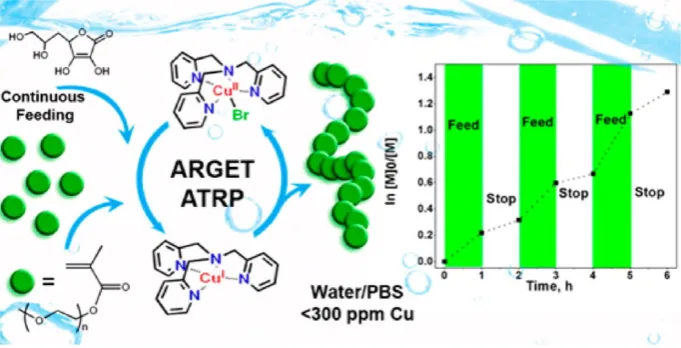
Activators regenerated by electron transfer (ARGET) ATRP follows a similar concept to
AGET. In ARGET the reducing agent is slowly fed into the reaction, thus allowing for lower
copper concentrations to be utilized, as (re)generation of Cu(I) from Cu(II) can occur
throughout the reaction. Commonly employed reducing agents include FDA approved tin(II)
2-ethylhexanoate (Sn(EH)2), ascorbic acid, and reducing sugars such as glucose.[32] In contrast
to ICAR, ARGET is better suited to the preparation of block copolymers as the means of
reducing deactivator cannot initiate homopolymerization during the formation of the second
Figure 4: Aqueous ARGET ATRP of PEGMA utilizing Cu/TPMA catalyst system, demonstrating temporal control. Figure adapted with permission from reference 33. Copyright 2012 American Chemical Society.
Aqueous ARGET ATRP was first reported in 2012 by Matyjaszewski and coworkers.[33] As
opposed to ARGET ATRP carried out in organic media, aqueous ARGET ATRP is much more
sensitive and relies on a number of factors including gradual feeding of the reducing agent and
addition of a simple halide salt. A Cu/TPMA catalyst system was selected due to its stability
at low concentrations and negligible disproportionation in aqueous media. It was demonstrated
that feeding of the reducing agent (ascorbic acid) so that reduction occurred at a steady rate
throughout the polymerization gave better control, in line with previous studies.[31a]
Experiments in which feeding was not used resulted in poor control, attributed to significant
termination events with the Cu/TPMA catalyst. In agreement with the previously discussed
report on aqueous ICAR ATRP it was found that ARGET ATRP also required the presence of
a halide salt in solution to provide halide ions which promote deactivator formation.
Polymerization of PEGMA proceeded to conversions of ~70% with dispersities of 1.3 and
below at a reaction temperature of 30 °C. Temporal control of the reaction was demonstrated
by stopping and starting the feed of reducing agent, with a decrease in rate associated with the
ceased addition of ascorbic acid (figure 4), although the control was not as pronounced as other
techniques which have since been developed.
4.3 Electrochemically Mediated (eATRP)
Electrochemical ATRP (eATRP) reversibly generates Cu(I) species from air-stable Cu(II) by
applying an electrochemical potential.[34] Varying the applied potential can effectively control
the rate of polymerization. Furthermore, cycling between time periods of applied potential and
periods of no potential show that polymerization is slowed when electrochemical regulation
[image:14.595.129.470.72.246.2]Following on from the initial report of copper based eATRP in organic media, Matyjaszewski
and coworkers expanded the technique to the polymerization of PEGMA in aqueous media.[35]
Reactions were conducted with a Cu/TPMA catalyst in water with various electrolytes
including tetraethylammonium tetrafluoroborate (Et4N+BF4-), PBS buffer and Et4N+Br-. As
with the polymerization of methyl acrylate (MA) reported in organic media, increasing the
magnitude of the applied potential was found to increase the rate of the polymerization,
however in aqueous media it was found that a high rate had negative consequences on the
degree of control over the polymerization. EApp of -0.55 V (vs. standard calomel electrode)
yielded poly(PEGMA) with a dispersity of 1.58, decreasing EApp to -0.31 V decreased the rate
of polymerization but had little effect on the degree of control (Đ = 1.53). Further reduction of
EApp to -0.21 V again showed a decrease in rate but with a marked increase in control (Đ =
1.16) at 99% monomer conversion. Low levels of control at higher applied potential is
attributed to increased bimolecular termination reactions at higher radical concentrations. One
of the drawbacks of this protocol is the use of platinum electrodes, which is present an obstacle
to larger scale synthesis due to cost. In 2016 Isse and coworkers demonstrated that eATRP
could also be conducted with non-noble metals such as NiCr and stainless steel by using a
simplified reaction setup (an undivided cell and galvanostatic mode).[36]
Aqueous eATRP has also been reported to control the polymerization of acrylamides,
significant due to the inability of many other ATRP techniques to effectively control the
polymerization of this class of monomer.[37] In one report Chmielarz et al. investigated
polymerization of AAm in mixed aqueous media (10 % v/v dimethyl formamide (DMF)). Of
the catalysts employed, Cu/Me6Tren catalyst system exhibited the best degree of control (Đ as
low as 1.09). In-situ chain extension with NiPAm demonstrated retention of the halide end
group, however conversions of AAm were not reported to be quantitative, resulting in the
second block being a statistical copolymer of AAm and NiPAm. Chain extension by means of
isolating a polyacrylamide macroinitiator was not reported, indicating that aqueous eATRP is
perhaps not an ideal approach for the synthesis of well-defined acrylamide block copolymer
architectures.
4.4 Photoinduced ATRP
External regulation of RDRP’s by photochemical mediation has attracted considerable
attention in recent years due to wide availability, environmental benignity and the possibility
relies on free amine ligand in solution that is able to reduce Cu(II) species to Cu(I) when in a
photoexcited state.
Photoinduced ATRP was first reported in aqueous media in 2015 by Matyjaszewski and
coworkers, promoted by visible light and a Cu(II)X2/TPMA catalyst.[6a] PEGMA was able to
be polymerized to high molecular weights (Mn > 100 kDa) with dispersities as low as 1.07. The
key to controlling the reaction was found to be addition of an additional halide salt, which
offsets the dissociation of Cu(II) species in aqueous media, as discussed in section 2.2. End
group fidelity was demonstrated through chain extension of an isolated macroinitiator with a
lower molecular weight PEGMA monomer to yield block copolymers with high molecular
weight (Mn = 139 kDa, Đ = 1.22). Temporal control was also demonstrated by cycling the
reaction between periods of illumination and darkness.
Figure 5: Scheme demonstrating reduction of Cu(II) by photoexcitation of ligand in photo ATRP, and demonstration of temporal control. Figure adapted with permission from references 6a and 6b. Copyright 2015 &
2016 American Chemical Society.
An initial report by Haddleton and coworkers of photo polymerization of acrylates using a UV
activated Cu(II)Br2/Me6Tren catalyst system found that reactions using these conditions were
uncontrolled in water with dispersities >2, despite the high degree of control and synthetic
[image:16.595.175.424.318.606.2]utilizing this catalyst system found that drastically increasing the catalyst concentration was
able to effectively control the polymerization of PEGA, indicating that dissociation of the
Cu(II)X2/L species is responsible for the poor control initially observed.[6b] Catalyst
concentrations were reduced significantly whilst maintaining control over the polymerization
by addition of sodium bromide, whereby the addition of excess free halide in solution drives
the dissociation equilibrium to the dissociated species capable of deactivating propagating
radicals (see section 2.2.) Three equivalents of sodium bromide with respect to initiator resulted
in poly(PEGA) with dispersities as low as 1.11 at a copper concentration of 67 ppm. Control
over polymerization was demonstrated at copper concentrations as low as 26 ppm. The
technique was also demonstrated to be able to polymerize HEA and 3-sulfopropyl acrylate
potassium salt with a similar degree of control. Quantitative monomer conversion was achieved
for all polymerizations of PEGA, a feature which was exploited for an in-situ chain extension
to demonstrate high end group fidelity. Temporal control over the reaction was found to be
good, with no conversion of monomer detected during periods in which the reaction vessel was
transferred to a dark room (figure 5), even over an extended period of time (6 hours).
4.5 Supplemental Activator and Reducing Agent (SARA) ATRP
Supplemental activator and reducing agent (SARA) ATRP utilizes a species which can reduce
deactivator to activator in a similar manner to ARGET (section 4.2), whilst also activating alkyl
halides independent of other ATRP components. Most reports concerning SARA ATRP utilize
Cu(0) as the SARA agent, however due to the large body of work associated with aqueous
RDRP in the presence of Cu(0) and the mechanistic debate within the literature,[4b]
Cu(0)-RDRP is treated separately in section 5.
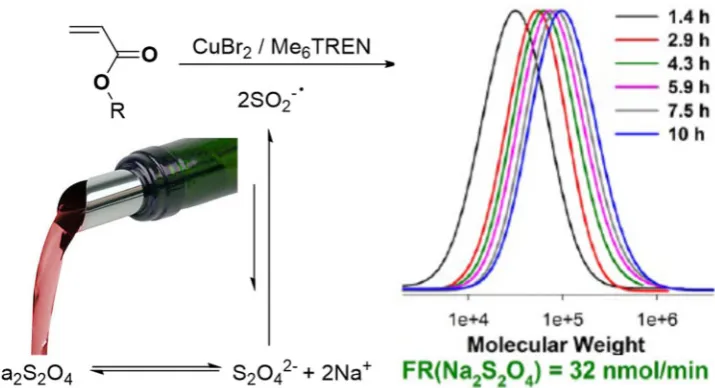
Matyjaszewski and coworkers introduced inorganic sodium sulfites (a common additive in
wine making) as SARA agents, which have been demonstrated to reduce Cu(II) to Cu(I) and
activate alkyl halides.[40] Polymerization of MA in organic media was demonstrated using
various sulfites with a CuBr2/Me6Tren catalyst. More recently sodium sulfites have been
utilized for SARA ATRP in aqueous media, as shown in figure 6.[41] Aqueous SARA ATRP
was carried out using TMPA instead of Me6Tren, in an effort to avoid disproportionation of
Cu(I) formed from reduction of Cu(II). Both PEGA and PEGMA were polymerized with
dispersities of ~1.20 and the polymerization rate could be slowed by stopping the feeding of
Figure 6: SARA ATRP utilizing sodium sulfite, a common additive in wine making, to reduce Cu(II) and form radicals from alkyl halides. Figure adapted with permission from reference 41. Copyright 2017 Royal Society of
Chemistry.
5. Aqueous RDRP in the Presence of Metallic Copper (Cu(0)-RDRP)
RDRP in the presence of metallic copper was first reported Matyjaszewski in 1997 for bulk
polymerizations,[42] with the intention of utilizing Cu(0) as a reducing agent to reform Cu(I)
from Cu(II) during polymerization in a process similar to ARGET-ATRP. Matyjaszewski and
coworkers noted enhanced rates and control over polymerizations in which Cu(0) was present.
In 2006 Percec and coworkers reported an “ultrafast” polymerization system using Cu(0) in
dimethyl sulfoxide (DMSO).[43] Cu(0) mediated techniques in water can be broadly
differentiated by the source of Cu(0) in the reaction, either externally added sources such as
copper wire or powder, or in-situ generated particles through disproportionation or reduction
reactions of higher oxidation state copper species.
5.1 Externally added Cu(0)(wire and powder)
The first reported method of conducting Cu(0)-RDRP in water was through use of an external
source of Cu(0), commonly in the form of copper wire or copper powder. Early examples
include the polymerization of DMAm and NiPAm in a mixed solvent system of methanol
(MeOH) and water.[44] Experiments with increasing water concentration dramatically increased
the dispersity of the final product (Đ = 1.12 in pure MeOH, Đ = 1.68 in 30/70 MeOH/H2O),
indicating a clear loss of control in aqueous environments. Uncontrolled polymerization was
also reported for Cu(0) wire mediated RDRP of HEA in water, in which it was noted that an
In contrast, Cu wire catalyzed polymerization of PEGA in water has been reported to proceed
to high conversions (>90%) with good control (Đ ~ 1.25).[46] Utilization of halide salts has also
enabled controlled polymerization of PEGA at ppm copper concentrations.[47]
2-(hydroxypropyl) methacrylamide, a monomer of considerable interest due to the
biocompatibility and non-toxic nature of its polymers, has been reported to proceed in water in
a copper wire catalyzed polymerization, however dispersities were around 1.4.[48]
5.2 In-situ Generation of Cu(0) by Disproportionation of Cu(I)
In 2013 Haddleton and coworkers introduced a new protocol for Cu(0) mediated RDRP in
aqueous media, utilizing in-situ generation Cu(0), where Cu(0) is formed from the rapid
disproportionation of Cu(I) prior to addition of monomer and initiator.[9a] The
disproportionation equilibrium of Cu(I) in water in the presence of aliphatic tertiary amine
ligands is extremely high, with kdisp of the order of 106. This is altered when an excess of
complexing ligand is present, dependent on the relative stabilization of Cu(I)X/L species to
Cu(II)X2/L species. By utilizing Me6Tren, a ligand which greatly stabilizes Cu(II) in water,
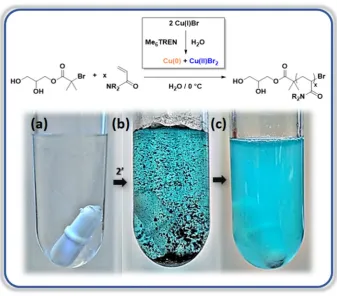
Cu(I)Br was shown to disproportionate in pure water on a timeframe of a few seconds (figure
7), generating metallic Cu(0) particles and Cu(II)Br2/Me6Tren. This disproportionated mixture
was subsequently deoxygenated by ‘sparging’ with nitrogen for up to15 minutes. An aqueous
deoxygenated solution of monomer and alkyl halide initiator was then injected into the
predisproportionated catalyst mixture triggering polymerization. Control over polymerizations
was shown to be excellent, with dispersities below 1.10 even at quantitative monomer
Figure 7: Polymerization of an acrylamide via pre-disproportionation of Cu(I)Br. (a) aqueous solution of Me6Tren. (b) Cu(0) particles and Cu(II) complex after addition of Cu(I)Br. (c) solution after addition of monomer
and initiator. Figure in part adapted with permission from reference 49c. Copyright 2016 Royal Society of
Chemistry.
Numerous monomers have been successfully polymerized using this technique, including
various acrylamides,[9a, 49] acrylates, methacrylates,[50] methacrylic zwitterionic monomers,[51]
polyoxazoline macromonomers,[52] and glycomonomers[53] at room temperature or below. A
significant advantage of the pre-disproportionation protocol is the ability to control the
synthesis of poly(acrylamides), a class of monomer shown to be problematic for many by
traditional ATRP techniques in both aqueous and organic media. The reaction has been
demonstrated to be tolerant to multiple functional groups, with examples of controlled
polymerization in biologically relevant aqueous environments such as PBS and blood serum.[54]
In addition to this the Haddleton group also reported controlled Cu(0)-RDRP in alcoholic
beverages (mixed ethanol-water binary solvents between 3 and 50 vol% ethanol),[55] in which
it was noted that carbonated solvents (including carbonated drinking water) allowed for both
controlled polymerization and in-situ depolymerization, a very unusual phenomenon which has
[image:20.595.128.466.71.367.2]Retention of chain-end functionality at conversions close to 100% is not a common feature of
Cu mediated RDRP techniques in aqueous media, due to hydrolysis of the alkyl halide ω chain
end (see section 2.2). In order to reduce the rate of hydrolysis and increase the end group
functionality the polymerizations were performed in an ice bath rather than room temperature.
This allowed the synthesis of one-pot block copolymers using a wide range of monomers.[9a,
49] The ability of the technique to provide access to high-order block copolymer architectures
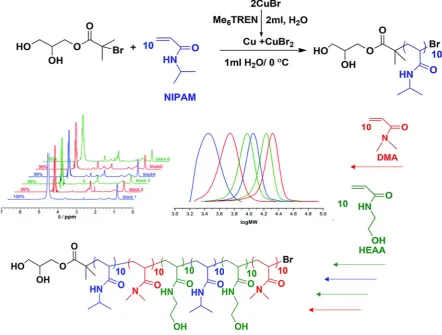
was best exemplified by Alsubaie et al. yielding decablock copolymers prepared in one pot in
very short time periods (Figure 8).[57] Timing of sequential additions of monomer was found to
be crucial to controlling polymerization, as leaving the reaction under conditions where [M]~0
leaves the bromide chain end susceptible to hydrolysis and side reactions.[58] Synthesis of other
complex macromolecular architectures have also been reported, including multiblock star
copolymers by Becer and coworkers[59] and well-defined polymer-protein bioconjugates by
[image:21.595.73.516.350.685.2]Wilson, Davis and Haddleton.[60]
Figure 8. Synthesis of multi-block copolymers composed of NiPAm, DMA and HEAm by iterative Cu(0)-RDRP in H2O, showing 1H NMR spectra and evolution of molecular weight by DMF SEC. Figure Adapted with
Aqueous Cu(0)-RDRP by pre-disproportionation has the distinct benefit of being applicable to
a wide range of monomers (particularly acrylamides) and being ideal for in-situ block
copolymerizations despite the susceptibility of the bromide ω chain end to hydrolysis.[15, 22a] In
terms of copper concentration, aqueous Cu(0)-RDRP typically use around 0.4 equivalents of
Cu(I)Br relative to initiator, this is an improvement over traditional ATRP techniques which
are usually stoichiometric with respect to copper. However it is still significantly higher than
activator regeneration ATRP methods which are typically conducted at ppm copper
concentrations (~0.02 eq. relative to initiator.)
5.3 In-situ Generation of Cu(0) by Reduction of Cu(II)
In 2016 Monteiro and coworkers reported a novel method of aqueous Cu(0)-RDRP of NiPAm
utilizing in-situ generated Cu(0) particles obtained via reduction of Cu(II)Br2 with NaBH4.[61]
The reduction of Cu(II) to Cu(0) was shown to be quantitative and as a result of this the ratio
between Cu(0) and Cu(II) in polymerizations could be tuned by simply changing the
stoichiometry between NaBH4 and Cu(II). Polymerization of NiPAm was demonstrated to
proceed to conversion close to 100% in just a few minutes with good agreement between
theoretical and experimental molecular weights. Furthermore, the end group fidelity was also
shown to be high (~95% at conversions approaching 100%) through matrix-assisted laser
desorption/ionization time of flight mass spectrometry (MALDI-ToF MS) of samples
‘end-capped’ by a thio-bromo substitution reaction to eliminate hydrolysis.[14] This technique is one
of the few Cu-mediated protocols shown to be effective for polymerizing an acrylamide
monomer, however the scope currently only encompasses PNiPAm at relatively low molecular
weights (Mn < 5 kDa) with no demonstration of chain extension, despite the high end group
fidelity reported.
6. Monomer Scope of Aqueous Cu Mediated RDRP
6.1. Acrylates, methacrylates and acrylamides
The main focus of this review has examined in detail the polymerization of methacrylate,
acrylate and acrylamide monomers in aqueous solution; all of which can yield water soluble
materials with wide ranging uses. Controlled polymerization of (meth)acrylates has been
successful with many of the techniques described, whereas acrylamide polymerization is more
problematic, with far fewer reports. However, the development of Cu(0)-RDRP via in-situ
quantitative conversion and end group fidelity; also yielding similar results for the
polymerization of (meth)acrylates.
Successful aqueous Cu-mediated RDRP also enables the polymerization of charged and acidic
monomers, which often have poor solubility in organic solvents. The following sections will
discuss and examine some of the Cu-mediated RDRP techniques which have enabled advances
in the polymerization of challenging monomers, for example monomers containing cationic
amine moieties, acidic groups, and zwitterionic characteristics.
6.2 Charged Monomers
Due to the limited solubility of charged and zwitterionic monomers in organic solvents, the
polymerization of this monomer family is typically limited to aqueous solution, with many
examples carried out in solvent mixtures commonly of water with DMF, MeOH or isopropanol.
The polymerization of these monomers and aqueous media in general is incompatible with
anionic polymerization and is also challenging with controlled radical polymerization
conditions vary significantly between those used for positive, negative and zwitterionically
charged monomers. These monomers can often be hygroscopic, difficult to handle, and contain
acidic functionalities (see subsequent section), for example sulfonates and phosphonates which
can provide further challenges and compete with the ligand for complexation to the copper
catalyst.
The first example of the polymerization of a charged monomer in purely aqueous solution was
in 2000 by Armes,[62] who reported the polymerization of methacryloxyethyl phosphocholine
(MPC). The issues surrounding the spontaneous uncontrolled polymerization of this monomer
were overcome by the rapid rate of ATRP polymerization, yielding 90% conversion in 5
minutes at ambient temperature. These reactions utilized a Cu(I)Br, bpy catalytic system and
in all cases illustrated a conversion greater than 96%, but only low molecular weights were
targeted (less than 10 kDa) and some degree of control was lost at the higher end of this range
with dispersity of 1.4 for those greater than 7 kDa. The work was later expanded to higher
molecular weights, by fine tuning the ratio of initiator to copper to ligand, yielding higher
molecular weights (Mn = 22 kDa , dispersity 1.26).[63] The group subsequently showed the
presence of end group fidelity by chain extension of PMPC (DP20, 99% conversion, Mn = 6
kDa, Ð = 1.12) with OEGMA generating a well-defined block copolymer (Mn = 16 kDa, Ð =
1.27),[64] and also illustrated the first example of a block copolymer of two zwitterionic
hydroxide (SBMA) as the second block. Note however that higher molecular weights, and a
broader scope of block copolymers could only be achieved by utilizing methanol or methanol
water mixtures.[63, 65] The copolymerization of SBMA (also known as
N,N-dimethyl-N-methacryloyloxyethyl-N-sulfobutyl ammonium (DMBS)) and acrylamide has also been
reported utilizing Cu(0)-RDRP in aqueous media, utilising Cu(0) powder and CuCl2/Me6Tren
as the catalyst.[66] Both PMPC and PSBMA were homopolymerized by Simula et al,[51] utilizing
the predisproportionation of Cu(I)Cl in the presence of Cu(II)Cl and PMDETA.
Other reports of charged methacrylates include the synthesis of well-defined
poly(2-[(methacryloyloxy)ethyl]trimethylammoniumdimethylaminoethyl methacrylate
chloride)(MeDMA) (the quaternized form of PDMAEMA) in aqueous solution utilizing
aqueous ATRP, with a Cu(I)Br catalyst and bpy as the ligand at room temperature.[67] All
reactions proceeded to high conversions (>90%) and were reasonably well controlled with
dispersities of 1.20-1.30. However, similarly to previous reports, to prepare well-defined block
copolymers solvent mixtures of water with methanol or isopropanol was required. Later, the
synthesis of star polymers of MeDMA were reported with similar polymerization
conditions.[68]
The most successful report to date is the polymerization of acryloyl phosphatidyl chloride
(APC), a zwitterionic acrylate monomer containing ammonium and phosphate functionalities
via aqueous Cu(0)-mediated LRP, generating PAPC up to DP50 with dispersities in the range
of 1.07-1.22.[49b] This is the only example of a zwitterionic polymer synthesized with
Cu-mediated RDRP that has a dispersity of less than 1.10, but as in previous cases increasing the
molecular weight further resulted in a reduction in conversion and a loss of control. However,
charged or zwitterionic acrylamides and methacrylamides are even less explored than
methacrylates and acrylates, with the only example up to date being the use of carboxybetaine
functionalized acrylamide and methacrylamides by Edlund et al, utilizing Cu(0) wire, a
hemicellulose macroinitiator and Me6Tren as the ligand.[69] Pseudo first order kinetics were
observed for both monomers, with conversions of greater than 90% achieved suggesting a good
degree of control over the process, however no SEC data was reported. Further examples are
limited to solvent mixtures, with poly(3-acrylamidopropyl)-trimethylammonium chloride
synthesised and chain extended in water ethanol mixtures via Cu(0)-RDRP, illustrated high
end group fidelity at 90% conversion yielding block copolymers with a dispersity of around
There are many remaining challenges in the synthesis of charged polymers in pure water via
Cu-mediated RDRP, with limited successful reports to date. The synthesis of block copolymers
and molecular weights higher than 15 kDa for homopolymers is challenging with broad
dispersities common, showing there are many remaining avenues of improvement to optimize
[image:25.595.158.442.181.485.2]this important group of monomers.
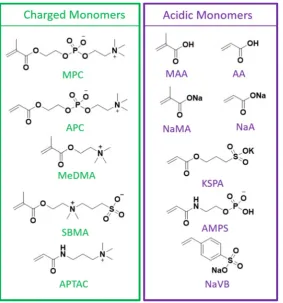
Figure 9. Examples of charged and acidic monomers successfully polymerized by aqueous Cu-mediated RDRP.
6.3 Acidic Monomers
Polymerization of acidic monomers by Cu-RDRP is challenging in both organic and aqueous
media. Most reports of controlled polymerizations are of monomer salts, in which the acidic
moiety is not protonated (figure 9).
The first example of ATRP of an acidic monomer was by Armes and coworkers in 1999.[19]
NaMA, the sodium salt of methacrylic acid (MAA), was polymerized in aqueous media using
Cu(I)Br and bpy. Molecular weights of up to 7.3 kDa were successfully prepared with good
conversions (50-80%) with a high degree of control (Đ = 1.20-1.30) However, targeting higher
molecular weights resulted in a loss of control with Đ > 2. pH was found to be a critical
parameter for successful polymerization as no polymerization was observed below pH 6, at
polymerization, in which it is favourable to polymerize MAA at low pH, to avoid a build-up
of anionic charge on the polymer backbone. The same group also reported the polymerization
of sodium 4-vinylbenzoate in aqueous solution (pH 11), using Cu(I)Br as the catalyst, a PEG
functionalized isobutyrate or sodium 4-(bromomethyl)benzoate as an initiator at ambient
temperature, illustrating linear kinetics and an Mn close to theory, even at very high conversions
(>95%, Ð =1.30).[71]
Cu(0)-RDRP utilizing predisproportionation of Cu(I)Br has been reported to be efficient for
the polymerization of the sodium salt of 2-acrylamido-2-methylpropane sulfonic acid
(NaAMPS), an important monomer in a variety of biological and industrial applications.[72]
Nikolaou et al. demonstrated the polymerization of NaAMPS with molecular weights up to 30
kDa with dispersities below 1.30.[49b] A monomer with similar functionality, sulfopropyl
acrylate potassium salt (KSPA), was reported to polymerize with a similar degree of control
utilizing the predisproportionation of Cu(I)Br in the presence of Me6Tren with a dispersity of
1.20 for DP40. As target DP was increased beyond 80, control was also lost with dispersities
greater than 1.50 illustrated in all cases. Low molecular weight PKSPA has also been
successfully reported by photoinduced ATRP.[6b]
Direct polymerization of acidic monomers in their protonated form, such as MAA or acrylic
acid (AA), was commonly considered to be impossible for most copper mediated RDRP
systems, due to protonation of the ligand at the low pH required. Even in organic media only a
small amount of MAA can be copolymerized whilst retaining control.[73] Direct polymerization
is attractive as kp can be higher for the protonated monomer (10 times higher in the case of
MAA vs. NaMA),[74] polymerization is not inhibited by build-up of anionic charge on the
polymer backbone, complexation to copper will be significantly lessened, and no titration of
the final product is required. In 2015 Fantin et al. conducted an electrochemical investigation
into three commonly used catalyst systems in aqueous ATRP: CuX/Me6Tren, CuX/PMDETA,
and CuX/TPMA, and found that polymerizations of PEGMA with TPMA could proceed
effectively at low pH (1.5).[75] This apparent stability at low pH was subsequently used to
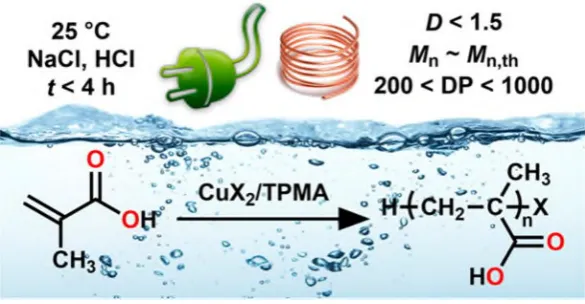
demonstrate the polymerization of MAA in acidic aqueous solution using eATRP and
Cu(0)-RDRP (figure 10).[76] Conducted at low pH (~1), poly(MAA) was prepared with molecular
weights up to 87 kDa, with varying degrees of control (Đ = 1.33->2.0). However, initiator
efficiencies varied significantly, in some cases being greater than 100%. Despite the high
conversions attained in some cases, no chain extensions are reported either in-situ or from an
Figure 10. Aqueous e-ATRP and Cu(0)-RDRP of MAA. Figure reprinted with permission from reference 76. Copyright 2016 American Chemical Society.
6.4 Current Limitations of Aqueous Cu-mediated RDRP
Despite the massive advancements made in controlled polymerization in aqueous media using
copper catalysts, there are still a number of challenges to be overcome, most of which relate to
monomer scope; some classes of monomer have yet to be polymerized with high degrees of
control.
Polymerization of N-vinyl monomers such as N-vinyl pyrrolidone (NVP) is challenging by
Cu-mediated RDRP; this is due to lack of resonance stabilization of the generated radicals and
strongly electron donating pendant groups, which makes them highly reactive and means that
end group fidelity is compromised by radical-radical termination, chain transfer reactions and
hydrolysis.[77] Few reports also exist of the successful polymerization of methacrylamides,
either in aqueous or organic media, with results in aqueous media showing linear kinetics but
a lack of control over molecular weight distributions (Đ = 1.47->2.0).[48] These two monomer
classes could be particularly useful as their polymers exhibit good water solubility and can
exhibit interesting biological behaviour.[48, 78] The controlled polymerization of charged
monomers to high molecular weights with degrees of control similar to uncharged water
soluble monomers is another key area that needs development in the field of aqueous
Cu-mediated RDRP.
7. Summary and Outlook
Aqueous Cu-RDRP has seen very encouraging advances since the first report of ATRP in
aqueous media. Many techniques have been developed which yield high levels of control over
chain length, molecular weight distribution, and macromolecular architecture. Activator
give better control than ever before, and the advent of aqueous Cu(0)-RDRP has made great
advancements in the synthesis of block copolymers thanks to retention of halide end groups at
quantitative monomer conversions. However, a number of challenges still remain. Important
classes of monomers such as NVP and methacrylamide that yield biologically relevant
polymers are still relatively poorly reported in Cu-RDRP and have not been optimized to the
same extent that other monomer classes have, with work to date reporting mostly uncontrolled
polymerizations. There are also limited successful reports of the polymerization of acidic and
charged monomers in solution and no examples of block copolymer synthesis with protonated
acidic monomers. Further challenges surrounding the uncontrolled spontaneous
polymerization of zwitterionic monomers in water has also not been surmounted. Techniques
which have demonstrated excellent qualities such as ultra-low catalyst loadings and high
conversions have often only been optimized for one or two monomer classes. An ideal aqueous
transition metal mediated system able to control the polymerization of a wide range of
(meth)acrylates, (meth)acrylamides, charged, acidic and N-vinyl monomers to quantitative
conversions with high end group fidelity at ppm catalyst concentrations still remains elusive.
Author Information
Athina Anastasaki is currently a Global Marie Curie and an Elings Fellow working alongside Professor Craig Hawker at the University of California, Santa Barbara. Prior to this appointment, she completed her PhD studies in the University of Warwick under the supervision of Professor Dave Haddleton and she was awarded (by RSC) the prize for the best PhD in Polymer Chemistry in the UK (2015). Her research focuses on controlled radical polymerization strategies for the synthesis of complex architectures for a wide range of applications.
Richard Whitfield was born in the town of Grantham, Lincolnshire and commenced his chemistry studies at Durham University, receiving his Master’s degree in 2014. He completed a final year project under the supervision of Dr. Ezat Khosravi utilizing thiol-ene click chemistry in the synthesis of thermosetting materials for coating applications. Later that year Richard joined the group of Professor David Haddleton to undertake a PhD at the University of Warwick, developing copper mediated polymerization strategies. His further research interests include polymer/RNA complexation and release strategies.
Evelina Liarou was born in Athens, Greece, in 1991. She graduated from the University of Patras in 2014. In 2016, she received her Master’s Degree (1st Class Honours) in Polymer Chemistry from the University of Athens, where she worked on multifunctional polypeptides and drug delivery systems, under the supervision of Professor Hermis Iatrou. As of October 2016, she is a PhD student at the University of Warwick under the supervision of Professor David Haddleton, focusing on polymer-protein conjugates, drug delivery systems and controlled radical polymerization.
David Haddleton was born in Birmingham, UK in 1962. He graduated from the University of York in 1986 with a PhD in organometallic photochemistry under the supervision of Professor Robin Perutz FRS. He spent time in industry at ICI and has been at the University of Warwick since 1993 promoted to full Professor in 1998. He leads a thriving and challenging team of young scientists at Warwick University, is currently CSO of a spin off company Medherant Ltd concerned with transdermal drug delivery. He was Editor in Chief of the RSC journal Polymer Chemistry until 2017.
Acknowledgments
We would like to thank the University of Warwick (GRJ, RW, NE, EL), the Lubrizol Corporation (GRJ, NE) and Syngenta (RW) for financial support. A. A. acknowledges the Global Marie Curie Fellowship for financial support (BINAMA EC 705041).
This project has received funding from the European Union’s Horizon 2020 and innovation
References
[1] H. C. Hailes, Org. Process Res. Dev. 2007, 11, 114-120.
[2] aC. J. Hawker, A. W. Bosman, E. Harth, Chem. Rev. 2001, 101, 3661-3688; bJ. Nicolas, Y.
Guillaneuf, C. Lefay, D. Bertin, D. Gigmes, B. Charleux, Prog. Polym. Sci. 2013, 38, 63-235.
[3] aJ. Chiefari, Y. Chong, F. Ercole, J. Krstina, J. Jeffery, T. P. Le, R. T. Mayadunne, G. F. Meijs, C. L.
Moad, G. Moad, Macromolecules 1998, 31, 5559-5562; bS. Perrier, Macromolecules 2017, 50,
7433-7447.
[4] aK. Matyjaszewski, J. Xia, Chem. Rev. 2001, 101, 2921-2990; bA. Anastasaki, V. Nikolaou, G.
Nurumbetov, P. Wilson, K. Kempe, J. F. Quinn, T. P. Davis, M. R. Whittaker, D. M. Haddleton,
Chem. Rev. 2016, 116, 835-877; cM. Kato, M. Kamigaito, M. Sawamoto, T. Higashimura,
Macromolecules 1995, 28, 1721-1723.
[5] aJ. Qiu, B. Charleux, K. Matyjaszewski, Polimery 2001, 46, 453-460; bJ. Qiu, B. Charleux, K.
Matyjaszewski, Polimery 2001, 46, 575-581; cJ. Qiu, B. Charleux, K. Matyjaszewski, Polimery
2001, 46, 663-672.
[6] aX. Pan, N. Malhotra, A. Simakova, Z. Wang, D. Konkolewicz, K. Matyjaszewski, J. Am. Chem.
Soc. 2015, 137, 15430-15433; bG. R. Jones, R. Whitfield, A. Anastasaki, D. M. Haddleton, J. Am.
Chem. Soc. 2016, 138, 7346-7352; cD. Konkolewicz, A. J. D. Magenau, S. E. Averick, A.
Simakova, H. K. He, K. Matyjaszewski, Macromolecules 2012, 45, 4461-4468.
[7] C. Boyer, N. A. Corrigan, K. Jung, D. Nguyen, T.-K. Nguyen, N. N. M. Adnan, S. Oliver, S.
Shanmugam, J. Yeow, Chem. Rev. 2016, 116, 1803-1949.
[8] US Food and Drug Administration, GRAS Substances (SCOGS) Opinion: Copper (cupric)
gluconate, Copper (cupric) sulfate, Cuprous iodide,
https://www.fda.gov/Food/IngredientsPackagingLabeling/GRAS/SCOGS/ucm261260.htm,
1979
[9] aQ. Zhang, P. Wilson, Z. Li, R. McHale, J. Godfrey, A. Anastasaki, C. Waldron, D. M. Haddleton,
J. Am. Chem. Soc. 2013, 135, 7355-7363; bJ. Qiu, B. Charleux, K. Matyjaszewski, Prog. Polym.
Sci. 2001, 26, 2083-2134; cA. Anastasaki, V. Nikolaou, N. W. McCaul, A. Simula, J. Godfrey, C.
Waldron, P. Wilson, K. Kempe, D. M. Haddleton, Macromolecules 2015, 48, 1404-1411.
[10] F. A. Leibfarth, K. M. Mattson, B. P. Fors, H. A. Collins, C. J. Hawker, Angew. Chem. Int. Ed.
2013, 52, 199-210.
[11] M. Fantin, A. A. Isse, K. Matyjaszewski, A. Gennaro, Macromolecules 2017, 50, 2696-2705.
[12] T. J. Zerk, M. Martinez, P. V. Bernhardt, Inorg. Chem. 2016, 55, 9848-9857.
[13] aN. V. Tsarevsky, T. Pintauer, K. Matyjaszewski, Macromolecules 2004, 37, 9768-9778; bH.
Mori, A. H. E. Müller, Prog. Polym. Sci. 2003, 28, 1403-1439.
[14] M. Gavrilov, Z. Jia, V. Percec, M. J. Monteiro, Polym. Chem. 2016, 7, 4802-4809.
[15] J. T. Rademacher, M. Baum, M. E. Pallack, W. J. Brittain, W. J. Simonsick, Macromolecules
2000, 33, 284-288.
[16] S. Coca, C. B. Jasieczek, K. L. Beers, K. Matyjaszewski, J. Polym. Sci., Part A: Polym. Chem. 1998,
36, 1417-1424.
[17] X. S. Wang, S. F. Lascelles, R. A. Jackson, S. P. Armes, Chem. Commun. 1999, 1817-1818.
[18] X. S. Wang, S. P. Armes, Macromolecules 2000, 33, 6640-6647.
[19] E. J. Ashford, V. Naldi, R. O'Dell, N. C. Billingham, S. P. Armes, Chem. Commun. 1999,
1285-1286.
[20] aD. M. Haddleton, C. B. Jasieczek, M. J. Hannon, A. J. Shooter, Macromolecules 1997, 30,
2190-2193; bD. M. Haddleton, M. C. Crossman, B. H. Dana, D. J. Duncalf, A. M. Heming, D. Kukulj, A.
J. Shooter, Macromolecules 1999, 32, 2110-2119.
[21] S. Perrier, S. P. Armes, X. S. Wang, F. Malet, D. M. Haddleton, J. Polym. Sci., Part A: Polym.
Chem. 2001, 39, 1696-1707.
[22] aM. Teodorescu, K. Matyjaszewski, Macromolecules 1999, 32, 4826-4831; bD. Bontempo, H.

![Figure 3: Synthesis of PPHs via (AGET) ATRP from [BSA]-O-iBBr30 and Selective Cleavage of Polymer](https://thumb-us.123doks.com/thumbv2/123dok_us/9429822.448306/13.595.104.493.291.496/figure-synthesis-pphs-aget-atrp-selective-cleavage-polymer.webp)