warwick.ac.uk/lib-publications
Original citation:Kokkinis, Andreas (2018) Exploring the effects of the ‘bonus cap’ rule : the impact of remuneration structure on risk-taking by bank managers. Journal of Corporate Law Studies. doi:10.1080/14735970.2018.1455492
Permanent WRAP URL:
http://wrap.warwick.ac.uk/100231
Copyright and reuse:
The Warwick Research Archive Portal (WRAP) makes this work by researchers of the University of Warwick available open access under the following conditions. Copyright © and all moral rights to the version of the paper presented here belong to the individual author(s) and/or other copyright owners. To the extent reasonable and practicable the material made available in WRAP has been checked for eligibility before being made available.
Copies of full items can be used for personal research or study, educational, or not-for profit purposes without prior permission or charge. Provided that the authors, title and full bibliographic details are credited, a hyperlink and/or URL is given for the original metadata page and the content is not changed in any way.
Publisher’s statement:
“This is an Accepted Manuscript of an article published by Taylor & Francis Journal of Corporate Law Studies on 23/04/2018 available
online: https://doi.org/10.1080/14735970.2018.1455492
A note on versions:
The version presented here may differ from the published version or, version of record, if you wish to cite this item you are advised to consult the publisher’s version. Please see the ‘permanent WRAP URL’ above for details on accessing the published version and note that access may require a subscription.
1 | P a g e
Exploring the Effects of the ‘Bonus Cap’ Rule: The Impact of
Remuneration Structure on Risk-Taking by Bank Managers
Andreas Kokkinis
⃰
⃰
Assistant Professor, University of Warwick, School of Law, Coventry, UK. Email: [email protected]
Unless otherwise stated, all URLs were last accessed on 15 November 2017. In footnotes, the titles of legal
journals appear abbreviated but the titles of journals from other disciplines appear in full. Earlier versions of this
article were presented at the SLSA Annual Conference 2015 at the University of Warwick and the SASE Annual
Conference 2015 at the London School of Economics. I am grateful to all the colleagues who have provided
comments on the relevant conference papers and on the article, especially to Professors Fiona Smith and Christian
2 | P a g e
Exploring the Effects of the ‘Bonus Cap’ Rule: The Impact of
Remuneration Structure on Risk-Taking by Bank Managers
This article explores the effects of the bonus cap rule on UK banks’ remuneration practices with a view to evaluating its likely impact on the financial incentives faced by senior managers to make risky business decisions. The main argument is that the ratio of variable to fixed remuneration is only one of the factors that determine the intensity of financial incentives for UK bank managers to make risky decisions. More crucially, the steps taken by major UK banks to evade the effects of the cap by introducing fixed pay allowances, which are paid in shares but are legally structured as fixed remuneration, have created additional risk-taking incentives. Indeed, it is shown that paying part of executive remuneration in shares as such, rather than partly determining the amount of remuneration based on corporate financial performance, is a significant driver of risk-taking. It follows that there is no reason to believe that the bonus cap has achieved any improvement in bank senior managers incentives and, therefore, that EU law’s emphasis on the ratio of variable to fixed remuneration is misplaced.
Keywords: bonus cap, executive remuneration, CRD IV Directive, prudential regulation, corporate governance, variable remuneration
I. Introduction
The 4th Capital Requirements Directive, known as CRD IV,1 contains a controversial provision
setting an upper limit to the amount of variable remuneration bank senior managers can receive
1 Directive 2013/36/EU of the European Parliament and of the Council of 26 June 2013 on access to the activity
3 | P a g e as a function of their fixed remuneration (the bonus cap rule). Unsurprisingly, this provision
has been opposed by the Prudential Regulation Authority (PRA), which has noted that the
significant increase in fixed remuneration, as a result of the new rule, is likely to weaken banks
in times of crisis, as earned fixed remuneration cannot be clawed back.2 In a similar vein, in
September 2013 the Treasury brought an unsuccessful legal challenge against the bonus cap
rule on the grounds of lack of competence by the European Union to legislate in the area.3
This article explores the effects of the implementation of the bonus cap rule on UK
banks’ remuneration practices and risk-taking incentives for bank senior managers. The
ultimate aim is to assess whether the new rule is likely to change financial incentives in a way
that is conducive to lower risk-taking, thus enhancing the safety and soundness of individual
financial institutions. In doing so, the discussion draws on the law and economics school of
thought, neoclassical economics and behavioural economics, which will be used to explore the
likely effects of the new rule on the behaviour of senior managers. As such, it adds to the
existing literature not only on executive remuneration but more broadly, as the insights
regarding the relationship between external financial incentives created by legal rules and
risk-taking are relevant to a broad range of issues in corporate law and financial regulation.
The main argument advanced herein is that the ratio of variable to fixed remuneration
is only one of themany factors that determine the intensity of financial incentives for UK bank
managers to take decisions which are optimal for bank shareholders but increase banks’
2002/87/EC and repealing Directives 2006/48/EC and 2006/49/EC [2013] OJ L176/338. From now on, it will be
abbreviated as ‘CRD IV’.
2 Prudential Regulation Authority, ‘Strengthening Capital Standards: Implementing CRD IV, Feedback and Final
Rules’ (PRA PS7/13, 2013), 4.7 <http://www.bankofengland.co.uk/pra/Pages/publications/implemcrdiv.aspx>.
3 Case C-507/13 United Kingdom v Parliament and Council [2013] was lodged on 20 September 2013 and was
4 | P a g e insolvency risk (and, more broadly, their risk of failure). Strictly speaking, neither the amount
nor the ratio of variable remuneration per se matter, but rather pay-performance sensitivity, for
which the ratio of variable to fixed remuneration is not necessarily a good proxy. More
crucially, the steps taken by major UK banks to evade the effects of the cap by introducing
fixed pay allowances, which are paid in shares but do not depend on performance and hence
are legally categorised as fixed remuneration, create additional financial incentives for senior
bank managers to increase banks’ risk of failure. Indeed, it is shown that paying part of
executive remuneration in shares in itself, rather than determining part of the amount of
remuneration on the basis on corporate financial performance, is probably the main driver of
risk taking.
Despite the forthcoming withdrawal of the UK from the EU in 2019, critical
engagement with CRD IV remains practically relevant, as it is a piece of EU law with EEA
relevance and will thus still apply to the UK if it joins the European Economic Area,4 or reaches
any type of agreement that preserves single market access for UK financial institutions. The
rule is also of considerable academic interest, as it showcases the challenges associated with
using command-and-control regulation5 to regulate senior executive remuneration.
The article is structured as follows. Part II provides a brief doctrinal exposition of the
bonus cap rule and the broader framework of regulatory rules on the structure of executive
4 The European Economic Area was established by the Agreement on the European Economic Area, signed in
Porto on 2 May 1992 [1994] OJ L1/3, and became effective on 1 January 1994. A detailed analysis of the status
of EU law in EEA countries can be found in A Kokkinis, ‘The Impact of Brexit on the Legal Framework for
Cross-Border Corporate Activity’ (2016) 27 EBLR 959, 963 – 966. See also L Lu, ‘The End of Bankers’ Bonus
Cap: How Will the UK Regulate Bankers’ Remuneration after Brexit?’ (2016) 27 EBLR 1091.
5 For a succinct discussion of the notion of command-and-control regulation, see J Black, ‘Paradoxes and Failures:
5 | P a g e remuneration in banks. Part III establishes that the main policy rationale for the bonus cap rule
is to strengthen financial stability, rather than to protect bank shareholders against excessive
remuneration, or to curb the amount of remuneration. Part IV puts forward a conceptual
framework of the relationship between remuneration structure and risk-taking in light of
empirical economic research. Part V presents evidence from major UK banks documenting
their response to the bonus cap rule. Based on these findings, Part VI evaluates the overall
impact of the rule on financial stability. Part VII concludes.
II. A brief doctrinal analysis of the bonus cap rule and of the framework of
structural rules on executive remuneration in banks
The purpose of this section is to examine the CRD IV provisions which regulate the ratio
between fixed and variable remuneration.6 It will also explain how this rule fits within the
broader structural regulatory framework applicable to executive remuneration in UK banks. As
a preliminary point, it is worth noting that, in all large companies, fixed remuneration includes
an executive’s salary, pension contributions, and benefits in kind. Variable remuneration
typically includes two types of remuneration: annual bonus awards which depend on a
manager’s performance during the relevant year; and awards of shares under Long-Term
Incentive Plans (LTIPs) which vest after a period of time (usually three to five years) subject
to the achievement of certain performance conditions.7
6 CRD IV rules on remuneration are implemented in the UK via the PRA Rulebook and FCA Handbook. As this
article focuses on major banks which are regulated by the PRA, all references will be to the PRA Rulebook.
7 For a detailed discussion of the various components of senior executive remuneration, see MT Moore, ‘Design
and Control of Remuneration in UK Banks’ in IHY Chiu, The Law on Corporate Governance in Banks (Edward
6 | P a g e CRD IV introduced a cap on bonuses and other forms of variable remuneration paid to
senior management of credit institutions and investment firms8 as a percentage of their fixed
remuneration. Indeed, variable remuneration cannot exceed 100% of fixed remuneration,9
unless the shareholders approve a higher rate, up to 200%.10 The Directive prescribes the
procedure to be followed in detail. Shareholders must be given reasonable notice and must be
provided with a detailed statement on the impact of the proposed increase in variable pay on
the bank’s ability to maintain a sound capital base. In addition, the resolution approving the
increase must be passed by at least 66% of the share capital provided that at least 50% of the
shares are represented at the meeting, or by 75% of the share capital. Any shares held by
individuals who are personally affected by the decision (e.g. directors or managers) are
disqualified from voting.
In parallel, the Directive enables Member States to allow banks to apply a discounted
rate to up to 25% of total variable remuneration11 provided that it is paid in instruments that
8 The Directive defines its scope of application as covering all material risk takers including ‘senior management,
risk takers, staff engaged in control functions and any employee receiving total remuneration that takes them into
the same remuneration bracket as senior management’. See CRD IV, article 94 (2). The exact scope of the CRD
IV remuneration rules was decided by the European Banking Authority in 2014. See Commission Delegated
Regulation (EU) No 604/2014 of 4 March 2014 supplementing Directive 2013/36/EU of the European Parliament
and of the Council with regard to regulatory technical standards with respect to qualitative and appropriate
quantitative criteria to identify categories of staff whose professional activities have a material impact on an
institution's risk profile [2014] OJ L167/30. For a discussion of these standards see J Cullen and G Johnsen,
‘Promoting Bank Stability through Compensation Reform: Lessons from Iceland’ (2015) 11 Icelandic Review of
Politics & Administration 333, 340 – 342.
9 See CRD IV, article 94 (1) (g) (i). Implemented by PRA Rulebook, CRR Firms, Remuneration 15.9.
10 See CRD IV, article 94 (1) (g) (ii). Implemented by PRA Rulebook, CRR Firms, Remuneration 15.10 – 15.12.
7 | P a g e are deferred for at least 5 years in accordance with guidelines prepared by the European
Banking Authority. The Guidelines take into account four factors to calculate the rate of
discount, namely: the national inflation rate, the average interest rate paid on EU sovereign
bonds, the length of the deferral period and any additional retention period requirement.12
According to the complex formula used, assuming that 25% of variable remuneration is paid
in appropriate instruments and is deferred for 5 years, variable remuneration can reach up to
114.19% of fixed remuneration (or 228.38% with shareholder approval).13Therefore,assuming
that a bank obtains shareholder approval to extend variable pay to 200% of fixed pay and takes
full advantage of the discounted rate, the bonus cap rule allows variable remuneration to be up
to 228% of fixed remuneration, that is, up to 69.5% of the total remuneration package.
Evidently the new rule presupposes a clear distinction between fixed and variable types
of remuneration. This has become a major regulatory policy issue due to the use of a new type
of ostensibly fixed remuneration by UK banks, typically described as fixed pay allowances or
role-based allowances. As will be seen in Part V, these allowances are paid in shares which
cannot be sold for a period of time. Unsurprisingly, the European Banking Authority was not
convinced that they constitute fixed remuneration and sought to constrain their use. The
relevant guidance asserts that all elements of remuneration are for the purposes of the Directive
either fixed or variable and it is each bank’s responsibility to decide the nature of each
component of its executive pay package. Any type of remuneration which is described by an
institution as fixed, but is in any way conditional on past or future performance or can be
12 See EBA, ‘Guidelines on the applicable notional discount rate for variable remuneration’ (27 March 2014)
EBA/GL/2014/01 <
https://www.eba.europa.eu/regulation-and-policy/remuneration/guidelines-on-discount-rate-for-variable-remuneration>.
8 | P a g e unilaterally altered during an employee’s term of employment, is, in fact, variable remuneration
for regulatory purposes. The competent national authority must thus ensure that banks do not
evade the overall ratio by using remuneration which is essentially variable but purports to be
fixed.14 This has led major UK banks to remove one feature of their fixed pay allowances,
namely the explicit provision that the amount of the allowance is to be reviewed annually,
which was typical in 2014 – immediately after the coming into force of the new rule.15 Still,
the EBA guidance does not restrict the possibility of altering an element of a remuneration
package by individual renegotiation of the terms of an employment contract and thus flexibility
in this regard is not totally lost. Also, nothing prevents banks from entering into yearly contracts
of employment with senior management.
To appreciate the likely impact of the bonus cap provision from a UK perspective it is
expedient to offer an overview of its immediate context i.e. the broader remuneration
framework for UK banks. This framework was not extensively reformed by the CRD IV
Directive because the Directive largely duplicated rules and procedures that were already in
place in the UK since the onset of the recent financial crisis. Indeed, the Financial Services Act
201016 vested the Prudential Regulation Authority with new responsibilities on executive
remuneration, including the duty to require regulated firms to adopt a remuneration policy
14 See European Banking Authority, ‘Guidelines on sound remuneration policies under Articles 74(3) and 75(2)
of Directive 2013/36/EU and disclosures under art 450 of Regulation (EU) No 575/2013’ (EBA/GL/2015/22,
2015), 120 – 123 <http://www.eba.europa.eu/document-library>.
15 As evinced from the latest annual reports of major UK banks with respect to 2016.
9 | P a g e consistent with effective risk management17 and, most importantly, the power to prohibit
relevant persons from being remunerated in a way that contravenes the above standards.
With regard to structural requirements, the provision of guaranteed variable
remuneration is prohibited other than to new staff and for the first year of their employment.18
The fixed component of remuneration must be high enough to enable firms to not pay any
variable remuneration when performance is poor.19 In addition, the Code requires that at least
50% of variable remuneration be paid in shares or similar share-linked instruments rather than
cash.20 The Code also requires large UK banks to defer at least 60% of variable senior executive
remuneration for at least three years, but for five years for those designated as risk takers and
seven years for senior managers, a category which includes executive directors.21 The deferred
element must vest no faster than on a pro rata basis i.e. equally on each anniversary of the
grant with no vesting for the first three years in the case of executive directors. All these
17 The policy must also be consistent with the 2009 Implementation Standards for Principles for Sound
Compensation Practices issued by the Financial Stability Board, according to section 139 A (3) (b) FSMA. See
PRA Rulebook, CRR Firms, Remuneration 6.2. This is also required by CRD IV, art 92 (2) (a).
18 PRA Rulebook, CRR Firms, Remuneration 15.7.
19 PRA Rulebook, CRR Firms, Remuneration 15.9 (2).
20 PRA Rulebook, CRR Firms, Remuneration 15.15.
21 PRA Rulebook, CRR Firms, Remuneration 15.17 and 15.18. In particular, all regulated firms are expected to
defer 40% of remuneration. However, with regard to large payments (in excess of 500,000 euros) and payments
to executive directors of firms that are large of complex, 60% of remuneration must be deferred. This evidently
covers the executive directors and senior managers of all major UK banks. The monetary limit was introduced by
CRD IV, article 94 (1) (m). A discussion of the policy behand this can be found in PRA, ‘Strengthening the
alignment of risk and reward: new remuneration rules’ (2015) PRA PS12/15, 7 – 8,
10 | P a g e provisions are also included in CRD IV.22 Furthermore, banks tend to require senior managers
by contract to maintain minimum levels of shareholding.23 Crucially, banks are required to
reduce any unvested remuneration (this is known as a malus), and take reasonable steps to
recover any vested variable remuneration (this is known as a clawback) in case a senior
manager is found guilty of misconduct or if there is a significant failure of risk management
within a seven-year period.24
Furthermore, regulatory rules demand firms to risk-adjust any profit-related metrics
used to assess performance, in line with principles of sound risk management.25 Consequently,
profitability is no longer exclusively assessed by (absolute or relative) total shareholder return
and earnings per share, but rather some major banks use return on risk-weighted assets. In
parallel, banks are required by CRD IV to use a variety of non-profit-related metrics alongside
profit-related ones.26 Non-profit-related criteria typically include: capital strength, liquidity,
minimisation of bad loans, customer satisfaction, compliance, risk management, corporate
reputation, and strategy development.
In addition to bank-specific rules, remuneration is also regulated by general company
law and corporate governance rules – mostly of procedural nature.27 The UK Corporate
Governance Code recommends that listed companies establish a remuneration committee,
22 CRD IV, art 94.
23 All major UK banks have a policy of requiring their executive directors to continue to own beneficially a
minimum number of shares defined as a function of their salary for the duration of their employment.
24 PRA Rulebook, CRR Firms, Remuneration 15.22 and 15.23 respectively.
25 PRA Rulebook, CRR Firms, Remuneration 11.2 – 11.6.
26 CRD IV, art 94 (1) (a).
27 For a detailed doctrinal analysis of the legal, regulatory and soft law framework on executive remuneration in
11 | P a g e consisting of independent directors, responsible for setting the remuneration of executive
directors and senior management.28 In parallel, the Companies Act 2006 requires quoted public
companies to have an annual advisory vote on directors’ remuneration report,29 and a triennial
legally binding vote on remuneration policy.30
III. The policy behind regulating the structure of executive remuneration in
banks: prioritising financial stability over shareholder profit maximisation
Contrary to conventional wisdom in corporate governance,31 the regulation of executive
remuneration in banks prioritises financial stability over shareholder profit maximisation. No
doubt, the significance of remuneration practices as a contributing factor to the 2007 – 2009
financial crisis has been acknowledged by the Financial Stability Board, which responded in
2009 by issuing a set of principles aiming at aligning remuneration in financial institutions with
prudent risk-taking.32 The FSB principles have been influential internationally and in the EU,
28 See UK Corporate Governance Code, Provisions D.2.1 and D.2.2. For banks having an independent
remuneration committee is mandatory by virtue of CRD IV, art 92, which has been implemented in the UK by
PRA Rulebook, CRR Firms, Remuneration 7.4.
29 Companies Act 2006, s 439. This rule was first introduced in 2002.
30 Companies Act 2006, s 439A, inserted by s 79 of the Enterprise and Regulatory Reform Act 2013.
31 For a succinct discussion of the rise of shareholder value from a USA perspective, see W Lazonick and M
O'Sullivan, ‘Maximizing shareholder value: a new ideology for corporate governance’ (2000) 29 Economy and
Society 13. An excellent analysis of the theoretical foundations of corporate contractarianism can be found in MT
Moore, ‘Private Ordering and Public Policy: The Paradoxical Foundations of Corporate Contractarianism’ (2014)
34 OJLS 693, 698 – 706.
32 See Financial Stability Forum, ‘FSF Principles for Sound Compensation Practices’ (2009)
http://www.fsb.org/what-we-do/policy-development/building-resilience-of-financial-12 | P a g e but CRD IV went above and beyond their requirements in adopting a highly prescriptive
approach to the regulation of executive remuneration in financial institutions.
The policy rationale behind the CRD IV cap on performance-based remuneration is
exactly to undermine incentives for senior managers to take risks that may lead to the failure33
of a financial institution, by reducing their financial benefits from such risk-taking, even
regarding risks that are optimal for shareholders. This reflects the fact that mechanisms which
can be effective in attenuating the shareholder-manager agency problem are not well-placed to
prevent excessive risk taking from the taxpayers’ perspective. 34 Indeed, the stated purpose of
the Directive’s approach to remuneration is to reduce financial incentives to engage in
excessive risk taking, which is perceived as one of the main causes of bank failures and
financial instability generally. For instance, the preamble of the Directive states that:
institutions/compensation/> accessed 4 February 2018, discussed in E Ferran, ‘New Regulation of Remuneration
in the Financial Sector in the EU’ (2012) 9 ECFR 1, 4 – 14.
33 Bank failure is a much broader notion than insolvency in the sense of the Insolvency Act 1986, s 122. Indeed,
bank failure is defined in section 37 (9) – (10) of the Banking Reform Act 2013, as follows: (i) entering into
ordinary and special bank insolvency proceedings; (ii) the use of any stabilisation option provided by the Banking
Act 2009, and (iii) the inability or likely inability of a bank to satisfy claims for the purposes of the Financial
Services Compensation Scheme.
34 See JE Thanassoulis and M Tanaka, ‘Bankers' Pay and Excessive Risk’ (2015) Bank of England Staff Working
Paper No. 558 <http://www.bankofengland.co.uk/research/Documents/workingpapers/2015/swp558.pdf>; and A
Kokkinis, Corporate Law and Financial Instability (Routledge, 217) ch 1. On the particular issue of the interplay
between remuneration design and systemic risk, see RA Albuquerque, LMB Cabral and J Guedes, ‘Relative
Performance, Banker Compensation, and Systemic Risk’ (2016) ECGI Finance Working Paper No. 490/2016
13 | P a g e Weaknesses in corporate governance in a number of institutions have contributed to
excessive and imprudent risk-taking in the banking sector which has led to the failure
of individual institutions and systemic problems in Member States and globally.35
The Directive then identifies excessive levels of variable remuneration as one such weakness,36
and asserts that a mandatory upper limit with regard to the ratio between the two forms of
remuneration ought to be imposed.37
It is also worth noting that safeguarding the stability of the UK financial system38 has
been, since the 2007 – 2009 financial crisis, one of the regulatory objectives of UK financial
regulation authorities enshrined in primary legislation. Indeed, the Banking Act 2009 added a
financial stability objective to the list of the statutory objectives of the Bank of England.39
35 CRD IV, Preamble, para 53.
36 For an academic critique of the mismatch between bank executive remuneration and long-term performance,
see LA Bebchuk, A Cohen and H Spamann, ‘The wages of failure: Executive compensation at Bear Sterns and
Lehman 2000 – 2008’ (2010) 27 Yale Journal on Regulation 257.
37 See CRD IV, Preamble, para 65.
38 Financial stability, although intuitively appealing, is an elusive concept that is hard to give a precise definition
to. Davies and Green argue that it is very difficult to say ex ante if a given financial system is stable or not, but
with the benefit of hindsight one can define instability as loss of normalcy and resilience. See H Davies and D
Green, Banking on the Future: The Rise and Fall of Central Banking (Princeton University Press, 2010), ch 3.
39 Banking Act 2009, s 238 (1) inserting s 2A to the Bank of England Act 1998. Similarly, the Financial Services
Act 2010 added financial stability to the objectives of the Financial Services Authority. Financial Services Act
2010, s 1 (3) inserting s 3A into the Financial Services and Markets Act 2000. The Act will be henceforth
14 | P a g e Furthermore, the Financial Services Act 2012 strengthened the formulation of the financial
stability objective of the Bank40 and introduced the Bank’s Financial Policy Committee.41
That being said, some scholars have doubted that financial incentives set by the
structure of executive remuneration did not play any material role in risk-taking by executives
during the 2007 – 2009 financial crisis. Indeed, empirical research on USfinancial institutions
indicates that failed indicates that their executives had not anticipated their collapse, as they
did not sell their shares in time.In addition, senior executives in failed institutions suffered
tremendous personal financial losses of at least $30 million on average. 42 However, the same
study found that institutions in which CEOs’ incentives were more tightly aligned with the
interests of the shareholders performed worse than others during the crisis. This supports the
view that aligning the interests of managers with those of the shareholders undermines the
safety and soundness offinancial institutions.
Indeed, Bebchuk et al demonstrate that a proper interpretation of available empirical
evidence supports the claim that financial incentives were – at least partly – to blame for
40 The Act requires the Bank to ‘protect and enhance the stability of the financial system of the UK’ rather than
merely to contribute ‘to the protection and enhancement’ of financial stability, as the previous statutory
formulation was. See Financial Services Act 2012, s 2 (2).
41 The FPC is charged – inter alia – with contributing to the achievement of the Bank’s financial stability objective.
See Bank of England Act 1998, s 9C (inserted by the Financial Services Act 2012, s 4).
42 R Fahlenbrach and R Stulz, ‘Bank CEO Incentives and the Credit Crisis’ (2010) Dice Center Working Paper
2009-13 <http://www.ssrn.com/abstract=1439859>. See also DO Edwards, ‘An Unfortunate Tail: Reconsidering
15 | P a g e excessive risk-taking by financial institution managers.43 After reviewing the overall gains and
losses of the executives of Lehman Brothers and Bear Stearns from 2000 to 2008, the authors
conclude that the management teams of these institutions earned as a group more than $1 billion
in variable remuneration, which greatly exceeds their losses when the two institutions failed.
There is also empirical evidence from American retail banks that in the years leading up to the
financial crisis the remuneration of CEOs was made more responsive to performance so as to
create stronger incentives for CEOs to exploit new (risky) opportunities, and that CEOs
responded positively to these incentives by taking more risk.44 Moreover, evidence from
European banks suggests that large long-term incentive plan rewards for CEOs are positively
correlated with an increased likelihood of failure.45
Furthermore, the causal link between shareholder empowerment and bank distress at
times of crisis has recently been empirically confirmed. A major study by Erkens et al assessed
the impact of ownership structure on the performance of financial institutions during the 2007
– 2009 financial crisis. The study examined the impact of the percentage of shares owned by
institutional investors on the stock returns of 296 financial firms (primarily banks) from 30
countries during the 2007 – 2008 period.46 It found that firms with a higher percentage of
43 LA Bebchuk, A Cohen and H Spamann, ‘The Wages of Failure: Executive Compensation at Bear Sterns and
Lehman 2000-2008’ (2010) ECGI Finance Working Paper No 287/2010 <http://ssrn.com/abstract_id=1513522>.
See also LA Bebchuk and H Spamann, ‘Regulating Bankers' Pay’ (2010) 98 Geo LJ 247, 271 – 275.
44 R DeYoung, E Peng and M Yan, ‘Executive Compensation and Business Policy Choices at U.S. Commercial
Banks’ (2013) 48 Journal of Financial and Quantitative Analysis 165.
45 See R Ayadi, E Arbak, and WP De Groen, ‘Executive Compensation and Risk-talking in European Banking’
in J Barth, C Lin, and C Wihlborg (eds), Research Handbook on International Banking and Governance (Edward
Elgar, 2012).
46 See D Erkens, M Hung and P Matos, ‘Corporate Governance in the 2007 – 2008 Financial Crisis: Evidence
16 | P a g e institutional ownership experienced worse share returns during the crisis. To further explore
this finding the authors tested whether higher institutional ownership led to higher risk taking
and concluded that firms with a higher percentage of institutional ownership took higher risk
before the crisis, which caused them to perform worse during the crisis. 47 This finding is
corroborated by Ferreira et al’s recent empirical study which also confirms that banks in which
managers were more insulated from shareholder pressures were less likely to fail during the
2007 – 2009 crisis. The explanation suggested is that bank shareholders tend to push banks to
take a level of risk that is excessive from the point of view of society. 48
In light of the above discussion, the prescriptive provisions of the Directive on the
special majorities and quorums required to extend the total level of variable pay from 100% to
200% of fixed pay49 appear paradoxical. These provisions suggest that the drafters of the
Directive viewed the cap as potentially beneficial to shareholders who are thus protected from
an extension to 200 per cent, unless it is approved by a special majority. This, of course, is at
47 This may sound paradoxical, but it has to be kept in mind that most business strategies engender an element of
risk if they fail, and thus following good business strategies still increases the overall insolvency risk of the
relevant corporate entity. For an explanation of the divergence between the optimal level of risk for bank
shareholders, on the one hand, and for society as a whole, on the other, see A Kokkinis, ‘A Primer on Corporate
Governance in Banks and Financial Institutions – Are Banks Special?’ in HYI Chiu (ed), The Law on Corporate
Governance in Banks (Edward Elgar, 2015).
48 D Ferreira and others, ‘Measuring Management Insulation from Shareholder Pressure’ (2013) ECGI Finance
Working Paper No 345/2013 <http://papers.ssrn.com/sol3/papers.cfm?abstract_id=2170392##>. Other studies
that support the same conclusion include: G Ferrarini, ‘Bankers’ Compensation and Prudential Supervision’ in
Jennifer Hill and Randall Thomas (eds), Research Handbook on Executive Compensation (Edward Elgar, 2012);
and A Saunders, E Strock, and NG Travlos, ‘Ownership Structure, Deregulation, and Bank Risk Taking’ (1990)
45 The Journal of Finance 643.
17 | P a g e odds with the both the theoretical understanding of the risk neutrality of diversified investors
and with the empirical evidence reviewed in the previous paragraphs, as the cap explicitly seeks
to undermine the alignment of incentives between senior managers and bank shareholders by
discouraging the former from taking risks that are optimal for the latter. So, we would expect
all banks to secure a nearly unanimous approval to extend the cap to 200% which, as will be
shown in the next part of the article, was the case in the UK. It follows that the Directive’s
emphasis on shareholder voting as a gatekeeper is misplaced and misses the point of the
fundamental misalignment between shareholder interests and the public interest. If it is thought
that a cap of 100% is necessary – which the argument herein by no means supports – then it
would make sense to dispense with the possibility of extending it with shareholder approval.
IV. A conceptual framework on remuneration structure and risk taking
Until 2009 all major UK banks were companies whose share ownership was separated from
their control, having no shareholder with a controlling stake.This changed for the banks that
received government support in 2009 as a result of the financial crisis. Of the two major banks
that received such support, the Government has now disposed of all its shares in Lloyds, but
has retained a majority stake in RBS, which is however managed on a commercial basis.50
The main purpose of executive employment contracts in widely-held companies is to
attract and retain talented individuals and provide them with incentives to pursue shareholder
50 The government’s investment has taken place through a separate corporate entity, the UK Financial Investments
Ltd (UKFI). On 31 March 2017, UKFI held approximately 71.2% of the equity capital of the Royal Bank of
Scotland Group plc. By 17 May 2017 UKFI Ltd held no shares in Lloyds’ Banking Group plc. See UK Financial
18 | P a g e value while keeping transaction costs at an optimal level. 51 According to agency theory, senior
managers are – economically speaking – shareholders’ agents and as such, they are likely to
pursue their personal interest or put suboptimal effort unless appropriate incentives are in place.
This applies inter alia to senior managers’ willingness to take an optimal level of risk from the
shareholders’ perspective. The pioneering work of Jensen and Murphy in 199052 demonstrated
that the remuneration of American CEOs was not linked to performance, and was lower during
the 1980s than during the 1930s. They urged companies to increase variable remuneration, as
better-aligned incentives would leave shareholders better-off.53 In order to understand the
relationship between financial incentives and risk taking for corporate managers it is necessary
to provide an overview of the way economics models human behaviour and in particular
preferences and attitudes to risk. In doing so, the discussion will incorporate the insights of
51 See FH Easterbrook, ‘Managers’ Discretion and Investors’ Welfare: Theories and Evidence’ (1984) 9 Del J
Corp L 540; DR Fischel, ‘The Corporate Governance Movement’ (1982) 35 Vand L Rev1259; SJ Grossman and
OD Hart, ‘An Analysis of the Principal-Agent Problem’ (1983) 51 Econometrica 7; B Holmstrom, ‘Moral Hazard
in Teams’ (1982) 13 Bell Journal of Economics 324; A Edmans and X Gabaix, ‘Is CEO Pay Really Inefficient?
A Survey of New Optimal Contracting Theories’ (2009) 15 European Financial Management 486.
52 See MC Jensen and KJ Murphy, ‘CEO Incentives: It’s Not How Much You Pay, But How’ [1990] Harvard
Business Review 138.
53 Of course, other scholars have argued that given the very limited decision-making powers of US shareholders,
variable remuneration has been used as a way to camouflage excessive executive remuneration. See e.g. LA
Bebchuk, JM Fried and DI Walker, ‘Managerial Power and Rent Extraction in the Design of Executive
Compensation’ (2002) 69 U Chi L Rev 751, 789-794. See also LA Bebchuk and JM Fried, ‘Paying for long-term
performance’ (2010) 158 U Pa L Rev 1915; and ibid, ‘Pay without Performance: Overview of the Issues’ (2004)
30 J Corp L 647. An overview of law and economics research insights on executive remuneration can be found
in DI Walker, ‘The law and economics of executive compensation: Theory and evidence’ in CA Hill and BH
19 | P a g e both neoclassical and behavioural economics, starting from the standard neoclassical model
and then refining it by reference to the findings of behavioural economic research. 54
a. The standard neoclassical economic model of decision-making
The standard model describes human decision-making based on three fundamental
assumptions, namely: that individuals are rational, selfish and possess unlimited willpower.
The notion of rationality in this context is a subject of much debate. The core minimum of the
notion of rationality refers to ‘choosing the best means to the chooser’s ends’55 which entails
comparing the cost and benefits of various potential courses of action in terms of the utility and
disutility they bring to the individual in question and making the choice that maximises his
utility. In a broader sense, frequently used by economists, rationality is also defined to mean
that an individual’s preferences comply with the axioms of completeness (all possible
outcomes are ranked), transitivity (if outcome A is preferred over outcome B and B is preferred
over C then A is preferred over C), monotonicity (if positive outcomes are bundled the
individual will prefer the bundle that contains more of at least one outcome and no less of any
other) and convexity (in ranking various bundled outcomes the individual will prefer averages
rather than extremes).56 In the broadest sense, rational preferences are defined as coherent,
54 The forthcoming discussion, however, will not examine the literature on the impact of board psychological
dynamics on the amount of executive remuneration, due to the scope of this article. On this, see CA O’Reilly III
and BGM Main, ‘Economic and psychological perspectives on CEO compensation: a review and synthesis’
(2010) 19 Industrial and Corporate Change 675.
55 RA Posner, ‘Rational Choice, Behavioral Economics, and the Law’ (1998) 50 Stan L Rev 1551, 1551.
20 | P a g e independent of immaterial factors57 and ‘not incompatible with empirical observations known
to the individual in question’.58
In the case of decisions made under risk or uncertainty, the standard model assumes
that rational individuals seek to maximise their expected utility which is calculated using
Bayesian statistics. A positive net expected value means that the expected future benefits
arising from a given decision outweigh the expected future losses, the relevant figures being
calculated based on the probability distribution of all potential outcomes. Most crucially,
rational choice models assume that individuals are risk averse which is a consequence of the
axiom of diminishing marginal utility which applies inter alia to wealth. The degree of risk
aversion of each individual will depend on the shape of their utility function. This means that
an individual will always prefer – say – to gain £10 rather than to be given a 50% chance of
gaining £20 (or zero) and to convince them to accept the risky option the expected gain will
have to be higher than the gain under the risk-free option. Of course, risk-aversion reduces
significantly or even disappears if an individual has the option of taking a risk multiple times,
as sophisticated individuals are aware of the law of large numbers, according to which the
actual ratio of outcomes will converge on the theoretical, or expected, ratio of outcomes, as the
number of experiments increases. This explains the anecdote related by Thaler involving a
colleague of him refusing to take a bet on a coin where he would either gain $200 or lose $100
but proposing instead to take 100 bets in which case he expected to win $5,000 and the chance
of him making a loss would be extremely small. The apparent inconsistency of preferences
(rejecting one bet but accepting 100 bets) was described by Thaler as irrational,59 arguably
57 E Shafir and R LeBoeuf, ‘Rationality’ (2002) 53 Annual Review of Psychology 491.
58 N Wilkinson and M Klaes, An Introduction to Behavioral Economics (2nd edn, Palgrave Macmillan, 2012),
74
21 | P a g e wrongly so, as it is in line with the mathematical definition of probability, which is only
applicable to repeated phenomena.60 In any case, this indicates that diversified equity investors
will tend to be risk-neutral regarding risk-taking by investee companies i.e. they will prefer the
option with the highest expected value, irrespective of risk. In the case of decisions, the
outcomes of which occur in the future, the standard models’ assumption is that individuals
discount future utility compared to present utility at a constant rate and, in that sense, they have
consistent time preferences. This is due to the risk that the individual may die before the
outcome materialises.
The other two fundamental assumptions of rational choice models are less crucial in
the sense that alternative assumptions can be accommodated by such models with appropriate
modifications. Selfishness – in the strictest possible sense – means that an individual’s utility
is independent of the utility of others. In a broader sense, an individual is still selfish if they are
motivated by what can be termed as impure altruism, that is, emotional benefit or harm arising
out of the utility or disutility of others. In the broadest sense, an individual’s utility includes
hedonic pleasure arising out of moral sentiments.61 Finally, the assumption of unlimited
willpower means that individuals will never knowingly act in a way which conflicts with their
own preferences.
60 According to BV Gnedenko, Theory of Probability (BD Seckler trns, Chelsea Publishing, 1962), 16, ‘a wide
range of phenomena exists for which, whenever the set of conditions C is realised repeatedly, the proportion of
occurrences of the event A only seldom deviates significantly from some average value and this number can thus
serve as a characteristic index of the mass phenomenon’ [emphasis original].
61 In the latter sense, all rational behaviour is by definition selfish and therefore the assumption does not have any
22 | P a g e
b. Modifying the standard model based on evidence from behavioural economics
Behavioural economics can be defined as a strand of scholarship that seeks to identify and
classify phenomena that cannot be explained using the standard model described above with a
view to ‘improving the explanatory power of economic theories by giving them a sounder
psychological basis’.62 The birth of the field was marked by Kahneman and Tversky’s work on
prospect theory63 in the late 1970s and its first major application to legal academic thinking
was marked by the work of Thaler et al in the late 1990s64 who asserted that the analysis of
legal rules and prescriptive statements about the law ought to take into account evidence
suggesting that individuals have bounded rationality,65 selfishness and willpower. As it is
impossible to do justice to the extremely rich behavioural economic literature within the
constraints of the present study,66 the discussion below will focus on the aspects of behavioural
62 Wilkinson and Klaes (above n 58), 20. See also BS Frey, Economics as a Science of Human Behavior: Towards
a New Social Science Paradigm (Kluwer Academic Publishers, 1992). For a brief history of the area, see H
Schwartz, Rationality Gone Awry? Decision Making Inconsistent with Economic and Financial Theory (Praeger
Publishers, 1998), 3 – 6. JM Keynes is generally recognised as a forefather of behavioural economics, especially
his monograph The General Theory of Employment, Interest and Money (Macmillan, 1936).
63 D Kahneman and A Tversky, ‘Prospect Theory: An Analysis of Decision Under Risk’ (1979) 47 Econometrica
263.
64 C Jolls, CR Sunstein and RH Thaler, ‘A Behavioral Approach to Law and Economics’ (1998) 50 Stan L Rev
147; and ibid, ‘Theories and Tropes: A Reply to Posner and Kelman’ (1998) 50 Stan L Rev 1593.
65 On this, see D Kahneman, ‘New Challenges to the Rationality Assumption’ in KJ Arrow and others (eds), The
Rational Foundations of Economic Behaviour (Palgrave Macmillan, 1996).
66 It is worth noting that according to its proponents, behavioural economic analysis of law raises jurisprudential
questions around the acceptability of paternalism. Indeed, Thaler is a proponent of a soft type of paternalism. See
CR Sunstein and RH Thaler, ‘Libertarian Paternalism Is Not An Oxymoron’ (2003) 70 Uni Chi L Rev 1159. This
view has met considerable opposition. See e.g. G Mitchell, Libertarian Paternalism Is an Oxymoron (2005) 99
23 | P a g e economics that are most relevant from the perspective of understanding the impact of financial
incentives on risk taking.
As such, it is essential to focus on prospect theory. Prospect theory developed to explain
a series of common phenomena that cannot be explained by standard expected utility theory,67
such as the status quo bias in consumer choice,68 the very high equity premium69 in capital
markets, and the longshot bias70 and end of the day effect in horse racing.71 These phenomena
have now been explained as due to the combined effect of the following cognitive errors: (a)
reference dependence; (b) loss aversion; (c) uncertainty aversion; and (d) a tendency to estimate
probabilities in a biased manner.72 Dependence on reference points means that individuals tend
67 For a taxonomy of such phenomena, see CF Camerer, ‘Prospect Theory in the Wild: Evidence from the Field’
in D Kahneman and A Tversky, Choice, Values and Frames (CUP, 2000).
68 This phenomenon refers to consumers being likely to stick to default options to the effect that their ultimate
choice is heavily influenced by the setting of the default option. See R Korobkin, ‘The Status Quo Bias and
Contract Default Rules’ (1997) 83 Cornell L Rev 608, esp 625 – 647.
69 Mehra and Prescott found that in the 1889 – 1978 period in the US, shares perfumed on average 6% higher than
safe Government bonds. See R Mehra and EC Prescott, ‘The Equity Premium: A Puzzle’ (1985) 15 Journal of
Monetary Economics 145.
70 Gamblers tend to bet excessively on horses with a low probability to win.
71 Gamblers who have made large losses during a racing day tend to make very risky bets towards the end of the
day as only these bets, if successful, allow them to return to the position they were at the beginning.
72 The availability bias refers to estimating probabilities based on the availability of relevant recent events in the
subject’s memory. See A Tversky and D Kahneman, ‘Judgment Under Uncertainty: Heuristics and Biases’ in D
Kahneman, P Slovic and A Tversky (eds), Judgment Under Uncertainty: Heuristics and Biases (CUP, 1982). The
well-known hindsight bias refers to overestimating the probability of an event once we know that it happened.
See B Fischhoff, ‘Hindsight ≠ Foresight: The Effect of Outcome Knowledge on Judgment Under Uncertainty’
24 | P a g e to adopt a certain status quo (either their current state or some expected future state) as a
reference point to assess whether the various outcomes they are asked to choose from (defined
technically as prospects) represent a gain or a loss compared to their status quo. Loss aversion
means that individuals tend to be much more averse to perceived losses than they are keen to
achieve gains. As a result, as soon as an individual has incurred large losses compared to their
reference point, they tend to become risk-seeking in a desperate attempt to return to that point.
Also attitude to risk depends on the perceived probability of gain or loss. Based on the available
empirical evidence it appears that most individuals are risk-averse in relation to high and
medium probability gains, risk-seeking in relation to small probability gains, risk-averse in
relation to small probability losses and risk-seeking in relation to medium and largeprobability
losses.73 Furthermore, empirical evidence implies that the discount applied to future gains and
losses grows as the gains or losses come further in the future, so that the function of future to
present utility is mathematically a hyperbole. It follows that preferences are inconsistent over
time and thus that individuals tend to be irrationally short-termist.74
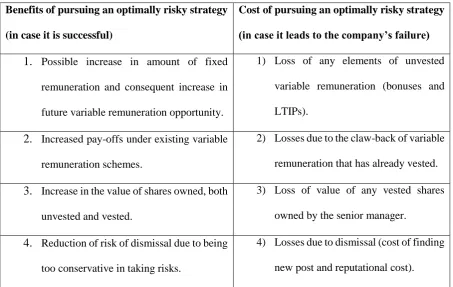
The above analysis suggests that, in the absence of any form of performance-sensitive
remuneration, corporate executives would be likely to refrain from taking optimal risks that
engender a non-negligible probability of a very severe negative outcome – which includes, but
is not limited to, the insolvency of the company in question. Indeed, they would stand nothing
to gain from taking such risks, but would stand to suffer the risk of losing their position should
to overestimate low and underestimate high probabilities in the case of negative events. See ND Weinstein,
‘Unrealistic Optimism About Future Life Events’ (1980) 39 Journal of Personality and Social Psychology 806.
73 A Tversky and D Kahneman, `Advances in Prospect Theory: Cumulative Representation of Uncertainty' (1992)
5 Journal of Risk and Uncertainty 297. See also M Rabin and RH Thaler, ‘Anomalies: Risk Aversion’ (2001) 15
The Journal of Economic Perspectives 219.
25 | P a g e the severely negative scenario materialise. Empirical evidence suggests that dismissal comes
at a high cost for executives, as on top of the direct cost of searching for an alternative position
they are likely to face a considerable period of unemployment and, when they do find
alternative employment, it is usually at a significantly lower rate of pay. Indeed, a study found
that a 1% increase in the dismissal risk of a CEO is associated with a 7% increase in the overall
subjective value of the CEO’s remuneration package, thus supporting the view that being
dismissed is costly for CEOs. Behavioural analysis suggests that, in the context of decision
making that can impact a company’s insolvency risk, being dismissed would be perceived as a
loss compared to current status quo. It follows that managers would tend to overestimate the
probability of low probability losses and would thus refrain from taking risks that are desirable
from the perspective of (risk-neutral) diversified shareholders.
The second area of behavioural economics that is crucial for the purposes of the present
discussion is game theory and, in particular, the relationship between external and intrinsic
incentives. Experiments that involve situations where cooperation is rationally desirable for
both parties, such as the ultimatum game,75 indicate that most individuals will refuse to
cooperate (thus reducing their material wealth) in order to retaliate against what they perceive
as unfair behaviour by the other party. Furthermore, experimental evidence suggests that
75 In ultimatum games, a sum that will be earned by the players only if they agree on how to distribute it amongst
them. One player makes a one-off offer and the other can accept it or reject it. Rationally, it would make sense for
the offeror to offer the other party a minimal amount and for the other party to accept. However, in reality a wide
variety of percentages are offered with an average of around 25%. See C Camerer and RH Thaler, ‘Anomalies:
26 | P a g e individuals tend to value their possessions irrationally high due to a feeling of entitlement and
that if they feel entitled to a gain they are reluctant to share any part of it with others.76
An implication of the above is that creating external financial motives can remove
intrinsic motives arising from social norms.77 This observation has led some corporate law
scholars to doubt the efficacy of performance-based remuneration.78 From the viewpoint of the
present discussion, this argument implies that regulatory rules such as the bonus cap are
unlikely to have any effect on senior managers’ behaviour and therefore are immaterial both
from the perspective of finical stability and from the perspective of shareholder wealth.
However, the aforementioned studies focus on non-market contexts where strong social norms
prevail and therefore it is too speculative to try to import their findings in the context of
professional corporate managers. Indeed, empirical studies focusing on the labour market
suggest that ‘trust contracts’ where the employer offers a high wage trusting the employee to
perform well tend to perform very badly and make losses for both parties, whereas ‘bonus
76 For experimental evidence on this, see D Kahneman, JL Knetsch and RH Thaler, ‘Experimental Tests of the
Endowment Effect and the Coase Theorem’ (1990) 98 Journal of Political Economy 1325; and L Babcock and G
Loewenstein, ‘Explaining Bargaining Impasse: The Role of Self-Serving Biases’ (1997) 11 Journal of Economic
Perspectives 109. On the Coase Theorem, see RH Coase, ‘The Problem of Social Costs’ (1960) 3 Journal of Law
and Economics 1.
77 EL Deci, R Koestner and RM Ryan, ‘A Meta-Analytic Review of Experiments Examining the Effect of
Extrinsic Rewards on Intrinsic Motivation’ (1999) 125 Psychological Bulletin 627.
78 For instance, Moore argues that, due to the effect of individuals’ bounded rationality and subjective perceptions
of relative deprivation, offering the senior managers of a company high levels of variable remuneration in order
to motivate them can have negative consequences on the motivation of both the beneficiaries of such remuneration
and other employees. See MT Moore, ‘Corporate Governance, Pay Equity, and the Limitations of Agency Theory’
(2015) 68 CLP 431, 449 – 461. See also See GA Akerlof and J.L. Yellen, ‘The Fair Wage Effort Hypothesis and
27 | P a g e contracts’ where the employer reserves discretion to reward the employee if performance is
good work much better.79 This provides strong support for the effectiveness and of
performance-based remuneration from the perspective of shareholders and hence for the
potential significance of remuneration regulation as a tool to protect financial stability.
V. The reaction of major UK banks to the introduction of the bonus cap rule
The aim of this section is to document the reaction of UK banks to the bonus cap rule, which
is necessary to assess whether the reform in question is likely to achieve its objective of
enhancing financial stability. It is worth noting that based on the standard neoclassical model,
as enriched by behavioural insights, one would expect the subjective value of executive
remuneration packages in UK banks to remain unaffected by the introduction of the bonus cap
rule. This is because the subjective value of remuneration packages depends on supply and
demand in the managerial labour market. Still, the (objective) expected value of remuneration
packages would be expected to reduce, due to risk aversion. In other words, as banks increase
the fixed component and reduce the variable component of remuneration packages, the risk
premium demanded by risk-averse senior managers reduces and hence a package with a lower
expected value than before will have the same subjective value. Finally, it is reasonable to
expect the maximum potential value of remuneration packages to reduce more steeply than
expected value, in tandem with the reduction in variable remuneration.
All data is taken from the relevant banks’ annual reports and accounts documents for
2013 and 2014, which are available on their respective websites.80 ‘Major UK banks’ refers to
79 On this, see E Fehr, A Klein and KM Schmidt, Fairness and Contract Design’ (2007) 114 Econometrica 121.
28 | P a g e banks that are public companies whose ultimate parent company is a bank or bank holding
company registered in the UK and whose shares are traded on the London Stock Exchange. At
the time of writing these include: Barclays Bank plc, HSBC Holdings plc, Lloyds Banking
Group plc, the Royal Bank of Scotland Group plc and Standard Chartered plc. 81 UK banks that
are subsidiaries of foreign banks are excluded as they do not operate within the same company
law framework.82 The analysis below is limited to the remuneration packages of the Chief
Executive Officers (CEOs) of the aforementioned banks. This is because banks only disclose
in full detail the remuneration structure of executive directors rather than senior managers83
and because the remuneration package of a CEO is generally representative of the remuneration
structure of all senior executives.84
The tables below summarise the structure of CEOs’ remuneration packages and the
actual and potential level of remuneration before and after the implementation of the bonus
cap.85 The years 2013 and 2014 were chosen because the former was the final year before the
81 In Tables 1, 2 and 3, Standard Chartered Bank plc is abbreviated as SCB.
82 The most important foreign bank operating in the UK retail market is currently Santander UK plc which is a
wholly owned subsidiary of the Spanish bank Banco Santander SA.
83 For senior managers who are not board members the following pieces of information is disclosed by UK banks
consistent with the relevant regulatory requirements: (a) the total number of employees whose remuneration
exceeds £1 million; (b) the total remuneration of the five highest paid employees; and (c) the total remuneration
and breakdown by component of the eight highest-paid senior executives.
84 It has been found that CEO remuneration is a significant but partial predictor of the level and structure of
remuneration of the top management team. See MA Carpenter and WG Sanders, ‘Top Management Team
Compensation: The Missing Link Between CEO Pay and Firm Performance?’ (2002) 23 Strategic Management
Journal 367, 372.
85 All sums are given in the currencies reported by the banks, that is, British Pounds Sterling for all banks except
29 | P a g e implementation of the bonus cap rule and the latter was the first year after its implementation
and hence comparing between these two years illustrates the rule’s impact. ‘Actual
remuneration’ refers to the amount paid with respect to performance during a financial year
even if it is subject to some performance conditions in the future. ‘Potential remuneration’
refers to the maximum amount of remuneration under the relevant component that the
remuneration committee could have awarded for a given year based on the bank’s remuneration
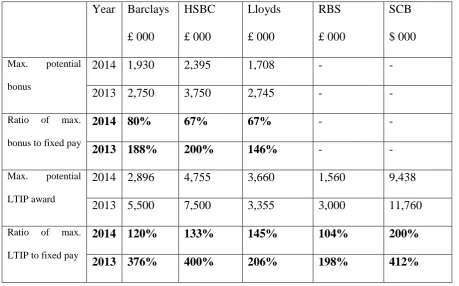
policy. In the case of bonuses all banks set a maximum potential award and decide annually
how much of that – if any – is to be awarded to each executive director. In the case of LTIPs,
however, most banks simply make a set award which is a function of an executive’s salary so
that the incentivisation effect is only due to the nature of the payment, that is, in shares.
<INSERT TABLE 1 HERE>
As can be seen in Table 1, UK banks had to make considerable changes to the structure
of their executive remuneration packages to ensure that the ratio between fixed and variable
components does not exceed the prescribed maximum. Their original position was one where
the available variable remuneration was between 3.5 and 6 times the fixed components with
the exception of RBS, which was already operating within the CRD IV imposed limit. This is
probably attributable to the fact that the Treasury has had since 2009 a majority stake in RBS.
Indeed, RBS is the only UK major bank which has not yet sought shareholder approval to
extend variable pay to 200 per cent of fixed pay following the procedures prescribed by the
Directive. All other banks obtained such approval at the respective 2014 annual general
meetings, and it is notable that the overwhelming majority of their shareholders voted in favour.
Conversely, many major banks have not made use of the possibility of benefiting from the
Directive’s discount rate, which appears to only have been utilised by RBS and Lloyds,
possibly due to the very demanding deferral requirements in place for remuneration to qualify
30 | P a g e paid out the picture is mixed, with an increase in Barclays, and Lloyds, a small decrease in
HSBC and a significant decrease in Standard Chartered and RBS.
<INSERT TABLE 2 HERE>
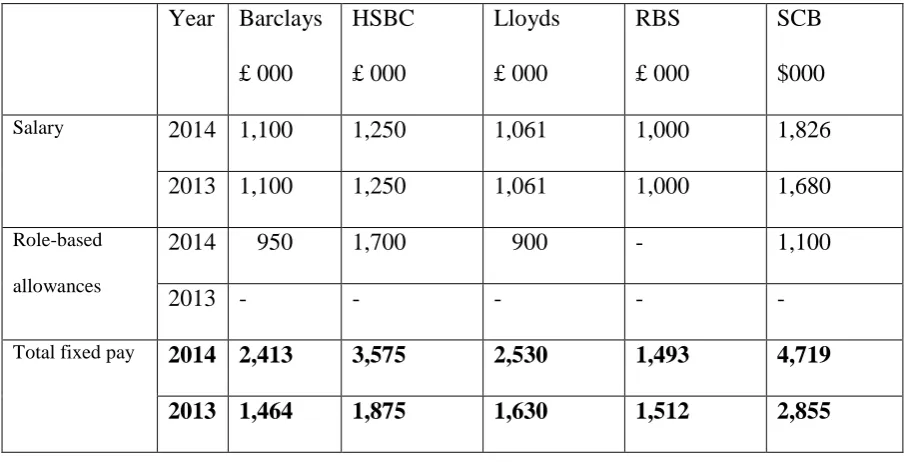
The introduction of the bonus cap rule had a major impact on the fixed component of
bank CEO remuneration packages,86 as is evident from Table 2. Total fixed remuneration
increased dramatically in 2014 in all banks apart from RBS: 87 by 91 per cent in HSBC, by 86
per cent in Standard Chartered, by 65 per cent in Barclays and by 55 per cent in Lloyds. This
was achieved mostly by introducing a new type of fixed remuneration described as an
allowance and paid in shares, which are released pro rata over a period of five years, 88 and
occasionally by increasing pension contributions and benefits in kind. It is notable that the bank
which introduced the highest role-based allowance compared to CEO salary, HSBC, was also
the bank that had to adapt its executive remuneration structure more to comply with the bonus
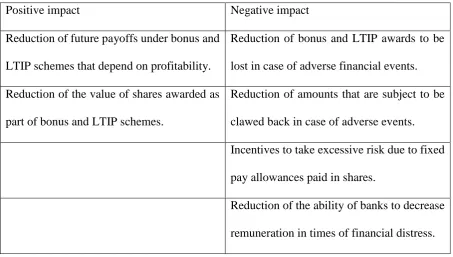
cap. Thus, fixed pay allowances appear to operate as quasi-variable remuneration. Indeed, the
use of fixed pay allowances can be explained as an attempt to maintain the pay performance
sensitivity of executive remuneration packages despite the cap, as will be explained in the next
part of the article.
<INSERT TABLE 3 HERE>
86 This includes the following elements: salary, fixed allowance, pension contribution and benefits.
87 The figure for the CEO of RBS in 2013 is adjusted to reflect the annual rate of pay. In fact, Ross McEwan
joined RBS on 1 October 2013, so the actual amounts paid were 25 per cent of those appearing on the table.
88 No such allowance was paid with regard to 2014 but RBS remuneration policy provided for a potential fixed
allowance paid wholly in shares of a value up to 100 per cent of an executive director’s salary. Such allowance of