Charting an Intent Driven Network
Yehia Elkhatib
•, Gareth Tyson
‡, and Geoff Coulson
••
Lancaster University, United Kingdom
‡
Queen Mary, University of London, United Kingdom
Abstract
The current strong divide between applications and the network control plane is desirable for many reasons; but a downside is that the network is kept in the dark regard-ing the ultimate purposes and intentions of applications and, as a result, is unable to optimize for these. An al-ternative approach, explored in this paper, is for appli-cations to declare to the network their abstract intents and assumptions; e.g. “this is a Tweet”, or “this appli-cation will run within a local domain”. Such an enriched semantic has the potential to enable the network better to fulfill application intent, while also helping optimize network resource usage across applications. We refer to this approach asintent driven networking(IDN), and we sketch an incrementally-deployable design to serve as a stepping stone towards a practical realization of the IDN concept within today’s Internet.
1
Introduction
A key principle of the early Internet was the provision of a very simple send/receive interface for applications. As the complexity of the Internet has grown, and new capa-bilities been added (multicast, streaming, mobility, etc.), we have attempted to continue to live with this very sim-ple API. Although the approach has served us well so far, clear downsides are emerging. In particular, applications essentially operate in the dark with respect to the capabil-ities and functioning of the underlying network, and are therefore obliged to include (complex) logic to handle network related events such as faults, performance fluc-tuations, service changes (e.g.mobility), etc. Similarly, the network operator does not understand the needs of applications beyond the issuance of apparently isolated send and receive calls, thus it is unable to optimize per-formance for applications or to optimally conserve its own resources.
At the heart of the matter is the inability of the net-work to see the underlyingintentof the application. In-stead, the network only sees a series of seemingly unre-lated micro-transactions (send and receive calls).
One solution might be to extend the network API to give direct access to all the individual network elements such as caches, middleboxes, routers, etc. But this is clearly problematic for many reasons: application devel-opers would find it too hard to understand, the API would regularly mutate in line with corresponding changes in the technologies, and it would promote unforeseen inter-actions between per-technology API elements, with un-predictable and probably undesirable consequences.
In this paper, we propose Intent Driven Networking (IDN)as an alternative approach. It enables the formula-tion of an applicaformula-tion’s “intents” as high level statements of its predicted macro-level behaviour, i.e. an abstract formulation of what it desires from the network, while re-maining agnostic about the underlying means used to sat-isfy them (protocols, etc.). For example, one particular intent might be to communicate with a particular group of users (e.g. collaborative document editing); another might be to stream a video uninterruptedly while switch-ing between a laptop and a smartphone as well as from an 802.11 network to a cellular one. Whereas the cur-rent Internet sees such intents as sets of isolated micro-transactions, an intent driven Internet would understand their aims, and therefore be in a position to optimize ac-cordingly.
IDN also allows us to simplify the development of ap-plications by removing the need for them to provide the “cover all cases” logic. Instead, we feed user require-ments straight down to the network thus providing flexi-bility in how different user application requirements are met without predefined restrictions. For instance, it mi-ght implicitly ensure the availability of a certain service despite the failure of a remote server; or ensure a certain level of Quality of Experience (QoE) even if the applica-tion is not designed to seek alternative potentially better
routes; etc. As a consequence, IDN facilitates more fluid development of end user applications and is conducive to better alignment of the network to application needs.
Another good example arises in the context of mobil-ity support [23]. Currently, host mobilmobil-ity is an extremely complicated process, typically managed in the lower lay-ers of the network stack by Mobile IP. In essence, these lower layers attempt to hide the effects of host mobil-ity (e.g.changes in IP addresses) from the higher layers (e.g.applications) using costly mechanisms such as tun-nelling. This measure is necessary as nearly all appli-cations assume stable, globally reachable addressing, as well as consistent connectivity, none of which are valid in the case of mobility. These needs, however, often only emerge because the lower layers have no understanding of theintentsthat exist at the higher layers. Imagine that an application, for example, has no need for consistent addressing or, alternatively, only requires access to con-tent within the local domain (i.e.no need for global ad-dressing). In such circumstances, the constraints are re-laxed and Mobile IP’s blanket-style behaviour becomes unnecessary. However, due to the network’s inability to see the application’s intent, there is no way to decide when such principles should or should not be applied. Consequently, the lowest common denominator must al-ways prevail.
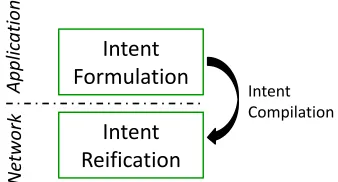
In order to attain the IDN vision, we need means by which application intents areformulated,compiled, and ultimatelyreified(i.e.acted upon) in the network. The structure implicit in this statement is illustrated in Fig-ure 1, which serves as the orienting architectFig-ure for the remainder of this paper.
Intent
Formulation
Intent
Reification
Applic
ation
Ne
two
rk
[image:2.612.101.270.488.579.2]Intent Compilation
Figure 1: High level view of an intent driven network.
We present the concept of an intent driven network using both a straw man design (§2) and illustrative ex-amples (§3). We focus particularly on the practical con-cern of how IDN might be incrementally and partially de-ployed in the existing Internet without restarting at year zero. We then comment on the implications of this IDN design (§4) and lay out a roadmap for the incremental realisation of IDN (§6).
2
Intents
This section provides a straw man design of IDN. Firstly, we define what an intent is (§2.1). We then propose an approach for the formulation of intents based on compo-sitions of primitive verbs (§2.2). Lastly, we discuss the mechanics of reifying intents in terms of a structure of “mediators” in the network (§2.3).
2.1
What is an Intent?
Anintentis an abstract declaration of what the applica-tion desires from the network on behalf of the user. It is a composition of a set of primitive “verbs”, each describ-ing a specific but high-level operation. For example, an intent to update an Instagram feed might be composed of primitive verbs to reconfigure the application topol-ogy (connect to a service and to peers), exchange data (update the content), and uphold a certain QoE level (al-locate sufficient network resources). In response to this, the network carries out the necessary configuration in or-der to best serve such an intent. This could entail setting up direct connections between users, and allocating fair shares of router queues considering other services in the network.
In more detail, the primitive elements that comprise in-tents are expressed as<verb, object, modifiers, subject>
tuples. Averbis an operation that describes the intent based on an ontology (described next in§2.2). Object
identifies a service, process or item that is the objective of the verb.Modifiersare then used to specialize or param-eterize this; each modifier can be tagged as either ‘essen-tial’ or ‘desirable’, indicating prioritization preference.
Subjectis an (optional) identifier of another service/pro-cess/item that is to be linked to that defined inobject.
Essentially, intent expression is based on the verb-object-subjectsentence structure used in linguistics, sup-plemented by modifiers as an additional set of words. Primitive intents expressed using such sentences are then composed using recursive encapsulation to form a full in-tent.
Intents are not limited to only user applications; they extend to applications operated by other players in the network (such as ISPs, cloud service providers, content providers) to express their own intents.
2.2
Formulating Intents
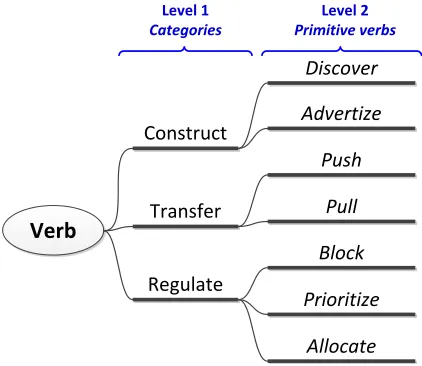
has a number of sub-operations from which the verb is chosen. Categories are just logical groupings; it is the verbs that signify the primitive intent.
Verb
TransferRegulate Construct
Push
Pull
Prioritize Block Advertize
Discover
Allocate
Level 1 Categories
[image:3.612.79.290.123.306.2]Level 2 Primitive verbs
Figure 2: A basic ontology of primitive verbs.
Constructis used when an application needs to form connections to another application (theobject) in a peer-to-peer fashion, either locally over a broadcast address or remotely. An example is a request of intent for a VoIP client to connect to another VoIP client. Discoveris is-sued to look for certain applications, whilstAdvertize al-lows an application to announce a new service that is able to serve the intents of other applications. Examples in-clude nodes spawning a caching or load balancing ser-vice.
Constructintents can be extended to another level that defines various applications to be discovered or adver-tized, such as data storage, caching, compression, etc. This would enable an application to offload common pro-cessing tasks to the network. These enable an applica-tion to dynamically employ external third party modules without the latter being a component of the native appli-cation code. This is of particular use to appliappli-cations run-ning on machines with scarce resources, like a mobile gaming application offloading its transcoding processes.
Transfer intents allow applications to pull and push content (theobject). An item of content could be referred to in any of a number of different ways, as illustrated in Table 1. In this sense, aTransferintent is analogous to an ICN abstraction, where thePushverb corresponds to a prefix announcement whilstPullcorresponds to an in-terest packet.
Finally, Regulateintents capture the desire of an ap-plication to have traffic handled in a certain way in the network rather than locally. This is helpful for propagat-ing traffic management higher up the network closer to the source, which facilitates better network management
and aggregation of interests. An example is an intent to block ssh login attempts from a certain address block, or to prioritize traffic from a service likehulu.com, or to apply QoE fairness policy (e.g.[12]).
2.3
Reifying Intents
Our conceptual architecture relies on a hierarchical stru-cture of mediators deployed in the network. These are middleboxes that arbitrate between user intents, network and service operator policies, and the current state of the network. We refer to this mediation presence in the network asMaatand each of the middleboxes as a
Maatagent, in reference to the ancient Egyptian concept of conflict resolution to achieve harmonious equilibrium and order.
Given this, user intents are initially sent on a specific broadcast address to be picked up by a local Maat agent. If a Maat agent is not available as signified by the ex-piry of a timer since issuing the intent, the application can widen the address scope to seek another agent in the parent subnetwork, or alternatively it could choose to fall back to non-IDN behaviour.
If a Maat agent finds that it is able to satisfy an in-tent, its job is to “reify” this intent by deploying or acti-vating the required mechanisms (such as an in-network function) or identifying candidate services (a nearby de-ployment), and consequently sending the relevant info-rmation back to the user application to realign itself ac-cordingly. The Maat agent is also required to create a session to keep track of how the intent was met. This is important for auditing mediation efficiency.
In realizing IDN we do not propose the re-writing of the entire network stack1. Instead, we propose to over-lay the concept of intents onto the existing Internet ar-chitecture. As such, our straw man IDN architecture has been designed to supportbackward compatibility (falling back to non-IDN behaviour) andincremental/ partial deployment. We will discuss this further in§4.2.
3
Examples
We now provide a set of use case examples to further illustrate the formulation of intent and its corresponding reification.
3.1
Use case #1: Clustering
Imagine that Alice is editing a document with her col-leagues Bob and Charlie on the Google Docs cloud ser-vice. Currently, this is handled in a manner that is
anal-1Although an IDN architecture could indeed be approached from
Table 1: Examples of different ways to refer to content in aTransferintent.
URL http://releases.ubuntu.com/15.04/ubuntu-15.04-server-i386.iso
CCN ubuntu.com/torrent/ubuntu-15.04-server-i386.iso
BitTorrent 05E965AC45FF0D739B3B8998FFFB815D1F238DE9
ogous to a chat server where the collaborators connect to the Google backend to push edits and/or receive up-dates. The problem with this is that it involves unneces-sary communication back and forth to where the remote service is hosted when some or all of the collaborators may be within a short network distance of each other.
Using IDN, the local application on Alice’s device (Google Docs in this case) would express its intent to share updates between Alice and a set of other users. For that, it needs to communicate with the Google backend to fetch the addresses of the collaborators’ devices. These are then used to formulate an intent as follows:
<allocate, ip_multicast,
(ttl=32,essential), <discover,
GoogleDocs,
(userID=92cd701c0be,essential), (userID=33a88280853,essential), NULL
> >
Note that the intent here takes the form of a composition betweendiscover andallocate verbs. Having first dis-covered the various players in this scenario (the Google-Docs application and the relevant users), the network al-locates a multicast group, and Maat responds with the group address. From then onwards, local communica-tions are exchanged over this group, and Alice’s appli-cation is responsible for sending periodic updates to the Google backend for backup if it requires. If the collab-orator devices move or change, Alice will issue a new intent accordingly.
3.2
Use case #2: Discovery
Serendipitous peer discovery is important for emerging Internet applications. A particularly important applica-tion of discovery is in Internet of Things (IoT) environ-ments where a large number of hosts would be operating different services in any one locality. Currently, discov-ery relies on the presence of directory or similar services, which obviously has its limitations in terms of consis-tency, scalability (considering the scale of IoT swarms to come [16]), and crossing vendor and operator divides [8].
In such a context we might signal an intent to build a new overlay structure from a set of suitable nodes (e.g. [6, 2]). This would work in a fashion similar to ARP; a node would seek other nodes that fit certain cri-teria on the service(s) they operate, location, communi-cation mode, QoS metrics, etc. The network would then propagate this intent announcement according to the cri-teria laid out in the intent modifiers.
Consider for instance an actuator in an IoT deploy-ment that wants to find a nearby node capable of run-ning a MapReduce analytics workflow over a collection of sensor data. In this case, the intent is formed by com-posing adiscoverprimitive verb with apushone as fol-lows:
<push,
dataset-201507-1800,
(net=1.2.3.0/24,essential), <discover,
hadoop,
(rtt<50ms,desirable) & (rtt<80ms,essential), hadoop-workflow.jar >
>
This would be examined and collated by Maat in order to allow the intent to be expanded and traverse across dif-ferent networks and operational environments (if within the specified criteria). As another example, an intent could emanate from a node in a sensor network seeking secure data storage, and use IDN to explore options as diverse as local fixed-power nodes and remote data cen-ters. Such discovery may also extend beyond IoT and in-clude intents formed at different levels, such as the ability to choose which middlebox (intrusion detection, proxies, interceptors, anonymizers, etc.) to go through.
It is important to explicitly note that this isnota pro-posal for another discovery broadcast protocol. On the contrary, a key objective of IDN is to enable applications to express high level intents and be agnostic about the protocols used to satisfy them.
3.3
Use case #3: Edge Deployment
these stakeholders have a lot to gain from a strong pres-ence towards the edge of the network in areas where there is demand for their services.
Consider for instance a content provider that finds an increase in the consumption of certain content (say the feature film “A Beautiful Mind” following the death of John Nash) in a particular area (say large metropolises in the US). It is in the provider’s interest to provide good viewing QoE for its customers and at the same time man-age increased load on its backend services. Accordingly, it might decide to push copies of the content to cache in different cities.
In this case, the intent will be expressed as a compo-sition of a verb that discovers suitable caching services (theobject) in certain locales (themodifiers), a verb that pushes content to the discovered caching points, and a final verb to announce the new content once cached.
The full intent will look like this:
<push,
ABeautifulMind,
(auth=https://provider.com/oauth), <push,
831FD96B0.mp4, NULL,
<discover, cache,
(asn=123456,essential), NULL
> > >
whereasnrepresents the AS number which signifies a certain customer base. Other modifiers could be used to identify target locales at a finer grain. In a similar fashion, a service provider might deploy applications to nodes offering hosting services. This could be to balance load at the edge, mitigate flash crowds, or improve user QoE.
4
Implications
As already described, IDN pushes some of the meta-logic of a deployed application to the network in a form that can be reified by Maat. As such, IDN opens up a whole new set of opportunities in research and opera-tional circles, and also creates some challenges. We now discuss some of these.
4.1
Opportunities
IDN opens up self-adaptation opportunities for all play-ers in the network space,e.g.users, developers and ser-vice providers. Users benefit from improved QoE
thro-ugh service provisioning that is dynamic and adaptive to their requirements and contexts. Application developers gain access to higher programming primitives that facil-itate fluid application behaviour at runtime, with less re-liance on ad hoc means of connecting services and miti-gating failures. Service providers are empowered to pro-vision their services in a migration-ready form so that they will be able to compete to provide better QoE for their end users.
IDN also opens a market for hosting services towards the edge. This can be beneficial particularly for small and medium sized service providers who cannot afford a highly customized CDN presence like the Googles and Facebooks of the world. Instead, they would be able to bid for edge resource provisioning that in many parts of the world has a wider reach that traditional CDNs [7, 9]. As such, there is also room for intermediaries to broker between the above parties.
4.2
Challenges
With the benefits that IDN brings, it also generates a number of challenges. The most prominent of these are
trust– specifically in terms ofsecurityandefficiency – anddeployment.
The securitychallenge could be summarized by the following question: Could the application trust the net-work to interfere with its communications, potentially redirecting it to an unintended destination? This is in-deed a major challenge that we recognize. We should first clarify that the in-network Maat agents receive and compile intents, not the subsequent communication which is more likely to contain sensitive information. Based on this, Maat would have information about the desires of the application such as connecting with peers, advertizing services or content, regulating network traf-fic, etc. There is potentially a lot of risk in divulging such information to outside parties. It is also noteworthy that such challenges are also being faced by the current Inter-net architecture.
resulting from such auditing mechanisms would engen-der competition.
Another challenge relates to deploymentand scala-bility. The core IDN design lends itself to partial deploy-ment through independent rollout of Maat agents most likely at the edge. There are different ways of doing this, one of which is to augment wireless routers with addi-tional modules. Such devices, however, are typically re-source constrained and might suffer from performance issues if a large number of services are advertized on their local address spaces. One way of avoiding this is to deploy dedicated Maat agents instead of piggyback-ing them on existpiggyback-ing infrastructure. This comes with its own cost, but is fairly feasible using commodity hard-ware Linux boxes.
5
Related Work
We discuss work that is relevant to our IDN concept, and briefly discuss some of the technologies that will enable the reification of intents in the network.
5.1
x-Centric Approaches
Bringing application awareness to networks has been a long sought after goal, with a number of technologies and network architectures being presented.
Resource-centric. The Representational State Trans-fer (REST) architectural principle [10] reduces network interactions to a fewverbs(GET, POST, DELETE, etc.). REST professes an entirely stateless, resource-oriented architectural style, transitioning between states using the data included in the requests. This makes infrastructure scalability and manageability much easier. However, the REST philosophy continues to adopt the “narrow” net-work API approach and, thus, continues to suffer from all of the associated problems discussed in§1.
Network-centric. Information-centric networking (ICN) solutions have been proposed to convert networks into inherent content delivery systems [14]. Similarly, service-centric networking (SCN)2[11, 4, 13, 22, 19] ex-tends ICN principles to apply to services as well as con-tent. Both ICN and SCN attempt to break away from statically binding to specific network resources. How-ever, they only partly address the problems we have out-lined in the specific cases of accessing content/services: they do not naturally generalize to other scenarios,e.g.
those involving switching of networks.
Stakeholder-centric. The Experience-oriented net-work architecture (EONA) [15] is one in which applica-tion and content providers as well as infrastructure oper-ators exchange information from their respective control
2Also known as service-oriented networking.
loops to improve user experience. We take inspiration from EONA, but are concerned about the viability of its approach. In a world where data is the new oil, we can not imagine such cooperative exchange of information happening between parties with sometimes conflicting interests [5]. The authors do not provide a reasonable argument for how this would be realized.
Application-centric. Closer to our proposal are re-cent efforts in the direction of enabling applications to express their requirements and allowing these to perco-late down to the underlying network. Pyretic [18] is an open source Python framework that raises the level of ab-straction of writing network policies, enabling the defini-tion of sophisticated network structures through a high-level language. Merlin [20] is another declarative lan-guage that enables the specification of a global network-ing policy, which is expressed as a collection of logical predicates to identify traffic subsets and a set of state-ments indicating the action(s) to be taken on each sub-set. However, both Pyretic and Merlin focus on issues relating to unifying network administration rather than identifying and addressing application requirements.
Other relevant efforts include: yanc [17], an ab-straction in Linux to facilitate network control logic to be written in any language; FlowOS [1], a pro-gramming model to capture and process Internet flows; NOSIX [24], an abstraction layer to enable portable de-ployments; and P4 [3], a language to configure switches to process packets and match header fields.
5.2
Enabling Technologies
TheActive networking(AN) paradigm enables users to modify network behavior by sending custom code to be executed on network devices (cf.[21]).Software defined networking(SDN) removes the need for bit-wise config-uration of network components, and instead allows a cen-tral policy to be applied system-wide. Both AN and SDN technologies could be used to the benefit of users, but neither helps the application signify its needs. Thus, they are complementary to IDN by providing mechanisms to manage and modify the network in order to reify intents.
6
Summary and Roadmap
de-Formulation Compilation Mediation Brokerage Reification
Common Ontologies
Common
Ontologies Prioritization Prioritization SDN Mappings SDN Mappings
Conflict Resolution
Conflict Resolution
Trust Trust
Security Security Compositional
Semantics Compositional
Semantics Developer
Tools Developer
Tools
[image:7.612.105.507.66.216.2]Auditing & Arbitration Auditing & Arbitration
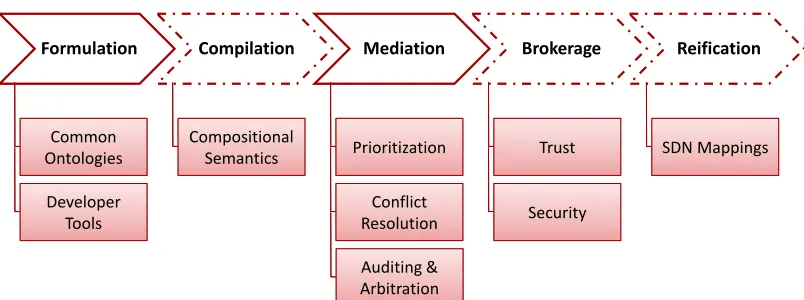
Figure 3: A roadmap for the realization of IDN.
sires (§2.2). Reification relies on the Maat system that provides in-network mediation between user intents and policies of network and service operators (§2.3).
Apart from enjoying network service levels that better match their intents, applications also benefit from IDN in that some of their logic could be pushed to the net-work. No longer are they expected to ship with intricate conditional logic to work around unexpected network be-haviour. (They still could employ such logic, but they would thereby be limiting their ability to be deployed in foreign environments and under unforeseen conditions.)
Maat also exploits the high semantic content of intent specification to optimize resource usage within the net-work. It does this by explicitly negotiating how each in-tent might best be reified to produce the most “friendly” way in which each network interaction can be performed, considering the needs of all stakeholders.
There is a huge body of future work required to de-velop IDN into a viable implementation. We tried to capture some of the required next steps in a roadmap depicted in Figure 3. This, however, is undoubtedly a non-exhaustive plan of action. Therefore, we solicit con-tributions from the wider systems research community, architects and developers of different disciplines.
We see the process of developing a proof-of-concept realisation of our design as falling into three main work-packages. First, we will work on the formalism of intent specification and its compilation into a format that can be used by Maat. This will involve refining the ontology presented in this paper and defining a domain-specific language for the formulation of intents on the basis of this, and also the creation of associated developer tools. It will also involve investigating the semantics of the (re-cursive) composition of intents in terms of existing in-tents and ultimately in terms of primitive verbs. Com-position semantics must take into account the effects of composing network functions that interact in complex
ways: for example how caching strategies change when associated with mobility.
The second workpackage involves the definition of the negotiation protocol employed between Maat agents. This should be independent of any particular set of verbs and rely on generic notions of utility and priority as de-rived from intent specification, and be capable of han-dling negotiations between multiple stakeholders and converging on distributed consensus. It is clear that me-diation is a highly complex task as it is likely that many conflicts will emerge. For example, a user streaming con-tent would want high quality delivery at low cost, a pub-lisher would wish to have their content viewed as many times as possible, and an ISP would prefer to only have low-cost (locally available) content viewed. Such po-tentially conflicting viewpoints will need to ensure thor-ough negotiation to ensure that all stakeholders are in-centivized to cooperate in the scheme.
The third workpackage would then focus on practical aspects of the deployment of Maat agents, as discussed in§4.2.
As a final consideration, marketplace brokerage is an area with a lot of potential for reifying spontaneous and strategic intent. Reification is likely to create the need for running in-network services towards the edge. Mar-ketplaces of resources to host such services might benefit from the operation of brokerage and arbitrage agencies, a role which might be co-located with Maat. For this, thorough investigation is required to alleviate concerns regarding trust and security. Efforts are also sought for reifying mediation outcomes in the form of adjusting the network control plane (using SDN technologies) or pro-viding information that could be used for late-binding.
References
[1] BEZAHAF, M., ALIM, A., AND MATHY, L. FlowOS: A flow-based platform for middleboxes. InHotMiddlebox(2013), ACM, pp. 19–24.
[2] BLAIR, G. S., BROMBERG, Y.-D., COULSON, G., ELKHATIB, Y., R ´EVEILLERE` , L., RIBEIRO, H. B., RIVIERE` , E.,ANDTA¨IANI, F. Holons:
To-wards a systematic approach to composing systems of systems. InWorkshop on Adaptive and Reflective Middleware(Dec 2015), ACM, pp. 5:1–5:6.
[3] BOSSHART, P., DALY, D., GIBB, G., IZ
-ZARD, M., MCKEOWN, N., REXFORD, J., SCHLESINGER, C., TALAYCO, D., VAHDAT, A., VARGHESE, G.,ANDWALKER, D. P4: Program-ming protocol-independent packet processors. SIG-COMM Computer Communication Review 44, 3 (Jul 2014), 87–95.
[4] BRAUN, T., MAUTHE, A.,ANDSIRIS, V. Service-centric networking extensions. In Symposium on Applied Computing(2013), ACM, pp. 583–590.
[5] CLARK, D. D., BAUER, S., LEHR, W., CLAFFY, K. C., DHAMDHERE, A. D., HUFFAKER, B.,
ANDLUCKIE, M. Measurement and analysis of in-ternet interconnection and congestion. In Telecom-munications Policy Research Conference(2014).
[6] COULSON, G., BLAIR, G. S., ELKHATIB, Y.,
ANDMAUTHE, A. The design of a generalised ap-proach to the programming of systems of systems. InProceedings of the workshop on Autonomic and Opportunistic Computing(Jun 2015).
[7] ELKHATIB, Y. Building cloud applications for challenged networks. InEmbracing Global Com-puting in Emerging Economies, R. Horne, Ed., vol. 514 ofCommunications in Computer and Info-rmation Science. 2015, pp. 1–10.
[8] ELKHATIB, Y. Mapping cross-cloud systems: Challenges and opportunities. In HotCloud (Jun 2016).
[9] FANOU, R., TYSON, G., FRANCOIS, P., AND
SATHIASEELAN, A. Pushing the frontier: Explor-ing the African web ecosystem. InWWW(2016).
[10] FIELDING, R. T. Architectural Styles and the De-sign of Network-based Software Architectures. PhD thesis, University of California, Irvine, 2000.
[11] FREEDMAN, M. J., ARYE, M., GOPALAN, P., KO, S. Y., NORDSTROM, E., REXFORD, J.,AND
SHUE, D. Service-centric networking with SCAF-FOLD. Tech. Rep. TR-885-10, Princeton Univer-sity, Sep 2010.
[12] GEORGOPOULOS, P., ELKHATIB, Y., BROAD
-BENT, M., MU, M., AND RACE, N.
To-wards network-wide QoE fairness using openflow-assisted adaptive video streaming. In Proceed-ings of the ACM SIGCOMM Workshop on Future Human-Centric Multimedia Networking (FhMN 2013)(Aug 2013), ACM, pp. 15–20.
[13] GRIFFIN, D., RIO, M., SIMOENS, P., SMET, P., VANDEPUTTE, F., VERMOESEN, L., BURSZ
-TYNOWSKI, D., AND SCHAMEL, F. Service ori-ented networking. InEuropean Conference on Net-works and Communications(Jun 2014), pp. 1–5.
[14] JACOBSON, V., SMETTERS, D. K., THORNTON, J. D., PLASS, M. F., BRIGGS, N. H.,ANDBRAY
-NARD, R. L. Networking named content. In
CoNEXT(2009).
[15] JIANG, J., LIU, X., SEKAR, V., STOICA, I.,AND
ZHANG, H. Eona: Experience-oriented network architecture. InHotNets(2014), ACM, pp. 11:1– 11:7.
[16] LEE, E., RABAEY, J., HARTMANN, B., KU
-BIATOWICZ, J., PISTER, K., SANGIOVANNI -VINCENTELLI, A., SESHIA, S., WAWRZYNEK, J., WESSEL, D., ROSING, T., BLAAUW, D., DUTTA, P., FU, K., GUESTRIN, C., TASKAR, B., JAFARI, R., JONES, D., KUMAR, V., MANG
-HARAM, R., PAPPAS, G., MURRAY, R., AND
ROWE, A. The swarm at the edge of the cloud.
IEEE Design & Test 31, 3 (2014), 8–20.
[17] MONACO, M., MICHEL, O., AND KELLER, E. Applying operating system principles to SDN con-troller design. InHotNets(2013), ACM, pp. 2:1– 2:7.
[18] REICH, J., MONSANTO, C., FOSTER, N., REX
-FORD, J., AND WALKER, D. Modular SDN programming with Pyretic. Technical Report of USENIX(2013).
[20] SOULE´, R., BASU, S., KLEINBERG, R., SIRER, E. G., AND FOSTER, N. Managing the network with merlin. InHotNets(2013), ACM, pp. 24:1– 24:7.
[21] TENNENHOUSE, D., SMITH, J., SINCOSKIE, W.,
WETHERALL, D., AND MINDEN, G. A survey of active network research. IEEE Communication Magazine 35, 1 (Jan 1997), 80–86.
[22] TSCHUDIN, C.,ANDSIFALAKIS, M. Named func-tions and cached computafunc-tions. InIEEE Consumer
Communications and Networking Conference(Jan 2014), pp. 851–857.
[23] TYSON, G., SASTRY, N., CUEVAS, R., RIMAC, I., AND MAUTHE, A. Where is in a name? A survey of mobility in information-centric networks.
Commun. of ACM 56, 12 (Dec 2013), 90–98.
[24] YU, M., WUNDSAM, A.,ANDRAJU, M. NOSIX: A lightweight portability layer for the SDN OS.