Manipulating concept spread using concept
relationships
James Archbold☯*, Nathan Griffiths☯
Department of Computer Science, University of Warwick, Coventry, United Kingdom
☯These authors contributed equally to this work. *[email protected]
Abstract
The propagation of concepts in a population of agents is a form of influence spread, which can be modelled as a cascade from a set of initially activated individuals. The study of such influence cascades, in particular the identification of influential individuals, has a wide range of applications including epidemic control, viral marketing and the study of social norms. In real-world environments there may be many concepts spreading and interacting. These interactions can affect the spread of a given concept, either boosting it and allowing it to spread further, or inhibiting it and limiting its capability to spread. Previous work does not consider how the interactions between concepts affect concept spread. Taking concept interactions into consideration allows for indirect concept manipulation, meaning that we can affect concepts we are not able to directly control. In this paper, we consider the problem of indirect concept manipulation, and propose heuristics for indirectly boosting or inhibiting concept spread in environments where concepts interact. We define a framework that allows for the interactions between any number of concepts to be represented, and present a heuristic that aims to identify important influence paths for a given target concept in order to manipulate its spread. We compare the performance of this heuristic, called maximum probable gain, against established heuristics for manipulating influence spread.
1 Introduction
In many environments it is possible for strategies, behaviours, knowledge or infections to spread within a population. The nature of propagation is determined by the interactions between individuals. Populations of autonomous entities are complex systems, meaning that the net effects of propagation are hard to predict or influence, despite being due to individual behaviour. Such propagation is a form of influence spread, which can be modelled as a cascade from a set of initially activated individuals [1].
Insight gained from understanding how to manipulate cascades in abstract populations has many applications, such as informing epidemic control, viral marketing, and understanding convention emergence in multi-agent systems. For example, characterising the spread of dis-ease aids in identifying at risk groups, enabling containment efforts to be focused to avoid wider spread. Understanding how ideas propagate can inform viral marketing campaigns a1111111111 a1111111111 a1111111111 a1111111111 a1111111111 OPEN ACCESS
Citation: Archbold J, Griffiths N (2018)
Manipulating concept spread using concept relationships. PLoS ONE 13(6): e0199845.https:// doi.org/10.1371/journal.pone.0199845
Editor: Irene Sendiña-Nadal, Universidad Rey Juan Carlos, SPAIN
Received: October 17, 2017
Accepted: June 14, 2018
Published: June 28, 2018
Copyright:©2018 Archbold, Griffiths. This is an open access article distributed under the terms of theCreative Commons Attribution License, which permits unrestricted use, distribution, and reproduction in any medium, provided the original author and source are credited.
Data Availability Statement: The synthetic
networks used within this study can be found in the Zenodo repository:https://zenodo.org/record/ 1005745#.WeW-G0e1vmE. The raw data used to generate the figures and tables seen within this work can be found in the Zenodo repository: https://zenodo.org/record/1007743#.WeW-RUe1vmE. The source code for this work can be found at the git hub repository:https://github.com/ JamesArchbold/ConceptInteraction.
Funding: This work was funded by The
through identifying influential individuals. Other applications include the adoption of behav-iours. It is known that behaviours, such as drinking and smoking, are often adopted by those who socialise with individuals that already partake in such behaviours. Furthermore, it has been shown that close acquaintances giving up smoking can encourage an individual to quit [2]. It may therefore be possible to identify individuals who, if they quit smoking, would result in the largest number of others quitting.
Modelling such a decision process can also inform an individual if they are being manipu-lated. For example, consider a competitive business such as finance, where a large factor in being successful is in the prediction of others’ behaviour. If a business can identify influential individuals and how their behaviours spread through a network, they may be able to identify when such an individual is taking an action as a strategy to influence others to take a similar action. Identifying this can allow for a business to avoid the manipulation tactic and make more informed decisions. The key enabler in all these examples is being able to identify the set of individuals who can help spread a behaviour, idea or product, or who can restrict future spreading (e.g. through their vaccination).
Several models have been developed to characterise influence spread [1,3], along with tech-niques to maximise spread [4]. These models represent a population as a network, with indi-viduals corresponding to the nodes, and edges representing the existence of an influential relationship from one individual to another. Opinions, behaviours, knowledge or diseases can be represented as concepts that spread along the edges of a network, with a chance to infect the nodes they encounter. Existing models of influence spread typically assume that only a single concept exists, or that concepts block the spread of other concepts, preventing an individual from activating multiple concepts [5,6]. In real-world environments, individuals can have multiple concepts active simultaneously and, through concept interaction, a concept’s ability to spread can be affected. As such, in this paper we remove the assumption that concepts are blocking, allowing for more complex concept interactions.
Previous work on the interactions between spreading concepts has focused on epidemics and how interactions between diseases may affect the epidemic threshold of a network [7]. However, there has been little consideration of concept interactions to help improve the spread of a giventarget concept, in situations where we cannot directly manipulate the spread of that target concept. Consider, for example, a disease spreading through a network. While it may not be possible to affect the disease directly, its spread can be inhibited through the spread of knowledge and the use of vaccination, both of which can also be modelled as concepts within a network. The interactions between such concepts may be positive or negative, aiding or hin-dering spreading respectively.
In previous work, we developed a heuristic that aims to maximise the spread of a chosen concept in an environment where concepts interact. This involved selecting seed nodes to avoid other, inhibiting, concepts while increasing the chance to encounter boosting concepts [8]. However that work, along with most previous work on influence spread, assumed that we can select seed nodes for the target concept we wish to maximise. There has been little consid-eration of scenarios where this is not the case. When we cannot control the target concept that we aim to manipulate, we must instead indirectly affect its spread through a secondary control-lable concept. It is this problem ofindirectconcept manipulation that is the focus of this paper.
Concept interactions facilitate the manipulation of a concept that cannot be directly con-trolled. Consider opinions spreading within a social network. It is extremely difficult to guar-antee an individual’s adoption of a chosen opinion, instead we may consider exposing an individual to particular information or news stories that makes them more, or less, likely to adopt that opinion themselves. This may be of use in encouraging loyalty to a given brand or promoting particular social habits within a group. If, for example, we wish to spread the 1500472, Influence Spread in Social Networks with
Dynamic Topologies (JA). The funders had no role in study design, data collection and analysis, decision to publish, or preparation of the manuscript.
Competing interests: The authors have declared
opinion that smoking is detrimental to health, we may choose to expose certain individuals to information on the health risks of smoking, making them more likely to agree when a friend shares a negative opinion on smoking. The use of a secondary concept to boost the spread of a given target concept is known as theindirect influence maximisation problem.
Alternatively, we may wish to indirectly inhibit the spread of a detrimental concept such as a disease or rumour. A potential approach to minimising the spread of a target concept is to expose a selected group of individuals to a secondary inhibiting concept. This is known as the
indirect influence limitation problem[9]. Previous investigations into minimising influence have focused on finding nodes present on a high number of shortest paths [10], or nodes that connect communities [11]. In environments where concepts are blocking, selecting such nodes to block concept spread prevents the undesirable concept from utilising the most influ-ential network paths. However, when concepts are not blocking but instead merely lower the chance of spreading, such methods are less effective. If a node is on many shortest paths, but is not near to the start of the target concept cascade, it is unlikely to encounter the target concept, and so its selection is unlikely to help limit the concept spread. As such both a node’s expected gain for the target concept and the likelihood of activating that target concept, must be consid-ered when evaluating a node’s suitability for influence limitation.
In this paper, we investigate the use of a secondary concept to affect, positively or nega-tively, the spread of a target concept. We present a framework for representing concept inter-action, and discuss the differences between indirect concept spread manipulation and the more widely studied influence maximisation problem. With those differences in mind, we pro-pose the maximum probable gain (MPG) heuristic and evaluate its effectiveness in both the indirect influence maximisation and indirect influence limitation problems. A subset of our experiments for the influence limitation problem, namely the performance of MPG and other heuristics in small-world, scale-free and real-world networks for the ICM has been previously published in [9].
2 Related work
Previously, there have been many proposed models of influence spread and corresponding approaches to the influence maximisation problem. Here, we highlight and discuss important models and methods, and introduce previous work that considers multiple concepts or uses concept interactions to affect the spread of a specific target concept.
2.1 The influence maximisation problem
The influence maximisation problem is that of finding a set ofknodes, referred to as the seed set, that will maximise the spread of a concept, for a given network. Kempeet al. were among the first to describe this problem, in addition to methods of modelling the propagation of a concept [1]. Since then, many influence propagation models have been proposed in the litera-ture [3,12,13]. Two of the most widely discussed, in terms of modelling influence spread, are the Independent Cascade Model (ICM) and the Linear Threshold Model (LTM).
In the ICM a node has a single chance on activation to activate each inactive neighbour with some probability,p[3]. Alternatively, in the LTM a node is influenced by each of its neighbours to varying degrees, as defined by the edge weights in the network [1]. Each nodev
has a thresholdθv, and when the sum of the weights ofv’s active neighbours exceedsθv,v
concept later, as in the SIS model, or the node can never reactivate the concept even if exposed to it again, as in the SIR model. The ICM can be viewed as an instantiation of the SIR model where a node deactivates the concept after only a single time step.
Influence related problems typically focus on the selection of a ‘seed set’. This is a set of nodes that are selected to activate a concept and initiate that concept’s spread through a net-work. Ideally, a seed set of sizekwill contain thekmost influential nodes within the network, however identifying these nodes is a challenging problem. A greedy approach is often effective in approximating the optimal solution, due to the sub-modularity of seed set selection [1,11]. Hill climbing can be used to select the node that provides the largest incremental increase to the performance of the current seed set, with Kempeet al. showing that this approach has a performance guarantee of slightly above 63% of the optimal solution [1]. Others have devel-oped algorithms based on hill climbing, such as the Cost Effective Lazy Forward (CELF) selec-tion algorithm proposed by Leskovicet al. [14], which evaluates the improvement in reward from including a node in the current seed set and adds the node that maximises that improve-ment. However, calculating the reward of adding a node involves simulating a number of cas-cades and recording the number of activations achieved by a given seed set. For real-world problem sizes, this approach is often intractable, since it has a time complexity ofOðn3Þor
higher [15]. Despite this, hill climbing is often used as a baseline for evaluating new heuristics for maximising influence spread. Heuristics, such as degree discount for the ICM, allow for the efficient approximation of a node’s performance improvement [4].
Degree discount has been shown to be an effective method of influence maximisation, com-parable in performance to the greedy algorithm [4]. It calculates the expected activations gained from the inclusion of a particular node in the seed set. When a node is selected as a seed, its neighbours have a chance to be activated in the first round of a cascade. As such, the expected gain of those neighbours is lowered. Nodes are initially ranked by degree, and when a node is added to the seed set its neighbours have their degree set todv− 2tv− (dv−tv)tvp,
wheredvis the original degree,tvis the number of neighbours in the seed set andpis the
prob-ability of infection. This calculation is based on the expected benefit of such nodes (details of its derivation can be found in [4]).
Other methods include the consideration of ak-core decomposition [16]. To begin, all nodes with only a single edge are removed, along with their edges, and then any nodes now left with only one edge are also removed. This continues until there are only nodes with two or more edges in the network. The removed nodes, along with any edges that connect those removed nodes, are the first k-shell. By repeating this, we can identify the nodes that make up the core of the network as ones with a high k-shell value. This method has been debated, with some claiming that it is not as effective as degree-based selection [17,18] and that nodes in the same k-shell can have very different levels of influence and so a method of ranking nodes in the same k-shell is needed [19].
Some greedy approaches can be made tractable, such as the Greedy Viral Stopper (GSV) algorithm, for environments in which ‘correct’ and ‘incorrect’ information propagates, with the correct information superseding incorrect information [20]. While intractable in the gen-eral case, the GSV algorithm can be performed on individual communities in a network [21]. By combining those individual solutions, a full network solution can be achieved.
2.2 Influence models with multiple concepts
cascades areblocking, meaning that nodes activated by one cascade cannot be activated by another. Additionally, most formulations assume that an environment contains only two con-cepts, when in reality there could be many more, all of which interact.
If concepts are not blocking, then how they interact must be modelled. Sanzet al. developed a multi-layer network model in which each concept spreads on a different layer, but nodes can activate more than one concept at a time [7]. When multiple concepts are active on the same node, they can boost or inhibit each other’s ability to spread. The idea of boosting and inhibit-ing the spread of a concept has been explored by others [9], including the effects this can have on concept interactions. Newman and Ferrario consider a model where an epidemic can only spread through nodes that have been infected by a previous epidemic [22]. In the work of Myers and Leskovec the concepts an agent chooses to adopt are affected by all the concepts they have previously been exposed to (regardless of adoption) [23]. Such models typically focus on concepts that are similar to each other, such as diseases, but other factors, such as the information available on that disease or the availability of vaccinations can also affect spread [10].
Related, but semantically different, concepts can also interact. Wanget al. demonstrated, with multi-layer networks, the relationship between a disease and information about that dis-ease. As the disease propagates, it increases the spread of information about it, which in turn allows people to make informed decisions and decrease the spreading rate of the original dis-ease [24]. Multi-layer networks can model multiple concepts by restricting each concept to its own layer, allowing for the modelling of transmission methods distinct to each concept [25]. For example, a concept spread by hand-to-hand contact will spread differently than one that utilises word-of-mouth. Multi-layer networks have also been utilised to facilitate the analysis of the effectiveness of introducing an immunising concept to a network that contains a spread-ing disease [26].
An individual’s opinions can affect the concepts they adopt or spread. These opinions can be represented through network and node attributes, as in the adaptation of the LTM proposed by Kaur and He [27]. Each edge is associated with two separate influence strengths, represent-ing a positive and negative opinion respectively. A node has both a positive and negative threshold, and will activate the opinion that first has its corresponding threshold exceeded. Nodes with high positive influence can be selected to block the negative opinion from spread-ing further. Stitchet al. present a method of representing opinions by assigning an attitude score to individual nodes [28]. Nodes with a high attitude score are more likely to spread negative word-of-mouth, even if they have been mostly exposed to positive opinions, and vice versa for nodes with low attitude scores. Both of these models again assume that concepts are blocking.
A further factor that has been shown to impact concept spread is the general behaviour of a population. Perraet al. present a model that changes the infectiousness of an epidemic over time to reflect behaviour [29]. Other approaches include modifying network connections to simulate fear [30], introducing an additional edge weight to represent social connections [31], and the use of game theory to model strategies that can change as the epidemic spreads [32]. The idea of responsiveness was introduced by Kisset al., with responsive individuals more likely to avoid infection or be treated quicker, reducing the spread of a disease [33].
2.3 Utilising concept interaction
another, known as bridge ends, to block an undesirable concept from reaching large commu-nities within the network [11]. Liet al. select nodes for immunization that will protect the bridge ends themselves, further distancing an undesired concept from other communities within the network [34]. Other methods have also been proposed, such as removing central nodes, partitioning the network and making it more difficult for a disease to spread [35]. While protecting bridge ends can limit the spread of a concept, the approach becomes less effective when concept, and therefore path, blocking cannot be guaranteed. The betweenness of nodes can also be utilised as an indicator of a node’s potential to limit a concept’s spread, but is computationally expensive to calculate [10].
Kotnis and Kuri propose a solution where individuals can be trained, at a cost based on their degree and the quality of training, to be better at deciding whether information is a rumour [36]. For a given budget, having more low quality trained individuals yields better results than having fewer individuals with higher quality training. While Kotnis and Kuri assume a single cascade, they discuss the possibility of other messages affecting the spread of a rumour.
A related problem, selecting a group of nodes and improving their ability to spread a target concept, is discussed by Liontis and Pitoura [37]. They present the MoBoo heuristic, which selects nodes to become able to boost the probability of spreading a target concept by evaluat-ing the possible gain from selectevaluat-ing each node.
To estimate the gain of a node, MoBoo first finds the likely paths that the target concept will travel through. For each node with the target concept active, MoBoo constructs a tree of paths that start from that node. With these trees in place, MoBoo then constructsλindependent paths, where typicallyλ= 2 in order to maintain a reasonable runtime. For each node,v, MoBoo selects the topλpaths where the only nodes shared are the end node,v, and possibly the starting node. These paths are referred to asμi, whereiis the rank of the path. Paths are ranked by their propagation probability and so MoBoo selects theλpaths that are most likely to activatev.
Using the propagation probability of these paths, theactivation probabilityof a node,ap(v) can be calculated. Forλ= 2:
apðvÞ ¼1 ðð1 Pðm1ðvÞÞÞ ð1 Pðm2ðvÞÞÞÞ ð1Þ
whereP(μi(v)) is the probability ofvto be activated from independent pathi.
These activation probabilities are used to calculate the gain for each node. The gain for a node,v, assumes thatvhas the boosted probability to spread the target concept to its neigh-bours and is calculated as:
gðvÞ ¼ X
u2OutðvÞ
p0 v;u
pv;u 1
! X
w descendant of u
apðwÞ ð2Þ
whereOut(v) is the set of nodes that are the children ofvin any independent pathμ,pv,uis the
probability of the concept spreading from nodevtouandp0
v;u¼pv;uþb, withbbeing the
improvement to spreading probability gained by a node when it is selected to become a boost-ing node.
The MoBoo algorithm focuses on boosting concepts, but the potential influence of a node may also be of use when considering an inhibiting concept. Targeting high influence paths with a boosting concept should provide a larger performance increase for the target concept than a low influence path. Similarly, limiting the potential of a high influence path may prove more damaging to a target concept than targeting a low influence path.
Budaket al. propose the highest infectees heuristic that, for environments with ‘good’ and ‘bad’ cascades, gives results comparable to greedy hill climbing [39]. This heuristic assumes knowledge of the seed set for the ‘bad’ cascade, and simulates a large number of cascades using that seed set. Nodes are ranked by the number of simulations in which they became infected with the ‘bad’ cascade, and are selected as seeds for the ‘good’ cascade in descending order. While the aim of this work is to limit the spread of the ‘bad’ cascade, it does so through maxi-mising the spread of a ‘good’ cascade. Therefore this may also be an applicable approach for both boosting and inhibiting a target concept through a secondary concept, in order to increase the number of concept interactions.
Rather than selecting nodes to block a concept’s spread, we may also consider modifying the edges in a network. Liet al. proposed reducing the edge weight to limit the rate of trans-mission [40]. An edge’s weight is expressed as a function of the degree of its two end points, and the rate of transmission between two connected nodes is proportional to the weight of the edge between them. The use of inflammation immunisation, which reduces edge weights by a chosen factor, is shown to be effective in this model and may translate well to real-world sce-narios. Notably, the reduction of edge weights lowers the transmission weight but does not compromise network efficiency. Conversely, the bond percolation approach suggested by Kimuraet al. curbs the spread of an infection but, by removing links, damages the network structure and in turn, the ability of the network to transmit other concepts [41].
Overall, we see that most previous work involving multiple cascades assumes that concepts block. This leads to a focus on competitive influence spread, where the aim is to maximise the spread of one cascade over another, where we directly choose the seed nodes for the concept we wish to maximise. Through more complex concept interactions, we can move beyond com-petitive influence and consider indirect influence manipulation. The work of Liontis and Pitoura [37] is one of the few approaches to consider indirect influence maximisation, although the ability to boost a concept’s spread cannot be spread itself.
2.4 Real-world experiments
The studies discussed above all rely on empirical results from simulations. This is due to the difficulty of performing real-world analysis on the spread of influence. In particular, there is not always a precise definition of what constitutes an individual being ‘influenced’. In studies involving the social media site Twitter, re-tweeting and using hash tags have been used to sig-nify that a person has been influenced, but this is not necessarily a reliable method [42]. If we cannot confidently state that an individual has been influenced, tracking a cascade is difficult.
Furthermore, having full knowledge of a social network is difficult. Presently, the majority of influence spread studies assume that we have knowledge of the full network and do not account for any possible hidden factors. The requirement of full knowledge for such studies makes translation to real-world scenarios difficult.
tangible effect, and that there is value in empirical simulations since the results can be subse-quently applied in real-world environments.
3 Indirect concept spread
Individuals, or nodes, in real-world networks are typically capable of activating many concepts at once, representing a wide range of ideas, opinions and attributes. Furthermore, concepts may be related to each other and have the ability to affect each other’s spread. As a result, the concepts active on a node may increase or decrease the likelihood that the node will activate other concepts in the future.
Previous work on limiting the spread of a concept typically assumes that concepts are blocking [11,27,28,34]. However, Sanzet al. presented a model for the interactions of two dis-eases spreading through a network, where an individual infected with one disease is more likely to be infected with the other [7]. This demonstrates the value of considering concept interaction, and highlights that such interactions could be used to indirectly affect a target con-cept. We adopt the view of Sanzet al., in assuming that concepts are not blocking.
Utilising the interactions between concepts allows for the manipulation of concepts that may not be directly controlled. For example, we could encourage the spread of an opinion through supporting information, or slow the spread of a disease with targeted vaccination. At the start of an influence cascade, some nodes will have concepts active on them, which can then spread to other nodes. The initial set of nodes that activate a concept is known as the seed set for that concept. When attempting to manipulate the spread of a concept indirectly, we consider two different types of concept, the target concept and the controllable concept:
Target Concept: A concept for which we cannot directly select seed nodes within the network but wish to manipulate its spread.
Controllable Concept: A concept for which we can directly place seed nodes within the net-work, that interacts with the target concept and affects the target concept’s spread.
Indirectly controlling the spread of a concept can be divided into two different problems. Theindirect influence maximisation problemaims to identify a seed set of sizekfor a boosting controllable concept that will maximise the spread of a target concept. Conversely, theindirect influence limitation problemaims to identify a seed set of sizekfor an inhibiting controllable concept that will minimise the spread of a given target concept. In both cases, the problem becomes how best to place seed nodes for a secondary concept to maximise our impact on the spread of the target concept, either positively or negatively.
When the objective is to leverage a controllable concept to indirectly manipulate a different concept, we must reconsider how we value nodes. In the traditional influence maximisation problem, nodes are valued on their ability to facilitate the spread of the target concept to the highest number of neighbours possible. For indirect concept manipulation, we must consider whether a selected node will help facilitate concept interactions, and the extent to which it will impact the spread of the target concept. With indirect concept manipulation, the final spread of the controllable concept is unimportant, since the concern is maximising the controllable concept’s effect on the target concept. This does not mean, however, that maximising the spread of the controllable concept is not a viable approach. If the controllable concept is spread widely throughout the network, then it will be more likely to interact with the target concept and thus impact its ability to spread.
of indirect influence manipulation. However, we may not have the budget to target every node that is currently spreading the target concept, especially if the two concepts are not introduced into the network at the same time and so the target concept has already spread. Alternatively, we may also be able to select more seeds for the controllable concept than there are nodes cur-rently spreading the target concept. Therefore, we would require a method to identify which nodes with the target concept active are the most valuable to select, and a method to evaluate the value of nodes without the target concept active.
Instead, we may consider the paths a concept is most likely to travel. Analysing the likely paths a concept will travel from a given node, and evaluating the activations expected as a result of travelling those paths, allows for nodes to be ranked in terms of their contribution to the spread of a chosen concept. Nodes that have a higher number of expected activations are naturally more valuable to the target concept and, through the use of concept interaction, the number of expected activations can be manipulated. Attempting to evaluate the full set of paths from every node within in a network is prohibitively computationally expensive. How-ever, the search space can be restricted to consider only paths above a given probability of being taken, allowing for the tractable estimation of the expected activations of a node.
In the ICM, each successive round of a cascade typically infects fewer nodes than the previ-ous round due to the relatively low probability of infection. Therefore, a concept performs the majority of its spreading in the early time steps of a cascade and so will be more affected by concept interactions in the early stages than at a later time. Furthermore, the higher the expected gain of a node, the greater its impact on the spread of the target concept. Naturally, if the target concept becomes active on a node with high expected gain, the concept can spread further and be more likely to encounter other nodes with a high expected gain. If we wish to boost the spread of a target concept, then targeting nodes with a high expected gain increases their impact even further. If the goal is to inhibit a target concept’s spread, targeting these nodes will result in a higher number of lost activations than targeting nodes with a lower expected gain. As such, for both the indirect influence maximisation problem and the indirect influence limitation problem, targeting nodes with a high expected gain could prove effective.
4 Concept interaction framework
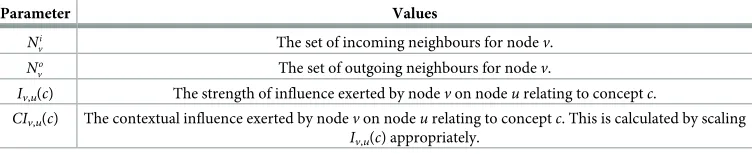
and LTM, our concept interaction framework is generally applicable and can represent a range of spreading dynamics. Furthermore, while we define the interactions between only two con-cepts, we briefly discuss how this framework can be extended to an arbitrary number of inter-acting concepts.Table 1summarises the notation used to described the framework.
4.1 Environment
We represent an environment by a set of nodes situated in a network. Each node,v, has a set of incoming neighbours,Ni
v, and outgoing neighbours,Nvo, where nodes inNvi can influencev,
andvcan influence nodes inNo
v. These sets are not necessarily disjoint and may be equivalent
in some environments, allowing both directed and undirected graphs to be represented.
4.2 Influence Spread
A concept spreads through a network during interactions between nodes. During these inter-actions, a concept can spread from the infector node to the receiver node dependent on the strength of the influence being exerted by the infector onto the receiver.Iv,u(c) represents the
influence strength exerted by nodevonto nodeuwith respect to conceptc. The value ofIv,u(c)
is defined based on the influence spread model that is used.
The ICM emulates word-of-mouth propagation, with concepts being spread from node to node based on single interactions. As discussed previously, a concept successfully spreads from an infector to a receiver with a given probabilityp, and each infector-receiver pair can interact only once per concept. We defineIv,u(c) =pfor any pair of nodes such thatv2Nui and
pis the chance of infection. In each time step, each node that activated a concept in the previ-ous step can attempt to spread that concept to each of its neighbours.
The LTM emulates the idea of group influence, with nodes activating a concept based on the number of their neighbours that have already activated that concept. Each node,n, has a threshold,Tn, that represents the total incoming influence required for a node to activate a
concept. A pair of nodes is connected by a directed edge, with a given weight,wv,u, that
repre-sents the strength of influence from the source nodevto the destination nodeu. In the origi-nal, single concept, LTM, a node activates the concept once the sum of incoming weights,wv,u
from neighbours with the concept active exceeds its own threshold.
When there are multiple concepts, a nodenwill have an individual threshold,Tc
n, for each
concept,c. Similarly, edges will have individual weights,wc
v;u, for each concept, leading to an
environment that is equivalent to a multi-layer network. Each concept is then activated on a node in a similar way to the original LTM. When the total incoming influence for a conceptc
exceeds a node’s threshold forc, that node activatesc. For a given conceptc, we define
Iv;uðcÞ ¼minð1;w c v;u=T
c
uÞ. We divide the weight of the edge between the two nodes by the
[image:10.612.200.576.89.166.2]receiver node’s threshold, so that influence strength represents the proportion of the receiver node’s threshold that is matched by the edge weight. Accounting for the threshold of the Table 1. Notation used to denote the concept interaction framework.
Parameter Values
Ni
v The set of incoming neighbours for nodev.
No
v The set of outgoing neighbours for nodev.
Iv,u(c) The strength of influence exerted by nodevon nodeurelating to conceptc.
CIv,u(c) The contextual influence exerted by nodevon nodeurelating to conceptc. This is calculated by scaling
Iv,u(c) appropriately.
receiver allows for a relative measure of influence strength, which can be better compared to other relationships within the network. We limitIv,u(c) to a maximum value of 1 since that
sig-nifies a guaranteed activation.
4.3 Concept interaction
When nodes interact, the spread of a concept can be affected by other concepts active on both the infector and the receiver. In this model, this effect is represented by scaling the influence strength that an infectorvcan exert on a receiveruregarding conceptc. The resulting value is referred to as the contextual influence and is represented byCIv,u(c).
The definition ofCIv,u(c) is dependent on the use case, in particular the number of concepts
that can interact within the model. For our case, where we have only a target concept,t, and a secondary controllable concept,s, we defineCIv,u(t) as follows:
CIv;uðtÞ ¼
minð1;Iv;uðtÞÞ ifsis not active on eithervoru
minð1;Iv;uðtÞ rÞ ifsis active on one ofvoru
minð1;Iv;uðtÞ r
2Þ ifsis active on bothvandu
8 > <
>
: ð3Þ
wherer2[0,1) is a feature of the environment that represents the extent to which concepts
affects conceptt. Ifr<1, thensdecreases the ability oftto spread, and the relationship is said to be inhibiting. Ifr>1, the relationship is said to be boosting assincreases the ability oftto spread. Ifr= 1 thenshas no impact on the ability oftto spread. As discussed previously, the concepts active on an infector can affect the concepts that spread from it, and the concepts active on a receiver affect the concepts the receiver will adopt. As such, we consider the context of both nodes when evaluating the strength of the contextual influence. Note that we limit the contextual influence value to a maximum of 1 as, in both the ICM and LTM, that means the receiver is guaranteed to activate the target concept. The possible effects of concept interaction are illustrated inFig 1, where we see a boosting concept increase the number of neighbours activated and an inhibiting concept decrease the number of neighbours activated.
The concept interaction model is designed to be extensible and allow for any number of concepts to spread within a network and interact. If there are more than two concepts that can interact, each relationship must be defined. In particular, this requires defining how each con-cept affects the spread of others when active on the infector and when active on the receiver. Each of these situations can be defined using a value forr. When a concept,c, spreads,Iv,u(c) is
[image:11.612.120.576.570.647.2]then scaled by the summation of the effects of each concept active on the infector and a sum-mation of the effects of each concept active on the receiver. While in this work we do not fully utilise the wider functionality of this model, the used to run the simulations has been designed
Fig 1. Illustration of a target concept (blue) spreading through a network, being affected by a boosting concept (green) on the left and an inhibiting concept (red) on the right. Note how the edge weights change when the target concept interacts with the boosting and inhibiting
concept, increasing on the left from an interaction with the boosting concept and decreasing on the right from an interaction with the inhibiting concept.
to allow for the most general case and is obtainable from:https://github.com/JamesArchbold/ ConceptInteraction.
5 Indirect concept manipulation
The influence maximisation problem has been well studied, leading to a variety of heuristics that aim to approximate an optimal solution. However, there may be situations where we do not have direct control of the concept we wish to manipulate, as discussed in Section 3. Con-cept interactions provide an opportunity for us to indirectly manipulate the spread of another concept, allowing us to tackle a wider range of problems when compared to assuming blocking concepts.
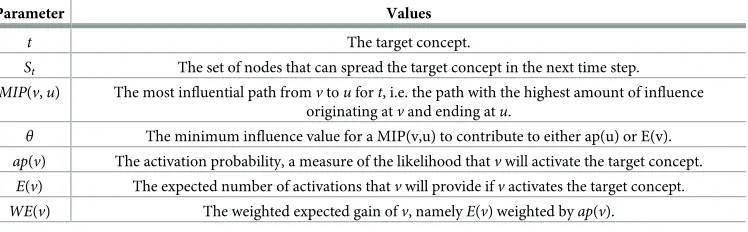
In this section, we propose the maximum potential gain (MPG) heuristic to address the indirect influence maximisation and indirect influence limitation problems in environments with concept interaction. Algorithm 1 defines the MPG heuristic and in this section we describe its operation in detail. A summary of the notation used in our description can be found inTable 2. Previous techniques that have been developed for environments where con-cepts block are less effective when dealing with concept interaction, as it becomes impossible to guarantee that a concept can be prevented from spreading. As such, new techniques are needed for indirect influence manipulation, leading to the development of MPG.
We wish to select locally influential nodes, that can spread the controllable concept and affect the spread of the target concept. This is similar to the notion of betweeness [10,45], since selecting nodes with a high betweeness means that they are likely to be encountered by the target concept and to reach a higher number of nodes. Determining betweeness is compu-tationally expensive, since it requires the calculation of a large number of shortest paths. Therefore, we need an alternative method to estimate the influence of a node. Nodes that are likely to both activate the target concept and provide a high number of expected activations are likely to be locally influential, therefore MPG aims to select such nodes.
Algorithm 1: Greedy Algorithm using MPG Heuristic
input: Set of nodes in the network, V; Set of nodes that will attempt to spread concept t in the next time step, St; probability threshold, θ; Number of seeds to select, s
output: Seed set for controllable concept c, Sc for v 2 V do
#Initialise the activation probability (ap) and expected gain (E) for node v.
ap(v) 0;
E(v) 0; end
[image:12.612.203.577.89.205.2]for n 2 St do
Table 2. Notation used to describe MPG.
Parameter Values
t The target concept.
St The set of nodes that can spread the target concept in the next time step.
MIP(v,u) The most influential path fromvtoufort, i.e. the path with the highest amount of influence originating atvand ending atu.
θ The minimum influence value for a MIP(v,u) to contribute to either ap(u) or E(v). ap(v) The activation probability, a measure of the likelihood thatvwill activate the target concept.
E(v) The expected number of activations thatvwill provide ifvactivates the target concept.
WE(v) The weighted expected gain ofv, namelyE(v) weighted byap(v).
foreach {v|IRn,v > θ} do
#Each node reachable by n has some chance of activating the concept t from n, and so we update their activation probability accordingly.
ap(v) ap(v) + IRn,v; end
end
#Only explore nodes with some chance of activating the target concept
foreach {v|ap(v) > 0} do
EðvÞ ¼X
ujIRn;v>yIRn;v ;
#We weight expected gain by the chance of activating the target concept
WE(v) E(v) × ap(v); end
while |Sc| < s do
#Select node n with highest weighted expected gain and add it to the seed set
v {n|8x2V WE(n) > WE(x)};
Sc Sc [ v;
#v’s adopting context will have changed, and so we must update the expected gain of nodes that included v in its calculation.
foreach {u|IRn,v > θ} do
Recalculate E(u) taking new concept interaction with c into account;
WE(u) E(u) × ap(u); end
#v’s spreading context will have changed, and so any node that receives influence from a node in St through v will need to have its
activation probability, ap(u), updated. foreach {u|v 2 MIP(w, u) ^ w 2 St} do
Recalculate ap(u) taking new concept interaction with c into account;
WE(u) E(u) × ap(u); end
end
return Sc;
We assume that MPG has full knowledge of the network, including which nodes have the tar-get concept active. A similar assumption was made by the authors of MoBoo [37], as some level of knowledge of the target concept is needed to be able to indirectly manipulate it. While not always realistic, there are cases where we may know that an individual has a concept active and be unable to directly interact with that concept. For instance, consider a disease such as bird flu. When it is first introduced into a population, there is no vaccine, but information about the dis-ease and its symptoms can help to limit its spread through a population. Alternatively, we can often learn of someone’s political affiliation, but it is difficult to directly encourage others to adopt that affiliation. Instead, a person may be influenced to read news stories that cause a change in opinion. In both cases we can see how, while we may not be able to control the target concept, we may be able to learn which individuals have it active and so manipulate its spread.
5.1 Activation probability
If an edge exists in a network from nodevto nodeu, thenvcan exert influence onuin relation to a conceptc. This influence,Iv,u(c), is used in an influence spread model to determine
whetheruwill activate conceptcbased onv’s influence. We define the setStas the set of nodes
the initial seed set. For the LTM, this is the set of nodes that currently have the target concept active, since nodes in the LTM always exert influence, to model the gradual effect of peer pressure.
For each nodev2St, the influence reaching nodeufromv, for conceptt, is dependant
on the most influential path fromvtou,MIPt(v,u). For a given pathP= {v=v1!v2!. . .!
vn−1!vn=u}, the strength of the influence reachingufromvis defined as:
IP¼ Y
vi;viþ12P
CIvi;viþ1ðtÞ ð4Þ
If a node in the path has activated the controllable concept, the influence it receives and exerts in relation to the target concept will be modified according to the concept relationship between the controllable and target concept. The use ofCIv,u(t) in the definition ofIPallows for that
relationship to be accounted for.MIP(v,u) can then be defined as:
MIPðv;uÞ ¼argmaxP2APðv;uÞðIPÞ ð5Þ
whereAP(v,u) is the set of all paths that start withvand end inu. This means the influence received byufromv, denoted asIR(v,u), is equal toIR(v,u) =IMIP(v,u). Ifvcannot reachuthen MIP(v,u) does not exist andIR(v,u) = 0. CalculatingIR(v,u) for every node that can be reached byvis computationally expensive. As such, for each nodev2St, only theIR(v,u)
val-ues for the local area are calculated. Starting atv, we explore the local neighbourhood recur-sively, calculating the most influential path for each new node encountered until theIR(v,u) values drop below a chosen threshold,θ. Since the influence received fromvdecreases as path length increases, eventually this threshold will be reached and exploration will stop. We can account for this in an expanded definition ofIR(v,u):
IRðv;uÞ ¼ IMIPðv;uÞ if9MIPðv;uÞ ^IMIPðv;uÞ>y
0 otherwise
(
ð6Þ
The activation probability of a node,u, can now be defined as the sum of the influence received from all nodes with the target concept active:
apðuÞ ¼X
v2St
IRðv;uÞ ð7Þ
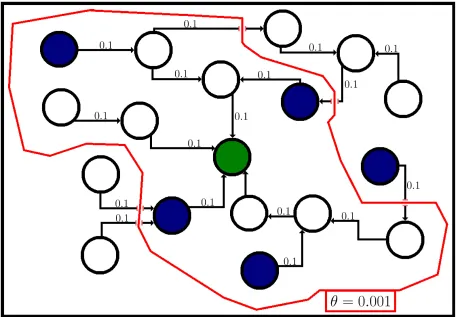
Fig 2illustrates the calculation of the activation probability ofu, represented in the figure as the green node. The blue nodes have the target concept active, and those within the red area can send influence touequal to or greater thanθand so contribute toap(u). The nodes outside the exploration range, which send influence touless thanθ, do not contribute toap(u). Note that in this case, the controllable concept has yet to be introduced, and so each edge has the same probability of propagating the target concept.
5.2 Expected gain
With the activation probability calculated, we now consider a node’s expected activations for the target concept. This is simply calculated as the sum of the influence that a node,u, exerts on all other nodes within the network:
EðuÞ ¼X
w
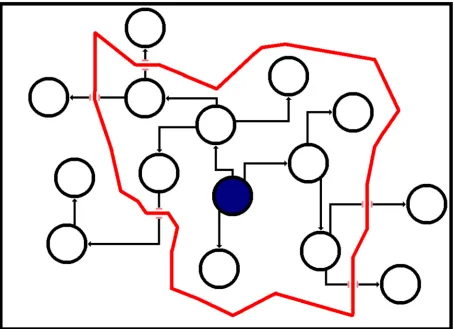
Due to the definition ofIR(u,w),E(u) can be calculated efficiently, as it will only need to the explore a small local area of the network. This is illustrated inFig 3, where nodes outside of the red area receive an amount of influence less thanθand so do not contribute toE(v).
To identify influential nodes that are likely to be encountered, the expected gain of a node is weighted by the probability that it will activate the target concept. This weighted expected gain,WE(u), for a nodeurepresents the expected value ofuto the spread of the target concept, is defined as:
WEðuÞ ¼EðuÞ apðuÞ ð9Þ
[image:15.612.120.577.77.394.2]A highWE(u) value indicates a node is both likely to activate the target concept and pro-vides a high expected gain for the target concept. As such, we select the node with the highest weighted expected gain,WE(u), as a seed node for the controllable concept and we update the value ofWE(v) for any nodevthat will be affected by the presence of the controllable concept at nodeu. The selection process then repeats, selecting the node with the highestWE(u) value, and recalculatingWE(v) for affected nodes until the seed set for the controllable concept reaches the desired size.
Fig 2. Illustration of how a node with the target concept active can contribute to another node’s activation probability in the ICM, where
p= 0.1. Blue nodes have the target concept active, and the red border signifies a propagation probability ofθ= 0.001. A concept spreading from a node within that border will reach the green node with a probability higher thanθ, a concept spreading from outside the border will reach the green node with a probability lower thanθand so does not contribute to the green node’sap(green).
6 Experimental set-up
[image:16.612.122.575.77.406.2]We evaluate the effectiveness of our proposed heuristic using the experimental parameters given inTable 3. For both the indirect influence maximisation and indirect influence limita-tion problems, we compare the performance of MPG against heuristics used to maximise the spread of the secondary concept and the MoBoo heuristic for indirect influence maximisation. Fig 3. Illustration of reachability, where the red border represents a propagation probability ofθ. Nodes inside the red area have a
probability higher thanθto be reached by a concept spreading from the blue node and so contribute to its expected gain. Nodes outside the red area have a probability lower thanθto be reached and so do not contribute to the expected gain of the blue node.
https://doi.org/10.1371/journal.pone.0199845.g003
Table 3. Experimental parameters.
Parameter Values
Graph size (nodes) 1000, 5000, 10000, 25000, 50000, 100000, 250000
Clustering exponent for small-world networks 0.25, 0.75
Number of edges added each evolution step for scale-free networks
4, 8
Real-world network samples used DBLP, CA-CondMat, soc-Epinions1
Seed set size 10, 25, 50, 100, 250, 500
rvalues 0, 0.2, 0.4, 0.6, 0.8, 1.2, 1.4, 1.6, 1.8, 2
Burn-in time steps 0, 2, 5
[image:16.612.200.578.575.697.2]As previously stated, the code used to run the simulations is obtainable from:https://github. com/JamesArchbold/ConceptInteraction.
In this evaluation, for the ICM we assumeθ= 0.001, meaning that a path must have an influence strength above 0.001 to be included in the calculation ofap(v) andE(v) values, limit-ing our considerations to a local area around each node with the target concept active. This set-ting is equivalent to SIR model where the probability of deactivation is 1, however the majority of influence spread studies use terms associated with the ICM, and so we use ICM terminology in this paper.
When evaluating MPG in the LTM,θinstead represents the length of a path. Due to the variance in influence strength present in the LTM, the amount of the network we explore can vary drastically. Since a typical cascade does the majority of its spreading in the first few time steps we only consider paths of length 4 or less, meaning that from each node we explore their 3-hop neighbourhood.
For the ICM, we assume that the probability of a concept spreading from an infector to a receiver is initiallyp= 0.1. This value is then modified by the interactions between the different concepts active on the infector and receiver. For the LTM, nodes have a threshold selected from a Gaussian distribution with a mean of 0.8 and standard deviation of 0.05. This means that the average node is difficult to activate, which mirrors the low chance of infection present in the ICM.
We acknowledge that both of these models are simplistic, and that the results we obtain are limited by the restrictions of the models. In this paper, we focus on demonstrating the fea-sibility of indirect concept manipulation and so we use two of the most widely used models in the study of influence spread. In the future, we intend to perform investigations with other, more dynamic models such as SIS and the SIR model with a wider range of deactivation probabilities.
We compare the performance of MPG against other heuristics for the indirect influence maximisation and the indirect influence limitation problems. In particular, we compare its performance against degree discount [4] and MoBoo [37]. These heuristics have been shown to perform well in related settings and so provide comparators for evaluating the performance of MPG. In addition, we will compare against the performance of simple heuristics, such as highest degree and random selection, to provide a baseline.
The target concept has a randomly selected seed set in all our experiments. We use the fol-lowing heuristics to select a seed set for the controllable concept:
• Random—randomly chosen nodes are selected.
• Highest Degree—nodes with the highest degree are selected.
• Single Discount—nodes with the highest degree of nodes not already selected for the seed set are selected.
• Degree Discount—nodes with the highest 1-hop expected gain are selected.
• MoBoo—nodes with the most probable paths of activation are selected.
• MPG—nodes likely to activate target concept, with high expected gain, are selected.
The primary target concept will spread for a given number of time steps, referred to as the burn-in time, before we introduce and select seeds for the controllable concept. We evaluate the heuristics using a variety of burn-in times in order to explore the impact of burn-in time on the effectiveness of the various heuristics. We focus on short burn-in times, preventing the controllable concept being introduced after the target concept has stopped spreading and at which point we would be unable to manipulate it.
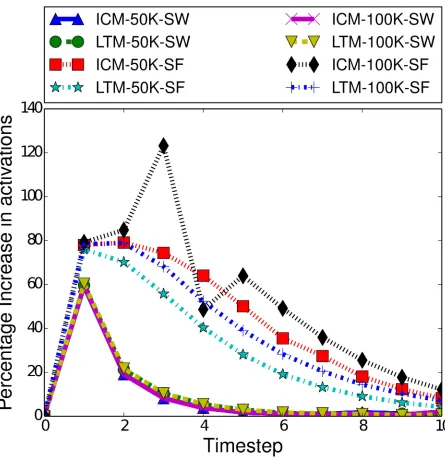
[image:18.612.124.569.220.677.2]We performed a small selection of initial cascades, where there is one concept spreading from a randomly selected seed set of 250 nodes, using either the ICM or LTM as described above. These tests used both scale-free and small-world networks of 50000 or 100000 nodes. As shown inFig 4, we see an increase in the number of infections each round in the early time
Fig 4. Mean percentage increase of activations in the first 10 time steps of a cascade, for a single concept using a randomly selected seed set of 250 nodes.
steps, but always by time step 4, the number of new infections begins to rapidly decline. Note this happens for both influence spread models, demonstrating why we wish to intervene early and so focus on early burn-in times. Furthermore, we test a range of boosting and inhibiting relationship strengths. This allows us to determine whether different strategies may be more viable at different levels of relationship strength.
Our evaluation of these heuristics requires a variety of networks. Real-world networks can be characterised by a number of topological features [46,47]. Two characteristics that are often considered are the small-world and scale-free properties, both of which are often present in real-world networks [48,49]. As such, synthetic small-world and scale-free networks are both used to evaluate the performance of the heuristics, with a range of sizes as detailed in
Table 3. The results from these networks can help to inform how MPG may perform in real-world situations.
The small-world networks used in this paper have a clustering exponent of either 0.25 or 0.75. These are generated using the Kleinberg small-world generator provided in the JUNG graph framework (http://jung.sourceforge.net/) [50]. The scale-free networks are constructed through the use of the Baraba´si-Albert generator provided in JUNG [51]. This generator begins with an initial set of unconnected nodes and introduces a new node at each evolution step. This node then gains a number of edges, with connections chosen randomly through preferential attachment. We begin with 10 unconnected nodes and add either 4 or 8 edges in each step. For each combination of network size, type and network characteristics, we generate 100 networks.
We also run tests on selected real-world networks, taken from the Stanford SNAP project networks (http://snap.stanford.edu/data), namelyDBLP,CA-CondMatandsoc-Epinions1. Real-world networks are not strictly small-world or scale-free and instead can display proper-ties of both types of network [52,53]. Details of the characteristics of the real-world network samples we utilise are provided inTable 4.
For networks of 10000 nodes or less, we perform simulations for each combination ofr
value, burn-in time, controllable concept heuristic and seed set size under 100. For networks of 25000 nodes or more, we use each seed set size of 100 or above. This means that for each controllable concept heuristic, we have 100 results for each combination ofrvalue, seed set size, burn-in time, network type and network size. For the real-world networks we run 100 simulations for each combination of parameters, using seed set sizes of 100 or above. We also performed two tailed t-tests to compare the performances of the various heuristics. For each environment, we performed the test on each possible pairing of heuristics.
[image:19.612.38.579.89.142.2]With these experiments we aim to evaluate the feasibility of indirect influence manipulation in a social network. The main limitation of this work is that while we use synthetic networks and models that have been widely used, we focus on simulation rather than real-world valida-tion. Ideally, after an initial period of testing, a real-world study would be performed. As dis-cussed in Section 2.4, the few real-world studies that exist are small in scope, and focus on the problem of uncertainty. Instead, we would wish to use a large network for which topological information is available, such as an online social network. We would then select individuals to Table 4. Characteristics of the real-world network samples used for evaluation.
Network Nodes Edges Avg. Degree Avg. Clustering Coefficient Num. of Triangles Diameter
DBLP 317080 1049866 3.31 0.6324 2224385 21
CA-CondMat 23133 93497 4.04 0.6334 173361 14
soc-Epinions1 75879 508837 6.7 0.1378 1624481 14
generate content that relates to another, trending, topic but without directly linking to it. From there we would track the individual’s neighbours that begin to spread information on the trending topic. However, such a study is difficult to perform as many social networks are, understandably, protective of their data. Furthermore, there is an issue of how to incentivise the individuals we choose to generate content. For now, we focus on empirically validating a method of indirect influence manipulation, since real-world studies are expensive to perform, are time consuming, and potentially raise privacy concerns. Our view is that demonstrating the effectiveness of a heuristic through simulation is an important first step that should precede any real-world application.
7 Results for indirect concept maximisation
We evaluate the performance of MPG for both the ICM and LTM for the indirect influence maximisation problem, across three types of network namely small-world, scale-free and real-world. In this problem, the controllable concept has a boosting relationship with the target concept and we aim to maximise the spread of the target concept.
7.1 Small-world networks
We begin our assessment of the performance of the different heuristics with small-world net-works. We first consider the ICM and then the LTM, discussing the impact of the different parameters explored in this study.
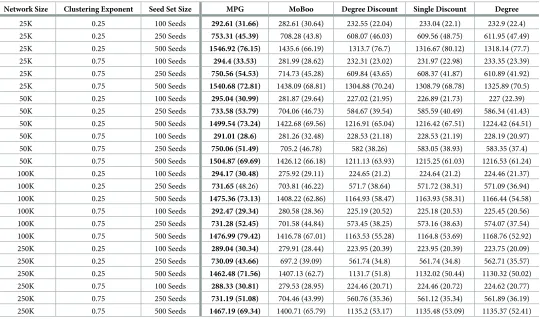
7.1.1 The Independent Cascade Model. When considering small-world networks in the
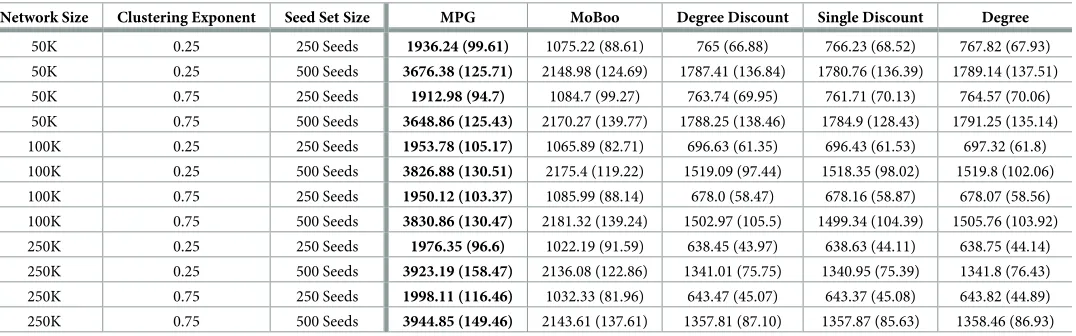
ICM, we see that MPG performs well when the burn-in time is 0, consistently outperforming all other heuristics in increasing the number of target concept activations, as shown inTable 5. MoBoo is the only other heuristic that performs close to MPG, with the other degree-based heuristics all performing poorly. This is to be expected, due to MoBoo being the only other heuristic that accounts for possible concept interactions and was explicitly designed for con-cept spread maximisation.Table 5summarises the performance of the heuristics when the concept relationship is strong. We note that, when comparing various graph types, the size of the graph and its clustering exponent have no significant effect on the performance of any heu-ristic. The size of the seed set does affect performance, as is to be expected. The more initial seed nodes there are, the further we expect concepts to spread. Importantly, the rank order of the heuristics’ performance does not change, but each heuristic increases the number of activa-tions by a similar magnitude.
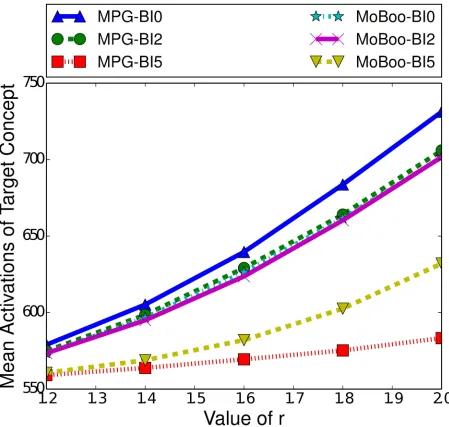
Two factors that do notably affect the performance of MPG and MoBoo are the length of the burn-in time and the strength of the relationship between the target and controllable con-cept.Fig 5highlights the difference in performance between MPG and MoBoo for a variety of burn-in times and relationship strengths. As the relationship strength increases, we see both heuristics improve their performance, as a stronger relationship will naturally make MPG and MoBoo more effective, as they aim to maximise the number of interactions between the con-cepts. With a strong concept relationship, any interaction between the target and controllable concept greatly increases the probability of the target concept spreading, which can in turn facilitate further interactions.
time is 0, we see a significant difference between the two heuristics (p<0.05) in favour of MPG. However, at a burn-in time of 2, there is minimal difference between the two heuristics, and with a burn-in of 5 MoBoo begins to outperform MPG. At weaker relationship strengths, we can see that the difference is minimal and not statistically significant (p>0.2). However, once the r value exceeds 1.4, MoBoo significantly outperforms MPG when the burn-in time is 5 (p<0.05).
While both heuristics calculate the gain of selecting a given node, the method utilised by MoBoo seems to mitigate the impact of fewer activations occurring in later time steps.
7.1.2 The Linear Threshold Model. When concepts spread using the LTM, we see a
simi-lar performance in small-world graphs as we do for when concepts use the ICM. AsTable 6
[image:21.612.37.577.96.415.2]highlights, MPG continues to out-perform the other heuristics when there is no burn-in time in small-world networks. A major difference is the magnitude of activations. When comparing similar network and seed set sizes, we see a larger number of activations for all heuristics in the LTM when compared to the ICM. Nodes in the LTM continuously exert influence once they activate a concept and so, unlike in the ICM, a node that activates the controllable concept after activating the target concept can still be affected. This means there will be more concept interactions, leading to the boosting relationship being more effective. Note that this is true for small-world networks due to the low variability of node degree, meaning that most nodes will have a degree close to the average. In the LTM, nodes typically require multiple neigh-bours to be active before they activate a concept and so these additional interactions contribute Table 5. Average infections for the target concept for small-world networks in the ICM, with no burn-in time and a r value of 2, with standard deviation in brackets, and the best performing heuristic in bold.
Network Size Clustering Exponent Seed Set Size MPG MoBoo Degree Discount Single Discount Degree
25K 0.25 100 Seeds 292.61 (31.66) 282.61 (30.64) 232.55 (22.04) 233.04 (22.1) 232.9 (22.4) 25K 0.25 250 Seeds 753.31 (45.39) 708.28 (43.8) 608.07 (46.03) 609.56 (48.75) 611.95 (47.49)
25K 0.25 500 Seeds 1546.92 (76.15) 1435.6 (66.19) 1313.7 (76.7) 1316.67 (80.12) 1318.14 (77.7)
25K 0.75 100 Seeds 294.4 (33.53) 281.99 (28.62) 232.31 (23.02) 231.97 (22.98) 233.35 (23.39)
25K 0.75 250 Seeds 750.56 (54.53) 714.73 (45.28) 609.84 (43.65) 608.37 (41.87) 610.89 (41.92) 25K 0.75 500 Seeds 1540.68 (72.81) 1438.09 (68.81) 1304.88 (70.24) 1308.79 (68.78) 1325.89 (70.5)
50K 0.25 100 Seeds 295.04 (30.99) 281.87 (29.64) 227.02 (21.95) 226.89 (21.73) 227 (22.39)
50K 0.25 250 Seeds 733.58 (53.79) 704.06 (46.73) 584.67 (39.54) 585.59 (40.49) 586.34 (41.43)
50K 0.25 500 Seeds 1499.54 (73.24) 1422.68 (69.56) 1216.91 (65.04) 1216.42 (67.51) 1224.42 (64.51) 50K 0.75 100 Seeds 291.01 (28.6) 281.26 (32.48) 228.53 (21.18) 228.53 (21.19) 228.19 (20.97)
50K 0.75 250 Seeds 750.06 (51.49) 705.2 (46.78) 582 (38.26) 583.05 (38.93) 583.35 (37.4)
50K 0.75 500 Seeds 1504.87 (69.69) 1426.12 (66.18) 1211.13 (63.93) 1215.25 (61.03) 1216.53 (61.24)
100K 0.25 100 Seeds 294.17 (30.48) 275.92 (29.11) 224.65 (21.2) 224.64 (21.2) 224.46 (21.37) 100K 0.25 250 Seeds 731.65 (48.26) 703.81 (46.22) 571.7 (38.64) 571.72 (38.31) 571.09 (36.94)
100K 0.25 500 Seeds 1475.36 (73.13) 1408.22 (62.86) 1164.93 (58.47) 1163.93 (58.31) 1166.44 (54.58)
100K 0.75 100 Seeds 292.47 (29.34) 280.58 (28.36) 225.19 (20.52) 225.18 (20.53) 225.45 (20.56)
100K 0.75 250 Seeds 731.28 (52.45) 701.58 (44.84) 573.45 (38.25) 573.16 (38.63) 574.07 (37.54) 100K 0.75 500 Seeds 1476.99 (79.42) 1416.78 (67.01) 1163.53 (55.28) 1164.8 (53.69) 1168.76 (52.92)
250K 0.25 100 Seeds 289.04 (30.34) 279.91 (28.44) 223.95 (20.39) 223.95 (20.39) 223.75 (20.09)
250K 0.25 250 Seeds 730.09 (43.66) 697.2 (39.09) 561.74 (34.8) 561.74 (34.8) 562.71 (35.57)
250K 0.25 500 Seeds 1462.48 (71.56) 1407.13 (62.7) 1131.7 (51.8) 1132.02 (50.44) 1130.32 (50.02) 250K 0.75 100 Seeds 288.33 (30.81) 279.53 (28.95) 224.46 (20.71) 224.46 (20.72) 224.62 (20.77)
250K 0.75 250 Seeds 731.19 (51.08) 704.46 (43.99) 560.76 (35.36) 561.12 (35.34) 561.89 (36.19)
250K 0.75 500 Seeds 1467.19 (69.34) 1400.71 (65.79) 1135.2 (53.17) 1135.48 (53.09) 1135.37 (52.41)
effectively to the number of activations. In networks with a higher number of low degree nodes, we expect to see fewer activations in the LTM. We also see that MoBoo has its relative performance affected. In the ICM we observed that MoBoo performed similarly to MPG, but in the LTM there is a much larger difference between the two.
[image:22.612.122.571.76.503.2]Another significant difference between the ICM and the LTM is the effect of burn-in time. AsFig 6demonstrates, a longer burn-in time actually slightly improves the performance of MPG. If we compare the difference in performance between a burn-in time of 0 and 2, we see a noticeable increase in the performance of MPG. Furthermore, we see a diminished increase between a burn-in time of 2 and 5. At higher burn-in times, in the LTM, there will be more actively spreading nodes, unlike in the ICM where there are less. For example, consider intro-ducing the controllable concept at time step 0, with a seed set size of 100 for both concepts. This means that there are 100 nodes that can spread the target concept when the controllable Fig 5. Mean activations of the target concept given the heuristic used to select the boosting concept in the ICM, for small-world networks of 100000 nodes, with a clustering coefficient of 0.75, a seed set of 250 nodes and a variety of burn-in (BI) times.