warwick.ac.uk/lib-publications
Manuscript version: Author’s Accepted Manuscript
The version presented in WRAP is the author’s accepted manuscript and may differ from the
published version or Version of Record.
Persistent WRAP URL:
http://wrap.warwick.ac.uk/108208
How to cite:
Please refer to published version for the most recent bibliographic citation information.
If a published version is known of, the repository item page linked to above, will contain
details on accessing it.
Copyright and reuse:
The Warwick Research Archive Portal (WRAP) makes this work by researchers of the
University of Warwick available open access under the following conditions.
© 2018 Elsevier. Licensed under the Creative Commons
Attribution-NonCommercial-NoDerivatives 4.0 International
http://creativecommons.org/licenses/by-nc-nd/4.0/.
Publisher’s statement:
Please refer to the repository item page, publisher’s statement section, for further
information.
The use of permutation representations in structural computations in
large finite matrix groups
John J. Cannon
School of Mathematics and Statistics, University of Sydney, NSW 2006, Australia
Derek F. Holt
Mathematics Institute, University of Warwick, Coventry CV4 7AL, UK
William R. Unger
School of Mathematics and Statistics, University of Sydney, NSW 2006, Australia
Abstract
We determine the minimal degree permutation representations of all finite groups with trivial soluble radical, and describe applications to structural computations in large finite matrix groups that use the output of theCompositionTreealgorithm. We also describe how this output can be used to help find an effective base and strong generating set for such groups. We have implemented the resulting algorithms inMagma, and we report on their performance.
Keywords: Permutation representation, finite matrix group, structural computation
1. Introduction
The main theoretical result in this paper is the determination of the smallest degree of a faithful permutation representation of any finite group that has no nontrivial soluble normal subgroups. We were motivated to investigate this question by its applications to structural computations in large finite matrix groups.
The paper [1] contains a detailed description of theCompositionTreealgorithm for computing a
composition treeof a finite groupG. A composition tree consists (roughly) of a composition series ofGtogether with some associated data. The algorithm is principally intended for the investigation of large finite matrix groupsG≤GL(d, q), but it can also be applied to finite permutation groups. The successful computation of a composition tree for Genables constructive membership testing
(that is, testing elements g ∈ GL(d, q) for membership of G and writing g ∈ G as words over a specified generating set X of G), identifying the composition factors of G as abstract simple
Email addresses: [email protected](John J. Cannon),[email protected](Derek F. Holt),
[email protected](William R. Unger)
groups, and setting up constructive isomorphisms between the nonabelian composition factors and their standard copies.
The paper [1] also contains descriptions of some applications of the output of CompositionTree, including the computation of a chief series, the soluble radical, and Sylow subgroups ofG. We shall refer to structural computations in a matrix groupGthat use this output asCT-SRalgorithms, since they all make use of a certain chief series forGthat passes through the soluble radicalLofG. Many of these algorithms can be rendered significantly more effective if a permutation representation of G/L of reasonably small degree can be found, and we shall show how our theoretical result mentioned above can be used in practice to compute effectively a permutation representation of
G/Lof smallest possible degree.
Prior to the availability of CompositionTree, almost all structural computations in finite matrix groups were carried out, by default, using base and strong generator set (BSGS) data structures, which were introduced originally by Sims [26] for computing in finite permutation groups. These have been very effective in groups for which a BSGS with reasonably short basic orbits is readily available. Some matrix groups, such as GL(d, q) for even moderately largedand q, have no such BSGS. But there are many examples of large matrix groups in which a good BSGS exists but is difficult to find. The other main topic of this paper is the description of aCT-SR algorithm that uses the CompositionTree data together with a permutation representation of G/L to help in the search for a good BSGS. This has turned out to be highly effective in a number of groups, particularly in examples where bothL andG/Lare moderately large.
We also include a brief description of a number of newCT-SRalgorithms, including the computation of conjugacy classes, character tables, and subgroups of bounded index. These are essentially routine applications of existing methods for use with the CompositionTreedata (although their implementation was often time-consuming).
CompositionTree has been implemented in Magma [3], as have our applications, which are all available in releases V2.23 upwards.
A more theoretical treatment of computation in matrix groups over finite fields, which also in-volves computing in the radical quotient G/L, is presented in [2]. A related but slightly different approach to practical computation is described in [23], and the algorithms presented there have been implemented inGAP [14] in the package recog[24]. Some of the methods that we describe in this paper, including the use of a permutation representation of G/L for the computation of conjugacy classes ofG, have been implemented by Hulpke inrecog, and are presented in [17].
The restriction of these methods to matrix groups over finite fields is not serious, because the algorithms described in [12] allow us easily to map a finite subgroup of GL(d, K) for an infinite fieldK to an isomorphic subgroup of GL(d, q) for a suitableq.
We prove our results about minimal degree permutation representations of groups with trivial soluble radical in Section 2. OurCT-SRalgorithm that attempts to find a useful BSGS is described in Section 3.
The newCT-SRalgorithms are described briefly in Section 4. Although they are based on existing methods, we note that we are now able to routinely compute character tables of groups that have been, until now, outside of the range of default general purpose methods, such as the subgroupG= 21+22.Co
2of the “Baby Monster” sporadic simple group, withGgiven as a subgroup of GL(1025,2).
Our method for finding subgroups of bounded index includes a new feature (which is also useful in calculations with permutation groups) that enables us to avoid unnecessary computations in simple composition factors that do not themselves have any proper subgroups up to that index.
2. Computing a permutation representation of the radical quotient G/L
2.1. Calculating the minimal permutation degree: theory
For a finite groupG, we definem(G) to be the smallest degree of a faithful permutation represen-tation ofG. Particularly whenGis insoluble, a low degree permutation representation, if it exists, is likely to be the most useful representation for carrying out effective structural computations in
G, and so calculating (or at least estimating)m(G) is important for this purpose. Our first aim in this section is to determinem(G) for all finite groups Gwith trivial soluble radical. For general finite groupsGthis problem appears to be significantly more difficult.
For a subgroup H ≤G, we recall that CoreG(H) is the smallest normal subgroup of G that is contained in H, and H is said to be core-free in G if CoreG(H) = 1. If G is simple or, more generally, ifGhas a unique minimal normal subgroup, then a minimal degree faithful permutation representation of G is transitive, and m(G) is equal to the smallest index in G of a core-free subgroup. In general, a minimal degree representation may be intransitive.
We have m(An) =nforn≥5, andm(G) is known for all sporadic finite simple groups; see [10]. Based on the study of the maximal subgroups of the classical simple groups and of the exceptional simple groups of Lie type in [18] (based on results in [11] and [25]) and [19], respectively,m(G) has been determined for simple groups in these classes in a series of papers by Mazurov and Vasilyev [20, 21, 28, 29, 30]. The results are presented in [15, Table 4]. So m(S) is known for all finite simple groupsS, and we observe thatm(S)≥5 andm(S)2<|S|for all suchS.
Lemma 2.1. Let G =×k
i=1Si be a direct product of finite nonabelian simple groups Si, and let
mi=m(Si). Then:
(i) The smallest index of a core-free subgroup ofG isQk
i=1mi.
(ii) m(G) =Pk
i=1mi.
Proof. (i) We use induction onk. The result is clear fork = 1, so suppose that k >1. Each Si has a subgroupHi of indexmi, and×ki=1Hiis a core-free subgroup ofGof indexQ
k
i=1mi. So we
need to prove that any core-free subgroupH ofGhas index at leastQk
i=1mi.
If the projection ofHonto eachSiis a proper subgroup ofSi, then this projection has index at least
mi in Si, and the result follows. Otherwise,H projects onto at least one of the Si, which we can assume to beS1. ThenH∩S1ES1, andH core-free implies thatH∩S16=S1, soH∩S1= 1. Let ρandρ0 be the projections ofH ontoS1andS10 :=×ki=2Si, respectively. So ker(ρ0) =H∩S1= 1.
If Im(ρ0) is core-free inS10 then, by induction, Im(ρ0) has index at leastQk
i=2mi in S
0
1 and index
at least|S1|Q
k
i=2mi>Q k
i=1mi in G, and the result follows, sinceH ∼= Im(ρ0).
Otherwise,C := CoreS0
1(Im(ρ
0)) is a nontrivial direct product of some of theSi. But, since H is
core-free in G, the kernel of ρrestricted to ρ0−1(C) is trivial. But, since ρ0−1(C)
EH, we have
ρ(ρ0−1(C))
Eρ(H) =S1, soρ(ρ0−1(C)) =S1. HenceCmust be equal to one of theSi, sayC=S2,
withS2∼=S1, andρ0−1(C) is a diagonal subgroup ofS1×S2. Now this subgroup is maximal and
self-normalising inS1×S2, and so it must be equal to the projection of H ontoS1×S2.
Sincem21<|S1|, the result now follows ifk= 2. Otherwise, Im(ρ0)/C = Im(ρ0)/S2 is a core-free
subgroup of S10/S2 ∼=×ki=3Si (or elseC would be larger) and, by induction, Im(ρ0)/S2 has index
at least Qk
i=3mi in S10/S2. So Im(ρ0) has index at least |S1|Q
k
i=3mi ≤ Q k
(ii) This is also proved in [13, Theorem 3.1]. Observe first that G has a faithful permutation representation of degree Pk
i=1mi withk orbits, and withSi acting faithfully of degreemi on the
i-th orbit and trivially on all other orbits. So we need to prove that, if Gacts faithfully on a set Ω, then|Ω| ≥Pk
i=1mi. We prove this by induction onk. The casek= 1 is clear, so assume that
k >1.
Since Pk
i=1mi <Q k
i=1mi, the result follows from (i) if the action is transitive. Otherwise Ω = Ω1∪Ω2where the subsets Ω1 and Ω2 are both fixed byG. Since eachSimust act faithfully on at least one of Ω1 and Ω2, the result follows by induction applied to these two actions.
Recall that a groupAisalmost simpleifS≤A≤Aut(S) for some finite nonabelian simple group
S. The proof of the following result consists of a similar analysis as for the simple groups, and will be omitted.
Proposition 2.2. Let S ≤ A ≤Aut(S) for a finite nonabelian simple group S. Then m(A) =
m(S), except in the following cases
S A m(S) m(A)
A6 A6≤S6 6 10
PSL(2,7) PGL(2,7) 7 8
M12 Aut(M12) = M12.2 12 2m(S)
O’N Aut(O’N) = O’N.2 122760 2m(S) PSL(d, q),d≥3
(d, q)6= (3,2),(4,2) A6≤PΓL(d, q) qq−d−11 2m(S)
PSp(4,2e),e≥2 A6≤PΓSp(4,2e) 24e−1
2e−1 2m(S)
PSU(3,5) A6≤PΣU(3,5) 50 126
PΩ+(2d,3),d≥4 3
6 |
|A/S|,(∗) 3d−1(32d−1) (3d−1)(32d−1+1) PΩ+(8, q),q≥4 3|
|A/S| (q4−q−1)(q13+1) 3m(S)PΩ+(8,2) 3
|
|A/S| 120 3m(S) PΩ+(8,3) 3|
|A/S|,66 |
|A/S| 1080 3m(S) PΩ+(8,3) 6|
|A/S| 1080 3360G2(3) Aut(G2(3)) 351 2m(S)
G2(3e), e >1 A6≤ΓG2(3e) q
6−1
q−1 2m(S)
F4(2e) A6≤ΓF4(2e) (q
12−1)(q4+1)
q−1 2m(S)
E6(q) A6≤ΓE6(q) (q
9−1)(q8+q4+1)
q−1 2m(S)
The Condition (∗) in the table is A 6≤ PGO(2d,3) when d >4, and A is not contained in any conjugate ofPGO(8,3) inAut(PΩ+(8,3)) whend= 4.
In particular, we havem(A)<4m(S)in all cases.
Remark. In fact we have m(A) ≤28m(S)/9 in all cases, with equality for certain subgroups of Aut(PΩ+(8,3)).
The following result can be proved by a routine examination of the examples in the table.
Lemma 2.3. For1≤i≤k withk >1, let Si be a finite nonabelian simple group, and let Ai be
an almost simple group withSi ≤Ai≤Aut(Si). ThenQ k
i=1m(Si)>P k
i=1m(Ai).
Next we consider the case when the groupGis not almost simple, but has a unique minimal normal subgroupM, which is insoluble. SoM =×k
groups that are permuted transitively under the conjugation action ofG. In [7, Section 3.2], it is shown that there is an embedding ψ:G→W := Aut(S1)oH that maps M isomorphically onto
the socle of W, where H is the transitive subgroup of Sk induced by the conjugation action of
G on the set{Si : 1 ≤i ≤ k}. By looking at the definition of ψ, we see that Im(ψ) ≤A1oH,
whereS1≤A1≤Aut(S1), and A1 is the subgroup of Aut(S1) induced by the conjugation action
ofNG(S1) onS1.
Lemma 2.4. Let G, M, Si, H, A1 be as above. Thenm(G) =km(A1).
Proof. The natural permutation representation of A1oH arising from a representation of A1 of
degreem(A1) is faithful of degreekm(A1), so we just need to prove thatm(G)≥km(A1).
So suppose that we have a faithful permutation representation ofGon a set Ω, and identifyGwith its image in Sym(Ω). Since Ghas a unique minimal normal subgroup, a minimal degree faithful permutation representation ofGis transitive, so we may assume thatGis transitive. ThenGacts transitively on the orbits ofM on Ω, and so there is a fixed numberj such that preciselyj of the
Si act nontrivially on each such orbit. Since eachSi acts nontrivially on some orbit of M, there must be at leastk/j orbits in total. By Lemma 2.1 (i), each such orbit ∆ satisfies |∆| ≥m(S1)j
and so |Ω| ≥km(S1)j/j which, by Lemma 2.3, is greater than km(A1) whenj >1. So we may
assume thatj= 1. In other words, the subgroups Si have mutually disjoint supports.
Now letN1 =NG(S1), and let Ω1 be an orbit ofN1 on whichS1 acts nontrivially. ThenS1 acts
nontrivially on each of its orbits in Ω1, so all Si withi > 1 act trivially on Ω1. For each i with
1≤i≤k, we define Ωi= Ωgi
1, forgi∈GwithS1gi =Si (which is independent of the choice ofgi). Since the Ωi are disjoint, we have|Ω| ≥k|Ω1|.
Suppose thatS1has exactly rorbits on Ω1 (soM haskr orbits on Ω). Ifr >3 then, by Lemma
2.1 (ii) and Proposition 2.2, |Ω| ≥4km(S1)> km(A1) as required, so assume that r≤3. Also, if S1acts imprimitively on these orbits, with blocks of sizeb >1, then the orbits have length at least bm(S1), so we can assume thatbr≤3 and hencer= 1 in that case. Let ¯N1and ¯C1be the induced
actions ofN1andC1:=CG(S1) on Ω1. Since the centraliser ofS1in its action on each of its orbits
has order at mostb!, we have |C¯1| ≤6, and S1 must permute the orbits of ¯C1 nontrivially. Then
¯
N1 induces a faithful action of ¯N1/C¯1∼=A1 on the orbits of ¯C1, so there are at leastm(A1) such
orbits, and hence|Ω1| ≥m(A1), which completes the proof.
Now let G be an arbitrary finite group with trivial soluble radical, and let M =M1× · · · ×Mr be the socle of G, where M1, . . . , Mr are the minimal normal subgroups of G. Then eachMi is the direct product of isomorphic simple groupsSi1, . . . , Siki for someki ≥1, which are permuted
transitively under the conjugation action ofG. Furthermore,Gis the subdirect product of groups
G1, . . . , Gr, where Gi has the unique minimal normal subgroup Mi. For each i, let Ai1 be the
group withSi1≤Ai1≤Aut(Si1) that is induced by conjugation inNG(Si1).
Proposition 2.5. With the notation in the previous paragraph, we havem(G) =Pr
i=1kim(Ai).
Proof. Since, by Lemma 2.4, Gis a subdirect product of groups Gi with m(Gi) = kim(Ai), we have m(G)≤Pr
i=1kim(Ai). So suppose that we have a faithful permutation representation ofG
on a set Ω, and identifyGwith its image in Sym(Ω). We have to prove that|Ω| ≥Pr
i=1kim(Ai).
The proof is by induction onr, and Lemma 2.4 handles the caser= 1, so we suppose thatr >1.
Suppose first that, for all orbits ∆ ofG, theMido not all act faithfully on ∆. Let ∆ be an orbit of
claim that|∆| ≥Ps
i=1kim(Ai). Since each Mi must act nontrivially on some orbit of G, this is enough to prove the result.
Let M0 =M1× · · · ×Ms. Using similar arguments to the proof of Lemma 2.4, if M0 has more
than three orbits on ∆, then the claim follows from Lemma 2.1 (ii) and Proposition 2.2. Then, puttingC=CG(M0) and ¯Cthe induced action ofCon ∆, we have|C¯| ≤6, andM0must faithfully permute the orbits of ¯C. So the induced action ofGon these orbits is a subdirect product of the groups G1, . . . , Gs and, since we are assuming thats < r, the claim follows from the inductive hypothesis.
Otherwise, there is an orbit ∆ of G on which each Mi acts faithfully. Let ∆M be an orbit of
M with ∆M ⊆∆. For 1≤i ≤k, suppose that precisely ji of the factors Si1, . . . Siki of Mi act
faithfully on ∆M. Thenji≥1 for alli.
By Lemma 2.1 (i), we have|∆M| ≥Q k
i=1m(Si1)jiwhich, by Lemma 2.3, is greater thanP
k
i=1jim(Ai1).
Now, since eachSij must act nontrivially on ∆ g
M for someg∈G, the total number of orbits ofM of the form ∆gM must be at leastki/ji for each individuali. So|Ω| ≥ |∆|>P
k
i=1kim(Ai1), which
completes the proof.
2.2. Calculating the minimal degree permutation representation: practice
The nonabelian composition factors ofGare identified as abstract simple groups byCompositionTree. Each nonabelian simple groupS has a designatedstandard copy, which is (the image of) either a permutation representation ofS, or a projective matrix representation ofS over a finite field. For example, the standard copy of Anis its natural permutation representation, and the standard copy of PSL(d, q) is SL(d, q)/Z(SL(d, q)), with the natural representation of SL(d, q). CompositionTree sets up effective isomorphisms between the nonabelian composition factors ofGand their standard copies: that is, isomorphisms for which images and inverse images of arbitrary group elements can be efficiently computed.
Let L be the soluble radical ofG. The structure of G/L as a subdirect product of groups with unique minimal normal subgroups is computed using the algorithms described in [1, Sections 10,11], and we use the notation of the previous subsection for the minimal normal subgroupsMiofG/L, and their simple factorsSij. In particular, we can identify the automorphisms of the groups Si1
induced by elements ofNi1 :=NG(Si1), and hence determine the subgroupsAi1 of Aut(Si1) that
are induced byNi1.
The results established in the previous subsection enable us to calculatem(G/L) =Pr
i=1kim(Ai). By the methods described in [7, Section 3.2] in the context of permutation groups, and also in [17] in the context of matrix groups with a composition tree, we can now computeρ :G→ Sym(Ω) with kerρ=L that induces a minimal degree permutation representation ofG/L provided that, for eachiwith 1≤i≤r, we can
(i) construct a minimal degree permutation groupApi1∼=Ai1; and
(ii) compute images under a surjective homomorphismρi:Ni1→Api1.
Since we shall be discussing a single value ofifrom now on, let us drop the first subscript, and write
S1 instead ofSi1,, etc. We shall now discuss how we accomplish (i) and (ii) for the various types
of simple groups Si. We denote by Ss
1 the standard copy of S1 computed by CompositionTree.
2.2.1. Alternating groups
Both tasks are straightforward forS1∼= An. Apart possibly from the small casesn= 5,6,8, where
An has an alternative name, we haveSs
1= Alt(n) (the natural representation of An), and we take Ap1= Alt(n) or Sym(n) in the natural representation. The image of an automorphism in Sym(n) ofSs
1 can be found easily by evaluating it on 3-cycles of Alt(n).
2.2.2. Classical groups
Suppose next that S1 is isomorphic to a classical simple group, and let ˆS1 be the corresponding
quasisimple matrix group. (So, for example, if S1 ∼= PSL(d, q), then ˆS1 = SL(d, q) in its natural
representation.) Then (except possibly for a few very small cases)S1s = ˆS1/Z( ˆS1).
Let V be the vector space on which ˆS1 acts naturally. Then, with the exception of a few cases
such as PSU(3,5) and PSp(2m,2) for m ≥3, the restriction of the smallest degree permutation representation ofA1toS1corresponds to the action of ˆS1on the subspaces ofV spanned by singular
or non-singular vectors ofV or, when ˆS1 = SU(4, q), the singular 2-subspaces of V. We can use
this action to define an effective homomorphism with kernelZ( ˆS1) from ˆS1to a permutation group P ∼=S1, which provides an effective isomorphismS1s →P. (In our current implementations, we do
not attempt to achieve a representation of smallest possible degree in the small exceptional cases.)
Any diagonal or field automorphisms ofS1inA1induce (linear or semilinear) actions onV, and so
their actions on the subspaces can also be computed easily, and we can extendP to a groupQof the same degree containing these automorphisms. (There are technical complications in the groups Ω−(d, q) resulting from the fact that field automorphisms do not always preserve the matrix of the fixed orthogonal form, but we will not discuss those further here.)
If there are no graph automorphisms in A1, then degQ = m(A1), and we can take A
p
1 = Q,
thereby solving Problem (i). Otherwise, we have m(A1) = 2 degQ or, in the case of the triality
automorphism of Ω+(8, q),m(A
1) = 3 degQ. The actions of the graph automorphisms onS1s in the
various cases are described precisely in [9, Section 12], and we can constructAp1 as a subgroup of
QoC2orQoSym(3), using essentially the same wreath product embedding techniques as described
earlier.
For the construction of the homomorphisms ρi in Problem (ii), we observe first that the CT-SR data enables us to compute the actions of the automorphisms of S1 induced by elements of N1
as automorphisms of S1s. We can use the methods described in [1, Section 10] to express these automorphisms as products of graph, field, diagonal and inner automorphisms. Our construction ofAp1 allows us to map (under ρi) the first three of these to the corresponding automorphisms in
Ap1. The inner automorphism in the product is returned as an element of ˆS1 that induces it, and
we can either use theCT-SRdata to express it as a word (or more precisely a straight line program) in the generators of ˆS1 and thereby compute its image under ρi, or (in almost all cases) we can compute this image directly by its action on the relevant subspaces ofV.
2.2.3. Exceptional groups of Lie type and sporadic groups
Similar methods to those for the classical groups could be used for the exceptional groups of Lie types and for the Suzuki groups. We have not yet implemented these (although it would be worthwhile to do this at least for the Suzuki groups, which should not be difficult), and we currently treat those groups in these classes that fall within the range of practical computation as sporadic groups.
isomor-phism fromSs
1 to its isomorphic image inA
p
1. Indeed, this isomorphism is typically equal to the
identity map when Ss
1 is a permutation group and to an action on subspaces of a vector space
whenSs
1 is a matrix group.
For Problem (ii), we have to identify an automorphism α of Ss
1, and we currently do this by
calculating the action ofαon the twostandard generatorsofS1s, mapping their images toAp1 and then identifying the element ofAp1which induces this automorphism by carrying out two conjugacy tests inAp1. These conjugacy tests are unsatisfactorily slow in some large groupsAp1(such as O0N.2, which has minimal degree 245520), and improved methods would be desirable.
2.3. Concluding remarks
For groupsA1for whichm(A1) is large, evaluation of the mapsρi, and hence also of the complete
permutation action mapρ:G→Sym(Ω) can be slow, particularly in the large sporadic groups. So we need to design subsequent algorithms to use as few applications ofρas possible. This was also observed by Hulpke in [17], who recommended using theshadowing technique wherever possible, which essentially means that, if we need to evaluateρ(g1g2· · ·gn) and we have already computed eachρ(gi), then we should store their values and compute it as ρ(g1)ρ(g2)· · ·ρ(gn).
In contrast to this, an inverse image under ρ can typically be evaluated much more quickly, by using BSGS techniques inAp1to express elements ofAp1as words over a strong generating set. Also, if we successfully use the data computed so far to find a satisfactory base forGusing the methods to be described in the following section, then we can redefine the mapρ using BSGS machinery, and its subsequent evaluation will be significantly faster.
3. Using CT-SR algorithms to compute a BSGS
The purpose of this section is to describe some new methods, that use CT-SR data, to find an effective BSGS of a matrix group over a finite field. We shall do that in Subsection 3.1 below, but let us first briefly survey some earlier methods.
LetG≤GL(d, K) be a finite matrix group over a field K, and let V ∼=Kd be the space of row vectors on whichGacts (on the right). AbaseforV consists of a sequence (β1, . . . , βk) of subspaces and vectors fromV such that only the identity element stabilises everyβi. LetG(i):=Gβ1,...,βi−1 be thei-th basic stabiliser; so G(k+1)= 1.
For efficient computation withinG, thebasic orbitsβG(i)
i should be moderately short (up to about 104is desirable, but computation remains feasible with basic orbit lengths exceeding 106). Another consideration is that computation is more efficient when the dimensions of the subspacesβiare not too large, and dimension 1 is the optimal choice. This is mainly because, when working with bases, large numbers of images of base points under group elements need to be tested for equality, and testing equality of subspaces requires the computation of echelonised bases. So, in practice, there is frequently a choice to be made between larger dimensionalβiand longer basic orbit lengths. Our (admittedly limited) experience to date suggests that it is preferable to choose lower dimensional
βi provided that this does not result in excessively large basic orbit lengths.
and at least d base points with orbit lengths of this order of magnitude. But there are many matrix groups that have satisfactory bases that are not straightforward to find, and in this section we shall describe some techniques for locating them.
The first implementations of BSGS methods for computing with a matrix groupGover a finite field were described by Butler in [5]. The base computed is a combination of 1-dimensional subspaces and vectors fromV. These subspaces were typically chosen as those spanned by basis vectors ofV. Methods for finding subspaces with shorter orbits, by choosing them as common eigenspaces of two or more group elements, were proposed by Murray and O’Brien in [22] and their implementations are available inMagma.
More recently, methods involving the algorithms used inCompositionTreehave been used in the case when the fieldK is finite. The idea is to first apply a suitably chosen basis change toV and then to choose (some of) theβi as the 1-dimensional subspaces spanned by basis vectors.
If the action ofGonV is reducible, then it is helpful (in the sense that the resulting basic orbit lengths will be shorter) to choose a basis for V that is compatible with a composition series for the action ofG, and to choose theβi from small dimensionalG-submodules. Again, if the action of G is imprimitive, then it helps to choose a basis for V that contains bases of the blocks of imprimitivity.
In the currentMagmaimplementation of theCT-SRalgorithms, before embarking on a computation with a new group, Magmawill, by default, use these methods to try and find a satisfactory base for the group. If it succeeds, then it will use that base for computations, and otherwise it will use CT-SR algorithms. Unfortunately, the best choice may depend on the nature of the subsequent computations with that group, which is obviously impossible for Magma to predict, so the user always has the option of specifying which methods to use.
3.1. Using theCT-SR data to search for a base
Even more recently, theCT-SRdata have been used to help search for a satisfactory base for matrix groups over a finite field. As we shall see, this new method involves making a variety of choices at all stages, and further research will be needed to develop guidelines for making effective choices. Unlike any of the methods described above, the chosen base may contain subspacesβiof dimension greater than 1. So it is sometimes necessary to make a choice between higher dimensionalβi and longer basic orbit lengths.
The new method has been successful in finding usable bases for almost all of the examples that are discussed in Section 5 below, so we also have a choice between using BSGS methods and theCT-SR data for the algorithms to be described in Section 4. The algorithm descriptions do not depend on which of these choices is made, but their implementations might. Our experience to date with Magmaimplementations is that the examples typically run faster using BSGS techniques but not by a factor greater than 4. We observe also that a considerably larger variety of algorithms is available in the BSGS context: for example we can compute conjugacy class representatives of all subgroups rather than just subgroups of a specified type as in Section 4.
The main idea of this new method is to find subgroups H < G of low index |G : H|, and look for subspacesW of V that are left invariant by H but not byG. If we find such a subspaceW, then the orbit length of W will be at most |G : H| so W may be a suitable choice for a base point for G. (But, for reasons mentioned earlier, if dim(W) is high, then we may prefer to defer this choice and first consider subgroups of larger index that might produce lower dimensional base points.) Provided that we consider subgroupsH in order of decreasing size, we will know thatH
is equal to the full stabiliser inGof W. We can then either apply the methods recursively toH
We start by running CompositionTree on the group and then using theCT-SR data to find the homomorphism onto the radical quotient G/L and also a permutation representation of G/L as described in Section 2.
In the case whenG/Lis trivial (that is, whenGis soluble), theCT-SRdata includes a representation of G as a PC-group, and we can use this effectively to find the required subgroups of G of low index. We remark however that the earlier methods for finding a BSGS, and specifically those that involve a basis change ofV to respect a decomposition ofGas a reducible or an imprimitive group, are typically highly effective in this situation.
OtherwiseG/Lis nontrivial and we can use the low index subgroups algorithm to find subgroups of low index in the permutation representation ofG/L, and then use their inverse images in Gas our candidate subgroupsH. In most of the examples that we have considered, this approach has been successful in finding a satisfactory base for G. In the small number of examples in which it failed (this happened for example in the example 214.A36.S3 <GL(64,5) in the tables in Section
5), we were able to apply the method recursively to a subgroupH of low index inGfor which the soluble radical ofH is larger than that ofG, and it succeeded onH.
4. Some further CT-SR algorithms
It is assumed throughout this section that a permutation representationρofG/L has been com-puted as described in Section 2. The algorithms discussed can be carried out either using the CT-SRdata, or with BSGS methods if a satisfactory base forGis available.
4.1. Centralisers, conjugacy testing, normalisers and intersections
We compute centralisers in G of elements of G, test pairs of elements of G for conjugacy in G, and find a set of representatives of the conjugacy classes of G by solving these problems in the permutation group Im(ρ) and then lifting the results through elementary abelian layers ofL, using the algorithms described in [16, Section 8.8] for polycyclic groups. These methods are also described for matrix groups in [17, Section 6]. Algorithms for computing normalisers in Gof subgroups of
G, testing subgroups ofGfor conjugacy inG, and computing the intersection of two subgroups of
G, were implemented using the same general approach.
4.2. Character tables
An algorithm developed by Unger [27] for computing the table of complex characters for a group
Gis based on Brauer’s result that every character of a finite groupGcan be written as an integer linear combination of characters induced from elementary subgroups ofG. Anelementary subgroup is one that is a direct product of a cyclic group and a group of prime-power order.
At the time the algorithm was published it was seen as being applicable only to groups of moderate size. However, a deeper understanding of the algorithm and a number of improvements have led to a more powerful algorithm that is capable of computing character tables of very large groups provided that the number of conjugacy classes does not much exceed three thousand.
including their verification using the Unger algorithm. More than 400 of the approximately 430 ATLAS character tables have now been verified. These include all but two of the sporadic groups. A mixture of permutation group BSGS methods and matrix groupCT-SRmethods are being used. The only serious error found so far was in the case of the character table for E6(2) where the
2-power map of six conjugacy classes of elements of order 91 had been incorrectly determined leading to errors in six characters. A paper describing this work is in preparation.
4.3. Normal subgroups, maximal subgroups, coset actions, and low index subgroups
To compute maximal subgroups and normal subgroups of matrix groups for which the CT-SR data has been computed, we use the same methods as are described for permutation groups in [7] and [6], respectively. The same applies to the computation of the permutation action τG,H of the group G on the right cosets of a subgroup H, which we can effectively split up into the corresponding computations for the subgroupHL/L of GL/Land for the subgroupH ∩L ofL, in their representations as a permutation group and as a PC-group, respectively.
An algorithm for computing representatives of the conjugacy classes of subgroups of finite permu-tation groups up to a specified indexnis described in [8]. This makes essential use of corresponding computations in G/L, and once again we can apply the same methods in the new situation. We have however introduced a new trick, which can also be used in the algorithm for permutation groups. TheCompositionTreedata includes an identification of all of the nonabelian composition factors ofGand, as we saw in Section 2 the smallest degrees of their nontrivial permutation rep-resentations are all known. If, for some composition factor, this minimal degree exceeds n, then we can effectively ignore it in our search for subgroups of index up ton, since any such subgroup would have to contain that factor. As a trivial example, to find subgroups of index up to 10 in
A5×A11, we can ignore theA11 factor and do all of our calculations inA5. But, as is often the
case, this idea is much easier to describe theoretically than it is to implement.
One motivation for the study of this problem in matrix groups is that a complete list of subgroups of index up to the degreed of an irreducible matrix group G≤GL(d, q) can be used to provide a straightforward definitive test for the primitivity of G. Particularly in examples in which G
is semilinear, this question is not always resolved by CompositionTree, and this application has already proved useful even in small matrix groups. It is often the case in such examples that some of the composition factors ofGhave no proper subgroups of index at mostd.
5. Performance
The tables list timings of various computations using ourMagmaimplementations of some of the functions that we have described in this paper. The computations were all done using an Intel Xeon E5-2687W CPU with a clock speed of 3.10GHz and having GB 396 of memory. All times are averages over ten runs.
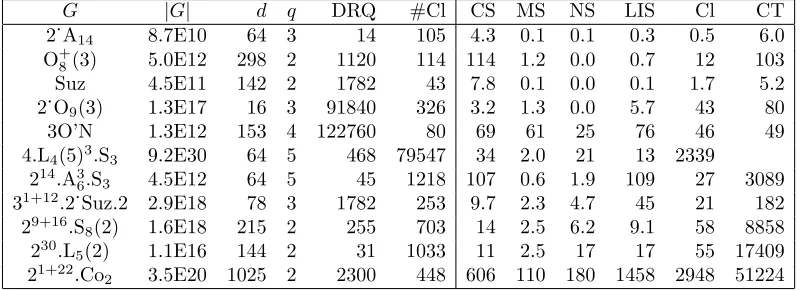
The times in Table 1 are for our implementations using just theCT-SR data, and those in Table 2 for the same examples using the BSGS computed using this data. (So the computations whose times are listed in the columns headed ‘CS’ and ‘RQ’ in the first table were prerequisites for the computations timed in the second table.) Table 3 lists times for computing this BSGS. For the final group in the first table we were unable to find a satisfactory BSGS.
In Tables 1 and 2, the columns to the left of the vertical line provide information about the examples, whereas those to the right list times in seconds. In the structural description of the groups, the notation O for the orthogonal groups O+8(3) and O9(3) denotes the simple group,
G |G| d q DRQ #Cl CS RQ MS NS LIS Cl CT 2·A14 8.7E10 64 3 14 105 4.0 0.7 0.1 0.1 17 0.7 18
O+8(3) 5.0E12 298 2 1120 114 113 2.1 2.4 0.1 56 10 1422 Suz 4.5E11 142 2 1782 43 5.7 0.1 0.2 0.0 0.4 1.4 6.2 2·O9(3) 1.3E17 16 3 91840 326 2.3 0.1 1.4 0.0 2.9 50 189
3O’N 1.3E12 153 4 122760 80 62 48 15 4.0 35 54 211 4.L4(5)3.S3 9.2E30 64 5 468 79547 14 14 3.3 24 237 1904
214.A3
6.S3 4.5E12 64 5 45 1218 8.0 21 0.2 2.3 1173 37 10220
31+12.2·Suz.2 2.9E18 78 3 1782 253 7.3 2.1 1.0 2.5 38 1034 314
29+16.Sp
8(2) 1.6E18 215 2 255 703 10 1.8 0.5 2.9 5.9 100 9819
230.L5(2) 1.1E16 144 2 31 1033 10 0.5 0.9 2.2 54 26 16208
21+22.Co2 3.5E20 1025 2 2300 448 375 50 26 117 189 4682 55616
[image:13.612.96.519.57.214.2]21+11.S10(2) 1.0E20 32 5 1023 1235 3.5 0.2 0.8 0.5 3.9 50 39443
Table 1:CT-SRtimes for subgroups, conjugacy classes and character tables
G |G| d q DRQ #Cl CS MS NS LIS Cl CT
2·A14 8.7E10 64 3 14 105 4.3 0.1 0.1 0.3 0.5 6.0
O+8(3) 5.0E12 298 2 1120 114 114 1.2 0.0 0.7 12 103 Suz 4.5E11 142 2 1782 43 7.8 0.1 0.0 0.1 1.7 5.2 2·O9(3) 1.3E17 16 3 91840 326 3.2 1.3 0.0 5.7 43 80
3O’N 1.3E12 153 4 122760 80 69 61 25 76 46 49 4.L4(5)3.S3 9.2E30 64 5 468 79547 34 2.0 21 13 2339
214.A3
6.S3 4.5E12 64 5 45 1218 107 0.6 1.9 109 27 3089
31+12.2·Suz.2 2.9E18 78 3 1782 253 9.7 2.3 4.7 45 21 182
29+16.S
8(2) 1.6E18 215 2 255 703 14 2.5 6.2 9.1 58 8858
230.L
5(2) 1.1E16 144 2 31 1033 11 2.5 17 17 55 17409
21+22.Co
2 3.5E20 1025 2 2300 448 606 110 180 1458 2948 51224
Table 2: BSGS times for subgroups, conjugacy classes and character tables
Notation such as 4.5E11 for a group order means 4.5×10¹¹. The columns headed ‘d’ and ‘q’ refer
to the degree and field of the input group G ≤ GL(d, q); ‘DRQ’ is the degree of the computed permutation representation of the radical quotient G/L; and ‘#Cl’ is the number of conjugacy classes of G. The columns headed ‘CS’, ‘RQ’, ‘MS’, ‘NS’, ‘LIS’, ‘Cl’, and ‘CT’ are the times for computing a composition series (including the composition tree), the permutation representation of G/L, the maximal subgroups, the normal subgroups, the subgroups of index up to 100, the conjugacy classes, and the character table ofG, respectively. We have chosen examples in which the default use of BSGS methods fails or is very slow.
In Table 3, we provide details of bases that were found for some of these groups using the method described in Subsection 3.1, after computing theCT-SR data and a permutation representation of the radical quotient ofG. In the ‘base dimensions’ column, an entry 0 means that the corresponding base point was a vector rather than a subspace. Observe that most of these bases were found moderately quickly.
[image:13.612.108.509.255.400.2]Group |G| d q Basic orbit lengths Dimensions Time
2·A14 8.7E10 64 3 14 13 12 11 10 9 8 7 6 5 4 3 2 32 16110 4.3
O+8(3) 5.0E12 298 2 1120 40 13 12 9 4 33272 38 26 14121 42 12
6 12
Suz 4.5E11 142 2 1782 416 100 63 96 36 14 7.9 2·O9(3) 1.3E17 16 3 91840 120 117 108 108 81 54 2 170 3.2
3O’N 1.3E12 153 4 122760 5586 112 6 3 140 68 4.L4(5)3.S3 9.2E30 64 5 468 155 150 125 16 312 155 150 16150 34
125 156 155 150 125 16 16 4
214.A3
6.S3 4.5E12 64 5 288 192 96 5 5 5 4 4 4 3 3 3 4 32120 107
313.2·Suz.2 2.9E18 78 3 22880 112 81 60 12 2 3 3 2 312 15 440 120 112 9.5 225.S8(2) 1.6E18 215 2 255 126 64 32 15 8 3 2 128 128 116 5.8
4 32 2 2 2 2
230.L5(2) 1.1E16 144 2 31 30 28 24 16 1024 256 2048 2 4514 10
223.Co
[image:14.612.125.492.56.238.2]2 3.5E20 1025 2 2300 672 165 128 72 9 2141024 155 75 65114 578
Table 3: Details of bases forG
in which we were unable to find any satisfactory BSGS using our programs.
References
[1] H. B¨a¨arnhielm, D. F. Holt, C. R. Leedham-Green, E. A. O’Brien. A practical model for com-putation with matrix groups,J. Symbolic Computation 68(2015), 27–60.
[2] L. Babai, R. Beals, and ´A. Seress. Polynomial-time theory of matrix groups. In STOC ’09 Proceedings of the forty-first annual ACM symposium on Theory of computing, ACM New York, 2009, 55–64.
[3] Wieb Bosma, John Cannon, and Catherine Playoust. TheMagmaalgebra system I: The user language, J. Symbolic Comput.24(1997), 235–265.
[4] T. Breuer, G. Malle, and E. A. O’Brien. Reliability and reproducibility of Atlas information, 2016,https://arxiv.org/abs/1603.08650.
[5] G. Butler. The Schreier algorithm for matrix groups. In SYMSAC ’76, Proc. ACM Sympos. Symbolic and Algebraic Computation, New York, 1976. (New York, 1976), Association for Computing Machinery, 167–170.
[6] J. J. Cannon, B. Cox, and D. F. Holt, Computing the subgroups of a permutation group, J. Symbolic Comput.31(2001), 149–161.
[7] J. J. Cannon and D. F. Holt. Computing maximal subgroups of finite groups, J. Symbolic Comput.37 (2004), 589–609.
[8] J. J. Cannon, M. Slattery, A. K. Steel, and D. F. Holt. Computing subgroups of bounded index in a finite group, J. Symbolic Comput.40(2005), 1013–1022.
[9] R. W. Carter.Simple Groups of Lie Type,John Wiley and Sons, 1972.
[11] B. N. Cooperstein. Minimal degree for a permutation representation of a classical group,Israel J. Math,30(1978), 213–235.
[12] A. S. Detinko, D. L. Flannery, and E. A. O’Brien. Recognizing finite matrix groups over infinite fields, J. Symbolic Comput.50(2013), 100–109.
[13] D. Easdown and C. E. Praeger, On minimal faithful permutation representations of finite groups,Bull. Austral. Math. Soc.38(1988), 207–220.
[14] The GAP Group. GAP — Groups, Algorithms, and Programming, Version 4.7, 2014, http://www.gap-system.org.
[15] S. Guest, J. Morris, C. E. Praeger and P. Spiga. On the maximum orders of elements of finite almost simple groups and primitive permutation groups, Trans. Amer. Math. Soc.367, no. 11 (2015), 7665-7694.
[16] Derek F. Holt, Bettina Eick, and Eamonn A. O’Brien.Handbook of computational group theory, Discrete Mathematics and its Applications (Boca Raton). Chapman & Hall/CRC, Boca Raton, FL, 2005.
[17] A. Hulpke. Computing conjugacy classes of elements in matrix groups,J. Algebra387(2013), 268-286.
[18] Peter Kleidman and Martin Liebeck The subgroup structure of the finite classical groups, Cambridge University Press: Cambridge, 1990.
[19] M. W. Liebeck and J. Saxl. On the orders of maximal subgroups of the finite exceptional groups of Lie type, Proc. London Math. Soc.55(1987), 299–330.
[20] V. D. Mazurov. Minimal permutation representations of finite simple classical groups. Special linear, symplectic, and unitary groups, Algebra Logika32No. 3 (1993), 267–287.
[21] V. D. Mazurov and V. A. Vasilyev. Minimal permutation representations of finite simple orthogonal groups, Algebra Logika33No. 6 (1994), 603–627.
[22] Scott H. Murray and E. A. O’Brien. Selecting base points for the Schreier-Sims algorithm for matrix groups, J. Symbolic Comput.19(1995), 577–584.
[23] M. Neunh¨offer and ´A. Seress. A data structure for a uniform approach to computations with finite groups. In ISSAC ’06: Proceedings of the 2006 international symposium on Symbolic and algebraic computation, ACM, New York, 2006, 254–261.
[24] Max Neunh¨offer and ´Akos Seress et al. recog - methods for constructive recognition, www-groups.mcs.st-and.ac.uk/~neunhoef/Computer/Software/Gap/recog.html.
[25] W. H. Patton,The minimum index for subgroups in some classical groups: a generalization of a theorem of Galois, PhD Thesis, U. of Illinois at Chicago Circle, 1972.
[26] Charles C. Sims. Computational methods in the study of permutation groups. In Computa-tional problems in abstract algebra (Oxford, 1967), J. Leech, editor, Pergamon Press, Oxford, 1970, pages 169–183.
[27] W. R. Unger. Computing the character table of a finite group, J. Symbolic Comput.41 No. 8 (2006), 847-862.
[29] A. V. Vasilyev. Minimal permutation representations of finite simple exceptional groups of typesE6,E7, andE8, Algebra Logika36No. 5 (1997), 518–530.
[30] A. V. Vasilyev. Minimal permutation representations of finite simple exceptional twisted groups, Algebra Logika37No. 1 (1998), 9–20