ISSN Online: 2162-2442 ISSN Print: 2162-2434
DOI: 10.4236/jmf.2019.92011 May 27, 2019 202 Journal of Mathematical Finance
Using Nested Logit Model in the Study of
Proxy Contest
Maggie Foley
1, Chengru Hu
2, Fabrizioi Rossi
3, Richard Cebula
11Davis College of Business, Jacksonville University, Jacksonville, FL, USA 2School of Business and Liberal Arts, SUNY Canton, Canton, NY, USA 3University of Cassino and Southern Lazio (Italy), Frosinone, Italy
Abstract
The nested logit model has been extensively used in studies focused on transportation. This model is based on a choice modeling framework and is also applicable to the study of a proxy contest. In this study, we illustrate how the nested logit model can be effectively used to evaluate a case of a proxy contest. We also present the specific model that can be used to predict the possibility of the occurrence of proxy contests.
Keywords
Nested Logit Model, Proxy Contest, Choice Modeling
1. Introduction
The nested logit model has been commonly used in various studies of transpor-tation and commercial behaviors ([1][2]). The nested logit model is specifically based on a “choice” modeling framework. It considers human beings as highly rational as we tend to make the best choices that we think has more value in terms of utility. From this perspective, when faced with the assessing the utility function of different choices, the respondents are observed to make the choices that best suit their needs. Considering the expected value of the available choices, with the logit model, the optimum probability for each choice can be evaluated.
For studies in finance, the use of the nested logit model as a statistical tool is not very common. But there are several circumstances in which the nested logit model can be involved in finance because of the need to make choices regarding money/cash holdings and expenditures, which is a common situation in the fi-nancial world.
In this study, we illustrate how to build the nested logit model using the proxy
How to cite this paper: Foley, M., Hu, C.R., Rossi, F. and Cebula, R. (2019) Using Nested Logit Model in the Study of Proxy Contest. Journal of Mathematical Finance, 9, 202-227.
https://doi.org/10.4236/jmf.2019.92011
Received: December 8, 2018 Accepted: May 24, 2019 Published: May 27, 2019
Copyright © 2019 by author(s) and Scientific Research Publishing Inc. This work is licensed under the Creative Commons Attribution International License (CC BY 4.0).
http://creativecommons.org/licenses/by/4.0/
DOI: 10.4236/jmf.2019.92011 203 Journal of Mathematical Finance contest as the framework. From a theoretical point of view, the person who con-trols the board has an absolute authority over the entire firm. This can be achieved by shareholder activists, who will leverage on the proxy contest to achieve this. There will be a formidable resistance in a situation where the firm is publicly traded, having as many as many as ten or more board members. In the corporate world, there is no shortcut to getting a board seat. As a candidate vy-ing for a board seat, one would have to win the support of a sufficient number of shareholders (a majority) during the annual shareholder meeting in order to get a board seat over time. The shareholder population is a widely dispersed one; this means that a candidate would need to use undertake a convincing campaign to win the needed votes during an election. This can be a very expensive plan to execute. For larger firms, the total expenses incurred from an election process can reach as high as $1 million and about $100,000 for smaller firms. On the av-erage, the candidate should expect expenses anywhere between $200,000 and $1 million ([3][4]). A good example of a proxy test contest was the case between Sam Wyly and Computer Associates Inc. As reported in the Los Angeles Times, the tussle for victory cost both contenders as much as $20 million each. In the end, the management team of Computer Associates Inc. emerged as the winner. Proxy contests are a rather unlikely choice for many investors because of the high-cost implications. Many stakeholders have found alternatives to the expen-sive proxy contests as ways to prevent any potential uprising that could lead to a takeover of the company. A good example is a situation where in a staggered board restricts one-third of the board seats to be reelected every year; hence, it might take as long as three years before activists could potentially replace the en-tire board.
DOI: 10.4236/jmf.2019.92011 204 Journal of Mathematical Finance party will publicly declare its victory (either management or the shareholder ac-tivists).
In summary, the entire process of a proxy contest can be broken down into three stages, with the end of each stage either resulting in an agreement or with the parties involved proceeding to the next stage. This is why a three-stage nested logit model is the most suitable statistical tool for the study of a proxy contest.
The remainder of the study is organized as follows. Section 2 provides the re-view of proxy contest and introduces the model. Section 3 describes the model assumptions and specification. Section 4 reveals the empirical results using nested logit model. Section 5 provides conclusions from the study.
2. The Proxy Contest and Setting up the Model
The responsibilities of a board seat involve fiduciary duties. In many cases, proxy contests have been used by the shareholder activists to get one of their members elected to the board. The shareholder activists launch campaigns aimed at se-curing top positions in the firms targeted. They typically accuse the firm’s man-agement of making wrong decisions with regard to the firms’ current and future plans, their methods of overseeing the firm’s operations and often express a va-riety of other criticisms. The shareholder activists propagate inciting messages to the stockholders, informing them of the damage the management team is caus-ing to the firm, which will potentially reduce the value of their stock. The end of a campaign like this is usually a tough proxy fight. From the management’s perspective, the shareholder activists seek to disrupt the activities’ of the firm in a selfish bid to strengthen their positions against the management. For every dispute between the two parties, there is always room for an amicable agreement to be arrived at. The management can acknowledge and implement the sugges-tions of the activists, and they can also choose to appoint activists to become a board member.
From a general viewpoint, the following figure could be used to illustrate the processes through which a proxy contest can be escalated:
The first offensive used by the activists at the beginning of a proxy contest is the propagation of a media-based threat against the company or companies with which they have disputes. It is very common to experience dissatisfaction from shareholders when the company is performing poorly or if the agency costs are very high. Firms that fall into this category will most likely be targeted. Also, shareholders can express their grievances by making shareholder proposals to address the issues ([5][6][7]).
DOI: 10.4236/jmf.2019.92011 205 Journal of Mathematical Finance Firms that fail to prevent moves for a proxy fight will appear vulnerable at this stage. This implies that the top management team will potentially lose their posi-tions at the helm of affairs. Faced with this threat, a proxy contest could be averted if the management team gives in to the requests of the shareholder activ-ists. If this happens, the shareholders can either back down from a proxy contest or choose to proceed with an election. This is the final stage of a proxy contest.
In summary, shareholder activists become aggravated by firms with huge po-tential for growth which will benefit the shareholder but performing poorly due to poor management. These firms may be targeted for a proxy contest, which will often start with the launch of a media accusation. The shareholder activists announce their decision to proceed with a proxy contest with the firms’ man-agement in the media. The firms that make the best targets are the one that has made few or no provisions to prevent or frustrate a takeover. These firms run with an independent board who are not deeply involved in decision making hence they can be swayed by external influence. The impact of a media threat can cause the management to begin negotiations with the activists which can end the proxy contest when an amicable agreement is reached. Failure to come to an agreement will propel the activists to proceed with informing the SEC of its plans. Even at this stage, agreements can still be arrived before the annual shareholder meeting when a vote will be held. Firms that are usually targeted by the shareholder activists are those firms that have a larger percentage of external supporters than internal supporters.
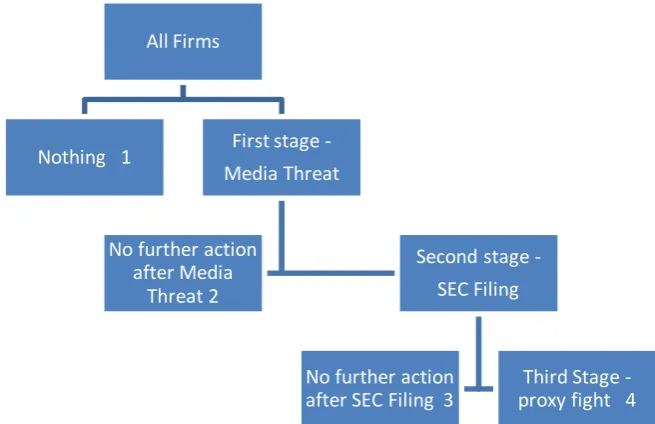
From the analysis above, an ideal nested structure in three distinctive levels clearly reveals the provisions for a proxy contest. This is illustrated in Figure 1. Specifically, firms at the lower levels have certain firm characteristics which are similar to those firms at the upper levels due to the nested structure representing the data. An example is a move by the shareholder activists against poorly per-forming firms by propagating media threats. This means firms involved in proxy contests that progress to the stage where the SEC is notified are poorly perform-ing firms. This eliminates the assessment of performance for firms when a SEC filing has been made because they had already been targeted by the media threat at the initial stage of the proxy contest due to poor performance. This generaliz-es poor performance as a factor that affects both the firms at the upper and lower levels. In view of this, firm attributes included in the upper levels should be shared by firms in the lower levels and there should be different considerations for the different stages of a proxy contest.
3. Using Nested Logit Model
3.1. Assumption of the Nested Logit Model
As a result of the structure illustrated in Figure 1, the nested logit model is adopted in this study. The model requires loads of the assumptions explained below.
DOI: 10.4236/jmf.2019.92011 206 Journal of Mathematical Finance Figure 1. Development of a proxy contest (Nested Tree Structure).
structure for the proxy contests is compellingly demonstrated. This means the assumptions have been convincingly satisfied in this study.
Second, the nested logit model relaxes assumption of Independent & Identi-cally Distributed (IID) and recognizes the possibility that each alternative may have information in the unobserved influences of that alternative, which in turn has a role to play in determining an outcome that is different across the alterna-tive branches ([8]). This difference implies that the variances of error might be different but the information content could be similar among subsets of alterna-tives generating some amount of correlation among these subsets ([8]). Under the context of the proxy contests, IID indeed does not hold. In fact, the utilities of the third and the fourth outcome are highly correlated in that the occurrence of both events depends on the contingency of the SEC Filing.
Lastly, the application of a nested logit model relaxes the restriction that the choice between any two pairs of alternatives is simply a binary logit model ([9]). In other words, this Independence of Irrelevant Alternatives (IIA) can be too re-strictive under the nested logit model. Indeed, if the ‘No further action after a Media Threat’ in Figure 1 is not an option anymore, then more cases of the ‘No further action after SEC Filing’ will occur. This will change the ratio of the oc-currence of the two mutually exclusive alternatives nested with SEC Filing. It should be noted that if the IIA is not applicable, then it can be assumed that IID will not be applicable because the IIA is a consequence of the assumption that the errors are IID ([2][10]).
In accordance with the standard procedure, we test the assumption of IIA by applying the Hausman ([11]) specification test to re-estimate the model on a subset of the alternatives since this test is not sensitive to the tree structure that we specify for a nested logit model ([2][10]). Hence, if IIA is valid, there will be a minimal difference between the parameters arrived at for the subset of
alterna-All Firms
Nothing 1 First stage
-Media Threat
No further action after Media
Threat 2
Second stage -SEC Filing
No further action
-DOI: 10.4236/jmf.2019.92011 207 Journal of Mathematical Finance tives and those ones obtained on the full set of alternatives. Where the difference is seen to be significant, the assumption of IIA will not be applicable. The test of the IIA assumption is provided in Section 4.
3.2. Specifications of the Nested Logit Model
The basic nested logit model is dependent on a “choice” modeling framework. It is based on the fact that people act rationally to make choices among options that have the highest utility values to them. This indicates that for a utility func-tion for the different choices, respondents would be expected to make the opti-mum choice. This will depend on the estimated utility value expected from the available choices, as obtainable from the logit model. An attempt to the opti-mum probability for the various choices will be possible.
utility, choice, utility,
1
e e
i
i n i
i
π
=
=
∑
(1)where i represents the ith choice among n alternatives.
A complicated choice structure of decision making could lead to the structure being nested in many layers. For each layer, it is possible to estimate the proba-bility for the different choices using the equation above, with the exception of the calculated probability for the choice which will be a conditional probability. The choice i’s marginal probability has a value equal to the conditional probabil-ity multiplied by the marginal probabilprobabil-ity of the previous event which is affi-liated with the choice i. This means it is possible to get a marginal probability function for the various alternatives. With a known choice, it is possible to get the log likelihood function.
(
choice, choice,)
1
lnL=ln
∑
in= π i×occurrence i (2)where i represents the ith choice among n alternatives.
With reference to Figure 1, while Nothing represents the independent (dege-nerate branch) alternative, there is a hierarchy that establishes groupings as Me-dia Threat with two distinct branches: ‘No further action after MeMe-dia Threat’ and SEC Filing. Proceeding to the next level, ‘No further action after Media Threat’ presents an independent alternative, whereas SEC Filing is connected with two distinct alternatives: No further action after SEC Filing and a proxy fight.
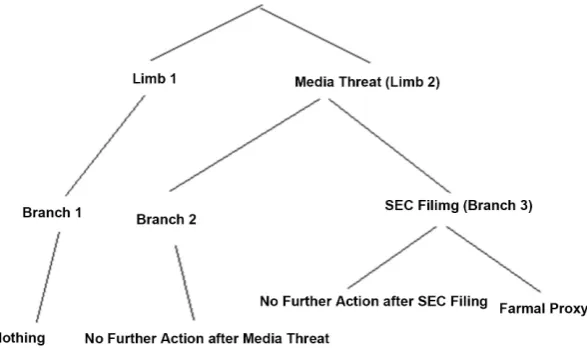
Figure 2 shows the three level nested tree structure representing the different states of proxy contests. There are the four elemental alternatives: Nothing, No further action after Media Threat, No further action after SEC filing and the proxy fight.
DOI: 10.4236/jmf.2019.92011 208 Journal of Mathematical Finance Figure 2. Nested tree structure for states of proxy contests.
outcome is the probability of a “No further action after SEC filing” or a proxy fight; this will be conditional depending on if the firm is classified under the SEC filing category. However, there are three nodes, Limb 1, Branch 1 and Branch 2; these three nodes are subject to degeneration with a single extension.
In summary, the nested logit models begin with the calculation of the ex-pected utilities for the lower level and the utilities at the higher levels which in-clude the expected utilities from the lower levels. This relies on the expected util-ities achievable at the different levels. The maximum likelihood function (ML function) is equal to the log of the summation for the different utilities multip-lied by the corresponding proxy contest results (indicator variable). This ML function is concave and it is characterized by efficient and consistent solutions.
The utility models at each level are, as follows:
( ) ( ) ( )
( ) ( )
( ) ( )
( )
( )Media Threat 1 1 1 2 1
3 1 4 1
5 1 6 1
1
Utility Free Cash Flow Leverage
Market to book ratio Stock Returns Firm Size Prior Shareholder Proposals
1 1,1 IV
γ β β
β β
β β
λ
= × + ×
+ × + ×
+ × + ×
+ ×
(3)
where,
( )1
(
( )1,1 utility of SEC Filing ( )2,1 utility of No further actions after Media Threat)
IV =ln eλ +eλ
(4)
( ) ( ) ( )
( ) ( ) ( )
( ) ( )
SEC Filing 1,1 1 1,1 2 1,1 3 1,1 4 1,1 5 1,1
6 1,1 1,1
Utility Poison pills Staggered Boards
Merger Bylaw Charter
Board Independence Level IV
λ β β
β β β
β
= × + ×
+ × + × + ×
+ × +
(5)
where,
( )1,1
(
(utility of proxy fight) (utility of No further actions after SEC Filing))
IV =ln e +e (6)
proxy fight 1 2
3 4
5
Utility Insider ownership Block-olders Ownership Institutional ownership No of funds active block-holders
a a
a a
a
β
β
β
β
β
= × + ×
+ × + ×
+ ×
’
DOI: 10.4236/jmf.2019.92011 209 Journal of Mathematical Finance
3.3. The Application of the Nested Logit Model in the Study of
Proxy Fight
This section will cover the reports for the theoretical analysis of the nested logit model in the context of the proxy contests. For this study, the choice behavior is described by applying a random utility framework. Also, the alternative chosen should provide the highest utility.
According to Hensher, Rose, and Greene ([12]), the scale parameters for the different limbs, branch and elemental alternatives for the three nested structure above is illustrated as follows:
Limb: γ(i) Branch: λ(j, i)
Elemental Alternative: μ(j, i) where:
γ(i) is the scale parameter for the ith limb, λ(j,i) is the scale parameter for the jth branch of limb i. Then, μ(j,i) represents the scale parameter for the elemental alternatives of branch j and limb i. It is identical for each alternative present within any given branch, because the variance of each elemental alternative present within branch j is equal.
The utility functions in the higher levels also include IV (inclusive value) which is calculated as the natural logarithm of the sum of the exponentials of the utility expressions for the level directly below which the IV is calculated.
For simplicity of model presentation, we normalize on μ(j,i) following random utility model 1 (RU 1).
Level 1 (elemental alternatives):
As discussed in Section 2, we focus on variables describing shareholder struc-tures for the bottom level:
1) Aggregated ownership by insiders. 2) Aggregated ownership by block-holders. 3) Aggregated ownership by institutional investors. 4) Number of institutional funds.
5) The indicator variable for filing of schedule 13-d.
For the elemental alternatives at Level 1, the utility functions can be expressed as follows.
( )
(
)
(
)
(
)
(
)
proxy fight
1 1 1 1 2 2 1 3 3
1 4 4 1 5 5
a
a a a a a a
a a a a
V V
f X f X f X
f X f X
µ β µ β µ β
µ β µ β
=
= + +
+ +
(8)
( )
(
)
(
)
(
)
(
)
No further actions after SEC filing
0 2 1 1 2 2 2 2 3 3
2 4 4 2 5 5
b
b b a b b b b
b b b b
V V
f X f X f X
f X f X
β β β β
β β
µ µ µ
µ µ
=
= + + +
+ +
(9)
DOI: 10.4236/jmf.2019.92011 210 Journal of Mathematical Finance
No further actions after Media Threat c 0
V =V = (10)
nothing d 0
V =V = (11)
Using RU11 as suggested by Hensher, Ross and Greene (2005), we normalize
1 2 1
µ =µ = , hence,
(
)
(
)
(
)
(
)
(
)
1 1 2 2 3 3 4 4 5 5
a a a a a a a a a a a
V =β f X +β f X +β f X +β f X +β f X (12)
(
)
(
)
(
)
(
)
(
)
1 1 2 2 3 3 4 4 5 5
b b a b b b b b b b b
V =β f X +β f X +β f X +β f X +β f X (13)
0
c
V = (4)
0
d
V = (15)
Since No further actions after SEC Filing and proxy fight are nested under the branch of SEC Filing, the probabilities of the two alternatives are defined as fol-lows:
(
)
( )
(
(
)
(
)
(
)
(
))
(
(
( )
(
)
(
)
(
)
(
)
(
( )
(
)
(
)
(
)
(
)
)
1 1 2 2 3 3 4 4
5 5 1 1 2 2 3 3
4 4 5 5 1 1 2 2
3 3 4 4 5 5
,proxy fight ^ ^ ^ a a b V V V
a a a a a a a a
a a a a a a a a
a a a a b a b b
b b b b b b
e a
e e
e f X f X f X f X
f X e f X f X f X
f X f X e f X f X
f X f X f X
π
β β β β
β β β β
β β β β
β β β
= + = + + + + + + + + + + + + + (16)
(
)
(
)
(
(
)
(
)
(
)
(
))
(
(
(
)
(
)
(
)
(
)
(
))
(
(
)
(
)
(
)
(
)
(
))
)
1 1 2 2 3 3 4 4
5 5 1 1 2 2 3 3
4 4 5 5 1 1 2 2
3 3 4 4 5 5
, No further actions after SEC Filing
^ ^ ^ b a b V V V
b a b b b b b b
b b a a a a a a
a a a a b a b b
b b b b b b
e b
e e
e f X f X f X f X
f X e f X f X f X
f X f X e f X f X
f X f X f X
π
β β β β
β β β β
β β β β
β β β
= + = + + + + + + + + + + + + + (17)
Nothing and No further actions after Media Threat are obviously degenerative alternatives. Nothing is not partitioned within a branch or a limb. Hence, Prob-ability (d, nothing) = e eVd Vd = 1. This implies that the probability that Noth-ing will be chosen is not calculated at Level 1, but rather is calculated at Level 3, the highest level of the tree structure being explored. In comparison, No further actions after Media Threat is partitioned within the branch of Media Threat. Still, Probability (c, No further actions after Media Threat) = e eVc Vc = 1. However, this probability is calculated at Level 2 rather than Level 1.
Level 2 (Branch):
We focus on antitakeover measures and board composition for the branch level, namely:
1) Poison pills position. 2) Staggered board position.
3) Super majority requirement on merger.
1In the RU 1 model the scale parameters are normalized at the bottom of the tree, in contrast to the
DOI: 10.4236/jmf.2019.92011 211 Journal of Mathematical Finance 4) Super majority requirement on charter.
5) Super majority requirement on bylaw. 6) Board independent measure.
Level 2 consists of three branches. Branch 2, No further actions after Media Threat and Branch 3, SEC Filing, stem from Limb 2, Media Threat. Branch 1 is degenerate with only one choice at Level 2.
The utility of Branch 3 can be expressed as follows.
( ) ( )
(
( ))
( )(
( ))
( )
(
( ))
(
( ))
( )SEC filing 1,1 1,1 1 1,1 1 1,1 2 1,1 2 1,1
6 1,1 6 1,1 1,1 1,1
V
1 IV
V f X f X
f X
λ β β
β µ
= = + +
+ + ∗
(18)
where,
( )1,1
(
( )1,1 ( )1,1)
IV =ln eµ Va+eµ Vb (19) Under RU1 which normalize µ
( )
1,1 =µ( )
2,1 =µ( )
3,2 1= , we got the fol-lowing.( )1,1 ( )1,1 1 1,1( )
(
1 1,1( ))
2 1,1( )(
2 1,1( ))
6 1,1( )(
6 1,1( ))
IV( )1,1V =λ β f X +β f X + + β f X + (20)
where,
( )1,1
(
( )1,1 ( )1,1)
(
)
IV =ln eµ Va +eµ Vb =ln eVa+eVb (21) Va and Vb are known from Level 1.
For Branch 2, it is assumed that the utility for No further actions after Media Threat is defined at this level. Hence, the expected utilities, the IV, from Level 1 is zero.
( )
( ) ( )
(
( ))
( )(
( ))
( )(
( ))
( ) ( )
( ) ( )
(
( ))
( )(
( ))
( )(
( ))
branch 2 2,1
2,1 1 2,1 1 2,1 2 2,1 2 2,1 6 2,1 6 2,1 2,1
2,1
2,1 1 2,1 1 2,1 2 2,1 2 2,1 6 2,1 6 2,1
1 IV
V V
f X f X f X
f X f X f X
λ β β β
λ β β β
µ =
= + + + + ×
= + + +
(22) In comparison, Branch 1 linked with Nothing at Level 1 is not defined at this level, but at Level 3. Hence, Vbranch 1 or V(3,2) is still zero.
Next, similar to the conditional logit model, the probability that a branch is chosen is calculated only by considering other branches partitioned within the same limb.
Hence,
( )
( ) ( ) ( )
1,1
1,1 1,1 2,1
V
V V
e e e
π =
+ (23)
( )
( ) ( ) ( )
2,1
2,1 1,1 2,1
V
V V
e e e
π =
+ (24)
( )2,1 1
DOI: 10.4236/jmf.2019.92011 212 Journal of Mathematical Finance Level 3 (limb):
Stock performance, prior shareholder proposals and agency costs are the focus of Limb Level. We also control for firm size:
1) Number of shareholder proposals in the prior year. 2) Market adjusted stock returns.
3) Industry adjusted log market to book ratio. 4) Industry adjusted free cash flow.
5) Industry adjusted square root leverage ratio. 6) Industry adjusted log firm size.
There are two limbs stemming from the same trunk. The utility function of Limb 2 regarding Media Threat with two branches can be written as follows.
( )
( ) ( )
( )
( ) ( )( )
( ) ( )( )
( ) ( ) ( )Media Threat 1
1 1 1 1 1 2 1 2 1 6 1 6 1 1 1,1 IV1
V V
f X f X f X
γ β β β λ
=
= + + + + × (26)
where,
( )1
(
( ) ( )1,1 1,1 ( ) ( )2,1 2,1)
IV =ln eλ V +eλ V (27)
Under RU1, the scale parameters at Level 1 are normalized but they are free to vary at Level 2. Further, the scale parameters for each connected branch are equal since the IID assumption is maintained within each nest.
So,
( )1,1 ( )2,1 ( )1; ( )3,2 ( )2
λ =λ =λ λ =λ
Hence,
( )1 ( )1 1 1( )
( )
1 1( ) 2 1( )( )
2 1( ) 6 1( )( )
6 1( ) 1 ( )1 IV( )1V =γ β f X +β f X + + β f X + λ × (28)
where
( )1
(
( ) ( )1 1,1 ( ) ( )1 2,1)
IV =ln eλ V +eλ V
(29)
Limb 1 is degenerate and it is assumed that the utility for Nothing is defined at this level. Hence, the expected utility, the IV, from Level 2 is zero.
( )2 ( )2 1 2( )
( )
1 2( ) 2 1( )( )
2 2( ) 8 1( )( )
6 2( ) 1 ( )2 IV( )2V =γ β f X +β f X + + β f X + λ × (30)
Since, IV( )2 =0, we get
( )2 ( )2 1 2( )
( )
1 2( ) 2 1( )( )
2 2( ) 6 1( )( )
8 2( )V =γ β f X +β f X + + β f X (31)
The probability of the first limb being selected under RU1 is as follows.
( )
( ) ( ) ( ) ( ) ( )( )
( ) ( )( )
( ) ( ) ( ) ( ) ( ) ( )(
)
( ) ( )( )
( ) ( )( )
( ) ( ) ( ) ( ) ( ) ( )(
)
( ) ( )( )
( ) ( )( )
( ) ( )( )
( ) 1 1 21 1,1 2 2,1
1 1 1 1 1 6 1 6 1
1
1 1,1 2 2,1
1 1 1 1 1 6 1 6 1 2 1 2 1 2 2 1 2 2 6 1 8 2
1 1 1 ln 1 ln V V V V V V V e e e
f X f X e e
f X f X e e f X f X f X
λ λ
λ λ
π
γ β β
λ
γ β β γ β β β
DOI: 10.4236/jmf.2019.92011 213 Journal of Mathematical Finance Similarly, for Limb 1, its probability is as follows.
( )
2 V( )1eV( )2V( )2e e
π =
+ (33) Probability summary:
The above probabilities calculated in each level are conditional probabilities. The following summarizes the conditional probabilities.
First, conditional on activists’ choices at branch level:
(
,proxy fight)
aa b V V V e a e e π =
+ (34)
(
, No further actions after SEC Filing)
ba b V V V e b e e π =
+ (35)
(
c, No further actions after Media Threat)
1π = (36)
(
d, Nothing)
1π = (37)
Second, conditional on activists’ choices at limb level:
( )
( ) ( ) ( )
1,1
1,1 1,1 2,1
V
V V
e e e
π =
+ (38)
( )
( ) ( ) ( )
2,1
2,1 1,1 2,1
V
V V
e e e
π =
+ (39)
( )3,2 1
π = (40)
Third, conditional on activists’ choices at top level:
( )
1 V( )1eV( )1V( )2e e
π =
+ (41)
( )
2 V( )1eV( )2V( )2e e
π =
+ (42) Next, the direct probabilities for each elemental alternative, each branch and each limb, can be calculated as follows.
(
)
( )1,1 ( )1,1 ( )2,1 ( )1 ( )1 ( )2 ,proxy fight aa b
V V
V
V V V V V V
e e e
a
e e e e e e
π = × ×
+ + + (43)
(
)
( ) ( ) ( ) ( ) ( ) ( ) 2,1 11,1 2,1 1 2
, No further actions after SEC Filing
b
a b
V V
V
V V V V V V
b
e e e
e e e e e e
π = × × + + + (44)
(
)
( ) ( ) ( ) ( ) ( ) ( ) 2,1 11,1 2,1 1 2
, Nofurther actions after Media Threat
1 V V V V V V
c
e e
e e e e
π
= × ×
+ +
(45)
(
d, Nothing)
1 1 V( )1eV( )2V( )2e e
π = × ×
+ (46)
(
Branch 3,SEC filing)
V( )1,1eV( )1,1V( )2,1 V( )1eV( )1V( )2e e e e
π = ×
DOI: 10.4236/jmf.2019.92011 214 Journal of Mathematical Finance
(
Limb 2,Media Threat)
V( )1eV( )1V( )2e e
π =
+ (48) To interpret the regression results, we following Cameron and Trivedi ([9], [13]) in order to obtain Marginal effects (ME), which is the first derivative of the probability functions over an independent variable.
Theoretically,
(
,)
Marginal effects
, ,
n j
n n
i
p ME
X X γ λ ∂
= = ∂ (49)
where, n represents the nth observation, i represents the ith variable of interest and j represents the jth elemental alternative in relation to the nth observation.
Consistent with Cameron and Trivedi ([9][13]), we use finite difference me-thods by considering an increase of one standard deviation from the sample mean of the variable of interest, excluding indicator variables.
Let x = (z, d), where z is defined as all independent variables other than d. Thus, the marginal effects for variable d is, as follows:
(
| *,) (
| *,)
d
ME =E y z z d D= = +σ −E y z z d D= = (50)
For the indicator variables, we use the following method to get the ME.
(
| * , 1) (
| *, 0)
d
ME =E y z =z d= −E y z z d= = (51) Following Cameron and Trivede ([9][13]), for each variable of interest, d, we calculate average marginal effects (AME), MEn to explain the regression
re-sults of a nested logit model:
, 1
N d i
d i
ME ME
N
=
=
∑
(52)N is the number of observations and i represents each observation. Interpret-ing the estimated average marginal effects is that 1 unit increase in x is related to ME% increase in y, while all other variables remain fixed.
Explaining the nest logit model using the AME is straightforward. It should be noted that the standard errors would not be addressed when the AME is used. Cameron and Trivedi ([13]) pointed out this challenge, however no solution was proffered for it. Also, Jones and Hensher ([8]) attempted to introduce the nested logit model into accounting research but failed to proffer solutions to this chal-lenge. The important fact is that they used p-values derived directly from the nested logit models in the discussion of the elasticity. This also implies that the elasticity (marginal effects) and the coefficient estimation have similar p-values. From this review, we follow Jones and Hensher ([8]) and Bethel, Liebeskind and Opler ([14]) and use the p-values obtained directly from the nested logit models in the discussions of marginal effects in Section 4.
4. Empirical Results
4.1. Nested Logit Model—Examination of Assumptions
occur-DOI: 10.4236/jmf.2019.92011 215 Journal of Mathematical Finance rence of the financial crisis in 2008. We hand-collected the data regarding proxy contests from Lexis Nexis. The multivariate analysis is used to explore the asso-ciation between the development of a proxy contest and firm attributes in four aspects: anti-takeover measures, ownership structure, agency costs and firm performance. This will be achieved by using the three-level nested logit models. As seen in Figure 2, the first level shows 6207 observations of Nothing firms (nor proxy contest) and there are 126 occurrences of Media Threat. At the mid-dle level, there are 71 observations of “no further action after media Threat” and 55 cases of SEC filings. The bottom level has 26 cases of “no further action after SEC filing” and 29 proxy fights. Also, in line with Hensher, Ross, and Greene ([12]) the choices of Nothing and “No further action after Media Threat” at the top and the middle level are extended to the bottom, representing two elemen-tary alternatives at the bottom level.
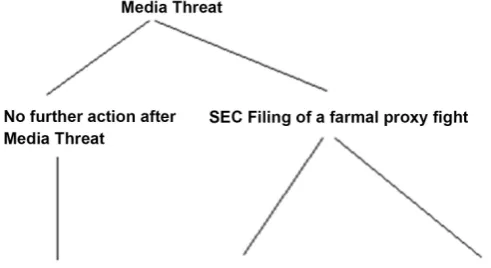
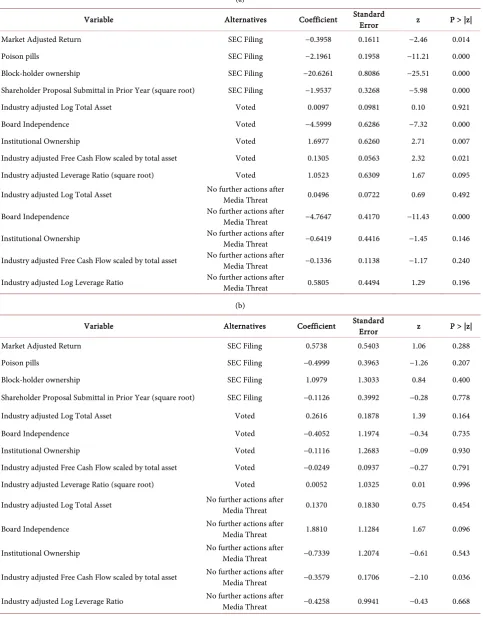
The nested logit model relaxes the restriction of IIA for all the alternatives. Specifically, the IIA assumption test is used to answer the question: Are the odds ratios ‘No further action after SEC Filing’ and proxy fight actually independent of the presence of the alternatives Nothing and ‘No further action after Media Threat’? Following the literature, we use the Hausman specification to test the IIA assumption. This method estimates the conditional logit model on full sam-ple (βa as estimated coefficients and Ωa as estimated covariance matrix) and sub-sample (βb as estimated coefficients and Ωb as estimated covariance matrix) in-dividually. The sub-sample is created by eliminating choice Nothing from the alternative set and by estimating a three choice model. Thus, 6207 observations under Nothing are eliminated. The new sub-sample has 126 observations of Me-dia Threats nested with 71 cases of ‘No further action after MeMe-dia Threats’ and 55 cases of SEC Filing. The latter alternative has 26 events of No further action after SEC Filing and 29 proxy fights. If IIA holds, there should not be any signif-icant differences between the two sets of estimates. Additionally, the quadratic form of (βa − βb)’(Ωa − Ωb)−1 (βa − βb) has a chi-square distribution. Figure 3 shows the new tree structure after eliminating Nothing from the sample:
Next, we use total assets, free cash flow, market to book ratio, leverage, prior shareholder proposals, poison pills, board independence, institutional ownership, and block-holder ownership in the Hausman test ([11]), rather than all variables in the nested logit model. This strategy is appropriate due to the small sample size of the subgroup. The purpose of the Hausman test is to demonstrate IIA as-sumption for some variables; hence, using certain variables while excluding the rest will not affect the conclusion.
DOI: 10.4236/jmf.2019.92011 216 Journal of Mathematical Finance Figure 3. New nested tree structure.
A different approach that can be used to test the IIA assumption is to apply the likelihood ratio test (LRT), which tests the “goodness of fit” between the nested logit model and the conditional nested model. The two models differ only in the dissimilarity parameters, which are set to equal to 1 in the conditional lo-git model while they are free for estimation in the nested lolo-git model. The LRT uses the following equation to compare the likelihood scores of the two models:
(
conditional logit model nested logit model)
2 ln ln
LR= × L − L (53)
This LRT statistic follows a chi-square distribution. The degree of freedom is equal to the number of additional parameters in the more complete model, which is 2, coming from the dissimilarity parameters for Media Threat and SEC Filing. The dissimilarity parameters for the two degenerate branches are set to one in the nested logit model; this also applies to the conditional logit model. The result of LRT is reported in Table 1 as part of the procedures of a nested logit model. The chi-square is 87.24, with 2 degrees of freedom. Thus, the IIA assumption is strongly rejected at the 1% level again, indicating that nested logit model is suitable.
In summary, the IIA assumption does not hold by applying both the Haus-man ([11]) test and the likelihood ratio test. Thus, the nested logit model is more appropriate2. The detailed utility and probability functions derived from the nested logit model are reported in the Appendix.
4.2. Graphs Based on Estimated Probabilities
In this section of the study, we provide the graphs based on the estimated proba-bilities with the independent variable of interest for Media Threat, SEC Filing, and Proxy Fight, respectively, while holding all the other variables fixed at
2We use Stata 10 to run the nested logit model. Stata 10 produces a nested logit model that is
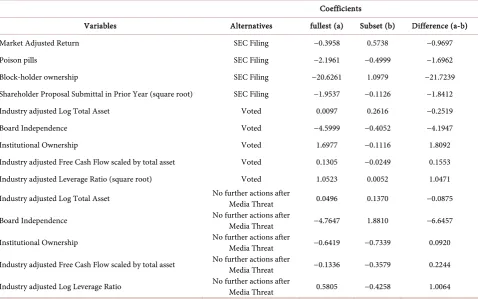
DOI: 10.4236/jmf.2019.92011 217 Journal of Mathematical Finance Table 1. Panel (a): Hausman test on IIA assumption step 1. Panel (b): Hausman test on IIA assumption step 2; Panel (c): Haus-man test on IIA assumption results.
(a)
Variable Alternatives Coefficient Standard Error z P > |z|
Market Adjusted Return SEC Filing −0.3958 0.1611 −2.46 0.014
Poison pills SEC Filing −2.1961 0.1958 −11.21 0.000
Block-holder ownership SEC Filing −20.6261 0.8086 −25.51 0.000 Shareholder Proposal Submittal in Prior Year (square root) SEC Filing −1.9537 0.3268 −5.98 0.000 Industry adjusted Log Total Asset Voted 0.0097 0.0981 0.10 0.921
Board Independence Voted −4.5999 0.6286 −7.32 0.000
Institutional Ownership Voted 1.6977 0.6260 2.71 0.007
Industry adjusted Free Cash Flow scaled by total asset Voted 0.1305 0.0563 2.32 0.021 Industry adjusted Leverage Ratio (square root) Voted 1.0523 0.6309 1.67 0.095
Industry adjusted Log Total Asset No further actions after Media Threat 0.0496 0.0722 0.69 0.492
Board Independence No further actions after Media Threat −4.7647 0.4170 −11.43 0.000
Institutional Ownership No further actions after Media Threat −0.6419 0.4416 −1.45 0.146
Industry adjusted Free Cash Flow scaled by total asset No further actions after Media Threat −0.1336 0.1138 −1.17 0.240
Industry adjusted Log Leverage Ratio No further actions after Media Threat 0.5805 0.4494 1.29 0.196
(b)
Variable Alternatives Coefficient Standard Error z P > |z|
Market Adjusted Return SEC Filing 0.5738 0.5403 1.06 0.288
Poison pills SEC Filing −0.4999 0.3963 −1.26 0.207
Block-holder ownership SEC Filing 1.0979 1.3033 0.84 0.400 Shareholder Proposal Submittal in Prior Year (square root) SEC Filing −0.1126 0.3992 −0.28 0.778 Industry adjusted Log Total Asset Voted 0.2616 0.1878 1.39 0.164
Board Independence Voted −0.4052 1.1974 −0.34 0.735
Institutional Ownership Voted −0.1116 1.2683 −0.09 0.930 Industry adjusted Free Cash Flow scaled by total asset Voted −0.0249 0.0937 −0.27 0.791 Industry adjusted Leverage Ratio (square root) Voted 0.0052 1.0325 0.01 0.996
Industry adjusted Log Total Asset No further actions after Media Threat 0.1370 0.1830 0.75 0.454
Board Independence No further actions after Media Threat 1.8810 1.1284 1.67 0.096
Institutional Ownership No further actions after Media Threat −0.7339 1.2074 −0.61 0.543
Industry adjusted Free Cash Flow scaled by total asset No further actions after Media Threat −0.3579 0.1706 −2.10 0.036
DOI: 10.4236/jmf.2019.92011 218 Journal of Mathematical Finance
(c)
Coefficients
Variables Alternatives fullest (a) Subset (b) Difference (a-b) Market Adjusted Return SEC Filing −0.3958 0.5738 −0.9697
Poison pills SEC Filing −2.1961 −0.4999 −1.6962
Block-holder ownership SEC Filing −20.6261 1.0979 −21.7239 Shareholder Proposal Submittal in Prior Year (square root) SEC Filing −1.9537 −0.1126 −1.8412 Industry adjusted Log Total Asset Voted 0.0097 0.2616 −0.2519
Board Independence Voted −4.5999 −0.4052 −4.1947
Institutional Ownership Voted 1.6977 −0.1116 1.8092
Industry adjusted Free Cash Flow scaled by total asset Voted 0.1305 −0.0249 0.1553 Industry adjusted Leverage Ratio (square root) Voted 1.0523 0.0052 1.0471
Industry adjusted Log Total Asset No further actions after Media Threat 0.0496 0.1370 −0.0875
Board Independence No further actions after Media Threat −4.7647 1.8810 −6.6457
Institutional Ownership No further actions after Media Threat −0.6419 −0.7339 0.0920
Industry adjusted Free Cash Flow scaled by total asset No further actions after Media Threat −0.1336 −0.3579 0.2244
Industry adjusted Log Leverage Ratio No further actions after Media Threat 0.5805 −0.4258 1.0064
This is the last step in testing IIA assumption. This last step is to calculate (βa − βb)’(Ωa − Ωb)−1(βa − βb). βa and βb are from step one and step two respectively
and Ωa and Ωb are covariance matrix. (βa − βb)’(Ωa − Ωb) −1(βa − βb) has a chi-square distribution when IIA holds, with two degree of freedom in this test.
Chi-square = (βa − βb)’(Ωa − Ωb) −1(βa − βb) =1 21.76. Prob > chi2 = 0.0000. Notes: 1) a = consistent under H0 and Ha obtained from conditional logit model 1.
2) b = inconsistent under Ha, efficient under H0 obtained from conditional logit model 2. 3) Test: H0: difference in coefficients is not systematic. 4) Ωa − Ωb
is not positive definite.
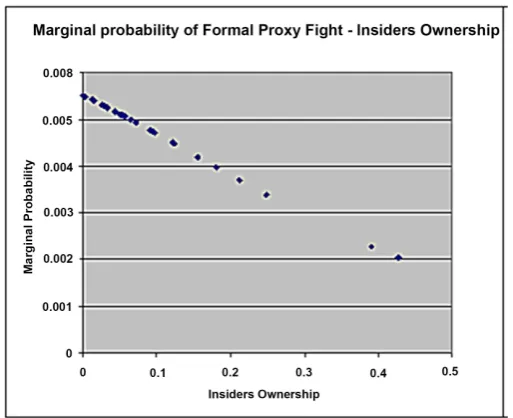
[image:17.595.59.538.86.385.2]sample mean, except for indicator variables whose values equal to one for all observations. Figure 4 plots the marginal probabilities of Media Threat for holding period return. Figure 5 and Figure 6 plot the marginal probabilities of SEC Filing for board independence level and the proxy fight for insider owner-ship, respectively. The estimated probabilities seem a little low. This might be because proxy contests are rare corporate events.
Figure 4 shows that when holding period return increases, the estimated probability of a media threat tends to drop.
Figure 5 shows that when board independence level increases, the estimated probability of a SEC filing tends to drop. However, when board independence level is more than 80%, the possibility of a SEC filing might increase.
Figure 6 shows that when board insiders’ ownership increases, the estimated probability of a formal proxy fight tends to fall.
5. Conclusions
DOI: 10.4236/jmf.2019.92011 219 Journal of Mathematical Finance Figure 4. Marginal probability of media threat and stock returns.
Figure 5. Marginal probability of SEC Filing & board independence.
[image:18.595.246.503.493.702.2]DOI: 10.4236/jmf.2019.92011 220 Journal of Mathematical Finance into different stages with each stage having multiple outcomes from which a choice can be made. In the context of the proxy contest, the development is in the following order:
Media Threat SEC Filing Proxy Fight
Under each stage, the activist can abandon the fight or proceed to the next level. This makes the nested logit model an appropriate study tool.
Conflicts of Interest
The authors declare no conflicts of interest regarding the publication of this paper.
References
[1] Heiss, F. (2002) Structural Choice Analysis with Nested Logit Models. The Stata Journal, 2, 227-252.https://doi.org/10.1177/1536867X0200200301
[2] Greene, W. (2002) Econometric Analysis. Prentice Hall, Upper Saddle River. [3] Bratton, W. (2007) Hedge Funds and Governance Targets. Georgetown Law
Jour-nal,95, 1307-1433.
[4] Clifford, C. (2008) Value Creation or Destruction? Hedge Funds as Shareholder Ac-tivists. Journal of Corporate Finance, 14, 323-336.
https://doi.org/10.1016/j.jcorpfin.2008.04.007
[5] Gillan, S. and Starks, L. (2000) Corporate Governance Proposals and Shareholder Activism: The Role of Institutional Investors. Journal of Financial Economics, 57, 275-305.https://doi.org/10.1016/S0304-405X(00)00058-1
[6] Gillan, S. and Starks, L. (2007) The Evolution of Shareholder Activism in the United States. Journal of Applied Corporate Finance, 19, 55-73.
https://doi.org/10.1111/j.1745-6622.2007.00125.x
[7] Renneboog, L. and Szilagyi, P. (2011) The Role of Shareholder Proposals in Corpo-rate Governance. Journal of Corporate Finance, 17, 167-188.
https://doi.org/10.1016/j.jcorpfin.2010.10.002
[8] Jones, S. and Hensher, D. (2007) Modeling Corporate Failure: A Multinomial Nested Logit Analysis for Unordered Outcomes. The British Accounting Review, 39, 89-107.https://doi.org/10.1016/j.bar.2006.12.003
[9] Cameron, A.C. and Trivedi, P.K. (2005) Microeconometrics with Methods and Ap-plication. Cambridge University Press, Cambridge.
https://doi.org/10.1017/CBO9780511811241
[10] Stata10 Reference I-P Reference Manual, 2007. Stata Press, College Station.
[11] Hausman, J.A. (1978) Specification Tests in Econometrics. Econometrica, 46, 1251-1271.https://doi.org/10.2307/1913827
[12] Hensher, D., Rose, J. and Greene, W. (2005) Applied Choice Analysis: A Primer. Cambridge University Press, Cambridge.
https://doi.org/10.1017/CBO9780511610356
[13] Cameron, A.C. and Trivedi, P.K. (2009) Microeconometrics Using Stata. Stata Press, College Station.
[14] Bethel, J., Liebeskind, J. and Opler, T. (1998) Block Share Purchases and Corporate Performance. Journal of Finance, 53, 605-634.
https://doi.org/10.1111/0022-1082.244195
DOI: 10.4236/jmf.2019.92011 221 Journal of Mathematical Finance
Appendix—The Functions of the Nested Logit Model
The coefficients and average marginal effects estimated from the nested logit model are reported in Panel (a) of Table A1. Based on the coefficients, we obtain the estimated utility functions and derive the estimated probability functions. They are, as follows:
Utility Functions:
In general, Unj =Vnj+
ε
nj, where Vnj is observed by the researcher and εnj is arandom variable whose value is not observable. Additionally, n represents the nth observations and j represents the jth alternatives.
(
(
(
)
Media Threat
18.44 0.16 TA 0.55 HPR 0.08 FCF 0.31 Leverage 1.05 MTB 0.60 Proposal 1 71.20 ln exp 0.18 Stagger
2.62 Poison 0.54 Merger 28.96 Boardindep 0.47 Bylaw 2.26 Charter exp 0.89 Stagger 2.19 Poiso
V
= × − × − × + × + ×
− × + × − × ×
+ × + × − × − ×
+ × +
(
− × − × n 0.93 Merger− ×)
(
(
)
(
36.72 Boardindep 1.34 Bylaw 3.90 Charter
ln e^ 0.54 institutional 19.91 Block-holder 30.36 Insiders 0.0011 fund_no 11.899 filing_13d e^ 0.26 institutional 22.40 Block-holder 34.86 Insiders 0.004 fund_no
+ × + × − ×
+ × − × + ×
− × + × + ×
+ × − × + ×
))
)
11.30 filing_13d
− ×
(
)
No further actions after Media Threat|Media Threat
71.20 0.18 Stagger 2.62 Poison 0.54 Merger 28.96 Boardindep 0.47 Bylaw 2.26 Charter
V
= − × × + × + ×
− × − × + ×
(
(
(
SEC Filing|Media Threat
71.20 0.89 Stagger 2.19 Poison 0.93 Merger 36.72 Boardindep 1.34 Bylaw 3.90 Charter ln e^ 0.54 institutional 19.91 Block-holder V
= − × − × − × − ×
+ × + × − ×
+ × − ×
)
(
)
)
)
30.06 Insiders 0.0011 fund_no 11.899 filing_13d e^ 0.26 institutional 22.40 Block-holder
34.86 Insiders 0.004 fund_no 11.30 filing_13d
+ × − × + ×
+ × + ×
− × + × − ×
No further actions after SEC Filing|SEC Filing
0.54 institutional 19.91 Block-holder 30.36 Insiders 0.0011 fund_no 11.899 filing_13d
V
= × − × + ×
− × + ×
Proxy fight|SEC Filing
0.26 institutional 22.40 Block-holder 34.86 Insiders 0.004 fund_no 11.30 filing_13d
V
= × + × − ×
+ × − ×
DOI: 10.4236/jmf.2019.92011 222 Journal of Mathematical Finance Table A1. Panel (a): Nested logistic regression results; Panel (b): Nested logistic regression results—dissimilarity parameters.
(a)
Variable Alternative Coefficient Marginal Effects Z value P > |z| Industry adjusted Log Total Asset Media Threat −0.1643* −0.0032 −1.92 0.055 Market Adjusted Return Media Threat −0.5509* −0.0106 −1.94 0.053 Industry adjusted Free Cash Flow scaled by total
asset Media Threat 0.0785** 0.0015 2.12 0.034
Industry adjusted Leverage Ratio (square root) Media Threat 0.3080 0.0059 0.78 0.435 Industry adjusted Log Market to Book Ratio Media Threat −1.0484*** −0.0202 −3.83 0.000 Shareholder Proposal Submittal in Prior Year
(square root) Media Threat 0.5966*** 0.0115 2.75 0.006
Staggered Board No further actions after Media Threat 0.1817 0.0012 0.18 0.856 Poison pills No further actions after Media Threat 2.6244** 0.0198 2.34 0.019 Requirement to Approve a Merger No further actions after Media Threat 0.5419 0.0040 0.34 0.738 Requirement to Amend Bylaws No further actions after Media Threat −0.4679 −0.0029 −0.39 0.696 Requirement to Amend Company Charter No further actions after Media Threat 2.2630 0.0280 1.09 0.276 Board Independence No further actions after Media Threat −28.9569*** −0.1254 −3.25 0.001
Staggered Board SEC Filing −0.8908 −0.0037 −0.68 0.498
Poison pills SEC Filing −2.1897 −0.0100 −1.51 0.13
Requirement to Approve a Merger SEC Filing −0.9289 −0.0032 −0.41 0.681 Requirement to Amend Bylaws SEC Filing 1.3447 0.0065 0.87 0.382 Requirement to Amend Company Charter SEC Filing −3.8977 −0.0083 −1.06 0.29 Board Independence SEC Filing 36.7119*** 0.1468 3.46 0.001 Institutional Ownership No further actions after SEC Filing 0.5389 0.0005 0.06 0.955 Number of funds No further actions after SEC Filing −0.0011 0.0000 −0.09 0.93 Insider ownership No further actions after SEC Filing 30.3590 0.0306 1.08 0.282 Block-holder ownership No further actions after SEC Filing −19.9147 −0.0201 −1.41 0.158 Filing of 13d—Presence of active block-holders No further actions after SEC Filing 11.8989 0.0766 1.14 0.254 Institutional Ownership Proxy Fight 0.2603 0.0002 0.03 0.979
Number of funds Proxy Fight 0.0041 0.0000 0.31 0.76
Insider ownership Proxy Fight −34.8581* −0.0329 −1.72 0.085 Block-holder ownership Proxy Fight 22.4023 0.0212 1.21 0.225 Filing of 13d—Presence of active block-holders Proxy Fight −11.3002 −0.0292 −1.32 0.186
DOI: 10.4236/jmf.2019.92011 223 Journal of Mathematical Finance
(b)
Level and Alternatives Dissimilarity Parameters Standard Error Top Level
Nothing (limb 1) 1
Media Threat 18.4435 8.9097
Middle Level
Nothing (branch 1) 1
No further actions after Media Threat (branch 2) 1
SEC Filing −71.1981 23.6095
The Table shows the dissimilarity parameters for the top level and middle level. The table also reports the likelihood ratio test result for IIA assumption. The alternatives are defined in Figure 1. Nothing and No further actions after Media Threat are with degenerate nodes and are extended to the bottom level as elementary alternatives. Their corresponding dissimilarity parameters are defined as 1 ([10]). Likelihood ratio test (LR) for IIA (tau = 1): chi2(2) = 87.24
Prob > chi2 = 0.0000.
(
(
(
(
(
)
Nothing
1 1 exp 18.44 0.16 TA 0.55 HPR 0.08 FCF 0.31 Leverage 1.05 MTB 0.60 Proposal 1 71.20 ln exp 0.18 Stagger
2.62 Poison 0.54 Merger 28.96 Boardindep 0.47 Bylaw 2.26 Charter exp 0.89 Stagger 2.19 Poi
π
= + × − × − × + × + ×
− × + × − × ×
+ × + × − × − ×
+ × +
(
− × − × son 0.93 Merger− ×)
(
(
)
(
36.72 Boardindep 1.34 Bylaw 3.90 Charter
ln e^ 0.54 institutional 19.91 Block-holder 30.36 Insiders 0.0011 fund_no 11.899 filing_13d e^ 0.26 institutional 22.40 Block-holder 34.86 Insiders 0.004 fund_no
+ × + × − ×
+ × − × + ×
− × + × + ×
+ × − × + ×
))
)
)
11.30 filing_13d− ×
(
(
(
(
)
Media Threat
exp 18.44 0.16 TA 0.55 HPR 0.08 FCF 0.31 Leverage 1.05 MTB 0.60 Proposal 1 71.20 ln exp 0.18 Stagger
2.62 Poison 0.54 Merger 28.96 Boardindep 0.47 Bylaw 2.26 Charter exp 0.89 Stagger 2.19 P
π
= × − × − × + × + ×
− × + × − × ×
+ × + × − × − ×
+ × +
(
− × − × oison 0.93 Merger− ×)
(
(
)
(
36.72 Boardindep 1.34 Bylaw 3.90 Charter
ln e^ 0.54 institutional 19.91 Block-holder 30.36 Insiders 0.0011 fund_no 11.899 filing _13d e^ 0.26 institutional 22.40 Block-holder 34.86 Insiders 0.004 fund_no
+ × + × − ×
+ × − × + ×
− × + × + ×
+ × − × + ×
))
)
(
(
(
11.30 filing_13d 1 exp 18.44 0.16 TA 0.55 HPR
− × + × − × − ×
(
(
)
(
0.08 FCF 0.31 Leverage 1.05 MTB 0.60 Proposal 1 71.20 ln exp 0.18 Stagger 2.62 Poison 0.54 Merger
28.96 Boardindep 0.47 Bylaw 2.26 Charter exp 0.89 Stagger 2.19 Poison 0.93 Merger 36.72 Boardindep 1.34
+ × + × − × + ×
− × × + × + ×
− × − × + ×
+ − × − × − ×
DOI: 10.4236/jmf.2019.92011 224 Journal of Mathematical Finance
(
(
)
(
)
)
)
)
ln e^ 0.54 institutional 19.91 Block-holder 30.36 Insiders 0.0011 fund_no 11.899 filing_13d e^ 0.26 institutional 22.40 Block-holder 34.86 Insiders 0.004 fund_no 11.30 filing_13d + × − × + × − × + × + × + × − × + × − ×
(
(
))
(
(
Closed after Media Threat|Media Threat
exp 71.20 0.18 Stagger 2.62 Poison 0.54 Merger 28.96 Boardindep 0.47 Bylaw 2.26 Charter / exp 71.20 0.18 Stagger 2.62 Poison 0.54 Merger
28.96 Boardindep 0.47 Byl
π − × × + × + × − × − × + × − × × + × + × − × − × =
))
(
(
aw 2.26 Charterexp 71.20 0.89 Stagger 2.19 Poison 0.93 Merger
+ × + − × − × − × − ×
)
(
(
)
(
36.72 Boardindep 1.34 Bylaw 3.90 Charter
ln e^ 0.54 institutional 19.91 Block-holder 30.36 Insiders 0.0011 fund_no 11.899 filing_13d e^ 0.26 institutional 22.40 Block-holder 34.86 Insiders 0.004 fund_no
+ × + × − × + × − × + × − × + × + × + × − × + ×
))
)
11.30 filing_13d − ×(
(
)
(
(
SEC Filing|Media Threat
exp 71.20 0.89 Stagger 2.19 Poison 0.93 Merger 36.72 Boardindep 1.34 Bylaw 3.90 Charter
ln e^ 0.54 institutional 19.91 Block-holder 30.36 Insiders 0.0011 fund_no 11.899 filing_
π − × − × − × − × + × + × − × + × − × + × − × + × =
)
(
13d e^ 0.26 institutional+ ×
))
)
(
(
))
(
(
22.40 Block-holder 34.86 Insiders 0.004 fund_no
11.30 filing_13d exp 71.20 0.18 Stagger 2.62 Poison 0.54 Merger 28.96 Boardindep 0.47 Bylaw 2.26 Charter exp 71.20 0.89 Stagger 2.19 Poison 0.93 Merger
+ × − × + ×
− × − × × + ×
+ × − × − × + ×
+ − × − × − × − ×
)
36.72 Boardindep 1.34 Bylaw 3.90 Charter+ × + × − ×
(
(
)
(
))
)
ln e^ 0.54 institutional 19.91 Block-holder 30.36 Insiders 0.0011 fund_no 11.899 filing_13d e^ 0.26 institutional 22.40 Block-holder 34.86 Insiders 0.004 fund_no 11.30 filing_13d + × − × + × − × + × + × + × − × + × − ×
(
(
(
(
SEC Filing Media Threat SEC Filing|Media Threatexp 18.44 0.16 TA 0.55 HPR 0.08 FCF 0.31 Leverage 1.05 MTB 0.60 Proposal 1 71.20 ln exp 0.18 Stagger
2.62 Poison 0.54 Merger 28.96 Boardindep 0.47 Bylaw
π =π ×π
= × − × − × + × + ×
− × + × − × ×
+ × + × − × − ×
)
(
2.26 Charter exp 0.89 Stagger 2.19 Poison 0.93 Merger
+ × + − × − × − ×
)
(
(
)
(
36.72 Boardindep 1.34 Bylaw 3.90 Charter
ln e^ 0.54 institutional 19.91 Block-holder 30.36 Insiders 0.0011 fund_no 11.899 filing _13d e^ 0.26 institutional 22.40 Block-holder 34.86 Insiders 0.004 fund_no
+ × + × − ×
+ × − × + ×
− × + × + ×
+ × − × + ×
))
)
(
(
(
11.30 filing_13d 1 exp 18.44 0.16 TA 0.55 HPR
DOI: 10.4236/jmf.2019.92011 225 Journal of Mathematical Finance
(
(
)
(
0.08 FCF 0.31 Leverage 1.05 MTB 0.60 Proposal 1 71.20 ln exp 0.18 Stagger 2.62 Poison 0.54 Merger
28.96 Boardindep 0.47 Bylaw 2.26 Charter exp 0.89 Stagger 2.19 Poison 0.93 Merger 36.72 Boardindep 1.34
+ × + × − × + ×
− × × + × + ×
− × − × + ×
+ − × − × − ×
+ × + ×Bylaw 3.90 Charter− ×
)
(
(
)
(
))
)
)
ln e^ 0.54 institutional 19.91 Block-holder 30.36 Insiders 0.0011 fund_no 11.899 filing _13d e^ 0.26 institutional 22.40 Block-holder 34.86 Insiders 0.004 fund_no 11.30 filing_13d exp 71.20 0.89 Stagger
+ × − × + × − × + × + × + × − × + × − × ×
(
− ×(
− ×)
2.19 Poison 0.93 Merger 36.72 Boardindep 1.34 Bylaw 3.90 Charter− × − × + × + × − ×
(
(
)
(
))
)
(
ln e^ 0.54 institutional 19.91 Block-holder 30.36 Insiders 0.0011 fund_no 11.899 filing_13d e^ 0.26 institutional 22.40 Block-holder 34.86 Insiders 0.004 fund_no 11.30 filing_13d exp 71.20 0.18 Stagger 2
+ × − × + × − × + × + × + × − × + × − ×
(
− × × +))
.62 Poison 0.54 Merger 28.96 Boardindep 0.47 Bylaw 2.26 Charter× + × − × − × + ×
(
(
)
(
(
exp 71.20 0.89 Stagger 2.19 Poison 0.93 Merger 36.72 Boardindep 1.34 Bylaw 3.90 Charter
ln e^ 0.54 institutional 19.91 Block-holder 30.36 Insiders
+ − × − × − × − ×
+ × + × − ×
+ × − × + ×
)
(
))
)
0.0011 fund_no 11.899 filing_13d e^ 0.26 institutional 22.40 Block-holder 34.86 Insiders 0.004 fund_no 11.30 filing_13d − × + × + × + × − × + × − ×
(
)
(
(
)
proxy fight|SEC Filing
e^ 0.26 institutional 22.40 Block-holder 34.86 Insiders 0.004 fund_no 11.30 filing_13d e^ 0.54 institutional 19.91 Block-holder 30.36 Insiders 0.0011 fund_no 11.899 filing_13d e^ 0
π = × + × − × + × − × × − × + × − × + × +
(
))
.26 institutional 22.40 Block-holder 34.86 Insiders 0.004 fund_no 11.30 filing_13d
× + × − × + × − ×
(
(
(
(
proxy fight Media Threat SEC Filing|Media Threat proxy fight|SEC Filing
exp 18.44 0.16 TA 0.55 HPR 0.08 FCF 0.31 Leverage 1.05 MTB 0.60 Proposal 1 71.20 ln exp 0.18 Stagger
2.62 Poison 0.54 Merger 28
π =π ×π ×π
= × − × − × + × + ×
− × + × − × ×
+ × + × −
)
(
.96 Boardindep 0.47 Bylaw2.26 Charter exp 0.89 Stagger 2.19 Poison 0.93 Merger
× − × + × + − × − × − ×
)
(
(
)
(
36.72 Boardindep 1.34 Bylaw 3.90 Charter
ln e^ 0.54 institutional 19.91 Block-holder 30.36 Insiders 0.0011 fund_no 11.899 filing _13d e^ 0.26 institutional 22.40 Block-holder 34.86 Insiders 0.004 fund_no
+ × + × − ×
+ × − × + ×
− × + × + ×
+ × − × + ×
))
)
(
(
(
11.30 filing_13d 1 exp 18.44 0.16 TA 0.55 HPR
DOI: 10.4236/jmf.2019.92011 226 Journal of Mathematical Finance
(
(
)
(
0.08 FCF 0.31 Leverage 1.05 MTB 0.60 Proposal 1 71.20 ln exp 0.18 Stagger 2.62 Poison 0.54 Merger
28.96 Boardindep 0.47 Bylaw 2.26 Charter exp 0.89 Stagger 2.19 Poison 0.93 Merger 36.72 Boardindep 1.34
+ × + × − × + ×
− × × + × + ×
− × − × + ×
+ − × − × − ×
+ × + ×Bylaw 3.90 Charter− ×
)
(
(
)
(
))
)
)
(
(
ln e^ 0.54 institutional 19.91 Block-holder 30.36 Insiders 0.0011 fund_no 11.899 filing_13d e^ 0.26 institutional 22.40 Block-holder 34.86 Insiders 0.004 fund_no 11.30 filing_13d exp 71.20 0.89 Stagger
+ × − × + ×
− × + × + ×
+ × − × + ×
− × × − × − ×
2.19 Poison 0.93 Merger 36.72 Boardindep 1.34 Bylaw
− × − × + × + ×
)
(
(
)
(
))
)
3.90 Charter ln e^ 0.54 institutional 19.91 Block-holder 30.36 Insiders 0.0011 fund_no 11.899 filing_13d
e^ 0.26 institutional 22.40 Block-holder 34.86 Insiders 0.004 fund_no 11.30 filing_13d exp 71.20 0
− × + × − ×
+ × − × + ×
+ × + × − ×
+ × − ×
(
− ×(
.18 Stagger2.62 Poison 0.54 Merger 28.96 Boardindep 0.47 Bylaw
×
+ × + × − × − ×
)
(
(
)
(
(
)
2.26 Charter exp 71.20 0.89 Stagger 2.19 Poison 0.93 Merger 36.72 Boardindep 1.34 Bylaw 3.90 Charter ln e^ 0.54 institutional 19.91 Block-holder 30.36 Insiders 0.0011 fund_no 11.899 filing_13d e^ 0.26
+ × + − × − × − ×
− × + × + × − ×
+ × − × + ×
− × + × +
(
×institutional22.40 Block-holder 34.86 Insiders 0.004 fund_no
+ × − × + ×
))
)
(
)
(
(
)
11.30 filing_13d e^ 0.26 institutional 22.40 Block-holder 34.86 Insiders 0.004 fund_no 11.30 filing_13d e^ 0.54 institutional 19.91 Block-holder 30.36 Insiders 0.0011 fund_no 11.899 filing_13d e^ 0.26 in
− × × × + ×
− × + × − ×
× − × + × − ×
+ × +
(
×))
stitutional 22.40 Block-holder 34.86 Insiders 0.004 fund_no 11.30 filing_13d
+ ×
DOI: 10.4236/jmf.2019.92011 227 Journal of Mathematical Finance
Note: Definition of Variables
TA: industry adjusted total asset (log). HPR: market adjusted holding period returns.
FCF: industry adjusted free cash flow scaled by total asset. Leverage: industry adjusted leverage ratio (square root). MTB: industry adjusted market to book ratio (log).
Proposal: shareholder proposal submittal in prior year (square root). Stagger: Indicator variable, staggered board.
Poison: Indicator variable, poison pills.
Merger: Indicator variable, super majority requirements to approve a merger. Boardindep: board independence level.
Bylaw: Indicator variable, super majority requirements to amend bylaws. Charter: Indicator variable, super majority requirements to amend company charter.
Institutional: Institutional ownership. Block-holder: block-holder ownership. Insiders: insider ownership.
Fund_no: number of funds