Selection Advantage Pattern of International
Sci-Tech Cooperation and Empirical Analysis
Li Li, Bin Yu
Shenzhen Graduate School, Harbin Institute of Technology, Shenzhen, China. Email: [email protected], [email protected]
Received November 15th, 2010; revised December 18th, 2010; accepted December 24th, 2010.
ABSTRACT
Traditional international sci-tech cooperation theories mainly focus on the ability and advantage owned by cooperative parties, and according to which to guide the direction of international science and technology cooperation. Based on the integration of traditional theories of international science and technology cooperation and concrete practice, this paper proposes the selection advantage pattern and matching mechanism, which comprehensively take cooperator ad-vantages, specification of project and change in circumstance into account and will play a guiding role in terms of de-termining the key country or region with which to prior carry out international science and technology cooperation. This paper also gives an analysis of the current status of industry development in Guangdong province and the research upon competitiveness evaluation of the world's related leading technology, puts forward corresponding countermea-sures and suggestions on the science and technology cooperation patterns and approaches in terms of technological level and resources of Guangdong province.
Keywords: International Science and Technology Cooperation, Competitiveness Analysis, Selection Advantage Pattern
1. Introduction
International science and technology cooperation means the science and technology research or communication for the mutual aim, conducted by governments, firms, institutions and individuals in two or more countries or regions; or to realize the recombination of production factors and constant improvement of production condi-tion through technology introducing, digesting, innovat-ing and diffusinnovat-ing between nations, for the purpose of minimizing the profit of cooperating parties, adapting the coordinated development of science and technology and productivity, and promoting economic relations between nations [1]. Currently, international science and technol-ogy cooperation is carried out quickly and widely be-tween countries and regions worldwide, which is the ob-jective trend of global allocation and flow of scientific and technological resource elements, and reflects the fact that international science and technology cooperation is the common needs of the development of the country and region. However, the problems that how to excavate and know clearly the world leading technology and accu-rately judge the key country and region needing to strengthen international science and technology coopera-
tion, so as to make the mode and policy capable of effec-tively promoting international science and technology cooperation, still need further study. With globalization trends of economic and technological cooperation, cor-rect understanding of the basic approach of international science and technology cooperation and of the regularity of regional science and technology cooperation, along with the realization of optimizing the allocation of re-sources, adapting coordinated development of science and technology and productivity, and promoting eco-nomic relations between countries, we are able to rapidly raise the science and technology development level of certain country or region, and strengthen core competi-tiveness and facilitate economic growth as well.
2. Literature Review and Research
Questions
theory circle, researchers worldwide have attached im-portance to and conducted extensive study on the cos-mopolitan subject of international science and technol-ogy cooperation. The topics conducted abroad included: the basic theories of international science and technology cooperation, such as theory of interdependency, theory of balanced growth, growth pole theory, factor endowment theory, comparative advantage theory, technology trans-fer theory, grad process theory, theory of monopoly ad-vantage and so on; statistical analysis and empirical re-search of international science and technology coopera-tion status [2,3]; studies on form and policy of interna-tional science and technology cooperation [4]; impacts of international science and technology cooperation on academic institutions’ performance [5]; R & D and tech-nology cooperation among international enterprises [6]; the cooperative environment problem during the process of international science and technology cooperation [7,8].
Meanwhile, researches on international science and technology cooperation conducted at home mainly cen-tered on the following themes that: international science and technology cooperation model studied by Wei Dazhi [9]; the international science and technology policy, which was researched by Li Xiaobing [10]; the relation-ship between the international science and the intellectual property studied by Gu Zuxue [11]; international science and technology cooperation and technology innovation, which was studied by several researchers, such as Yi Tong [12]; and international science and technology per-formance evaluation researched by Zhang Ju and Wu Danqing [13]. And the mechanism and organizational innovation, system construction and policy design had been made based on those researches above.
In spite of the remarkable achievement obtained in theory and practice area, and the deep study carried out in single subjects, with respect to resources, environment, investment, R & D, technology transfer and intellectual property protection and so on, the researches on the comprehensive analysis and systematic study on outward regional science and technology cooperation showed obviously insufficiency. The problems that how to selec-tively carry out high-level science and technology coop-eration with world key counties and regions, according to the principle of complementary advantages , how to build an effective platform for the international scientific and technological communication, the cooperation develop-ment and market developdevelop-ment in high and new technol-ogy field, and how to establish a new cooperation model and cooperation mechanism capable of effectively pro-moting the international science and technology coopera-tion, become the urgent subjects to be studied.
3. Research Method
3.1. Basis Assumptions
First, the research objects concerned in this paper are all rational. Here, rationality has another meaning, aside from purchasing maximum self-interest, that one may restrict the interest of counterpart with potential threat at the cost of its own interest. For instance, advanced coun-try may blockade techniques against its counterpart with potential threat and adopt export control policy and so on.
Second, the correct matching analysis and comprehen-sive evaluation towards cooperative parties are the foun-dation for actually operating international science and technology cooperation. The ability or advantage of co-operative parties’ is only a prerequisite for cooperation, rather than a sufficient condition. Traditional theories just conducted theoretical analysis on the cooperative parties’ resources, in terms of natural resource, human resource, technological condition etc, respectively, from which the conclusions drawn may prove inoperative or risky.
Third, the priority fields of a country or region act as the principal direction and major basis for international science and technology cooperation. The resource ad-vantage and technological gap should be associated with the requirements of specific project, and meanwhile, the occurrence of international science and technology co-operation depends on that whether the advantageous re-source matches the requirement of specific project.
Fourth, international science and technology coopera-tion circumstance today is under a dynamic state, in terms of world political circumstance, economic policy, technological and cultural environment etc. So interna-tional science and technology cooperation should take adjustment to changes in circumstance and select advan-tages constantly to ensure the effectiveness of carrying out international science and technology cooperation.
3.2. Selection Advantage Pattern
International science and technology cooperation should take factors from the following four aspects into account:
3.2.1. Analysis on the Seeker’s Development Fields with Priority and Advantage
pol-icy support, and then take the conclusion drawn above as the major basis and main direction for it carrying out international science and technology cooperation.
3.2.2. Advantage Analysis of World Leading Technology Fields
By means of a mass of literature search, data analysis and case studies, to judge and understand the core technolo-gies in the development fields with priority of the seeker, and the countries and regions with leading technological advantage worldwide; and then to have a comprehensive analysis of the tendency of science and technology coop-eration between the seeker and the country or region with leading technology concerned, the scientific and techno-logical resource, management ability they own and the encouragement or regulation policy of government; and through the study on the technological gap of the party seeking cooperation in those associated fields, to finally determine the technical capacity and potential coopera-tive direction in those concerned fields which are most in need of development.
3.2.3. Analysis of Circumstance for International Science and Technology Cooperation
With the globalization of economic and technological activities, in order to avoid government regulation, sys-tem obstacle and blockade on techniques, at the same time to promote the successful launching of international science and technology cooperation, it is essential to correctly grasp the global allocation and optimal recom-bination direction of technical elements, to see clearly the evolutionary trend of current international science and technology cooperation, progress in international bi-lateral or multi-lateral mechanism and inter-countries science and technology cooperation fields propelled and advocated with emphasis by international organization.
3.2.4. Judgment on International Science and Technology Cooperation Threshold
Resource advantage and wide technology gap only can’t guarantee certainly the successful launching of interna-tional science and technology cooperation. In addition, the willingness, financing capacity, institutional factor, government policy, cooperative targets of cooperative parties, along with the requirements of specific project, in terms of technology concerned, supporting facilities and technical staff, and many other factors together con-tribute to the operability of cooperation.
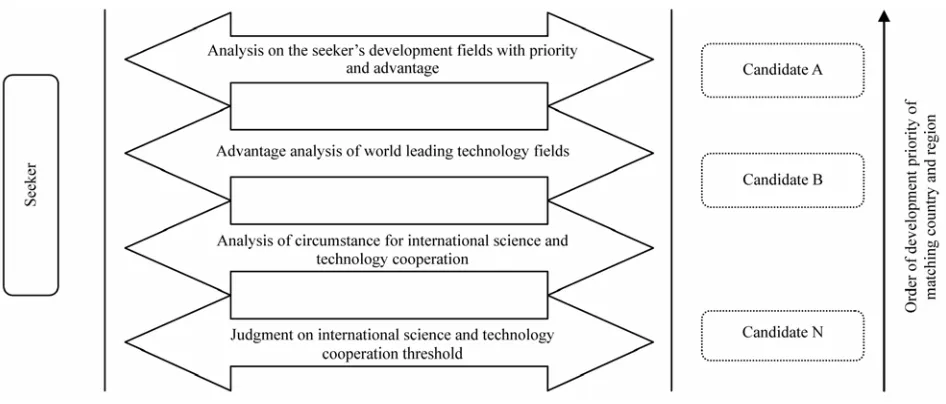
The general idea of the model can be explained in de-tails as follows: at first, we should determine the devel-opment fields with priority and understand the prior di-rection supported by government policy through the en-vironmental analysis in terms of social, economy and
technology of the seeker, namely, the party seeking for cooperation; then taking into account the technology gap, to ascertain the priority technology fields in each indus-try field with priority and find out the key countries and regions owning the advanced technical advantage in each related fields; and then according to the findings derived from previous steps, we have a comprehensive analysis on the technical cooperation trend, the scientific and technological resource, the management ability, as well as the encouragement or regulation policy of the gov-ernment, in addition, to pay sufficient attention to changes in international scientific and technological cooperation circumstance and evolutionary tendency of the interna-tional scientific and technological cooperation, along with cooperative threshold and operability of specific project. We take the thoughts and steps described above as the important basis for the seeker to follow in seeking selection advantage and matching during international science and technology cooperation.
3.3. Implementation Mechanism
Figure 1. International science and technology cooperation selection advantage and matching mechanism.
4. Empirical Analysis
Since China’s reform and opening-up in the 80s, Guang- dong province has carried out extensive and various forms of international science and technology coopera-tion with many countries or regions. Multi-faceted in- ternational science and technology cooperation, the in-troduction and exchange of high-tech are becoming a key component of supporting the export-oriented economy of Guangdong Province to continue rapid development. Despite of lots of achievements in international science and technology cooperation, Guangdong province is still in an imbalance situation in terms of international sci-ence and technology cooperation with eastern and west-ern countries, because of the geographic and historic reasons, the lack of adequate judgments on the priority countries and regions in the world it needs to strengthen cooperation with, and the weakness on the basic ways of international science and technology cooperation and systematic understanding of regional science and tech-nology cooperation.
General idea: According to the overall layout and pri-ority development areas of plans for the development of Guangdong’s national economy, science and technology, and society, clear the leading industries needing to be prioritized. We analyze it from two directions, first is the development status analysis of eight leading industries in Guangdong province, by which sort these areas, in order to optimize resources allocation, and determine the in-dustries with priority support and policy orientation; the second is taking into account both the eight leading in-dustries in Guangdong province and the technology gap with international advanced level, from the
complemen-tary perspective, determine the priority technology areas needing cooperation in each area, in which determine the leading technology products, then with the combination of the customs import and export targets, ascertain the priority in different countries or regions of each area. According to the two directions, define the countries or regions, with which Guangdong province to prioritize international cooperation.
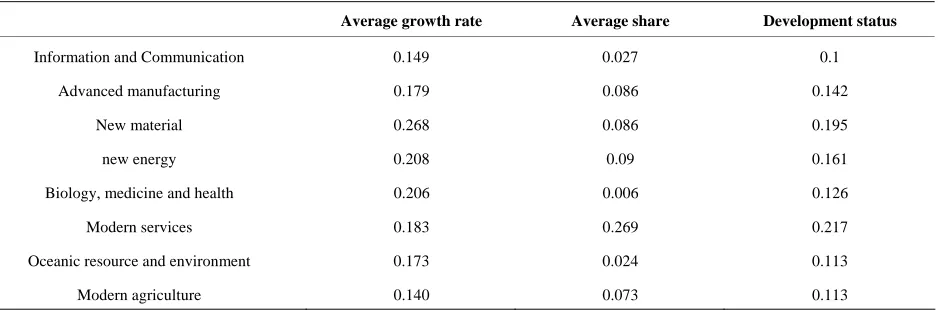
Table 1 reflects the industrial added value of eight major industries in Guangdong Province in the recent four years (according to the new division regulation of statistical indicators division, data selection from 2005); Table 2 shows the average growth rate and average share of GDP, in the recent four years, of the eight leading in-dustries in Guangdong province. The weighted value of these two variables above can determine the development status and key support direction of eight industrial in Guangdong province.
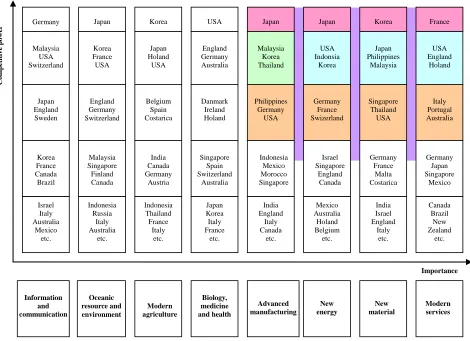
As for the second direction, in each field prioritized in Guangdong, we choose two representative leading-edge technology products, with the time span of two years, and examine their imports targets through the Customs Statistical Yearbook. The weighted average index share indicates, in some extent, the availability of the advanced technology or product of the world in the field. Figure 2 points out the key countries and regions with the corre-sponding leading-edge technology and products in eight major industries of Guangdong province. It shows both the advanced technology level of the world in the areas prioritized and the technology availability.
Table 1. Industry added value as a share of GDP in Guangdong province.
2005 2006 2007 2008
Time
Industry Added value Share Added value Share Added value Share Added value Share
Information and Communication 626.61 0.028 809.05 0.031 673.7 0.022 950.46 0.027
Advanced manufacturing 1896.82 0.085 2289.86 0.088 2602.57 0.084 3108.13 0.087
New material 1689.24 0.076 2131.14 0.081 2802.53 0.09 3445.32 0.097
New energy 1875.9 0.084 2380.6 0.091 2783.64 0.09 3303 0.093
Biology, medicine and health 131.67 0.006 161.28 0.006 185.79 0.006 230.77 0.006
Modern services 5919.48 0.265 6868.4 0.263 8503.1 0.274 9806.84 0.275
Oceanic resource and environment 546.24 0.024 603.26 0.023 705.79 0.023 882.4 0.025
Modern agriculture 1752.87 0.078 1891.56 0.072 2158.85 0.069 2596.83 0.073
Source: Guangdong Statistic Yearbook; China High-tech Industries Statistic Yearbook; Database of Zhonghong Industry.
Table 2. Leading industry development status in Guangdong province.
Average growth rate Average share Development status
Information and Communication 0.149 0.027 0.1
Advanced manufacturing 0.179 0.086 0.142
New material 0.268 0.086 0.195
new energy 0.208 0.09 0.161
Biology, medicine and health 0.206 0.006 0.126
Modern services 0.183 0.269 0.217
Oceanic resource and environment 0.173 0.024 0.113
Modern agriculture 0.140 0.073 0.113
Note: development status = 0.6*average growth rate + 0.4*average share.
tive, we determined the priority technology areas needing cooperation in each area. And according to the leading technology product index, we ascertained the countries, with which Guangdong province should prioritize sci-ence and technology cooperation, are: USA, Japan, France, Korea, Germany, England, Holland, Italy, Switzerland, Sweden, Singapore, Malaysia and so on; In the light of the sorts over the development speed and contribution of the eight areas of Guangdong province, modern services, new material, new energy and energy saving, advanced manufacturing should obtain the priority support of the external science and technology cooperation provided by the government.
This paper reveals that, in the modern service industry, Guangdong province should cooperate primarily with France, USA, England, Holland and Italy, focusing on
Intelligent Transportation Systems, Web-based Educa-tion, Electronic Commerce, Modern Logistics and Digi-tal Medical Technology; and it should cooperate with
Korea, Japan, USA, Germany, Malaysia, Thailand in new material industry, in terms of nano-material, high molecular material, metallic material, alloy material, atomic and molecular design of materials; as for new energy industry, it should cooperate with Japan, USA, Korea, Germany, France, focusing on nuclear technology, new energy power generation technology, technology of energy saving and reproducible energytechnology; while in advanced manufacturing industry, the seeking for co-operation with Japan, Korea, USA, Germany, Malaysia and Thailand is necessary, including key technology and equipment of electronic manufacturing, automobile elec-tronic technology, key process and equipment technology of machinery manufacturing, high-end home appliances, etc.
[image:5.595.71.540.314.469.2]Germany Japan Korea USA Japan Japan Korea France Malaysia USA Switzerland Korea France USA Japan Holand USA England Germany Australia Malaysia Korea Thailand USA Indonsia Korea Japan Philippines Malaysia USA England Holand Japan England Sweden England Germany Switzerland Belgium Spain Costarica Danmark Ireland Holand Philippines Germany USA Germany France Swizerland Singapore Thailand USA Italy Portugal Australia Korea France Canada Brazil Malaysia Singapore Finland Canada India Canada Germany Austria Singapore Spain Switzerland Australia Indonesia Mexico Morocco Singapore Israel Singapore England Canada Germany France Malta Costarica Germany Japan Singapore Mexico Israel Italy Australia Mexico etc. Indonesia Russia Italy Australia etc. Indonesia Thailand France Italy etc. Japan Korea Italy France etc. India England Italy Canada etc. Mexico Australia Holand Belgium etc. India Israel England Italy etc. Canada Brazil New Zealand etc. C o m p eti ti v e p o wer Importance Information and communication Oceanic resource and environment Modern agriculture Biology, medicine and health Advanced manufacturing New energy New material Modern services
Figure 2. Correspondence relationship between eight industries and key cooperation countries.
dong will primarily cooperate with in information and communication, new material, new energy, biology, me- dicine and health, oceanic resource and environment, ad- vanced manufacturing fields, the preferential patterns adapted are: Science and Technology Exhibition, Science and Technology Park, Technology Investigation, Tech-nology Trade, Capital–Driven Pattern, Team Introduction, Multinational Alliances, Joint Laboratory, Cooperative Research, Joint Institution, etc. Guangdong should strong- ly promote the exchanges, introduction and cooperative research of high technology.
As to the countries with priority cooperation in mod-ern service, modmod-ern agriculture industries, the coopera-tion patterns are Internacoopera-tional Funding, Complementary Resources, High-level Visits and Exchanges, Capital– Driven Pattern, Technology Trade, Exchange and Coop-eration of Expert, Technology Information Exchange, Sharing of Network Information Resources, Technology Investigation, etc.
5. Conclusions and Suggestions
Carrying out the comprehensive analysis and systematic
research of external regional science and technology co-operation is the basis and prerequisite to guarantee the success of international science and technology coopera-tion. By means of the comprehensive survey of both the advantages of cooperative parties, threshold of coopera-tion and cooperative circumstance, from the prospective of complementary, selectively carrying out high-level science and technology cooperation with main country or region, can realize the optimization allocation of scien-tific and technological resource, rapidly raise science and technology development level of certain country or re-gion.
science and technology cooperation.
Based on the study of this paper, when carrying out international science and technology cooperation practi-cally, we recommend that: 1) Understanding the devel-opment demand of certain country or region. Determine the direction of international science and technology co-operation according to the object of planning of certain country or region. For instance, a country may firstly determine its leading industry, and then carry out inter-national science and technology cooperation centering on the leading industries. 2) Determining the content of prior cooperation. We are required of abundant effort to the assessment of the leading technology fields world-wide, then comprehensively analyze their technical ad-vantage, cooperative tendency, science and technology resource, management ability and encouragement and regulation policy of government, and finally identify the direction and content of cooperation in most need of co-operation in concerned fields. 3) Selecting cooperator objectively. When selecting cooperator, we should con-sider such countries that can both make up for our defi-ciencies in leading industry and play a leading role in concerned fields. Through analysis of these four dimen-sions of international science and technology cooperation, to determine the priority order of the countries or regions we are going to carry out international science and tech-nology cooperate with. 4) Conducting real-time moni-toring on the whole process of science and technology cooperation. International science and technology coop-eration should adjust rapidly according to the changes in circumstance, and select advantage constantly, so as to decrease the uncertainty existing in cooperation, and to avoid and defend risk.
The study conducted by this paper is more appropriate to the science and technology cooperation carried out between developing country and advanced country under disequilibrium condition. More case studies and discus-sion are expected to further perfect the model.
6. Acknowledgements
Research works in this paper are financially supported by the Soft Science Foundation of Guangdong Province (No. 2008B070800080).
REFERENCES
[1] X. L. Li, “Research on International Science and Tech-nology Cooperation Mode and Strategy,” Ph.D. Thesis,
Jiangsu University, Zhenjiang, 2008, pp. 9-21.
[2] E. N. Comelia, “Ten Years of International Scientific Cooperation in Fisheries, Aquaculture and Coastal Zones: Some Preliminary Lessons,” Environment, Development and Sustainability, Vol. 10, No. 5, 2008, pp. 605-622.
doi:10.1007/s10668-008-9153-4
[3] R. Ponds, “The Limits to Internationalization of Scientific Research Collaboration,” Journal of Technology Transfer, Vol. 34, No. 1, 2009, pp. 76-94.
doi:10.1007/s10961-008-9083-1
[4] H. Y. Hou, H. Kretschmer and Z. Y. Liu, “The Structure of Scientific Collaboration Networks in Scientometrics,” Scientometrics, Vol. 75, No. 2, 2008, pp. 89-202.
doi:10.1007/s11192-007-1771-3
[5] A. Basu and R. Aggarwal, “International Collaboration in Science in India and Its Impact on Institutional Perform-ance,” Scientometrics, Vol. 52, No. 3, 2001, pp. 379-394.
doi:10.1023/A:1014239731175
[6] U. Cantner and A. Meder, “Technological Proximity and the Choice of Cooperation Partner,” Journal of Ecnomic Interaction and Coordination, Vol. 2, No. 1, 2007, pp. 45-65. doi:10.1007/s11403-007-0018-y
[7] S. J. Christian and T. Jarle, “Globalisation or European- isation?” International Contact among University Staff, Vol. 49, No. 4, 2005, pp. 449-466.
[8] S. A. Kiswany, “Matei Ripeanu, Adriana Iamnitchi, Sud-harshan Vazhkudai. Beyond Music Sharing: An Evalua-tion of Peer-to-Peer Data DisseminaEvalua-tion Techniques in Large Scientific Collaborations,” Journal of Grid Com-puting, Vol. 7, 2009, pp. 91-114.
[9] D. Z. Wei, “A Market Leading Mode of the International Science and Technology Cooperation in Shenzhen,” Fo-rum on Science and Technology in China, Vol. 1, 2005, pp. 140-145.
[10] X. B. Li, “Current Situation and Policies of International Science and Technology Cooperation in Chinese Enter-prises,” Technological Development of Enterprise, Vol. 24, No. 6, 2005, pp. 59-60.
[11] Z. X. Gu and Q. D. Zhao, “On Tortuous Lawsuit of Intel-lectual Property Rights in International Cooperation of Science and Technology,” Journal of Central South Uni-versity (Social Science Edition), Vol. 14, No. 4, 2008, pp. 499-506.
[12] Y. Tong, “Technology Transfer in Chinese International Science and Technology Cooperation,” Forum on Science and Technology in China, Vol. 7, No. 4, 2007, pp. 38-43.