DOI:10.1051/0004-6361/201526455 c
ESO 2016
Astrophysics
&
The VIMOS Public Extragalactic Redshift Survey (VIPERS)
On the recovery of the count-in-cell probability distribution function
J. Bel
2,7,31,, E. Branchini
10,28,29, C. Di Porto
9, O. Cucciati
17,9, B. R. Granett
2, A. Iovino
2, S. de la Torre
4,
C. Marinoni
7,30,31, L. Guzzo
2,27, L. Moscardini
17,18,9, A. Cappi
9,21, U. Abbas
5, C. Adami
4, S. Arnouts
6,
M. Bolzonella
9, D. Bottini
3, J. Coupon
32, I. Davidzon
9,17, G. De Lucia
13, A. Fritz
3, P. Franzetti
3, M. Fumana
3,
B. Garilli
3,4, O. Ilbert
4, J. Krywult
15, V. Le Brun
4, O. Le Fèvre
4, D. Maccagni
3, K. Małek
23, F. Marulli
17,18,9,
H. J. McCracken
19, L. Paioro
3, M. Polletta
3, A. Pollo
22,23, H. Schlagenhaufer
24,20, M. Scodeggio
3, L. A. M. Tasca
4,
R. Tojeiro
11, D. Vergani
25,9, A. Zanichelli
26, A. Burden
11, A. Marchetti
1,2, Y. Mellier
19, R. C. Nichol
11,
J. A. Peacock
14, W. J. Percival
11, S. Phleps
20, and M. Wolk
19(Affiliations can be found after the references)
Received 3 May 2015/Accepted 21 January 2016
ABSTRACT
We compare three methods to measure the count-in-cell probability density function of galaxies in a spectroscopic redshift survey. From this comparison we found that, when the sampling is low (the average number of object per cell is around unity), it is necessary to use a parametric method to model the galaxy distribution. We used a set of mock catalogues of VIPERS to verify if we were able to reconstruct the cell-count probability distribution once the observational strategy is applied. We find that, in the simulated catalogues, the probability distribution of galaxies is better represented by a Gamma expansion than a skewed log-normal distribution. Finally, we correct the cell-count probability distribution function from the angular selection effect of the VIMOS instrument and study the redshift and absolute magnitude dependency of the underlying galaxy density function in VIPERS from redshift 0.5 to 1.1. We found a very weak evolution of the probability density distribution function and that it is well approximated by a Gamma distribution, independently of the chosen tracers.
Key words.large-scale structure of Universe – cosmology: observations – galaxies: high-redshift
1. Introduction
Galaxy clustering offers a formidable playground in which to try to understand how structures have grown during since. the evo-lution of the Universe. A number of statistical tools have been developed and used over the past 30 years (seeBernardeau et al. 2002, for a review). In general, these statistical methods use the fact that the clustering of galaxies is the result of the gravitational pull of the underlying matter distribution. Hence, the study of the spatial distribution of galaxies in the Universe allows us to get information about the statistical properties of its content matter. As a result, it is of paramount importance to be able to mea-sure the statistical quantities that describe the galaxy distribution from a redshift survey. In particular, we focus on the probability
Based on observations collected at the European Southern
Observatory, Cerro Paranal, Chile, using the Very Large Telescope under programmes 182.A-0886 and partly 070.A-9007. Also based on observations obtained with MegaPrime/MegaCam, a joint project of CFHT and CEA/DAPNIA, at the Canada-France-Hawaii Telescope (CFHT), which is operated by the National Research Council (NRC) of Canada, the Institut National des Sciences de l’Univers of the Centre National de la Recherche Scientifique (CNRS) of France, and the University of Hawaii. This work is based in part on data products pro-duced at TERAPIX and the Canadian Astronomy Data Centre as part of the Canada-France-Hawaii Telescope Legacy Survey, a collaborative project of NRC and CNRS. The VIPERS web site ishttp://www. vipers.inaf.it/
Corresponding author: J. Bel,
e-mail:[email protected]
distribution of galaxy cell count which has also been measured in previous redshift surveys (Bouchet et al. 1993;Szapudi et al. 1996;Yang & Saslaw 2011).
The development of multi-object spectrographs on 8-m class telescopes during the 1990s triggered a number of deep redshift surveys with measured distances beyondz∼0.5 over areas of 1–
2 deg2(e.g. VVDSLe Fevre et al. 2005; DEEP2Newman et al. 2013; andzCOSMOSLilly et al. 2009). Even so, it was not until the wide extension of VVDS was produced (Garilli et al. 2008), that a survey existed with sufficient volume to attempt cosmolog-ically meaningful computations atz∼1 (Guzzo et al. 2008). In general, clustering measurements atz1 from these samples re-mained dominated by cosmic variance, as is dramatically shown by the discrepancy observed between the VVDS and zCOSMOS correlation functions atz0.8 (de la Torre et al. 2010).
The VIMOS Public Extragalactic Redshift Survey (VIPERS) is part of a global attempt to take cosmological measurements at
z∼1 to a new level in terms of statistical significance. In contrast to the BOSS and WiggleZ surveys, which use large field-of-view (∼1 deg2) fibre optic positioners to probe huge volumes at low
sampling density, VIPERS exploits the features of VIMOS at the ESO VLT to yield a dense galaxy sampling over a moderately large field-of-view (∼0.08 deg2). It reaches a volume at 0.5 <
z<1.2,comparable to that of the 2dFGRS (Colless et al. 2001) atz∼0.1, allowing the cosmological evolution to be tested with
few statistical errors.
The VIPERS redshifts are being collected by tiling the se-lected sky areas with a uniform mosaic of VIMOS fields. The
area covered is not contiguous, but presents regular gaps owing to the specific footprint of the instrument field of view, in addi-tion to intrinsic unobserved areas, which are due to bright stars or defects in the original photometric catalogue. The VIMOS field of view has four rectangular regions of about 8×7 square arcminutes each, separated by an unobserved cross (Guzzo et al. 2014; de la Torre et al. 2013). This creates a regular pattern of gaps in the angular distribution of the measured galaxies. Additionally, the target sampling rate and the survey success rate vary among the quadrants, and a few of the latter were lost because of mechanical problems within VIMOS (Garilli et al. 2014). Finally, the slit-positioning algorithm, SPOC (seeBottini et al. 2005), also introduces some small-scale angular selection effects, with different constraints along the dispersion and spatial directions of the spectra, as thoroughly discussed inde la Torre et al.(2013). Clearly, this combination of angular selection ef-fects has to be properly taken into account when estimating any clustering statistics.
In this paper we measure the probability distribution function of galaxy fluctuations from the VIPERS Public Data Release 1 (PDR-1) redshift catalogue, including∼64% of the final num-ber of redshifts expected at completion (seeGuzzo et al. 2014; Garilli et al. 2014, for a detailed description of the survey data set). The paper is organized as follows: in Sect. 2, we introduce the VIPERS survey and the features of the PDR-1 sample. In Sect. 3, we review the basics of the three methods that we com-pared. In Sect. 4, we present a null test of the three method on a synthetic galaxy catalogue. In Sect. 5, we use galaxy mock catalogues to assess the performances of two of the methods. Magnitude and redshift dependance of the probability distribu-tion funcdistribu-tion of VIPERS PDR-1 galaxies are presented in Sect. 6 and conclusions are drawn in Sect. 7.
Throughout, the Hubble constant is parameterized viah = H0/100 km s−1Mpc−1, all magnitudes in this paper are in the
AB system (Oke & Gunn 1983), and we will not give an explicit AB suffix. To convert redshifts into comoving distances, we as-sume that the matter density parameter isΩm =0.27, and that
the Universe is spatially flat with aΛCDM cosmology without radiations.
2. Data
The VIMOS Public Extragalactic Redshift Survey (VIPERS) is a spectroscopic redshift survey, which is being built using the VIMOS spectrograph at the ESO VLT. The survey tar-get sample has been selected from the Canada-France-Hawaii Telescope Legacy Survey Wide (CFHTLS-Wide) optical photo-metric catalogues (Mellier et al. 2009). The final VIPERS will cover∼24 deg2 on the sky, divided over two areas within the
W1 and W4 CFHTLS fields. Galaxies are selected to a limit of
iAB<22.5, further applying a simple and robustgricolour
pre-selection, to effectively remove galaxies atz <0.5. Coupled to
an aggressive observing strategy (Scodeggio et al. 2009), this allows us to double the galaxy sampling rate in the redshift range of interest, with respect to a pure magnitude-limited sam-ple (∼40%). At the same time, the area, and depth of the survey result in a fairly large volume,∼5 ×10⁷ h−3Mpc3, analogous
to that of the 2dFGRS atz ∼ 0.1. This combination of
sam-pling and depth is quite unique over current redshift surveys at
z > 0.5. The VIPERS spectra are collected with the VIMOS
[image:2.595.337.524.94.240.2]multi-object spectrograph (Le Fevre et al. 2003) at moderate res-olution (R = 210), using the LR Red grism, which provides a wavelength coverage of 5500–9500 Å and a typical redshift er-ror of 141(1+z) km s−1. The full VIPERS area is covered through
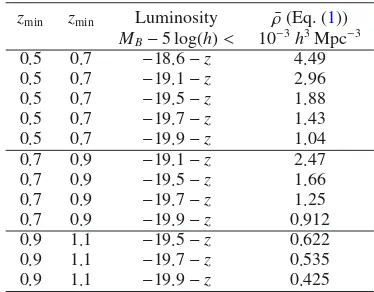
Table 1.Magnitude selected objects (inB-band) in the VIPERS PDR-1.
zmin zmin Luminosity ρ¯(Eq. (1)) MB−5 log(h)< 10−3h3Mpc−3 0.5 0.7 −18.6−z 4.49 0.5 0.7 −19.1−z 2.96 0.5 0.7 −19.5−z 1.88 0.5 0.7 −19.7−z 1.43 0.5 0.7 −19.9−z 1.04 0.7 0.9 −19.1−z 2.47 0.7 0.9 −19.5−z 1.66 0.7 0.9 −19.7−z 1.25 0.7 0.9 −19.9−z 0.912 0.9 1.1 −19.5−z 0.622 0.9 1.1 −19.7−z 0.535 0.9 1.1 −19.9−z 0.425
a mosaic of 288 VIMOS pointings (192 in the W1 area, and 96 in the W4 area). A discussion of the survey data-reduction and management infrastructure is presented inGarilli et al.(2012). An early subset of the spectra that is used here is analysed and classified through a principal component analysis (PCA) in Marchetti et al.(2013).
A quality flag is assigned to each measured redshift, based on the quality of the corresponding spectrum. Here and in all parallel VIPERS science analyses we use only galaxies with flags 2 to 9 inclusive, corresponding to a global redshift confi-dence level of 98%. The redshift confirmation rate and redshift accuracy have been estimated using repeated spectroscopic ob-servations in the VIPERS fields. A more complete description of the survey construction, from the definition of the target sample to the actual spectra and redshift measurements, is given in the parallel survey description paper (Guzzo et al. 2014).
The data set used in this paper and the other papers of this early science release is the VIPERS Public Data Release 1 (PDR-1) catalogue, which has been made publicly available in September 2013. This includes 55 359 objects, spread over a global area of 8.6×1.0 deg2and 5.3×1.5 deg2in W1 and W4,
respectively. This corresponds to the data frozen in the VIPERS database at the end of the 2011/2012 observing campaign, i.e. 64% of the final expected survey. For the specific analysis pre-sented here, the sample has been further limited to its higher-redshift part, selecting only galaxies with 0.55< z <1.1. The
reason for this selection is related to minimizing the shot noise and maximizing the volume. This reduces the usable sample to 18 135 and 16 879 galaxies in W1 and W4, respectively (always with quality flags between 2 and 9). The corresponding effective volume of the two samples are 6.57 and 6.14×10⁶h−3Mpc3. At redshift,z=1.1 the two volumes span the angular comoving
dis-tances∼370 and 230 h−1Mpc, respectively. We divide the W1 and W4 fields into three redshift bins and we build magnitude limited subsamples in each of them. For convenience, we use the magnitude limits that are listed in Table 1 ofdi Porto et al. (2014), which we recall in Table1.
The VIMOS footprint has an important impact on the ob-served probability of finding N galaxies in a randomly placed spherical cell in the survey volume. As a matter of fact, a direct appreciation of the masked area can be shown on the first mo-ment of the probability distribution, i.e. the expectation value of the number count ¯N ≡∞N=0NPN. On the one hand, we can
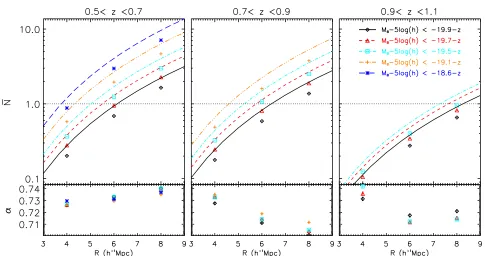
Fig. 1.Upper: expected mean number count in spheres (solid line, from Eq. (2)) with respect to the observed one (symbols) for the various luminosity cuts and for the three redshift bins [0.5,0.7] (left panel), [0.7,0.9] (central panel), and [0.9,1.1] (right panel). The selection in absolute magnitudeMBinB-band, corresponding to each symbols/lines and colors, are indicated in the inset. The dotted line displays the ¯N=1.Lower: deviationα(see Eq. (3)) between the expected mean number ¯NRand the observed one ¯Nwith respect to the radiusRof the cells.
number of galaxiesN1andN4contained in a redshift bin that has
been extracted from each field, we can estimate the total number density as
¯
ρ= N1+N4
Ω1+ Ω4
1
Vk
, (1)
whereVkis defined as the volume corresponding to a sector of
a spherical shell with a solid angle equal to unity. In the case of VIPERS PDR-1, the effective solid angles that correspond to W1 and W4 areΩ1=1.6651683×10⁻³andΩ4=1.5573021×10⁻³
(in square radians), respectively. The corresponding expected number of objects in each cell can be predicted by multiply-ing the averaged number density by the volume of a cell. This reads as
¯
NR=
4 3πR
3ρ,¯ (2)
in the case of the spherical cells of radiusR, as considered in this work. The expectation value ¯NR, with respect to the radius of
the cells corresponding to each luminosity sub-sample extracted from VIPERS-PDR1, is represented by lines in Fig.1. In the same figure, we display the measured mean number of object ¯N
in each redshift bins. We note that, to perform this measurement, we place a grid of equally separated (4h−1Mpc) spheres of
ra-diusR =4,6,8h−1Mpc and we reject spheres with more than
40% of their volume outside the observed region (seeBel et al. 2014). We quantify the effect of the mask using the quantity α≡ N¯¯
NR
· (3)
In fact the bottom panels of Fig.1 show that, for all subsam-ples and at all redshifts, the neat effect of the masks is to under-sample the galaxy field by roughly 72%. It also shows that the correction factorαdepends on the redshift that is considered, on
the luminosity, and on the cell-size. The scale dependency can be explained by the fact that the correction parameterαdepends on how the cells overlap with the masked regions. The left panel of Fig.1suggests that, at low redshift, the mask effect behaves in the same way for all the luminosity samples, while the mid-dle panel shows a clear dependency with respect to luminosity. The correction factorαdepends on the redshift distribution. As a result, the apparent dependency with respect to the luminosity is due to the dependence of the number density with respect to the luminosity of the considered objects.
The mask not only modifies the mean number of object, it also modifies the higher order moments of the distribution in such a way that the measuredPN will be systematically altered.
In this paper, we show that this systematic effect can be taken into account by measuring the underlying probability density function of the galaxy density contrastδ. It has been shown (see Fig. 8 ofBel et al. 2014) that, after rejecting spheres with more than 40% of their volume outside the survey, the local poisson process approximation holds. The same kind of rejection crite-ria is implemented byCappi et al.(2015) to measure the mo-ments of the galaxy distribution function. In our case, it allows us to use the ‘wrong’ probability distribution function to get reli-able information on the underlying probability density function
p(δ). By then applying the Poisson sampling, we can recover
the unaltered PN using that ¯N = N¯(masked)/α. For the sake
of completeness, we provide tthe measured probability function that was obtained after rejecting the cells with more than 40% of their volume outside the survey (see Fig.8).
In particular, letPM andPN, respectively, be the observed
and the true counting probability distribution function (CPDF). Assuming that, from the knowledge ofPM, there exists a process
can compute the true CPDF applying
PN =
∞
0
P[N|Λ]p(Λ)dΛ, (4) whereP[N|Λ] is called the sampling conditional probability; this determines the sampling process from which the discrete cell-count arises. In the following, we assume that this sampling con-ditional probability follows a Poisson law (Layzer 1956), and as a result in Eq. (4) we substitute
P[N|Λ]=K[N,Λ]≡Λ
N
N!e
−Λ. (5)
It is also convenient to express Eq. (4) in terms of the density contrast of the stochastic fieldΛ,δ≡Λ/Λ¯ −1, it follows that
PN =
∞
−1
K[N|N¯(1+δ)]p(δ)dδ, (6)
where we used ¯Λ = N¯, which is a property of the Poisson sampling.
Continuing in this direction, we propose to compare three methods which aim at extracting the underlying probability den-sity function (PDF) to correct the observed CPDF from the an-gular selection effects of VIPERS.
3. Methods
In this section we review the PDF estimators that we use and compare them with each other in this paper. The purpose is to select the method that is more adapted to the characteristics of VIPERS.
3.1. The Richardson-Lucy deconvolution
This is an iterative method that aims at inverting Eq. (6) with-out parametrising the underlying PDF, and it has been investi-gated bySzapudi & Pan(2004). This method starts with an ini-tial guessp0for the probability density functionp, which is used
to compute the corresponding expected observedPN,0via
PN,0=
∞
−1
ˆ
KN,N¯(1+δ)p0(δ)dδ,
where ˆKN,N¯(1+δ)≡K/NK. The probability density
func-tion used at the next step is obtained using
ˆ
pi+1(δ)=pˆi(δ) Nmax
N=0
PN PN,i
ˆ
KN,N¯(1+δ),
where ˆp ≡ pNK. For each step, the agreement between the
expected observed probability distributionPN,i and the truePN
is quantified by
χ2
i ≡
Nmax
N=0
PN PN,i −
1
2
.
It is therefore possible to know the evolution of the cost function χ2with respect to the stepsi.
In fact it has been shown bySzapudi & Pan(2004) that the cost function converges toward a constant value that corresponds with the best evaluation of the probability density function p,
given the observed probability distributionPN. Since these
au-thors have shown that this convergence occurs after around 30 it-erations, we did our own convergence tests, which show that adopting a value of 30 iterations is enough. However, the evo-lution of theχ2 is not always monotonic. In practice, we store
the χ2 result of each step and we look for the step for which
theχ2 is minimum, i.e.p(δ) = p
imin(δ). As an initial guess, we
make sure that the discret CPDF is equal to the continuous one (p0(δ)=p).
3.2. The skewed log-normal distribution
This is a parametric method where the shape of the probabil-ity densprobabil-ity depends on a given number of parameters, in this case the probability density function is assumed to be well de-scribed by a skewed log-normal (SLN;Colombi 1994) distri-bution. It is derived from the log-normal distribution (Coles & Jones 1991;Kim & Strauss 1998) but is more flexible. It is, in fact, built upon an Edgeworth expansion; if the stochastic field Φ≡ln(1+δ), is following a normal distribution then the density contrastδinstead follows a log-normal distribution. In the case of the SLN density function, the fieldΦfollows an Edgeworth expanded normal distribution
PΦ(Φ)≡ 1+ν
3 c
6 H3(ν)+
ν4 c
24 H4(ν)+ 5 72ν
32 cH6(ν)
G(ν)
σΦ , (7) whereν ≡ Φσ−μφ
Φ ,G is the central reduced normal distribution G(ν) ≡ e−
ν2 2
√
2π, andν
n
cdenotes the cumulant expectation value
ofν. As a result, the SLN is parameterised by the four param-etersμΦ,σΦ,ν3
c, andν4cwhich are related, respectively to
the mean, the dispersion, the skewness, and the kurtosis of the stochastic variableΦ. They can all be expressed in terms of cu-mulantsΦncof ordernof the weakly non-Gaussian fieldΦ. In
Szapudi & Pan(2004), they use a best-fit approach and deter-mine these parameters by minimizing the difference between the measured counting probabilityPNand the one obtained from PthN =
∞
−1
KN,N¯(1+δ)PΦln(1+δ), μΦ, σ2Φ,Φ3c,Φ4c
×d ln(1+δ). (8)
However, this requires us to perform the integral (Eq. (8)) in a four-dimensional parameter space which is numerically expensive.
In this paper, we use an alternative implementation, which is computationally more efficient. Instead of trying to maximize the likelihood of the model given the observations, we instead use the observations to predict the parameters of the SLN. To do so, we use the property of the local Poisson sampling (Bel & Marinoni 2012); the factorial moments(N)n
fof the discrete
counts are equal to the moments of the underlying continuous distributionΛn. Since the transformation between the density
contrast δ and the Edgeworth expanded field Φ is local and deterministic, it is possible to find a relation between the mo-mentsΛnand the cumulantsΦn
c.
By definition, the moments of the positive continuous field Λare given by
Λn ≡
∞
0
Λn
Since, for a local deterministic transformation the conservation of probability imposesP(Λ)dΛ = PΦ(Φ)dΦ, it follows that the moments ofΛcan be recast in terms ofΦ;
Λn=Λ¯n
∞
0
enΦPΦ(Φ)dΦ.
On the right hand side, we recognise the definition of the mo-ment that generates functionMΦ(t)≡ etΦ,we therefore obtain that
MΦ(t=n)=Λ n
¯
Λn ≡An. (9)
This equation allows us to link the moment ofΛto the cumulants ofΦvia the moment generating functionMΦ.
Moreover, since the probability density Pφ is the product of a sum of Hermite polynomials with a Gaussian function, it is straightforward to compute the explicit expression of the moment-generating function so that we obtain
MΦ(t)= 1+Φ3c
t3
6 +Φ
4 c
t4
24 +Φ
32 c
5 72t
6
etμΦ+t2σ2Φ 2 . (10)
In fact, Eqs. (10) and (9) together allow us to set up a system of four equations, so that forn=1,2,3,4 it reads
Yn2XnBn=An, (11)
whereY ≡eσ
2 Φ
2 ,X ≡eμΦ andBn ≡ MΦ(t =n, μΦ=0, σΦ=0).
In the system of equations (Eq. (11)), the right hand side is given by observations and the left hand side depends on the cumulants μΦ, σ2
Φ, Φ3c, and Φ4c parameterised in terms of X,Y, x ≡
Φ3
c andy ≡ Φ4c. In AppendixA, we detail the procedure to
solve this non-linear system of equations. We therefore get the values of the four parameters of the SLN by simply measuring the moments of the counting variableNup to the fourth order.
3.3. The Gamma expansion
The Gamma expansion method follows the same idea as de-scribed in Sect.3.2but uses a Gamma distribution instead of a Gaussian one. Thit uses the orthogonality properties of the Laguerre polynomialsto modify the moments of the Gamma PDF. This type of an expansion has been investigated in Gaztañaga, Fosalba & Elizalde(2000) where they compared it to the Edgeworth expansion to model the one-point PDF of the matter-density field. Since then it has been extended further by Mustapha & Dimitrakopoulos(2010), in a more general context, to multi-point distributions.
As mentioned above the Gamma expansion requires the use of the Gamma distributionφGdefined as
φG(u)≡
uk−1
θΓ(k)e −u,
(12) whereΓis the Gamma function (for an integern,Γ(n+1)=n!, θandkare two parameters, which are related to the first two moments of the PDF. If the galaxy probability density function is well described by a Gamma expansion at ordernthen it can be formally written as
P(Λ)=φG(u)fn(k−1)(u), (13)
where, by definition,u ≡ Λθ,k = Λσ¯22 Λ,θ ≡
¯ Λ k = σ2 Λ ¯
Λ. The func-tion fn(k−1) represents the expansion. which aims at tuning the
moments of the Gamma distribution; we note that the exponent (k−1) is not the derivative of orderk−1. Since this expansion is built upon the orthogonal properties of products of Laguerre polynomials with the Gamma distribution, the function fn(k−1)is
given by the sum
fn(k−1)(x)≡ n
i=0
ciL( k−1)
i (x), (14)
whereL(ik−1)are the generalised Laguerre polynomials of orderi
and the coefficientsci represent the coefficients of the Gamma
expansion and therefore depend on the moments of the galaxy fieldΛ:
cn≡ n
i=0
n
i
Γ(k) Γ(k+i)(−1)
iΛi
θi · (15)
The main interrest of the Gamma expansion with respect to the SLN is that the coefficients of the expansion are directly related to the moments of the distribution we want to model, i.e. it is not necessary to solve a complicated non-linear system of equations, or perform a likelihood estimation of the coefficients. Moreover, it can be easily performed at higher order to describe, as well as possible, the underlying probability-density function of galaxies. Another advantage of describing the galaxy field Λ by a Gamma expansion probability-density function is that the cor-responding observedPN can be expressed analytically, which is
not the case for the SLN, which must be integrated numerically. In Appendix B we demonstrate the previous statement, which follows that the CPDFPNcan be calculated from
PN =
(−θ)N
N!
n
i=0
ciΓ
(i+k) Γ(k) h
(N)
i (θ), (16)
wherehi≡ i1! θ
i
(1+θ)i+k and, in this case, we use the notationh
(N)
i =
dNh i
dγN. The successive derivatives ofhican be obtained from the
recursive relation
h(iN)(θ)=(i) N
f
θN hi(θ)− N
m=1
N m
(i+k)mf (1+θ)mh
(N−m)
i (θ).
In addition to the fact that having the possibility of computing the corresponding observedPN without requiring an infinite
in-tegral for each numberNis computationally more efficient, it is also practical to have the analytical calculation for some partic-ular values of thekparameter of the distribution. In fact, whenk
is lower than 1,which occurs on small scales (4h−1Mpc), the
probability-density function goes to infinity whenΛgoes to 0 (although the distribution is still well defined). In particular, this numerical divergence would induce large numerical uncertain-ties in the computation of the void probabilityP0. Moreover,
one can see that, for the void probability, we have the simple relation
P0=
n
i=0
ciΓ
(k+i)
Γ(k) hi(θ), (17)
4. Application of the methods on a synthetic galaxy distribution
In this section we analyse a suite of synthetic galaxy distribu-tions generated from 20 realizadistribu-tions of a Gaussian stochastic field. The full process involved in generating these benchmark catalogues is detailed in AppendixC. Each comoving volume has a cubical geometry of size 500h−1Mpc. We generate the
galaxies by discretizing the density field according to the sam-pling conditional probabilityP[N|Λ], which we assume to be a Poisson distribution with meanΛ. In this way, we know the true underlying galaxy density contrastδ. We can therefore per-form a reasonable comparison between the methods introduced in Sect. 3.
To avoid the effect of the grid (0.95 h−1Mpc), we smooth
both the density field and the discrete field using a spherical top-hat filter of radiusR=8h−1Mpc. We apply the three methods
mentioned in Sect. 3 and compare the reconstructed probability-density function to the one expected to be obtained directly from the density fieldδ.
The discrete distribution of points contains an average num-ber of object per cell ¯N=8,which is the one that is expected, ac-cording to our sampling process. The correspondingPNis given
by the black histogram in the lower panel of Fig.2. From this measurement we apply the three methods R-L, SLN, andΓeand
obtain an estimation of the probability density function that cor-responds to each method. In the upper panel of Fig.2, we com-pare the performance of the three methods at recovering the true probability-density function (the black histogram referred to as a reference in the inset). We note that, for this test case, we use a Gamma expansion at order 4 to be coherent with the order of the expansion of the skewed log-normal. We have also represented the probability-density function, estimated when neglecting the shot noise (red dotted line), which is used as the initial guess in the case of the R-L method.
From the top panel of Fig.2, we can conclude that the three methods perform reasonably well. It seems that theΓemethod
reproduces the density distribution of under-dense regions (δ∼ −1) better but this is expected in the sense that the distribution used to generate the synthetic catalogues is a Gamma distribu-tion (see AppendixC). However, this is not obvious because the scale on which the density field has been set up is one or-der of magnitude smaller than the scale of the reconstruction
R=8h−1Mpc.
The performance of the three methods is also represented in the bottom panel of Fig.2, in which we compare the expected observedPN we compare the PN that is expected from the
[image:6.595.340.521.74.422.2]un-derlying density distribution obtained from each method to the true probability distribution. It can be seen that they all agree at the 15% level, hence it is not possible to conclude that one is better than an other. This scenario was actually expected, based on a comparison of the underlying density field (Fig.2). Indeed, if one of the methods did not agree with the PDF, then we would also expect a disagreement on the observed CPDF (see Sect.6). Below, we investigate the sensitivity of the three methods with respect to the shot noise. In fact, as shown in Fig.1, we will work with a high shot noise level ( ¯N ≤ 1) in most of the sub-samples of VIPERS PDR-1. We therefore randomly under-sample the fake galaxy distribution by keeping only 10% of the total number of objects contained in each comoving volume. This process gives an average number per cell of 0.8, which is more representative in the context of the application of the re-construction method. We perform the same comparison as in the ideal case ( ¯N 8) and find that the R-L method appears to be
Fig. 2.Upper: black histogram with error bars showing the true under-lying probability-density function (referred to as reference in the inset) compared to the reconstruction obtained with the R-L (red dashed line), the SLN (green dot-dashed line), and theΓe (blue long dashed line) methods. The red dotted histogram shows the PDF used as the initial guess for the R-L method and the coloured dotted lines around each method line represent the dispersion of the reconstruction among the 20 fake galaxy catalogues. We also display the relative difference of the result obtained from each method with respect to the true PDF.Lower: the black histogram with error bars shows the observed probability-density function (referred to as reference in the inset) compared to the reconstruction obtained with the R-L (red dashed line), the SLN (green dot-dashed line), and theΓe(blue long dashed line) methods. We also display the relative difference in the result obtained from each method with respect to the observedPN.
highly sensitive to shot noise. In fact, if the mean number of ob-jects per cell is too few then the output of the method depends too much on the initial guess. It follows that, if it is too far from the true PDF, the process does not converge (see top panel of Fig.3) and the correspondingPN does not match the observedPN (see
bottom panel of Fig.3). We note that we explicitly checked this effect by increasing the number of iterations from 30 to 200. While in the case of both the SLN and the Gamma expansion, in Fig.3we can see the output probability-density function is in agreement (with a larger scatter) to the one obtained in the ¯N8 case. This means that the sensitivity regarding to the shot noise is much smaller when considering parametric methods.
Fig. 3.Same as in Fig.2, but we use only 10% of the galaxies con-tained in the fake galaxy catalogues. As a result, the average number of galaxies per cell drops from ¯N=8 to ¯N=0.8.
methods SLN andΓe. In the following, we compare them using
more realistic mock catalogues for which we don’t know, apriori, the true underlying PDF.
5. Performances in realistic conditions
In this section, we discuss how observational effects have been accounted for in our analysis and test the robustness of the recon-struction methods SLN and Gamma expansion. For this purpose we use a suite of mock catalogues created from the Millenium simulation, which are also used in the analysis performed by di Porto et al.(2014).
We compare the reconstruction methods between two cat-alogues, namely REFERENCE and MOCK. The reference is a galaxy catalogue that was obtained from semi-analytical models. We simulate the redshift errors of VIPERS PDR-1 by perturbing the redshift (including distortions owing to pe-culiar motions) with a normally distributed error with rms 0.00047(1+z). Each MOCK catalogue is built from the cor-responding REFERENCE catalogue by applying the same ob-servational strategy (de la Torre et al. 2013) which is applied to VIPERS PDR-1; spectroscopic targets are selected from the REFERENCE catalogue by applying the slit-positioning algorithm (SPOC,Bottini et al. 2005) with the same settings as for the PDR-1. This allows us to reproduce the VIPERS footprint on the sky, the small-scale angular incompleteness that is due to spectra collisions, and the variation of the target sampling rate
Table 2.List of the magnitude selected objects (inB-band) in the mock catalogues.
zmin zmin Luminosity MB−5 log(h)< 0.5 0.7 −18.42−z 0.5 0.7 −19.12−z 0.5 0.7 −19.72−z 0.7 0.9 −19.12−z 0.7 0.9 −19.72−z 0.9 1.1 −19.72−z
Fig. 4.Comparison between the SLN andΓemethods at 0.9<z<1.1. Each panel corresponds to a cell radiusRof 4, 6,and 8h−1Mpc from
left to right. Top: the red histogram shows the observed PDF in the
MOCK catalogues while the black histogram displays the PDF ex-tracted from the REFERENCE catalogues. The blue diamonds with lines and the magenta triangles each show theΓeexpansion performed in the REFERENCE and MOCK catalogues, respectively. On the other hand, the cyan diamonds with lines and the orange triangles show, respectively, the SLN expansion performed in the REFERENCE and MOCK catalogues.Bottom: relative deviation of theΓe and SLN ex-pansions applied to both the REFERENCE and MOCK catalogues with respect to the PDF of the REFERENCE catalogues.
across the fields. Finally, we deplete each quadrant to reproduce the effect of the survey success rate (SSR, see de la Torre et al. 2013). In this way, we end up with 50 realistic mock catalogues, which simulate the detailed survey completeness function and observational biases of VIPERS in the W1 and W4 fields.
To perform a similar analysis to the one we aim at doing for VIPERS PDR-1, we construct subsamples of galaxies selected according to their absolute magnitudeMBinB-band; we take all
objects brighter than a given luminosity. We list these samples in Table 2, having a total of six galaxy samples. The highest luminosity cut (MB−5 log(h)<19.72−z) allows us to follow a
single population of galaxies at three cosmic epochs.
In Figs.4–6, we show the reconstruction performances for the SLN and theΓemethod. We consider the same population
(Mb−5 logh+z<−19.72) but in three redshift bins, 0.9<z<
1.1, 0.7 < z < 0.9,and 0.5 < z < 0.7. To test the stability of
the methods, we perform the reconstruction using three smooth-ing scales,R = 4, 6,and 8 h−1Mpc. The comparison is done as follows, on the one hand we estimate the truePN from the
REFERENCE catalogue (before applying the observational se-lection) and we perform the reconstruction on it so that we can test the intrinsic biases that are the result of the assumed para-metric method (SLN orΓe). On the other hand, we estimate the
observedPMin the MOCK catalogues, from which we perform
the reconstruction to verify if we recover the expectedPN from
[image:7.595.306.551.107.337.2]Fig. 5.Comparison between the SLN andΓemethods at 0.7<z<0.9. Each panel corresponds to a cell radiusRof 4, 6,and 8h−1Mpcfrom left to right.
Fig. 6.Comparison between the SLN andΓemethods at 0.5<z<0.7. Each panel corresponds to a cell radiusRof 4, 6,and 8h−1Mpcfrom left to right.
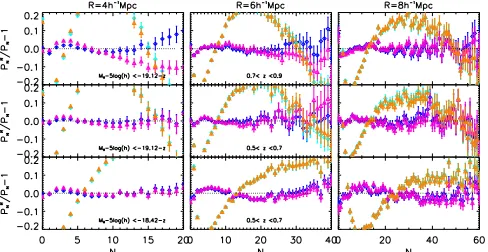
Fig. 7.Comparison between the SLN andΓe methods. Each column corresponds to a cell radiusRof 4, 6,and 8h−1Mpcfrom left to right, and each row corresponds to a combination of redshift and magnitude cut.
Looking more closely at Fig.4, firstly, we can see that the in-trinsic error that is due to the specific modelling of the methods is much greater for the SLN (cyan diamonds compared to the black histogram) than for theΓe(magenta diamonds compared
to the black histogram). From the top panel we see that the SLN does not reproduce the tail of the CPDF, and from the bottom panel we see that, even for low counts, it shows deviations as large as 20%. This intrinsic limitation propagates when perform-ing the reconstruction on the MOCK catalogue (orange triangles compared to the black histogram) while, for theΓe, we see that
the agreement is better than 10% (magenta triangles compared to the black histogram) in the low count regime and the tail is fairly well reproduced. In the second place, comparing theΓethat was
performed on the REFERENCE and the MOCK catalogues (blue
diamonds with respect to magenta triangles), we can see the loss of information owing to the observational strategy that has, at most, an impact of 10% on the reconstructed CPDF, which is reduced when considering larger cells (less shot noise).
In general, Figs. 5 and 6 confirm that for the considered galaxy population the same results hold at lower redshifts. However, the reconstruction atR = 4 h−1Mpc can, in
particu-lar, exhibit deviations larger than 20%, which is at odds with the fact that the shot noise contribution is expected to be the same for the three redshift bins (magnitude limited). We attribute this larger instability to the fact that, not only is the shot noise contri-bution higher forR=4h−1Mpc, but the volume probed is also
smaller when decreasing the redshift.
The performances of the reconstruction for the last three galaxy samples are shown in Fig.7, where each row corresponds to a galaxy sample (we only show the residual with respect to the REFERENCE). This comparison allows us to claim that the re-construction instability at 4h−1Mpc was indeed due to the high
level of shot noise. We can conclude that, in the HOD galaxy mock catalogues, the galaxy distribution is more likely to be modelled by aΓe instead of an SLN. Finally, for a chosen
re-construction method, the information contained in the MOCK catalogues is enough to be able to reconstruct the CPDF of the REFERENCE catalogue at the 10% level.
6. VIPERS PDR-1 data
In this section, we apply the reconstruction method to the VIPERS PDR-1. In the previous sections, we saw that the SLN andΓemethods are sensitive to the assumptions we make about
the underlying PDF. In fact, we saw in Sect.4that, if the under-lying PDF is close to the chosen model, then the reconstruction works. In Sect.5, we found that the galaxy distribution arising from semi-analytic models is better described by aΓe than an
SLN distribution. However, in the following we do not take for granted that the same property holds for galaxies in the PDR-1.
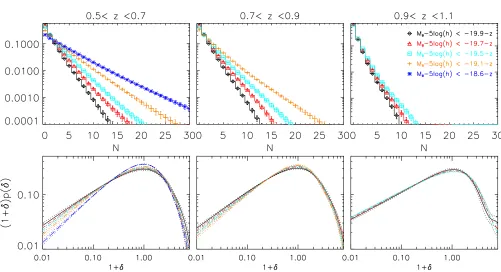
We want to choose which one of the two distributions (log-normal or gamma) best describes the observed galaxy distribu-tion in VIPERS PDR-1, when no expansion is applied. Thus, we compare the observed PDF to the one that is expected from the Poisson sampling of the log-normal probability density function (PS-LN) and to the one that is expected from the Poisson sam-pling of the Gamma distribution (the so-called negative bino-mial). Error bars are obtained by performing a jack-knife resam-pling of 3×7 subregions in each of the fields, W1 and W4.
The SP-LN distribution does not have an analytic expres-sion and must be obtained by numerically integrating Eq. (6), while the Poisson sampling of the Gamma distribution leads to the negative binomial distribution defined as
PN =
θN N!
r(r+1)...(r+N−1)
(1+θ)N+r , (18)
whereθ = Nr¯ andr = σ2N¯2
N−N¯
[image:8.595.42.286.431.557.2]Fig. 8.Observed count-in-cell probability distribution functionPN(histograms) from VIPERS PDR-1 for various luminosity cuts (indicated in the inset). Each row corresponds to a redshift bin,from the bottom to the top, 0.5<z<0.7, 0.7<z<0.9, and 0.9<z<1.1. Each column corresponds to a cell radiusR=4,6,8h−1Mpcfrom left to right. Moreover we added the expected PDF from two models which match the two first moments of the observed distribution; the red solid line shows the prediction for a Poisson-sampled log-normal (PS-LN) CPDF, while the green dashed line indicates the negative binomial model for the CPDF.
by a Gamma distribution than by a log-normal. Hence, we only use the Gamma expansion to model the galaxy distribution of VIPERS PDR-1.
Moreover, the use of the Gamma expansion instead of the SLN substantially simplifies the analysis. In Fig.9we provide the reconstructed probability-distribution function of VIPERS PDR-1, together with the corresponding underlying probability-density function for each redshift bin and luminosity cut. Each panel of Fig.9shows how the choice of a particular class of trac-ers (selected according to their absolute magnitude in B-band) influences the PDF of galaxies. When measuring specific prop-erties of the intrinsic galaxy distribution for each luminosity cut, it is enough to look at the CPDF. However, when comparing the distributions with each other, it is necessary to take account of the averaged number of objects per cell, which varies from sam-ple to samsam-ple. As a result, it appears more useful to compare the properties of the different galaxy samples using their underlying probability-density function which, assuming Poisson sampling, is free from sampling-rate variation between different type of tracers.
For the two first redshift bins, we can see that the probabil-ity densprobabil-ity function is broadening when selecting more luminous galaxies, this goes in the direction of increasing the linear bias with respect to the matter distribution. However, for the highest redshift bin, it seems that this goes in the opposite direction, de-spite a less significant trend. This trend might be an artifact; in-deed by analysing Fig.1, we see that, for all these samples, the averaged number of object per cell is between 0.2–0.4,which shows that theses samples could be highly affected by shot noise effects. Consequently, particular care should be taken when in-terpreting these three high redshift samples.
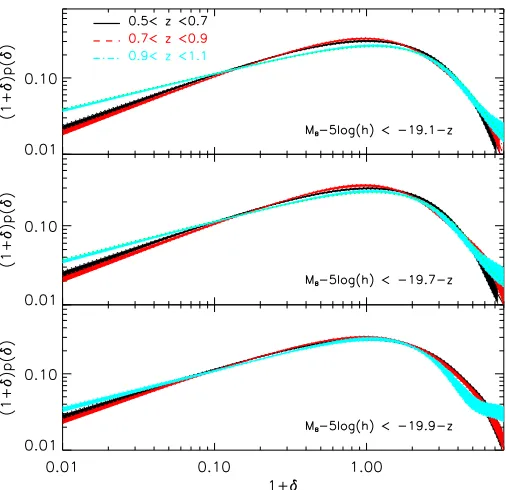
In the following, we focus on the evolution of the underlying PDF for a particular class of objects on the wide redshift range
probed by VIPERS PDR-1. Figure10displays the outcome of this study and shows how the PDF evolves, with regard to the redshift at which it is measured, for three populations (the three highest magnitude cuts). The three populations (top, middle, and bottom panels) exhibit non-monotonic evolution in relation to the redshift. In particular, the more luminous population shows that the PDF at 0.9<z<1.1 appears to be systematically diff er-ent to that is the two lower redshift bins. However, we see also that some instabilities appear in the reconstruction (see wiggles at high 1+δ). This might be due to the fact that we have fewer galaxies in this sample, giving rise to a large shot-noise contribu-tion ( ¯N<0.3). Indeed, we verified that, for the high mass bin and
the two other galaxy populations, if we vary the order of the ex-pansion from 6 to 4, the resulting PDF changes by less than 1σ, while for the most luminous population, truncating the expan-sion at order 4 only removes the instability without changing the overall behaviour of the PDF significantly. This consistency test shows that the radical change in the measured PDF for the high-est redshift bin appears to be the true feature. Probably only the final VIPERS data set will be able to give a robust conclusion.
Finally, in Table3, we list the relevant coefficients of the Gamma expansion, which we measured from the VIPERS PDR-1 at the scaleR =6h−1Mpc. These can be used to model both the CPDF (Eq. (16)) and the PDF (Eq. (13)).
7. Summary
Fig. 9.Top: reconstructed PDF applying theΓemethod in three redshift bins (from left to right) at the intermediate smoothing scaleR=6h−1Mpc.
Bottom: underlying PDF corresponding to the CPDF inthe top panel, for each luminosity cut the 1-sigma uncertainty is represented by the dotted
lines.
Table 3.Coefficients of theΓeexpansion, which describe the VIPERS PDR-1 data forR=6h−1Mpc.
z MB−5 log(h) k θ c3 c4 c5 c6
0.5−0.7 −18.6−z 0.87961819 4.5053822 −0.027583435 −0.030026522 −0.018218867 −0.019292756 −19.1−z 0.78883961 3.2677238 −0.011759548 −0.0041201299 0.0076149367 −0.0010233871 −19.5−z 0.72531432 2.2643581 −0.020667396 0.00070338969 0.021056193 −0.00061403852 −19.7−z 0.64267892 1.4068744 −0.034276861 −0.022797814 0.022229339 0.023963984 −19.9−z 0.64267892 1.4068744 −0.0071341640 −0.0072444524 −0.0030038079 −0.045733910 0.7−0.9 −19.1−z 0.76911853 2.9737929 −0.063844766 −0.046627985 −0.032441385 −0.067589757 −19.5−z 0.73969794 2.0841542 −0.032831012 −0.032693436 −0.028383261 −0.064019117 −19.7−z 0.70270085 1.6638888 −0.019063352 −0.048572844 −0.061832661 −0.078445546 −19.9−z 0.67984433 1.2608492 0.013646925 −0.028325455 −0.042087256 −0.021113201 0.9−1.1 −19.5−z 0.47473429 1.3138704 −0.10794135 −0.17074978 −0.10267837 −0.0089188521
−19.7−z 0.49470455 1.0926144 −0.075805086 −0.16739016 −0.13623398 −0.019540367 −19.9−z 0.48382041 0.90259279 −0.076620326 −0.20604275 −0.23060122 −0.14506575
the counting probability that has been corrected from sparseness effects. We therefore compared three ways (R-L, SLN andΓe) of
measuring the probability density of galaxies that are classified in two categories: direct and parametric. We found that, when the sampling is high ( ¯N 10), the direct method (Rychardson-Lucy deconvolution) performs well and avoids putting any prior on the shape of the distribution. On the other hand, we saw that, when the sampling is low ( ¯N 1), the direct method fails to converge to the true underlying distribution. We thus concluded that, in such cases, the only alternative is to use a parametric method.
We presented two parametric forms that are aimed at de-scribing the galaxy density distribution, the SLN, which is often used in the literature to model the matter distribution and theΓe.
Despite the fact that the two distributions used in this paper al-ready have been investigated in previous works, the approach we propose to estimate their parameters is completely new. Previously, fitting procedures were used to estimate parameters. Here we propose to measure the parameters of the distributions
directly from the observations. The method can be applied to both SLN andΓedistributions and decreases the computational
time of the process considerably.
Relying on simulated galaxy catalogues of VIPERS PDR1, we tested the reconstruction scheme of the counting probability (PN) under realistic conditions in the case of the SLN andΓe
expansions. We found, that the reconstruction depends on the choice of the model for the galaxy distribution. However, we have also shown that it is possible to test which distribution bet-ter describes the observations.
Using VIPERS PDR1, on the relevant scales that are investi-gated in this paper (R=4,6,8h−1Mpc), we found that theΓ
dis-tribution gives a better description of the observedPNthan that
provided by the log-normal (see Fig.8). We therefore adopted the Γe parametric form to reconstruct the probability-density
functions of galaxies. From these reconstruction we studied how their PDF changes according to their absolute luminosity in
[image:10.595.52.546.411.550.2]Fig. 10.Evolution of three galaxy populations, selected according to their luminosity (from bottom to top). On each panel, the black solid, red dashed, and cyan dot-dashed lines represent, respectively, the three redshift bins 0.5<z<0.7, 0.7<z<0.9,and, 0.9<z<1.1.
bins, while it seems that the density distribution of the galaxy field is strongly evolving in the last redshift bin.
Finally, we used the measured PDF to reconstruct the count-ing probability (CPDF) that would be observed if VIPERS was not masked by gaps between the VIMOS quadrants.
Acknowledgements. J.B. acknowledges useful discussions with E. Gaztañaga.
We acknowledge the crucial contribution of the ESO staff for the manage-ment of service observations. In particular, we are deeply grateful to M. Hilker for his constant help and support of this programme. Italian participation in VIPERS has been funded by INAF through PRIN 2008 and 2010 programmes. J.B., L.G. and B.J.G. acknowledge support of the European Research Council through the Darklight ERC Advanced Research Grant (# 291521). OLF ac-knowledges support of the European Research Council through the EARLY ERC Advanced Research Grant (# 268107). A.P., K.M., and J.K. have been supported by the National Science Centre (Grants UMO-2012/07/B/ST9/04425 and UMO-2013/09/D/ST9/04030), the Polish-Swiss Astro Project (co-financed by a grant from Switzerland, through the Swiss Contribution to the en-larged European Union), the European Associated Laboratory Astrophysics Poland-France HECOLS and a Japan Society for the Promotion of Science (JSPS) Postdoctoral Fellowship for Foreign Researchers (P11802). G.D.L. ac-knowledges financial support from the European Research Council under the European Community’s Seventh Framework Programme (FP7/2007-2013)/ERC grant agreement no. 202781. W.J.P. and R.T. acknowledge financial support from the European Research Council under the European Community’s Seventh Framework Programme (FP7/2007-2013)/ERC grant agreement no. 202686. W.J.P. is also grateful for support from the UK Science and Technology Facilities Council through Grant ST/I001204/1. E.B., F.M. and L.M. acknowledge the sup-port from grants ASI-INAF I/023/12/0 and PRIN MIUR 2010-2011. C.M. is grateful for support from specific project funding of the Institut Universitaire de France and the LABEX OCEVU.
References
Bel, J., & Marinoni, C. 2012,MNRAS, 424, 971
Bel, J., Marinoni, C., Granett, B. R., et al. (the VIPERS Team) 2014,A&A, 563, A37
Bernardeau, F., Colombi, S., Gaztaãga, E., & Scoccimarro, R. 2002,Phys. Rep., 367, 1
Bottini, D., Garilli, B., Maccagni, D., et al. 2005,PASP, 117, 996
Bouchet, F. R., Strauss, M. A., Davis, M., et al. 1993,ApJ, 417, 36
Cappi, A., Marulli F., Bel, J., et al. (the VIPERS team)2015, A&A, 579, A70
Carruthers, P., Duong-van, M. 1983,Phys. Lett. B, 131, 116
Coles, P., & Jones, B. 1991,MNRAS, 248, 1
Colless, M., Dalton, G., Maddox, S., et al. 2001,MNRAS, 328, 1039
Colombi, S. 1994,ApJ, 435, 536
de la Torre, S., Guzzo, L., Kovac, K., et al. (the ZCOSMOS collaboration) 2010,
MNRAS, 409, 867
de la Torre, S., Guzzo, L., Peacock, J. A., et al. (VIPERS team) 2013,A&A, 557, A54
di Porto, C., Branchini, E., Bel, J., et al. (VIPERS team) 2014, A&A, submitted [arXiv:1406.6692]
Eisenstein, D. J., & Hu, W. 1998,ApJ, 496, 605
Garilli, B., Le Fèvre, O., Guzzo, L., et al. (the VVDS collaboration)2008, A&A, 486, 683
Garilli, B., Paioro, L., Scodeggio, M., et al. 2012,PASP, 124, 1232
Garilli, B., Guzzo, L., Scodeggio, M., et al. (the VIPERS team)2014, A&A, 562, A23
Gaztañaga, E., Fosalba, P., & Elizalde, E. 2000,ApJ, 539, 522
Greiner, M., & Enβlin, T. A. 2015,A&A, 574, A86
Guzzo, L., Pierleoni, M., Meneux, B., et al. (the VVDS team) 2008,Nature, 451, 541
Guzzo, L., Scodeggio, M., Garilli, B., et al. (the VIPERS team) 2014,A&A, 566, A108
Kim, R. S. J., & Strauss, M. A. 1998,ApJ, 493, 39
Layzer, D. 1956,AJ, 61, 383
Le Fèvre, O., Saisse, M., Mancini, D., et al. 2003,Proc. SPIE, 4841, 1670
Le Fèvre, O. Vettolani, G., Garilli, B., et al. 2005,A&A, 439, 845
Lilly, S. J., Le Brun, V., Maier, C., et al. (the ZCOSMOS collaboration) 2009,
ApJS, 184, 218
Marchetti, A., Granett, B. R., Guzzo, L., et al. (the VIPERS team) 2013,
MNRAS, 428, 1424
Mellier, Y., Bertin, E., Hudelot, P., et al. 2008, The CFHTLS T0005 Release, http://terapix.iap.fr/cplt/oldSite/Descart/ CFHTLS-T0005-Release.pdf
Mustapha, H., & Dimitrakopoulos, R. 2010,Int. Conf. of Numerical Analysis and Appl. Math., AIP Conf. Proc., 60, 2178
Newman, J. A., Cooper, M. C., Davis, M., et al. (the DEEP2 collaboration) 2013,
ApJS, 208, 5
Oke, J. B., & Gunn, J. E. 1983, ApJ, 266, 713
Saslaw, W. C., & Hamilton, A. J. S. 1984,ApJ, 276, 13
Scodeggio, M., Franzetti, P., Garilli, B., et al. 2009,The Messenger, 135, 13
Szapudi, I., & Pan, J. 2004,ApJ, 602, 26
Szapudi, I., Meiksin, A., Nichol, R. C., et al. 1996,ApJ, 473, 15
Yang, A., & Saslaw, W. C. 2011,ApJ, 729, 123
1 Università degli Studi di Milano, via G. Celoria 16, 20130 Milano, Italy
2 INAF–Osservatorio Astronomico di Brera, via Brera 28, 20122 Milano, via E. Bianchi 46, 23807 Merate, Italy
3 INAF–Istituto di Astrofisica Spaziale e Fisica Cosmica Milano, via Bassini 15, 20133 Milano, Italy
4 Aix Marseille Université, CNRS, LAM (Laboratoire d’Astrophysique de Marseille) UMR 7326, 13388 Marseille, France
5 INAF–Osservatorio Astronomico di Torino, 10025 Pino Torinese, Italy
6 Canada-France-Hawaii Telescope, 65–1238 Mamalahoa Highway, Kamuela, HI 96743, USA
7 Aix Marseille Université, CNRS, CPT, UMR 7332, 13288 Marseille, France
8 Université de Lyon, 69003 Lyon, France
9 INAF–Osservatorio Astronomico di Bologna, via Ranzani 1, 40127 Bologna, Italy
10 Dipartimento di Matematica e Fisica, Università degli Studi Roma Tre, via della Vasca Navale 84, 00146 Roma, Italy
11 Institute of Cosmology and Gravitation, Dennis Sciama Building, University of Portsmouth, Burnaby Road, Portsmouth, PO1 3FX, UK
12 Institute of Astronomy and Astrophysics, Academia Sinica, PO Box 23-141, 10617 Taipei, Taiwan
13 INAF–Osservatorio Astronomico di Trieste, via G. B. Tiepolo 11, 34143 Trieste, Italy
14 SUPA, Institute for Astronomy, University of Edinburgh, Royal Observatory, Blackford Hill, Edinburgh EH9 3HJ, UK
16 Department of Particle and Astrophysical Science, Nagoya University, Furo-cho, Chikusa-ku, 464-8602 Nagoya, Japan 17 Dipartimento di Fisica e Astronomia – Alma Mater Studiorum
Università di Bologna, viale Berti Pichat 6/2, 40127 Bologna, Italy 18 INFN, Sezione di Bologna, viale Berti Pichat 6/2, 40127 Bologna,
Italy
19 Institute d’Astrophysique de Paris, UMR7095 CNRS, Université Pierre et Marie Curie, 98bis boulevard Arago, 75014 Paris, France 20 Max-Planck-Institut für Extraterrestrische Physik, 84571 Garching
b. München, Germany
21 Laboratoire Lagrange, UMR7293, Université de Nice Sophia Antipolis, CNRS, Observatoire de la Côte d’Azur, 06300 Nice, France
22 Astronomical Observatory of the Jagiellonian University, Orla 171, 30-001 Cracow, Poland
23 National Centre for Nuclear Research, ul. Hoza 69, 00-681 Warszawa, Poland
24 Universitätssternwarte München, Ludwig-Maximillians Universität, Scheinerstr. 1, 81679 München, Germany
25 INAF–Istituto di Astrofisica Spaziale e Fisica Cosmica Bologna, via Gobetti 101, 40129 Bologna, Italy
26 INAF–Istituto di Radioastronomia, via Gobetti 101, 40129 Bologna, Italy
27 Dipartimento di Fisica, Università di Milano-Bicocca, P.zza della Scienza 3, 20126 Milano, Italy
28 INFN, Sezione di Roma Tre, via della Vasca Navale 84, 00146 Roma, Italy
29 INAF–Osservatorio Astronomico di Roma, via Frascati 33, 00040 Monte Porzio Catone (RM), Italy
30 Institut Universitaire de France, 75231 Paris Cedex 05, France 31 Université de Toulon, CNRS, CPT, UMR 7332, 83957 La Garde,
France
Appendix A: Non-linear system
The problem with this system of equations is that it is non-linear, and is therefore difficult to solve. However, it can be reduced to a one-dimensional equation which can be solved numerically.
The two first equations (n=1 andn=2) can be used to ex-press the first two cumulants with respect to the third and fourth order ones:
σ2
Φ = ln(A2)+ln
⎛ ⎜⎜⎜⎜⎝B2
1
B2
⎞
⎟⎟⎟⎟⎠ (A.1)
μΦ = −1
2
⎡
⎢⎢⎢⎢⎣ln(A2)+ln
⎛ ⎜⎜⎜⎜⎝B4
1
B2
⎞
⎟⎟⎟⎟⎠⎤⎥⎥⎥⎥⎦, (A.2)
whereB1andB2are both functions ofxandy. Then, using other
combinations of the equation, one can express a system of two equations forxandyalone:
B23 = a1B21B4 (A.3)
B3B31 = a2B32, (A.4)
wherea1 ≡
A2 3
A4 anda2 ≡
A3
A3 2
. To properly solve the system, we prefer to express it in terms of one parameterη ≡B2/B1,
more-over one can see that polynomialsB1toB4are not independent,
as a result.
B4=d+aB1+bB2+cB3,
wherea =96,b = −32,c= 22427,d =−192527 and which can be substituted in Eq. (A.3). Combining Eqs. (A.3) and (A.4) one obtains a parametric equation forB1
(a+bη)B31+(d+c f(η))B21−g(η)=0, (A.5) which can be solved for each value of the parameterη and an independent parametric equation forB3
B3= f(η).
As a result we can find a couple B1,B3 for each value of the
parameterη. It follows that one can expressxandywith respect toηand, given the definition ofη, the possible solutionxandy must satisfy the condition
B2[x(η), y(η)]−ηB1[x(η), y(η)]=0,
which gives the possible values ofη from which one can re-coverxandy. Finally, from Eqs. (A.1) and (A.2) we can com-pute the values ofσΦandμΦthat correspond to each couple (x, y) of the solutions. This allows us to select the solution which provides a value ofA5that is closer to the observed one.
Once the values of the cumulantsμΦ,σ2
Φ,Φ3candΦ4c
are known from the process detailed above, we know that the moments of the correspondingPth
N will match those of the
ob-served up to order 4. In the end, we can check whether the SLN distribution provides a good match to data by numerically inte-grating the probability-density function that was convolved with the Poisson kernelK(see Eq. (5)).
Appendix B: Generating function
We show that the CPDF that was associated with a Gamma expanded PDF can be calculated analytically from an expres-sion that depends explicitly on the coefficientsciof the Gamma
expansion.
BeGN the generating function associated to the probability
distributionPN, it is defined as
GN(λ)≡ ∞
i=0
λN
PN. (B.1)
In case of the Poisson sampling of a Gamma distribution, after some algebra, one can show that it can be expressed with respect to the coefficients of the Gamma expansion as
GN(λ)=
1 Γ(k)
n
i=0
ciFi(γ), (B.2)
whereγ≡(1−λ)θand
Fi(γ)≡
∞
0
xk−1e−xLi(k−1)(x)e−γxdx.
Nevertheless, this integral can be computed using the Laguerre expansion of the exponential
e−γx= ∞
i=0
γi
(1+γ)i+α+1L (α)
i (x),
where it reads to
Fi(γ)=
γi
(1+γ)i+k Γ(i+k)
i! · (B.3)
The formal expression of the generating function is therefore given by
GN(λ)=
(1+γ)−k Γ(k)
n
i=0
ciΓ
(i+k)
i!
γ
1+γ
, (B.4)
where we still useγ = (1−λ)θ. From the explicit expression of the moment-generating function (Eq. (B.4)) one can get the probability distributionPNby iteratively deriving the generating
function with respect toγ:
PN ≡
1
N! dNG
N(λ)
dλN
λ=0= (−θ)N
N! dNG
N(γ)
dγN γ=θ·
These derivatives can be calculated explicitly.
Appendix C: Synthetic galaxy catalogues
We describe here how we generate synthetic galaxy catalogues from Gaussian realizations. The first requirement of these cata-logues is that they must be characterised by a known power spec-trum and 1-point probability-distribution function. The second requirement is that the probability-distribution function must be measurable.
The basic idea is simple, we generate a Gaussian random field in Fourier space (assuming a power spectrum), we inverse Fourier transform it to get its analog in configuration space. We further apply a local transform to map the Gaussian field into a stochastic field that is characterised by the target PDF. The two crucial steps of this process are the choice of the input power spectrum and the choice of the local transform.
Beνa stochastic field following a centered (ν=0) reduced (σ2
ν ≡ ν2c = 1) Gaussian distribution. From a realization of
this field, one can generate a non-Gaussian density fieldδ by applying a local mappingLbetween the two, hence