LDM (Layered Deployment Model): A Novel Framework
to Deploy Sensors in an Irregular Terrain
Chandan Kumar Bhattacharyya1, Swapan Bhattacharya2 1Department of Computer Science & Engineering
, Techno India, Salt Lake, Kolkata, India 2Department of Computer Science & Engineering
, Jadavpur University, Kolkata, India
E-mail: ckbckb2010@rediffmail.com, bswapan2000@yahoo.co.in
Received May 1, 2011; revised June 2, 2011; accepted June 8, 2011
Abstract
Deployment of sensors in any irregular terrain with 100% coverage and connectivity is a challenging issue in the field of Wireless Sensor Networks. Traditional deployments often assume homogeneous environments, which ignore the effect of terrain profile as well as the in-network obstacles situated randomly like buildings, trees, roads and so on. Proper deployment of sensors in such irregular region and its corresponding routing is one of the most fundamental challenges of Wireless Sensor Networks. In this work, we have considered that the terrain is irregular in shape and there may be obstacles within the terrain in any random position with any random shape, which is the reality in real world. With this novel framework, we have shown that an opti-mum deployment can be achieved in such irregular terrain without compromising coverage as well as con-nectivity between the sensor nodes for effective routing.
Keywords:Wireless Sensor Networks, Sensor Deployment, Shortest Path, Routing, Irregular Terrain
1. Introduction
The sensor networks are the distributed collection of sensors (nodes), mobile or localized, with sensing, com-putation and communication capabilities within a desired level of accuracy. Each node needs to know the identity and location of its neighbors to support processing and collaboration of information. In addition to the knowl-edge of topology, each sensor also needs to know its own location. Due to cost restrictions and to achieve the maximum life-time by energy savings, these sensor nodes are rather low-capability devices equipped just with a simple processing unit and a small radio device that can sense object and communicate information be-tween neighbor nodes only. In most of the previous work [1-5], the sensing terrain was considered as regular in shape and the deployments are movement-assisted with-out the knowledge of location information. But, if the terrain is not a regular, which happens actually in real scenario, we must be very careful about deployment of nodes as because, the terrain boundary may be the border of a state or a country and one deployment beyond bor-der means wastages of resources as well as facing in-ter-country or inter-state network hazards. In our pro-posed system, we have considered the terrain as any ran-
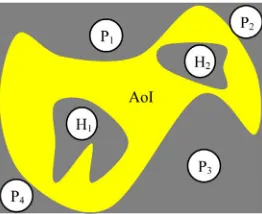
[image:1.595.358.489.588.695.2]dom geometric shape in nature with random obstacles at random positions within the terrain as shown in Figure 1. Our objective is to deploy the sensors only in the Area of Interest (AoI) marked as yellow skip-ping the pockets (P1, P2, P3, P4) and obstacles (H1, H2) with optimum number of nodes without compromising the coverage as well as connectivity. Pockets, as we define, are the area outside the AoI but inside its edged-boundary and obsta-cles are the areas inside the given irregular terrain but outside the AoI as shown in the Figure 1. The rest of the paper is organized as follows: In section 2, some pre-liminaries and assumptions are discussed. The definition of the problem is proposed and formulated in section 3.
In section 4, we briefly discuss the related work. Section 5 and 6 is our proposal for the topology of node deploy-ment in LDM framework and corresponding routing methodology respectively. A simulated study of this so-lution is given in section 7. Finally, we conclude in sec-tion 8.
2. Preliminaries and Assumptions
The proper sensing of any object by a sensor is highly related with the geometric distance of the object from the sensor. Here we assume that a sensor can sense the en-ergy emitted by the object in a homogeneous circular area with maximum radius r, as shown in Figure 2, un-der the constraint of noise and other distortions. This energy is called Threshold Energy (Eth) and an object
will not be sensed if the received energy by the sensor is less than this threshold energy. This coverage is consid-ered as optimum coverage of a sensor with desired level of acceptable value. Assuming the energy emitted by an object is constant, the signal energy Es, as detected by
sensor si for an object situated at distance dt from the
sensor will be, Es = E0(1-αdn)where E0 is the energy at distance 0 i.e. maximum energy, α is the decay co-efficient and dn is the normalized distance of the
ob-ject from the sensor and will be expressed as dn = dt/r
where r is the optimum sensing range. For example, in the Figure 2, the signal energies for three different loca-tions are expressed as:
Eth = E0(1 – α) = Threshold Energy; Ex = E0(1 – αdx/r) = Energy at distance dx;
Ey = E0(1– αdy/r) = Energy at distance dy.
Since dx > dy, it is obviously Ex < Ey. An object will be
sensed only if its emitted energy lies between E0 and Eth.
We assume that the wireless sensor nodes are given as a set S with n sensor nodes where 1 j n i and for
each sensor si, its location i i i
S S
)
y
( ,
[image:2.595.120.232.586.694.2]l x is known as it is deployed. We also assume that all the sensors are static sensors and there are no road constraints within AoI. Each sensor is assumed to have same sensing range as
Figure 2. Measurement of signal energy with respect to the distance.
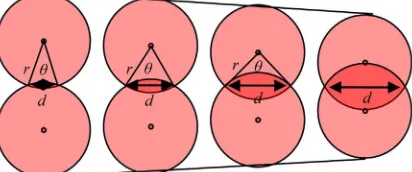
denoted by r. A pair of sensors will be able to see (cov-erage) and hear (connectivity) each other if they have overlapped coverage space. If only coverage is consid-ered, less number of nodes will be required but the de-ployed nodes will not be able to communicate with each other. Figure 3 shows the relation between the optimal coverage and connectivity. As we move from coverage to connectivity, the overlapping domain (d) gets in-creased where d f r
, . Here, we assume homoge-neous coverage and connectivity i.e. both coverage and connectivity ranges are same and is equal to r.3. Problem Definition and Objectives
To communicate between each other with optimum cov-erage we have to deploy the next node at the maximum sensing boundary with threshold signal energy Eth to any
of the four sides (i.e. Right, Left, Up, Down) of the pre-viously deployed. To minimize the channel overhead, we have proposed the concept of layered accumulation i.e. outer layer information will only be transmitted to its immediate inner layer and not directly to Fusion Node and communication to Fusion Node will be done only through First layer nodes (and/or from the boundary nodes for leaving of any object from AoI). Since volume of information is being increased layer by layer towards the Fusion Node, we have deployed nodes with variable capacities in different layers. We define capacity of a node as its rate of consumption of power, maximum sto-rage/buffer size, processing speed etc. Hence, the objec-tive or the problem definition of our proposed model can be defined as:
Finding Fusion Node Capacity
Deploying Layer wise Sensors with variable capaci-ties
Designing Effective Routing Model
4. Related Work
[image:2.595.321.527.615.701.2]Several deployment schemes with existing holes [7-9] in the network have been proposed to enhance the coverage. They have considered that the target region is regular and rectangular and the holes are situated randomly within
Table 1. Comparative analysis of existing work with proposed model.
Studies Coverage
Density
Full
Coverage Boundary
In-boundary Obstacle
Obstacle Information
Boundary Nodes Detected
Knowledge of Neighbor Location
Shortest Path
[10]
Non-Uniform IrregularNo Not Not Exist Known No Not Known Not Known
[11]
Non-Uniform IrregularNo Not Not Exist Known No Not Known Not Known
[12]
Non-Uniform IrregularNo Not Not Exist Known No Not Known Not Known
[13]
Uniform Yes Irregular Not Not Exist Known No Not Known Not Known
[14]
Non-Uniform IrregularNo Not Not Exist Known No Not Known Not Known
[15]
Non-Uniform IrregularNo Not Not Exist Known No Not Known Not Known
LDM
(Proposed) YesUniform Irregular
Exist and
Irregular Not Known KnownYes Known
5. Proposed Model
the target boundary. More over the geometry of the holesare also bounded and are defined as a regular graph with certain number of nodes and edges. In certain cases, holes defined with less than four edges could turn out to be large areas that act as greater barriers to the network than normal. An extreme scenario could present itself with the occurrence of a large area that is only connected through two edges. With such consideration, we need to deploy more nodes to cover the entire range of area, which is a trade-off with cost optimization. In [10-15], irregular areas have been considered with no obstacles. A comparative analysis is shown in Table 1 with proposed model.
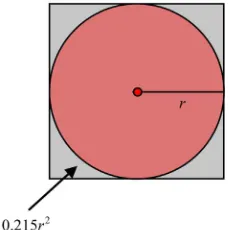
Let us define our proposed model i.e. Layered Deploy-ment Model (LDM). If a logical grid is created around a deployed node, some part of the grid area remains un-covered as shown in the Figure 4. The uncovered area will further be covered with next layer of deployment at distance r from the deployed node at right, left, up and down subject to the calculated co-ordinates of deploy-ment lie within AoI, otherwise we have to search for next effective location in any of the four sides at distance r and establish connectivity. The stepwise deployment of five nodes is shown in the Figure 5 and corresponding maximum coverage area with optimum connectivity is shown in the Figure 6. Figure 7 shows the final model The accuracy of sensor placement may be subject to
[image:3.595.362.477.410.525.2]various errors. Kenan Xu, et al. [16], in their paper, iden-tified two deployment errors namely, misalignment and random errors. They derived the minimum number of sensors required by a robust grid-based sensor deploy-ment assuming that the errors are bounded. F. Zhao, et al. [17], have addressed the dynamic sensor collaboration problem to determine dynamically which sensor is most appropriate to perform the sensing, what needs to be sensed, and to whom to communicate the information. It is based on the information-driven sensor querying ap-proach, enabling collaboration, under resource con-straints and cost of transmitting information. Here, the next node selection is done by predicting Mahalanobis distance measure technique where the computation from predicted likelihood function may be strongly biased by the prior distribution. Y. Rachlin, R. Negi, and P. Khosla, [18] have addressed the technique of measuring sensing capacity in a sensor network with respect to the maxi-mum ratio of target positions to sensors as achievable within a certain tolerable distortion. As one target is be-ing sensed by more than one sensor, the network will soon get flooded with redundant information. Moreover, sensors lifetime will eventually get reduced as all the time more than one sensor is sensing one target. [19,20] [21] are based on grid-based Stable Routing Protocol with multi-hop broadcast technique. In [22] several power-efficient routing algorithms are proposed for a sensor network with 2D grid topology.
Figure 4. Logical grid with covered and uncovered area for a node deployed.
[image:3.595.327.520.561.693.2]Figure 6. Final view of optimum connectivity (yellow line) and maximum coverage area (blue line) with five nodes deployed.
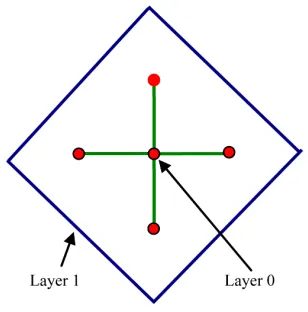
Figure 7. Layer 0 and layer 1 deployment within AoI with maximum coverage area (8r2) with connectivity.
of lay ered deployment with two layers and the relation between layer number and coverage area with total de-ployed node is shown in Table 2.
In case of existing obstacles, the deployment will be done to the next effective location that lies within AoI and in consequence, connectivity will be rebuilt accord-ingly. To find the deployment co-ordinates, we first make the boundary of the irregular space by squaring the boundary of the sensing terrain as shown in the Figure 1.
Table 2. Layerwise node deployment.
Layer No.
Maximum Deployed
Node
Total Nodes Deployed
Range of Node Number
Maximum Coverage
Area
L0
Fusion
Node 0001 2r
2
L1 4 5 01 - 04 8r2
L2 138 1805 - 12 r2
L3
12 25 3213 - 24 r2
L4
16 41 5025 - 40 r2
... … … …
Ll
4l 2l2 + 2l + 1 (2l2–2l+1) -
(2l2+2l) 2(l + 1)2r2
Nodes are deployed from the center of the regular boun-dary as its co-ordinate is known and the first node will be the Fusion Node i.e. the Central Server. We deploy the first node i.e. Fusion Node at the center of the square boundary of the terrain to reduce the average hop be-tween any node and the Fusion Node provided the center lies within AoI and not within any obstacle. However, depending the complexity of the terrain property, the Central Server can also be placed at any desired location from which other nodes will be deployed. We assume that the entire sensing area has no geographic limitation to deploy or access any node unless it lies in obstacles where nodes will not be deployed at all.
5.1. Average Capacity of Fusion Node
As the volume of data aggregation to the Fusion Node is directly proportionate to the hop size i.e. layer number, the capacity of the Fusion Node controls the size of the network. We are assuming that one Fusion Node is re-sponsible for data aggregation of a single network. For a large space where one Fusion Node will not be able to cover the entire network we have to partition the network into sub-networks each of which will be headed by one sub-Fusion Node. Then we have to build the network of sub-Fusion Nodes to cover the entire area.
Let m = maximum message in bits (including its own address, number, tracking time of object etc) a node is sending to Fusion Centre. Let hmax = maximum
hop-distance from a boundary node (sender node) to the Fusion Centre and Let β = the bit size that every node is padding with the message for update information. So, the dynamic information created by nodes (intermediate node address, number, time-stamp etc) in bits, as denoted by md = (hmax – 1)β and the maximum message size that
will reach to Fusion Node = mmax= md + m. Let B be the
maximum buffer-size of a node, so, the message will be split to p no. of packets where p = mmax /B. If pk be
the packet header size, and pm be the message size (= B
for maximum), the minimum capacity of a Fusion Node should be p(pk + pm) bits to receive the in-bound
infor-mation from different nodes. For in network data aggre-gation, more space is also required for Fusion Node and the processing element of Fusion Node should also be very powerful.
5.2. Deployment of Fusion Node
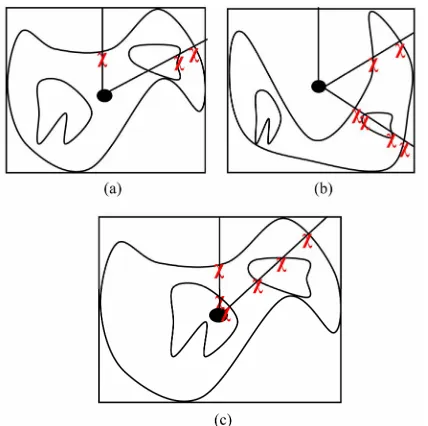
Since the pockets or obstacles may lie in any random position, the co-ordinate of Fusion Node may lie in any of the following three positions as stated below and is shown in the Figure 8:
[image:4.595.56.286.590.722.2]Figure 8. (a) center within AoI with odd number of section (b) center within pocket with even number of inter-section (c) center within obstacle with even number of in-tersection.
Within any pocket Within any obstacle
We will skip deploying Fusion Node at center except the first condition and keep on searching for the next accepted location within AoI in any of the four sides i.e. Right, Left, Up and Down. To test whether the derived co-ordinate lies within AoI or not, we have counted the number of intersection points from the Fusion Node co-ordinate to the boundary as shown in Figure 10. It is obvious that if the number of intersection is odd (1, 3, 5, ), the point lies within AoI, otherwise (0 or even), it is outside AoI i.e. it may fall either in pocket or in obstacle. The algorithm for Fusion Deploy is stated below.
Algorithm for Fusion Node Deployment within AoI FusionNodeDeploy(){
Find boundary co-ordinates of top-left
x ytl, tl
andright-bottom
xrb,yrb
;Find center co-ordinate ,
2 2
tl rb tl rb
x x y y
[image:5.595.66.280.76.289.2]
[image:5.595.312.537.77.316.2]Figure 9. Fusion Node (layer 0) and other nodes in Layer 1, 2 and 3 (Node Number, Layer) as shown in different color in AoI assuming no obstacle. The connectivity is shown in lines.
Figure 10. Automatic bypassing of deployment within hole by intersection countmethod.
5.3. Deployment of Other Nodes
; If (LieAOI()) {
Deploy();
StoreCoordinate(); }
Else {
While (!LieAOI())
TestRight(); TestLeft(); TestUp(); TestDown();
Deploy();
StoreCoordinate(); } }
[image:5.595.310.540.380.485.2]Algorithm for Fusion Node Deployment within AoI count = 0;
GetNodeRight(si) {
while (!boundary()) {
GetCoordinateRight();
if (intersection(si, si+1)) {
count++;
if (odd(count)) CurrentNodeId = si;
if(even(count)) si = CurrentNodeId;
}
if (even(count) {
DeployNode(si+1); GetNodeRight(si+1) } else GetNodeRight(si+1); } }
5.4. Deployment Exception
According to the algorithm for node deployment, the nodes are being deployed as per Figure 9 where we count the number of intersection(s). However, when the intersection line touches the boundary without crossing it, as shown in the Figure 11, it senses as odd count and skip deploying nodes, which creates algorithmic de-ployment error. The nature of error is in random and the probability of the occurrence of such error is very negli-gible and highly depends on the shape of the area and the radius of the coverage of the deployed node. We have handled this type of exceptions by finding the direction of the movement of curve during the scanning of the pixels with its adjacent upper and lower pixels as shown in Figure 12. As we are scanning lines horizontally, the upper pixels from the central one (as per Figure 12(a)
determine the upward movement of the curve, and the lower pixels determine the downwards movement of the curve. Following conditions satisfies whether the cut is an intersection or a touch:
If the curve has both upwards and downwards move- ment, it is an intersection (as per Figure 12(b)). If the curve has either upward or downward
move-ment, it is touch (as per Figure 12(c)).
Figure 11. Deployment exception.
Figure 12. Analysis of deployment exception.
If the curve has no movement, it is either a point or a line parallel to the scanning line. (as per Figure 12(d))
5.5. Performance of Algorithm
For a worst-case scenario with native assumptions, let us consider the terrain, as rectangular shape having width, w and height, h and it is free from any obstacle. Let the nodes are deployed within the terrain in interval of r. we also assume that all nodes are homogeneous. Number of nodes required to cover each row in interval rw r1 and each column = h r1. So maximum total number nodes required to cover the entire region =
w r 1
h r1
. To find obstacle boundary or Terrain boundary to deploy the nodes, intersection scan per row in interval r will be
w r 1
r
w r
since we have to con-sider two extreme boundaries. So, the complexity will become
h r1
w r
d r
2 r
d 2 whereh w d .
6. Connectivity and Routing
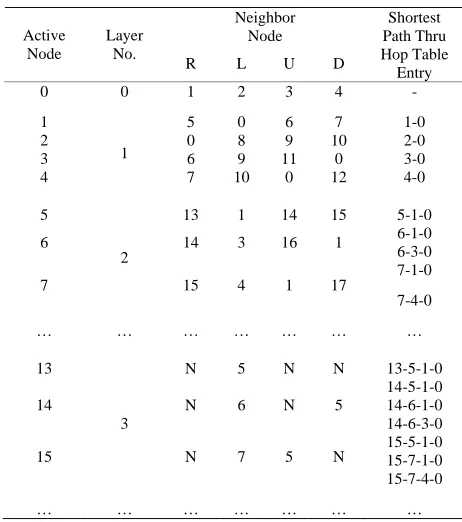
Fusion Node. The complete shortest path history from any node to the Central Server as per Figure 9 is shown in Table 3.
Since the nodes are connected with known co-ordinate as well as with known neighbors, more than one shortest path can be generated and the entire path can be stored in the node database so that for any crisis in any selected path, an alternative path can also be taken instantly. Since all the shortest path history is already kept with each deployed node during its deployment, no run-time searching of alternative shortest path is required for each link failure, which eventually saves huge amount of run-time shortest path searching time which is a chal-lenging problem for most of the major previous works.
7. Simulation
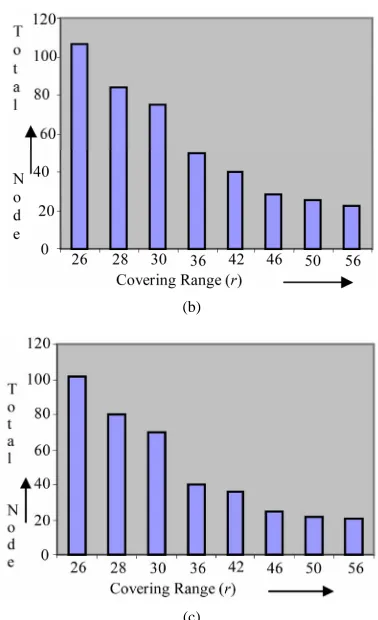
[image:7.595.329.520.72.209.2] [image:7.595.313.533.238.521.2]It is obvious that the cost of deployment is proportionate to the sensing range of each node. With greater range, the number of deployed nodes will be minimized but at the same time, it also increases the boundary wastage. Therefore, the optimum deployment will definitely be a challenge and can only be approximated with different simulated result. we have tested with different r value and find the optimum topology with respect to the boun-dary wastage. We have taken three different random ir-regular sensing terrain with variable obstacles as shown in Figure 13 and find the optimum topology (as per
Figure 14) with minimum wastages and with full cover-age and connectivity. Figure 15 shows different situation
Table 3. Shortest path history.
Neighbor Node Active
Node
Layer No.
R L U D Shortest Path Thru Hop Table Entry
0 0 1 2 3 4 -
1 5 0 6 7 1-0
2 0 8 9 10 2-0
3 6 9 11 0 3-0
4
1
7 10 0 12 4-0
5 13 1 14 15 5-1-0
6 14 3 16 1 6-1-0
6-3-0
7
2
15 4 1 17 7-1-0
7-4-0
… … …
13 N 5 N N 13-5-1-0
14 N 6 N 5
14-5-1-0 14-6-1-0 14-6-3-0
15
3
N 7 5 N 15-5-1-0 15-7-1-0 15-7-4-0
… … …
A B
[image:7.595.55.286.463.724.2]C
Figure 13. Three different shape of random geometric area.
Figure 14. Optimum topology with different shapes: pock-ets with no obstacle (a), single obstacle (b), multiple obstacle (c).
[image:7.595.330.512.565.720.2](b)
[image:8.595.76.265.74.384.2](c)
Figure 15. Pair {Total deployed node, covering range} ratio for shapes A, B and C as per Figure 13.
Figure 16. Screenshot of deployment with layer (in differen
f deployment with the variation of r in pair {sensing
this paper, we have introduced the model of lay deployment of wireless sensors with corresponding shortest-path routing technique in any random irregular t color) corresponding to 13(b).
o
radius, total node}. A partial node database as per Figure 16 is shown in Table 4.
8. Conclusions
In ered
[image:8.595.306.539.93.259.2]
Table 4. Node database corresponding to 13(b).
Node Id Layer No
Left Node
Right Node
Up Node
Down Node
0 0 NULL 1 2 3
1
N 1
1
0 59
4 5
5 60
6 0 2
3 1 NULL 6 0 22
4 2 1 7 8 9
5 2 2 8 ULL 1
6 2 3 9 1 23
7 3 4 10 11 12
8 3 5 11 NULL 4
9 3 6 12 4 24 10 4 7 13 14 15 … … … … … …
geo hic a The uni featu as ach with this co-ordinated red de yment are:
Average hop-count is minimum as Sink is terrain-
about its
ighbour addresses of each node are known
-d with all possible shortest
well detected as one of its
] L. Zhao and Q. L. Liang, “Fuzzy Deployment for Wire-etworks,” Proceedings of the 2005 IEEE
onference on Computational Intelligence
grap rea. major que res ieved laye plo
centered
At the time of deployment, nodes are aware all four neighbours with Ids
All the ne
The shortest path to Sink is also known to each node at its time of deployment
Topology can be redefined with the variation of indi vidual sensing range
Instant routing is achieve path
Boundary nodes are neighbour will be NULL
9. References
[1
less Sensor N International C
for Homeland Security and Personal Safety, Orlando, 2005, pp. 79-83. doi:10.1109/CIHSPS.2005.1500615
[2] Y. C. Wang, C. C. Hu and Y. C. Tseng, “Efficient De-ployment Algorithms for Ensuring Coverage and Con-nectivity of Wireless Sensor Networks,” Proceedings of First International Conference on Wireless Internet, Bu-dapest, 2005, pp. 114-121. doi:10.1109/WICON.2005.13
[3] G. Wang, G. Cao and T. L. Porta, “Movement-Assisted Sensor Deployment,” IEEE Transactions on Mobile Computing, Vol. 5, No. 6, 2006, pp. 640-652.
doi:10.1109/TMC.2006.80
[4] S. H. Yang, M. L. Li and J. Wu, “Scan-Based Movement- Assisted Sensor Deployment Methods in Wire
Networks,” Proceedings of
less Sensor Parallel and Distributed Sys-tems, IEEE Transactions Publication, Vol. 18, No. 8, 2007, pp. 1108-1121.
doi:10.1109/TPDS.2007.1048
[image:8.595.56.281.428.570.2]Deployment,” Proceedings of Networking Conference
6, pp. ment-Assisted Sensor
Wireless Communications and , Las Vegas, 31 March-3 April 2008, pp. 2057-2062.
[6] M. de Berg, M. van Kreveld, M. Overmars and O. Schwarzkopf, “Computational Geometry, Algorithm and Application,” 2nd Edition, Springer, Berlin, 2000.
[7] Q. Fang, J. Gao and L. J. Guibas, “Locating and Bypass-ing Holes in Sensor Networks,” ProceedBypass-ings of Mobile Networks and Applications, Vol. 11, No. 2, 200 187-200. doi:10.1007/s11036-006-4471-y
[8] F. Reitsma and S. Engel, “Searching for 2D Spatial Net-work Holes,” Proceedings of International Conference on Computational Science and Its Applications, Assisi, 14-
Computational Geometry,
International Conference on 17 May 2004, pp. 1069-1078.
[9] S. Funke and C. Klein, “Hole Detection or: How much Geometry Hides in Connectivity?” Proceedings of the 22nd Annual Symposium on
Sedona, 2006, pp. 377-385.
[10] B. D. Ying and Z. Z. Hou, “Irregular-Location Based Key Pre-Distribution Scheme for Distribution Sensor Net-works,” Proceedings of 1st
Information Science and Engineering, Nanjing, 26-28 December 2009, pp. 4042-4046.
doi:10.1109/ICISE.2009.698
[11] B. Xiao, L. Chen, Q. J. Xiao and M. L. Li, “Reliable An-chor-Based Sensor Localization in Irr
Transactions on Mobile Comp
egular Areas,” IEEE uting, Vol. 9, No. 1, 2010,
Proceedings of World Congress on Nature &
ional Conference on
Com-Target
Takahara and H. Hassanein, “On the
Ro-iven
Dy-pp. 60-72.
[12] S. K. Udgata, S. L. Sabat and S. Mini, “Sensor Deploy-ment in Irregular Terrain Using Artificial Bee Colony Algorithm,”
Biologically Inspired Computing, Coimbatore, 9-11 De-cember 2009, pp. 1309-1314.
[13] G. Takahara, K. Xu and H. Hassanein, “Efficient Cover-age Planning for Grid-Based Wireless Sensor Networks,” Proceedings of IEEE Internat
munications, Glasgow, 24-28 June 2007, pp. 3522-3526. [14] C. Y. Chang, C. T. Chang, Y. C. Chen and H. R. Chang,
“Obstacle-Resistant Deployment Algorithms for Wireless Sensor Networks,” IEEE Transactions on Vehicular Technology, Vol. 58, No. 6, 2009, pp. 2925- 2941.
[15] T. L. Chin, “Sensor Deployment for Collaborative Detection in the Presence of Obstacles,” Proceedings of IEEE Global Telecommunications Conference, Hawaii, 2009, pp. 1-5.
[16] K. N. Xu, G.
bustness of Grid-Based Deployment in Wireless Sensor Networks,” Proceedings of the 2006 International Con-ference on Wireless Communications and Mobile Com-puting, British Columbia, 2006, pp. 1183-1188.
[17] F. Zhao, J. Shin and J. Reich, “Information-Dr
namic Sensor Collaboration for Tracking Applications,” Signal Processing Magazine, Vol. 19, No. 2, 2002, pp. 61-72. doi:10.1109/79.985685
[18] Y. Rachlin, R. Negi and P. Khosla, “Sensing Capacity for
, “Sensor Deployment Strat-Target Detection,” Information Theory Workshop, 24-29 October 2004, pp. 147-152.
[19] Z. H. Yuan and G. F. Wang
egy for Collaborative Target Detection with Guaranteed Accuracy,” Proceedings of the 4th International Confer-ence on Mobile Ad-hoc and Sensor Networks, Wuhan, 10-12 December 2008, pp. 68-71.
doi:10.1109/MSN.2008.14
[20] Z. Y. Wu, H. T. Song, S. F. Jiang and X. M. Xu, “A
i, “Coverage-Preserving Routing Protocols for Grid-Based Stable Routing Algorithm in Mobile Ad Hoc Networks,” First Asia International Conference on Mod-elling & Simulation, Phuket, 27-30 March 2007, pp. 181-186.
[21] Y. R. Tsa
Randomly Distributed Wireless Sensor Networks,” IEEE Transactions on Wireless Communications, Vol. 6, No. 4, 2007, pp. 1240-1245. doi:10.1109/TWC.2007.348320 [22] J. Zhang and H. Shi, “Energy-Efficient Routing for 2D
Grid Wireless Sensor Networks,” Proceedings of Inter-national Conference on Information Technology: Re-search and Education, 11-13 August 2003, pp. 311-315. [23] C. Kr. Bhattacharyya and S. Bhattacharyya,