56
Regular transductions with MCFG input syntax
Mark-Jan Nederhof
University of St Andrews
Heiko Vogler
Technische Universit¨at Dresden
Abstract
We show that regular transductions for which the input part is generated by some multiple context-free grammar can be simulated by syn-chronous multiple context-free grammars. We prove that synchronous multiple context-free grammars are strictly more powerful than this combination of regular transductions and mul-tiple context-free grammars.
1 Introduction
In machine translation, one is interested in auto-matically translating sentences of one natural lan-guage into sentences of another natural lanlan-guage. Such translations can be considered as string-to-string transductions by viewing the words of a nat-ural language as symbols of a formal language, and viewing sentences as strings. Several formal models for such transductions have been proposed, e.g., syntax-directed translation schemata (Lewis and Stearns, 1968), also known as synchronous context-free grammars (Chiang,2007), two-way generalized sequential machines (2gsm) ( Sheperd-son,1959;Aho and Ullman,1970), MSO definable string-to-string transductions (MSO-sst) (Courcelle and Engelfriet,2012), and streaming string trans-ducers (SST) (Alur and ˇCern´y,2010).
It has been established that the deterministic versions of 2gsm, MSO-sst, and SST generate the same class of string-to-string transductions (Alur and ˇCern´y,2010;Engelfriet and Hoogeboom, 2001); the same is true for the nondeterministic ver-sions of MSO-sst and SST (Alur and Deshmukh, 2011). Due to these characterizations, the involved transducers and the corresponding transductions are calledregular transducers andregular trans-ductions, respectively.
In statistical machine translation (Lopez,2008), one aims at automatically inferring a translation
model from some bilingual corpus, where the trans-lation model is chosen from some class of formal devices, e.g., the class of regular transducers. In the seminal paper byBrown et al.(1993), the inference is based on the concept ofalignment graph(used as hidden random variable in the EM-algorithm (Dempster et al.,1977)); each such graph consists of an input sentencew, an output sentencev, and a binary relation between the setpos(v)of positions ofvand the setpos(w)of positions ofw. In the particular case of the IBM models each alignment graph is a partial mapping frompos(v)topos(w). These have almost the same mathematical structure as theorigin graphsofBoja´nczyk(2013), except that in the latter, the mapping is total.
Boja´nczyk(2013) andBoja´nczyk et al.(2017a,b) investigated the concept of regular transductions with origin semantics, where the origin semantics of a regular transducer A is a set of the origin graphs thatAcan create: ifAproduces a portion
v0 of the output while reading the input symbol at positioni, then each position ofv0is aligned toi.
2 Preliminaries
We let N = {0,1,2, . . .}, N+ = N\ {0}, and
[i, j] = {k ∈ N| i≤ k ≤j}for everyi, j ∈N. We abbreviate [1, j] by [j]. We abbreviate se-quences of objects, likea1· · ·an anda1, . . . , an,
by a1,n. We denote the powerset of a set A by
P(A). We abbreviate a set{a}with one element bya. An alphabetAis a nonempty and finite set.
For functionsf :A →B andg :B → C, we denote their composition byf◦g, i.e.,(f◦g)(a) =
g(f(a))for eacha∈A.
We let X = {x1, x2, x3, . . .} be a set of
vari-ablesandXk={x1, . . . , xk}for eachk∈N.
Let Σ1 andΣ2 be alphabets. Anorigin graph (overΣ1andΣ2) is a triple(w, v, g)wherew∈Σ∗1,
v∈Σ∗2, andg(origin mapping) maps each position
j ofv to a positioni of w. Intuitively, the pair
(j, i)∈gindicates that the symbol at positionjof
voriginated from positioniofw. LetAbe a set of origin graphs andL1 andL2formal languages. Then we define
Ae(L1×L2) =
{(w, v, g)|(w, v, g)∈A, w∈L1, v∈L2} .
We generally refer toΣ1 as theinput alphabet andΣ2as theoutput alphabet. For a setL⊆L1×
L2 we define theinput projectionasproj1(L) = {w | (w, v) ∈ L} and the output projectionas
proj2(L) ={v|(w, v)∈L}.
3 Streaming String Transducers
Here we recall the definition of streaming trans-ducer fromAlur and Deshmukh(2011), with some slight modifications that refer to the final output of a string.
LetRbe a finite set ofregisters, and letρ=|R|. Let Γbe an alphabet. Acopyless assignment to R over Γ (or short: assignment) is a mapping
α: R → (R ∪Γ)∗such that anyr∈ Roccurs at most once in the set{α(r0)|r0∈ R}. We assume there is a fixed total orderingr1, . . . , rρof theρ
reg-isters inR. This allows us to specify an assignment
αin the form(r1, . . . , rρ) := (α(r1), . . . , α(rρ)).
Theidentity assignmentis the mappingid :R →
(R ∪Γ)∗ such that id(r) = r for each r ∈ R. The set of all copyless assignments to Rover Γ
is denoted byAss(R,Γ). The composition of two copyless assignmentsα1, α2 ∈ Ass(R,Γ)is the
mappingα1◦α02 :R → (R ∪Γ)∗, where α02 is the canonical extension ofα2to a mapping of type
(R ∪Γ)∗ →(R ∪Γ)∗. For convenience, we drop the prime and write α1 ◦ α2 instead of α1 ◦α02. Clearly,α1◦α2is a copyless assignment toRover
Γ, and(Ass(R,Γ),◦,id)is a monoid.
Anondeterministic streaming string transducer (over Σ1 and Σ2) (for short: NSST) is a tuple A = (Q,Σ1,Σ2,R, ro, T, q0, F)whereQis a fi-nite, nonempty set ofstates,Σ1andΣ2are the in-put alphabet and the outin-put alphabet, respectively, Ris a finite set ofregisters,ro ∈ Ris theoutput
register,T ⊆Q×Σ1×Ass(R,Σ2)×Qis a finite set oftransitions,q0 ∈ Qis theinitial state, and
F ⊆Qis the set offinal states.
Thesummary ofAis the mapping
∆ : (Q×Σ∗1)→ P(Ass(R,Σ2)×Q)
defined inductively as follows.
∆(q, ε) ={(id, q)}
∆(q, wa) ={(α◦αw, q00)|
(∃q0 ∈Q) : (αw, q0)∈∆(q, w),
(q0, a, α, q00)∈T}
for eachq ∈Q,w∈Σ∗1, anda∈Σ1.
The string-to-string transductioncomputed byA is the set[[A]]⊆Σ∗1×Σ∗2defined by
[[A]] ={(w,(α◦α0ε)(ro))|
w∈Σ∗1,(∃q0 ∈F) : (α, q0)∈∆(q0, w)}
whereαε ∈ Ass(R,Σ2)is defined byαε(r) =ε.
Clearly,proj1([[A]])is a regular language. We note that q0 ∈ F if and only if {v ∈ Σ∗2 | (ε, v) ∈
[[A]]}={ε}.
Each (w, v) ∈ [[A]] is obtained by at least one sequence of transitions, and possibly more than one due to nondeterminism. For a given such sequence, each symbol occurrence invis obtained by applica-tion of a transiapplica-tion(q0, a, α, q00), and this links the index of that symbol occurrence invto the index of the corresponding occurrence ofainw. Thereby the sequence of transitions corresponds in a natu-ral way to an origin graph. The set of such origin graphs is denoted by[[A]]o, and will be called the
origin semantics ofA.
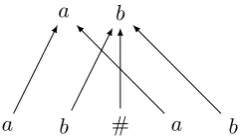
Example 3.1. LetΣ ={a, b,#}. We consider the transformation
τ ={(w, w#w)|w∈ {a, b}∗,
a b
[image:3.595.121.242.64.134.2]a b # a b
Figure 1: Origin graph of (ab, ab#ab) in Exam-ple3.1.
For instance (ab, ab#ab) ∈ τ. The transfor-mation τ can be computed by the NSST A = (Q,Σ,Σ,R, r1, T, q0, F)whereQ={q0, q1, qf},
F = {qf}, R = {r1, r2}, T contains, for every
i∈ {0,1}andγ ∈ {a, b}, the transitions
qi, γ,(r1, r2) := (r1γ, r2γ), q1−i
and
q1, γ,(r1, r2) := (r1γ#r2γ, ε), qf
.
For instance,
∆(q0, ε) ={(id, q0)}
∆(q0, a) ={((r1, r2) := (r1a, r2a), q1)}
∆(q0, ab) ={((r1, r2) := (r1ab, r2ab), q0),
((r1, r2) := (r1ab#r2ab, ε), qf)} .
Letαdenote(r1, r2) := (r1ab#r2ab, ε). Then
(α◦αε)(r1) =αε(α(r1)) =αε(r1ab#r2ab)
=ab#ab .
Sinceq0is the initial state andqf is the final state,
we obtain(ab, ab#ab)∈[[A]]. The corresponding origin graph is shown in Figure1.
We call a NSST nondeleting if for each as-signment α occurring in a transition, each reg-ister r occurs exactly once in {α(r0) | r0 ∈ R}. For each NSST A, there is a nondeleting NSST A0 such that [[A]] = [[A0]]. The proof is very similar to the proof of a similar result for MCFG bySeki et al.(1991), which we will men-tion again in Secmen-tion 4. We outline how A0 = (Q0,Σ1,Σ2,R0, ro, T0, q00, F0)is constructed from
A= (Q,Σ1,Σ2,R, ro, T, q0, F).
First,Q0contains a new stateq00 plus states of the formqD whereq ∈QandD⊆ R. The intuition
is that the registers inDare those that must remain empty inA0, as in a corresponding computation inAtheir contents would later appear as part of a register that is deleted (or that is not the output register when the end of the input is reached). By keeping those registers empty, they no longer need
to be deleted, and instead can be added in an ar-bitrary way to assignments without changing the semantics. We letqD ∈ F0 if and only ifq ∈ F
andro ∈/ D, andq00 ∈F0 if and only ifq0 ∈F.
For eachD⊆ Rand(q, a, α, q0)∈T, we have
(qD0, a, α0, q0
D)∈T
0, whereD0andα0are defined
as follows. The registers inD0are obtained in one of two ways. First, ifr ∈ D, then every register inα(r)is inD0, and secondly, if a registerr0does not occur inα(r)for anyr, then it is inD0.
In the first instance,α0(r)is a copy ofα(r)for eachr /∈ D, andα0(r)is obtained fromα(r)by omitting all output symbols for eachr∈D. How-ever, each registerr0 that does not occur inα(r), for anyr, is added toα0(r00) in an arbitary place for an arbitraryr00. Moreover, ifq =q0, thenT0
also contains(q00, a, α0, qD0 ).
For example, if
(q, a,(r1, r2, r3, r4) := (r2br3, c, d, er1), q0)
is in T, then for D = {r1, r3}, we have D0 = {r2, r3, r4}, whereD0 containsr2andr3 because
r2br3 is assumed to be deleted later, andD0 con-tains r4 because it is deleted here. Further, T0 would include
(qD0, a,(r1, r2, r3, r4) := (r2r3, cr4, ε, er1), qD0 )
where we have addedr4to the right-hand side of the assignment in an arbitrary place.
4 Synchronous Multiple Context-Free
Grammars
A multiple context-free grammar (over Σ) (for short: MCFG) is a tupleG= (N, S,Σ, P)where
N is an alphabet ofnonterminals, each nontermi-nalAhas afanoutinN(denoted byfo(A)),S ∈N
is aninitial nonterminalwithfo(S) = 1,Σis an alphabet ofterminals, andP is a finite set ofrules, where each rule has the form
A0(w1,`0)→A1(x (1)
1,`1)· · ·An(x (n) 1,`n)
where n ∈ N, A0, A1, . . . , An are nonterminals
withfo(Ai) = `ifor eachi∈ [0, n]; for eachi∈
[n],x(1i,`i) is a sequence of`ivariables inXsuch that
the set of all variables occurring inx(1)1,`
1, . . . , x (n) 1,`n
isXmwherem=Pni=1`i; for eachj ∈[`0], each
wj is in (Σ∪Xm)∗; finally, the rule islinear in
w1· · ·w`0. Therankof this rule isn. The rank of
Gis the maximal rank of its rules.
Rules can be instantiated by consistent substi-tution of variables. The derivation relation⇒of Gis defined in the usual way, by applying instan-tiated rules. The language over Σ generated by G is defined to be the set of strings w such that
S(w)⇒∗ε, and is denoted byL(G). Two MCFGs areequivalentif they generate the same language.
A MCFG is calleduni-lexicalizedif there is ex-actly one terminal in each rule. For each MCFG there is an equivalent uni-lexicalized MCFG. A MCFG is callednondeletingif each variable that occurs in the right-hand side occurs exactly once in the left-hand side. For each MCFG there is an equivalent nondeleting MCFG (Seki et al.,1991).
Asynchronous multiple context-free grammar
(for short: synchronous MCFG) is a tuple G =
(N, S,Σ1,Σ2, P) such that G0 = (N, S,Σ1 ∪
Σ2, P) is an MCFG (called underlying MCFG) except thatShas fanout 2. Moreover, for each non-terminalAwe split its fanout`into aninput fanout `1 and anoutput fanout`2 such that`= `1 +`2, and denote this byfo(A) = (`1, `2). In particular, we let fo(S) = (1,1). We call the first `1 argu-ments ofAitsinput argumentsand the remaining
`2 arguments itsoutput arguments, and we sepa-rate these two blocks by a semicolon. We require that elements ofΣ1andΣ2may only occur in in-put arguments and outin-put arguments, respectively. Finally, we require that no variable may simultane-ously occur in an input and in an output argument. We implement this requirement by choosingXas set of input variables andY ={y1, y2, . . .}as set of output variables. Hence, a rule of a synchronous MCFG has the form
A0(w1,`0;v1,m0)→
A1(x(1)1,`1;y(1)1,m1)· · ·An(x(1n,`n) ;y1(n,mn) )
where n ∈ N, A0, A1, . . . , An are nonterminals
and eachAi has fanout(`i, mi); for eachi∈[n],
x(1i,`i) andy(1i,mi) are sequences of variables inXand
Y, respectively; for eachj ∈ [`0], stringwj is in
(Σ1∪ {x(1)1,`1, . . . , x1(n,`n)})∗, and for eachj∈[m0],
stringvjis in(Σ2∪ {y1(1),m1, . . . , y1(n,mn) })∗; finally, the rule is linear inXandY.
The MCFG G1 = (N, S,Σ1, P1) is the input
component ofG, where the fanout of each nonter-minal ofN is its input fanout inG, andP1is the set
of all rules ofPin which the output arguments are dropped. Similary, we define theoutput component ofG.
LetGbe a synchronous MCFG. We define the derivation relation ⇒G of G to be the derivation relation of its underlying MCFG. The string-to-string transduction computed byGis the set
[[G]] ={(w, v)∈Σ∗1×Σ∗2 |S(w;v)⇒∗ε} .
Auni-lexicalizedsynchronous MCFG is a syn-chronous MCFG in which each rule either contains exactly one input symbol or contains neither input symbols nor output symbols. In a straightforward way, we can associate with each uni-lexicalized synchronous MCFGGa set[[G]]oof origin graphs by linking each occurrence of an output terminal of a rule to the unique input terminal of that rule.
5 Intersecting the Input of NSST with MCFG
Lemma 5.1. For every NSST A over Σ1 and
Σ2 and every MCFG G over Σ1, there is a uni-lexicalized synchronous MCFGG0 overΣ
1 andΣ2 such that[[A]]oe([[G]]×Σ∗
2) = [[G0]]o.
Proof. Let A = (Q,Σ1,Σ2,R, ro, T, q0, F), whereRconsists of the registersr1, . . . , rρ, and
letG= (N, S,Σ1, P)be an MCFG. Without loss
of generality we may assume thatAis nondeleting and thatGis uni-lexicalized.
The intuition behind the construction ofG0 cov-ers two aspects. Starting from the MCFGG, we impose the state behaviour of A onto the non-terminal behaviour of G by a type of construc-tion that can be traced back to Bar-Hillel et al. (1964). This aspect of the construction achieves
proj1([[G0]]) = proj
1([[A]])∩[[G]]. The second as-pect concerns the manipulation of the registers of A. We letG0simulate the assignments in its output component, while its input component processes the input string.
occurrences. The patterns are maintained as anno-tations of the nonterminals ofG0 and the residues appear in the output arguments ofG0. The residues of the left-hand side of a rule will be expressed in terms of residues that appear as output variables in the right-hand side. For this purpose, we intro-duce assignments that have output variables in their image.
For instance, let G contain the rule
A(ax(2)1 x(1)1 ) → B(x(1)1 ) C(x(2)1 ) and A have states q1, . . . , q5. Assume that there is a transition(q5, a, α, q3), and that there are strings
w(2)1 , w1(1) ∈ Σ∗1 such that(α2, q1) ∈ ∆(q3, w(2)1 ) and(α1, q2) ∈ ∆(q1, w(1)1 ). ThenG0 will have a rule of the form
A
(q5,p(0)1 ,q2)(ax (2) 1 x
(1) 1 ;...)→
B(q
1,p(1)1 ,q2) x (1) 1 ;...
C(q
3,p(2)1 ,q1) x (2) 1 ;...
wherep(1)1 andp(2)1 are patterns corresponding to
α1 andα2, respectively, andp(0)1 corresponds to
α1◦α2◦α. Hence there is a corresponding pattern for each argument in the right-hand sided and in the left-hand side.
Formally, apattern overRis an assignmentp∈
Ass(R,∅). Obviously,Ass(R,∅)is finite. Now as-sume a ruleA0(w1,`0)→A1(x
(1)
1,`1)· · ·An(x (n) 1,`n).
Let~` = (`1, . . . , `n), X~` = {x
(k)
i | k ∈ [n], i ∈
[`k]}, andY~` ={yi(k) | k∈ [n], i ∈[2ρ`k]}. For
eachα ∈ Ass(R,Σ2∪Y~`)we define thepattern
p(α)and theresiduer(α)∈((Σ2∪Y~`)∗)∗as
fol-lows. Assume that for each j ∈ [ρ] the string
α(rj) has the form vj,0rj,1vj,1· · ·rj,µjvj,µj for
someµj ∈ [0, ρ],vj,k ∈(Σ2∪Y~`)∗ (k ∈[0, µj]),
and{rj,1, . . . , rj,µj} ⊆ R. Then
p(α) = ((r1, . . . , rρ) :=
(r1,1· · ·r1,µ1, . . . , rρ,1· · ·rρ,µρ))
r(α) = (v1,0, v1,1, . . . , v1,µ1, . . . ,
vρ,0, vρ,1, . . . , vρ,µρ) .
For example, letαbe the assignment
(r1, r2, r3, r4) :=
(ay3br4, r2y2cr3, dey4, fy1r1) .
Then
p(α) = ((r1, r2, r3, r4) := (r4, r2r3, ε, r1))
r(α) = (ay3b, ε, ε, y2c, ε, dey4, fy1, ε) .
For a patternp(ik)corresponding tox(ik), we de-fine an assignment[p(ik)]∈Ass(R, Y~`), which
in-troduces output variables next to register occur-rences. Assume that
p(ik)= ((r1, . . . , rρ) := (s1· · ·sµ1,
sµ1+1· · ·sµ2, . . . ,
sµρ−1+1· · ·sµρ))
for someµ1, . . . , µρ∈[0, ρ],µi ≤µi+1(i∈[ρ−
1]), and sj ∈ R (j ∈ [µρ]). Let µ0 = 0 and
κj = 2ρ(i−1) +µj+j(j∈[0, µρ]). Then
[p(ik)](rj) =
yκj(k)−
1+1 sµj−1+1y (k)
κj−1+2 · · · sµj y (k)
κj .
For instance, ifρ= 4andp(2)3 is the pattern
(r1, r2, r3, r4) := (r4, r2r3, ε, r1)
then µ1 = 1, µ2 = 3, µ3 = 3, µ4 = 4, κ0 =
2ρ(i−1) = 16,κ1 = κ0+µ1 + 1 = 18, κ2 =
κ0 +µ2 + 2 = 21, κ3 = κ0 +µ3 + 3 = 22,
κ4 =κ0+µ4+ 4 = 24, and
[p(2)3 ] = ((r1, r2, r3, r4) :=
(y(2)17r4y18(2), y(2)19r2y(2)20r3y21(2), y(2)22, y(2)23r1y(2)24)) .
We construct the synchronous MCFG G0 =
(N0, S0,Σ1,Σ2, P0)as follows. We let
N0 ={S0} ∪ {Ac|A∈N,foG(A) =`,
c∈(Q×Ass(R,∅)×Q)`}
where foG0(S0) = (1,1) and foG0(Ac) =
(foG(A),2ρ·foG(A)).
Let A0(w1,`0) → A1(x (1)
1,`1)· · ·An(x (n) 1,`n) be a
rule in P. For every k ∈ [0, n]and i ∈ [`k]let
qi,(k1), qi,(k2) ∈Qandp(ik) ∈Ass(R,∅). We
abbrevi-ate(q(i,k1), p(ik), q(i,k2))byc(ik).
We extend∆to a function
∆0:Q×(Σ1∪X~`)∗ → P(Ass(R,Σ2∪Y~`)×Q)
by defining
∆0(q, ε) ={(id, q)}
∆0(q, wa) ={(α◦αw, q00)|
(∃q0 ∈Q) : (αw, q0)∈∆0(q, w),
(q0, a, α, q00)∈T}
∆0(q, wx(ik)) ={([pi(k)]◦αw, qi,(k2))|
Then the setP0 contains the rule
(A0)c(0) 1,`0
(w1,`0;v1,2ρ`0)→
(A1)c(1) 1,`1
(x(1)1,`
1;y (1)
1,2ρ`1) · · ·
(An)c(n) 1,`n
(x(1n,`n) ;y(1n,2)ρ`n)
for each choice of α1,`0 such that (αi, q (0)
i,2) ∈
∆0(qi,(0)1, wi)and p(αi) = p(0)i , for eachi ∈ [`0], wherer(αi) = (v2ρ(i−1)+1,2ρi). This is illustrated
in Figure2.
In addition, for each c ∈ {(q0, p(1)1 , q) | p ∈
Ass(R,∅), q∈F}the rule
S0(x1;αε([p(1)1 ](ro)))→Sc(x1;y1(1),2ρ)
is inP0. Note that ifGis uni-lexicalized, then so is G0.
We can prove the following invariant. For ev-ery A ∈ N, ` = fo(A), w1, . . . , w` ∈ Σ∗1,
v1, . . . , v2ρ` ∈ Σ∗2, c = (c1, . . . , c`) with ci =
(qi1, pi, qi2)∈Q×Ass(R,∅)×Qfor eachi∈[`], we have
Ac(w1,`;v1,2ρ`)⇒∗G0 ε if and only if
A(w1,`)⇒∗G ε∧
(∀i∈[`]) : (∃α) : (α, qi2)∈∆(qi1, wi)∧
r(α) =v2ρ(i−1)+1,2ρi .
This invariant implies that for everyw∈Σ∗1and
v ∈Σ∗2: S0(w;v) ⇒∗G0 εif and only ifS(w) ⇒∗G ε∧(w, v) ∈ [[A]]. Thus [[G0]] = [[A]] ∩([[G]] ×
Σ∗2). By the assumption thatG is uni-lexicalized, furthermore[[G0]]o= [[A]]oe([[G]]×Σ∗2).
Example 5.2. We consider the NSSTA of Ex-ample3.1and the MCFGG= (N, A,Σ, P)with
N = {A}, fo(A) = 1, and for eachγ ∈ Σ, P
contains the rules
A(γx1)→A(x1) and A(γ)→ε .
Obviously,[[G]] = Σ∗. We apply the construction of Lemma5.1toAandGand we obtain the uni-lexicalized synchronous MCFGG0 which contains for eachγ ∈Σandi∈ {0,1}at least the following rules.
S0(x1; y1y2y3)→A(q0,p,qf)(x1; y1,4)
A(qi,p,qf)(γx1; y1, γy2, γy3, y4)→
A(q1−i,p,qf)(x1; y1,4)
A(q1,p,qf)(γ; ε, γ#, γ, ε)→ε
wherep = ((r1, r2) := (r1r2, ε)). For instance,
∆0(q0, γx1) contains([p(1)1 ]◦α, qf) where α =
((r1, r2) := (r1γ, r2γ))is the assignment in the transition(q0, γ, α, q1) of A. The calculation of
[p(1)1 ]◦αis
r1
r2
[p(1)1 ] −→
y1r1y2r2y3
y4
α
−→
y1r1γy2r2γy3
y4
hencep([p(1)1 ]◦α) = ((r1, r2) := (r1r2, ε))and
r([p(1)1 ]◦α) = (y1, γy2, γy3, y4).
An example of a derivation is
S0(ab;ab#ab) ⇒G0 A(q
0,p,qf)(ab;ε, ab#, ab, ε)
⇒G0 A(q
1,p,qf)(b;ε, b#, b, ε)
⇒G0 ε .
This example can be easily generalized:
Lemma 5.3. For every NSST A there is a uni-lexicalized synchronous MCFGG0 such that
[[A]]o= [[G0]]o.
Proof. LetAbe a NSST overΣ1andΣ2. As illus-trated by Example5.2, we can construct a MCFG G such that [[G]] = Σ∗1. The result then follows from Lemma5.1.
On the basis of Lemma5.3, one can obtain com-plexity bounds on typical tasks involving NSST, such as deciding whether(w, v) ∈[[A]]for given stringswandv and NSSTA, relying on known complexity results for synchronous MCFG, and related formalisms such as synchronous LCFRS (Kaeshammer,2013).
However, the relation between NSST and syn-chronous MCFG does not in any obvious way sug-gest a practical algorithm to do inference of NSST on the basis of sets of origin graphs, and this prob-lem must remain outside the scope of the present paper.1
6 A Proper Subclass of Synchronous
MCFG
In the light of Lemma5.1one may ask whether for
everysynchronous MCFGGone may find NSSTA
1We thank an anonymous reviewer for the suggestion to
A
(q5,p(0)1 ,q2)
ax(2)1 x(1)1 ; y(1)1 y3(2)b, cy4(2)y2(1)y(2)1 de, y(2)2 y3(1), y4(1)
B
(q1,p(1)1 ,q2)
x(1)1 ;y1(1), y2(1), y3(1), y(1)4 C
(q3,p(2)1 ,q1)
x1(2);y1(2), y2(2), y(2)3 , y(2)4
(α1, q2)∈∆0(q5, ax(2)1 x (1) 1 )
α1= [p(1)1 ]◦[p (2)
1 ]◦α= ((r1, r2) := (y1(1)y (2)
3 b r1cy4(2)y (1) 2 y
(2)
1 de r2y(2)2 y (1) 3 , y
(1) 4 ))
p(α1) = ((r1, r2) := (r1r2, ε)) =p(0)1
r(α1) = (y1(1)y (2)
3 b, cy
(2) 4 y
(1) 2 y
(2)
1 de, y
(2) 2 y
(1) 3 , y
(1) 4 )
p(1)1 = ((r1, r2) := (r2r1, ε))
[p(1)1 ] = ((r1, r2) := (y1(1)r2y(1)2 r1y3(1), y (1) 4 ))
p(2)1 = ((r1, r2) := (r2, r1))
[p(2)1 ] = ((r1, r2) := (y1(2)r2y2(2), y (2)
[image:7.595.73.523.63.254.2]3 r1y4(2)))
Figure 2: The construction in the proof of Lemma 5.3, for an NSST with two registers, A(ax(2)1 x(1)1 ) → B(x(1)1 )C(x(2)1 ), and transition(q5, a, α, q3)withα= ((r1, r2) := (br1c, der2)).
and MCFGG0such that[[G]] = [[A]]∩([[G0]]×Σ∗2), for the shared output alphabetΣ2, and perhaps even that[[G]]o= [[A]]oe([[G0]]×Σ∗2). In this section we show the answer to the former question is negative, whereby it is negative for the latter question as well. This holds even if the rank ofGis restricted to 1 and
[[G]]is a function, that is, if(w, v1),(w, v2)∈[[G]] impliesv1 =v2.
To see this, consider the synchronous MCFG G of rank 1 with N = {S, A}, Σ1 = Σ2 = {a, b, a0, b0}, and the following rules.
S(x1x2; y)→A(x1, x2; y)
A(x1a, x2a0; yaa0)→A(x1, x2; y)
A(x1a, x2b0; yab0)→A(x1, x2; y)
A(x1b, x2a0; yba0)→A(x1, x2; y)
A(x1b, x2b0; ybb0)→A(x1, x2; y)
A(ε, ε; ε)→ε
For two stringsw =a1· · ·anandw0 =a01· · ·a0n
of identical lengthn, we defineshuffle(w, w0)to be the stringa1a01· · ·ana0n. The string-to-string
transduction computed byGcan now be written as
[[G]] ={(ww0,shuffle(w, w0))|(∃n∈N) :
w∈ {a, b}n∧w0 ∈ {a0, b0}n}
which is clearly a function. Suppose [[G]] were
[[A]] ∩ ([[G0]] × Σ∗2) for some NSST A = (Q,Σ1,Σ2,R, co, T, q0, F)and MCFGG0. Then
[[G]] = [[A]]∩({ww0|(∃n∈N) :
w∈ {a, b}n∧w0 ∈ {a0, b0}n} ×Σ∗ 2) .
For each(w, w0)∈ {a, b}n× {a0, b0}n, there are
q ∈ Q,q0 ∈F, and assignmentsα1 andα2 such that(α1, q) ∈ ∆(q0, w)and(α2, q0) ∈ ∆(q, w0). We then have(α2◦α1◦αε)(ro) = shuffle(w, w0).
As illustrated in Figure3, we want to capture how the contents that the registers have just after readingweventually become substrings of register
ro, after alsow0 has been read. To formalize this, we first defineΦα1(r) =r
|(α1◦αε)(r)|forr ∈ R. In
words, each registerris mapped to|(α1◦αε)(r)|
copies of its own name, to encode the size of its contents after readingw. Secondly, we introduce a new symbol†, and defineΨto be the assignment such thatΨ(r) = r forr ∈ RandΨ(c) = †for
c ∈ Σ2. We now define σ(α1, α2) = (α2 ◦Ψ◦
Φα1)(ro) ∈ ({†} ∪ R)
2n. We call σ(α
1, α2) the
schemaofα1andα2.
If we fixn >0, to be determined later, then the number of possible schemasσ(α1, α2)is bounded by(2n)2ρ, whereρ=|R|as before. This follows from the fact that each schema is determined by a set of pairs of indices. There is one such pair for each registerr, consisting of the index in the schema where the substringr|(α1◦αε)(r)|starts, and another index where it ends. If this substring is empty, this can be encoded by a starting index that is greater than the ending index.
We define the predicateGas
G(w, w0, q, s)≡
(∃α1, α2, q0 ∈F) : (α1, q)∈∆(q0, w)∧
(α2, q0)∈∆(q, w0)∧
α1◦αε
a b0 b r1
.. .
b0 b a0 ri
.. .
a a0 b a0 rj
.. .
α2◦α1◦αε
a
.. .
ro
a a0 b a0 b b0 b a0 b
.. .
σ(α1, α2) †
.. .
rj
rj
rj
rj
† ri
ri
ri
† .. .
indices
q0 w q w q0
[image:8.595.156.449.65.275.2]0
Figure 3: The processing ofww0 and corresponding schemaσ(α1, α2). A set of indices, one pair per register, determines a schema.
for (w, w0) ∈ {a, b}n × {a0, b0}n, q ∈ Q and
schemas. For each(w, w0)∈ {a, b}n× {a0, b0}n,
there is at least one combination ofqandssuch thatG(w, w0, q, s).
For each q ∈ Q, let C(q) be the number of pairs (w, w0) ∈ {a, b}n × {a0, b0}n such that
G(w, w0, q, s) for somes. Now fix q to be such
thatC(q)is maximal among theκstates ofA. This means that there are at least22n/κpairs(w, w0)∈ {a, b}n × {a0, b0}n such that G(w, w0, q, s) for somes.
For each schema s, let C(q, s) be the num-ber of pairs (w, w0) ∈ {a, b}n× {a0, b0}n such
that G(w, w0, q, s). Now fix s to be such that
C(q, s) is maximal among the at most (2n)2ρ
schemas. This means that there are at least κ·(222nn)2ρ
pairs (w, w0) ∈ {a, b}n × {a0, b0}n such that
G(w, w0, q, s).
There is a string w0 ∈ {a0, b0}n such that
there are at least κ·(222nn)2ρ/2n =
2n
κ·(2n)2ρ strings
w ∈ {a, b}nsuch thatG(w, w0, q, s). For thisw0 and α2 fixed, there are at leastlog2( 2
n
κ·(2n)2ρ) =
n−log2κ−2ρ(1 + log2n)≥n−log2κ−2ρn
positions in shuffle(w, w0) where we may find both a and b, depending on the choice of w ∈ {a, b}n. This means the schemascontains at least
2n−2 log2κ−4ρn−ρoccurrences of symbols from R; note that in the output string, symbols from {a0, b0} are interlaced with symbols from {a, b}.
Similarly, there is a stringw∈ {a, b}nsuch that
there are at least κ·(22nn)2ρ strings w0 ∈ {a0, b0}n
such thatG(w, w0, q, s). For thiswandα1 fixed, there are at least n−log2κ−2ρn positions in
shuffle(w, w0)where we may find botha0 andb0, depending on the choice of w0 ∈ {a, b}n. This
means the schemascontains at least2n−2 log2κ−
4ρn−ρoccurrences of†.
Altogether, this requires the length of the schema, and thereby of the output string, to be at least4n−4 log2κ−8ρn−2ρ. We now obtain the contradiction4n−4 log2κ−8ρn−2ρ >2n
by choosingn > ρ+2 log2κ 1−4ρ .
The transduction[[G]]above is almost the same as the transduction calledmergebyAlur and ˇCern´y (2010), who also present a proof that this is beyond the power of deterministic SST (DSST). Because this transduction is a function, and because func-tional NSSTs are equivalent to DSSTs (Alur and Deshmukh,2011), this could be used to produce an alternative to our proof above. However, the proof byAlur and ˇCern´y(2010) appears to contain at least one mistake, which is why we chose to present our own.2
2
The proof byAlur and ˇCern´y(2010) considers “short configurations”. These represent the contents of the registers after reading the first half of an input string, but replacing the contents of a register by a special symbol∗if its length is greater than some numbertsuch that2t > ρ. (Here we
7 Conclusions
Motivated by potential applications of origin graphs for machine translation, we have consid-ered NSSTs. We have shown that when their input languages are restricted by MCFGs, then transduc-ers with origin semantics are obtained that can also be generated by synchronous MCFGs. We have further shown that not every synchronous MCFG can be obtained by such a combination of a NSST and a MCFG.
Acknowledgments
Anonymous reviewers provided valuable com-ments.
References
A.V. Aho and J.D. Ullman. 1970. A characterization of two-way deterministic classes of languages. J. Com-put. Syst. Sci., 4(6):523––538.
R. Alur and P. ˇCern´y. 2010. Expressiveness of stream-ing strstream-ing transducers. In FSTTCS, volume 8 of LIPIcs, pages 1––12. Schloss Dagstuhl - Leibniz-Zentrum f¨ur Informatik.
R. Alur and J.V. Deshmukh. 2011. Nondeterminis-tic streaming transducers. In International Collo-quium on Automata, Languages, and Programming (ICALP 2011), volume 6756 ofLNCS, pages 1–20. Springer-Verlag.
Y. Bar-Hillel, M. Perles, and E. Shamir. 1964. On formal properties of simple phrase structure gram-mars. In Y. Bar-Hillel, editor,Language and Infor-mation: Selected Essays on their Theory and Appli-cation, chapter 9, pages 116–150. Addison-Wesley, Reading, Massachusetts.
M. Boja´nczyk. 2013. Transducers with origin seman-tics. Technical report, arXiv:1309.6124, 24. Sep 2013.
M. Boja´nczyk, L. Daviaud, B. Guillon, and V. Penelle. 2017a. Which classes of origin graphs are gener-ated by transducers? In 44th Int. Colloquium on Automata, Languages, and Programming (ICALP 2017), pages 114:1–114:13.
κ(1+P t0≤t4t
0
)ρ, as for each register, the short configuration contains either∗or a string of length up totover an alphabet of 4 symbols; their assumption that registers at that point cannot contain symbolsa0orb0is insufficiently motivated, and even if it were, there is a discrepancy betweenκ(1 +P
t0≤t2 t0
)ρ
andκρ2t, which places the correctness of the proof as a whole
in doubt.
M. Boja´nczyk, L. Daviaud, B. Guillon, and V. Penelle. 2017b. Which classes of ori-gin graphs are generated by transducers?
http://guillon.di.unimi.it/files/
automatic/pdf/gb_2017_oxford.pdf.
P.F. Brown, V.J. della Pietra, S.A. della Pietra, and R.L. Mercer. 1993. The mathematics of statistical ma-chine translation: parameter estimation. Computa-tional Linguistics, 19(3)(2):263–311.
D. Chiang. 2007. Hierarchical phrase-based transla-tion. Computational Linguistics, 33(2):201–228.
B. Courcelle and J. Engelfriet. 2012. Graph structure and monadic second-order logic. Cambridge Uni-versity Press.
A.P. Dempster, N.M. Laird, and D. Rubin. 1977. Max-imum likelihood from incomplete data via the EM algorithm. Journal of the Royal Statistical Society. Series B (Methodological), 39(1):1–38.
J. Engelfriet and H.-J. Hoogeboom. 2001. MSO de-finable string transductions and two-way finite state transducers. ACM Transactions on Computational Logic (TOCL), 2(2):216–254.
M. Kaeshammer. 2013. Synchronous linear context-free rewriting systems for machine translation. In Proceedings of the Seventh Workshop on Syntax, Semantics and Structure in Statistical Translation, pages 68–77, Atlanta, Georgia. Association for Computational Linguistics.
P. Lewis and R. Stearns. 1968. Syntax-directed trans-duction.Journal of the ACM, 15(3):465–488.
A. Lopez. 2008. Statistical machine translation. ACM Computing Surveys, 40(3):8:1–8:9.
H. Seki, T. Matsumura, M. Fujii, and T. Kasami. 1991. On multiple context-free grammars. Theoretical Computer Science, 88:191–229.