J. Electromagnetic Analysis & Applications, 2010, 2, 664-671
doi:10.4236/jemaa.2010.212087 Published Online December 2010 (http://www.SciRP.org/journal/jemaa)
Study of Dielectric Constant of (1-x) Zn.xMg.TiO
3
(ZMT) Ceramic Material at Microwave
Frequencies as a Function of Composition x and
Processing Temperature
Ravi Kumar Gangwar1, Surya Pal Singh1, Meenakshi Choudhary2, Nitish Kumar Singh2*, Devendra
Kumar2, Om Parkash2
1Department of Electronics Engineering Institute of Technology, Banaras Hindu University, Varanasi, India; 2Department of Ceramic
Engineering, Institute of Technology, Banaras Hindu University, Varanasi, India; *Affiliated address: Department of Physics, Udai Pratap Autonomous College,Varanasi, India.
Email:[email protected]
Received October 9th, 2010; revised November 22nd, 2010; accepted November 29th, 2010.
ABSTRACT
In this paper measurement of real part of permittivity and loss tangent of (1-x) Zn.xMg.TiO3(ZMT) material in powder
form in S-band of microwave frequencies is presented and the associated accuracy estimated. This approach is based on the measurement of transmitted power from the cavity at and off resonance. Details of the design and fabrication of the rectangular cavity and the input and output coupling are given. The variation of dielectric properties of (1-x) Zn.xMg.TiO3(ZMT) with x-value and calcination temperature (for x = 0.1) is presented. The effect of doping of V2O5 is
alsostudied.The results of present work may provide useful design guidelines for development of microwave compo-nents including dielectric resonator antennas.
Keywords: Cavity Perturbation Method, Permittivity, Loss Tangent And Ceramic Material
1. Introduction
The measurement of electromagnetic properties of mate-rials at microwave frequencies is considered important since it provides the relaxation time, dipole moment in liquids, characteristics of materials for device applica-tions, microwave conductivity, effective mass in semi-conductors etc. [1].
The microwave measurement techniques for electro-magnetic characterization of materials generally are di-vided into two groups: Non-resonant methods and reso-nant methods. Non-resoreso-nant methods mainly involve reflection or transmission methods. The reflection meth-ods include open-circuit and short-circuit line methmeth-ods. The transmission/reflection methods have many varieties, including free-space, coaxial line, waveguide, and planar structures such as microstrip and stripline. These meth-ods have achieved success in permittivity and permeabil-ity measurements of high- and medium-loss materials. However, non-resonant methods usually require large size samples and have strict requirements on sample
(meas-urement fixture) thus altering the electromagnetic bounda-ries of the resonator and the electromagnetic properties of the sample are deduced from the change in the reso-nant properties of the resonator. Due to its high accuracy and flexibility in sample preparation, resonant. perturba-tion method is widely used for low-loss samples, samples in powder form, small size samples and samples of ir-regular shapes. Resonant perturbation methods mainly include wall replacement methods and cavity perturba-tion methods. In wall replacement methods, part of the resonator wall is replaced by sample surfaces. Wall-re-placement methods are often used in the study of the electro-dynamic properties of conductors after the dis-covery of high Tc superconductors. Many methods have been developed based on wall-replacement method to measure the surface resistance of superconducting thin films. The cavity perturbation method is based on the change in the resonant frequency and quality factor of the cavity due to the insertion of a sample inside the cavity at the position of maximum electric field or maximum magnetic field depending on the nature of the parameter to be studied. In this method, the sample under study is introduced into a resonant cavity, and its complex per-mittivity or complex permeability is determined from the change of resonant frequency and quality factor of the cavity due to the introduction of the sample. Cavity per-turbation methods are popular in the study of the elec-tromagnetic properties of dielectrics, semiconductors, magnetic materials and composite materials [4].
Ceramic materials are widely used in the design and development of microwave circuits. Further, low loss ceramic materials find applications in the development of stable microwave sources and dielectric resonator antennas.
In this paper cavity perturbation technique, which is highly accurate and advantageous in the determination of small loss tangents is used to measure the dielectric con-stant and the loss tangent of ZMT material in powder form in S-band of microwave frequencies.The accuracy of the present technique is determined through measure-ment on Teflon and comparison of results with that available in the literature [5]. The variations in dielectric properties of the ZMTmaterial with the x-value, the cal-cination temperature and the V2O5 doping for x = 0.1 are
also studied experimentally.
2. Theory
The cavity perturbation technique for measurements of dielectric constant of material has been analyzed in the literature [4,6-10]. A brief description of the analysis is given in the following:
Consider two almost identical cavities which are
dis-tinguished by subscripts 1 and 2. Cavity 1 is empty and cavity 2 contains very small size dielectric material. Both cavity walls are assumed to be lossless. Maxwell’s equa-tions for these cavities can be written as
j j j j
E j H
(1)
j j j j
H j E
j1, 2
By taking suitable dot products with the four equations given in Equation (1), subtracting and integrating over the cavity volume (remembering that cavity walls are perfectly conducting), one obtains
2 0
1 2
2 0
1 22 1 2 2 0 1 . 2 S C V V V s
H H dV E E dV
dV
E
(2) where 1 and 2 are respectively the complexreso-nant angular frequencies before and after the introduction of the sample; 0 and 2are respectively the
permit-tivities of free-space and the sample; 0 and 2 are
respectively the magnetic permeabilities of free-space and the sample; C is the region enclosed by the cavity,
and is the volume of the sample. V
S
Equation (2) is the basic cavity perturbation formula. Derivation of the formula has been done under the as-sumptions that the cavity walls are perfectly conducting and the perturbation is small [4,10].
V
In the present work, non-magnetic ceramic material is considered and therefore Equation (2) reduces to
1 22 2 1 2 2 1 1 2 s C V r V
E E dV
E dV
(3)
The relationship of complex angular frequency to real frequency and Q factor is given by
2 1 2 1
2 2 2
1 1
2
r r
r L
f f j
f Q Q
L1
(4)
where r1 and r2 are respectively the resonant
fre-quencies of the cavity before and after the introduction of sample; and 1
f f
L
Q and QL2 are the corresponding loaded quality factors.
From Equations (3) and (4), we get
1 2 1 2
2 2
2 2 1
1
.
1 1
2 1 S
C
V
r r
r
r L L
V
E E dV f f
j
f Q Q
Study of Dielectric Constant of (1-x) Zn.xMg.TiO (ZMT) Ceramic Material at Microwave
666 3
Frequencies as a Function of Composition x and Processing Temperature
3. Dielectric Constant and Loss Factor
The length of very small diameter (as compared to cavity size and the wavelength) cylindrical plastic tube which can hold the sample is slightly greater than the narrow dimension ‘b’ of the cavity so that it can occupy the en-tire narrow dimension of the cavity and can be taken out from or inserted into the TE101 mode cavity through a
small hole cut in the broad wall centre where electric field is maximum.
From Equation (5) the expressions for real and imagi-nary parts of the dielectric constant can be written as
1 2
2 2 1
c r r
r r
c s
V f f
V V
(6)
2
2 1
1 1
4
c
r r
s L L
V
V Q Q
(7)
The Loss factor
tan can be written astan r
r
(8)
4. Design and Fabrication
4.1. Preparation of Sample
In the present study the sample is prepared by the con-ventional solid state ceramic route. Stoichiometric amount of MgCO3 [99.5%, Thomas Baker, India], ZnO
[99.5%, S. D. Fine. Chem. India] and TiO2 [98%, S. D.
Fine. Chem. India] are weighed accurately to make the total amount equal to 15 grams. Weighed powders are mixed thoroughly using acetone in a mortar with pestle for about 2 hour. After that powders were ball milled for 4 hours using acetone as mixing medium. The mixture is then dried and placed for calcination in platinum cruci-bles at 1200˚C for 12 hours. The calcined powders were ground and mixed with 2% polyvinyl alcohol as binder. It was then pressed using a hydraulic press at optimized load (= 60 kN) to get the pellets. The pellets of all the compositions (x = 0.1, 0.2, 0.3, 0.4 and 0.5) were sin-tered at 1300˚C for 24 hours at a heating and cooling rate of 4˚C /min. on a platinum foil. The pellets of all the compositions were crushed in a mortar with the help of pestle to obtain powdered sample for measurement pur-pose.
Other samples of composition (x = 0.1) were also pre-pared but the calcination temperatures are different for different samples. The calcination temperatures used are 900, 950 and 1000˚C, and total heating time for each sample was chosen to be 9 hours. The doping of V2O5
was done in one of the samples for which calcination temperature is 1000˚C.
4.2. Design and Fabrication of Cavity
Rectangular TE101 mode transmission cavity for
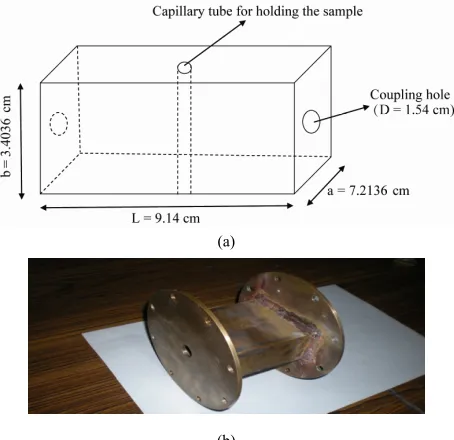
reso-nance at 2.62 GHz was designed [11] and fabricated us-ing a standard S-band waveguide (WR-284) (Figure 1).
The length of the cavity is 9.14 cm (= 2
g
at 2.62 GHz).
Two copper plates were used as shorting plates to form the cavity from the standard waveguide. For coupling power into the cavity, a hole of diameter D = b/2.2, where b is the height of waveguide [11], was made at the centre of each of the shorting plates. The diameter of each coupling hole comes out to be 1.54 cm for the designed cavity. To insert the powdered sample material into the cavity, a circular slot of diameter 2.5 mm was cut at the centre of one of the broad walls of the cavity. The inner and outer diameters of the polythene capillary tube used for filling the powdered sample are chosen to be 1.3 and 2.3 mm respectively and its length is equal to 3.6 cm.
5. Experiments, Results and Discussion
The arrangement for measuring the dielectric properties of (1-x)Zn.xMg.TiO3 ceramic material consists of
Agilent Technologies make analog microwave source (Model no. E8257D, 250 kHz-20 GHz), SICO make waveguide/coaxial transition, variable attenuator, fabri-cated cavity and HP power sensor (Model no. 436A) and meter forming a test bench as shown in Figure 2. The standard procedure given in the reference [10] was fol-lowed to measure power fed to and transmitted from the cavity with and without the sample as a function of fre-quency deviation from resonance. Resonant frefre-quency corresponds to maximum transmitted power in each case.Measurement of dielectric properties of (1-x) Zn.xMg. TiO3 ceramic material was carried out for
dif-ferent x-values and difdif-ferent calcination temperatures for x = 0.1. A number of measurements were performed to determine the resonance frequency and 3-dB frequencies ‘f1’ and ‘f2’ both for cavity with the capillary tube and
cavity with tube containing the powdered sample mate-rial. The average values of measured and computed pa-rameters of the cavity with the capillary tube but without the sample are shown in Table 1. The average values of the parameters of the cavity with the capillary tube con-taining the sample for different x-values and calcination temperatures are shown respectively in Tables 2 and 3. The loaded quality factor for the cavity with and without the sample material is computed using the formula
2 1
r L
f Q
f f
, where fr is the resonant frequency
of TE101 mode cavity .The values of r , rand tan δ
[image:3.595.53.286.241.383.2]and the results are shown in Tables 2 and 3 respectively for different x-values and calcination temperature. The variations in the values of r and
tan
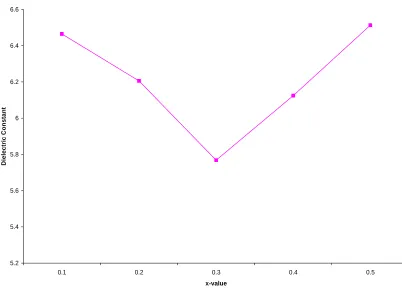
withx-value are shown in Figures 3 and 4 respectively. The variations in the values of r and
tan
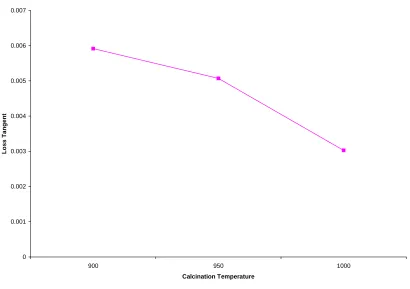
withcalcination temperature for x = 0.1 are shown in Figures 5 and 6 respectively.
From Figure 3 and Table 2 it can be seen that
r
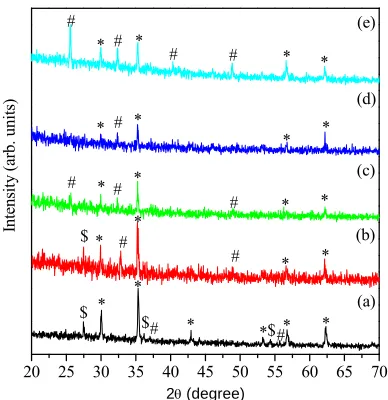
[image:4.595.310.537.252.472.2] value first decreases with increase in x-value and reaches 5.768 at x = 0.3 and then increases for x > 0.3. The loss tangent first increases and reaches 0.004 at x = 0.2, it then decreases and reaches 0.001 at x = 0.3, and again increases for values of x above 0.3, as shown in Figure 4 and Table 2. These variations in the dielectric properties may be attributed to the presence of multiple phases in the material and the variation in the amount of phases determined by the area under peaks with change in x-value as shown in Figure 7. The possible 2values (Bragg angle) where reflections occur are determined by unit cell dimensions. However, the intensities of the re-flections are determined by the distribution of the elec-trons in the unit cell. The highest electron density is found around atoms. Therefore, the intensities depend on what kind of atoms we have and where in the unit cell they are located. Planes going through areas with high electron density will reflect strongly, planes with low electron density will give weak intensities. From Figures 5 and 6 and Table 3, it is observed that the material r
value increases and tan δ decreases with increase in cal-cination temperature of the material, though the rates of increase are different. This variation in the dielectric properties with calcinations temperature may be attrib-uted to the presence of single phase in the material. The dielectric constant and loss tangent of V2O5 doped and
1000˚C calcined sample were 4.04 and 0.002698. Di-electric constant is higher and loss tangent is lower in comparison with undoped and 1000˚C calcined sample. The change inr and tan δ of ZMT with the addition of
V2O5 is due to increase in densification rate of ZMT. The
measured dielectric constant values are lower than those reported in reference [5]. This is due to lower value of percentage density of sample material. The sample mate-rial used for measurement in [5] was in highly dense pel-let form, while in the present study we measured dielec-tric constant of sample material in powder form. The
reported percentage density of solid sample material studied in reference [5] is more than 95%.
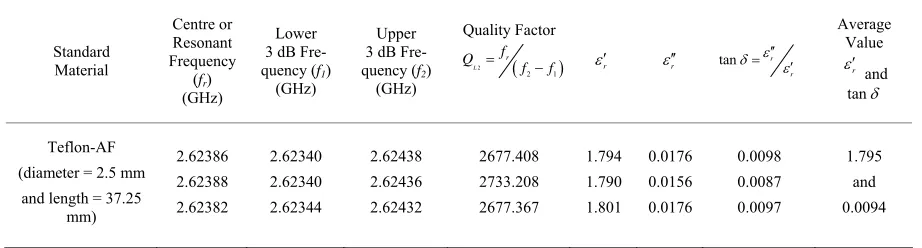
To test the accuracy of the cavity perturbation tech-nique measurement on a sample of Teflon-AF of known dielectric constant ( ) [12] was repeated three times. The measured and computed parameters are pre-sented in Tables 3 and 4. The average values of
1.93
r
r
and tan are found to be 1.795 and 0.0094.
6. Conclusions
The microwave dielectric properties of Zinc Magnesium Titanate (1-x) Zn.xMg.TiO3 (x = 0.1, 0.2, 0.3, 0.4, 0.5) in
(a)
[image:4.595.322.524.513.607.2](b)
Figure 1. Rectangular S-band cavity (a) Design layout (b) Fabricated cavity.
[image:4.595.72.526.668.724.2]Figure 2. Experimental setup for dielectric constant meas-urement.
Table 1. Resonant frequency and quality factor of cavity with only the capillary tube.
Average Centre or Resonance Fre-quency (fr)(GHz)
Average Lower 3 dB Fre-quency (f1)
(GHz)
Average Upper 3 dB Fre-quency (f2)
(GHz)
Average Band-width (f2-f1)
(GHz)
Average Quality Factor
1
2 1
r L
f Q
f f
Study of Dielectric Constant of (1-x) Zn.xMg.TiO (ZMT) Ceramic Material at Microwave
668 3
[image:5.595.71.526.111.240.2]Frequencies as a Function of Composition x and Processing Temperature
Table 2. Dielectric constant of ((1-x) Zn.xMg.TiO3) for different values of x.
X value
Average Centre or Resonant Frequency (fr)
(GHz)
Average Lower 3dB
Frequency (f1)
(GHz)
Average Upper 3 dB
Frequency (f2)
(GHz)
Average Quality Fac-tor 2 2 1 L r f Q f f
r r tan
[image:5.595.73.527.267.409.2]r r 0.1 0.2 0.3 0.4 0.5 2.61462 2.61494 2.61548 2.61504 2.61456 2.61422 2.61454 2.61546 2.61468 2.61418 2.61500 2.61534 2.61620 2.61542 2.61494 3352.07 3268.67 3534.91 3533.83 3404.21 6.4648 6.2055 5.768 6.1244 6.5134 0.0169 0.0249 0.00063 0.00072 0.0121 0.0026 0.0040 0.0001 0.00011 0.00185
Table 3. Dielectric constant of ((1-x) Zn.xMg.TiO3) where x = 0.1, for different values of calcination temperatures.
Sample Temperature Calcination ( 0C)
Centre or Resonant Frequency (fr)
(GHz)
Lower 3dB Fre-quency (f1)
(GHz)
Upper 3 dB Frequency
(f2)
(GHz) Quality Factor 2 2 1 L r f Q f f
r r tan
r r ZMT ZMT ZMT ZMT +V2O5
900 950 1000 1000 2.61728 2.61736 2.61752 2.61472 2.61688 2.61696 2.61712 2.61434 2.61770 2.61778 2.61790 2.61514 3191.80 3191.90 3355.79 3268.40 2.94 3.03 3.67 4.04 0.0174 0.0173 0.0111 0.01188 0.005914 0.00507 0.003026 0.002698
Table 4. Resonance frequency and quality factor of cavity without standard sample.
Average Centre or Resonance Fre-quency (fr) (GHz)
Average Lower 3 dB Fre-quency ( f1)
(GHz)
Average Upper 3 dB Fre-quency (f2)
(GHz)
Average Bandwidth (f2-f1)
(GHz)
Average Quality Factor
1 2 1 r L f Q f f
2.62794 2.62754 2.62834 0.00080 3284.925
Table 5. Dielectric constant of standard material (Teflon-AF).
Standard Material
Centre or Resonant Frequency
(fr)
(GHz)
Lower 3 dB Fre-quency (f1)
(GHz)
Upper 3 dB Fre-quency (f2)
(GHz) Quality Factor 2 2 1 L r f Q f f
r r tan r
r Average Value r and
tan
Teflon-AF (diameter = 2.5 mm
and length = 37.25 mm) 2.62386 2.62388 2.62382 2.62340 2.62340 2.62344 2.62438 2.62436 2.62432 2677.408 2733.208 2677.367 1.794 1.790 1.801 0.0176 0.0156 0.0176 0.0098 0.0087 0.0097 1.795 and 0.0094
powder form have been investigated. The cavity pertur-bation technique has been used for the evaluation of di-electric properties of the material in S-band of micro-wave frequencies. In this technique, a cavity has been
[image:5.595.69.527.441.507.2] [image:5.595.68.529.538.662.2]5.2 5.4 5.6 5.8 6 6.2 6.4 6.6
0.1 0.2 0.3 0.4 0.5
x-value
D
ielectr
ic C
o
nsta
[image:6.595.94.496.99.392.2]nt
Figure 3. The experimentally observed variation of dielectric constant with x-value.
0 0.0005 0.001 0.0015 0.002 0.0025 0.003 0.0035 0.004 0.0045
0.1 0.2 0.3 0.4 0.5
x-value
Lo
ss
Ta
ng
en
[image:6.595.99.504.422.699.2]t
Study of Dielectric Constant of (1-x) Zn.xMg.TiO3 (ZMT) Ceramic Material at Microwave
Frequencies as a Function of Composition x and Processing Temperature 670
2 2.2 2.4 2.6 2.8 3 3.2 3.4 3.6 3.8
900 950 1000
Calcination Temperature
Di
el
e
c
tr
ic
C
ons
ta
[image:7.595.99.479.98.380.2]nt
Figure 5. The experimentally observed variation of dielectric constant with calcination temperature for composition x = 0.1.
0 0.001 0.002 0.003 0.004 0.005 0.006 0.007
900 950 1000
Calcination Temperature
Lo
ss
Ta
ng
e
n
t
[image:7.595.95.505.413.702.2]20 25 30 35 40 45 50 55 60 65 70 $
$ $
# #
#
$
# #
# #
#
# # #
* *
*
* *
*
* *
*
* *
* *
* *
*
* *
* * *
# *
(a) (b) (c) (d) (e)
In
tens
ity
(
ar
b.
units
)
[image:8.595.75.269.96.296.2]2 (degree)
Figure 7. X-ray diffraction patterns of (1-x)Zn.xMg.TiO3 with (a) x = 0.1, (b) x = 0.2, (c) x = 0.3, (d) x = 0.4 and (e) x = 0.5 ( where * (Mg, Zn)TiO3, # (Mg, Zn)Ti2O5 and $ TiO2).
constant decreases with increase in x-value. In the pre-sent study the dielectric constant value decreased for x–values from x = 0.1 to 0.3 and then increased for x > 0.3. This is because of the presence of different phases in the composite material and the variation in the amount of phases with change in x-values as shown in the XRD patterns of the material. The dielectric constant has in-creased and loss tangent reduced with increase in calci-nation temperature. This may be attributed to the pres-ence of single phase in the material. The r value
in-creased and tan δ reduced with the addition of V2O5 in
ZMT material. This is because of improvement in the rate of densification of ZMT material. The measured dielectric constant values are lower than those reported in reference [5]. This is due to lower value of percentage density of sample material. The reported percentage den-sity of sample materials studied in reference [5] is more than 95%. Sample material used for measurement in ref-erence [5] is in highly dense pellet form while in the present study we measured the permittivity of sample material in powder form.
It is concluded that the results represented here may provide important inputs for the design of devices at mi-crowave frequencies.
REFERENCES
[1] V. Subramanian, V. Sivasubramanian, V. R. K. Murty
and J. Sobhanadri, “Measurement of Complex Dielectric Permittivity of Partially Inserted Samples in a Cavity Perturbation Technique,” Review of Scientific Instruments, Vol. 67, No. 1, January 1996, pp. 279-282.
[2] L. G. Chen, C. K. Ong and B. T. G. Tan, “Amendment of Cavity Perturbation Method for Permittivity Measure-ment of Extremely Low-Loss Dielectrics,” IEEE Trans-actons on Instrumentation and Measurement, Vol. 48, No. 6, December 1999, pp. 1031-1037.
[3] J. Y. H. Sheen, “Amendment of Cavity Perturbation Technique for Loss Tangent Measurement at Microwave Frequencies,” Journal of Applied Physics, Vol. 102, No.
1, July 2007, pp. 014102-014102-6.
[4] A. Kumar and S. Sharma, “Measurement of Dielectric Constant and Loss Factor of the Dielectric Material at Microwave Frequencies,” Progress in Electromagnetic Research, PIER,Vol. 69, 2007, pp. 47-54.
[5] W. R. Wang, S. F. Wang and Y. M. Lin, “Low Tempera-ture Sintering of (Zn1-x MgX)TiO3 Microwave
Dielec-tric,” Ceramic International,Vol. 31, 2005, pp. 905-909.
[6] M. Lin and M. N. Safer, “A New Cavity Perturbation Technique for Accurate Measurement of Dielectric Pa-rameters,” Ieee Mtt-S International Microwave Sympo-sium Digest, San Francisco, 11-16 June 2006, pp. 1630- 1633.
[7] B. Meng, J. Booske and R. Cooper, “A System to Meas-ure Complex Permittivity of Low Loss Ceramics at Mi-crowave Frequencies and over Large Temperature Ranges,” Review of Scientific Instruments, Vol. 66, No. 2,
February 1995, pp. 1068-1071.
[8] A. Verma and D. C. Dube, “Measurement of Dielectric Parameter of Small Samples X-Band Frequencies by Cavity Perturbation Techniques,” IEEE Transaction on Instrumentation and Measurement, Vol. 54, No. 5,
Octo-ber 2005, pp. 2120-2123.
[9] V. R. K. Murty and R. Raman, “A Method for the Evaluation of Microwave Dielectric and Magnetic Pa-rameters Using Rectangular Cavity Perturbation Tech-nique,” Solid State Communication, Vol. 70, No. 8, 1989,
pp. 847-850.
[10] H. M. Altschuler, “Dielectric Constant,” In: M. Sucher and J. Fox, Eds., Handbook of Microwave Measurements,
Brooklyn, Polytechnic Press, New York, Vol. II, 1963, pp. 518-548.
[11] A report on, “Standard Test Method for Complex Permit-tivity (Dielectric Constant) of Solid Electrical Insulating Material at Microwave Frequencies and Temperature to 1850 Degree Centigrade,” ANSI/ASTM D. pp. 2520-2577.
![Figure 2.standard procedure given in the reference [10] was fol-](https://thumb-us.123doks.com/thumbv2/123dok_us/8999432.396739/3.595.53.286.241.383/figure-standard-procedure-given-reference-fol.webp)