Removal of Lead from Contaminated Soils with Chelating Agents
Masakazu Niinae, Koudai Nishigaki
*and Kenji Aoki
Department of Urban and Environmental Engineering, Graduate School of Engineering, Kyoto University, Kyoto 615-8540, Japan
The biodegradable chelating agents [S,S]-ethylenediaminedisuccinic acid (EDDS), citric acid and the low biodegradable chelating agent ethylenediaminetetraacetic acid (EDTA) were investigated for their applicability for the removal of lead from soil by soil washing and electrokinetic processing.
In the soil washing tests at 298 K, the removal efficiency of lead with EDDS and EDTA was high in the pH range from 7 to 10 and the ability of lead removal with EDDS in this pH region is comparable to that with EDTA. Meanwhile, the removal efficiency of lead with citric acid was approximately 50% at pH 4 and decreased with increasing pH. Therefore, citric acid was hardly useful. Acid contribution was predominant for the removal of lead with EDDS and citric acid at pH 4 and the complexation between these chelating agents and lead were negligible.
In the electrokinetic tests at ambient temparature, EDTA was more effective than EDDS and citric acid for lead transport through the soil by electrokinetic processing. [doi:10.2320/matertrans.M-MRA2008825]
(Received December 7, 2007; Accepted July 4, 2008; Published September 3, 2008)
Keywords: soil remediation, lead, chelating agent, ethylenediaminetetraacetic acid, [S,S]-ethylenediaminedisuccinic acid, citric acid
1. Introduction
The contamination of soils with heavy metals is a major environmental problem throughout the world, which may threaten ecosystems and human health. Various heavy metal remediation techniques have been investigated, of which the possible ones are ex-situ soil washing and in-situ electro-kinetic soil remediation. In soil washing, the excavated soil is washed with chemical extractants in an aqueous solution. It consists of the physical separation of the clay and silt fraction containing the majority of the metals due to their high specific adsorption capacity and the removal of heavy metals using mineral acids or chelating agents. Washing with mineral acids has been widely tested but the cost of chemicals used for acidification to around pH 1 and for subsequent neutralization is usually prohibitive.1) Meanwhile, use of chelating agents in the washing process offers the advantages of high potential extraction efficiencies and homogeneous treatment of the polluted matrix. In electrokinetic soil remediation, contaminants are removed from soil and groundwater by action of an electrical potential applied across electrodes embedded in the contaminated medium.2) The primary removal mechanisms are electroosmotic advec-tion and ionic migraadvec-tion. Therefore,in-situelectrokinetic soil remediation can be used for cleaning up contaminants in fine-grained soils such as clay and silt. Since the rate of ionic migration is proportional to the applied electric field strength and ion charge, ionic migration is generally more rapid process than electroosmosis. Consequently, heavy metals are typically removed by the ionic migration. Meanwhile, uncharged contaminants, usually organic chemicals, have to be removed by electroosmosis. Electrokinetic phenomena is restricted to soluble substances in aqueous media. It is necessary to dissolve contaminants that are adsorbed on the soil or are present as precipitates in pore water. Pore water is the aqueous media in the soil. The solubility of most heavy metals is significantly reduced at elevated pH values. Furthermore, when impurities such as iron oxides are present
in soil, electrokinetics alone may not be effective in the extraction of heavy metals due to the higher acid/base buffer capacity.3,4) Also, the acidification might cause dissolution of part of the solid matrix,5)and so it is desirable to perform the soil treatment at neutral pH.
The solubility of metals can be enhanced by adding reagents that form metal complexes. Chelating agents bond with the metal to form stable, ring-like coordination complexes called chelates. Many researchers have reprorted that ethylenediaminetetraacetic acid (EDTA) is excellent solubilizing agents for metals including lead from con-taminated soils. However, EDTA is quite persistent in the environment due to its low biodegradability. Recently the easily biodegradable chelating agent [S,S]-stereoisomer of ethylenediaminedisuccinic acid (abbreviated as EDDS) has been proposed to enhance the uptake of heavy metals in phytoextraction.6) Apart from efficacy as metal extractants, chelating agents need also to be rated for safety of use. Biodegradability is of importance because treated soils always contain residual chelates that may, upon soil reuse in the field, result in actual metal mobilization and transport to groundwater. It appears therefore essential for these residual chelates to be rapidly biodegraded. This is even more important forin-situsoil flushing operations.
The aim of this study is to investigate the applicability of EDTA, EDDS and citric acid in soil washing and elec-trokinetic processing to remove lead from the contaminated soil.
2. Experimental
2.1 Soil washing test
The soil used in this study was a kaolinite (South Carolina, USA). The soil samples were prepared by mixing 30 g of kaolinite with 400 cm3 of aqueous solution containing lead ions (8:0104mol/dm3 Pb(NO
3)2-1:0102mol/dm3 NaNO3) in water bath kept at 298 K. This mixing procedure was conducted while adjusting the solution pH to around 6.8, periodically adding NaOH solution with a pH-stat. After centrifugation, the soil sample was dried for 5 h at
*Graduate Student, Kyoto University
383 K. The concentration of lead in the soil was1:05105 mol-Pb/g-dry soil.
The soil washing tests were performed in a 1000 cm3glass reaction vessel equipped with a stirrer, placed in a water bath kept at 298 K. 400 cm3of solution including chelating agent of 2 mole equivalent of total amount of lead in the soil was placed in the reactor, and 2.0 g of the soil sample prepared as mentioned above was added to there. The slurry was stirred at 700 rpm and its pH was adjusted to the appropriate value with a pH-stat.
Chelating agents used in this study were EDTA in the di-sodium salt form (C10H14N2Na2O82H2O, Nacalai Tesque), EDDS ([S,S]-EDDS, in this article referred to as EDDS) in tri-sodium salt form (C10H13N2Na3O8, Chelest) and citric acid in the tri-sodium salt form (C6H5Na3O72H2O, Nacalai Tesque). The [S,S]-stereoisomer of EDDS is easily biodegradable, while the [R,R]- and [S,R]-stereoisomers are not. We therefore used the [S,S]-stereoisomer of EDDS. Solution samples were taken from the slurry at appropriate intervals during a run and the contents of lead were determined using an atomic absorption spectrophotometer (Shimadzu AA-6200).
2.2 Electrokinetic processing test
The soil samples were prepared by mixing 90 g of kaolinite with 400 cm3of aqueous solution (8:0104mol/ dm3 Pb(NO3)2-1:0102mol/dm3 NaNO3). This mixing procedure was the same manner as soil washing test. After centrifugation, the saturated soil sample was packed into a polyvinyl chloride column (20 cm long, 2 cm diameter), which is horizontally connected on each end to a reservoir installed with a graphite electrode (2 cm diameter). The kaolinite is prevented from entering the reservoirs by filter paper supported on a stainless steel screen. Anolyte solution was 1:0102mol/dm3 NaNO
3 solution and anolyte pH was adjusted to around 7, by periodically adding NaOH solution with a pH-stat. Chelating agent was added to 1:0102mol/dm3 NaNO
3 catholyte solution. Catholyte pH was adjusted to around 8 by adding NaOH or HNO3 solution. Anolyte solution was circulated continuously to anode reservoir with a micro tubing pump. Meanwhile, fresh catholyte solution from cathode tank was continuously introduced to the cathode reservoir with a micro tubing pump. Pressure-induced flow was prevented by equalizing the water level in the both electrode reservoirs. The voltage of 20 V DC was applied between the electrodes. The apparatus used for these experiments is described in detail in previous report.7) These electrokinetic experiments were carried out at the ambient temperature. During the experi-ments, samples of solution were taken from the electrode reservoirs for determining lead concentration. At the end of the experiments, the kaolinite was sectioned into 10 segments, and each section was analyzed for pH and lead concentration. Final soil pH was measured using a pH meter. After the soil samples of each section were dried for 24 h at 383 K, 1.0 g of each soil sample was mixed with 50 cm3 of 1.4 mol/dm3 HNO3 solution before centri-fugation for determining the concentration of lead. The lead content was determined using an atomic absorption spectrophotometer.
3. Results and Discussion
3.1 Conditional stability constant for lead—EDTA, EDDS and citric acid complexes
Ethylenediaminetetraacetic acid and [S,S]-ethylenediami-nedisuccinic acid are tetraprotic acid abbreviated as H4X and H4Y where X and Y denote the ethylenediaminetetraace-tate ion EDTA4 and [S,S]-ethylenediaminedisuccinate ion
EDDS4, respectively. Ligand causes acid-base reactions
and the species varies with pH. Also, metal ion forms the metal-hydroxide complexes and metal-ligand complexes. Therefore, these reactions must be considered as the side reactions for determining the conditional stability constant of the main reaction. The conditional stability constant is related to the true stability constant by considering the side reactions, and it has a maximum at a certain pH. That is the pH where the ligand forms the complex with metal ion most effectively. Therefore, the pH region where the ligand forms the more stable complex is estimated from the value of the conditional stability constant. In this study, acid-base reactions of ligand, formations of lead—hydroxide com-plexes and lead—ligand comcom-plexes were considered as the side reactions. The conditional stability constant (KPbX0) for lead—EDTA complex (PbX2) is defined as the following
equation:
KPbX0¼ ðPbX=PbXÞKPbX ð1Þ
Where KPbXdenotes the stability constant of PbX2 and denotes the side reaction coefficient, and eachis defined as the following equations:
PbX¼ ð½PbX2 þ ½PbHXÞ=½PbX2
¼1þKPbHX½Hþ ð2Þ
Pb¼ ð½Pb2þ þ ½PbOHþ þ ½Pb(OH)2 þ ½Pb(OH)3Þ=½Pb2þ
¼1þ1Kw=½Hþ þ2Kw2=½Hþ2
þ3Kw3=½Hþ3 ð3Þ
X¼ ð½X4 þ ½HX3 þ ½H2X2
þ ½H3X þ ½H4XÞ=½X4 ¼1þ ½Hþ=K
HXþ ½Hþ2=KHXKH2X
þ ½Hþ3=K
HXKH2XKH3X
þ ½Hþ4=KHXKH2XKH3XKH4X ð4Þ
Where KPbHX, Kw, n (n¼1{4) and KHnX (n¼1{4) denote the stability constant of PbHX, the ion product of
water, the stability constant of lead—hydroxide complexes and the acid dissociation constant of EDTA, respectively.
Meanwhile, the stability constants of lead—EDDS com-plexes are not available at present other than the stability constant (KPbY) for lead—EDDS complex (PbY2), there-fore, only the formation of PbY2 was considered as the
complexation between EDDS and lead. The conditional stability constant (KPbY0) for lead—EDDS complex (PbY2) is defined as the following equation:
KPbY0¼ ðPbY=PbYÞKPbY ð5Þ
PbY¼ ½PbY2=½PbY2
¼1:0 ð6Þ
Y¼ ð½Y4 þ ½HY3 þ ½H2Y2
þ ½H3Y þ ½H4YÞ=½Y4 ¼1þ ½Hþ=K
HYþ ½Hþ2=KHYKH2Y
þ ½Hþ3=KHYKH2YKH3Y þ ½Hþ4=K
HYKH2YKH3YKH4Y ð7Þ
Where KHnY (n¼1{4) denotes the acid dissociation constant of EDDS.
The conditional stability constant (KPbL0) for lead—citrate complex (PbL, H
3L: citric acid) is defined as the following equation:
KPbL0¼ ðPbL=PbLÞKPbL ð8Þ
PbL¼ ð½PbL þ ½PbHL þ ½PbH2LþÞ=½PbL
¼1þ ðKPbHL=KPbLÞ½Hþ þ ðKPbH2L=KPbLÞ½Hþ2 ð9Þ
L¼ ð½L3 þ ½HL2 þ ½H2L þ ½H3LÞ=½L3
¼1þ ½Hþ=KHLþ ½Hþ2=KHLKH2L þ ½Hþ3=K
HLKH2LKH3L ð10Þ
[image:3.595.55.285.72.261.2]Where KPbHL, KPbH2L and KHnL (n¼1{3) denote the stability constants of PbHL and PbH2Lþ, and the acid dissociation constant of citric acid, respectively.
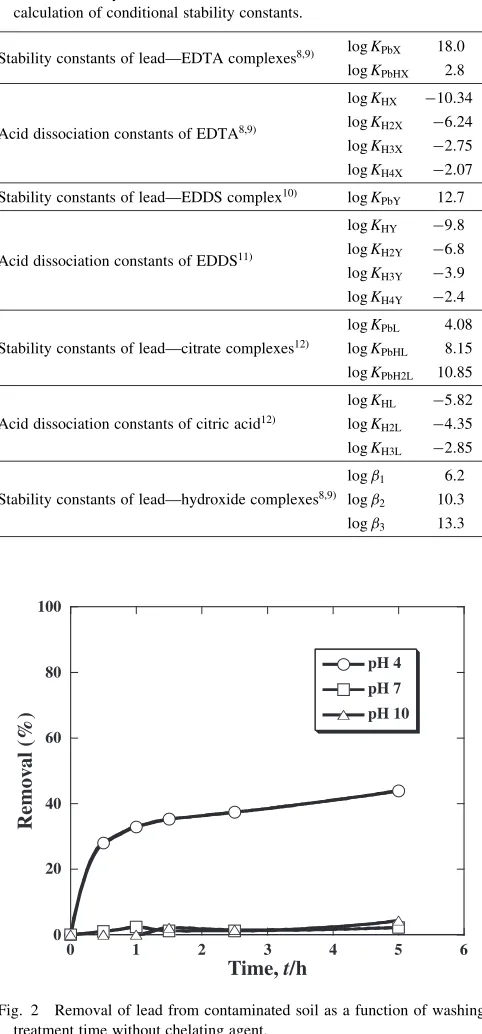
Figure 1 shows the dependence of the conditional stability constants of PbX2, PbY2and PbLon pH calculated from
eqs. (1)–(10). The values of stability constants and acid dissociation constants used for calculation are given in Table 1. The larger the conditional stability constant, the more stable the complex. As shown in Fig. 1, the conditional stability constant of PbX2 and PbY2were relatively large
in the pH range from 7 to 10, indicating the effectiveness of EDTA and EDDS in lead removal from contaminated soils as compared with citric acid in the same pH region.
3.2 Removal of lead by soil washing
The soil washing experiments without chelating agent were performed at pH 4, pH 7 and pH 10. Figure 2 shows
the relationship between the removal of lead from contami-nated soil and the treatment time. The extraction of lead is approximately 40% at pH 4, but lead is hardly removed from soil at pH 7 and pH 10.
Figure 3 and Fig. 4 show similar experimental results with EDTA and EDDS at pH 4, pH 7 and pH 10. As shown in Fig. 3, the removal of lead with EDTA is very high in the pH range from 4 to 10. However, it is considered that acid also contributes to the extraction of lead at pH 4. The removal of lead rapidly increases for first 1 h and remains nearly constant thereafter. Meanwhile, the removal of lead with EDDS is very high at pH 7 and pH 10 as shown in Fig. 4. The ability of lead removal in this pH region with EDDS is comparable to that with EDTA. However, the -15
-10 -5 0 5 10 15 20
0 2 4 6 8 10 12 14
log [Conditional stability constant]
pH
Pb - EDTA
Pb - EDDS
Pb - Citrate
Fig. 1 Relationships between pH and conditional stability constants of lead—EDTA complex (PbX2), lead—EDDS complex (PbY2) and lead—citrate complex (PbL).
Table 1 Stability constants and acid dissociation constants used for calculation of conditional stability constants.
Stability constants of lead—EDTA complexes8;9Þ logKPbX 18.0
logKPbHX 2.8
logKHX 10:34
Acid dissociation constants of EDTA8;9Þ logKH2X 6:24
logKH3X 2:75 logKH4X 2:07
Stability constants of lead—EDDS complex10Þ logKPbY 12.7
logKHY 9:8
Acid dissociation constants of EDDS11Þ logKH2Y 6:8
logKH3Y 3:9 logKH4Y 2:4
logKPbL 4.08 Stability constants of lead—citrate complexes12Þ logK
PbHL 8.15 logKPbH2L 10.85
logKHL 5:82 Acid dissociation constants of citric acid12Þ logKH2L 4:35
logKH3L 2:85
log1 6.2
Stability constants of lead—hydroxide complexes8;9Þ log
2 10.3
log3 13.3
0 20 40 60 80 100
0
pH 4
pH 7
pH 10
Remov
al (%)
Time, t/h
1 2 3 4 5 6
[image:3.595.306.547.79.596.2] [image:3.595.303.550.93.352.2] [image:3.595.310.544.343.566.2]ability decreases significantly at pH 4. From the results of Figs. 2 and 4, it is considered that acid contributes signifi-cantly to the lead removal at pH 4 and the complexation between EDDS and lead is negligible.
The removal of lead with citric acid at pH 4, pH 7 and pH 10 are shown in Fig. 5. As shown in the figure, the removal of lead is approximately 50% at pH 4 and decreases with increasing pH. Therefore, at pH 4, acid contribution is predominant for the lead removal and citric acid is hardly useful.
3.3 Removal of lead by electrokinetic processing
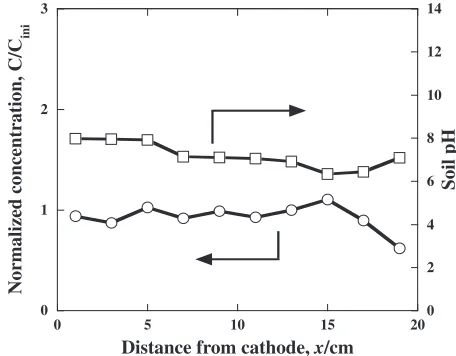
The electrokinetic lead removal experiments were per-formed for 264 h without chelating agent. Figure 6 shows the pH and lead concentration in the soil. The initial soil pH was 6.75 through out the column. Anolyte pH and catholyte pH were maintained at 7 and 8, respectively, during the run. The soil pH at the end of experiment ranged between 6 and 8 through out the column and did not change significantly from
the initial soil pH. As shown in Fig. 6, the lead concentration across the soil after 264 h treatment hardly changes as compared to the initial lead concentration. Also, lead was not detected in the electrode reservoirs. Therefore, it is consid-ered that lead does not migrate through the soil without chelating agent.
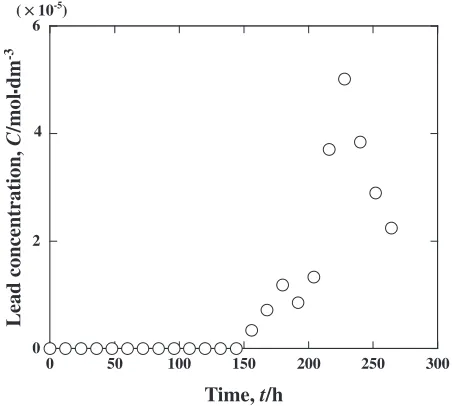
The similar experiment was performed for 264 h with 0.1 mol/dm3 EDTA. Anolyte pH and catholyte pH were maintained at 7 and 8, respectively. The results are shown in Fig. 7. The initial soil pH of 6.90 hardly changes after the experiment, but the lead in soil migrates toward the anode. Figure 8 shows the time change of lead concen-tration in the anode reservoir. Lead is not detected for first 150 h in the anode reservoir, but lead concentration increases thereafter. EDTA with negative charge migrates through the soil toward the anode by ionic migration and forms negatively charged lead—EDTA complex (PbX2). This dissolved chelate then migrates toward the anode by ionic migration.
0 20 40 60 80 100
0
pH 4
pH 7 pH 10
Remov
al (%)
Time, t/h
1 2 3 4 5 6
Fig. 3 Removal of lead from contaminated soil as a function of washing treatment time with EDTA.
0 20 40 60 80 100
0 1 2 3 4 5 6
pH 4 pH 7 pH 10
Remov
al (%)
Time, t/h
Fig. 4 Removal of lead from contaminated soil as a function of washing treatment time with EDDS.
0 20 40 60 80 100
0 1 2 3 4 5 6
pH 4 pH 7
pH 10
Remov
al (%)
Time, t/h
Fig. 5 Removal of lead from contaminated soil as a function of washing treatment time with citric acid.
0 1 2 3
0 2 4 6 8 10 12 14
0 5 10 15 20
Normalized concentration, C/C
ini
Soil pH
Distance from cathode, x/cm
[image:4.595.313.541.74.265.2] [image:4.595.55.286.75.264.2] [image:4.595.56.285.320.509.2] [image:4.595.311.539.321.499.2]The similar experiments with 0.1 mol/dm3 and 0.2 mol/ dm3 EDDS were performed over the duration times of 354 h and 264 h, respectively. The initial soil pHs of each run were 6.77 and 6.81, respectively. Anolyte pH and catholyte pH were maintained at the same as those of EDTA. The experimental results are shown in Fig. 9. The soil pHs do not change significantly from the initial soil pHs. As compared with Figs. 7 and 9, the transport of lead toward the anode at 354 h with 0.1 mol/dm3EDDS is less than that at 264 h with 0.1 mol/dm3 EDTA. However, as shown in Fig. 9, the transport of lead toward the anode at 264 h with 0.2 mol/dm3 EDDS is significantly enhanced as compared to that at 354 h with 0.1 mol/dm3 EDDS. Meanwhile, the treatment with 0.1 mol/dm3 citric acid hardly change the lead content in the soil even after 264 h. This result was similar to that without chelating agent. From these results, it is found that EDTA is more effective than EDDS and citric acid for lead transport through the soil by electro-kinetic processing.
4. Conclusions
Effectiveness of EDTA, EDDS and citric acid as chelating agents to the removal of lead from contaminated soil was examined both in the soil washing and the electrokinetic processing. In the soil washing, the removal efficiency of lead with EDTA and EDDS was high in the pH range from 7 to 10. Meanwhile, citric acid was less effective than EDTA and EDDS. In the electrokinetic processing, EDTA was more effective reagent than EDDS and citric acid.
Acknowledgements
This research was partially supported by the Japanese Ministry of Education, Culture, Sports, Science and Tech-nology (MEXT), Grant-in-Aid for Scientific Research (C) (No. 19560810) and Steel Industry Foundation for the Advancement of Environmental Protection Technology (SEPT).
REFERENCES
1) P. H. Masscheleyn, F. M. Tack and M. G. Verloo: Water Air Soil Pollut.89(1996) 317–335.
2) A. P. Shapiro, P. C. Renaud and R. F. Probstein: PhysicoChem. Hydrodyn.11(1989) 785–802.
3) A. T. Yeung, C. Hsu and R. M. Menon: J. Geotech. Eng.122(1996) 666–673.
4) J. S. Wong, R. E. Hicks and R. F. Probstein: J. Hazard. Mater.55(1997) 61–79.
5) M. A. M. Kedziorek and A. C. M. Bourg: J. Contam. Hydrol.40(2000) 381–392.
6) E. Meers, A. Ruttens, M. J. Hopgood, D. Samson and F. M. G. Tack: Chemosphere58(2005) 1011–1022.
7) M. Niinae, Y. Aoki and K. Aoki: Journal of MMIJ120(2004) 49–53. 8) T. Tanaka and H. Sugi: Complexation in Analytical Chemistry (Saku Keisei Hanno-Bunseki Kagaku ni-okeru Ouyo), (Sangyo Tosho, Tokyo, 1965) pp. 21–53.
9) T. Tanaka and H. Sugi:Complexation in Analytical Chemistry(Saku Keisei Hanno-Bunseki Kagaku ni-okeru Ouyo), (Sangyo Tosho, Tokyo, 1965) pp. 311–328.
0 1 2 3
0 2 4 6 8 10 12 14
0 5 10 15 20
Normalized concentration, C/C
ini
Soil pH
Distance from cathode, x/cm
Fig. 7 Distributions of lead concentration across soil column and soil pH after 264 h treatment with 0.1 mol/dm3EDTA. (Initial lead concentration
in soil:2:55106mol-Pb/g-dry soil)
0 2 4 6
0
Lead concentration,
C
/mol
Time, t/h
10-5)
(
dm
-3
50 100 150 200 250 300
×
Fig. 8 Time change of lead concentration in anode reservoir.
0 1 2 3
0 2 4 6 8 10 12 14
0 5 10 15 20
Pb conc.: 0.1M EDDS, 354 h Pb conc.: 0.2M EDDS, 264 h
Soil pH: 0.1M EDDS, 354 h Soil pH: 0.2M EDDS, 264 h
Normalized concentration, C/Cini
Soil pH
Distance from cathode, x/cm
Fig. 9 Distributions of lead concentration across soil column and soil pH with EDDS. (Initial lead concentration in soil: 0.1 mol/dm3 EDDS,
354 h:2:38106mol-Pb/g-dry soil; 0.2 mol/dm3EDDS, 264 h:2:49
[image:5.595.56.283.74.254.2] [image:5.595.306.545.74.264.2] [image:5.595.56.282.319.522.2]10) P. Vandevivere, F. Hammes, W. Verstraete, T. Feijtel and D. Schowanek: J. Environ. Eng.127(2002) 802–811.
11) P. Vandevivere, H. Saveyn, W. Verstraete, T. Feijtel and D. Schowanek: Environ. Sci. Technol.35(2001) 1765–1770.
12) D. D. Perrin:Stability Constants of Metal-ion Complexes —Part B— Organic Ligands(Pergamon Press, Oxford, 1979) pp. 360–364.
Appendix
: Side reaction coefficient
n (n¼1{4): Stability constant of lead — hydroxide complexes
H3L: Citric acid
H4X: Ethylenediaminetetraacetic acid (EDTA)
H4Y: [S,S]-ethylenediaminedisuccinic acid (EDDS)
KHnL (n¼1{3): Acid dissociation constant of citric acid
KHnX(n¼1{4): Acid dissociation constant of EDTA
KHnY(n¼1{4): Acid dissociation constant of EDDS
KPbL,KPbHL,KPbH2L: Stability constant of lead — citrate
complexes
KPbL0: Conditional stability constant for lead — citrate complex (PbL)
KPbX,KPbHX: Stability constant of lead — EDTA complexes
KPbX0: Conditional stability constant for lead — EDTA complex (PbX2)
KPbY: Stability constant of lead — EDDS complex
KPbY0: Conditional stability constant of lead — EDDS complex (PbY2)
Kw: Ion product of water L: Citrate ion
X: Ethylenediaminetetraacetate ion (EDTA4)