Integrating Natural Language Components into Graphical Discourse
S t e p h a n Dilley, J o h n B a t e m a n , U l r i c h T h i e l , A n n e T i s s e n
G M D , I n t e g r a t e d P u b l i c a t i o n a n d I n f o r m a t i o n S y s t e m s I n s t i t u t e (IPSI) DolivostralSe 15, D - 6 1 0 0 D a r m s t a d t , F R G
e - m a i h { b a t e m a n , d i l l e y , t h i e l , t i s s e n } @ d a r m s t a d t . g m d . d e
Abstract
In our current research into the design of cognitively well-mo- tivated interfaces relying primarily on the display of graphical information, we have observed that graphical information alone does not provide sufficient support to users particu- larly when situations arise that do not simply conform to the users' expectations. This can occur due to too much informa- tion being requested, too little, information of the wrong kind, etc. To solve this problem, we are working towards the integra- tion of natural language generation to augment the interaction functionalities of the interface. This is intended to support the generation of flexible natural language utterances which pin- point possible problems with a user's request and which fur- ther go on to outline the user's most sensible courses of action away from the problem. In this paper, we describe our first pro- totype, where we combine the graphical and interaction plan- ning capabilities of our graphical information system SIC! with the text generation capabilities of the Penman system. We illustrate the need for such a combined system, and also give examples of how a general natural language facility beneficial- ly augments the user's ability to navigate a knowledge base graphically.
I
Introduction
Natural language interfaces to information systems allow the user to converse with the system in a natural way without being restricted by the syntax of a formal query language. However, users often have difficulties in stating their information need precisely (cf. Brooks et al., 1986) and so a user interface design emphasizing multimedia aspects of information systems may be more appropriate. An object oriented presentation meets this requirement because users are allowed to investigate in- formation items directly. Thus, the distance between the users' intentions and the objects they involve is reduced to a mini- mum (cf. Hutchins et al., 1986). However, visual presentations of abslract information items have to be designed carefully to support the user in perceiving them correctly. Often the in- herent limitations of available presentation forms, e.g. the number ofdisplayable items, are an impediment to an adequate visualization. These difficulties which are well known in visu-
al languages can be attacked by combining the presentation of graphical objects to the user with cooperative system re- sponses in natural languages.
Our approach to human-computer interaction provides the basis for an integration of different interaction styles, in our case natural language and graphics, in a multi-modal informa- tion system. The choice of an appropriate combination of modes is essential for a successful interface design. As there is not yet a complete theory of multi-modal interaction, this ques- tion has to be answered experimentally. Therefore, we propose a modular architecture for multi-modal interfaces composed of interaction tools. In this paper, we discuss the addition ot natural language generation to the interaction tools provided. This capability is embodied in the prototype IGiNG (_Integrat- ing Graphics and Natural Language Generation) which com- bines
• the graphical information system SIC! (System for In- formation on Conferences) comprising a dialog man- ager which is able to track the user's goals and, conse- quently, to plan system reactions as cooperative responses (Tissen, 1991), a database access module providing relevant data (Kracker, 1991) and apresen- tation manager generating visualizations of the re- trieved information items (Kerner and Thiel, 1991). • the text generation component KOMET/Penman
(Bateman et al., 1991; Penman, 1989), comprising ex- tensive grammatical, semantic, and text organization- al linguistic resources.
2 Related Work
One body of related work has primarily intended to coordinate different modes of expression within a framework of natural communication (cf. Hayes, 1987; Neal and Shapiro, 1988; Co- hen et al., 1989, Feiner and McKeown, 1990; Bandyopadhyay,
1990; S tock, 1991; Wahlster et al., 1991). The principle effort here is to ascertain factors that can motivate the distribution of information across different modes (e.g. Arens and Hovy, 1990). A further body of related work moves towards prob- lems of interaction by exploring the potential of the combina- tion of natural language and deictic gestures (cf. Allgayer et al., 1989; Moore and Swartout, 1990). In a similar vein, ap- proaches to flexible graphical interaction based on the con- versationalmetaphor (cf. Reichman, 1986, 1989; Thiel, 1990) treat user inputs such as mouse clicks, menu selections, etc. not as invocations of methods that can be executed without regard- ing the dialog context, but instead as dialog acts expressing a discourse goal of the user. The direct manipulation of an object then becomes itself a part of the dialog of the user with the sys- tem, meaning that the system can respond in a more flexible way by taking into account the illocutionary and semantic as- pects of the user's input. Related work from generation in- cludes the correction of misconceptions in the work of McCoy (1986) and the explicit representation of information about a system's own knowledge and planning activities that is found in the Explainable Expert Systems system of Swartout and Smoliar (1987). None of this work, however, addresses the problems of meta-dialog concerning graphically supported in- teraction.
In our approach we bring the kind of natural language ca- pabilities required by the first body of related work (i.e., graph- ical and natural language information functioning together) to bear on the kinds of problems that arise in the second body of related work when the direct manipulation of objects by a user creates goals that the system cannot fulfil. Here we must not only respond to the user's attempt to manipulate an object or the user's deictic gesture as a dialog act, but also be able to en-
gage in a meta-interaction to debug that act if it creates a prob- lematic situation. We show that natural language possesses properties that make it preferable over the graphical mode of expression for such meta-interaction and hence natural lan- guage generation needs to be supported even in graphics-ori- ented interfaces.
3 The
S I C ! - S y s t e mWe demonstrate the combination of graphics ,and natural lan- guage output in the context of the SIC! system, SIC[ is imple- mented using HyperNews (HyperNews, 1989), a hypermedia- like user-interface management system which can be controlled from aLISP-client. SIC! offers information on con- ferences; its domain consists of abstract information on con- ferences including workshops, tutorials, persons, institutes, and conference topics. A user who wants to obtain information from SIC! poses a query whereafter he can inspect the data re- trieved. This is done by selecting a presentation form. In SIC! we use several cognitively motivated presentation forms (Kemer and Thiel; 1991).
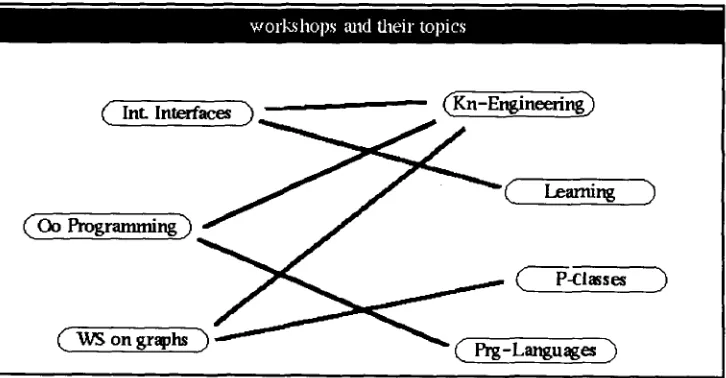
One of these forms is the ring presentation form (cf. Fig- ure 1 ) which surveys a structure of given data. All items are positioned on a virtual ring structure, the relations between the concepts being presented as single lines. In our example the ring presentation form contains the categories workshop and topic. The concepts of the workshops are on the left side of the figure, those of the topics on the right. However, this presenta- tion form is clearly limited with respect to the quantity of data that can be presented simultaneously.
Consider, for example, the following situation: A user asks for a subset of the IJCAI89 workshops and their related topics. SIC! retrieves three workshops and several topics. If the user wants to get an overview of the data's structure, then for this goal the ring is the most adequate presentation form available in SIC! But this causes a problem when the ring form cannot display as many data as SIC! retrieved. There are sever- al ways of solving this problem, depending on the user's main
Q Int Interfaces
( 0 o Programming)
( WS on graphs
(
)
Figure I :
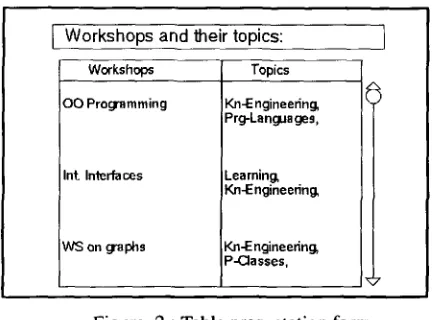
[image:2.612.75.438.526.715.2]point of interest. If he wants to see all the data he might select a presentation form that can show unlimited amounts of in- formation, e.g. the table presentation form (cf. Figure 2 ). If he
Workshops and their topics: ]
Workshops
O0 Programming
Int. Interfaces
WS on graphs
Topics
Kn-E ngineefinD,
10
Prg-Langua ge*,I
Learning,
I
Kn-Enginecring, i
I
Kn-Engineering~
I
P-Classes,Figure 2 : Table presentation form
is interested more in the structure of the data, he might change his initial query so that less data are retrieved. But, importantly, the user cannot be aware of the details of the current situation of retrieval and its implications simply from the graphical in- formation displayed. Hence the system has to inform him of the situation and offer possible alternatives. This needs to be done in a way that enables users to grasp the situation and to choose the appropriate alternatives for their purpose. To achieve this, the system has to create a coherent informative act that is concise and yet unambiguous (in context), giving all the information necessary for the user to determine his future actions.
Based on work by Feiner and McKeown (1990) on the coordination of text and graphics in explanation generation and by Lombardi (1989), who examined the assignment of in- formation to media, we assume that text is the appropriate me- dium for informative acts in meta-dialogs, since a well- constructed text is not only concise and easy to understand, but also guarantees the necessary flexibility to meet any situation that ,arises. Graphical 'acts' cannot be constructed composi- tionally to express possibly unforeseen complex circum- stances: novel graphics must first be learnt by u s e r s - - a situa- tion avoided by the generation of situationally appropriate natural language. Thus, generating natural language text, par- ticularly text involving controlled and appropriate deployment of text-forming resources such as rhetorical relations, en- hances the total coherence of the user's dialog with the system. Our hypothesis is that the user's understanding of the situation and its implications is increased by the natural language out- put, which becomes an intermediary between the various pos- sibilities for information presentation.
4 K O M E T / P e n m a n T e x t G e n e r a t i o n S y s t e m We are using the KOMET/Penman I system (Mann and Mat- thiessen, 1983) for generating the natural language output our system requires. KOMET/Penman is a domain-independent text generation system based on systemic-functional grammar (Halliday, 1978). It consists of extensive grammars of English and German (Matthiessen, 1990; Teich, 1991), a linguistically motivated ontology, called the Upper Model (Bateman, Kasp- er, Moore and Whitney, 1989), a semantic interface that relates the categories of the conceptual ontology with their possible grammatical expressions in English and German (Matthies- sen, 1990), and a basic lexicon containing English and German closed-class items and default lexical realizations for the con- cepts in the Upper Model ontology. The definition of the lexi- cal items includes morphological information and sets of lexi- cal features that determine the grammatical contexts in which items are to be selected.
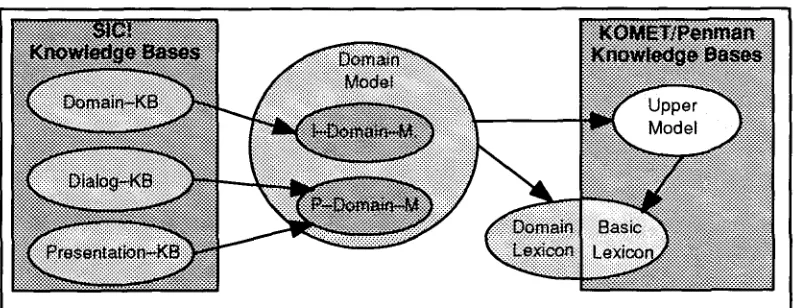
The Upper Model is the component of the system that is primarily responsible for mediating between the knowledge specific to any given domain and the general lexical and gram- matical expressions that are provided by a language. Because it is possible to state how any particular Upper Model concept is to be realized, subordinating domain concepts to particular Upper Model concepts causes those domain concepts to inherit appropriate forms of expression. For example, concepts from the object-class are usually realized as nominal phrases, while concepts from theprocess-class (e.g., mental-process, verbal- process, action-process, relation-process) are often realized by clauses 2. The relationship between Upper Model and domain model is diagrammed in the context of its application for SIC! in Figure 3 .
Input to the KOMET/Penman text generation system is given in terms of the Sentence Plan Language (Kasper, 1989), of which we will see examples below. An SPL expression de- fines the semantic content of a sentence to be generated; it con- sists of a set of typed variables and relations defined between those variables. Both the types and the possible relations are defined either by the Upper Model directly or by concepts or relations in the domain model that have been subordinated to the Upper Model. In addition to this information, SPL expres- sions may also contain direct statements in terms of the gram- roar's semantic interface - - in practical applications these latter are often abbreviated by use of macros (e.g. :tense pres- ent) or are defaulted.
[image:3.612.97.313.122.282.2]~i~i;i::iiiii--i;i;:~::.::::::::iiii#ii~:~::;~iiiiii.:i.:i~.:.:~j::: I
!ii 7
.
Figure 3 : Interfacing SIC! with KOMET/Penman on the Knowledge Level
5 Interfacing SIC! with the Text Generation
System
To interface SIC! with KOMET/Penman we have to provide several types of knowledge (cf. Figure 3 )
• A domain model, which is a taxonomy of knowledge specific to our application-domain. We split the do- main into two parts: an Information-Domain (I-Do- main), which contains concepts related to the informa- tion that is shown by SIC!, e.g. workshops and topics (cf. Figure 1 ), and a Presentation-Domain (P-Do- main), which contains concepts related to the way this information is presented by SIC!, e.g. ring, table. By splitting the domain model we increase the adaptabil- ity in case of changes in the underlying application do- main, e.g. replacing the conference knowledge base with a knowledge base on research projects. Every concept
in
the domain model has to be linked to some Upper Model concept from which it inherits attributes which enable KOMET/Penman to express the concept in a way that is grammatically correct. The I-Domain concepts can be generated automatically flom the un- derlying SIC! knowledge bases (cf. Figure 3 ). Con- cepts can also be associated to lexical items.• A domain lexicon, containing the definitions of lexi- cat items of all the words that may appear in the ap- plication domain.
6 Creating the Natural Language Output
6.1 Planning Sentences
As stated in our example above, we want to produce text that, in this case, informs the user that not all the information that was requested can be shown because the current presentation- form's capacity is limited. Furthermore, we need to offer pos- sible actions which solve this problem. In Figure 4 , we show the semantic input to KOMET/Penman, expressed in SPL, that would cause KOMET/Penman to generate the first sentence
I
(a / ascription:domain (c / capacity
:owned-by (p /
presentation-form))
:range (e /exceeded))
Fig.
4 :
SPL-Plan for"The presentation-form's capacity is exceeded."
that we require: i.e., "The presentation-form's capacity is ex- ceeded." One type of abstract concept that the system requires is the status of a particular entity that may be displayed or used. Possible statuses are, for presentation-forms, exceeded, in- complete. These status concepts can then be attributed to ob- jects by means of the Upper Model relation ascription, which has roles ':domain' and ':range'. They represent the concepts which are related, in our example the presentation-form's ca- pacity and exceeded. In general, ':domain' contains the essen- tial concept of the relation while ':range' contains additional information. The P-Domain concept capacity has been mod- eled as an object.
6.2 Using Rhetorical Relations
Figure 5 shows a more complex SPL-plan which demon- strates some of the more advanced possibilities given by KO- MET/Penman. The most interesting aspect in this plan is the use of rhetorical relations based on Rhetorical-Structure- Theory (RST).
[image:4.612.114.511.63.217.2](rl /rst-nonvolitional-result :domain (el/ existence
:domain (cl /
concept
:number mass :process ( r 2 / s h o w:saying cl :speechact denial :tense present))) :range (a/ascription
:domain (c2 /
capacity
:owned-by (p/pres-form)) :range (ex /
exceeded)
:tense present)))
Figure 5 : SPL-Plan for "There are concepts that are not shown, because the presentation-form's capacity is exceeded".
RST relations because they proved to be quite useful when we link portions of information. In KOMET/Penman, RST-rela- tions are treated the same way as other relations, e.g. ascription which we used in the plan shown in Figure 4 .
The SPL-plan shown in Figure 5 combines two relations: the ascription-relation, which we used in the SPL-plan in Fig- ure 4 , and the existence-relation. Existence is a so called one- place-relation, because it contains only a :domain-role but no :range. It is usually realized as "There is ...", where :domain defines what exists. We link these two relations via an RST- relation called rst-nonvolitional-result. This RST-relation im- plies that the nucleus, which is defined in our :domain-role is a result of the satellite, defined in :range. One possible output is <domain>, because <range>, in our case "<There are concepts • ..>, because <... capacity is exceeded>". Because what is de- fined in the :domain ("There are concepts that are not shown") is not volitional, we use rst-nonvolitional-result instead of rst- volitional-result. The fact that there is data that is not shown by the current presentation-form is essential to our informational purpose. Therefore this fact becomes the nucleus (represented by :domain) of our plan.
RST-relations which ensure the connectivity between our text segments. Pragmatic coherence is supported by the mere fact that we are using text as a medium for meta-dialogs, as these are difficult to understand on a graphical level.
7 Controlling Multimodal Discourse
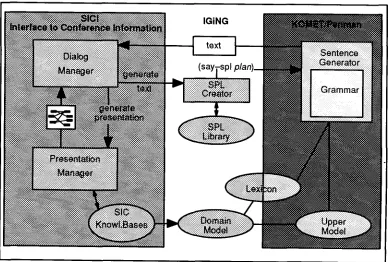
The dialog manager is one of the main components of our in- terface system (cf. Figure 6 ). It chooses interaction modes (graphic or text) and controls the navigation or exploration in the information space.
In order to prevent the user from 'being lost in hyper- space', we guide the user by case-based dialog plans (Tissen, 1991). In a case-based planning system a new plan will be gen- erated by retrieving the plan which is most appropriate to the user's goals and adapting it dynamically during the ongoing dialog. Two types of adaptations can be distinguished: In'st, system-driven modifications using domain dependent back- ground knowledge, and second, corrections of misconcep- tions, handled interactively in meta-dialogs with the user.
The dialog manager detects misconceptions, i.e. situa- tions in which an intended goal cannot be realized, e.g. more items were retrieved than can be displayed in the current pre- sentationform. The corrector operates on knowledge bases of misconceptions and correction rules, e.g. " i f there is a miscon- ception like 'ring presentation: not all requested data can be presented in the ring' and there is no automatic plan modifica- tion possible then start a meta-dialog, which informs the user about the situation and offers alternatives." Because meta- dialogs will be handled in text mode, the dialog manager re- quests the SPL creator to produce SPL plans. Therefore, the dialog manager informs the SPL creator on the current miscon- ception and possible alternatives the user has to choose from to resolve the situation. Then, the SPL creator produces the ap- propriate SPL plans by combining information on the miscon- ception and possible alternatives with elements from the SPL library. The SPL plans are transformed into natural language text by the KOMET/Penman system. The resulting text is re- turned to the dialog manager which presents it to the user.
6.3 Supporting Coherence
In his work on coherence in multi-modal discourse, Bandyo- padhyay (Bandyopadhyay, 1990) states that there are three levels of coherence: syntactic coherence, semantic coherence and pragmatic coherence. Syntactic coherence deals with the immediate connectivity among adjacent segments (in texts this is often called text cohesion). Semantic coherence ensures the wellformed thematic organization of a discourse. Dis- course segments are connected by semantic ties (Hobbs, 1983). Bandyopadhyay defines a discourse to bepragmatical- ly coherent if it is compatible with the addressees' interpreta- tive ability. In our system syntactic coherence is enhanced by the way we present the natural language output in our graphical environment. Semantic coherence is supported by the use of
8 Controlling utterance selection
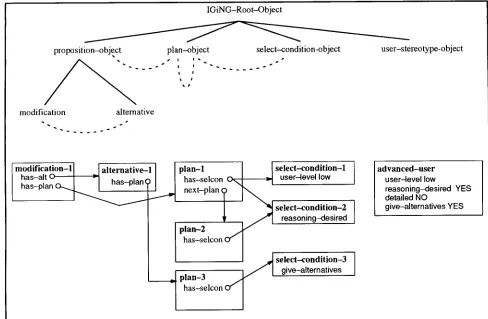
The IGiNG system intends to produce user adapted naturaJ language output. It is an object oriented system consisting ol several object classes (cf. Figure 7 )
[image:5.612.93.328.66.235.2]Figure 6 : Integrating SIC! and KOMET/Penman
Example: Let us consider the IGiNG-objects given in Fig- ure 7 . IGiNG is requested to express rood-1. It builds a list of possible plan-objects, which is (plan-1 plan-2). As con- cise statements are desired, plan-1 is tested first. Because c o n - 1 is not satisfied (it demands that user-level is low while the current user level is advanced) plan-1 is rejected. Next, p l a n - 2 is tested. As all conditions are satisfied, the plan given by p l a n - 2 is generated.
Adapting to new situations
When a new situations is to be included, the following steps have to be performed:
A new proposition-instance has to be defined as the suc- cessor of an existing proposition-class. If the new proposition is not a part of any of the existing proposition-classes, a new proposition-class should be defined first.
For any of the possible utterances a parameterizable par- tial sentence plan has to be written, which is stored in a plan- object, together with a reference to the plan-object's select-
condition-object. Of course, it is possible to use existing plan-objects, if they are suitable for the intended purpose.
Finally the plan-objects have to be linked to select-condi- tions. As these are domain independent, preexisting select- conditions can be reused.
These are all the steps necessary for defining new proposi- tions. The new objects inherit from their ancestors all the func- tionality which is necessary for selection and expression.
9 Future Work
[image:6.612.117.507.63.325.2]IGiNG-Root-Object
proposition-object plan-object select-condition-object
B ~ s
I !
modification alternative
user-stereotype-object
m~difia~ t t ioo n-1 !
J alt.ernati.ve_l I
I pnan-,
J select-condition-I
h a s _ p l a n ~ ~ i has-selcon C-,,,j next-plan ~ ~ , ~ , - I user-levell°w
l
~
select-condition-2
t , .,,,J~'l
reasoning-desired
plan-2
has-selcon O"
.,~ select-condition-3
- l ~ [ give-alternatives
has-selcon O" I
m
advanced-user
user-level low
reasoning-desired YES detailed NO
[image:7.612.104.592.63.382.2]give-alternatives YES
Figure 7 : IGiNG object hierarchy and sample instances
References
Allgayer, J., Harbusch, K., Kobsa, A., Reddig, C., Reithin- ger, N., and Schmauks, D. 1989. XTRA: A Natural Lan- guage Access System to Expert Systems. In: Int. J. Man- Machine Studies, Vol. 31, No. 2, 1989, pp. 161-195 Arens, Y. and Hovy, E.H. 1990. How to describe what ? Towards a theory of modality utilization. In: twelfth annual conference of the Cognitive Science Society, pp. 487-94, Lawrence Erlbaum Associates, Hillsdale, New Jersey, 1990, July 25-28, 1990, Cambridge, USA
Bandyopadhyay, S. 1990. Towards an Understanding of Coherence in Multi-Modal Discourse, Technical Memo TM-90-01, Deutsches Forschungsinstitut fuer Kuenst- liche InteUigenz GmbH, Saarbruecken, 1990
Bateman, J., Kasper, B., Moore, J., and Whitney, R. 1989.
A general organization of knowledge for natural language processing: the Penman Upper Model. USC/Information Sciences Institute, Technical Report, 1989
Bateman, J. and Paris, C. 1989. Phrasing text in terms the user can understand. In: Proceedings of IJCAI-89
Bateman, J., Maier, E., Teich, E., and Wanner,L. 19c~
Towards an Architecture for Situated Text Generation, i
International Conference on Current Issues in Compul tional Linguistics, Penang, Malaysia, 1991
Brooks, H.M., Daniels, P.J. and Belkin, N.J. 1986./q
search on Information Interaction and Intelligent lnforrr tion Provision Mechanisms. In: J. of Information Scienl Vol. 12, 1986, pp. 37--44
Cohen, P. R., Dalrymple, M., Moran, D., Pereira, F., Su] van, J., Gargan Jr., R., Schlossberg, J., and Tyler, S. 19t
Synergistic Use of Direct Manipulation and Natural Lc guage. In: Bice, K., and Lewis, C. (eds): Proceedings CHI '89, (Austin, Texas, April 30 - May 4, 1989), Nq York: ACM, 1989, pp. 227-233
Feiner, S.K. and McKeown, K.R. 1990. Coordinating T, and Graphics in Explanation Generation. In: AAAI -c. Proc. 8th Nat. Conf. on Artificial Intelligence. July
Grosz, B.J. and Sidner, C.L. 1986.Attention, Intention, and the Structure of Discourse, Computational Linguistics, Vol. 12, No. 3, pp. 175-204, 1986
Halliday, 1978. Language as Social Semiotic. London: Ed- ward Arnold.
Hayes, Philip J. 1987. Steps towards Integrating Natural Language and Graphical Interaction for Knowledge- Based Systems. In: Boulay, B. du / Hogg, D. / Steels, L. (eds): Advances in Artificial Intelligence - - II. (Proc. ECAI-86), Amsterdam et al.: North-Holland, 1987, pp. 543--552
Hobbs, J. 1983. Why is Discourse Coherent ? In: Neubauer (Editor), Coherence in Natural Language Texts, Buske,
1983
Hutchins, E.L., Hollan, J.D. and Norman, D.A. 1986. Di- rectManipulation Interfaces. In: Norman, D.A,, and Drap- er, S.W. (eds): User Centered System Design: New Per- spectives on Human-Computer Interaction. Hillsdale, NJ & London: Lawrence Erlbaum, 1986, pp. 87--124 HyperNews 1989. HyperNeWS User's Guide, Hoff, Arthur van (Editor), The Turing Institute, Glasgow, UK, 1989 Kasper, R. 1989. A flexible interface for linking applica- tions to Penman's sentence generator. Proceedings of the DARPA Workshop on Speech and Natural Language. Kerner, A. and Thiel, U. 1991. Graphical Support for Users' Inferences within Retrieval Dialogues. In: Proceed- ings of the IEEE Workshop on Visual Languages 1991, pp.211-216,
Kracker, M. 1991. Unscharfes assoziativesBegriffswissen zur Unterstiitzung der Formulierung von Datenbankabfra- gen, Dissertation, TU Wien, April 1991. Title in English: Fuzzy Associative Conceptual Knowledge for Supporting Query Formulation.
Lombardi, C. 1989. Experiments for Determining the As- signment of Information to Media in COMET, Columbia University, New York, N.Y., USA, 1989
Mann W.C. and Matthiessen C. 1983. Nigel: A Systemic Grammar for Text Generation, Technical Report RR-83-105, USC/Information Sciences Institute, 1983 Mann, W.C. and Thompson, S.A. 1987. Rhetorical Struc- ture Theory: A Theory of Text Organization. In: Polanyi, L. (Editor): The Structure of Discourse, Ablex Publishing Company, Norwood, N.J., 1987. Also available as US C/In- formation Sciences Institute Technical Report Number RS-87-190
Matthiessen, C.M.I.M. 1990. Lexicogrammatical Cartog- raphy: the systems of English.
Expanding ongoing draft. Department of Linguistics, Uni- versity of Sydney, Australia.
McCoy, K.F. 1986. The ROMPER system: responding to object-related misconceptions using perspective. Pro-
ceedings of the 24th. Annual Meeting of the Association for Computational Linguistics, New York.
Moore, J.D. and Swartout, J.R. 1990. Pointing: A Way Toward Explanation Dialogue. In: AAAI-90: Proc. 8th Nat. Conf. on Artificial Intelligence. July 29, 1990-- Aug. 3, 1990. Vol. I. Menlo Park et al.: AAAI Press / The MIT Press, 1990, pp. 457~464
Neal, J.G. and Shapiro S.C. 1988. Intelligent Multi-Media Interface Technology. In: Sullivan, J.W./Tyler, S.W. (eds): Proceedings of the Workshop on Architectures for Intelli- gent Interfaces: Elements and Prototypes. ACM/Addison- Wesley, 1989, pp. 69--91
Penman 1989. The Penman Project: The Penman Primer, User Guide and Nigel Manual. USC / Information Sciences Institute, Marina del Rey, CA, 1989
Reichman, R. 1986. Communication Paradigms for a Win- dow System. In: Norman, D.A. / Draper, S.W. (eds): User Centered System Design: New Perspectives on Human- Computer Interaction. Hillsdale, NJ & London: Lawrence Erlbaum, 1986, pp. 285--313
Reichman, R. 1989. Integrated Interfaces Based on a Theory of Context and Goal Tracking. In: Taylor, M.M. / Neel, F. / Bouwhuis, D.G. (eds): The Structure of Multimo- dal Dialogue. Amsterdam et al.: North-Holland, 1989, pp. 209---228
Sitter, S. and Stein, A. 1991. Modeling the lllocutionary Aspects of Information-Seeking Dialogues, Arbeitspa- piere der Gesellschaft fuer Mathematik und Datenverar- beitung 515, 1991
Stock, O. 1991. Natural Language and the Exploration of an Information Space: the ALFresco Interactive System.
IJCAI91, Sydney. pp972-978.
Swartout, W.R. and Smoliar, S. 1987. Explaining the link between causal reasoning and expert behavior. In: Pro- ceedings of the Symposium on Computer Applications in Medical Care. Washington, D.C.
Teich, E. 1991. A Systemic Grammar of German for Text Generation, to appear in: Davies, M., L. Ravelli, Advances in Systemic Linguistics: Recent Theory and Practice, in progress.
Thiel, U. 1990. Konversationale graphische lnteraktion mit lnformationssystemen: Ein sprechakttheoretischer An- satz. Dissertation, Universitat Konstanz. Title in English: Conversational Graphical Interaction with Information- Systems. An approach based on Speechact Theory. Tissen, A. 1991. A Case-Based Architecture for a Dia- logue Manager for Information-Seeking Processes. In: Procceedings of SIGIR '91, October 13-16, 1991, Chica- go, USA