Explana~..: 3tructures in XSEL
Karen Kukich Computer Science Department
Carnegie-Mellon University Pittsburgh, PA 15213
412-578.2621 Kukich@CMU-CS-A
1.
Introduction
Expert systems provide a rich testbed from which to develop and test techniques for natural language processing. These systems capture the knowledge needed to solve real-world problems in their respective domains, and that knowledge can and should be exploited for testing computational procedures for natural language processing. Parsing. semantic ,nterpretation, dialog monitoring, discourse organization, and text gef,eration are just a few of the language processinq problems that might takeadvantage of the pre.structured semantic knowledge of an expert system. In particular, the need for explanation generation facilities for expert systems provides an opportunity to explore the relationships between the underlying knowleqge structures needed for automated reasoning and those needed for natural language processing. One such exploration was the development of an explanation generator for XSEL, which is an expert system that hellos a salesperson in producing a purchase order for a computer system[10]. This pager describes a technique called "link-dependent message generation" that forms the basis for explanation generation in XSEL.
1.1. Overview of XSEL
Briefly, the function of the XSEL system is to assist a salesperson in configuring a custom-tailored purchase order for a Digital Equipment Corporation VAX computer system. XSEL works with the salesperson tO elicit the functional computing requirements of the individual customer, and then goes on to select the components that best fit those requirements. The output of an XSEL session is a purchase order consisting of a list of line-items that specify hardware and software components.
There ~re two main phases to XSEL's processincj, a fact gathering phase and a component select=on phase. During the fact gathering phase XSEL carries on an interactive dialog with the salesperson to elicit values for facts that determine the customer's functional computing requirements. These might include requirements for total disk space, percent of removable disk storage, number of terminals, lines-per.minute of printing, etc. Natural language processing during the fact gathering dialog is minimal: XSEL displays menues and pre-formutated queries and accepts one- or two-word answers from the user.
Once enough facts have been collected XSEL begins a silent phase of processing. During this phase a set of candidate components that satisfy the customer's basic requirements is retrieved from the DEC parts database. Within each class of component, i.e., processor, disk, terminal, etc., candidates are ranked according to their score on a~q evaluation function that measures the degree to which a candidate satisfies the customer's weighted functional requirements. The candidate with the highest score is selected and placed on the purchase order.
The most important knowledge structure used by XSEL during the fact gathering I~ase is a fact. A fact is simply a list of attribute-value pairs that represent knowledge about one of the customer's functional computing requirements. Figure 1-1 depicts a sample facL
(FACT ?ATTRIBUTE TOTAL.DISK-SPACE ?STATUS INFERENCE TCLASS DISK ?UNITS MEGAB~'TE3 ?MEAN 3600 YTOKEN G'.29)
The fact collection process is driven by backward-chaining
rules. A top-level rule deposits a few " c o r e " facts for which XSEL
must obtain values, such as "total.disk-space", "total-number.of-
terminals", etc. One at a time, XSEL solicits a value for these
core facts from the salesperson. If the salesperson answers
"unknown" to a solicitation, another rule fires to deposit some
additional facts that would enable XSEL to infer a value for the
unknown fact. The cycle is then repeated as XSEL solicits values
for each of the newly deposited facts. Any time a newly
instantiated fact completes the set of facts required to infer a
value for some other fact. the appropriate inference rule is
automatically triggered and the value for another fact is inferred.
This backward-chaining process continues until XSEL obtains
values for all of the core facts, or until no more data can be
collected and no more inferences can be made, in which case
some default value rules fire to instantiate values for any
remaining unknown facts.
The most important knowledge structure used by XSEL during
the component selection phase is a rank element. Like a fact, a
rank element is simply a list of atthbute.value palm. In this case
the attribute-value pairs represent knowledge about a candidate's
score for one term in the evaluation function. A different
evaluation function is associated with each class of component.
and each evaluation function is a sum of some weighted terms.
The terms of the evaluation function for the class disk, for
example, include price, disk-pack-type, storage-capacity,
average-access-time, peak-transfer-rate, and handednesa. For
every candidate, XSEL computes a rank value for each term in
the evaluation function. The rank value for a term is the product
of the candidate's normalized SCore for the term and a weight which represents an importance factor. The essential information
needed to compute a rank value for a term for a candidate is
stored in a rank element, an example of which is shown in Figure
1-2.
(RANK tRANK-NAME AVERAGE.ACCESS-TIME tNAME RA60-AA" tCLASS DISK
fRANK-VALUE -3 tCOEFFICIENT t tVALUE 50 tlMPORTANCE I tTOKEN G:9)
Figure 1-2: Sample XSEL Rank
After aJl the rank values have been computed for a candidate they
are summed to obtain a total score for the candidate. The
candidate with the highest total score is selected and placed on
the purchase order.
The component selection phase is driven by forward.chaining
rules. These rules perform the subtasks of first, retrieving
candidates from the database, next, determining a quantity and
cost for each of the candidates, next, computing a total rank
score for each candidate, and finally, selecting the candidate with
the highest rank score.
At present, the entire XSEL system consists of over three
thousand OPS5 [2] rules. The explanation generator, which will
be described shortly, comprises an additional five hundred rules.
Anywhere from approximately five hundred to five thousand rules
may fire during the fact gathering phase to create from fifty to five
hundred facts, and roughly three thousand rules will fire during
the component selection phase to create around one thousand
rank elements. The whole process can take anywhere from ten to
thirty minutes of real time, depending on how XSEL's queries are
answered.
t .2. S a m p l e E x p l a n a t i o n s
Three of the most obvious types of queries a user m~ght ask
were targeted for initial explanation development. Sample
explanations from each of those types are given in this section.
The following sections describe the knowledge structures and
processes within both XSEL and the explanation generator that
produced those explanations, as well as the goals and rationale
behind them.
One type of query that is likely to be asked is why a particular
component appears on a purchase order. We refer to queries of
this type as "why-choice" queries. To answer a why-choice
query the explanation generator must compare the rank elements
for each candidate on each term of the evaluation function in
order to determine which attributes were responsible for the
higher SCore of the component that was actually selected. The
following are sample explanations from the why-choice class of
? why ra81
THE RA81 IS CHEAPER THAN ANY ALTERNATIVE RXED PACK DISK, POSSIBLY BECAUSE IT HAS A SMALLER TOTAL STORAGE CAPACITY AND A SLOWER AVERAGE-ACCESS-TIME. ?why rm05
ALTHOUGH THERE ARE LESS EXPENSIVE DISK S, THE RM05 HAS A LARGER DISK PACK THAN ANY ALTERNATIVE REMOVABLE PACK DISK.
Figure 1-3: Sample Why-Choice Explanations
A second obvious type of query asks why a certain fact has whatever value it has. e.g., why total-disk.space is 3600 megabytes. We refer to queries in this class as "why-lact" queries. In the case of why-fact queries, the explanation generator must examine the facts that were created during the fact gathering phase, and it must determine how those facts are related through the backward-chaining process. An example of an explanation that was generated in response to a why.fact query follows:
? why q total-disk-space
XSEL INFERRED A VALUE QF 3600 MEGABYTES FOR TOTAL-DISK.SPACE. 3574 MEGABYTES ARE REQUIRED FOR TOTAL.USER-DISK-SPACE. THE REMAINDER IS ACCOUNTED FOR BY OTHER FACTORS, SUCH AS SUM-OF-SYSTEM-DISK- SPACE.
3574 MEGABYTES WAS INFERRED FOR TOTAL-USER-DISK-SPACE BECAUSE 2859 MEGABYTES ARE REQUIRED FOR USER-DISK- SPACE AND THAT VALUE IS MULTIPLIED BY 125 FOR PERCENT-FOR-EXPANSION . XSEL INFERRED A VALUE OF 25 MEGABYTES FOR SUM.OF.SYSTEM.DISK-SPACE FROM 1 SYSTEM-DISK-SPACE REQUIREMENT OF 25 MEGABYTES FOR THE VMS OPERATING-SYSTEM.
Figure 1,4: Sample Why-Fact Explanation
This explanation would have ended immediately following the first paragraph had not the user previously asked for longer
explanations. But because the user had earlier typed "explain more", the explanation generator went on to explain the terms "total-user-disk-space" and "sum.of.system.disk-space", which were introduced in the first paragraph. If the user were to type "explain more" a second time. and then ask the same question "why quantity total-disk-space", the explanation generator would not stop where it did. Instead, it would go on to explain the terms user-disk.space, percent.for-expansion, and system.disk-space, which were introduced in the second and third paragraphs,
There is no upper bound on the number of levels of explanation the user may request. If the number of levels to explain is high. XSEL will keep explaining until it reaches those facts whose values were set either by user input or by default, in which case there is nothing further to explain. The user can ~lso type "explain less" at any time, thus decreasing the number of levels to explain. The lower bound on the number of levels to explain is one.
The mechanism for determining which term to explain next is a queue. As new terms are introduced they are placed in the queue. The queue was originally implemented as a stack, but as explanations got longer they began to sound less coherent using the stack mechanism. So the queue was implemented, but the stack was retained. Now one can toggle between them by typing "explain queue" or "explain stack", thus producing alternatively structured explanations for the sake of comparison.
stopped there; the remaining two paragraphs were generated in response to terms introduced in the first two paragraphs.
? why q ra60
4 RA60-AA" 'S WERE SELECTED IN ORDER TO SATISFY A REMOVABLE-DISK-SPACE
REQUIREMENT OF 900 MEGABYTES.
EACH RA60-AA" PROVIDES A CAPACITY OF 205 MEGABYTES. THEREFORE, 4 RA60-AA" 'S ARE REQUIRED TO YIELD AT LEAST 90 PERCENT OF THE REMOVABLE-DISK-SPACE CAPACITY OF 900 MEGABYTES.
900 MEGABYTES OF THE TOTAL-DISK.SPACE REQUIREMENT OF 3600 MEGABYTES WERE ALLOCATED TO REMOVABLE.DISK-SPACE . XSEL INFERRED A VALUE OF 900 MEGABYTES FOR REMOVABLE-DISK-SPACE BECAUSE 3600 MEGABYTES ARE REQUIRED FOR TOTAL-DISK. SPACE AND 2700 RXED-DISK ARE
SUBTRACTED FROM IT TO GET THE DIFFERENCE . THE VALUE OF 205 MEGABYTES FOR REMOVABLE- DISI(-UNIT.CAPABILITY WAS RETRIEVED FROM THE DATABASE.
Figure 1-5: Sample Why-Line.Item Explanation
2. XSEL Explanation Design Goals
2.1. Related Explanation Work
The desi(jn of the XSEL explanation generator was motivated by three goals: first, that explanations should be accurate. second, that explanations should be direct, and third, that some degree of generality should be attempted.
Most early attempts at explanation generation adopted either a canned text or an execution trace approach. The canned text approach led to accuracy problems and the execution trace approach led to directness problems. These problems are described in detail by Swartout[12]. In brief, canned explanations can suffer from a lack of accuracy in the event that any modifications or additions are made to the Performance program without the corresl0onding modifications or additions being made to the canned text. Execution trace.explanations tend to suffer from a lack of directness because every step during
program execution gets reported, including what Swartout has referred to as "computer artifacts", as in "Variable X was initialized to 0".
Another common early approach to explanation generation was the goal tree approach, which is very.similar to the execution trace approach. The original explanations produced by the MYCIN system were goal tree explanations [1]. This approach allowed the user to question any request for information made by the system, and the system would simply locate the goal immediately above the current one in the goal tree and report that it needed the information to resolve that higher goal. Goal tree explanations tend to suffer from the same lack of directness problems that execution trace explanations suffer from.
Swartout's work on an explanation generator for the Digitalis Therapy Advisor attacked the accuracy and directness problems successfully. His approach was to redesign the DTA, separating descriptive facts from domain principles and from the abstract goals of the system. This allowed the performance program to be generated by an automatic programmer, which also created a goal refinement structure in the process. The goal refinement structure captures the knowledge that goes into writing the performance program, and makes it accessible to the explanation generator, where it can be used to produce explanations that are both accurate and direct. Furthermore, as Swartout points out, such explanations can be viewed as "justifications" for the system's behavior.
One of the major contributions of the DTA work was to demonstrate that a singte explicit representation of knowledge can and should drive both the automatic program generation process and the explanation generation process. Further research supporting the "shared explicit knowledge" approach to automatic knowledge acquisition, rule generation, and explanation generation is underway for at least three other projects [8] [4] [5] [6].
2.2. The XSEL Explanation Approach
the approaches discussed above. The sheer size of XSEL would
make implementing canned responses tedious. Similarly, the
number of rule firings on any run would make reading execution
trace explanations labonous even. or perhaps especially, if they
were translated into natural lanaguage. The approach taken by
Swartout of extracting the regularities and representing them separately as domain principles would work for the backward-
chaining rules used during XSEL's fact gathering phase, but the
forward-chaining rules used during the component selection
phase are so irregular that attempting to extract regularities
would result in the duplication of nearly the entire set of rules.
Some other common denominator needed to be found in order to
achieve some computational power for explanation generation.
For about two thirds of XSEL's explanation facilities, that
computational power was bought by the creation of links, which
are simple knowledge structures that establish relations between
elements in XSEL's working memory. The role of links will be the
focus of the remainder of this paper. But first a brief general
overview of all the explanation facilities is given.
There is a simple variant of a goal tree explanation facility built
into XSEL. so that the system can always state why it wants a
value for any fact it reduests during the fact gathering dialog. But
the explanation samples shown in the previous section were
generated by an entirely different mechanism, a message-based
explanation generator. A message-based explanation generator
is a two-phase processor that first generates and organizes
messages based on the contents of working memory, and then
maps those messages into surface strings. Two different types of
message generator have been implemented for XSEL. The
message generator used to answer why-choice queries may be
called a comparative message generator; it examines and
compares the rank elements produced by the evaluation
functions to determine what roles they play in the selection of the
chosen component, and then it creates a,opropriate messages,
The message generators used to answer the why-fsct and why.
line.item clueries may be called link-dependent message generators: they examine the facts and the links between facts to
determine what relations hold among them, and then they create
appropriate messages.
Explanations produced by both the comparative message
generator and the link-dependent message generators are
certain to be accurate because they always originate from the
contenfs of working memory. Special steps had to be taken to
ensure the directness of the link-dependent message generators.
however. Those steps will be discussed in the following sections.
which describe the workings of the lipk-dependent message
generators in some detail. Discussion of the comparative
message generator and the surface generator will be reserved for
other occasions.
3. Link-dependent Message Generation
3.1. Generic vs. Relational E x p l a n a t i o n s
Both of the link-dependent message generators are capable of
operating in two modes, generic mode and relational mode. (The
user can toggle between modes by typing "explain generic" or
"explain relational".) The explanations shown above in Figures
1-4 and 1-5 are relational explanations: they explicate the
relations that hold between facts. Some of those relations are
arithmetic relations, such as sum and product, and some are
abstract relations, such as satisfaction and allocation relations.
Contrast the relational explanation for the query "why q total-
disk-space" shown in Figure 3-1 with the generic explanation for
the same query shown in Figure 1-4. Generic explanations do not
explicate the relations that hold between facts; they simply state
that some generic dependencies exist. The same message
generator is used to generate both generic and relational
explanations. (Notice that the same queuing mechanism is used
to explain subsequent terms in both generic and relational
explanations.) The difference between generic and relational
explanations results from the fact that there are two different
tyoes of links in XSEL's memory, qeneric links and relational links. Both types of links establish -~ connectton between two or
more facts. The difference is that generic links are ~lways
unnamed, binary links, whereas relational links are always
named, n.ary links, where the name may be an arithmetic relation
such as sum or product, or an abstract relation, such as
? why q total-disk-space
THE VALUE OF 3600 MEGABYTES FOR TOTAL-DISK IS DEPENDENT
ON 1424 KILOBYTES FOR TOTAL-APPLICATION-DIS 110592 KILOBYTES FOR PROGRAMMER-DISK.SPAC 2816000 KILOBYTES FOR TOTAL-DATA-FILE.DISK-S 600 KILOBYTES FOR PAGE-AND-SWAP-SPACE AND 25600 KILOBYTES FOR SYSTEM-DISK-SPACE.
THE VALUE OF 25600 KILOBYTES FOR SYSTEM.DIS IS DEPENDENT
ON VMS FOR OPERATING-SYSTEM .
THE VALUE OF 600 KILOBYTES FOR PAGE-AND-SW IS DEPENDENT
ON 200 KILOBYTES FOR CODE-SIZE.
THE VALUE OF 2816000 KILOBYTES FOR TOTAL-DA IS DEPENDENT
ON 2816000 KILOBYTES FOR DATA-FILE.DISK.SPAC
THE VALUE OF 110592 KILOBYTES FOR PROGRAM IS DEPENDENT
ON 2048 KILOBYTES FOR EDITOR-DISK-SIZE, 2816000 KILOBYTES FOR LARGEST-DATA.FILE, 4 PROGRAMMERS FOR NUMBER-OF.PROGRAMME AND 102400 KILOBYTES FOR LANGUAGE.USE.DISK
THE VALUE OF 1424 KILOBYTES FOR TOTAL.APPLI IS DEPENDENT
ON 1024 KILOBYTES FOR SOFTWARE-DEDICATED. AND 150 KILOBYTES FOR APPLICATION.DISK-SPAC
Rgu re 3-1: Sample Generic Explanation
XSEL's working memory by the re;lsoning rules that fire during
program execution. As links are de;)osited during XSEL's
execution, two dynamically growing networks are built up; the
generic network is a sim0le dependency network, and the
relational network is an augmented semantic network. These
networks are the mare source of knowledge for the link-
dependent message generators.
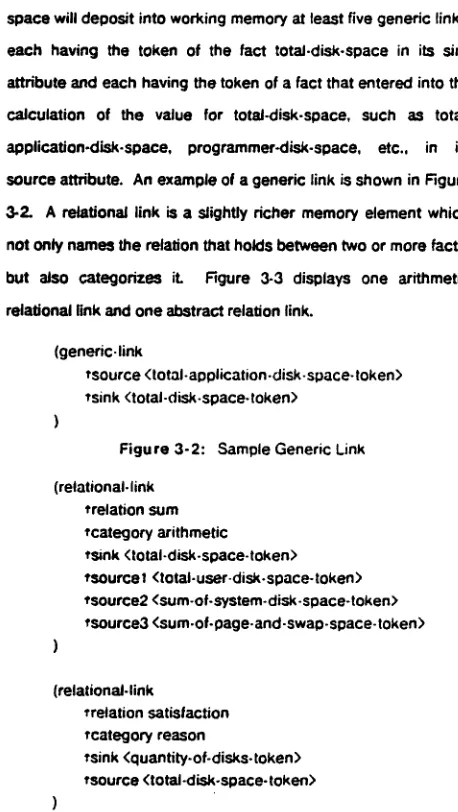
A generic link is a very sJmple memory element consisting of
only two attributes, a source attribute and a sink attribute. The
value of the source attribute is the token (i.e., unique identifier) of
some fact that entered into the inference of the resultant fact; the
value of the sink attribute is the token of the resultant fact. For
example, the rules that fire to infer a value for the fact total-disk-
space will deposit into working memory at lea.st five generic links,
each having the token of the fact total-disk-space in its sink
attribute and each having the token of a fact that entered into the
calculation of the value for total-disk-space, such aS total-
application-disk-space, programmer-disk-space, etc., in its
source attribute. An example of a generic link is shown in Figure
3-2. A relational link is a sJightly richer memory element which
not only names the relation that holds between two or more facts,
but also categorizes it. Figure 3-3 displays one arithmetic
relational link and one abstract relation link.
(generic.link
tsource <total-application-disk-space-token> tsink <total-disk.space-token>
)
Figure 3-2: Sample Generic Link
(relational- link trelation sum tcategory arithmetic
tsmk <total-disk-space-token> tsourcet <total-user-disk-space-token> tsource2 <sum-of- System-disk-space- token> tSOurce3 <sum-of-page-and-swap-space-token>
)
(relational-link
~retation satisfaction ¢category reason
tsink <quantity-of-disks-token> tsource <total-disk-space- token>
)
F i g u r e 3 - 3 : Sample Arithmetic and Abstract Relational Links
The network formed by relational links is in some ;)laces more
dense and in other ;)laces less dense than the network formed by
genenc links; arithmetic relational links create more levels thus
making the relaUonal network denser, while abstract links tend to
bridge long chains of facts, thus making the network sparser. To
see this distinction, consider the arithmetic formula used by XSEL
to calculate the total-disk-space requirement: total-disk.space =
( (total. application -disk. space + programmer-disk-space ÷ total-data- file-disk- space)
* 125%)
+ sum of system.disk.space
[image:6.612.326.555.93.499.2]The rules that execute this formula create at least five generic
links linking total-disk.space to total-application-disk-space, programmer-disk-space, total-data-file-disk-space, one or more
system-disk-sp,3ce facts, and one or more page-and-swap-space
facts. At the same time they create one relational link linking
total-disk-space to three new intermediate level facts, total-user-
disk-space, sum.of-system-disk-space, and sum-of-page-and-
swap.space, and they create additional relational links linking
each of the intermediate facts to their subfacts. Total.user-disk-
space is a newly created intermediate fact, and a relational link,
with rrelation percent, is created linking it to two more new
intermediate facts, user-disk-space and percent.for-expansion.
Another relational link is in turn created linking user-disk-space to
the three facts total-application-disk-space, programmer-disk-
space, and total-data-file-disk-space.
On the other hand, the rules that determine how many RA60
disk drives are needed, for example, create a dense generic
network linking all the facts that enter into the calculation of total-
disk-space to the facts that allocate some portion of that amount
to fixed-disk-space. From there the network would get even
denser as fixed-disk-space is linked tO the fixed.disk.unit.
capabihty and quantity-of-fixed-disks facts for each candidate. In
fact, these generic links are not currently created due to
limitations of working memory space. In contrast to the
potentially dense generic network, the relational network
contains only a few abstract relation links, such as satisfaction
and allocation links, that bridge many of the generic links, thus
resulting in a sparser network (and in more direct explanations).
There are good reasons for the existence of two complete
networks. Essentially, the tradeoff is that while generic links are
trivial tO create, they do not facilitate satisfying explanations. On
the other hand, the creation of relatil)nal links often requires
manual intervention, lout relational links facilitate direct
explanations. Compare again the generic explanation in Figure
3- I to its corresponding relational explanation in Figure 1.4.
Generic links require little effort to create because they simply
incorporate the tokens of the facts that are used in an inference
234
rule. In fact, an automatic rule generator was developed for
automatically creating most of XSEL's backward.chaining fact-
gathering rules from simple arithmetic formulas such as the
formula for total-disk-spsce discussed above.lit was a trivial task
to have the automatic rule generator include the actions required
to have the inference rules create the generic links.
The task of augmenting the fact-gathering rules to create
arithmetic relational links was also automatable, for the most part.
An automatic link-creator was written to parse the arithmetic
formulas that were input to the rule generator and create the
appropriate links. This parser identified the main arithmetic
operations, created names for intermediate facts, and modified
XSEL's rules to have them create the arithmetic relational links.
The output of the automatic link-creator required only minor
manual retouching in those cases where its heuristics for
creating names for intermediate facts fell short. 2 But the task of
augmenting the component selection rules to create the abstract
relational links between facts has so far resisted an automatic
solution. These links are now being added manually. They
require the effort of someone who understands the workings of
XSEL and recognizes what explanations might be called for and.
consequently, which rules should be modified to create relational
links.
3.2. O v e r v i e w of P r o c e s s i n g
The processing of a query by a link-dependent message
generator goes as follows. When the initial query is input, a
query-interpretation context is entered. In this context some
rules fire tO identify and locate the fact in question, to create a
query-term with the same token as the fact. and to place that
query-term in the query-queue. Following query-interpretation, a
message generation cycle consisting roughly of the following five
steps reiterates: 1) focus on the next query-term in the queue, 2)
locate the links related to that query-term, 3) select an
explanation schema 3 based on the links found, 4) create
1XSEL's automatic ride gammer was v~ten by Samly Marcus.
additional query-terms and messages suggested by the selected
schema, and 5) turn control over to the surface generator. Each
time a new query-term is created, queue-control rules decide
whether to place it in the query-queue, depending on such
factors as whether the term has already been explained and how
many levels of explanation the user has requested. As long as
the query-queue is not empty, the message generation cycle is
reiterated.
When the message generator is in generic mode, it b
constrained to locating generic links during step 2 of the cycle,
and it is constrained to selecting the generic schema during step
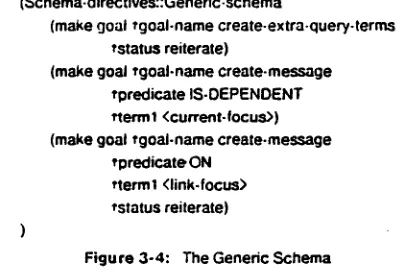
3 of the cycle. A simplified version of the generic schema is
depicted in Figure 3.4. The first directive of the generic schema
(Schema-directives::Generic-schema
(make goal tgoal-name create.extra.query.terms tstatus reiterate)
(make goal Tgoal-name create-message tgredicate IS-DEPENDENT ~ e r m l <current-focus>) (make goal rgoal-narne create-message
?predicate ON ~terml <link.focus> tstatus reiterate)
[image:8.612.85.289.337.472.2])
Figure 3-4: The Generic Schema
directs the message generator to create additional query.terms
for all the facts that are linked to the current query-term. The
second directive directs the message generator to create one
message with the predicate "IS-DEPENDENT" and with the
focus-token of term1, which is the current query.term. The
surface realization of this message will be the clause "THE
VALUE OF 3600 MEGABYTES FOR TOTAL-DISK-SPACE IS
DEPENDENT ". The third directive of the generic schema directs
the message generator to create one additional message with the
predicate "ON" and the focus.token of terror for each of the link
terms found. These messages will emerge as prepositional
phrases in their surface form, such as " ON 1424 KILOBYTES
FOR TOTAL-APPLICATION.DISK.SPACE, 110592 KILOBYTES
3'The term so/letup wls adOl~ed fRmt ~e ~ of McKeown(11), ~ simdet smBclu=~s f~ discou~e o¢~=anizatlo~.
FOR PROGRAMMER.DISK.SPACE , 2816000 KILOBYTES FOR
TOTAL-DATA.FILE.DISK.SPACE , 600 KILOBYTES FOR PAGE.
AND-SWAP-SPACE AND 25600 KILOBYTES FOR SYSTEM-DISK-
SPACE ."
When the message generator is in relational mode, it is
constrained to locating relational links and using relational
schemas. There are a variety of each. Currently, relational links
are categorized as being either reasons, elaborations, or
arithmetic links. During step 2 of the message-generation cycle,
the message generator searches first for reason links, next for
elaboration links, and finally for arithmetic links. In some cases,
the search for arithmetic links may be suppressed. For example,
some links whose relation is allocation are subcategorized as
being arithmetic operations, as in "75 percent of the total.disk.
space requirement was allocated to removable-pack disks". In
these cases, expressing the arithmetic relation also would be
redundant.
When a relational link is located, a corresponding schema is
selected. In contrast to the single generic schema, there are a
variety of arithmetic and abstract relational ~chemas. Figure 3-5
illustrates the arithmetic "plus" schema that was used to
generate the messages for the first paragraph of the "why
quantity totaJ-disk-space" relational explanation shown in Figure
1-4. It contains five directives, one to create the new query-terms
found in the arithmetic reasoning trace and four to create
messages. The second message creation directive will create as
many messages as are needed to account for at least 80 percent
of the total value of the fact being explained. (The 80 percent
factor was implemented in order to filter out insignificant facts,
thus making the explanation more concise. Another process that
contributes to more readable explanations is the conversion of all
units in different clauses of the explanation to the same highest
common denominator, eg. megabytes.) Following that, two
additional messages will be created, one to mention that the
remainder of the total is accounted for by other terms, and
another to give an example.
(Schema-directives:plus-schema
(make goal tgoal-name create-extra-query.terms ~status reiterate)
(make goal tgoal-name create- message tfocus-token <token I >
tpredicate CAPACITY.REQUIREMENT tsubname RECOMMENDED) (make goal tgoal.name create-messege
tfocus-token new
?predicate CAPACITY-REQUIREMENT ~ubname GENERAL
tamount 80)
(make goal tgoal-name create-message tpredicate REMAINDER)
(make goal tgoal.name Create-message tfocus.token new tpredicate EXAMPLE)
)
F i g u r e 3-5: Sample Arithmetic Schema
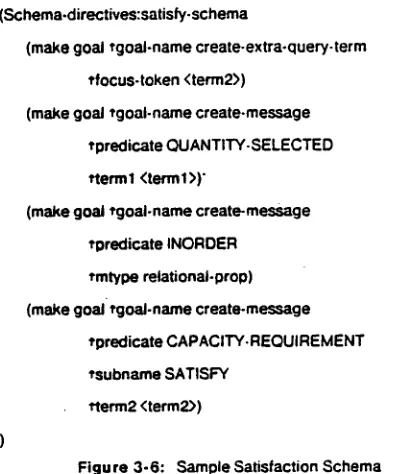
to create the massages for the first sentence of the "why quantity RA60" explanation shown in Figure 1-5. It contains one directive to create an extra query-term matching the token of the new term identified in the "satisfaction" link, and three actions making the three messages which surface as three clauses of text in the explanation.
4 .
Rationale
The knowledge structures just described, including mas=mge~ query.terms, the query-queue, schemas and links, serve as intermediate structures between the reasoning knowledge of the expert system and the linguistic knowledge needed for language generation .4 Some of the terminology used to describe these structures, e.g., "reason" and "elaboration" relations, is derived from the work of Mann [7] and Hobbs[3] on discourse organization. Mann and Hobbs independently postulate that discourse relations, such as reason and elaboration relations among others, are rasDonsible for coherence in well-organized
(Schema.directives:satisfy-schema
(make goal tgoal-name create-extra.query-term Hocus-token <term2>)
(make goal tgoal.narne create-message ?predicate QUANTITY.SELECTED tterml <term1>)"
(make goal ?goal.name create-message tpredicate INORDER
1"retype relational-prop) (make goal tgoal-narne create-message
?predicate CAPACITY.REQUIREMENT tsubncme SATISFY
[image:9.612.55.290.81.515.2]tterm2 <term?.>)
Figure 3-6: Sample Satisfaction Schema
natural language text. One of the premises of this work on explanation generation is that the relations, or links, that are embodied in the inference rules of a successful reasoning system are the same ones that give coherence to natural language explanations. An immediate goal of this research is to identity those relations. At the present time only twenty.six different reasoning relations, have been identified in XSEL. As more types of reasoning relations are identified and corresponding links are added to XSEL's rules, more of XSEL's reasoning will be explainable. A long term goal of this work is to continue to identify and add reasoning links and schemas until we see some generalities begin to emerge. Perhaps some domain- independent set of reasoning relations and schemas might be found. Furthermore. such relations and schemas might facilitate the design of a knowledge acquisition system that would elicit knowledge from an expert, represent it as relations, and generate inference rules from relations. We realize that this could be a
very long term goal, but it aJse has the short term benefit of providing useful explanations.
[image:9.612.311.508.101.338.2]Acknowledgements
Many people at CMU and DEC have contributed to the development of XSEL. Some of these include John McDermott, Tianran Wang, and Kim Smith who developed XSEL's sizing and selection knowledge; Robert Schnelbach and Michael Browne who worked on explanation facilities; Sandy Marcus, who wrote XSEL's rule generator;, George Wood, Jim Park, and Mike Harmon who provided technical support; and Dan Offutt who is extending XSEL's sizing knowledge with a view towards developing knowledge acquisition facilities.
10. John McDermott. Building Expert Systems. Proceedings of the 1983 NYU Symposium on Artificial Intelligence Applications for Business, New York Univer~ty, New York City, April 198,3. 11. Kathleen Rose McKeown. Generating Natural Language Text in Response to Questions about Database Structure. Ph.D. Th., University of Pennsylvania Computer and Information Science Department, 1982.
12. William R. Swartout. "XPLAIN: a System for Creating and Explaining Expert Consulting Programs". Artificial Intelligence
27 (198,3), 285-325.
References
1. R. Davis. Applications of meta level knowledge to the construction, maintenance, and use of large knowledge bases.
Ph.D. Th., Stanford University, 1976. Stanford Artificial Intelligence L~oratory Memo 283, Stanford, CA.
2. C. L Forgy. OPS.5 User's Manual. CMU.CS-81-135, Dept of Computer Science, Carnegie-Mellon University, Pittsburgh, PA 15213, July 1981.
3. Jerry R. Hobbs. Towards an Understanding of Coherence in Discourse. In W. G. Lehnert and M. H. Ringle, Ed., Strategies for Natural Language Processing, Lawrence Erlbaum Associates, New Jersey, 1982, pp. 223-24,3.
4. Gary Kahn, Steve Now/an, and John McDermott. A
Foundation for Knowledge Acquisition. Proceedings of the IEEE Workshop on Principles of Knowledge.Based Systems, IEEE, Denver, CO, 1984, pp..
5. Gary Kahn and David Gelier. MEX: An OPS-based approach to explanation. 1984.
6. Karan Kukich, John McDermott and Tianran Wang. XSEL as Knowledge Acquirer and Explainer. 1985.
7. William C. Mann and Sandra A. Thompson. Relational Propositions in Discourse. 198,3.
8. Sandra L. Marcus, John McDermott and Tianran Wang. A Knowledge Acquisition System for VT. Proceedings of the AAAI, AAAI, Los Angeles, CA, 1985, pp..