Proceedings of the 49th Annual Meeting of the Association for Computational Linguistics, pages 846–855,
Learning to Transform and Select Elementary Trees for Improved
Syntax-based Machine Translations
Bing Zhao
†,
and
Young-Suk Lee
†,
and
Xiaoqiang Luo
†,
and
Liu Li
‡IBM T.J. Watson Research
†and Carnegie Mellon University
‡{zhaob, ysuklee, xiaoluo}@us.ibm.com and [email protected]
Abstract
We propose a novel technique of learning how to transform the source parse trees to improve the trans-lation qualities of syntax-based transtrans-lation mod-els using synchronous context-free grammars. We transform the source tree phrasal structure into a set of simpler structures, expose such decisions to the decoding process, and find the least expensive transformation operation to better model word re-ordering. In particular, we integrate synchronous bi-narizations, verb regrouping, removal of redundant parse nodes, and incorporate a few important fea-tures such as translation boundaries. We learn the structural preferences from the data in a generative framework. The syntax-based translation system in-tegrating the proposed techniques outperforms the best Arabic-English unconstrained system in NIST-08 evaluations by1.3absolute BLEU, which is sta-tistically significant.
1 Introduction
Most syntax-based machine translation models with syn-chronous context free grammar (SCFG) have been re-lying on the off-the-shelf monolingual parse structures to learn the translation equivalences for string-to-tree, tree-to-string or tree-to-tree grammars. However, state-of-the-art monolingual parsers are not necessarily well suited for machine translation in terms of both labels and chunks/brackets. For instance, in Arabic-to-English translation, we find only 45.5% of Arabic NP-SBJ struc-tures are mapped to the English NP-SBJ with machine alignment and parse trees, and only 60.1% of NP-SBJs are mapped with human alignment and parse trees as in
§2. The chunking is of more concern; at best only 57.4% source chunking decisions are translated contiguously on the target side. To translate the rest of the chunks one has to frequentlybreakthe original structures. The main issue lies in the strong assumption behind SCFG-style nonterminals – each nonterminal (or variable) assumes a source chunk should be rewritten into acontiguouschunk in the target. Without integrating techniques to mod-ify the parse structures, the SCFGs are not to be effec-tive even for translating NP-SBJ in linguistically distant language-pairs such as Arabic-English.
Such problems have been noted in previous literature. Zollmann and Venugopal (2006) and Marcu et al. (2006) used broken syntactic fragments to augment their gram-mars to increase the rule coverage; while we learn opti-mal tree fragments transformed from the original ones via a generative framework, they enumerate the fragments available from the original trees without learning pro-cess. Mi and Huang (2008) introduced parse forests to blur the chunking decisions to a certain degree, to ex-pand search space and reduce parsing errors from 1-best trees (Mi et al., 2008); others tried to use the parse trees as soft constraints on top of unlabeled grammar such as Hiero (Marton and Resnik, 2008; Chiang, 2010; Huang et al., 2010; Shen et al., 2010) without sufficiently lever-aging rich tree context. Recent works tried more com-plex approaches to integrate both parsing and decoding in onesinglesearch space as in (Liu and Liu, 2010), at the cost of huge search space. In (Zhang et al., 2009), combinations of tree forest andtree-sequence(Zhang et al., 2008) based approaches were carried out by adding pseudo nodes and hyper edges into the forest. Overall, the forest-based translation can reduce the risks from up-stream parsing errors and expand the search space, but it cannot sufficiently address the syntactic divergences between various language-pairs. The tree sequence ap-proach adds pseudo nodes and hyper edges to the forest, which makes the forest even denser and harder for nav-igation and search. As trees thrive in the search space, especially with the pseudo nodes and edges being added to the already dense forest, it is becoming harder to wade through the deep forest for the best derivation path out.
We propose to simplify suitable subtrees to a reason-able level, at which the correct reordering can be easily identified. The transformed structure should be frequent enough to have rich statistics for learning a model. In-stead of creating pseudo nodes and edges and make the forest dense, we transform a tree with a few simple oper-ators; only meaningful frontier nodes, context nodes and edges are kept to induce the correct reordering; such oper-ations also enable the model to share the statistics among all similar subtrees.
On the basis of our study on investigating the language divergence between Arabic-English with human aligned and parsed data, we integrate several simple statistical op-erations, to transform parse trees adaptively to serve the
translation purpose better. For each source span in the given sentence, a subgraph, corresponding to an elemen-tary tree (in Eqn. 1), is proposed for PSCFG translation; we apply a few operators to transform the subgraph into some frequent subgraphs seen in the whole training data, and thus introduce alternative similar translational equiv-alences to explain the same source span with enriched statistics and features. For instance, if we regroup two adjacent nodes IV and NP-SBJ in the tree, we can ob-tain the correct reordering pattern for verb-subject order, which is not easily available otherwise. By finding a set of similar elementary trees derived from the original ele-mentary trees, statistics can be shared for robust learning. We also investigate the features using the context be-yond the phrasal subtree. This is to further disambiguate the transformed subgraphs so that informative neighbor-ing nodes and edges can influence the reorderneighbor-ing prefer-ences for each of the transformed trees. For instance, at the beginning and end of a sentence, we do not expect dramatic long distance reordering to happen; or under SBAR context, the clause may prefer monotonic reorder-ing for verb and subject. Such boundary features were treated as hard constraints in previous literature in terms of re-labeling (Huang and Knight, 2006) or re-structuring (Wang et al., 2010). The boundary cases were not ad-dressed in the previous literature for trees, and here we include them in our feature sets for learning a MaxEnt model to predict the transformations. We integrate the neighboring context of the subgraph in our transforma-tion preference predictransforma-tions, and this improve translatransforma-tion qualities further.
The rest of the paper is organized as follows: in sec-tion 2, we analyze the projectable structures using hu-man aligned and parsed data, to identify the problems for SCFG in general; in section 3, our proposed approach is explained in detail, including the statistical operators using a MaxEnt model; in section 4, we illustrate the in-tegration of the proposed approach in our decoder; in sec-tion 5, we present experimental results; in secsec-tion 6, we conclude with discussions and future work.
2 The Projectable Structures
A context-free style nonterminal in PSCFG rules means the source span governed by the nonterminal should be translated into a contiguous target chunk. A “projectable” phrase-structure means that it is translated into a con-tiguous span on the target side, and thus can be gener-alized into a nonterminal in our PSCFG rule. We carried out a controlled study on the projectable structures using human annotated parse trees and word alignment for5k Arabic-English sentence-pairs.
In Table 1, the unlabeled F-measures with machine alignment and parse trees show that, for only 48.71% of the time, the boundaries introduced by the source parses
Alignment Parse Labels Accuracy
H H
NP-SBJ 0.6011 PP 0.3436 NP 0.4832 unlabel 0.5739
M H
NP-SBJ 0.5356 PP 0.2765 NP 0.3959 unlabel 0.5305
M M
[image:2.612.334.520.71.231.2]NP-SBJ 0.4555 PP 0.1935 NP 0.3556 unlabel 0.4871
Table 1: The labeled and unlabeled F-measures for projecting the source nodes onto the target side via alignments and parse trees; unlabeled F-measures show the bracketing accuracies for translating a source span contiguously. H: human, M: machine.
are real translation boundaries that can be explained by a nonterminal in PSCFG rule. Even for human parse and alignment, the unlabeled F-measures are still as low as 57.39%. Such statistics show that we should not blindly learn tree-to-string grammar; additional transformations to manipulate the bracketing boundaries and labels ac-cordingly have to be implemented to guarantee the reli-ability of source-tree based syntax translation grammars. The transformations could be as simple as merging two adjacent nonterminals into one bracket to accommodate non-contiguity on the target side, or lexicalizing those words which have fork-style, many-to-many alignment, or unaligned content words to enable the rest of the span to be generalized into nonterminals. We illustrate several cases using the tree in Figure 1.
NP−SBJ
the millde east crisis up
that make
mn
PREP PRON
+hA Azmp NOUN
Al$rq ADJ
AlAwsT PRON IV
Alty ttAlf
NOUN WHNP VP PP−CLR
SBAR
S
NP
Figure 1: Non-projectable structures in an SBAR tree with human parses and alignment; there are non-projectable struc-tures: the deleted nonterminals PRON (+hA), the many-to-many alignment for IV(ttAlf) PREP(mn), fork-style alignment for NOUN (Azmp).
[image:2.612.325.522.485.627.2]illus-trated: the deleted nonterminals PRON (+hA), the many-to-many alignment for IV(ttAlf) PREP(mn), fork-style alignment for NOUN (Azmp). Intuitively, it would be good to glue the nodes NOUN(Al$rq) ADJ(AlAwsT) un-der the node of NP, because it is more frequent for moving ADJ before NOUN in our training data. It should be eas-ier to model the swapping of (NOUN ADJ) using the tree (NP NOUN, ADJ) instead of the original bigger tree of (NP-SBJ Azmp, NOUN, ADJ) with one lexicalized node. Approaches in tree-sequence based grammar (Zhang et al., 2009) tried to address the bracketing problem by us-ing arbitrary pseudo nodes to weave a new “tree” back into the forest for further grammar extractions. Such ap-proach may improve grammar coverage, but the pseudo node labels would be arguably a worse choice to split the already sparse data. Some of the interior nodes con-necting the frontier nodes might be very informative for modeling reordering. Also, due to the introduced pseudo nodes, it would needexponentiallymany nonterminals to keep track of the matching tree-structures for translations. The created pseudo node could easily block the informa-tive neighbor nodes associated with the subgraph which could change the reordering nature. For instance, IV and NP-SBJ tends to swap at the beginning of a sentence, but it may prefer monotone if they share a common parent of SBAR for a subclause. In this case, it is unnecessary to create a pseudo node “IV+SBJ” to block useful factors.
We propose to navigate through the forest, via simpli-fying trees by grouping the nodes, cutting the branches, and attaching connected neighboring informative nodes to further disambiguate the derivation path. We apply ex-plicit translation motivated operators, on a given mono-lingual elementary tree, to transform it into similar but simpler trees, and expose such statistical preferences to the decoding process to select the best rewriting rule from theenrichedgrammar rule sets, for generating tar-get strings.
3 Elementary Trees to String Grammar
We propose to use variations of an elementary tree, which is a connected subgraph fitted in the original monolingual parse tree. The subgraph is connected so that the frontiers (two or more) are connected by theirimmediate common parent. Letγbe a source elementary tree:
γ=< `;vf, vi, E >, (1) wherevf is a set offrontier nodeswhich contain
nonter-minals or words;viare theinterior nodeswith source
la-bels/symbols;Eis the set ofedgesconnecting the nodes
v=vf+viinto a connectedsubgraphfitted in the source
parse tree;`is theimmediate common parentof the fron-tier nodesvf. Our proposed grammar rule is formulated
as follows:
< γ;α;∼; ¯m; ¯t >, (2)
where α is the target string, containing the terminals and/or nonterminals in a target language; ∼is the one-to-one alignment of the nonterminals betweenγandα;¯t
contains possible sequence of transform operations (to be explained later in this section) associated with each rule;
¯
mis a function of enumerating the neighborhood of the source elementary treeγ, and certain tree context (nodes and edges) can be used to further disambiguate the re-ordering or the given lexical choices. The interior nodes ofγ.vi, however, are not necessarily informative for the
reordering decisions, like the unary nodes WHNP,VP, and PP-CLR in Figure 1; while the frontier nodesγ.vfare the
ones directly executing the reordering decisions. We can selectively cut off the interior nodes, which have no or only weak causal relations to the reordering decisions. This will enable the frequency or derived probabilities for executing the reordering to be more focused. We call suchtransformation operators¯t. We specified a few op-erators for transforming an elementary treeγ, including flattening tree operators such as removing interior nodes invi, or grouping the children via binarizations.
Let’s use the trigram “Alty ttAlf mn” in Figure 1 as an example, the immediate common parent for the span is SBAR:γ.` = SBAR; the interior nodes areγ.vi = {WHNP VP S PP-CLR}; the frontier nodes areγ.vf =
(x:PRON x:IV x:PREP). The edgesγ.E(as highlighted in Figure 1) connectγ.viandγ.vfinto a subgraph for the
given source ngram.
For any source span, we look up one elementary treeγ
covering the span, then we select an operator¯t ∈ T, to explore a set of similar elementary treest(γ,¯ m) =¯ {γ0}
as simplified alternatives for translating that source tree (span)γinto an optimal target stringα∗accordingly. Our
generative model is summarized in Eqn. 3:
α∗= arg max
¯
t∈T;γ0∈t(γ,¯ m)¯
pa(α0|γ0)×
pb(γ0|¯t, γ,m)¯ ×
pc(¯t|γ,m).¯ (3)
In our generative scheme, for a given elementary tree
γ, we sample an operator (or a combination of operations)
¯
t with the probability of pc(¯t|γ); with operation ¯t, we
transformγinto a set of simplified versionsγ0 ∈¯t(γ,m)¯
with the probability ofpb(γ0|¯t, γ); finally we select the
transformed version γ0 to generate the target string α0
with a probability ofpa(α0|γ0). Note here,γ0andγshare
the same immediate common parent`, but not necessar-ily the frontier, or interior, or even neighbors. The frontier nodes can be merged, lexicalized, or even deleted in the tree-to-string rule associated withγ0, as long as the
align-ment for the nonterminals are book-kept in the deriva-tions. To simplify the model, one can choose the operator
¯
to learn arepa(α0|γ0)for rule alignment, and the
pref-erence model pb(γ0|¯t, γ,m)¯ , and the operator proposal
modelpc(¯t|γ,m)¯ , which in our case is a maximum
en-tropy model— the key model in our proposed approach in this paper for transforming the original elementary tree into similar trees for evaluating the reordering probabili-ties.
Eqn. 3 significantly enriches reordering powers for syntax-based machine translation. This is because it uses allsimilarset of elementary trees to generate the best tar-get strings. In the next section, we’ll first define the op-erators conceptually, and then explain how we learn each of the models.
3.1 Model pa(α0|γ0)
A log linear model is applied here to approximate
pa(α0|γ0)∝exp(¯λ·f f)via weighted combination (¯λ) of
feature functionsf f(α0, γ0), including relative
frequen-cies in both directions, and IBM Model-1 scores in both directions asγ0 andα0 have lexical items within them.
We also employed a few binary features listed in the fol-lowing table.
γ0is observed less than 2 times
(α0, γ0)deletes a src content word
(α0, γ0)deletes a src function word
(α0, γ0)over generates a tgt content word
(α0, γ0)over generates a tgt function word
Table 2: Additional5Binary Features forpa(α0|γ0)
3.2 Model pb(γ0|¯t, γ,m)¯
pb(γ0|¯t, γ,m)¯ is our preference model. For instance
us-ing the operator t¯of cutting an unary interior node in
γ.vi, ifγ.vi has more than one unary interior node, like
the SBAR tree in Figure 1, having three unary interior node: WHNP, VP and PP-CLR,pb(γ0|¯t, γ,m)¯ specifies
which one should have more probabilities to be cut. In our case, to make model simple, we simply choose his-togram/frequency for modeling the choices.
3.3 Model pc(¯t|γ,m)¯
pc(¯t|γ,m)¯ is our operator proposal model. It ranks
the operators which are valid to be applied for the given source tree γ together with its neighborhoodm¯. Here, in our approach, we applied a Maximum Entropy model, which is also employed to train our Arabic parser:
pc(¯t|γ,m)¯ ∝ exp ¯λ·f f(¯t, γ,m)¯ . The feature sets we
use here are almost the same set we used to train our Ara-bic parser; the only difference is the future space here is operator categories, and we check bag-of-nodes for inte-rior nodes and frontier nodes. The key feature categories we used are listed as in the Table 3. The headtable used in our training is manually built for Arabic.
bag-of-nodesγ.vi
bag-of-nodes and ngram ofγ.vf
chunk-level features: left-child, right-child, etc. lexical features: unigram and bigram
pos features: unigram and bigram contextual features: surrounding words
Table 3: Feature Features for learningpc(¯t|γ,m)¯
3.4 t¯: Tree Transformation Function
Obvious systematic linguistic divergences between language-pairs could be handled by some simple oper-ators such as using binarization to re-group contiguously aligned children. Here, we start from the human aligned and parsed data as used in section 2 to explore potential useful operators.
3.4.1 Binarizations
One of the simplest way for transforming a tree is via bi-narization. Monolingual binarization chooses to re-group children into smaller subtree with a suitable label for the newly created root. We choose a function mapping to se-lect thetop-frequentlabel as the root for the grouped chil-dren; if such label is not found we simply use the label of the immediate common parent forγ. In decoding time, we need to select trees from all possible binarizations, while in the training time, we restrict the choices allowed with the alignment constraint, that every grouped chil-dren should be aligned contiguously on the target side. Our goal is to simulate the synchronous binarization as much as we can. In this paper, we applied the four ba-sic operators for binarizing a tree: left-most, right-most and additionally head-out left and head-out right for more than three children. Two examples are given in Table 4, in which we used LDC style representation for the trees.
With the proper binarization, the structure becomes rich in sub-structures which allow certain reordering to happen more likely than others. For instance for the sub-tree (VP PV NP-SBJ), one would apply stronger statistics from training data to support the swap of NP-SBJ and PV for translation.
3.4.2 Regrouping verbs
Verbs are keys for reordering especially for Araic-English with VSO translated into SVO. However, if the verb and its relevant arguments for reordering are at different lev-els in the tree, the reordering is difficult to model as more interior nodes combinations will distract the distributions and make the model less focused. We provide the fol-lowing two operations specific for verb in VP trees as in Table 5.
3.4.3 Removing interior nodes and edges
Binarization Operations Examples
right-most (NP XnounXadj1 Xadj2)7→(NP Xnoun(ADJPXadj1 Xadj2))
[image:5.612.114.257.404.507.2]left-most (VP Xpv XNP-SBJXSBAR)7→(VP (VP XpvXNP-SBJ)XSBAR)
Table 4: Operators for binarizing the trees
Operators for regroup verbs Examples
regroup verb (V P1Xv (V P2Y))7→(V P1(V P2XvY))
regroup verb and remove the top level VP (R (V P1Xv(R2Y)))7→(R (R2XvY))
Table 5: Operators for manipulating the trees
possible due to the many-to-many alignment, insertions and deletions of terminals. So, we introduce the oper-ators to remove the interior nodesγ.vi selectively; this
way, we can flatten the tree, remove irrelevant nodes and edges, and can use more frequent observations of simpli-fied structures to capture the reordering patterns. We use two operators as shown in Table 6.
The second operator deletes all the interior nodes, la-bels and edges; thus reordering will become a Hiero-alike (Chiang, 2007) unlabeled rule, and additionally a spe-cial glue rule: X1X2 → X1X2. This operator is
neces-sary, we need a scheme to automatically back off to the meaningful glue or Hiero-alike rules, which may lead to a cheaper derivation path for constructing a partial hypoth-esis, at the decoding time.
NP*
PREP
to ignite the situation
AlAwDAE DET+NOUN
AlAnfjAr DET+NOUN
dfE NOUN
NP NP
PP*
NP
Aly
Figure 2: A NP tree with an “inside-out” alignment. The nodes “NP*” and “PP*” are not suitable for generalizing into NTs used in PSCFG rules.
As shown in Table 1, NP brackets has only 35.56% of time to be translated contiguously as an NP in machine aligned & parsed data. The NP tree in Figure 2 happens to be an “inside-out” style alignment, and context free gram-mar such as ITG (Wu, 1997) can not explain this structure well without necessary lexicalization. Actually, the Ara-bic tokens of “dfE Aly AlAnfjAr” form a combination and is turned into English word “ignite” in an idiomatic way. With lexicalization, a Hiero style rule “dfE X Aly AlAnfjAr7→to ignite X” is potentially a better alterna-tive for translating the NP tree. Our operators allow us to back off to such Hiero-style rules to construct deriva-tions, which share the immediate common parent NP, as
defined for the elementary tree, for the given source span.
3.5 m¯: Neighboring Function
For a given elementary tree, we use functionm¯ to check the context beyond the subgraph. This includes looking the nodes and edges connected to the subgraph. Similar to the features used in (Dyer et al., 2009), we check the following three cases.
3.5.1 Sentence boundaries
When the treeγfrontier sets contain the left-most token, right-most token, or both sides, we will add to the neigh-boring nodes the corresponding decoration tagsL(left),
R(right), andB (both), respectively. These decorations are important especially when the reordering patterns for the same trees are depending on the context. For instance, at the beginning or end of a sentence, we do not expect dramatic reordering – moving a token too far away in the middle of the sentences.
3.5.2 SBAR/IP/PP/FRAG boundaries
We check siblings of the root forγfor a few special la-bels, including SBAR, IP, PP, and FRAG. These labels indicate a partial sentence or clause, and the reordering patterns may get different distributions due to the posi-tion relative to these nodes. For instance, the PV and SBJ nodes under SBAR tends to have more monotone prefer-ence for word reordering (Carpuat et al., 2010). We mark the boundaries with position markers such asL-PP, to in-dicate having a left sibling PP,R-IP for having a right sibling IP, andC-SBAR to indicate the elementary tree is a child of SBAR. These labels are selected mainly based on our linguistic intuitions and errors in our translation system. A data-driven approach might be more promis-ing for identifypromis-ing useful markups w.r.t specific reorder-ing patterns.
3.5.3 Translation boundaries
operators for removing nodes/edges Examples
remove unary nodes (R Xt1(R1 (R2 Xt2)))7→(R Xt1(R2 Xt2)))
[image:6.612.123.492.70.113.2]remove all labels (R (R1 Xt1(R2 Xt2)))7→ (R Xt2Xt1)
Table 6: Operators for simplifying the trees
are nottranslation boundaries, and to avoid translation errors we should identify them by applying a PSCFG rule on top of them. During training, we label nodes with translation boundaries, as one additional function tag; during decoding, we employ the MaxEnt model to predict the translation boundary label probability for each span associated with a subgraphγ, and discourage deriva-tions accordingly for using nonterminals over the non-translation boundary span. The non-translation boundaries over elementary trees have much richer representation power. The previous works as in Xiong et al. (2010), defined translation boundaries on phrase-decoder style derivation trees due to the nature of their shift-reduce al-gorithm, which is a special case in our model.
4 Decoding
Decoding using the proposed elementary tree to string grammar naturally resembles bottom up chart parsing al-gorithms. The key difference is at the grammar querying step. Given a grammarG, and the input source parse tree
πfrom a monolingual parser, we first construct the ele-mentary tree for a source span, and then retrieve all the relevant subgraphs seen in the given grammar through the proposed operators. This step is called populating, using the proposed operators to find all relevant elemen-tary treesγ which may have contributed to explain the source span, and put them in the corresponding cells in the chart. There would have been exponential number of relevant elementary trees to search if we do not have any restrictions in the populating step; we restrict the maxi-mum number of interior nodes|γ.vi|to be3, and the size
of frontier nodes|γ.vf|to be less than6; additional
prun-ing for less frequent elementary trees is carried out. After populating the elementary trees, we construct the partial hypotheses bottom up, by rewriting the fron-tier nodes of each elementary tree with the probabili-ties(costs) forγ →α∗as in Eqn. 3. Our decoder (Zhao and Al-Onaizan, 2008) is a template-based chart decoder in C++. It generalizes over the dotted-product operator in Earley style parser, to allow us to leverage many opera-tors¯t∈T as above-mentioned, such as binarizations, at different levels for constructing partial hypothesis.
5 Experiments
In our experiments, we built our system using most of the parallel training data available to us: 250M Arabic run-ning tokens, corresponding to the “unconstrained”
condi-tion in NIST-MT08. We chose the testsets ofnewswire
andwebloggenres from MT08 and DEV101. In
partic-ular, we choose MT08 to enable the comparison of our results to the reported results in NIST evaluations. Our training and test data is summarized in Table 5. For test-ings, we have 129,908 tokens in our testsets. For lan-guage models (LM), we used 6-gram LM trained with
10.3 billion English tokens, and also a shrinkage-based LM (Chen, 2009) – “ModelM” (Chen and Chu, 2010; Emami et al., 2010) with150 word-clusters learnt from
2.1million tokens.
From the parallel data, we extract phrase pairs(blocks) and elementary trees to string grammar in various con-figurations: basic tree-to-string rules (Tr2str), elementary tree-to-string rules with boundaries ¯t(elm2str+ ¯m), and with both¯t andm¯ (elm2str+¯t+ ¯m). This is to evalu-ate the operators’ effects at different levels for decoding. To learn our MaxEnt models defined in§3.3, we collect the events during extracting elm2str grammar in training time, and learn the model using improved iterative scal-ing. We use the same training data as that used in training our Arabic parser. There are16thousand human parse trees with human alignment; additional 1 thousand hu-man parse and aligned sent-pairs are used as unseen test set to verify our MaxEnt models and parsers. For our Arabic parser, we have a labeled F-measure of 78.4%, and POS tag accuracy 94.9%. In particular, we’ll evaluate modelpc(¯t|γ,m)¯ in Eqn. 3 for predicting the translation
boundaries in§3.5.3 for projectable spans as detailed in
§5.1.
Our decoder (Zhao and Al-Onaizan, 2008) supports grammars including monotone, ITG, Hiero, tree-to-string, string-to-tree, and several mixtures of them (Lee et al., 2010). We used19feature functions, mainly from those used in phrase-based decoder like Moses (Koehn et al., 2007), including two language models (one for a 6-gram LM, one for ModelM, one brevity penalty, IBM Model-1 (Brown et al., 1993) style alignment probabil-ities in both directions, relative frequency in both direc-tions, word/rule counts, content/function word mismatch, together with features on tr2str rule probabilities. We use BLEU (Papineni et al., 2002) and TER (Snover et al., 2006) to evaluate translation qualities. Our base-line used basic elementary tree to string grammar without any manipulations and boundary markers in the model,
1DEV10 are unseen testsets used in our GALE project. It was
Data Train MT08-NW MT08-WB Dev10-NW Dev10-WB # Sents 8,032,837 813 547 1089 1059 # Tokens 349M(ar)/230M(en) 25,926 19,654 41,240 43,088
Table 7: Training and test data; using all training parallel training data for 4 test sets
and we achieved a BLEUr4n455.01for MT08-NW, or a cased BLEU of53.31, which is close to the best offi-cially reported result53.85for unconstrained systems.2
We expose the statistical decisions in Eqn. 3 as the rule probability as one of the 19 dimensions, and use Sim-plex Downhill algorithm with Armijo line search (Zhao and Chen, 2009) to optimize the weight vector for de-coding. The algorithm moves all dimensions at the same time, and empirically achieved more stable results than MER(Och, 2003) in many of our experiments.
5.1 Predicting Projectable Structures
The projectable structure is important for our proposed elementary tree to string grammar (elm2str). When a span is predicted not to be a translation boundary, we want the decoder to prefer alternative derivations out-side of the immediate elementary tree, or more aggres-sive manipulation of the trees, such as deleting inte-rior nodes, to explore unlabeled grammar such as Hi-ero style rules, with proper costs. We test separately on predicting the projectable structures, like predicting function tags in§3.5.3, for each node in syntactic parse tree. We use one thousand test sentences with two con-ditions: human parses and machine parses. There are totally 40,674 nodes excluding the sentence-level node. The results are shown in Table 8. It showed our Max-Ent model is very accurate using human trees: 94.5% of accuracy, and about 84.7% of accuracy for using the ma-chine parsed trees. Our accuracies are higher compared with the 71+% accuracies reported in (Xiong et al., 2010) for their phrasal decoder.
Setups Accuracy Human Parses 94.5% Machine Parses 84.7%
Table 8: Accuracies of predicting projectable structures
We zoom in the translation boundaries for MT08-NW, in which we studied a few important frequent labels in-cluding VP and NP-SBJ as in Table 9. According to our MaxEnt model, 20% of times we should discourage a VP tree to be translated contiguously; such VP trees have an average span length of 16.9 tokens in MT08-NW. Simi-lar statistics are 15.9% for S-tree with an average span of 13.8 tokens.
2See link: http://www.itl.nist.gov/iad/mig/tests/mt/2008/doc/mt08
official results v0.html
[image:7.612.316.535.339.459.2]Labels total NonProj Percent Avg.len VP* 4479 920 20.5% 16.9 NP* 14164 825 5.8% 8.12 S* 3123 495 15.9% 13.8 NP-SBJ* 1284 53 4.12% 11.9
Table 9: The predicted projectable structures in MT08-NW
Using the predicted projectable structures for elm2str grammar, together with the probability defined in Eqn. 3 as additional cost, the translation results in Table 11 show it helps BLEU by 0.29 BLEU points (56.13 v.s. 55.84). The boundary decisions penalize the derivation paths us-ing nonterminals for non-projectable spans for partial hy-pothesis construction.
Setups TER BLEUr4n4
Baseline 39.87 55.01 right-binz (rbz) 39.10 55.19 left-binz (lbz) 39.67 55.31 Head-out-left (hlbz) 39.56 55.50 Head-out-right (hrbz) 39.52 55.53 +all binzation (abz) 39.42 55.60 +regroup-verb 39.29 55.72 +deleting interior nodesγ.vi 38.98 55.84
Table 10: TER and BLEU for MT08-NW, using only¯t(γ)
5.2 Integratingt¯andm¯
We carried out a series of experiments to explore the im-pacts using¯tandm¯ for elm2str grammar. We start from transforming the trees via simple operatort(γ)¯ , and then expand the function with more tree context to include the neighboring functions:¯t(γ,m)¯ .
Setups TER BLEUr4n4 Baseline w/¯t 38.98 55.84 + TM Boundaries 38.89 56.13 + SENT Bound 38.63 56.46 all¯t(γ,m)¯ 38.61 56.87
Table 11: TER and BLEU for MT08-NW, using¯t(γ,m)¯ .
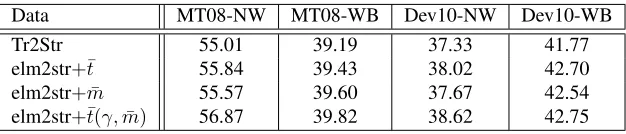
[image:7.612.122.246.532.571.2] [image:7.612.335.515.585.652.2]Data MT08-NW MT08-WB Dev10-NW Dev10-WB Tr2Str 55.01 39.19 37.33 41.77 elm2str+¯t 55.84 39.43 38.02 42.70 elm2str+ ¯m 55.57 39.60 37.67 42.54 elm2str+¯t(γ,m)¯ 56.87 39.82 38.62 42.75
Table 12: BLEU scores on various test sets; comparing elementary tree-to-string grammar (tr2str), transformation of the trees (elm2str+¯t), using the neighboring function for boundaries ( elm2str+ ¯m), and combination of all together ( elm2str+¯t(γ,m)¯ ). MT08-NW and MT08-WB have four references; Dev10-WB has three references, and Dev10-NW has one reference. BLEUn4 were reported.
over the baseline from +0.18 (via right-most binarization) to +0.52 (via head-out-right) BLEU points. When we combine all binarizations (abz), we did not see additive gains over the best individual case – hrbz. Because during our decoding time, we do not frequently see large number of children (maximum at 6), and for smaller trees (with three or four children), these operators will largely gen-erate same transformed trees, and that explains the differ-ences from these individual binarization are small. For other languages, these binarization choices might give larger differences. Additionally, regrouping the verbs is marginally helpful for BLEU and TER. Upon close ex-aminations, we found it is usually beneficial to group verb (PV or IV) with its neighboring nodes for expressing phrases like “have to do” and “will not only”. Deleting the interior nodes helps on shrinking the trees, so that we can translate it with more statistics and confidences. It helps more on TER than BLEU for MT08-NW.
Table 11 extends Table 10 with neighboring function to further disambiguate the reordering rule using the tree context. Besides the translation boundary, the reorder-ing decisions should be different with regard to the posi-tions of the elementary tree relative to the sentence. At the sentence-beginning one might expect more for mono-tone decoding, while in the middle of the sentence, one might expect more reorderings. Table 11 shows when we add such boundary markups in our rules, an improvement of 0.33 BLEU points were obtained (56.46 v.s. 56.13) on top of the already improved setups. A close check up showed that the sentence-begin/end markups signifi-cantly reduced the leading “and” (from Arabic word w#) in the decoding output. Also, the verb subject order un-der SBAR seems to be more like monotone with a lead-ing pronoun, rather than the general strong reorderlead-ing of moving verb after subject. Overall, our results showed that such boundary conditions are helpful for executing the correct reorderings. We conclude the investigation with full function¯t(γ,m)¯ , which leads to a BLEUr4n4 of 56.87 (cased BLEUr4n4c 55.16), a significant improve-ment of 1.77 BLEU point over a already strong baseline. We apply the setups for several other NW and WEB datasets to further verify the improvement. Shown in Ta-ble 12, we apply separately the operators for¯tandm¯ first,
then combine them as the final results. Varied improve-ments were observed for different genres. On DEV10-NW, we observed 1.29 BLEU points improvement, and about 0.63 and 0.98 improved BLEU points for MT08-WB and DEV10-MT08-WB, respectively. The improvements for newwire are statistically significant. The improve-ments for weblog are, however, only marginally better. One possible reason is the parser quality for web genre is reliable, as our training data is all in newswire. Regarding to the individual operators proposed in this paper, we ob-served consistent improvements of applying them across all the datasets. The generative model in Eqn. 3 leverages the operators further by selecting the best transformed tree form for executing the reorderings.
5.3 A Translation Example
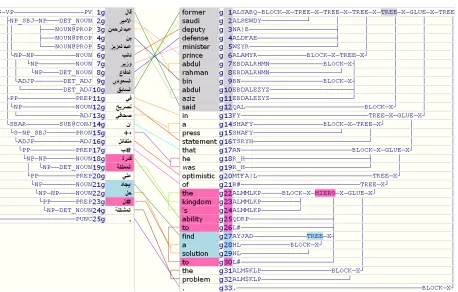
To illustrate the advantages of the proposed grammar, we use a testing case with long distance word reordering and the source side parse trees. We compare the translation from a strong phrasal decoder (DTM2) (Ittycheriah and Roukos, 2007), which is one of the top systems in NIST-08 evaluation for Arabic-English. The translations from both decoders with the same training data (LM+TM) are in Table 13. The highlighted parts in Figure 3 show that, the rules on partial trees are effectively selected and ap-plied for capturing long-distance word reordering, which is otherwise rather difficult to get correct in a phrasal sys-tem even with a MaxEnt reordering model.
6 Discussions and Conclusions
Src Sent qAl AlAmyr EbdAlrHmn bn EbdAlEzyz nA}b wzyr AldfAE AlsEwdy AlsAbq fy tSryH SHAfy An +h mtfA}l b# qdrp Almmlkp Ely AyjAd Hl l# Alm$klp .
Phrasal Decoder prince abdul rahman bin abdul aziz , deputy minister of defense former saudi said in a press statement that he was optimistic about the kingdom ’s ability to find a solution to the problem .
Elm2Str+¯t(γ,m)¯ former saudi deputy defense minister prince abdul rahman bin abdul aziz said in a press statement
[image:9.612.80.538.168.460.2]that he was optimistic of the kingdom ’s ability to find a solution to the problem . Table 13: A translation example, comparing with phrasal decoder.
Figure 3: A testing case: illustrating the derivations from chart decoder. The left panel is source parse tree for the Arabic sentence — the input to our decoder; the right panel is the English translation together with the simplified derivation tree and alignment from our decoder output. Each “X” is a nonterminal in the grammar rule; a “Block” means a phrase pair is applied to rewrite a nonterminal; “Glue” and “Hiero” means the unlabeled rules were chosen to explain the span as explained in§3.4.3 ; “Tree” means a labeled rule is applied for the span. For instance, for the source span [1,10], a rule is applied on a partial tree with PV and NP-SBJ; for the span [18,23], a rule is backed off to an unlabeled rule (Hiero-alike); for the span [21,22], it is another partial tree of NPs.
Within the proposed framework, we also presented several special cases including the translation boundaries for nonterminals in SCFG for translation. We achieved a high accuracy of 84.7% for predicting such bound-aries using MaxEnt model on machine parse trees. Fu-ture works aim at transforming such non-projectable trees into projectable form (Eisner, 2003), driven by translation rules from aligned data(Burkett et al., 2010), and infor-mative features form both the source3and the target sides
(Shen et al., 2008) to enable the system to leverage more
3The BLEU score on MT08-NW has been improved to57.55since
the acceptance of this paper, using the proposed technique but with our GALE P5 data pipeline and setups.
isomorphic trees, and avoid potential detour errors. We are exploring the incremental decoding framework, like (Huang and Mi, 2010), to improve pruning and speed.
Acknowledgments
This work was partially supported by the Defense Ad-vanced Research Projects Agency under contract No. HR0011-08-C-0110. The views and findings contained in this material are those of the authors and do not necessar-ily reflect the position or policy of the U.S. government and no official endorsement should be inferred.
References
Peter F. Brown, Stephen A. Della Pietra, Vincent. J. Della Pietra, and Robert L. Mercer. 1993. The mathematics of statistical machine translation: Parameter estimation. In Computational Linguistics, volume 19(2), pages 263–331. David Burkett, John Blitzer, and Dan Klein. 2010. Joint
pars-ing and alignment with weakly synchronized grammars. In Proceedings of HLT-NAACL, pages 127–135, Los Angeles, California, June. Association for Computational Linguistics. Marine Carpuat, Yuval Marton, and Nizar Habash. 2010. Reordering matrix post-verbal subjects for arabic-to-english smt. In17th Confrence sur le Traitement Automatique des Langues Naturelles, Montral, Canada, July.
Stanley F. Chen and Stephen M. Chu. 2010. Enhanced word classing for model m. InProceedings of Interspeech. Stanley F. Chen. 2009. Shrinking exponential language
mod-els. InProceedings of NAACL HLT,, pages 468–476. David Chiang. 2007. Hierarchical phrase-based translation. In
Computational Linguistics, volume 33(2), pages 201–228. David Chiang. 2010. Learning to translate with source and
target syntax. InProc. ACL, pages 1443–1452.
Chris Dyer, Hendra Setiawan, Yuval Marton, and Philip Resnik. 2009. The University of Maryland statistical machine trans-lation system for the Fourth Workshop on Machine Trans-lation. InProceedings of the Fourth Workshop on Statisti-cal Machine Translation, pages 145–149, Athens, Greece, March.
Jason Eisner. 2003. Learning Non-Isomorphic tree mappings for Machine Translation. InProc. ACL-2003, pages 205– 208.
Ahmad Emami, Stanley F. Chen, Abe Ittycheriah, Hagen Soltau, and Bing Zhao. 2010. Decoding with shrinkage-based language models. InProceedings of Interspeech. Bryant Huang and Kevin Knight. 2006. Relabeling syntax
trees to improve syntax-based machine translation quality. In Proc. NAACL-HLT, pages 240–247.
Liang Huang and Haitao Mi. 2010. Efficient incremental decoding for tree-to-string translation. InProceedings of EMNLP, pages 273–283, Cambridge, MA, October. Asso-ciation for Computational Linguistics.
Zhongqiang Huang, Martin Cmejrek, and Bowen Zhou. 2010. Soft syntactic constraints for hierarchical phrase-based trans-lation using latent syntactic distributions. InProceedings of the 2010 EMNLP, pages 138–147.
Abraham Ittycheriah and Salim Roukos. 2007. Direct transla-tion model 2. InProc of HLT-07, pages 57–64.
Philipp Koehn, Hieu Hoang, Alexandra Birch, Chris Callison-Burch, Marcello Federico, Nicola Bertoldi, Brooke Cowan, Wade Shen, Christine Moran, Richard Zens, Chris Dyer, On-drej Bojar, Alexandra Constantin, and Evan Herbst. 2007. Moses: Open source toolkit for statistical machine transla-tion. InACL, pages 177–180.
Young-Suk Lee, Bing Zhao, and Xiaoqian Luo. 2010. Con-stituent reordering and syntax models for english-to-japanese statistical machine translation. In Proceedings of Coling-2010, pages 626–634, Beijing, China, August.
Yang Liu and Qun Liu. 2010. Joint parsing and translation. InProceedings of COLING 2010,, pages 707–715, Beijing, China, August.
Daniel Marcu, Wei Wang, Abdessamad Echihabi, and Kevin Knight. 2006. Spmt: Statistical machine translation with syntactified target language phraases. In Proceedings of EMNLP-2006, pages 44–52.
Yuval Marton and Philip Resnik. 2008. Soft syntactic con-straints for hierarchical phrased-based translation. In Pro-ceedings of ACL-08: HLT, pages 1003–1011.
Haitao Mi and Liang Huang. 2008. Forest-based translation rule extraction. InProceedings of EMNLP 2008, pages 206– 214.
Haitao Mi, Liang Huang, and Qun Liu. 2008. Forest-based translation. InIn Proceedings of ACL-HLT, pages 192–199. Franz Josef Och. 2003. Minimum error rate training in
Statis-tical Machine Translation. InACL-2003, pages 160–167. Kishore Papineni, Salim Roukos, Todd Ward, and Wei-Jing
Zhu. 2002. Bleu: a method for automatic evaluation of ma-chine translation. InProc. of the ACL-02), pages 311–318, Philadelphia, PA, July.
Libin Shen, Jinxi Xu, and Ralph Weischedel. 2008. A new string-to-dependency machine translation algorithm with a target dependency language model. InProceedings of ACL-08: HLT, pages 577–585, Columbus, Ohio, June. Associa-tion for ComputaAssocia-tional Linguistics.
Libin Shen, Bing Zhang, Spyros Matsoukas, Jinxi Xu, and Ralph Weischedel. 2010. Statistical machine translation with a factorized grammar. In Proceedings of the 2010 EMNLP, pages 616–625, Cambridge, MA, October. Asso-ciation for Computational Linguistics.
Matthew Snover, Bonnie Dorr, Richard Schwartz, Linnea Mic-ciulla, and John Makhoul. 2006. A study of translation edit rate with targeted human annotation. InAMTA.
W. Wang, J. May, K. Knight, and D. Marcu. 2010. Re-structuring, re-labeling, and re-aligning for syntax-based sta-tistical machine translation. InComputational Linguistics, volume 36(2), pages 247–277.
Dekai Wu. 1997. Stochastic inversion transduction grammars and bilingual parsing of parallel corpora. InComputational Linguistics, volume 23(3), pages 377–403.
Deyi Xiong, Min Zhang, and Haizhou Li. 2010. Learn-ing translation boundaries for phrase-based decodLearn-ing. In NAACL-HLT 2010, pages 136–144.
Min Zhang, Hongfei Jiang, Aiti Aw, Haizhou Li, Chew Lim Tan, and Sheng Li. 2008. A tree sequence alignment-based tree-to-tree translation model. InACL-HLT, pages 559–567. Hui Zhang, Min Zhang, Haizhou Li, Aiti Aw, and Chew Lim Tan. 2009. Forest-based tree sequence to string translation model. InProc. of ACL 2009, pages 172–180.
Bing Zhao and Yaser Al-Onaizan. 2008. Generalizing local and non-local word-reordering patterns for syntax-based ma-chine translation. InProceedings of EMNLP, pages 572– 581, Honolulu, Hawaii, October.
Bing Zhao and Shengyuan Chen. 2009. A simplex armijo downhill algorithm for optimizing statistical machine trans-lation decoding parameters. InProceedings of HLT-NAACL, pages 21–24, Boulder, Colorado, June. Association for Com-putational Linguistics.