E r r o r - D r i v e n P r u n i n g of T r e e b a n k G r a m m a r s
for B a s e N o u n P h r a s e I d e n t i f i c a t i o n
C l a i r e C a r d i e a n d D a v i d P i e r c e D e p a r t m e n t o f C o m p u t e r S c i e n c e
C o r n e l l U n i v e r s i t y I t h a c a , N Y 14853 c a r d i e , p i e r c e @ c s . c o r n e l l . e d u
A b s t r a c t
Finding simple, non-recursive, base noun phrases is an important subtask for many natural language processing applications. While previous empirical methods for base NP identification have been rather complex, this paper instead proposes a very simple algorithm that is tailored to the relative simplicity of the task. In particular, we present a corpus-based approach for finding base NPs by matching part-of- speech tag sequences. The training phase of the al- gorithm is based on two successful techniques: first the base NP grammar is read from a "treebank" cor- pus; then the grammar is improved by selecting rules with high "benefit" scores. Using this simple algo- rithm with a naive heuristic for matching rules, we achieve surprising accuracy in an evaluation on the Penn Treebank Wall Street Journal.
1 I n t r o d u c t i o n
Finding base noun phrases is a sensible first step for many natural language processing (NLP) tasks: Accurate identification of base noun phrases is ar- guably the most critical component of any partial parser; in addition, information retrieval systems rely on base noun phrases as the main source of multi-word indexing terms; furthermore, the psy- cholinguistic studies of Gee and Grosjean (1983) in- dicate that text chunks like base noun phrases play an important role in human language processing. In this work we define base NPs to be simple, nonre- cursive noun phrases - - noun phrases that do not contain other noun phrase descendants. The brack- eted portions of Figure 1, for example, show the base NPs in one sentence from the Penn Treebank Wall Street Journal (WSJ) corpus (Marcus et al., 1993). Thus, the string the sunny confines of resort towns
like Boca Raton and Hot Springs is too complex to
be a base NP; instead, it contains four simpler noun phrases, each of which is considered a base NP: the
sunny confines, resort towns, Boca Raton, and Hot
Springs.
Previous empirical research has addressed the problem of base NP identification. Several algo- rithms identify "terminological phrases" - - certain
When [it] is [time] for [their biannual powwow] , [the nation] 's [manufacturing titans] typically jet off to [the sunny confines] of [resort towns]
like [Boca Raton] and [Hot Springs].
Figure 1: Base NP Examples
base noun phrases with initial determiners and mod- ifiers removed: Justeson & Katz (1995) look for repeated phrases; Bourigault (1992) uses a hand- crafted noun phrase grammar in conjunction with heuristics for finding maximal length noun phrases; Voutilainen's NPTool (1993) uses a handcrafted lex- icon and constraint grammar to find terminological noun phrases that include phrase-final prepositional phrases. Church's PARTS program (1988), on the other hand, uses a probabilistic model automati- cally trained on the Brown corpus to locate core noun phrases as well as to assign parts of speech. More recently, Ramshaw & Marcus (In press) ap- ply transformation-based learning (Brill, 1995) to the problem. Unfortunately, it is difficult to directly compare approaches. Each method uses a slightly different definition of base NP. Each is evaluated on a different corpus. Most approaches have been eval- uated by hand on a small test set rather than by au- tomatic comparison to a large test corpus annotated by an impartial third party. A notable exception is the Ramshaw & Marcus work, which evaluates their transformation-based learning approach on a base NP corpus derived from the Penn Treebank WSJ, and achieves precision and recall levels of approxi- mately 93%.
text, we could simply search for all occurrences of the base NPs seen during training - - it, time, their bian- nual p o w w o w , . . . , Hot Springs - - and mark them as base NPs in the new text. However, this method would certainly suffer from d a t a sparseness. Instead, we use a similar approach, but back off from lexical items to parts of speech: we identify as a base NP any string having the same part-of-speech tag se- quence as a base NP from the training corpus. The training phase of the algorithm employs two previ- ously successful techniques: like Charniak's (1996) statistical parser, our initial base NP grammar is read from a "treebank" corpus; then the grammar is improved by selecting rules with high "benefit" scores. Our benefit measure is identical to that used in transformation-based learning to select an ordered set of useful transformations (Brill, 1995).
Using this simple algorithm with a naive heuristic for matching rules, we achieve surprising accuracy in an evaluation on two base NP corpora of varying complexity, both derived from the Penn Treebank WSJ. The first base NP corpus is that used in the Ramshaw & Marcus work. The second espouses a slightly simpler definition of base NP that conforms to the base NPs used in our Empire sentence ana- lyzer. These simpler phrases appear to be a good starting point for partial parsers that purposely de- lay all complex attachment decisions to later phases of processing.
Overall results for the approach are promising. For the Empire corpus, our base NP finder achieves 94% precision and recall; for the Ramshaw & Marcus corpus, it obtains 91% precision and recall, which is 2% less than the best published results. Ramshaw & Marcus, however, provide the learning algorithm with word-level information in addition to the part- of-speech information used in our base NP finder. By controlling for this disparity in available knowl- edge sources, we find that our base NP algorithm performs comparably, achieving slightly worse preci- sion (-1.1%) and slightly better recall (+0.2%) than the Ramshaw & Marcus approach. Moreover, our approach offers many important advantages that make it appropriate for many NLP tasks:
* Training is exceedingly simple.
. The base NP bracketer is very fast, operating in time linear in the length of the text.
. The accuracy of the treebank approach is good for applications that require or prefer fairly sim- ple base NPs.
. The learned grammar is easily modified for use with corpora that differ from the training texts. Rules can be selectively added to or deleted from the grammar without worrying about or- dering effects.
* Finally, our benefit-based training phase offers a simple, general approach for extracting gram- mars other than noun phrase grammars from annotated text.
Note also that the treebank approach to base NP identification obtains good results in spite of a very simple algorithm for "parsing" base NPs. This is ex- tremely encouraging, and our evaluation suggests at least two areas for immediate improvement. First, by replacing the naive match heuristic with a proba- bilistic base NP parser that incorporates lexical pref- erences, we would expect a nontrivial increase in re- call and precision. Second, many of the remaining base NP errors tend to follow simple patterns; these might be corrected using localized, learnable repair rules.
The remainder of the paper describes the specifics of the approach and its evaluation. The next section presents the training and application phases of the treebank approach to base NP identification in more detail. Section 3 describes our general approach for pruning the base NP grammar as well as two instan- tiations of that approach. The evaluation and a dis- cussion of the results appear in Section 4, along with techniques for reducing training time and an initial investigation into the use of local repair heuristics. 2 T h e T r e e b a n k A p p r o a c h
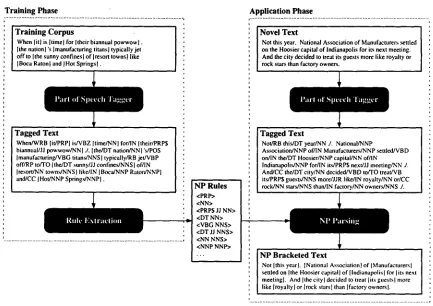
Figure 2 depicts the treebank approach to base NP identification. For training, the algorithm requires a corpus that has been annotated with base NPs. More specifically, we assume that the training corpus is a sequence of words wl, w 2 , . . . , along with a set of base NP annotations b(il&), b ( i ~ j ~ ) , . . . , where b(ij)
indicates that the NP brackets words i through j: [NP Wi, . . . , W j]. The goal of the training phase is to create a base NP grammar from this training corpus: 1. Using any available part-of-speech tagger, as- sign a part-of-speech tag ti to each word wi in the training corpus.
2. Extract from each base noun phrase b(ij) in the training corpus its sequence of part-of-speech tags tl . . . . , t j to form base NP rules, one rule per base NP.
3. Remove any duplicate rules.
The resulting "grammar" can then be used to iden- tify base NPs in a novel text.
1.
2.
Assign part-of-speech tags tl, t 2 , . . , to the input words wl, w2, • • •
Proceed through the tagged text from left to right, at each point matching the NP rules against the remaining part-of-speech tags
Training Phase
Training Corpus
When lit] is [time] for [their biannual powwowl. [ the nation I's I manufacturing titans I typically jet offto [the sunny confinesl of Ireson townsl like [Boca Ratonl and IHot Springs[.
Tagged Text
When/W'RB [it/PRP] is/VBZ [time/NN] for/IN [their/PRP$ biannual/JJ powwow/NN] ./. [the/DT nation/NN] 's/POS Imanufacmring/VBG titans/NNSI typically/RB jet/VBP off/RP to/TO Ithe/DT snnny/JJ confines/NNSI of/IN I resort/NN towns/NNS ] like/IN I Boca/NNP Raton/NNPI and/CC IHot/NNP Spring~NNPI.
~lP R u l e s <PRP> <NN> <PRP$ JJ NN> <DT NN> <VBG NNS> <DT JJ NNS> <NN NNS> <NNP NNP>
Application Phase
Novel Text ,
Not this year. National Association of Manufacturers settled on the Hoosier capital of Indianapolis for its next meeting. And the city decided to treat its guests more like royalty or rock sta~ than factory owners.
Tagged Text
Not/RB this/DT year/NN J. National/NNP
Association/NNP of/IN ManufacturerffNNP settled/VBD on/IN the/DT Hoosier/NNP capital/NN of/IN lndianapoli~NNP for/IN its/PRP$ nexV'JJ meeting/NN J. And/CC the/DT city/NN decided/VBD to/TO treaV'VB its/PRP$ guesl.,;/NNS more/J JR like/IN royahy/NN or/CC rock/NN star,4NNS than/IN factory/NN owners/NNS ./.
NP Bracketed Text
Not [this year]. I National Association ] of I Manufacturers I settled on Ithe Hoosier capitall of [Indianapolisl for l its next meetingl. And Ithe cityl decided to treat [its guestsl more like [royaltyl or/rock starsl than [factory ownerq.
Figure 2: The Treebank Approach to Base NP Identification 3. If there are multiple rules that match beginning
at ti, use the longest matching rule R. Add the new base noun phrase
b(i,i+]R[-1)
to the set of base NPs. Continue matching at ti+lR[.With the rules stored in an appropriate data struc- ture, this greedy "parsing" of base NPs is very fast. In our implementation, for example, we store the rules in a decision tree, which permits base NP iden- tification in time linear in the length of the tagged input text when using the longest match heuristic.
Unfortunately, there is an obvious problem with the algorithm described above. There will be many unhelpful rules in the rule set extracted from the training corpus. These "bad" rules arise from four sources: bracketing errors in the corpus; tagging er- rors; unusual or irregular linguistic constructs (such as parenthetical expressions); and inherent ambigu- ities in the base NPs - - in spite of their simplicity. For example, the rule (VBG NNS), which was ex- tracted from
manufacturing/VBG titans/NNS
in the example text, is ambiguous, and will cause erroneous bracketing in sentences such asThe execs squeezed
in a few meetings before [boarding/VBG buses/NNS~
again.
In order to have a viable mechanism for iden- tifying base NPs using this algorithm, the grammar must be improved by removing problematic rules.The next section presents two such methods for au- tomatically pruning the base NP grammar.
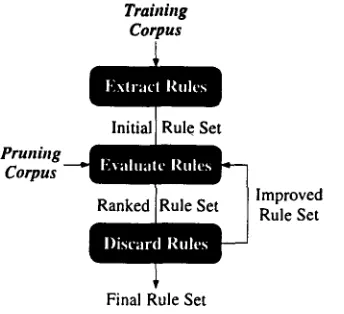
3 P r u n i n g t h e B a s e N P G r a m m a r As described above, our goal is to use the base NP corpus to extract and select a set of noun phrase rules that can be used to accurately identify base NPs in novel text. Our general pruning procedure is shown in Figure 3. First, we divide the base NP cor- pus into two parts: a training corpus and a pruning corpus. The initial base NP g r a m m a r is extracted from the training corpus as described in Section 2. Next, the pruning corpus is used to evaluate the set of rules and produce a ranking of the rules in terms of their utility in identifying base NPs. More specif- ically, we use the rule set and the longest match heuristic to find all base NPs in the pruning corpus. Performance of the rule set is measured in terms of labeled precision (P):
p _- # of correct proposed NPs # of proposed NPs
[image:3.612.86.519.76.382.2]Training
Corpus
Pruning Corpus
Improved Rule Set
Final Rule Set
Figure 3: Pruning the Base NP G r a m m a r
is the number of NPs correctly identified by r, and E~ is the number of precision errors for which r is responsible. 1 A rule is considered responsible for an error if it was the first rule to bracket part of a refer- ence NP, i.e., an NP in the base NP training corpus. Thus, rules that form erroneous bracketings are not penalized if another rule previously bracketed part of the same reference NP.
For example, suppose the fragment containing base NPs Boca Raton, Hot Springs, and Palm Beach
is bracketed as shown below. resort towns like
[NP1 B o c a / N N P R a t o n / N N P , H o t / N N P ] [NP2 Springs/NNP], and
[NP3 P a l m / N N P Beach/NNP]
Rule (NNP NNP , NNP) brackets NP1; (NNP / brackets NP2; and (NNP NNP / brackets NP~. Rule (NNP NNP , NNP / incorrectly identifies Boca Ra- ton, Hot as a noun phrase, so its score is - 1 . Rule (NNP) incorrectly identifies Springs, but it is not held responsible for the error because of the previ- ous error by (NNP N N P , NNP / on the same original NP Hot Springs: so its score is 0. Finally, rule (NNP NNP) receives a score of 1 for correctly identifying
Palm Beach as a base NP.
The benefit scores from evaluation on the pruning corpus are used to rank the rules in the grammar. With such a ranking, we can improve the rule set by discarding the worst rules. Thus far, we have investigated two iterative approaches for discarding rules, a thresholding approach and an incremental
approach. We describe each, in turn, in the subsec- tions below.
1 This same benefit measure is also used in the R&M study, but it is used to rank transformations rather than to rank NP
rules.
3 . 1 T h r e s h o l d P r u n i n g
Given a ranking on the rule set, the threshold algo- rithm simply discards rules whose score is less than a predefined threshold R. For all of our experiments, we set R = 1 to select rules that propose more cor- rect bracketings than incorrect. The process of eval- uating, ranking, and discarding rules is repeated un- til no rules have a score less than R. For our evalua- tion on the WSJ corpus, this typically requires only four to five iterations.
3 . 2 I n c r e m e n t a l P r u n i n g
Thresholding provides a very coarse mechanism for pruning the NP grammar. In particular, because of interactions between the rules during bracketing, thresholding discards rules whose score might in- crease in the absence of other rules that are also be- ing discarded. Consider, for example, the Boca Ra- ton fragments given earlier. In the absence of (NNP NNP , NNP), the rule (NNP NNP / would have re- ceived a score of three for correctly identifying all three NPs.
As a result, we explored a more fine-grained method of discarding rules: Each iteration of incre- mental pruning discards the N worst rules, rather than all rules whose rank is less than some thresh- old. In all of our experiments, we set N = 10. As with thresholding, the process of evaluating, rank- ing, and discarding rules is repeated, this time until precision of the current rule set on the pruning cor- pus begins to drop. The rule set that maximized precision becomes the final rule set.
3 . 3 H u m a n R e v i e w
[image:4.612.107.279.87.244.2]were omitted from the human-pruned rule sets used in the experiments of Section 4.
4 E v a l u a t i o n
To evaluate the treebank approach to base NP iden- tification, we created two base NP corpora. Each is derived from the Penn Treebank WSJ. The first corpus a t t e m p t s to duplicate the base NPs used the Ramshaw & Marcus (R&M) study. The second cor- pus contains slightly less complicated base NPs - - base NPs that are b e t t e r suited for use with our sentence analyzer, Empire. 2 By evaluating on both corpora, we can measure the effect of noun phrase complexity on the treebank approach to base NP identification. In particular, we hypothesize t h a t the treebank approach will be most appropriate when the base NPs are sufficiently simple.
For all experiments, we derived the training, prun- ing, and testing sets from the 25 sections of Wall Street Journal distributed with the Penn Treebank II. All experiments employ 5-fold cross validation. More specifically, in each of five runs, a different fold is used for testing the final, pruned rule set; three of the remaining folds comprise the training corpus (to create the initial rule set); and the final partition is the pruning corpus (to prune bad rules from the ini- tial rule set). All results are averages across the five folds. Performance is measured in terms of precision and recall. Precision was described earlier - - it is a standard measure of accuracy. Recall, on the other hand, is an a t t e m p t to measure coverage:
# of correct proposed NPs P =
# of proposed NPs # of correct proposed NPs R =
# of NPs in the annotated text Table 1 summarizes the performance of the tree- bank approach to base NP identification on the R&M and Empire corpora using the initial and pruned rule sets. The first column of results shows the performance of the initial, unpruned base NP grammar. The next two columns show the perfor- mance of the automatically pruned rule sets. The final column indicates the performance of rule sets that had been pruned using the handcrafted pruning heuristics. As expected, the initial rule set performs quite poorly. Both automated approaches provide significant increases in both recall and precision. In addition, they outperform the rule set pruned using handcrafted pruning heuristics.
2Very briefly, t h e E m p i r e sentence analyzer relies on par- tial p a r s i n g to find simple c o n s t i t u e n t s like b a s e N P s a n d verb g r o u p s . M a c h i n e l e a r n i n g a l g o r i t h m s then operate on the o u t p u t of the partial parser to perform all a t t a c h m e n t de- cisions. T h e u l t i m a t e o u t p u t of the parser is a s e m a n t i c case frame r e p r e s e n t a t i o n of t h e f u n c t i o n a l s t r u c t u r e of the input sentence.
R&M (1998)
]" R&M (1998)
with [ without lexical templates lexical templates93.1P/93.5R ~
90.5P/90.7RTreebank ] Approach
89.4p/9o.9a ]
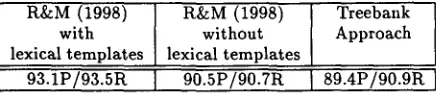
Table 2: Comparison of Treebank Approach with Ramshaw & Marcus (1998) both With and Without Lexical Templates, on the R&M Corpus
T h r o u g h o u t the table, we see the effects of base NP complexity - - the base NPs of the R&M cor- pus are substantially more difficult for our approach to identify than the simpler NPs of the Empire cor- pus. For the R&M corpus, we lag the best pub- lished results (93.1P/93.5R) by approximately 3%. This straightforward comparison, however, is not en- tirely appropriate. Ramshaw & Marcus allow their learning algorithm to access word-level information in addition to part-of-speech tags. The treebank ap- proach, on the other hand, makes use only of part-of- speech tags. Table 2 compares Ramshaw & Marcus' (In press) results with and without lexical knowl- edge. The first column reports their performance when using lexical templates; the second when lexi- cal templates are not used; the third again shows the treebank approach using incremental pruning. The treebank approach and the R&M approach without lecial templates are shown to perform comparably (-1.1P/+0.2R). Lexicalization of our base NP finder will be addressed in Section 4.1.
Finally, note the relatively small difference be- tween the threshold and incremental pruning meth- ods in Table 1. For some applications, this minor drop in performance may be worth the decrease in training time. Another effective technique to speed up training is motivated by Charniak's (1996) ob- servation t h a t the benefit of using rules that only occurred once in training is marginal. By discard- ing these rules before pruning, we reduce the size of the initial grammar - - and the time for incremental pruning - - by 60%, with a performance drop of only -0.3P/-0.1R.
[image:5.612.312.530.83.130.2]Base NP I Initial I Threshold Incremental I Human Corpus Rule Set Pruning Pruning Review Empire I 23.OP/46.5RI 91.2P/93.1R 92.TP/93.7RI 90.3P/9O.5R
R&M 19.0P/36.1R 87.2P/90.0R 89.4P/90.9R 81.6P/g5.0R
Table h Evaluation of the Treebank Approach Using the Mitre Part-of-Speech Tagger (P = precision; R = recall)
BaseNP I Threshold I Threshold I Incremental I Incremental I Corpus Improvement T Local Repair Improvement + Local Repair Empire [ 91.2P/93.1R 92.8P/93.7R 92.7P/93.7R 93.7P/94.0R
87.2P/90.0R I 89.2P/gO.6R I 89"4P/90"gR I 90.7P/91.IR I R&M
I
Table 3: Effect of Local Repair Heuristics
* Conjunctions. Conjunctions were a major prob- lem in the R&M corpus. For the Empire corpus, conjunctions of adjectives proved dif- ficult:
[record/N2~ [third-quarter/JJ and/CC
nine-month/JJ results/NN5~.
• Gerunds. Even though the most difficult VBG constructions such as
manufacturing titans
were removed from the Empire corpus, there were others that the bracketer did not handle, like[chiej~ operating [officer].
Like conjunctions, gerunds posed a major difficulty in the R&M corpus.• NPs Containing Punctuation. Predictably, the bracketer has difficulty with NPs containing pe- riods, quotation marks, hyphens, and parenthe- ses.
• Adverbial Noun Phrases. Especially temporal NPs such as
last month
inat [83.6~] of[capacity
last month].
• Appositives. These are juxtaposed NPs such as
of [colleague Michael Madden]
that the brack- eter mistakes for a single NP.• Quantified NPs. NPs that look like PPs are a problem:
at/IN [least/JJS~ [the/DT right/JJ
jobs/NNS~; about/IN [25/CD million/CD].
Many errors appear to stem from four underly- ing causes. First, close to 20% can be attributed to errors in the Treebank and in the Base NP cor- pus, bringing the effective performance of the algo- rithm to 94.2P/95.9R and 91.5P/92.TR for the Em- pire and R&M corpora, respectively. For example, neither corpus includes WH-phrases as base NPs. When the bracketer correctly recognizes these NPs, they are counted as errors. Part-of-speech tagging errors are a second cause. Third, many NPs are missed by the bracketer because it lacks the appro- priate rule. For example,
household products busi-
ness
is bracketed as[household/NN products/NNS~
[business/Nh~.
Fourth, idiomatic and specialized ex- pressions, especially time, date, money, and numeric phrases, also account for a substantial portion of the errors.These last two categories of errors can often be de- tected because they produce either recognizable pat- terns or unlikely linguistic constructs. Consecutive NPs, for example, usually denote bracketing errors, as in
[household/NN products/NNS~ [business/Nh~.
Merging consecutive NPs in the correct contexts would fix many such errors. Idiomatic and special- ized expressions might be corrected by similarly local repair heuristics. Typical examples might include changing[effective/JJ Monday/NNP]
toeffective
[Monday];
changing[the/DT balance/NN due/J J]
to[the balance] due;
and changingwere/VBP [n't/RB
the/DT only/RS losers/NNS~
towere n't [the only
losers].
[image:6.612.161.459.78.131.2]Given these observations, we implemented three local repair heuristics. The first merges consecutive NPs unless either might be a time expression. The second identifies two simple date expressions. The third looks for quantifiers preceding of NP. The first heuristic, for example, merges
[household products]
[business]
to form[household products business],
but leavesincreased [15 ~ [last Friday]
untouched. The second heuristic merges[June b~ , [1995]
into[June
5, 1995];
and[June], [1995]
into[June, 1995].
The third finds examples likesome of[the companies]
and produces[some] of [the companies].
These heuristics represent an initial exploration into the effectiveness of employing lexical information in a post-processing phase rather than during grammar induction and bracketing. While we are investigating the latter in current work, local repair heuristics have the ad- vantage of keeping the training and bracketing algo- rithms both simple and fast.achieving approximately 9 4 P / R for the Empire cor- pus and approximately 91P/R for the R&M corpus. Note that these are the final results reported in the introduction and conclusion. Although these experi- ments represent only an initial investigation into the usefulness of local repair heuristics, we are very en- couraged by the results. The heuristics uniformly boost precision without harming recall; they help the R&M corpus even though they were designed in response to errors in the Empire corpus. In addi- tion, these three heuristics alone recover 1/2 to 1/3 of the improvements we can expect to obtain from lexicalization based on the R&M results.
5
Conclusions
This paper presented a new method for identifying base NPs. Our treebank approach uses the simple technique of matching part-of-speech tag sequences, with the intention of capturing the simplicity of the corresponding syntactic structure. It employs two existing corpus-based techniques: the initial noun phrase grammar is extracted directly from an an- notated corpus; and a benefit score calculated from errors on an improvement corpus selects the best subset of rules via a coarse- or fine-grained pruning algorithm.
The overall results are surprisingly good, espe- cially considering the simplicity of the method. It achieves 94% precision and recall on simple base NPs. It achieves 91% precision and recall on the more complex NPs of the Ramshaw & Marcus cor- pus. We believe, however, that the base NP finder can be improved further. First, the longest-match heuristic of the noun phrase bracketer could be re- placed by more sophisticated parsing methods that account for lexical preferences. Rule application, for example, could be disambiguated statistically using distributions induced during training. We are cur- rently investigating such extensions. One approach closely related to ours - - weighted finite-state trans- ducers (e.g. (Pereira and Riley, 1997)) - - might pro- vide a principled way to do this. We could then consider applying our error-driven pruning strategy to rules encoded as transducers. Second, we have only recently begun to explore the use of local re- pair heuristics. While initial results are promising, the full impact of such heuristics on overall perfor- mance can be determined only if they are system- atically learned and tested using available training data. Future work will concentrate on the corpus- based acquisition of local repair heuristics.
In conclusion, the treebank approach to base NPs provides an accurate and fast bracketing method, running in time linear in the length of the tagged text.. The approach is simple to understand, im- plement, and train. The learned grammar is easily modified for use with new corpora, as rules can be
added or deleted with minimal interaction problems. Finally, the approach provides a general framework for developing other treebank grammars (e.g., for subject/verb/object identification) in addition to these for base NPs.
A c k n o w l e d g m e n t s . This work was supported in part by NSF (]rants IRI-9624639 and GER-9454149. We thank Mitre for providing their part-of-speech tag- ger.
R e f e r e n c e s
D. Bourigault. 1992. Surface Grammatical Anal- ysis for the Extraction of Terminological Noun Phrases. In
Proceedings, COLING-92,
pages 977- 981.Eric Brill. 1 9 9 5 . Transformation-Based Error- Driven Learning and Natural Language Process- ing: A Case Study in Part-of-Speech Tagging.
Computational Linguistics,
21(4):543-565. E. Charniak. 1996. Treebank Grammars. InPro-
ceedings of the Thirteenth National Conference on
Artificial Intelligence,
pages 1031-1036, Portland, OR. AAAI Press / MIT Press.K. Church. 1988. A Stochastic Parts Program and Noun Phrase Parser for Unrestricted Text. In
Pro-
ceedings of the Second Conference on Applied Nat-
ural Language Processing,
pages 136-143. Associ- ation for Computational Linguistics.J. P. Gee and F. Grosjean. 1983. Performance struc- tures: A psycholinguistic and linguistic appraisal.
Cognitive Psychology,
15:411-458.John S. Justeson and Slava M. Katz. 1995. Techni- cal Terminology: Some Linguistic Properties and an Algorithm for Identification in Text.
Natural
Language Engineering,
1:9-27.M. Marcus, M. Marcinkiewicz, and B. Santorini. 1993. Building a Large Annotated Corpus of En- glish: The Penn Treebank.
Computational Lin-
guistics,
19(2):313-330.Fernando C. N. Pereira and Michael D. Riley. 1997. Speech Recognition by Composition of Weighted Finite Automata. In Emmanuel Roche and Yves Schabes, editors,
Finite-State Language Process-
ing.
MIT Press.Lance A. Ramshaw and Mitchell P. Marcus. In press. Text chunking using transformation-based learning. In
Natural Language Processing Using
Very Large Corpora.
Kluwer. Originally appeared in WVLC95, 82-94.