Bitext Correspondences through Rich Mark-up
R a q u e l M a r t l n e z
D e p a r t a m e n t o de Sis. I n f o r m £ t i c o s y P r o g r a m a c i S n , F a c u l t a d de M a t e m £ t i c a s U n i v e r s i d a d C o m p l u t e n s e de M a d r i d
e - m a i l : r a q u e l © e u c m o s , s i m . ucm. e s
J o s e b a A b a i t u a
F a c u l t a d de Filosofia y L e t r a s U n i v e r s i d a d de D e u s t o , Bilbao
e - m a i l : a b a i t u a ~ f i l , d e u s t o , es
A r a n t z a Casillas
D e p a r t a m e n t o de A u t o m ~ t i c a , U n i v e r s i d a d de Alcal~ de H e n a r e s e - m a i l : a r a n t z a ¢ a u t , a l c a l a , e s
A b s t r a c t
Rich mark-up can considerably benefit the process of establishing bitext correspondences, that is, the task of providing correct identification and align- ment methods for text segments that are transla- tion equivalences of each other in a parallel corpus. We present a sentence alignment algorithm that, by taking advantage of previously annotated texts, ob- tains accuracy rates close to 100%. The algorithm evaluates the similarity of the linguistic and extra- linguistic mark-up in both sides of a bitext. Given that annotations are neutral with respect to typolog- ical, grammatical and orthographical differences be- tween languages, rich mark-up becomes an optimal foundation to support bitext correspondences. The main originality of this approach is that it makes maximal use of annotations, which is a very sensible and efficient method for the exploitation of parallel corpora when annotations exist.
1 I n t r o d u c t i o n
Adequate encoding schemes applied to large bodies of text in electronic form have been a main achievement in the field of humanities computing. Research in computational linguis- tics, which since the late 1980s has resorted to methodologies involving statistics and probabil- ities in large corpora, has however largely ne- glected the existence and provision of extra in- formation from such encoding schemes. In this paper we present an approach to sentence align- ment t h a t crucially relies on previously intro- duced annotations in a parallel corpus. Fol- lowing (Harris 88), corpora containing bilingual
texts have been called "bitexts" (Melamed 97), (Martlnez et al. 97).
T h e utility of a n n o t a t e d bitexts will be d e m o n s t r a t e d by the proposition of a methodol- ogy t h a t crucially takes advantage of rich mark- up to resolve bitext correspondences, t h a t is, the task of providing correct identification and alignment m e t h o d s for text segments t h a t are translation equivalencies of each other (Chang & Chen 97). Bitext correspondences provide a great source of information for applications such as example and m e m o r y based approaches to machine translation (Sumita & Iida 91), (Brown et al. 93), (Collins et al. 96); bilingual termi- nology extraction (Kupiec 93), (Eijk 93), (Da- gan et al. 94), (Smajda et al. 96); bilingual lexicography (Catizione et al. 93), (Daille et al. 94), (Gale & Church, 91b); multilingual in- formation retrieval (SIGIR 96), and word-sense disambiguation (Gale et al. 92), (Chan & Chen 97). Moreover, the increasing availability of r u n n i n g parallel text in a n n o t a t e d form (e.g. W W W pages), together with evidence t h a t poor mark-up (as HTML) will progressively be re- placed by richer m a r k - u p (e.g. S G M L / X M L ) , are good enough reasons to investigate m e t h o d s that benefit from such encoding schemes.
This is the 'tags as cognates' algorithm, TasC.
2 B i t e x t t a g g i n g a n d s e g m e n t a t i o n A large bitext has been compiled consisting of a collection of administrative and legal bilingual documents written b o t h in Spanish and Basque, with close to 7 million words in each language. For the experiments, we have worked on a rep- resentative subset of around 500,000 words in each language. Several stages of automatic tag- ging, based on p a t t e r n matching and heuristics, were undertaken, rendering different descriptive levels:
General encoding (paragraph, sentence, quoted text, dates, numbers, abbrevia- tions, etc.).
• Document specific tags that identify doc- u m e n t types and define document internal organisation (sections, divisions, identifica- tion code, number and date of issue, issuer, lists, itemised sections, etc.).
• Proper noun tagging (identification and categorisation of proper nouns into several classes, including: person, place, organi- sation, law, title, publication and uncate- gorised).
This collection of tags (shown in Table 1) re- flects basic structural and referential features, which appear consistently at b o t h sides of the bitext. Although the alignment of smaller seg- ments (multi-word lexical units and colloca- tions) will require more expressive tagging, such as part-of-speech tagging (POS), for the task of sentence alignment, this is not only unnec- essary, b u t also inappropriate, since it would introduce undesired language dependent infor- mation. T h e encoding scheme has been based on TEI's guidelines for SGML based mark-up (Ide & Veronis 95).
2.1 P r o p e r n o u n t a g g i n g
As for many other text processing applications, proper n o u n tagging plays a key role in our approach to sentence alignment. It has been reported that proper nouns reach up to 10% of tokens in text (newswire text (Wakao et al. 96) and (Coates-Stephens 92)) and one third of noun groups (in the Agence France Presse flow (Wolinski et al. 95)). We have calculated that proper nouns constitute a 15% of the tokens in
our corpus. T h e module for the recognition of proper nouns relies on patterns of typography (capitalisation and punctuation) a n d on contex- tual information (Church 88). It also makes use of lists with most c o m m o n person, organisation, law, publication and place names. T h e tagger annotates a multi-word chain as a proper noun when each word in the chain is uppercase initial. A closed list of functional words (prepositions, conjunctions, determiners, etc.) is allowed to appear inside the proper n o u n chain, see exam- ples in Table 2. A collection of heuristics dis- card uppercase initial words in sentence initial position or in other exceptional cases.
In contrast with other known classifications (e.g. MUC-6 95), we exclude from our list of proper nouns time expressions, percentage expression, and monetary a m o u n t expressions (which for us fall under a different descriptive level). However, on top of organisation, person and location names, we include other entities such as legal nomenclature, the name of publi- cations as well as a n u m b e r of professional titles whose occurrence in the bitext becomes of great value for alignment.
2.2 B i t e x t a s y m m e t r i e s
[[ Descriptive levels Tagset [] II General encoding <p>, <s>, <num>, <date> <abbr>, <q> I
Document especific <div>, <classCode> <keywords>, <dateline>, <list><seg>
Proper nouns <rs>
Table 1: Tagset used for sentence alignment
Proper Noun Classes Spanish Basque
Person Ana Ferndndez Gutierrez-Crespo Ana Ferndndez Gutierrez-Crespo
Place Valle de Arratia Arratiko arana
Organisation Departamento de Presidencia Lehendakaritza Saileko
Law Real Decreto Legislativo Legegintzazko Erret Dekretuko
Title Diputado Foral de Urbanisrno Hirigintza foru diputatua
Publication Boletln Oficial de Bizkaia Bizkaiko Aldizkari Ofizialean
Uncategorised A nexo eraskin
Table 2: Examples
.
3 U s i n g t a g s a s c o g n a t e s f o r s e n t e n c e a l i g n m e n t
Algorithms for sentence alignment abound and range from the initial pioneering proposals of (Brown et al. 91), (Gale & Church 91a), (Church 93), or (Kay & Roscheisen 93), to the more recent ones of (Chang & Chen 97), or (Tillmann et al. 97). The techniques employed include statistical machine translation, cognates identification, pattern recognition, and digital signal and image processing. Our algorithm, as (Simard et al. 92), and (Melamed 97) em- ploys cognates to align sentences; and similar to (Brown et al. 91), it also uses mark-up for that purpose. Its singularity does not lie on the use of mark-up as delimiter of text regions (Brown et al. 91) in combination with other techniques, but on the fact that it is the sole foundation for sentence alignment. We call it the 'tags as cognates' algorithm, TasC. This algorithm is not disrupted by word order differences or small asymmetries in non-literal translation, and, un- like other reported algorithms (Melamed 97), it possesses the additional advantage of being portable to any pair of languages without the need to resort to any language-specific heuris- tics. Provided an adequate and consistent bi- text mark-up, sentence alignment becomes a simple and accurate process also in the case of typologically disparate or orthographically dis- tinct language pairs for which techniques based on lexical cognates may be problematic. One of
of proper nouns
the best consequences of this approach is that the burden of language dependent processing is dispatched to the monolingual tagging and seg- mentation phase.
3.1 S i m i l a r i t y c a l c u l u s b e t w e e n b i t e x t s The alignment algorithm establishes similarity metrics between candidate sentences which are delimited by corresponding mark-up. Dice's co- efficient is used to calculate these similarity met- rics (Dice 45). The coefficient returns a real nu- meric value in the range 0 to 1. Two sentences which are totally dissimilar in the content of their internal mark-up will return a Dice score of 0, while two identical contents will return a Dice score of 1.
For two text segments, P and Q, one in each language, the formula for Dice's similarity coef- ficient will be:
Dice(P, Q) -- 2FpQ
Fp + FQ
where FpQ is the number of identical tags that P and Q have in common, and Fp and FQ are the number of tags contained by each text seg- ment P and Q.
[image:3.612.94.527.46.267.2]Proper Noun Classes Person
Place
Organisation Law
Title Publication Uncategorised Total
Spanish Basque
Precision I Recall 1% Spanish PN Precision I Recall 1% Basque PN
100% 100%
100% 100%
99.2% 97.8%
99.2% 99.2%
100% 100%
100% 100%
100% 100%
4.48% 6.38% 23.96% 47.93% 6.55% 2.58% 8.10%
100% 100% 4.76%
100% 100% 6.95%
100% 1 0 0 % 24.17%
100% 1 0 0 % 46.15%
97.2% 97.2% 6.59%
100% 100% 2.74%
100% 100% 8.60
100%
II
99.8% 199.8%[ 100%II 99.4%199.1%[
Table 3: Results of proper noun identification
may serve also to subcategorise proper noun tags: < r s t y p e = p l a c e > B i l b a o < / r s > .
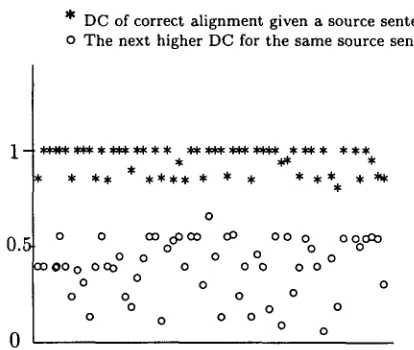
Such subcategorisations are of great value to calculate the similarity metrics. If mark-up is consistent, the correlation between tags in the candidate text segments will be high and Dice's coefficient will come close to 1. For a randomly created bitext sample of source sentences, Fig- ure 1 illustrates how correct candidate align- ments have achieved the highest Dice's coeffi- cients (represented by '*'s), while next higher coefficients (represented by 'o's ) have achieved significant lower values. It must be noted that the latter do not correspond to correct values.
The difference mean between Dice's coeffi- cients corresponding to correct alignments and next higher values is:
n
~ ( D C c i - D C w i )
M = i=1 = 0.45
n
Where for a given source sentence i, D C c i represents Dice's coefficient corresponding to its correct alignment and D C w i represents the next higher value of Dice's coefficients for the same source sentence i. In all the cases, this difference is greater than 0.2.
For consistently marked-up bitexts, these re- sults show that sentence alignment founded on the similarity between annotations can be ro- bust criterion.
Figure 2 illustrates how the Dice's coefficient is calculated between candidate sentences to alignment.
3.2 T h e s t r a t e g y o f t h e T a s C a l g o r i t h m The alignment of text segments can be for- malised by the matching problem in bipartite
_
0.5
$ D C o f c o r r e c t a l i g n m e n t g i v e n a s o u r c e s e n t e n c e o T h e n e x t h i g h e r D C f o r t h e s a m e s o u r c e s e n t e n c e
o
o o c o oO c o c o o o o o o o ~ o o o ~ 0 0 0 0 0 0 0 0 0 0 0 0
0 0 0
0 0 0 0
0 0
0 0 0 0
o%~
o o o 0 o
Figure 1: Values of Dice's coefficient between corresponding sentences
graphs. Let G = (V, E, U) be a bipartite graph, such that V and U are two disjoint sets of vertices, and E is a set of edges connecting vertices from V to vertices in U. Each edge in E has associated a cost. Costs are represented by a cost matrix. The problem is to find a perfect matching of G with minimum cost. The minimisation version of this problem is well known in the literature as the assignment problem.
[image:4.612.76.523.46.173.2] [image:4.612.301.508.216.391.2]Spanish Sentence:
< s id=sESdoc5-4>Habi4ndose detectado en el anuncio publicado en el ndmero<num num=79> 79 < / n u m > de fecha <date date=2?/04>27 de abril</date> de este < r s type=publication>Boletfn</rs>, la omisi6n del primer p~rrafo de la < r s type=law>Orden F o r a l < / r s > de referencia, se procede a su ~ntegra publicaci6n. < / s >
Basque Sentence:
<s id=sEUdoc5-5>Agerkaria honetako < d a t e dat e=27/04>apirilaren 2 7 k o < / d a t e > < n u m num=79>79k.an </num> argitaratutako ira- garkian aipameneko < r s type=law>Foru A g i n d u a r e n < / r s > lehen lerroaldea ez dela geri detektatu ondoren beraren argitarapen osoa egitera jo d a . < / s >
T h e c o m m o n tags are: <date date=27/04>, <num num=79>, <rs type=law> T h e Dice's similarity coefficient will be: Dice(P,Q)= 2x3 / 4 + 3 = 0.857
Figure 2: Similarity calculus between candidate sentences
erality to the assignment problem and makes it possible to a d d constraints to the solutions re- p o r t e d in the literature. These constraints take into account t h e order in which sentences in b o t h the source a n d target texts have been writ- ten, and c a p t u r e t h e prevailing fact t h a t trans- lators m a i n t a i n the order of the original text in their translations, which is even a stronger p r o p e r t y of specialised texts,
By default, a whole d o c u m e n t delimits the space in which sentence alignment will take place, a l t h o u g h this space can be customised in the algorithm. T h e average n u m b e r of sen- tences per d o c u m e n t is approximately 18. Two types of alignment can take place:
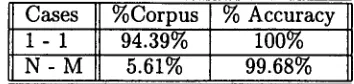
• 1 to 1 alignment: when one sentence in the source d o c u m e n t corresponds to one sen- tence in t h e target d o c u m e n t (94.39% of the cases).
• N to M alignment: when N sentences in the source d o c u m e n t correspond to M sen- tences in the target d o c u m e n t (only 5.61% of t h e cases). It includes cases of 1-2, 1-3 and 0-1 alignments.
Both alignment types are h a n d l e d by the algo- rithm.
3.3 T h e
.
T h e a l g o r i t h m
TasC
algorithm works in two steps:It obtains the similarity m a t r i x S from Dice's coefficients corresponding to can- d i d a t e alignment options. Each row in S represents t h e alignment options of a source sentence classified in decreasing or- der of similarity. In this m a n n e r , each col- u m n represents a preference position (1 the
best alignment option, 2 the second best and so on). Therefore, each
Si,j
is the identification of one or more target sen- tences which m a t c h the source sentence i in the preference position j. In order to obtain the similarity matrix, it is not nec- essary to consider all possible alignment options. Constraints regarding sentence ordering and grouping greatly r e d u c e the n u m b e r of cases to be evaluated by the al- gorithm. In the algorithm each source sen- tence xi is c o m p a r e d with c a n d i d a t e target sentencesyj
as follows: (xi, Yi);(xi, YjYj+I
. . . , whereYjYj+I
represents t h e concate- nation ofyj
withYj+I.
T h e a l g o r i t h m m o d u l e t h a t deals with c a n d i d a t e align- m e n t options can be easily customised to cope with different bitext configurations (since bitexts m a y range from a very simple one-paragraph text to m o r e complex struc- tures). In the c u r r e n t version of t h e al- g o r i t h m seven alignment options are t a k e n into account.2. T h e
TasC
algorithm solves an assignment problem with several constraints. It aligns sentences by assigning to eachith
source sentence theSi,j
target option w i t h min- i m u m j value, t h a t is, t h e option with more similarity. F u r t h e r m o r e , t h e algo- r i t h m solves the possible conflicts w h e n a sentence matches with o t h e r sentences al- r e a d y aligned. T h e average cost of the al- gorithm, e x p e r i m e n t a l l y c o n t r a s t e d , is lin- ear in t h e size of the input, a l t h o u g h in the worst case the cost is bigger.C a s e s
1 - 1 N - M
%Corpus 94.39%
% Accuracy 100%
5.61%
99.68%
Table 4: TasC Algorithm results
in Figure 3. This attribute points to the cor- responding sentence identification code in the other language.
4 E v a l u a t i o n
The current version of the algorithm has been tested against a subcorpus of 500,000 words in each language consisting of 5,988 sentences and has rendered the results shown in Table 4.
The accuracy of the 1 to 1 alignment is 100%. In the N to M case only 1 error occurred out of 314 sentences, which reaches 99.68% accuracy. The algorithm to sentence alignment has been designed in such a m o d u l a r way that it can eas- ily change the tagset used for alignment and the weight of each tag to adapt it to different bitext annotations. T h e current version of the algo- r i t h m uses the tagset shown in Table 1 without weights.
5 F u t u r e w o r k
Once sentences have been aligned, the next step is the alignment of sentence-internal seg- ments. The sentence will delimit the search space for this alignment, and hence, by reduc- ing the search space, the alignment complexity is also reduced.
5.1 P r o p e r n o u n a l i g n m e n t
Proper nouns are a key factor for the efficient m a n a g e m e n t of the corpus, since they are the basis for the indexation and retrieval of doc- uments in the two versions. For this reason, at present we are concerned with proper noun alignment, something which is not usually done in the m a p p i n g of bitexts. The alignment is achieved by resorting to:
• T h e identification of cognate nouns, aided by a set of phonological rules that apply when Spanish terms are taken to produce loan words in Basque.
• T h e restriction of cognate search space to previously aligned sentences, and
* The application of the TasC algorithm adapted to proper n o u n alignment.
5.2 A l i g n m e n t o f c o l l o c a t i o n
The next step is the recognition and alignment of other multi-word lexical units and colloca- tions. Due to the still unstable translation choices of much administrative terminology in Basque, on top of the considerable typological and structural differences between Basque and Spanish, many of the techniques reported in the literature (Smadja et al. 96), (Kupiec 93) and (Eijk 93) cannot be effectively applied. POS tagging combined with recurrent bilingual glos- sary lookup is the approach we are currently experimenting with.
6 C o n c l u s i o n s
We have presented a sentence alignment ap- proach that, by taking advantage of previously introduced mark-up, obtains accuracy rates close to 100%. This approach is not disrupted by word order differences and is portable to any pair of languages without the need to resort to any language specific heuristics. Provided and adequate and consistent bitext mark-up, sen- tence alignment becomes an accurate and ro- bust process also in the case of typologically distinct language pairs for which other known techniques may be problematic. T h e TasC algo- r i t h m has been designed in such a m o d u l a r way that it can be easily a d a p t e d to different bitext configurations as well as other specific tagsets.
7 A c k n o w l e d g e m e n t s
This research is being partially s u p p o r t e d by the Spanish Research Agency, project ITEM, TIC- 96-1243-C03-01.
R e f e r e n c e s
Brown, P., Lai, J.C., Mercer, R. (1991). Aligning Sentences in Parallel Corpora. Proceedings of the 29th Annual Meeting of the Association .for Computational Linguistics, 169-176, Berkeley, 1991.
Brown, P., Della Pietra, V., Della Pietra, S., Mercer, R. (1993). The mathematics of statistical machine transla- tion: parameter estimation. Computational Linguistics 19(2):263-301 1993.
Catizone, R., Russell, G., Warwick, S. (1993). Deriving Trans- lation Data from Bilingual Texts. Proccedings of the First International Lexical Acquisition Workshop, Detroit, MI, 1993.
[image:6.612.88.265.49.91.2]Spanish Sentence:
< s i d = s E S d o c 5 - 4 c o r r e s p = s E U d o c 5 - 5 > H a b i 4 n - dose detectado en el anuncio publicado en el n d m e r o < n u m num=79> 79 < / n u m > de fecha < d a t e date=27/04>27 de abril</date> de
este <rs t y p e = p u b l i c a t i o n > B o l e t f n < / r s > ,
la omisi6n del primer phrrafo de la < r s type=law>Orden Foral</rs> de referencia se procede a su integra publicaci6n.</s>
B a s q u e S e n t e n c e :
<s id=sEUdoc5-5 corresp=sESdoc5-4>Agerkaria
honetako <date date=27/04> apirilaren
27ko</date> <num num=79>79k.an </num>
a r g i t a r a t u t a k o i r a g a r k i a n a i p a m e n e k o < r s t y p e = l a w > F o r u A g i n d u a r e n < / r s > l e h e n ler- r o a l d e a ez d e l a geri d e t e k t a t u o n d o r e n b e r a r e n a r g i t a r a p e n osoa e g i t e r a j o d a . < / s >
Figure 3: Results of sentence alignment expressed by the c o r r e s p attribute
Church, K.W. (1988). A Stochastic parts program and noun phrase parser for unrestricted text. Proceedings of the Sec- ond Conference on Applied Natural Language Processing, 136-143, 1988. Association for Computational Linguistics. Church, K.W. (1993). Char_Align: A Program for Aligning Parallel Texts at the Character Level. Proceedings of the 31th Annual Meeting of the Association for Computational Linguistics, Columbus, USA 1993.
Coates-Stephen, S. (1992). The Analysis and Acquisition of Proper Names for Robust Text Understanding, Ph.D. De- partment of Computer Science of City University, London, England, 1992.
Collins, B., Cunningham, P., Veale, T. (1996). An Exam- ple Based Approach to Machine Translation. Expand- ing M T Horizonts: Proceedings of the Second Confer- ence of the Association for Machine Translation in the Americas:AMTA-96, 125-134, 1996.
Daille, B., Gaussier, E., Lange, J.M. (1994). Towards Auto- matic Extraction of Monolingual and Bilingual Terminol- ogy. Proceedings of the 15th International Conference on
Computational Linguistics, 515-521, Kyoto, Japan. Dagan, I., Church, K. (1994). Termigh: Identifying and trans-
lating Technical Terminology. Proceedings Fourth Confer- ence on Applied Natural Language Processing (ANLP-94), Stuttgart, Germany, 34-40, 1994. Association for Compu- tational Linguistics.
Dice, L.R. (1945). Measures of the Amount of Ecologic Asso- ciation Between Species. Ecology, 26, 297-302.
Eijk, P. van der. (1993). Automating the acquisition of Bilin- gual Terminology. Proceedings Sixth Conference of the Eu- ropean Chapter of the Association for Computational Lin- guistic, Utrecht, The Netherlands, 113-119, 1993. Gale, W., Church, K.W. (1991a). A Program for Aligning
Sentences in Bilingual Corpora. Proceedings of the 29th Annual Meeting of the Association for Computational Lin- guistics, 177-184, Berkeley, 1991a.
Gale, W., Church, K. W. (1991b). Identifying Word Corre- spondences in Parallel Texts. Proceedings of the DARPA SNL Workshop, 1991.
Gale, W., Church, K. W., Yarowsky, D. (1992). Using Bilin- gual Materials to Develop Word Sense Disambiguation Methods. Proceedings of the 4th International Confer- ence on Theoretical and Methodological Issues in Machine Translation (TMI-92), 101-112, Montreal, Canada 1992. Harris, B. (1988). Bi-Text, a New Concept in Translation The-
ory. Language Monthly #54, 1988.
Ide,N., Veronis, J. (1994). MULTEXT (Multilingual Text Tools and Corpora.) Proceedings of the International Workshop on Sharable Natural Language Resources, 90- 96, 1994.
Ide, N., Veronis, J. (1995). The Text Encoding Initiative: Background and Contexts. Dordrecht: Kluwer Academic Publishers, 1995.
Kay, M., Roscheisen, M. (1993). Text-Translation Alignment. Computational Linguistics, 19:1, 121-142, 1993.
Kupiec, J. (1993). An algorithm for finding noun phrase cor- respondences in bilingual corpora. Proceedings of the 31st Annual Meeting of the ACL, Columbus, Ohio, 17-22. As- sociation for Computational Linguistics 1993.
Martinez, R., Casillas, A., Abaitua, J. (1997). Bilingual paral- lel text segmentation and tagging for specialized documen- tation. Proceedings of the International Conference Recent Advances in Natural Language Processing, RANLP'97, 369-372, 1997.
Melamed, I.D. (1997). A Portable Algorithm for Mapping Bitext Correspondence. Proceedings of the 35th Annual Meeting of the Association for Computational Linguistics, 305-312, 1997.
MUC-6. (1995). Proceedings of the Sixth Message Under- standing Conference (MUC-6). Morgan Kaufman. SIGIR. (1996). Workshop on Cross-linguistic Multilingual In-
formation Retrieval, Zurich, 1996.
Simard, M., Foster, G.F., Isabelle, P. (1992). Using Cognates to Align Sentences in Bilingual Corpora. Proceedings of the Fourth International Conference on Theoretical and Methodological Issues in Machine Translation, Montreal, 67-81, 1992.
Smadja, F., McKeown, K., Hatzivassiloglou, V.(1996). Trans- lating Collocations for Bilingual Lexicons: A Statistical Approach. Computational Linguistics Volume 22, No. 1, 1996.
Sumita, E., Iida, H. (1991). Experiments and prospect of example-based machine translation. Proceedings of the As- sociation for Computational Linguistics. Berkeley,185-192, 1991.
Tillmann, C., Vogel, S., Ney, H., Zubiaga, A. (1997). A DP based Search Using Monotone Alignments in Statistical Translation. Proceedings of the 35th Annual Meeting of the Association for Computational Linguistics, 289-296, 1997.
Wakao, T., Gaizauskas, R., Wilks, Y. (1996). Evaluation of an Algorithm for the Recognition and Classification of Proper Names. Proceedings of the 16th International Con- ference on Computational Linguistics (COLING96),418- 423, 1996.