A Rational Model of Eye Movement Control in Reading
Klinton Bicknell and Roger Levy
Department of Linguistics University of California, San Diego 9500 Gilman Dr, La Jolla, CA 92093-0108
{kbicknell,rlevy}@ling.ucsd.edu
Abstract
A number of results in the study of real-time sentence comprehension have been explained by computational models as re-sulting from the rational use of probabilis-tic linguisprobabilis-tic information. Many times, these hypotheses have been tested in read-ing by linkread-ing predictions about relative word difficulty to word-aggregated eye tracking measures such as go-past time. In this paper, we extend these results by ask-ing to what extent readask-ing is well-modeled as rational behavior at a finer level of anal-ysis, predicting not aggregate measures, but the duration and location of each fix-ation. We present a new rational model of eye movement control in reading, the cen-tral assumption of which is that eye move-ment decisions are made to obtain noisy visual information as the reader performs Bayesian inference on the identities of the words in the sentence. As a case study, we present two simulations demonstrating that the model gives a rational explanation for between-word regressions.
1 Introduction
The language processing tasks of reading, listen-ing, and even speaking are remarkably difficult. Good performance at each one requires integrat-ing a range of types of probabilistic information and making incremental predictions on the ba-sis of noisy, incomplete input. Despite these re-quirements, empirical work has shown that hu-mans perform very well (e.g., Tanenhaus, Spivey-Knowlton, Eberhard, & Sedivy, 1995). Sophisti-cated models have been developed that explain many of these effects using the tools of com-putational linguistics and large-scale corpora to make normative predictions for optimal perfor-mance in these tasks (Genzel & Charniak, 2002,
2003; Keller, 2004; Levy & Jaeger, 2007; Jaeger, 2010). To the extent that the behavior of these models looks like human behavior, it suggests that humans are making rational use of all the infor-mation available to them in language processing. In the domain of incremental language compre-hension, especially, there is a substantial amount of computational work suggesting that humans be-have rationally (e.g., Jurafsky, 1996; Narayanan & Jurafsky, 2001; Levy, 2008; Levy, Reali, & Grif-fiths, 2009). Most of this work has taken as its task predicting the difficulty of each word in a sen-tence, a major result being that a large component of the difficulty of a word appears to be a function of its probability in context (Hale, 2001; Smith & Levy, 2008). Much of the empirical basis for this work comes from studying reading, where word difficulty can be related to the amount of time that a reader spends on a particular word. To re-late these predictions about word difficulty to the data obtained in eye tracking experiments, the eye movement record has been summarized through word aggregate measures, such as the average du-ration of the first fixation on a word, or the amount of time between when a word is first fixated and when the eyes move to its right (‘go-past time’).
It is important to note that this notion of word difficulty is an abstraction over the actual task of reading, which is made up of more fine-grained decisions about how long to leave the eyes in their current position, and where to move them next, producing the series of relatively stable pe-riods (fixations) and movements (saccades) that characterize the eye tracking record. While there has been much empirical work on reading at this fine-grained scale (see Rayner, 1998 for an overview), and there are a number of successful models (Reichle, Pollatsek, & Rayner, 2006; En-gbert, Nuthmann, Richter, & Kliegl, 2005), little is known about the extent to which human read-ing behavior appears to be rational at this finer
grained scale. In this paper, we present a new ratio-nal model of eye movement control in reading, the central assumption of which is that eye movement decisions are made to obtain noisy visual informa-tion, which the reader uses in Bayesian inference about the form and structure of the sentence. As a case study, we show that this model gives a ratio-nal explanation for between-word regressions.
In Section 2, we briefly describe the leading models of eye movements in reading, and in Sec-tion 3, we describe how these models account for between-word regressions and the intuition behind our model’s account of them. Section 4 describes the model and its implementation and Sections 5– 6 describe two simulations we performed with the model comparing behavioral policies that make re-gressions to those that do not. In Simulation 1, we show that specific regressive policies outperform specific non-regressive policies, and in Simulation 2, we use optimization to directly find optimal policies for three performance measures. The re-sults show that the regressive policies outperform non-regressive policies across a wide range of per-formance measures, demonstrating that our model predicts that making between-word regressions is a rational strategy for reading.
2 Models of eye movements in reading
The two most successful models of eye
move-ments in reading areE-ZReader (Reichle,
Pollat-sek, Fisher, & Rayner, 1998; Reichle et al., 2006) and SWIFT (Engbert, Longtin, & Kliegl, 2002; Engbert et al., 2005). Both of these models charac-terize the problem of reading as one of word
iden-tification. InE-ZReader, for example, the system
identifies each word in the sentence serially, mov-ing attention to the next word in the sentence only after processing the current word is complete, and (to slightly oversimplify), the eyes then follow the attentional shifts at some lag. SWIFT works simi-larly, but with the main difference being that pro-cessing and attention are distributed over multiple words, such that adjacent words can be identified in parallel. While both of these models provide a good fit to eye tracking data from reading, neither model asks the higher level question of what a ra-tional solution to the problem would look like.
The first model to ask this question, Mr. Chips (Legge, Klitz, & Tjan, 1997; Legge, Hooven, Klitz, Mansfield, & Tjan, 2002), predicts the op-timal sequence of saccade targets to read a text
based on a principle of minimizing the expected entropy in the distribution over identities of the current word. Unfortunately, however, the Mr. Chips model simplifies the problem of reading in a number of ways: First, it uses a unigram model as its language model, and thus fails to use any information in the linguistic context to help with word identification. Second, it only moves on to the next word after unambiguous identification of the current word, whereas there is experimental evidence that comprehenders maintain some un-certainty about the word identities. In other work, we have extended the Mr. Chips model to remove these two limitations, and show that the result-ing model more closely matches human perfor-mance (Bicknell & Levy, 2010). The larger prob-lem, however, is that each of these models uses an unrealistic model of visual input, which obtains absolute knowledge of the characters in its visual window. Thus, there is no reason for the model to spend longer on one fixation than another, and the
model only makes predictions forwheresaccades
are targeted, and nothow longfixations last. Reichle and Laurent (2006) presented a rational model that overcame the limitations of Mr. Chips to produce predictions for both fixation durations and locations, focusing on the ways in which eye movement behavior is an adaptive response to the particular constraints of the task of reading. Given this focus, Reichle and Laurent used a very simple word identification function, for which the time re-quired to identify a word was a function only of its length and the relative position of the eyes. In this paper, we present another rational model of eye movement control in reading that, like Reichle and Laurent, makes predictions for fixation durations and locations, but which focuses instead on the dynamics of word identification at the core of the task of reading. Specifically, our model identifies the words in a sentence by performing Bayesian inference combining noisy input from a realistic visual model with a language model that takes context into account.
3 Explaining between-word regressions
In this paper, we use our model to provide a novel explanation for between-word regressive saccades. In reading, about 10–15% of saccades are regressive – movements from right-to-left (or to previous lines). To understand how models
re-gressive saccades to previous words, recall that the system identifies words in the sentence (gen-erally) left to right, and that identification of a word in these models takes a certain amount of time and then is completed. In such a setup, why should the eyes ever move backwards? Three ma-jor answers have been put forward. One
possibil-ity given byE-ZReader is as a response to
over-shoot; i.e., the eyes move backwards to a previ-ous word because they accidentally landed fur-ther forward than intended due to motor error. Such an explanation could only account for small between-word regressions, of about the magni-tude of motor error. The most recent version,
E-Z Reader 10 (Reichle, Warren, & McConnell,
2009), has a new component that can produce longer between-word regressions. Specifically, the model includes a flag for postlexical integration failure, that – when triggered – will instruct the model to produce a between-word regression to the site of the failure. That is, between-word
re-gressions in E-Z Reader 10 can arise because of
postlexical processes external to the model’s main task of word identification. A final explanation for between-word regressions, which arises as a result of normal processes of word identification, comes from the SWIFT model. In the SWIFT model, the reader can fail to identify a word but move past it and continue reading. In these cases, there is a chance that the eyes will at some point move back to this unidentified word to identify it. From the present perspective, however, it is unclear how it could be rational to move past an unidentified word and decide to revisit it only much later.
Here, we suggest a new explanation for between-word regressions that arises as a result of word identification processes (unlike that of
E-Z Reader) and can be understood as rational
(unlike that of SWIFT). Whereas in SWIFT and
E-Z Reader, word recognition is a process that
takes some amount of time and is then ‘com-pleted’, some experimental evidence suggests that word recognition may be best thought of as a process that is never ‘completed’, as comprehen-ders appear to both maintain uncertainty about the identity of previous input and to update that uncer-tainty as more information is gained about the rest of the sentence (Connine, Blasko, & Hall, 1991; Levy, Bicknell, Slattery, & Rayner, 2009). Thus, it is possible that later parts of a sentence can cause a reader’s confidence in the identity of the
previ-ous regions to fall. In these cases, a rational way to respond might be to make a between-word regres-sive saccade to get more visual information about the (now) low confidence previous region.
To illustrate this idea, consider the case of a
lan-guage composed of just two strings, ABand BA,
and assume that the eyes can only get noisy in-formation about the identity of one character at a time. After obtaining a little information about the identity of the first character, the reader may be reasonably confident that its identity isAand move on to obtaining visual input about the second acter. If the first noisy input about the second char-acter also indicates that it is probablyA, then the
normative probability that the first character isA
(and thus a rational reader’s confidence in its iden-tity) will fall. This simple example just illustrates the point that if a reader is combining noisy vi-sual information with a language model, then con-fidence in previous regions will sometimes fall.
There are two ways that a rational agent might deal with this problem. The first option would be to reach a higher level of confidence in the iden-tity of each word before moving on to the right, i.e., slowing down reading left-to-right to prevent having to make right-to-left regressions. The sec-ond option is to read left-to-right relatively more quickly, and then make occasional right-to-left re-gressions in the cases where probability in pre-vious regions falls. In this paper, we present two simulations suggesting that when using a rational model to read natural language, the best strate-gies for coping with the problem of confidence about previous regions dropping – for any trade-off between speed and accuracy – involve making between-word regressions. In the next section, we present the details of our model of reading and its implementation, and then we present our two sim-ulations in the sections following.
4 Reading as Bayesian inference
model’s prior distribution over the identity of the sentence given the language model is updated to a posterior distribution taking into account both the language model and the visual input obtained thus far. On the basis of that new distribution, the model again selects an action and the cycle repeats.
This framework is unique among models of eye movement control in reading (except Mr. Chips) in having a fully explicit model of how visual in-put is used to discriminate word identity. This ap-proach stands in sharp contrast to other models, which treat the time course of word identifica-tion as an exogenous funcidentifica-tion of other influenc-ing factors (such as word length, frequency, and predictability). The hope in our approach is that the influence of these key factors on the eye move-ment record will fall out as a natural consequence of rational behavior itself. For example, it is well known that the higher the conditional probabil-ity of a word given preceding material, the more rapidly that word is read (Boston, Hale, Kliegl, Patil, & Vasishth, 2008; Demberg & Keller, 2008; Ehrlich & Rayner, 1981; Smith & Levy, 2008).
E-ZReader and SWIFT incorporate this finding by
specifying a dependency on word predictability in the exogenous function determining word process-ing time. In our framework, in contrast, we would expect such an effect to emerge as a byproduct of Bayesian inference: words with high prior proba-bility (conditional on preceding fixations) will re-quire less visual input to be reliably identified.
An implemented model in this framework must formalize a number of pieces of the reading prob-lem, including the possible actions available to the reader and their consequences, the nature of vi-sual input, a means of combining vivi-sual input with prior expectations about sentence form and struc-ture, and a control policy determining how the model will choose actions on the basis of its poste-rior distribution over the identities of the sentence. In the remainder of this section, we present these details of the formalization of the reading problem we used for the simulations reported in this paper: actions (4.1), visual input (4.2), formalization of the Bayesian inference problem (4.3), control pol-icy (4.4), and finally, implementation of the model using weighted finite state automata (4.5).
4.1 Formal problem of reading: Actions
For our model, we assume a series of discrete timesteps, and on each time step, the model first
obtains visual input around the current location of the eyes, and then chooses between three ac-tions: (a) continuing to fixate the currently fixated position, (b) initiating a saccade to a new posi-tion, or (c) stopping reading of the sentence. If
on theith timestep, the model chooses option (a),
the timestep advances to i+1 and another
sam-ple of visual input is obtained around the current position. If the model chooses option (c), the read-ing immediately ends. If a saccade is initiated (b), there is a lag of two timesteps, roughly represent-ing the time required to plan and execute a sac-cade, during which the model again obtains visual input around the current position and then the eyes move – with some motor error – toward the in-tended targetti, landing on position`i. On the next
time step, visual input is obtained around `i and
another decision is made. The motor error for sac-cades follows the form of random error used by all major models of eye movements in reading: the
landing position`i is normally distributed around
the intended targettiwith standard deviation given
by a linear function of the intended distance1
`i ∼ N ti,(δ0+δ1|ti−`i−1|)2
(1)
for some linear coefficientsδ0 and δ1. In the
ex-periments reported in this paper, we follow the SWIFT model in usingδ0=0.87,δ1=0.084.
4.2 Noisy visual input
As stated earlier, the role of noisy visual input in our model is as the likelihood term in a Bayesian inference about sentence form and identity. There-fore, if we denote the input obtained thus far from
a sentence as I, all the information pertinent to
the reader’s inferences can be encapsulated in the
formp(I|w)for possible sentencesw. We assume
that the inputs deriving from each character posi-tion are condiposi-tionally independent given sentence identity, so that if wj denotes letter jof the
sen-tence and I(j) denotes the component of visual
input associated with that letter, then we can de-composep(I|w)as∏jp(I(j)|wj). For simplicity,
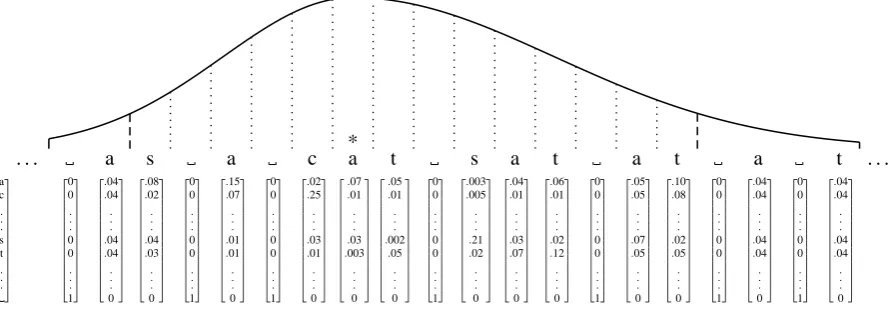
we assume that each character is either a lowercase letter or a space. The visual input obtained from an individual fixation can thus be summarized as a vector of likelihoods p(I(j)|wj), as shown in
. . . a s a c a* t s a t a t a t . . . a c . . . s t . . . 0 0 . . . 0 0 . . . 1 0 0 . . . 0 0 . . . 1 0 0 . . . 0 0 . . . 1 0 0 . . . 0 0 . . . 1 0 0 . . . 0 0 . . . 1 0 0 . . . 0 0 . . . 1 0 0 . . . 0 0 . . . 1 .04 .04 . . . .04 .04 . . . 0 .04 .04 . . . .04 .04 . . . 0 .04 .04 . . . .04 .04 . . . 0 .08 .02 . . . .04 .03 . . . 0 .15 .07 . . . .01 .01 . . . 0 .02 .25 . . . .03 .01 . . . 0 .07 .01 . . . .03 .003 . . . 0 .05 .01 . . . .002 .05 . . . 0 .003 .005 . . . .21 .02 . . . 0 .04 .01 . . . .03 .07 . . . 0 .06 .01 . . . .02 .12 . . . 0 .05 .05 . . . .07 .05 . . . 0 .10 .08 . . . .02 .05 . . . 0
Figure 1: Peripheral and foveal visual input in the model. The asymmetric Gaussian curve indicates
declining perceptual acuity centered around the fixation point (marked by∗). The vector underneath each
letter position denotes the likelihood p(I(j)|wj)for each possible letter wj, taken from a single input
sample withΛ=1/
√
3 (see vector at the left edge of the figure for key, and Section 4.2). In peripheral vision, the letter/whitespace distinction is veridical, but no information about letter identity is obtained. Note in this particular sample, input from the fixated character and the following one is rather inaccurate.
Figure 1. As in the real visual system, our vi-sual acuity function decreases with retinal eccen-tricity; we follow the SWIFT model in assuming that the spatial distribution of visual processing
rate follows an asymmetric Gaussian with σL =
2.41,σR=3.74, which we discretize into
process-ing rates for each character position. Ifεdenotes a
character’s eccentricity in characters from the cen-ter of fixation, then the proportion of the total pro-cessing rate at that eccentricity λ(ε) is given by integrating the asymmetric Gaussian over a char-acter width centered on that position,
λ(ε) =
Z ε+.5
ε−.5 1 Zexp
− x
2
2σ2
dx,σ =
(
σL, x<0
σR,x≥0
where the normalization constantZis given by
Z=
r
π
2(σL+σR).
From this distribution, we derive two types of
vi-sual input,peripheralinput giving word boundary
information and foveal input giving information
about letter identity.
4.2.1 Peripheral visual input
In our model, any eccentricity with a processing rate proportionλ(ε)at least 0.5% of the rate
pro-portion for the centrally fixated character (ε ∈
[−7,12]), yields peripheral visual input, defined as veridical word boundary information indicat-ing whether each character is a letter or a space.
This roughly corresponds to empirical estimates that humans obtain useful information in reading from about 19 characters, more from the right of fixation than the left (Rayner, 1998). Hence in Fig-ure 1, for example, left-peripheral visual input can be represented as veridical knowledge of the initial whitespace (denoted ), and a uniform distribution over the 26 letters of English for the lettera.
4.2.2 Foveal visual input
In addition, for those eccentricities with a process-ing rate proportionλ(ε)that is at least 1% of the
total processing rate (ε ∈[−5,8]) the model
re-ceives foveal visual input, defined only for letters2 to give noisy information about the letter’s iden-tity. This threshold of 1% roughly corresponds to estimates that readers get information useful for letter identification from about 4 characters to the left and 8 to the right of fixation (Rayner, 1998).
In our model, each letter is equally confusable with all others, following Norris (2006, 2009), but ignoring work on letter confusability (which could be added to future model revisions; Engel, Dougherty, & Jones, 1973; Geyer, 1977). Visual information about each character is obtained by sampling. Specifically, we represent each letter as a 26-dimensional vector, where a single element is 1 and the other 25 are zeros, and given this rep-resentation, foveal input for a letter is given as a sample from a 26-dimensional Gaussian with a
mean equal to the letter’s true identity and a di-agonal covariance matrix Σ(ε) =λ(ε)−1/2I. It is
relatively straightforward to show that under these conditions, if we take the processing rate to be the expected change in log-odds of the true letter iden-tity relative to any other that a single sample brings about, then the rate equalsλ(ε). We scale the
over-all processing rate by multiplying each rate byΛ.
For the experiments in this paper, we set Λ=4.
For each fixation, we sample independently from the appropriate distribution for each character po-sition and then compute the likelihood given each possible letter, as illustrated in the non-peripheral region of Figure 1.
4.3 Inference about sentence identity
Given the visual input and a language model,
in-ferences about the identity of the sentencew can
be made by standard Bayesian inference, where the prior is given by the language model and the likelihood is a function of the total visual input ob-tained from the first to theith timestepIi
1,
p(w|I1i) = p(w)p(I
i
1|w)
∑
w0
(w0)p(I1i|w0). (2)
If we letI(j)denote the input received about char-acter position jand letwjdenote the jth character
in sentence identityw, then the likelihood can be
broken down by character position as
p(Ii
1|w) =
n
∏
j=1 p(Ii
1(j)|wj)
wherenis the final character about which there is
any visual input. Similarly, we can decompose this into the product of the likelihoods of each sample
p(Ii
1|w) =
n
∏
j=1
i
∏
t=1
p(It(j)|wj). (3)
If the eccentricity of the jth character on the tth
timestepεtj is outside of foveal input or the
char-acter is a space, the inner term is 0 or 1. If the sam-ple was from a letter in foveal inputεtj∈[−5,8], it
is the probability of samplingIt(j)from the
mul-tivariate GaussianN(wj,ΛΣ(ε j t)).
4.4 Control policy
The model uses a simple policy to decide between
actions based on the marginal probabilitymof the
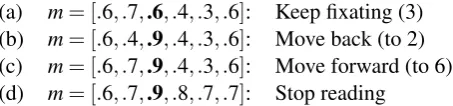
[image:6.595.314.541.63.116.2](a) m= [.6, .7,.6, .4, .3, .6]: Keep fixating (3) (b) m= [.6, .4,.9, .4, .3, .6]: Move back (to 2) (c) m= [.6, .7,.9, .4, .3, .6]: Move forward (to 6) (d) m= [.6, .7,.9, .8, .7, .7]: Stop reading
Figure 2: Values of mfor a 6 character sentence
under which a model fixating position 3 would take each of its four actions, ifα =.7 andβ=.5.
most likely charactercin position j,
m(j) =max
c p(wn=c|I i
1)
=max
c
∑
w0:w0n=c
p(w0|Ii
1). (4)
Intuitively, a high value ofmmeans that the model
is relatively confident about the character’s iden-tity, and a low value that it is relatively uncertain.
Given the values of this statistic, our model de-cides between four possible actions, as illustrated in Figure 2. If the value of this statistic for the cur-rent position of the eyes m(`i) is less than a
pa-rameterα, the model chooses to continue fixating
the current position (2a). Otherwise, if the value
ofm(j) is less thanβ for some leftward position
j< `i, the model initiates a saccade to the closest
such position (2b). Ifm(j)≥β for all j< `i, then
the model initiates a saccade to ncharacters past
the closest position to the right j> `i for which
m(j)<α (2c).3Finally, if no such positions exist
to the right, the model stops reading the sentence (2d). Intuitively, then, the model reads by making a rightward sweep to bring its confidence in each character up toα, but pauses to move left if confi-dence in a previous character falls belowβ.
4.5 Implementation with wFSAs
This model can be efficiently and simply im-plemented using weighted finite-state automata (wFSAs; Mohri, 1997) as follows: First, we be-gin with a wFSA representation of the language model, where each arc emits a single character (or is an epsilon-transition emitting nothing). To per-form belief update given a new visual input, we create a new wFSA to represent the likelihood of each character from the sample. Specifically, this wFSA has only a single chain of states, where, e.g., the first and second state in the chain are con-nected by 27 (or fewer) arcs, which emit each of
the possible characters forw1along with their re-spective likelihoods given the visual input (as in the inner term of Equation 3). Next, these two wFSAs may simply be composed and then nor-malized, which completes the belief update, re-sulting in a new wFSA giving the posterior dis-tribution over sentences. To calculate the statistic m, while it is possible to calculate it in closed form from such a wFSA relatively straightforwardly, for efficiency we use Monte Carlo estimation based on samples from the wFSA.
5 Simulation 1
With the description of our model in place, we next proceed to describe the first simulation in which we used the model to test the hypothesis that making regressions is a rational way to cope with confidence in previous regions falling. Be-cause there is in general no single rational trade-off between speed and accuracy, our hypothesis is that, for any given level of speed and accu-racy achieved by a non-regressive policy, there is a faster and more accurate policy that makes a faster left-to-right pass but occasionally does make re-gressions. In the terms of our model’s policy
pa-rametersα andβ described above, non-regressive
policies are exactly those with β =0, and a
pol-icy that is faster on the left-to-right pass but does
make regressions is one with a lower value of α
but a non-zeroβ. Thus, we tested the performance
of our model on the reading of a corpus of text typ-ical of that used in reading experiments at a range of reasonable non-regressive policies, as well as a
set of regressive policies with lower α and
posi-tive β. Our prediction is that the former set will
be strictly dominated in terms of both speed and accuracy by the latter.
5.1 Methods
5.1.1 Policy parameters
We test 4 non-regressive policies (i.e., those with
β =0) with values ofα ∈ {.90, .95, .97, .99}, and
in addition, test regressive policies with a lower range ofα∈ {.85, .90, .95, .97}andβ∈ {.4, .7}.4
5.1.2 Language model
Our reader’s language model was an unsmoothed bigram model created using a vocabulary set
con-4We tested all combinations of these values of
α andβ
except for[α,β] = [.97, .4], because we did not believe that a value ofβ so low in relation toαwould be very different
from a non-regressive policy.
sisting of the 500 most frequent words in the British National Corpus (BNC) as well as all the words in our test corpus. From this vocabulary, we constructed a bigram model using the counts from every bigram in the BNC for which both words were in vocabulary (about 222,000 bigrams).
5.1.3 wFSA implementation
We implemented our model with wFSAs using the OpenFST library (Allauzen, Riley, Schalk-wyk, Skut, & Mohri, 2007). Specifically, we constructed the model’s initial belief state (i.e., the distribution over sentences given by its lan-guage model) by directly translating the bigram model into a wFSA in the log semiring. We then composed this wFSA with a weighted finite-state transducer (wFST) breaking words down into characters. This was done in order to facili-tate simple composition with the visual likelihood wFSA defined over characters. In the Monte Carlo
estimation of m, we used 5000 samples from the
wFSA. Finally, to speed performance, we bounded the wFSA to have exactly the number of char-acters present in the actual sentence and then re-normalized.
5.1.4 Test corpus
We tested our model’s performance by simulating reading of the Schilling corpus (Schilling, Rayner, & Chumbley, 1998). To ensure that our results did not depend on smoothing, we only tested the model on sentences in which every bigram oc-curred in the BNC. Unfortunately, only 8 of the 48 sentences in the corpus met this criterion. Thus, we made single-word changes to 25 more of the sentences (mostly changing proper names and rare nouns) to produce a total of 33 sentences to read, for which every bigram did occur in the BNC.
5.2 Results and discussion
Timesteps
Accur
acy
−1.2 −1.0 −0.8 −0.6
●
● ●
●
50 55 60 65 70
Beta
[image:8.595.73.291.60.207.2]● non−regressive (beta=0) regressive (beta=0.4) regressive (beta=0.7)
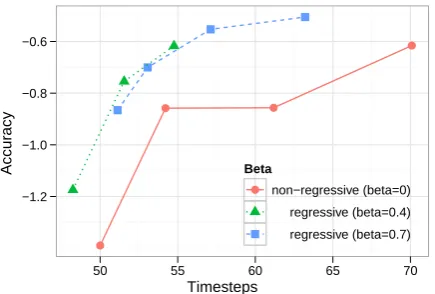
Figure 3: Mean number of timesteps taken to read a sentence and (natural) log probability of the true identity of the sentence ‘Accuracy’ for a range of
values of α and β. Values ofα are not labeled,
but increase with the number of timesteps for a
constant value ofβ. For each non-regressive
pol-icy(β =0), there is a policy with a lowerα and
higherβ that achieves better accuracy in less time.
that making regressions when confidence about previous regions falls is a rational reader strategy, in that it appears to lead to better performance, both in terms of speed and accuracy.
6 Simulation 2
In Simulation 2, we perform a more direct test of the idea that making regressions is a rational re-sponse to the problem of confidence falling about previous regions using optimization techniques. Specifically, we search for optimal policy param-eter values (α,β) for three different measures of
performance, each representing a different trade-off between the importance of accuracy and speed.
6.1 Methods
6.1.1 Performance measures
We examine performance measures interpolating between speed and accuracy of the form
L(1−γ)−Tγ (5)
whereLis the log probability of the true identity
of the sentence under the model’s beliefs at the end
of reading, andT is the total number of timesteps
before the model decided to stop reading. Thus, each different performance measure is determined by the weighting for timeγ. We test three values of γ∈ {.025, .1, .4}. The first of these weights
accu-racy highly, while the final one weights 1 timestep almost as much as 1 unit of log probability.
6.1.2 Optimization of policy parameters
Searching directly for optimal values ofα andβ
for our stochastic reading model is difficult be-cause each evaluation of the model with a partic-ular set of parameters produces a different result.
We use the PEGASUSmethod (Ng & Jordan, 2000)
to transform this stochastic optimization problem into a deterministic one on which we can use
stan-dard optimization algorithms.5Then, we evaluate
the model’s performance at each value ofα andβ
by reading the full test corpus and averaging per-formance. We then simply use coordinate ascent (in logit space) to find the optimal values ofα and
β for each performance measure.
6.1.3 Language model
The language model used in this simulation be-gins with the same vocabulary set as in Sim. 1, i.e., the 500 most frequent words in the BNC and every word that occurs in our test corpus. Because the search algorithm demands that we evaluate the performance of our model at a number of
param-eter values, however, it is too slow to optimizeα
andβ using the full language model that we used
for Sim. 1. Instead, we begin with the same set of bigrams used in Sim. 1 – i.e., those that contain two in-vocabulary words – and trim this set by re-moving rare bigrams that occur less than 200 times in the BNC (except that we do not trim any bi-grams that occur in our test corpus). This reduces our set of bigrams to about 19,000.
6.1.4 wFSA implementation
The implementation was the same as in Sim. 1.
6.1.5 Test corpus
The test corpus was the same as in Sim. 1.
6.2 Results and discussion
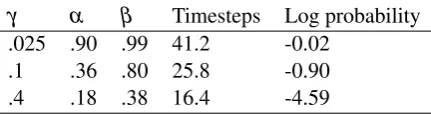
The optimal values of α and β for each γ ∈
{.025, .1, .4} are given in Table 1 along with the
mean values forLandT found at those parameter
values. As the table shows, the optimization
proce-dure successfully found values ofα andβ, which
go up (slower reading) as γ goes down (valuing
accuracy more than time). In addition, we see that the average results of reading at these parameter
values are also as we would expect, withT andL
going up asγgoes down. As predicted, the optimal
γ α β Timesteps Log probability
.025 .90 .99 41.2 -0.02
.1 .36 .80 25.8 -0.90
[image:9.595.74.290.61.118.2].4 .18 .38 16.4 -4.59
Table 1: Optimal values ofαandβ found for each
performance measure γ tested and mean
perfor-mance at those values, measured in timesteps T
and (natural) log probabilityL.
values ofβfound are non-zero across the range of
policies, which include policies that value speed over accuracy much more than in Sim. 1. This provides more evidence that whatever the partic-ular performance measure used, policies making regressive saccades when confidence in previous regions falls perform better than those that do not. There is one interesting difference between the results of this simulation and those of Sim. 1, which is that here, the optimal policies all have a value ofβ >α. That may at first seem surprising,
since the model’s policy is to fixate a region
un-til its confidence becomes greater thanαand then
return if it falls belowβ. It would seem, then, that
the only reasonable values ofβ are those that are
strictly below α. In fact, this is not the case
be-cause of the two time step delay between the de-cision to move the eyes and the execution of that saccade. Because of this delay, the model’s
confi-dence when it leaves a region (relevant toβ) will
generally be higher than when it decided to leave
(determined byα). In Simulation 2, because of the
smaller grammar that was used, the model’s confi-dence in a region’s identity rises more quickly and this difference is exaggerated.
7 Conclusion
In this paper, we presented a model that performs Bayesian inference on the identity of a sentence, combining a language model with noisy informa-tion about letter identities from a realistic visual input model. On the basis of these inferences, it uses a simple policy to determine how long to continue fixating the current position and where to fixate next, on the basis of information about where the model is uncertain about the sentence’s identity. As such, it constitutes a rational model of eye movement control in reading, extending the insights from previous results about rationality in language comprehension.
The results of two simulations using this model
support a novel explanation for between-word re-gressive saccades in reading: that they are used to gather visual input about previous regions when confidence about them falls. Simulation 1 showed that a range of policies making regressions in these cases outperforms a range of non-regressive poli-cies. In Simulation 2, we directly searched for op-timal values for the policy parameters for three dif-ferent performance measures, representing differ-ent speed-accuracy trade-offs, and found that the optimal policies in each case make substantial use of between-word regressions when confidence in previous regions falls. In addition to supporting a novel motivation for between-word regressions, these simulations demonstrate the possibility for testing a range of questions that were impossi-ble with previous models of reading related to the goals of a reader, such as how should reading be-havior change as accuracy is valued more.
There are a number of obvious ways for the model to move forward. One natural next step is to make the model more realistic by using letter confusability matrices. In addition, the link to pre-vious work in sentence processing can be made tighter by incorporating syntax-based language models. It also remains to compare this model’s predictions to human data more broadly on stan-dard benchmark measures for models of read-ing. The most important future development, how-ever, will be moving toward richer policy families, which enable more intelligent decisions about eye movement control, based not just on simple confi-dence statistics calculated independently for each character position, but rather which utilize the rich structure of the model’s posterior beliefs about the sentence identity (and of language itself) to make more informed decisions about the best time to move the eyes and the best location to direct them next.
Acknowledgments
References
Allauzen, C., Riley, M., Schalkwyk, J., Skut, W., & Mohri, M. (2007). OpenFst: A general and efficient weighted finite-state transducer library. InProceedings of the Ninth International Con-ference on Implementation and Application of Automata, (CIAA 2007) (Vol. 4783, p. 11-23). Springer.
Bicknell, K., & Levy, R. (2010). Rational eye movements in reading combining uncertainty about previous words with contextual
probabil-ity. InProceedings of the 32nd Annual
Confer-ence of the Cognitive SciConfer-ence Society. Austin, TX: Cognitive Science Society.
Boston, M. F., Hale, J. T., Kliegl, R., Patil, U., & Vasishth, S. (2008). Parsing costs as predic-tors of reading difficulty: An evaluation using
the potsdam sentence corpus. Journal of Eye
Movement Research,2(1), 1–12.
Connine, C. M., Blasko, D. G., & Hall, M. (1991). Effects of subsequent sentence context in audi-tory word recognition: Temporal and linguistic
constraints. Journal of Memory and Language,
30, 234–250.
Demberg, V., & Keller, F. (2008). Data from eye-tracking corpora as evidence for theories of
syn-tactic processing complexity. Cognition, 109,
193–210.
Ehrlich, S. F., & Rayner, K. (1981). Contextual effects on word perception and eye movements
during reading. Journal of Verbal Learning and
Verbal Behavior,20, 641–655.
Engbert, R., & Krügel, A. (2010). Readers use Bayesian estimation for eye movement control. Psychological Science,21, 366–371.
Engbert, R., Longtin, A., & Kliegl, R. (2002). A dynamical model of saccade generation in read-ing based on spatially distributed lexical
pro-cessing. Vision Research,42, 621–636.
Engbert, R., Nuthmann, A., Richter, E. M., & Kliegl, R. (2005). SWIFT: A dynamical model
of saccade generation during reading.
Psycho-logical Review,112, 777–813.
Engel, G. R., Dougherty, W. G., & Jones, B. G.
(1973). Correlation and letter recognition.
Canadian Journal of Psychology,27, 317–326. Genzel, D., & Charniak, E. (2002, July). Entropy
rate constancy in text. InProceedings of the 40th annual meeting of the Association for Computa-tional Linguistics(pp. 199–206). Philadelphia: Association for Computational Linguistics.
Genzel, D., & Charniak, E. (2003). Variation of entropy and parse trees of sentences as a func-tion of the sentence number. In M. Collins &
M. Steedman (Eds.), Proceedings of the 2003
Conference on Empirical Methods in Natural Language Processing (pp. 65–72). Sapporo, Japan: Association for Computational Linguis-tics.
Geyer, L. H. (1977). Recognition and confusion
of the lowercase alphabet. Perception &
Psy-chophysics,22, 487–490.
Hale, J. (2001). A probabilistic Earley parser as
a psycholinguistic model. InProceedings of the
Second Meeting of the North American Chapter of the Association for Computational Linguistics (Vol. 2, pp. 159–166). New Brunswick, NJ: As-sociation for Computational Linguistics.
Jaeger, T. F. (2010). Redundancy and
re-duction: Speakers manage syntactic
in-formation density. Cognitive Psychology.
doi:10.1016/j.cogpsych.2010.02.002.
Jurafsky, D. (1996). A probabilistic model of
lexical and syntactic access and disambiguation. Cognitive Science,20, 137–194.
Keller, F. (2004). The entropy rate principle as a predictor of processing effort: An evaluation against eye-tracking data. In D. Lin & D. Wu
(Eds.),Proceedings of the 2004 Conference on
Empirical Methods in Natural Language Pro-cessing (pp. 317–324). Barcelona, Spain: As-sociation for Computational Linguistics. Legge, G. E., Hooven, T. A., Klitz, T. S.,
Mans-field, J. S., & Tjan, B. S. (2002). Mr.
Chips 2002: new insights from an ideal-observer
model of reading. Vision Research, 42, 2219–
2234.
Legge, G. E., Klitz, T. S., & Tjan, B. S. (1997). Mr. Chips: an Ideal-Observer model of reading. Psychological Review,104, 524–553.
Levy, R. (2008). A noisy-channel model of ra-tional human sentence comprehension under
un-certain input. InProceedings of the 2008
Con-ference on Empirical Methods in Natural Lan-guage Processing (pp. 234–243). Honolulu, Hawaii: Association for Computational Linguis-tics.
Levy, R., Bicknell, K., Slattery, T., & Rayner, K. (2009). Eye movement evidence that read-ers maintain and act on uncertainty about past
linguistic input. Proceedings of the National
Levy, R., & Jaeger, T. F. (2007). Speakers op-timize information density through syntactic re-duction. In B. Schölkopf, J. Platt, & T. Hoffman
(Eds.), Advances in Neural Information
Pro-cessing Systems 19(pp. 849–856). Cambridge, MA: MIT Press.
Levy, R., Reali, F., & Griffiths, T. L. (2009).
Modeling the effects of memory on human on-line sentence processing with particle filters. In D. Koller, D. Schuurmans, Y. Bengio, & L.
Bot-tou (Eds.),Advances in Neural Information
Pro-cessing Systems 21(pp. 937–944).
Mohri, M. (1997). Finite-state transducers in
lan-guage and speech processing. Computational
Linguistics,23, 269–311.
Narayanan, S., & Jurafsky, D. (2001). A Bayesian model predicts human parse preference and reading time in sentence processing. In T. Diet-terich, S. Becker, & Z. Ghahramani (Eds.), Ad-vances in Neural Information Processing Sys-tems 14 (pp. 59–65). Cambridge, MA: MIT Press.
Ng, A. Y., & Jordan, M. (2000). PEGASUS:
A policy search method for large MDPs and
POMDPs. In Uncertainty in Artificial
Intelli-gence, Proceedings of the Sixteenth Conference (pp. 406–415).
Norris, D. (2006). The Bayesian reader: Explain-ing word recognition as an optimal Bayesian
de-cision process.Psychological Review,113, 327–
357.
Norris, D. (2009). Putting it all together: A unified account of word recognition and reaction-time
distributions. Psychological Review,116, 207–
219.
Rayner, K. (1998). Eye movements in reading and information processing: 20 years of research. Psychological Bulletin,124, 372–422.
Reichle, E. D., & Laurent, P. A. (2006). Using reinforcement learning to understand the emer-gence of “intelligent” eye-movement behavior
during reading. Psychological Review, 113,
390–408.
Reichle, E. D., Pollatsek, A., Fisher, D. L., &
Rayner, K. (1998). Toward a model of eye
movement control in reading.Psychological
Re-view,105, 125–157.
Reichle, E. D., Pollatsek, A., & Rayner, K. (2006). E-Z Reader: A cognitive-control, serial-attention model of eye-movement behavior
dur-ing readdur-ing. Cognitive Systems Research,7, 4–
22.
Reichle, E. D., Warren, T., & McConnell, K.
(2009). Using E-Z Reader to model the
ef-fects of higher level language processing on eye
movements during reading. Psychonomic
Bul-letin & Review,16, 1–21.
Schilling, H. E. H., Rayner, K., & Chumbley, J. I.
(1998). Comparing naming, lexical decision,
and eye fixation times: Word frequency effects
and individual differences. Memory &
Cogni-tion,26, 1270–1281.
Smith, N. J., & Levy, R. (2008). Optimal process-ing times in readprocess-ing: a formal model and empir-ical investigation. In B. C. Love, K. McRae, &
V. M. Sloutsky (Eds.),Proceedings of the 30th
Annual Conference of the Cognitive Science So-ciety(pp. 595–600). Austin, TX: Cognitive Sci-ence Society.
Tanenhaus, M. K., Spivey-Knowlton, M. J., Eber-hard, K. M., & Sedivy, J. C. (1995). Integration of visual and linguistic information in spoken
language comprehension. Science,268, 1632–