Unsupervised Multilingual Grammar Induction
Benjamin Snyder, Tahira Naseem, and Regina Barzilay
Computer Science and Artificial Intelligence Laboratory Massachusetts Institute of Technology
{bsnyder, tahira, regina}@csail.mit.edu
Abstract
We investigate the task of unsupervised constituency parsing from bilingual par-allel corpora. Our goal is to use bilin-gual cues to learn improved parsing mod-els for each language and to evaluate these models on held-out monolingual test data. We formulate a generative Bayesian model which seeks to explain the observed par-allel data through a combination of bilin-gual and monolinbilin-gual parameters. To this end, we adapt a formalism known as un-ordered tree alignmentto our probabilistic setting. Using this formalism, our model loosely binds parallel trees while allow-ing language-specific syntactic structure. We perform inference under this model us-ing Markov Chain Monte Carlo and dy-namic programming. Applying this model to three parallel corpora (Korean-English, Urdu-English, and Chinese-English) we find substantial performance gains over the CCM model, a strong monolingual baseline. On average, across a variety of testing scenarios, our model achieves an 8.8 absolute gain in F-measure.1
1 Introduction
In this paper we investigate the task of unsuper-vised constituency parsing when bilingual paral-lel text is available. Our goal is to improve pars-ing performance on monolpars-ingual test data for each language by using unsupervised bilingual cues at training time. Multilingual learning has been suc-cessful for other linguistic induction tasks such as lexicon acquisition, morphological segmentation, and part-of-speech tagging (Genzel, 2005; Snyder and Barzilay, 2008; Snyder et al., 2008; Snyder
1Code and the outputs of our experiments are available at http://groups.csail.mit.edu/rbg/code/multiling induction.
et al., 2009). We focus here on the unsupervised induction of unlabeled constituency brackets. This task has been extensively studied in a monolingual setting and has proven to be difficult (Charniak and Carroll, 1992; Klein and Manning, 2002).
The key premise of our approach is that am-biguous syntactic structures in one language may correspond to less uncertain structures in the other language. For instance, the English sentence I saw [the student [from MIT]] exhibits the classic problem of PP-attachment ambiguity. However, its Urdu translation, literally glossed asI[[MIT of] student]saw, uses a genitive phrase that may only be attached to the adjacent noun phrase. Know-ing the correspondence between these sentences should help us resolve the English ambiguity.
One of the main challenges of unsupervised multilingual learning is to exploit cross-lingual patterns discovered in data, while still allowing a wide range of language-specific idiosyncrasies. To this end, we adapt a formalism known as un-ordered tree alignment (Jiang et al., 1995) to a probabilistic setting. Under this formalism, any two trees can be embedded in an alignment tree. This alignment tree allows arbitrary parts of the two trees to diverge in structure, permitting language-specific grammatical structure to be pre-served. Additionally, a computational advantage of this formalism is that the marginalized probabil-ity over all possible alignments for any two trees can be efficiently computed with a dynamic pro-gram in linear time.
We formulate a generative Bayesian model which seeks to explain the observed parallel data through a combination of bilingual and mono-lingual parameters. Our model views each pair of sentences as having been generated as fol-lows: First an alignment tree is drawn. Each node in this alignment tree contains either a soli-tary monolingual constituent or a pair of coupled bilingual constituents. For each solitary
lingual constituent, a sequence of part-of-speech tags is drawn from a language-specific distribu-tion. For each pair of coupled bilingual con-stituents, a pair of part-of-speech sequences are drawn jointly from a cross-lingual distribution. Word-level alignments are then drawn based on the tree alignment. Finally, parallel sentences are assembled from these generated part-of-speech se-quences and word-level alignments.
To perform inference under this model, we use a Metropolis-Hastings within-Gibbs sampler. We sample pairs of trees and then compute marginal-ized probabilities over all possible alignments us-ing dynamic programmus-ing.
We test the effectiveness of our bilingual gram-mar induction model on three corpora of parallel text: Korean, Urdu and English-Chinese. The model is trained using bilingual data with automatically induced word-level align-ments, but is tested on purely monolingual data for each language. In all cases, our model out-performs a state-of-the-art baseline: the Con-stituent Context Model (CCM) (Klein and Man-ning, 2002), sometimes by substantial margins. On average, over all the testing scenarios that we studied, our model achieves an absolute increase in F-measure of 8.8 points, and a 19% reduction in error relative to a theoretical upper bound.
2 Related Work
The unsupervised grammar induction task has been studied extensively, mostly in a monolin-gual setting (Charniak and Carroll, 1992; Stolcke and Omohundro, 1994; Klein and Manning, 2002; Seginer, 2007). While PCFGs perform poorly on this task, the CCM model (Klein and Manning, 2002) has achieved large gains in performance and is among the state-of-the-art probabilistic models for unsupervised constituency parsing. We there-fore use CCM as our basic model of monolingual syntax.
While there has been some previous work on bilingual CFG parsing, it has mainly focused on improving MT systems rather than monolingual parsing accuracy. Research in this direction was pioneered by (Wu, 1997), who developed Inver-sion Transduction Grammars to capture cross-lingual grammar variations such as phrase re-orderings. More general formalisms for the same purpose were later developed (Wu and Wong, 1998; Chiang, 2005; Melamed, 2003; Eisner,
2003; Zhang and Gildea, 2005; Blunsom et al., 2008). We know of only one study which eval-uates these bilingual grammar formalisms on the task of grammar induction itself (Smith and Smith, 2004). Both our model and even the monolingual CCM baseline yield far higher performance on the same Korean-English corpus.
Our approach is closer to the unsupervised bilingual parsing model developed by Kuhn (2004), which aims to improve monolingual per-formance. Assuming that trees induced over paral-lel sentences have to exhibit certain structural reg-ularities, Kuhn manually specifies a set of rules for determining when parsing decisions in the two languages are inconsistent with GIZA++ word-level alignments. By incorporating these con-straints into the EM algorithm he was able to im-prove performance over a monolingual unsuper-vised PCFG. Still, the performance falls short of state-of-the-art monolingual models such as the CCM.
More recently, there has been a body of work attempting to improve parsing performance by ex-ploiting syntactically annotated parallel data. In one strand of this work, annotations are assumed only in a resource-rich language and are projected onto a resource-poor language using the parallel data (Hwa et al., 2005; Xi and Hwa, 2005). In another strand of work, syntactic annotations are assumed on both sides of the parallel data, and a model is trained to exploit the parallel data at test time as well (Smith and Smith, 2004; Burkett and Klein, 2008). In contrast to this work, our goal is to explore the benefits of multilingual grammar induction in a fully unsupervised setting.
We finally note a recent paper which uses pa-rameter tying to improve unsupervised depen-dency parse induction (Cohen and Smith, 2009). While the primary performance gains occur when tying related parameters within a language, some additional benefit is observed through bilingual ty-ing, even in the absence of a parallel corpus.
3 Model
(i) (ii) (iii)
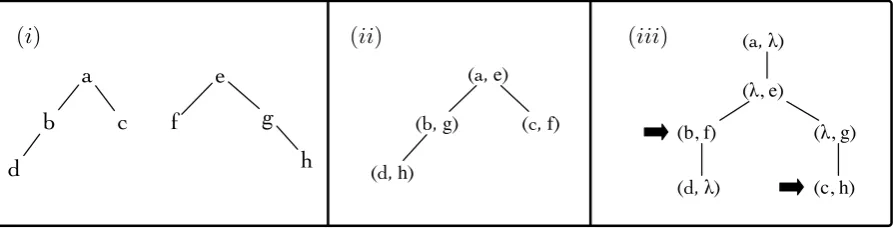
Figure 1: A pair of trees (i) and two possible alignment trees. In (ii), no empty spaces are inserted, but the order of one of the original tree’s siblings has been reversed. In (iii), only two pairs of nodes have been aligned (indicated by arrows) and many empty spaces inserted.
word-level alignments, as observed data. We ob-tain these word-level alignments using GIZA++ (Och and Ney, 2003).
Our model seeks to explain this observed data through a generative process whereby two aligned parse trees are produced jointly. Though they are aligned, arbitrary parts of the two trees are permitted to diverge, accommodating language-specific grammatical structure. In effect, our model loosely binds the two trees: node-to-node alignments need only be used where repeated bilingual patterns can be discovered in the data.
3.1 Tree Alignments
We achieve this loose binding of trees by adapting unordered tree alignment(Jiang et al., 1995) to a probabilistic setting. Under this formalism, any two trees can be aligned using analignment tree. The alignment tree embeds the original two trees within it: each node is labeled by a pair (x, y),
(λ, y), or(x, λ) wherex is a node from the first tree,yis a node from the second tree, andλis an empty space. The individual structure of each tree must be preserved under the embedding with the exception of sibling order (to allow variations in phrase and word order).
The flexibility of this formalism can be demon-strated by two extreme cases: (1) an alignment be-tween two trees may actually align noneof their individual nodes, instead inserting an empty space
λ for each of the original two trees’ nodes. (2) if the original trees are isomorphic to one an-other, the alignment may match their nodes ex-actly, without inserting any empty spaces. See Figure 1 for an example.
3.2 Model overview
As our basic model of syntactic structure, we adopt the Constituent-Context Model (CCM) of Klein and Manning (2002). Under this model, the part-of-speech sequence of each span in a sen-tence is generated either as a constituent yield — if it is dominated by a node in the tree — or otherwise as a distituent yield. For example, in the bracketed sentence [John/NNP[climbed/VB [the/DTtree/NN]]], the sequenceVB DT NNis gen-erated as a constituent yield, since it constitutes a complete bracket in the tree. On the other hand, the sequence VB DT is generated as a distituent, since it does not. Besides these yields, the con-texts(two surrounding POS tags) of constituents and distituents are generated as well. In this exam-ple, the context of the constituentVB DT NNwould be (NNP, #), while the context of the distituentVB DT would be (NNP, NN). The CCM model em-ploys separate multinomial distributions over con-stituents, dicon-stituents, constituent contexts, and dis-tituent contexts. While this model is deficient — each observed subsequence of part-of-speech tags is generated many times over — its performance is far higher than that of unsupervised PCFGs.
Under our bilingual model, each pair of sen-tences is assumed to have been generated jointly in the following way: First, an unlabeledalignment tree is drawn uniformly from the set of all such trees. This alignment tree specifies the structure of each of the two individual trees, as well as the pairs of nodes which are aligned and those which are not aligned (i.e. paired with aλ).
tree), a single constituent and context are drawn, from language-specific distributions. Distituents and their contexts are also drawn from language-specific distributions. Finally, word-level align-ments are drawn based on the structure of the alignment tree.
In the next two sections, we describe our model in more formal detail by specifying the parame-ters and generative process by which sentences are formed.
3.3 Parameters
Our model employs a number of multinomial dis-tributions:
• πiC :over constituent yields of languagei,
• πiD :over distituent yields of languagei,
• φCi :over constituent contexts of languagei,
• φD
i :over distituent contexts of languagei, • ω:overpairsof constituent yields, one from
the first language and the other from the sec-ond language,
• Gzpair : over a finite set of integer val-ues{−m, . . . ,−2,−1,0,1,2, . . . , m}, mea-suring the Giza-score of aligned tree node pairs (see below),
• Gznode : over a finite set of integer values {−m, . . . ,−2,−1,0}, measuring the Giza-scoreof unaligned tree nodes (see below).
The first four distributions correspond exactly to the parameters of the CCM model. Parameterωis a “coupling parameter” which measures the com-patibility of tree-aligned constituent yield pairs. The final two parameters measure the compatibil-ity of syntactic alignments with the observed lexi-calGIZA++ alignments. Intuitively, aligned nodes should have a high density of word-level align-ments between them, and unaligned nodes should have few lexical alignments.
More formally, consider a tree-aligned node pair (n1, n2) with corresponding yields (y1, y2).
We call a word-level alignment good if it aligns a word iny1 with a word in y2. We call a
word-level alignmentbadif it aligns a word iny1 with
a word outside y2, or vice versa. The
Giza-score for (n1, n2) is the number of good word
alignments minus the number ofbadword align-ments. For example, suppose the constituentmy
long nameis node-aligned to its Urdu translation mera lamba naam. If only the word-pairsmy/mera andname/naam are aligned, then the Giza-score for this node-alignment would be 2. If however, the English word long were (incorrectly) aligned underGIZA++ to some Urdu word outside the cor-responding constituent, then the score would drop to 1. This score could even be negative if the num-ber ofbadalignments exceeds those that aregood. DistributionGzpairprovides a probability for these scores (up to some fixed absolute value).
For an unaligned node n with corresponding yieldy, onlybadGIZA++ alignments are possible, thus the Giza-score for these nodes will always be zero or negative. Distribution Gznode provides a probability for these scores (down to some fixed value). We want our model to find tree alignments such that both aligned node pairs and unaligned nodes have highGiza-score.
3.4 Generative Process
Now we describe the stochastic process whereby the observed parallel sentences and their word-level alignments are generated, according to our model.
As the first step in the Bayesian generative pro-cess, all the multinomial parameters listed in the previous section are drawn from their conjugate priors — Dirichlet distributions of appropriate di-mension. Then, each pair of word-aligned parallel sentences is generated through the following pro-cess:
1. A pair of binary treesT1 andT2 along with
an alignment treeA are drawn according to
P(T1, T2, A). A is an alignment tree forT1
and T2 if it can be obtained by the
follow-ing steps: First insert blank nodes (labeled by
λ) into T1 and T2. Then permute the order
of sibling nodes such that the two resulting treesT10 andT20 are identical in structure. Fi-nally, overlayT10 andT20 to obtainA. We ad-ditionally require thatAcontain no extrane-ous nodes – that is no nodes with two blank labels(λ, λ). See Figure 1 for an example. We define the distributionP(T1, T2, A)to be
uniform over all pairs of binary trees and their alignments.
2. For each node inA of the form(n1, λ) (i.e.
nodes inT1left unaligned byA), draw
(ii) a constituent context according toφC1, (iii) a Giza-score according toGznode.
3. For each node inA of the form(λ, n2) (i.e.
nodes inT2 left unaligned byA), draw
(i) a constituent yield according toπ2C, (ii) a constituent context according toφC2, (iii) a Giza-score according toGznode.
4. For each node inAof the form(n1, n2)(i.e.
tree-aligned node pairs), draw
(i) a pair of constituent yields (y1, y2)
ac-cording to:
φC1(y1)·φC2(y2)·ω(y1, y2)
Z (1)
which is a product of experts combining the language specific context-yield dis-tributions as well as the coupling distri-butionωwith normalization constantZ, (ii) a pair of contexts according to the ap-propriate language-specific parameters, (iii) a Giza-score according toGzpair.
5. For each span inTinotdominated by a node (for each language i ∈ {1,2}), draw a dis-tituent yield according toπDi and a distituent context according toφDi .
6. Draw actual word-level alignments consis-tent with the Giza-scores, according to a uni-form distribution.
In the next section we turn to the problem of inference under this model when only the part-of-speech tag sequences of parallel sentences and their word-level alignments are observed.
3.5 Inference
Given a corpus of paired part-of-speech tag se-quences (s1,s2) and their GIZA++ alignments
g, we would ideally like to predict the set of tree pairs (T1,T2) which have highest
proba-bility when conditioned on the observed data:
P T1,T2
s1,s2,g
. We could rewrite this by explicitly integrating over the yield, context, cou-pling, Giza-score parameters as well as the align-ment trees. However, since maximizing this in-tegral directly would be intractable, we resort to standard Markov chain sampling techniques. We use Gibbs sampling (Hastings, 1970) to draw trees for each sentence conditioned on those drawn for
all other sentences. The samples form a Markov chain which is guaranteed to converge to the true joint distribution over all sentences.
In the monolingual setting, there is a well-known tree sampling algorithm (Johnson et al., 2007). This algorithm proceeds in top-down fash-ion by sampling individual split points using the marginal probabilities of all possible subtrees. These marginals can be efficiently pre-computed and form the “inside” table of the famous Inside-Outside algorithm. However, in our setting, trees come in pairs, and their joint probability crucially depends on their alignment.
For theithparallel sentence, we wish to jointly sample the pair of trees (T1, T2)i together with their alignment Ai. To do so directly would in-volve simultaneously marginalizing over all pos-sible subtrees as well as all pospos-sible alignments between such subtrees when sampling upper-level split points. We know of no obvious algorithm for computing this marginal. We instead first sam-ple the pair of trees(T1, T2)i from a simpler pro-posal distributionQ. Our proposal distribution as-sumes that no nodes of the two trees are aligned and therefore allows us to use the recursive top-down sampling algorithm mentioned above. After a new tree pairT∗ = (T1∗, T2∗)i is drawn fromQ, we accept the pair with the following probability:
min
1,P(T ∗|T
−i,A−i)Q(T|T−i,A−i)
P(T|T−i,A−i)Q(T∗|T−i,A−i)
where T is the previously sampled tree-pair for sentence i, P is the true model probability, and
Q is the probability under the proposal distribu-tion. This use of a tractable proposal distribution and acceptance ratio is known as the Metropolis-Hastings algorithm and it preserves the conver-gence guarantee of the Gibbs sampler (Hastings, 1970). To compute the terms P(T∗|T−i,A−i) andP(T|T−i,A−i)in the acceptance ratio above, we need to marginalize over all possible align-ments between tree pairs.
Fortunately, for any given pair of trees T1 and T2 this marginalization can be computed using
a dynamic program in time O(|T1||T2|). Here
we provide a very brief sketch. For every pair of nodes n1 ∈ T1, n2 ∈ T2, a table stores the
marginal probability of the subtrees rooted atn1
andn2, respectively. A dynamic program builds
this table from the bottom up: For each node pair
n1, n2, we sum the probabilities of all local
appro-priate marginals already computed in the table for lower-level node pairs. This algorithm is an adap-tation of the dynamic program presented in (Jiang et al., 1995) for finding minimum cost alignment trees (Fig. 5 of that publication).
Once a pair of trees (T1, T2) has been
sam-pled, we can proceed to sample an alignment tree
A|T1, T2.2 We sample individual alignment
deci-sions from the top down, at each step using the alignment marginals for the remaining subtrees (already computed using the afore-mentioned dy-namic program). Once the triple (T1, T2, A) has
been sampled, we move on to the next parallel sen-tence.
We avoid directly sampling parameter val-ues, instead using the marginalized closed forms for multinomials with Dirichlet conjugate-priors using counts and hyperparameter pseudo-counts (Gelman et al., 2004). Note that in the case of yield pairs produced according to Distribution 1 (in step 4 of the generative process) conjugacy is technically broken, since the yield pairs are no longer produced by a single multinomial distribu-tion. Nevertheless, we count the produced yields as if they had been generated separately by each of the distributions involved in the numerator of Distribution 1.
4 Experimental setup
We test our model on three corpora of bilin-gual parallel sentences: Korean, English-Urdu, and English-Chinese. Though the model is trained using parallel data, during testing it has ac-cess only to monolingual data. This set-up ensures that we are testing our model’s ability to learn bet-ter paramebet-ters at training time, rather than its abil-ity to exploit parallel data at test time. Following (Klein and Manning, 2002), we restrict our model to binary trees, though we note that the alignment trees do not follow this restriction.
Data The Penn Korean Treebank (Han et al., 2002) consists of 5,083 Korean sentences trans-lated into English for the purposes of language training in a military setting. Both the Korean and English sentences are annotated with syntactic trees. We use the first 4,000 sentences for training and the last 1,083 sentences for testing. We note that in the Korean data, a separate tag is given for
2Sampling the alignment tree is important, as it provides us with counts of aligned constituents for the coupling pa-rameter.
each morpheme. We simply concatenate all the morpheme tags given for each word and treat the concatenation as a single tag. This procedure re-sults in 199 different tags. The English-Urdu par-allel corpus3 consists of 4,325 sentences from the first three sections of the Penn Treebank and their Urdu translations annotated at the part-of-speech level. The Urdu side of this corpus does not pro-vide tree annotations so here we can test parse ac-curacy only on English. We use the remaining sections of the Penn Treebank for English test-ing. The English-Chinese treebank (Bies et al., 2007) consists of 3,850 Chinese newswire sen-tences translated into English. Both the English and Chinese sentences are annotated with parse trees. We use the first 4/5 for training and the final 1/5 for testing.
During preprocessing of the corpora we remove all punctuation marks and special symbols, fol-lowing the setup in previous grammar induction work (Klein and Manning, 2002). To obtain lex-ical alignments between the parallel sentences we employGIZA++ (Och and Ney, 2003). We use in-tersection alignments, which are one-to-one align-ments produced by taking the intersection of to-many alignments in each direction. These one-to-one intersection alignments tend to have higher precision.
We initialize the trees by making uniform split decisions recursively from the top down for sen-tences in both languages. Then for each pair of parallel sentences we randomly sample an initial alignment tree for the two sampled trees.
Baseline We implement a Bayesian version of the CCM as a baseline. This model uses the same inference procedure as our bilingual model (Gibbs sampling). In fact, our model reduces to this Bayesian CCM when it is assumed that no nodes between the two parallel trees are ever aligned and when word-level alignments are ignored. We also reimplemented the original EM version of CCM and found virtually no difference in perfor-mance when using EM or Gibbs sampling. In both cases our implementation achieves F-measure in the range of 69-70% on WSJ10, broadly in line with the performance reported by Klein and Man-ning (2002).
Hyperparameters Klein (2005) reports using smoothing pseudo-counts of 2 for constituent
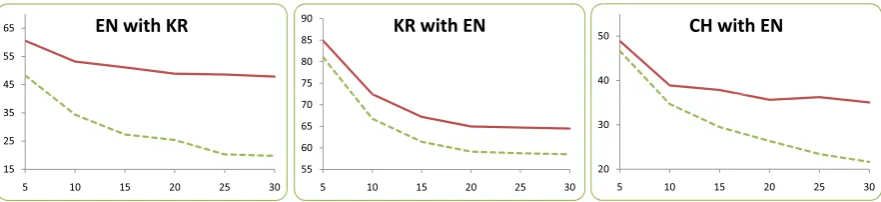
Figure 2: The F-measure of the CCM baseline (dotted line) and bilingual model (solid line) plotted on the y-axis, as the maximum sentence length in the test set is increased (x-axis). Results are averaged over all training scenarios given in Table 1.
yields and contexts and 8 for distituent yields and contexts. In our Bayesian model, these similar smoothing counts occur as the parameters of the Dirichlet priors. For Korean we found that the baseline performed well using these values. How-ever, on our English and Chinese data, we found that somewhat higher smoothing values worked best, so we utilized values of 20 and 80 for con-stituent and dicon-stituent smoothing counts, respec-tively.
Our model additionally requires hyperparam-eter values for ω (the coupling distribution for aligned yields), Gzpair and Gznode (the distribu-tions over Giza-scores for aligned nodes and un-aligned nodes, respectively). For ω we used a symmetric Dirichlet prior with parameter 1. For
GzpairandGznode, in order to create a strong bias towards high Giza-scores, we used non-symmetric Dirichlet priors. In both cases, we capped the ab-solute value of the scores at 3, to prevent count sparsity. In the case of Gzpair we gave pseudo-counts of 1,000 for negative values and zero, and pseudo-counts of 1,000,000 for positive scores. For Gznode we gave a pseudo-count of 1,000,000 for a score of zero, and 1,000 for all nega-tive scores. This very strong prior bias encodes our intuition that syntactic alignments which re-spect lexical alignments should be preferred. Our method is not sensitive to these exact values and any reasonably strong bias gave similar results.
In all our experiments, we consider the hyper-parameters fixed and observed values.
Testing and evaluation As mentioned above, we test our model only on monolingual data, where the parallel sentences are not provided to the model. To predict the bracketings of these monolingual test sentences, we take the smoothed
counts accumulated in the final round of sampling over the training data and perform a maximum likelihood estimate of the monolingual CCM pa-rameters. These parameters are then used to pro-duce the highest probability bracketing of the test set.
To evaluate both our model as well as the base-line, we use (unlabeled) bracket precision, re-call, and F-measure (Klein and Manning, 2002). Following previous work, we include the whole-sentence brackets but ignore single-word brack-ets. We perform experiments on different subsets of training and testing data based on the sentence-length. In particular we experimented with sen-tence length limits of 10, 20, and 30 for both the training and testing sets. We also report the upper bound on F-measure for binary trees. We average the results over 10 separate sampling runs.
5 Results
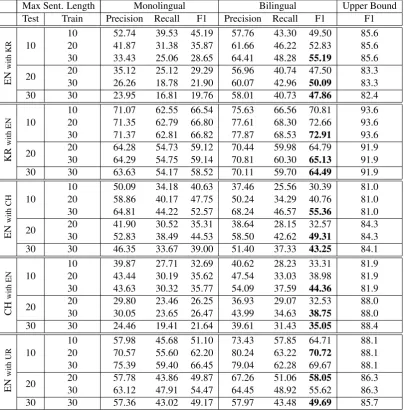
Table 1 reports the full results of our experiments. In all testing scenarios the bilingual model out-performs its monolingual counterpart in terms of both precision and recall. On average, the bilin-gual model gains 10.2 percentage points in preci-sion, 7.7 in recall, and 8.8 in F-measure. The gap between monolingual performance and the binary tree upper bound is reduced by over 19%.
sub-Max Sent. Length Monolingual Bilingual Upper Bound Test Train Precision Recall F1 Precision Recall F1 F1
EN
with
KR 10
10 52.74 39.53 45.19 57.76 43.30 49.50 85.6 20 41.87 31.38 35.87 61.66 46.22 52.83 85.6 30 33.43 25.06 28.65 64.41 48.28 55.19 85.6
20 20 35.12 25.12 29.29 56.96 40.74 47.50 83.3
30 26.26 18.78 21.90 60.07 42.96 50.09 83.3
30 30 23.95 16.81 19.76 58.01 40.73 47.86 82.4
KR
with
EN 10
10 71.07 62.55 66.54 75.63 66.56 70.81 93.6 20 71.35 62.79 66.80 77.61 68.30 72.66 93.6 30 71.37 62.81 66.82 77.87 68.53 72.91 93.6
20 20 64.28 54.73 59.12 70.44 59.98 64.79 91.9
30 64.29 54.75 59.14 70.81 60.30 65.13 91.9
30 30 63.63 54.17 58.52 70.11 59.70 64.49 91.9
EN
with
CH 10
10 50.09 34.18 40.63 37.46 25.56 30.39 81.0 20 58.86 40.17 47.75 50.24 34.29 40.76 81.0 30 64.81 44.22 52.57 68.24 46.57 55.36 81.0
20 20 41.90 30.52 35.31 38.64 28.15 32.57 84.3
30 52.83 38.49 44.53 58.50 42.62 49.31 84.3
30 30 46.35 33.67 39.00 51.40 37.33 43.25 84.1
CH
with
EN 10
10 39.87 27.71 32.69 40.62 28.23 33.31 81.9 20 43.44 30.19 35.62 47.54 33.03 38.98 81.9 30 43.63 30.32 35.77 54.09 37.59 44.36 81.9
20 20 29.80 23.46 26.25 36.93 29.07 32.53 88.0
30 30.05 23.65 26.47 43.99 34.63 38.75 88.0
30 30 24.46 19.41 21.64 39.61 31.43 35.05 88.4
EN
with
UR 10
10 57.98 45.68 51.10 73.43 57.85 64.71 88.1 20 70.57 55.60 62.20 80.24 63.22 70.72 88.1 30 75.39 59.40 66.45 79.04 62.28 69.67 88.1
20 20 57.78 43.86 49.87 67.26 51.06 58.05 86.3
30 63.12 47.91 54.47 64.45 48.92 55.62 86.3
[image:8.595.99.504.63.474.2]30 30 57.36 43.02 49.17 57.97 43.48 49.69 85.7
Table 1: Unlabeled precision, recall and F-measure for the monolingual baseline and the bilingual model on several test sets. We report results for different combinations of maximum sentence length in both the training and test sets. The right most column, in all cases, contains the maximum F-measure achievable using binary trees. The best performance for each test-length is highlighted in bold.
stantial. This asymmetry should not be surprising, as Chinese on its own seems to be quite a bit more difficult to parse than English.
We also investigated the impact of sentence length for both the training and testing sets. For our model, adding sentences of greater length to the training set leads to increases in parse accu-racy for short sentences. For the baseline, how-ever, adding this additional training data degrades performance in the case of English paired with Ko-rean. Figure 2 summarizes the performance of our model for different sentence lengths on sev-eral of the test-sets. As shown in the figure, the largest improvements tend to occur at longer sen-tence lengths.
6 Conclusion
We have presented a probabilistic model for bilin-gual grammar induction which uses raw parallel text to learn tree pairs and their alignments. Our formalism loosely binds the two trees, using bilin-gual patterns when possible, but allowing substan-tial language-specific variation. We tested our model on three test sets and showed substantial improvement over a state-of-the-art monolingual baseline.4
4
References
Ann Bies, Martha Palmer, Justin Mott, and Colin Warner. 2007. English Chinese translation treebank v 1.0. LDC2007T02.
Phil Blunsom, Trevor Cohn, and Miles Osborne. 2008. Bayesian synchronous grammar induction. In Pro-ceedings of NIPS.
David Burkett and Dan Klein. 2008. Two languages are better than one (for syntactic parsing). In Pro-ceedings of EMNLP, pages 877–886.
Eugene Charniak and Glen Carroll. 1992. Two exper-iments on learning probabilistic dependency gram-mars from corpora. In Proceedings of the AAAI Workshop on Statistically-Based NLP Techniques, pages 1–13.
David Chiang. 2005. A hierarchical phrase-based model for statistical machine translation. In Pro-ceedings of the ACL, pages 263–270.
Shay B. Cohen and Noah A. Smith. 2009. Shared lo-gistic normal distributions for soft parameter tying in unsupervised grammar induction. InProceedings of the NAACL/HLT.
Jason Eisner. 2003. Learning non-isomorphic tree mappings for machine translation. InThe Compan-ion Volume to the Proceedings of the ACL, pages 205–208.
Andrew Gelman, John B. Carlin, Hal S. Stern, and Donald B. Rubin. 2004. Bayesian data analysis. Chapman and Hall/CRC.
Dmitriy Genzel. 2005. Inducing a multilingual dictio-nary from a parallel multitext in related languages. InProceedings of EMNLP/HLT, pages 875–882.
C. Han, N.R. Han, E.S. Ko, H. Yi, and M. Palmer. 2002. Penn Korean Treebank: Development and evaluation. In Proc. Pacific Asian Conf. Language and Comp.
W. K. Hastings. 1970. Monte carlo sampling meth-ods using Markov chains and their applications.
Biometrika, 57:97–109.
R. Hwa, P. Resnik, A. Weinberg, C. Cabezas, and O. Kolak. 2005. Bootstrapping parsers via syntactic projection across parallel texts. Journal of Natural Language Engineering, 11(3):311–325.
T. Jiang, L. Wang, and K. Zhang. 1995. Alignment of trees – an alternative to tree edit. Theoretical Com-puter Science, 143(1):137–148.
M. Johnson, T. Griffiths, and S. Goldwater. 2007. Bayesian inference for PCFGs via Markov chain Monte Carlo. In Proceedings of the NAACL/HLT, pages 139–146.
Dan Klein and Christopher D. Manning. 2002. A generative constituent-context model for improved grammar induction. In Proceedings of the ACL, pages 128–135.
D. Klein. 2005. The Unsupervised Learning of Natu-ral Language Structure. Ph.D. thesis, Stanford Uni-versity.
Jonas Kuhn. 2004. Experiments in parallel-text based grammar induction. In Proceedings of the ACL, pages 470–477.
I. Dan Melamed. 2003. Multitext grammars
and synchronous parsers. In Proceedings of the NAACL/HLT, pages 79–86.
Franz Josef Och and Hermann Ney. 2003. A sys-tematic comparison of various statistical alignment models. Computational Linguistics, 29(1):19–51.
Yoav Seginer. 2007. Fast unsupervised incremental parsing. InProceedings of the ACL, pages 384–391.
David A. Smith and Noah A. Smith. 2004. Bilingual parsing with factored estimation: Using English to parse Korean. InProceeding of EMNLP, pages 49– 56.
Benjamin Snyder and Regina Barzilay. 2008. Un-supervised multilingual learning for morphological segmentation. In Proceedings of the ACL/HLT, pages 737–745.
Benjamin Snyder, Tahira Naseem, Jacob Eisenstein, and Regina Barzilay. 2008. Unsupervised multi-lingual learning for POS tagging. InProceedings of EMNLP, pages 1041–1050.
Benjamin Snyder, Tahira Naseem, Jacob Eisenstein, and Regina Barzilay. 2009. Adding more languages improves unsupervised multilingual part-of-speech tagging: A Bayesian non-parametric approach. In
Proceedings of the NAACL/HLT.
Andreas Stolcke and Stephen M. Omohundro. 1994. Inducing probabilistic grammars by Bayesian model merging. InProceedings of ICGI, pages 106–118.
Dekai Wu and Hongsing Wong. 1998. Machine
translation with a stochastic grammatical channel. In Proceedings of the ACL/COLING, pages 1408– 1415.
Dekai Wu. 1997. Stochastic inversion transduction grammars and bilingual parsing of parallel corpora.
Computational Linguistics, 23(3):377–403.
Chenhai Xi and Rebecca Hwa. 2005. A backoff model for bootstrapping resources for non-english languages. InProceedings of EMNLP, pages 851 – 858.