Multi-Criteria-based Active Learning for Named Entity Re cognition
Dan Shen
†‡1Jie Zhang
†‡Jian Su
†Guodong Zhou
†Chew-Lim Tan
‡†
Institute for Infocomm Technology
21 Heng Mui Keng Terrace
Singapore 119613
‡
Department of Computer Science
National University of Singapore
3 Science Drive 2, Singapore 117543
{shendan,zhangjie,sujian,zhougd}@i2r.a-star.edu.sg
{shendan,zhangjie,tancl}@comp.nus.edu.sg
1 Current address of the first author: Universität des Saarlandes, Computational Linguistics Dept., 66041 Saarbrücken, Germany
Abstract
In this paper, we propose a multicriteria -based active learning approach and effec-tively apply it to named entity recognition. Active learning targets to minimize the human annotation efforts by selecting ex-amples for labeling. To maximize the con-tribution of the selected examples, we consider the multiple criteria: informative-ness, representativeness and diversity and propose measures to quantify them. More comprehensively, we incorporate all the criteria using two selection strategies, both of which result in less labeling cost than single-criterion-based method. The results of the named entity recognition in both MUC-6 and GENIA show that the labeling cost can be reduced by at least 80% with-out degrading the performance.
1
Introduction
In the machine learning approaches of natural la n-guage processing (NLP), models are generally trained on large annotated corpus. However, anno-tating such corpus is expensive and time-consuming, which makes it difficult to adapt an existing model to a new domain. In order to over-come this difficulty, active learning (sample sele c-tion) has been studied in more and more NLP applications such as POS tagging (Engelson and Dagan 1999), information extraction (Thompson et al. 1999), text classif ication (Lewis and Catlett 1994; McCallum and Nigam 1998; Schohn and Cohn 2000; Tong and Koller 2000; Brinker 2003), statistical parsing (Thompson et al. 1999; Tang et al. 2002; Steedman et al. 2003), noun phrase chunking (Ngai and Yarowsky 2000), etc.
Active learning is based on the assumption that
a small number of annotated examples and a large number of unannotated examples are available. This assumption is valid in most NLP tasks. Dif-ferent from supervised learning in which the entire corpus are labeled manually, active learning is to select the most useful example for labe ling and add the labeled example to training set to retrain model. This procedure is repeated until the model achieves a certain level of performance. Practically, a batch of examples are selected at a time, called batched-based sample sele ction (Lewis and Catlett 1994) since it is time consuming to retrain the model if only one new example is added to the training set. Many existing work in the area focus on two ap-proaches: certainty-based methods (Thompson et al. 1999; Tang et al. 2002; Schohn and Cohn 2000; Tong and Koller 2000; Brinker 2003) and commit-tee-based methods (McCallum and Nigam 1998; Engelson and Dagan 1999; Ngai and Yarowsky 2000) to select the most informative examples for which the current model are most uncertain.
Being the first piece of work on active learning for name entity recognition (NER) task, we target to minimize the human annotation efforts yet still reaching the same level of performance as a super-vised learning approach. For this purpose, we make a more comprehensive consideration on the contribution of individual examples, and more im-portantly maximizing the contrib ution of a batch based on three criteria : informativeness, represen-tativeness and diversity.
We build our NER model using Support Vec-tor Machines (SVM). The experiment shows that our active learning methods achieve a promising result in this NER task. The results in both MUC-6 and GENIA show that the amount of the labeled training data can be reduced by at least 80% with-out degrading the quality of the named entity rec-ognizer. The contributions not only come from the above measures, but also the two sample selection strategies which effectively incorporate informa-tiveness, representativeness and diversity criteria. To our knowledge, it is the first work on consider-ing the three criteria all together for active learnconsider-ing. Furthermore, such measures and strategies can be easily adapted to other active learning tasks as well.
2
Multi-cri teria for NER Active Learning
Support Vector Machines (SVM) is a powerful machine learning method, which has been applied successfully in NER tasks, such as (Kazama et al. 2002; Lee et al. 2003). In this paper, we apply ac-tive learning methods to a simple and effecac-tive SVM model to recognize one class of names at a time, such as protein names, person names, etc. In NER, SVM is to classify a word into positive class “1” indicating that the word is a part of an entity, or negative class “-1” indicating that the word is not a part of an entity. Each word in SVM is rep-resented as a high-dimensional feature vector in-cluding surface word information, orthographic features, POS feature and semantic trigger features (Shen et al. 2003). The semantic trigger features consist of some special head nouns for an entity class which is supplied by users. Furthermore, a window (size = 7), which represents the local con-text of the target word w, is also used to classify w.
However, for active learning in NER, it is not reasonable to select a single word without context for human to label. Even if we require human to label a single word, he has to make an addition effort to refer to the context of the word. In our active learning process, we select a word sequence which consists of a machine-annotated named en-tity and its context rather than a single word. Therefore, all of the measures we propose for ac-tive learning should be applied to the machine-annotated named entities and we have to further study how to extend the measures for words to named entities. Thus, the active learning in SVM-based NER will be more complex than that in sim-ple classification tasks, such as text classif ication on which most SVM active learning works are conducted (Schohn and Cohn 2000; Tong and Koller 2000; Brinker 2003). In the next part, we will introduce informativeness, representativeness
and diversity measures for the SVM-based NER.
2.1
Informativeness
The basic idea of informativeness criterion is simi-lar to certainty-based sample selection methods, which have been used in many previous works. In our task, we use a distance-based measure to evaluate the informativeness of a word and extend it to the measure of an entity using three scoring functions. We prefer the examples with high in-formative degree for which the current model are most uncertain.
2.1.1 Informativeness Measure for Word
In the simplest linear form, training SVM is to find a hyperplane that can separate the posit ive and negative examples in training set with maximum margin. The margin is defined by the distance of the hyperplane to the nearest of the positive and negative examples. The training examples which are closest to the hyperplane are called support vectors. In SVM, only the support vectors are use-ful for the classific ation, which is different from statistical models. SVM training is to get these support vectors and their weights from training set by solving quadratic programming problem. The support vectors can later be used to classify the test data.
Intuitively, we consider the informativeness of an example as how it can make effect on the sup-port vectors by adding it to training set. An exam-ple may be informative for the learner if the distance of its feature vector to the hyperplane is less than that of the support vectors to the hyper-plane (equal to 1). This intuition is also justified by (Schohn and Cohn 2000; Tong and Koller 2000) based on a version space analysis. They state that labeling an example that lies on or close to the hy-perplane is guaranteed to have an effect on the so-lution. In our task, we use the distance to measure the informativeness of an example.
The distance of a word’s feature vector to the hyperplane is computed as follows:
1
( ) ( , )
N
i i i i
Dist α y k b
=
=
∑
+w s w
where w is the feature vector of the word, ai, yi, si
corresponds to the weight, the class and the feature vector of the ith support vector respectively. N is the number of the support vectors in current model.
We select the example with minimal Dist,
which indicates that it comes closest to the hyper-plane in feature space. This example is considered most informative for current model.
Based on the above informativeness measure for a word, we compute the overall informativeness de-gree of a named entity NE. In this paper, we pro-pose three scoring functions as follows. Let NE =
w1…wN in which wi is the feature vector of the i th
word of NE.
• Info_Avg: The informativeness of NE is scored by the average distance of the words in
NE to the hyperplane.
( ) 1 ( )
i
i N E
Info N E Dist
∈ = −
∑
w
w
where, wi is the feature vector of the i
th
word in
NE.
• Info_Min: The informativeness of NE is scored by the minimal distance of the words in
NE.
( ) 1 { ( )}
i
i NE
Info NE Min Dist
∈ = −
w
w
• Info_S/N: If the distance of a word to the hy-perplane is less than a threshold a (= 1 in our task), the word is considered with short dis-tance. Then, we compute the proportion of the number of words with short distance to the to-tal number of words in the named entity and use this proportion to quantify the informa-tiveness of the named entity.
( ( ) )
( ) i
i N E
N U M Dist Info N E
N
α ∈ <
= w w
In Section 4.3, we will evaluate the effective-ness of these scoring functions.
2.2
Representativeness
In addition to the most informative example, we also prefer the most representative example . The representativeness of an example can be evaluated based on how many examples there are similar or near to it. So, the examples with high representa-tive degree are less likely to be an outlier. Adding them to the training set will have effect on a large number of unlabeled examples. There are only a few works considering this selection criterion (McCallum and Nigam 1998; Tang et al. 2002) and both of them are specific to their tasks, viz. text classification and statistical parsing. In this section, we compute the simila rity between words using a general vector-based measure, extend this measure to named entity level using dynamic time warping algorithm and quantify the representativeness of a named entity by its density.
2.2.1 Similarity Measure between Words
In general vector space model, the similarity be-tween two vectors may be measured by computing the cosine value of the angle between them. The smaller the angle is, the more similar between the vectors are. This measure, called cosine-similarity
measure, has been widely used in information re-trieval tasks (Baeza-Yates and Ribeiro-Neto 1999). In our task, we also use it to quantify the similarity between two words. Particularly, the calculation in SVM need be projected to a higher dimensional space by using a certain kernel functionK(wi,wj).
Therefore, we adapt the cosine-similarity measure to SVM as follows:
( , ) ( , )
( , ) ( , ) i j i j
i i j j k
Sim
k k
= w w
w w
w w w w
where, wi and wj are the feature vectors of the
words i and j. This calculation is also supported by (Brinker 2003)’s work. Furthermore, if we use the linear kernel (k w wi, j)= wi⋅wj , the measure is
the same as the traditional cosine similarity
meas-ure cos i j
i j
θ = ⋅
⋅
w w
w w
and may be regarded as a
general vector-based similarity measure.
2.2.2 Similarity Meas ure between Named En-tities
In this part, we compute the similarity between two machine-annotated named entities given the simi-larities between words. Regarding an entity as a word sequence, this work is analogous to the alignment of two sequences. We employ the dy-namic time warping (DTW) algorithm (Rabiner et al. 1978) to find an optimal alig nment between the words in the sequences which maximize the accu-mulated similarity degree between the sequences. Here, we adapt it to our task. A sketch of the modified algorithm is as follows.
Let NE1 = w11w12…w1n…w1N, (n = 1,…, N) and
NE2 = w21w22…w2m…w2M, (m = 1,…, M) denote two
word sequences to be matched. NE1 and NE2
con-sist of M and N words respectively. NE1(n) = w1n
and NE2(m) = w2m. A similarity value Sim(w1n ,w2m)
has been known for every pair of words (w1n,w2m)
within NE1 and NE2. The goal of DTW is to find a
path, m = map(n), which map n onto the corre-sponding m such that the accumulated similarity
Sim* along the path is maximized.
1 2
{ ( )} 1
* { ( ( ), ( ( ))}
N
m a p n n
Sim M a x Sim N E n N E m a p n
=
=
∑
A dynamic programming method is used to deter-mine the optimum path map(n). The accumulated similarity SimA to any grid point (n, m) can be
re-cursively calculated as
1 2
( , ) ( , ) ( 1, )
A n m q m A
S i m n m S i m w w M a x S i m n q
≤
= + −
Finally, Sim* =SimA(N M, )
Certainly, the overall similarity measure Sim*
1 2
*
( , )
( , ) Sim Sim NE NE
Max N M
=
2.2.3 Representativeness Measure for Named Entity
Given a set of machine-annotated named entities
NESet = {NE1, … , NEN}, the representativeness of
a named entity NEiin NESet is quantified by its
density. The density of NEi is defined as the
aver-age similarity between NEi and all the other
enti-ties NEj in NESet as follows.
( , )
( )
1
i j j i
i
Sim N E NE
Density N E
N
≠ =
−
∑
If NEi has the largest density among all the entities
in NESet, it can be regarded as the centroid of NE-Set and also the most representative examples in
NESet.
2.3
Diversity
Diversity criterion is to maximize the training util-ity of a batch. We prefer the batch in which the examples have high variance to each other. For example , given the batch size 5, we try not to se-lect five repetitious examples at a time. To our knowledge, there is only one work (Brinker 2003) exploring this criterion. In our task, we propose two methods: local and global, to make the exam-ples diverse enough in a batch.
2.3.1 Global Consideration
For a global consideration, we cluster all named entities in NESet based on the similarity measure proposed in Section 2.2.2. The named entities in the same cluster may be considered similar to each other, so we will select the named entities from different clusters at one time. We employ a K-means clustering algorithm (Jelinek 1997), which is shown in Figure 1.
Given:
NESet = {NE1, … , NEN} Suppose:
The number of clusters is K Initialization:
Randomly equally partition {NE1, … , NEN} into K
initial clusters Cj (j = 1, … , K).
Loop until the number of changes for the centroids of all clusters is less than a t hreshold
•Find the centroid of each cluster Cj (j = 1, … , K).
arg ( ( , ))
j i j
j i
N E C NE C
NECent max Sim NE NE
∈ ∈
=
∑
•Repartition {NE1, … , NEN} into K clusters. NEi
will be assigned to Cluster Cj if
( i, j) ( i, w),
Sim NE NECent ≥Sim NE NECent w≠ j Figure 1: Global Consideration for Diversity: K-Means Clustering algorithm
In each round, we need to compute the pair-wise similarities within each cluster to get the cen-troid of the cluster. And then, we need to compute the similarities between each example and all cen-troids to repartition the example s. So, the algo-rithm is time-consuming. Based on the assumption that N examples are uniformly distributed between the K clusters, the time complexity of the alg o-rithm is about O(N2/K+NK) (Tang et al. 2002). In one of our experiments, the size of the NESet (N) is around 17000 and K is equal to 50, so the time complexity is about O(106). For efficiency, we may filter the entities in NESet before clustering them, which will be further discussed in Section 3.
2.3.2 Local Consideration
When selecting a machine-annotated named entity, we compare it with all previously selected named entities in the current batch. If the similarity be-tween them is above a threshold ß, this example cannot be allowed to add into the batch. The order of selecting examples is based on some measure, such as informativeness measure, representative-ness measure or their combination. This local se-lection method is shown in Figure 2. In this way, we avoid selecting too similar examples (simila rity value
≥
ß) in a batch. The threshold ß may be the average similarity between the examples in NESet.Given:
NESet = {NE1, … , NEN}
BatchSet with the maximal size K. Initialization:
BatchSet = empty Loop until BatchSet is full
• Select NEi based on some measure from NESet.
• RepeatFlag = false;
• Loop from j = 1 to CurrentSize(BatchSet) If Sim NE NE( i, j)≥β Then
RepeatFlag = true; Stop the Loop;
•If RepeatFlag == false Then add NEi into BatchSet
• remove NEi from NESet
Figure 2: Local Consideration for Diversity
This consideration only requires O(NK+K2) computational time. In one of our experiments (N ˜ 17000 and K = 50), the time complexity is about
O(105). It is more efficient than clustering alg o-rithm described in Section 2.3.1.
3
Sample Selection strategies
to reach the maximum effectiveness on NER active learning. We build two strategies to combine the measures proposed above. These strategies are based on the varying priorities of the criteria and the varying degrees to satisfy the criteria.
• Strategy 1: We first consider the informative-ness criterion. We choose m examples with the most informativeness score from NESet to an in-termediate set called INTERSet. By this pre-selecting, we make the selection process faster in the later steps since the size of INTERSet is much smaller than that of NESet. Then we cluster the examples in INTERSet and choose the centroid of each cluster into a batch called BatchSet. The cen-troid of a cluster is the most representative exam-ple in that cluster since it has the largest density. Furthermore, the examples in different clusters may be considered diverse to each other. By this means, we consider representativeness and diver-sity criteria at the same time. This strategy is shown in Figure 3. One limitation of this strategy is that clustering result may not reflect the distrib u-tion of whole sample space since we only cluster on INTERSet for efficiency. The other is that since the representativeness of an example is only evalu-ated on a cluster. If the cluster size is too small, the most representative example in this cluster may not be representative in the whole sample space.
Given:
NESet = {NE1, … , NEN}
BatchSet with the maximal size K. INTERSet with the maximal size M Steps:
• BatchSet =
∅
• INTERSet =
∅
• Select M entities with most Info score from NESet to INTERSet.
• Cluster the entities in INTERSet into K clusters
• Add the centroid entity of each cluster to BatchSet Figure 3: Sample Selection Strategy 1
• Strategy 2: (Figure 4) We combine the infor-mativeness and representativeness criteria using the functio λInfo NE( i)+ −(1 λ)Density NE( i) , in which the Info and Density value of NEi are
nor-malized first. The individual importance of each criterion in this function is adjusted by the trade-off parameter
λ
(0
≤ ≤
λ
1
) (set to 0.6 in our experiment). First, we select a candidate exampleNEi with the maximum value of this function from
NESet. Second, we consider diversity criterion using the local method in Section 3.3.2. We add the candidate example NEi to a batch only if NEi is
different enough from any previously selected ex-ample in the batch. The threshold ß is set to the average pair-wise similarity of the entities in NE-Set.
Given:
NESet = {NE1, … , NEN}
BatchSet with the maximal size K. Initialization:
BatchSet =
∅
Loop until BatchSet is full
• Select NEi which have the maximum value for the
combination function between Info score and Den-sity socre from NESet.
arg ( ( ) (1 ) ( ))
i
i i i
N E NESet
N E M a x λInfo NE λ Density N E
∈
= + −
• RepeatFlag = false;
• Loop from j = 1 to CurrentSize(BatchSet) If Sim NE NE( i, j)≥β Then
RepeatFlag = true; Stop the Loop;
•If RepeatFlag == false Then add NEi into BatchSet
• remove NEi from NESet
Figure 4: Sample Selection Strategy 2
4
Experimental Results and Analysis
4.1 Experiment Settings
In order to evaluate the effectiveness of our sele c-tion strategies, we apply them to recognize protein (PRT) names in biomedical domain using GENIA corpus V1.1 (Ohta et al. 2002) and person (PER), location (LOC), organization (ORG) names in newswire domain using MUC-6 corpus. First, we randomly split the whole corpus into three parts: an initial training set to build an in itial model, a test set to evaluate the performance of the model and an unlabeled set to select examples. The size of each data set is shown in Table 1. Then, iteratively, we select a batch of examples following the sele c-tion strategie s proposed, require human experts to label them and add them into the training set. The batch size K = 50 in GENIA and 10 in MUC-6. Each example is defined as a machine-recognized named entity and its context words (previous 3 words and next 3 words).
Domain Class Corpus Initial Training Set Test Set Unlabeled Set
Biomedical PRT GENIA1.1 10 sent. (277 words) 900 sent. (26K words) 8004 sent. (223K words)
PER 5 sent. (131 words) 7809 sent. (157K words)
LOC 5 sent. (130 words) 7809 sent. (157K words)
Newswire
ORG
MUC-6
5 sent. (113 words)
602 sent. (14K words)
The goal of our work is to minimize the human annotation effort to learn a named entity recognizer with the same performance level as supervised learning. The performance of our model is evalu-ated using “precision/recall/F-measure”.
4.2 Overall Result in GENIA and MUC-6
In this section, we evaluate our selection strategies by comparing them with a random sele ction method, in which a batch of examples is randomly selected iteratively, on GENIA and MUC-6 corpus. Table 2 shows the amount of training data needed to achieve the performance of supervised learning using various selection methods, viz. Random,
Strategy1 and Strategy2. In GENIA, we find:
•The model achieves 63.3 F-measure using 223K
words in the supervised learning.
•The best performer is Strategy2 (31K words), requiring less than 40% of the training data that
Random (83K words) does and 14% of the train-ing data that the supervised learntrain-ing does.
•Strategy1 (40K words) performs slightly worse than Strategy2, requiring 9K more words. It is probably because Strategy1 cannot avoid select-ing outliers if a cluster is too small.
•Random (83K words) requires about 37% of the training data that the supervised learning does. It indicates that only the words in and around a named entity are useful for classific ation and the words far from the named entity may not be helpful.
Class Supervised Random Strategy1 Strategy2 PRT 223K (F=63.3) 83K 40K 31K PER 157K (F=90.4) 11.5K 4.2K 3.5K LOC 157K (F=73.5) 13.6K 3.5K 2.1K ORG 157K (F=86.0) 20.2K 9.5K 7.8K Table 2: Overall Result in GENIA and MUC-6
Furthermore, when we apply our model to news-wire domain (MUC-6) to recognize person,
loca-tion and organizaloca-tion names, Strategy1 and
Strategy2 show a more promising result by com-paring with the supervised learning and Random, as shown in Table 2. On average, about 95% of the data can be reduced to achieve the same per-formance with the supervised learning in MUC-6. It is probably because NER in the newswire do-main is much simpler than that in the biomedical domain (Shen et al. 2003) and named entities are less and distributed much sparser in the newswire texts than in the biomedical texts.
4.3 Effectiveness of Informativeness-based Selection Method
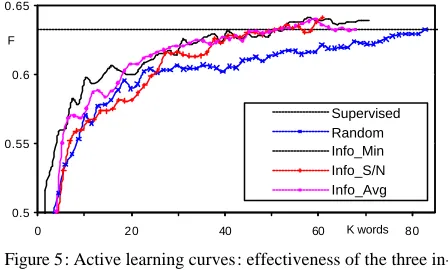
In this section, we investigate the effectiveness of informativeness criterion in NER task. Figure 5 shows a plot of training data size versus F-measure
achieved by the informativeness-based measures in Section 3.1.2: Info_Avg, Info_Min and Info_S/N as
well as Random. We make the comparisons in
GENIA corpus. In Figure 5, the horizontal line is the performance level (63.3 F-measure) achieved by supervised learning (223K words). We find that the three informativeness-based measures per-form similarly and each of them outperper-forms Ran-dom. Table 3 highlights the various data sizes to achieve the peak performance using these selection methods. We find that Random (83K words) on average requires over 1.5 times as much as data to achieve the same performance as the informative-ness-based sele ction methods (52K words).
0.5 0.55 0.6 0.65
0 20 40 60 K words 80
F
[image:6.596.315.539.252.387.2]Supervised Random Info_Min Info_S/N Info_Avg
Figure 5: Active learning curves: effectiveness of the three in-formativeness-criterion-based selections comparing with the Random selection.
Supervised Random Info_Avg Info_Min Info_ S/N 223K 83K 52.0K 51.9K 52.3K Table 3: Training data sizes for various selection methods to achieve the same performance level as the supervised learning
4.4 Effectiveness of Two Sample Selection Strategies
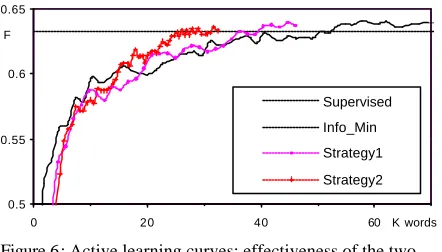
In addition to the informativeness criterion, we further incorporate representativeness and diversity criteria into active learning using two strategies described in Section 3. Comparing the two strate-gies with the best result of the single -criterion-based selection methods Info_Min, we are to jus-tify that representativeness and diversity are also important factors for active learning. Figure 6 shows the learning curves for the various methods:
Strategy1, Strategy2 and Info_Min. In the begin-ning iterations (F-measure < 60), the three methods performed similarly. But with the larger training set, the efficiencies of Stratety1 and Strategy2 be-gin to be evident. Table 4 highlights the final re-sult of the three methods. In order to reach the performance of supervised learning, Strategy1
(40K words) and Strategyy2 (31K words) require
about 80% and 60% of the data that Info_Min
0.5 0.55 0.6 0.65
0 20 40 60 K words
F
Supervised
Info_Min
Strategy1
[image:7.596.62.283.62.188.2]Strategy2
Figure 6: Active learning curves: effectiveness of the two multi-criteria-based selection strategies comparing with the informativeness-criterion-based selection (Info_Min).
Info_Min Strategy1 Strategy2
51.9K 40K 31K
Table 4: Comparisons of training data sizes for the multi-criteria-based selection strategies and the informativeness-criterion-based selection (Info_Min) to achieve the same per-formance level as the supervised learning.
5
Related Work
Since there is no study on active learning for NER task previously, we only introduce general active learning methods here. Many existing active learn-ing methods are to select the most uncertain exam-ples using various measures (Thompson et al. 1999; Schohn and Cohn 2000; Tong and Koller 2000; Engelson and Dagan 1999; Ngai and Yarowsky 2000). Our informativeness-based measure is similar to these works. However these works just follow a single criterion. (McCallum and Nigam 1998; Tang et al. 2002) are the only two works considering the representativeness criterion in ac-tive learning. (Tang et al. 2002) use the density information to weight the selected examples while we use it to select examples. Moreover, the repre-sentativeness measure we use is relatively general and easy to adapt to other tasks, in which the ex-ample selected is a sequence of words, such as text chunking, POS ta gging, etc. On the other hand, (Brinker 2003) first incorporate diversity in active learning for text classification. Their work is simi-lar to our local consideration in Section 2.3.2. However, he didn’t further explore how to avoid selecting outliers to a batch. So far, we haven’t found any previous work integrating the informa-tiveness, representativeness and diversity all to-gether.
6
Conclusion and Future Work
In this paper, we study the active learning in a more complex NLP task, named entity recognition. We propose a multi-criteria -based approach to se-lect examples based on their informativeness, rep-resentativeness and diversity, which are
incorporated all together by two strategies (local and global). Experiments show that, in both MUC-6 and GENIA, both of the two strategies combin-ing the three criteria outperform the scombin-ingle criterion (informativeness). The labeling cost can be sig-nificantly reduced by at least 80% comparing with the supervised learning. To our best knowledge, this is not only the first work to report the empir i-cal results of active learning for NER, but also the first work to incorporate the three criteria all to-gether for selecting examples.
Although the current experiment results are very promising, some parameters in our experi-ment, such as the batch size K and the
λ
in the function of strategy 2, are decided by our experi-ence in the domain. In practical application, the optimal value of these parameters should be de-cided automatically based on the training process. Furthermore, we will study how to overcome the limitation of the strategy 1 discussed in Section 3 by using more effective clustering algorithm. An-other interesting work is to study when to stop ac-tive learning.References
R. Baeza-Yates and B. Ribeiro-Neto. 1999. Mod-ern Information Retrieval. ISBN 0-201-39829-X. K. Brinker. 2003. Incorporating Diversity in Ac-tive Learning with Support Vector Machines. In
Proceedings of ICML, 2003.
S. A. Engelson and I. Dagan. 1999. Committee-Based Sample Selection for Probabilistic Classi-fiers. Journal of Artifical Intelligence Research. F. Jelinek. 1997. Statistical Methods for Speech
Recognition. MIT Press.
J. Kazama, T. Makino, Y. Ohta and J. Tsujii. 2002. Tuning Support Vector Machines for Biomedi-cal Named Entity Recognition. In Proceedings of the ACL2002 Workshop on NLP in Biomedi-cine.
K. J. Lee, Y. S. Hwang and H. C. Rim. 2003. Two-Phase Biomedical NE Recognition based on
SVMs. In Proceedings of the ACL2003
Work-shop on NLP in Biomedicine.
D. D. Lewis and J. Catlett. 1994. Heterogeneous Uncertainty Sampling for Supervised Learning. In Proceedings of ICML, 1994.
A. McCallum and K. Nigam. 1998. Employing EM in Pool-Based Active Learning for Text Classi-fication. In Proceedings of ICML, 1998.
T. Ohta, Y. Tateisi, J. Kim, H. Mima and J. Tsujii. 2002. The GENIA corpus: An annotated re-search abstract corpus in molecular biology do-main. In Proceedings of HLT 2002.
L. R. Rabiner, A. E. Rosenberg and S. E. Levinson. 1978. Considerations in Dynamic Time Warping Algorithms for Discrete Word Recognition. In
Proceedings of IEEE Transactions on acoustics, speech and signal processing. Vol. ASSP-26, NO.6.
D. Schohn and D. Cohn. 2000. Less is More: Ac-tive Learning with Support Vector Machines. In
Proceedings of the 17th International Confer-ence on Machine Learning.
D. Shen, J. Zhang, G. D. Zhou, J. Su and C. L. Tan. 2003. Effective Adaptation of a Hidden Markov Model-based Named Entity Recognizer for
Bio-medical Domain. In Proceedings of the
ACL2003 Workshop on NLP in Biomedicine. M. Steedman, R. Hwa, S. Clark, M. Osborne, A.
Sarkar, J. Hockenmaier, P. Ruhlen, S. Baker and J. Crim. 2003. Example Selection for Bootstrap-ping Statistical Parsers. In Proceedings of HLT-NAACL, 2003.
M. Tang, X. Luo and S. Roukos. 2002. Active Learning for Statistical Natural Language Pars-ing. In Proceedings of the ACL 2002.
C. A. Thompson, M. E. Califf and R. J. Mooney. 1999. Active Learning for Natural Language Parsing and Information Extraction. In Proceed-ings of ICML 1999.
S. Tong and D. Koller. 2000. Support Vector Ma-chine Active Learning with Applications to Text Classification. Journal of Machine Learning Re-search.
V. Vapnik. 1998. Statistical learning theory.