G R A M M A R
S P E C I A L I Z A T I O N T H R O U G H
E N T R O P Y T H R E S H O L D S
C h r i s t e r S a m u e l s s o n
S w e d i s h I n s t i t u t e o f C o m p u t e r S c i e n c e B o x 1263 S - 1 6 4 28 K i s t a , S w e d e n
I n t e r n e t : c h r i s t e r @ s i c s , s e
A b s t r a c t
Explanation-based generalization is used to extract a specialized g r a m m a r from the original one using a train- ing corpus of parse trees. This allows very much faster parsing and gives a lower error rate, at the price of a small loss in coverage. Previously, it has been necessary to specify the tree-cutting criteria (or operationality cri- teria) manually; here they are derived automatically from the training set and the desired coverage of the specialized grammar. This is done by assigning an en- tropy value to each node in the parse trees and cutting in the nodes with sufficiently high entropy values.
B A C K G R O U N D
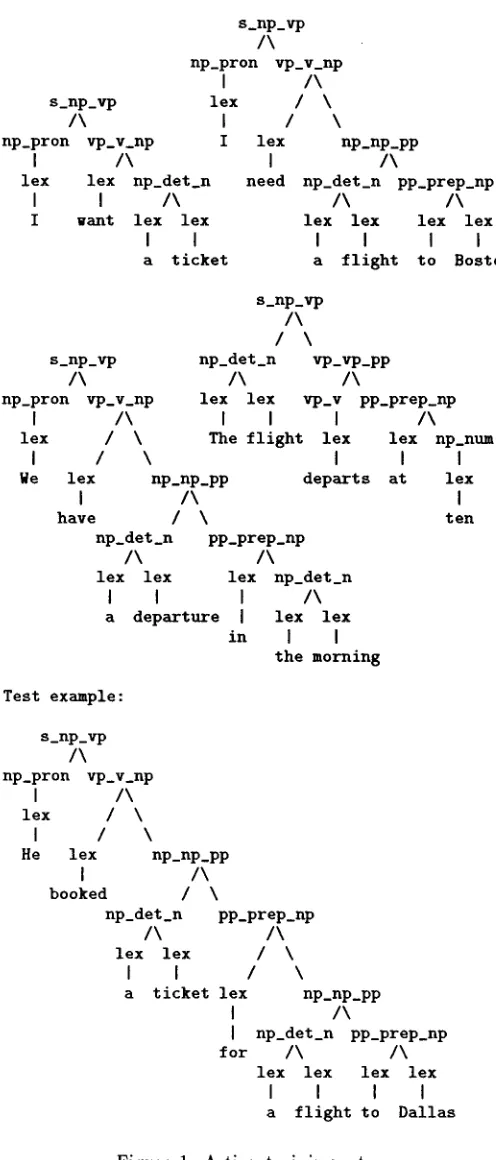
Previous work by Manny Rayner and the author, see [Samuelsson &~ Rayner 1991] a t t e m p t s to tailor an ex- isting natural-language system to a specific application domain by extracting a specialized g r a m m a r from the original one using a large set of training examples. T h e training set is a treebank consisting of implicit parse trees that each specify a verified analysis of an input sentence. The parse trees are implicit in the sense that each node in the tree is the (mnemonic) name of the grammar rule resolved on at that point, rather than the syntactic category of the LHS of the g r a m m a r rule as is the case in an ordinary parse tree. Figure 1 shows five examples of implicit parse trees. T h e analyses are ver- ified in the sense that each analysis has been judged to be the preferred one for that input sentence by a h u m a n evaluator using a semi-automatic evaluation method.
A new g r a m m a r is created by cutting up each implicit parse tree in the treebank at appropriate points, creat- ing a set of new rules t h a t consist of chunks of original grammar rules. T h e LHS of each new rule will be the LHS phrase of the original g r a m m a r rule at the root of the tree chunk and the RHS will be the RHS phrases of the rules in the leaves of the tree chunk. For example, cutting up the first parse tree of Figure 1 at the N P of the rule vp_v_np yields rules 2 and 3 of Figure 3.
The idea behind this is to create a specialized gram- mar that retains a high coverage but allows very much faster parsing. This has turned out to be possible - - speedups compared to using the original g r a m m a r of
in median 60 times were achieved at a cost in cover- age of about ten percent, see [Samuelsson 1994a].1 An- other benefit from the m e t h o d is a decreased error rate when the system is required to select a preferred ana- lysis. In these experiments the scheme was applied to the g r a m m a r of a version of the SRI Core Language Engine [Alshawi ed. 1992] adapted to the Atis domain for a speech-translation task [Rayner el al 1993] and large corpora of real user d a t a collected using Wizard- of-Oz simulation. T h e resulting specialized gram- mar was compiled into LR parsing tables, and a spe- cial LR parser exploited their special properties, see [Samuelsson 1994b].
T h e technical vehicle previously used to extract the specialized g r a m m a r is explanation-based generaliza- tion (EBG), see e.g. [Mitchell et al 1986]. Very briefly, this consists of redoing the derivation of each train- ing example top-down by letting the implicit parse tree drive a rule expansion process, and aborting the expan- sion of the specialized rule currently being extracted if the current node of the implicit parse tree meets a set of tree-cutting criteria 2. In this case the extraction pro- cess is invoked recursively to extract subrules rooted in the current node. T h e tree-cutting criteria can be local ( " T h e LHS of the original g r a m m a r rule is an N P , " ) or dependent on the rest of the parse tree ( " t h a t doesn't dominate the e m p t y string only,") and previous choices of nodes to cut at ("and there is no cut above the cur- rent node that is also labelled N P . " ) .
A problem not fully explored yet is how to arrive at an optimal choice of tree-cutting criteria. In the previous scheme, these must be specified manually, and the choice is left to the designer's intuitions. This article addresses the problem of a u t o m a t i n g this process and presents a m e t h o d where the nodes to cut at are selected automatically using the information-theoretical concept of entropy. Entropy is well-known from physics, but the concept of perplexity is perhaps better known in the speech-recognition and natural-language communities. 1Other more easily obtainable publications about this are in preparation.
For this reason, we will review the concept of entropy at this point, and discuss its relation to perplexity. E n t r o p y
Entropy is a measure of disorder. Assume for exam- ple t h a t a physical system can be in any of N states, and t h a t it will be in state si with probability Pi. T h e entropy S of t h a t system is then
N
S -= ~ -- Pi " In Pi i = 1
If each state has equal probability, i.e. if Pi ~- 1 for all i, then
N
1 1
S = Z - ~ - - l n ~ - = l n N i = 1
In this case the entropy is simply the logarithm of the number of states the system can be in.
To take a linguistic example, assume t h a t we are try- ing to predict the next word in a word string from the previous ones. Let the next word be wk and the pre- vious word string w l , . . . , w k - 1 . Assume further t h a t we have a language model t h a t estimates the proba- bility of each possible next word (conditional on the previous word string). Let these probabilities be Pi for i = 1 .... , N for the N possible next words w~, i.e. Pi = p(wik I Wl, . . . ,
wk-a).
T h e entropy is then a measure of how hard this prediction problem is:S ( L / ) I , . . . , W k - x ) :
N
- - P(Wik I w , , . . . , W k - i ) . I n p ( w ~ I Wl, ' " , W k - i ) i=1
If all words have equal probability, t h e entropy is the logarithm of the branching factor at this point in the input string.
P e r p l e x i t y
Perplexity is related to entropy as follows. The observed perplexity Po of a language model with respect to an (imaginary) infinite test sequence wl, w2, ... is defined through the formula (see [Jelinek 1990])
In Po = lim - - l l n p ( w i , ..., wn) rl--* OO n
Here p ( w l , . . . , Wn) denotes the probability of the word string W l , ..., W n .
Since we cannot experimentally measure infinite lim- its, we t e r m i n a t e after a finite test string wl, ...,WM, arriving at the measured perplexity Pro:
Pm = -- --~--ln p ( w l , . . . , WM)
In
Rewriting p ( w l , . . . , w k ) as p(wk [ w l , . . . , w k - 1 ) • p(wl, ..., wk-1) gives us
M 1
In Pm --- ~ ~ - I n p(wk I wl, ..., w ~ - l ) k = l
Let us call the exponential of the expectation value of - I n p(w [ String) the local perplexity P~(String), which can be used as a measure of the information content of the initial String.
In P t ( w l , ..., wk-1) = E ( - l n P(~k I wl,..., w k - i ) ) = N
-- p(wik I wl, ..., wk-1)" In p(wik I wl .... , w k - i ) i = 1
Here E(q) is the expectation value of q and the sum- m a t i o n is carried out over all N possible next words w~. C o m p a r i n g this with the last equation of the previous section, we see t h a t this is precisely the entropy S at point k in the input string. Thus, the entropy is the logarithm of the local perplexity at a given point in the word string. If all words are equally probable, then the local perplexity is simply the branching factor at this point. I f the probabilities differ, the local perplexity can be viewed as a generalized branching factor t h a t takes this into account.
T r e e e n t r o p y
We now turn to the task of calculating the entropy of a node in a parse tree. This can be done in m a n y different ways; we will only describe two different ones here.
Consider the small test and training sets of Figure 1. Assume t h a t we wish to calculate the entropy of the phrases of the rule P P --* Prep N P , which is n a m e d
pp_prep_np. In the training set, the LHS P P is at- tached to the RHS P P of the rule np_np_pp in two cases and to the RHS P P of the rule vp_vp_pp in one case, giving it tile entropy - 2 l n ~ - ½1n½ ,~ 0.64. T h e RHS preposition Prep is always a lexical lookup, and the entropy is thus zero 3, while the RHS N P in one case attaches to the LHS of rule n p _ d e t _ n p , in one case to the LHS of rule np_num, and in one case is a lexical lookup, and the resulting entropy is thus - l n ½ ~ 1.10.
T h e complete table is given here:
Rule LHS 1st RHS 2nd RHS
s_np_vp 0.00
np_np_pp 0.00
n p _ d e t _ n 1.33 n p _ p r o n 0.00
np_num 0.00
vp_vp_pp 0.00
vp_v_np 0.00
vp_v 0.00
pp_prep_np 0.64
0.56 0.56 0.00 0.00 0.00 0.00 0.00
0.00
0.00 0.00 0.00 0.64 0.00
0.00 1.10
If we want to calculate the entropy of a particular node in a parse tree, we can either simply use the phrase 3Since there is only one alternative, namely a lexiea] lookup. In fact, the scheme could easily be extended to en- compass including lexical lookups of particular words into the specialized rules by distinguishing lexical lookups of dif- ferent words; the entropy would then determine whether or not to cut in a node corresponding to a lookup, just as for any other node, as is described in the following.
Training examples:
s_np_vp /k
np_pron vp_v_np
I / \
l e x l e x n p _ d e t _ n
I I / \
I w a n t l e x l e x
I I
a ticket
s_np_vp / \
n p _ p r o n v p _ v _ n p
I / \
lex / \
I / \
I lex np_np_pp
I /\
need np_det_n pp_prep_np
/ \ / \
lex lex lex lex
I I I I
a flight to Boston
s_np_vp
/\ / \
s_np_vp np_det_n vp_vp_pp
/\ /\ /\
np_pron vp_v_np lex lex vp_v pp_prep_np
I / \ I I I / \
lex / \ The flight lex lex
I / \ I I
We lex np_np_pp departs at
] /\
have / \
np_det_n pp_prep_np
/ \ / \
lex lex lex np_det_n
I I I / \
a d e p a r t u r e I lex lex
i n I I
the morning
np_nuR
I
lex
I
ten
Test example:
s _ n p _ v p / \
n p _ p r o n v p _ v _ n p
I / \
l e x / \
I / \
He l e x n p _ n p _ p p
I / \
b o o k e d / \
n p _ d e t _ n p p _ p r e p _ n p
/ \ / \
lex lex / \
I I / \
a ticket lex np_np_pp
I /\
] np_det_n pp_prep_np
f o r / \ / \
lex lex lex lex
I I I I
a flight to Dallas
Figure 1: A tiny training set
entropy of the RttS node, or take the sum of the en- tropies of the two phrases t h a t are unified in this node. For example, the entropy when the RHS NP of the rule p p _ p r e p _ n p is unified with the LHS of the rule n p _ d e t n will in the former case be 1.10 and in the latter case be 1.10 + 1.33 = 2.43.
S C H E M E O V E R V I E W
In the following scheme, the desired coverage of the spe- cialized g r a m m a r is prescribed, and the parse trees are cut up at appropriate places without having to specify the tree-cutting criteria manually:
1. Index the treebank in an and-or tree where the or- nodes correspond to alternative choices of g r a m m a r rules to expand with and the and-nodes correspond to the RHS phrases of each g r a m m a r rule. Cutting up the parse trees will involve selecting a set of or- nodes in the and-or tree. Let us call these nodes
"cutnodes".
2. Calculate the entropy of each or-node. We will cut at each node whose entropy exceeds a threshold value. The rationale for this is that we wish to cut up the parse trees where we can expect a lot of variation i.e. where it is difficult to predict which rule will be resolved on next. This corresponds exactly to the nodes in the and-or tree that exhibit high entropy values.
3. The nodes of the and-or tree must be partitioned into equivalence classes dependent on the choice of cutnodes in order to avoid redundant derivations at parse time. 4 Thus, selecting some particular node as a cutnode m a y cause other nodes to also become cut- nodes, even though their entropies are not above the threshold.
4. Determine a threshold entropy that yields the desired coverage. This can be done using for example interval bisection.
5. Cut up the training examples by matching them against the and-or tree and cutting at the determined cutnodes.
It is interesting to note that a textbook method for conslructing decision trees for classification from attribute-value pairs is to minimize the (weighted aver- age of the) remaining entropy 5 over all possible choices of root attribute, see [Quinlan 1986].
4This can most easily be seen as follows: Imagine two identical, but different portions of the and-or tree. If the roots and leaves of these portions are all selected as cut- nodes, but the distribution of cutnodes within them differ, then we will introduce multiple ways of deriving the portions of the parse trees that match any of these two portions of the and-or tree.
[image:3.612.65.313.66.646.2]D E T A I L E D S C H E M E
First, the treebank is partitioned into a training set and a test set. The training set will be indexed in an and- or tree and used to extract the specialized rules. The test set will be used to check the coverage of the set of extracted rules.
I n d e x i n g t h e t r e e b a n k
Then, the set of implicit parse trees is stored in an and- or tree. The parse trees have the general form of a rule identifier I d dominating a list of subtrees or a word of the training sentence. From the current or-node of the and-or tree there will be arcs labelled with rule iden- tifiers corresponding to previously stored parse trees. From this or-node we follow an arc labelled Id, or add a new one if there is none. We then reach (or add) an and-node indicating the RHS phrases of the gram- mar rule named Id. Here we follow each arc leading out from this and-node in turn to a c c o m m o d a t e all the subtrees in the list. Each such arc leads to an or-node. We have now reached a point of recursion and can index the corresponding subtree. The recursion terminates if
Id is the special rule identifier lex and thus dominates a word of the training sentence, rather than a list of subtrees.
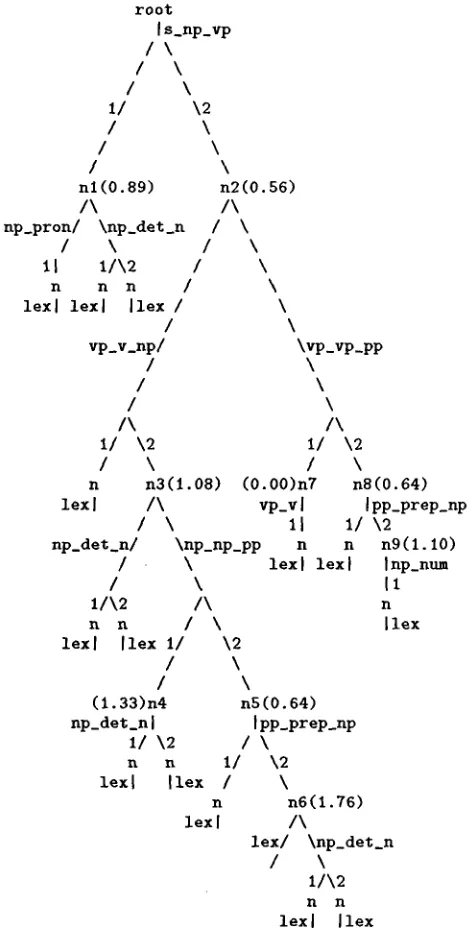
Indexing the four training examples of Figure 1 will result in the and-or tree of Figure 2.
F i n d i n g t h e c u t n o d e s
Next, we find the set of nodes whose entropies exceed a threshold value. First we need to calculate the entropy of each or-node. We will here describe three different ways of doing this, but there are m a n y others. Before doing this, though, we will discuss the question of re- dundancy in the resulting set of specialized rules.
We must equate the cutnodes that correspond to the same type of phrase. This means that if we cut at a node corresponding to e.g. an NP, i.e. where the arcs incident from it are labelled with g r a m m a r rules whose left-hand-sides are NPs, we must allow all specialized NP rules to be potentially applicable at this point, not just the ones that are rooted in this node. This requires that we by transitivity equate the nodes that are dom- inated by a cutnode in a structurally equivalent way; if there is a path from a cutnode cl to a node nl and a path from a cutnode c2 to a node n2 with an identical sequence of labels, the two nodes nl and n2 must be equated. Now if nl is a cutnode, then n2 must also be a cutnode even if it has a low entropy value. The following iterative scheme accomplishes this:
F u n c t i o n N* ( N °)
1. i : = 0 ;
2. R e p e a t i := i + 1; N i := N ( N I - 1 ) ; 3. U n t i l N i = N i-1
4. R e t u r n N~;
root
I s _ n p _ v p
/ \
/ k
/ \
1/ \2
/ X
/ X
/ X
n i ( 0 . 8 9 ) n2(0.56)
IX IX
np_pronl \np_det_n I \
/ \ / \
11 1/\2 / \
n n n I \
l e x I l e x I I l e x / \
/ \
vp_v_np/ \vp_vp_pp
/ \
/ \
/ \
/ \ /k
il X2 il \2
/ X / \
n n 3 ( 1 . 0 8 ) (O.O0)n7 n 8 ( 0 . 6 4 )
lex I / \ vp_v I I pp_prep_np
/ \ II 11 \2
np_det_n/ \np_np_pp n n n9(l. I0)
/ \ lex~ lex~ I np_num
I \ l l
i l k 2 I \ n
n n / \ llex
l e x l I l e x 1/ \2
/ \
/ \
( 1 . 3 3 ) n 4
np_de¢_n I
11 \2
n l e x l
n 5 ( 0 . 6 4 ) Ipp_prep_np / \
n 11 \ 2
flex / \
n n6(1.76)
lexl /\
lex/ \np_det_n
/ \
1/\2 n n
l e x l Jlex
Figure 2: The resulting and-or tree
[image:4.612.313.550.124.591.2]Here
N ( N j)
is the set of cutnodesNJ
augmented with those induced in one step by selecting N~ as the set of cutnodes. In ~ practice this was accomplished by compil- ing an and-or graph from the and-or tree and the set of selected cutnodes, where each set of equated nodes constituted a vertex of the graph, and traversing it.In the simplest scheme for calculating the entropy of an or-node, only the RHS phrase of the parent rule, i.e. the dominating and-node, contributes to the en- tropy, and there is in fact no need to employ an and-or tree at all, since the tree-cutting criterion becomes local to the parse tree being cut up.
In a slightly more elaborate scheme, we sum over the entropies of the nodes of the parse trees that m a t c h this node of the and-or tree. However, instead of letting each daughter node contribute with the full entropy of the LHS phrase of the corresponding g r a m m a r rule, these entropies are weighted with the relative frequency of use of each alternative choice of g r a m m a r rule.
For example, the entropy of node n3 of the and- or tree of Figure 2 will be calculated as follows: T h e mother rule vp_v_np will contribute the entropy asso- ciated with the RHS
NP,
which is, referring to the table above, 0.64. There are 2 choices of rules to resolve on, namely n p _ d e t _ n and np_np_pp with relative frequen- cies ½ and ~ respectively. Again referring to the entropy table above, we find t h a t the LHS phrases of these rules have entropy 1.33 and 0.00 respectively. This results in the following entropy for node n3:1 2
S(n3) = 0 . 6 4 + ~ - 1 . 3 3 + ~ - 0 . 0 0 = 1.08
The following function determines the set of cutnodes N that either exceed the entropy threshold, or are in- duced by structural equivalence:
F u n c t i o n
N ( Smin )
1. N : : { n :S(n)
> S, ni,-,}; 2. R e t u r n N * ( N ) ;Here
S(n)
is the entropy of node n.In a third version of the scheme, the relative frequen- cies of the daughters of the or-nodes are used directly to calculate the node entropy:
S(n) = ~ . , - p ( n i l n ) .
In p(n, lu )
n i : ( n , n i ) E AHere A is the set of arcs, and
{n, ni)
is an arc from n tohi.
This is basically the entropy used in [Quinlan 1986]. Unfortunately, this tends to promote daughters of cut- nodes to in turn become cutnodes, and also results in a problem with instability, especially in conjunction with the additional constraints discussed in a later section, since the entropy of each node is now dependent on the choice of cutnodes. We must redefine the functionN(S)
accordingly:
F u n c t i o n
N(Smin)
1. N O := 0;
2. R e p e a t i := i + 1;
N := { n :
S ( n l g '-1) > S,~i,~}; g i :=
N * ( N ) ; 3. U n t i l N*" = N i-14. R e t u r n
N i;
Here
S(n]N j)
is the entropy of node n given that the set of cutnodes is NJ. Convergence can be ensured 6 by modifying the termination criterion to be3. U n t i l 3j e [0, i - 1] :
p ( N i , Y j) < 6 ( Y i , N j)
for some appropriate set metric
p(N1, N2)
(e.g. the size of the symmetric difference) and norm-like function6(N1,N2)
(e.g. ten percent of the sum of the sizes), but this is to little avail, since we are not interested in solutions far away from the initial assignment of cut- nodes.F i n d i n g t h e t h r e s h o l d
We will use a simple interval-bisection technique for finding the appropriate threshold value. We operate with a range where the lower bound gives at least the desired coverage, but where the higher bound doesn't. We will take the midpoint of the range, find the cut- nodes corresponding to this value of the threshold, and check if this gives us the desired coverage. If it does, this becomes the new lower bound, otherwise it becomes the new upper bound. If the lower and upper bounds are close to each other, we stop and return the nodes corresponding to the lower bound. This termination cri- terion can of course be replaced with something more elaborate. This can be implemented as follows:
F u n c t i o n
N(Co)
1. Stow :=
0;Shigh :=
largenumber;Nc
:= N(0);2. I f Shigh - Sto~o < 6s
t h e n g o t o 6
Sto,,, + Sh i•h .
e l s e
Staid
:= 2 ' 3. N := N(Smla);4. I f
c ( g ) < Co
t h e n Shiflh : : Srnid
e l s e
Sio~, := Smld; N¢ := N;
5. G o t o 2; 6. R e t u r n Arc;
Here
C(N)
is the coverage on the test set of the spe- cialized g r a m m a r determined by the set of cutnodes N. Actually, we also need to handle the boundary case where no assignment of cutnodes gives the required cov- erage. Likewise, the coverages of the upper and lower bound may be far apart even though the entropy dif- ference is small, and vice versa. These problems can readily be taken care of by modifying the termination criterion, but the solutions have been omitted for the sake of clarity.1) "S => Det N V P r e p ~IP"
s_np_vp / \ / \
np_det_n vp_vp_pp
/\ /\
lex lex vp_v pp_prep_np
I /\
lex lex NP
2) "S => Pron V NP"
s _ n p v p / \
np_pron vp_v_np I / \
lex lex NP
3) "NP => Det N"
n p d e t _ n /\
lex lex
4) "NP => NP Prep NP"
np_np_pp /\
NP pp_prep_np /\
lex NP
5) "NP => Nu~"
np _hUm I lex
Figure 3: T h e specialized rules
In the running example, using the weighted sum of the phrase entropies as the node entropy, if any thresh- old value less than 1.08 is chosen, this will yield any desired coverage, since the single test example of Fig- ure 1 is then covered.
R e t r i e v i n g t h e s p e c i a l i z e d r u l e s
When retrieving the specialized rules, we will match each training example against the and-or tree. If the current node is a cutnode, we will cut at this point in the training example. The resulting rules will be the set of cut-up training examples. A threshold value of say 1.00 in our example will yield the set of cutnodes
{u3, n4, n6, ng}
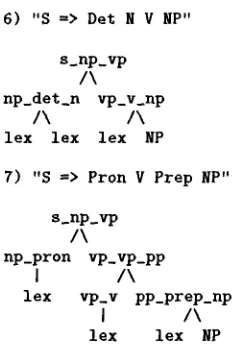
and result in the set of specialized rules of Figure 3.If we simply let the and-or tree determine the set of specialized rules, instead of using it to cut up the training examples, we will in general arrive at a larger number of rules, since some combinations of choices in
6) "S => Det N V NP"
s_np_vp /\
np_det_n v p _ v n p
/ \ / \
lex lex lex NP 7) "S => Pron Y Prep NP"
s_np_vp / \
np_pren v p v p _ p p I / \
lex vp_v pp_prep_np I / \ l e x l e x NP
Figure 4: Additional specialized rules
the and-or tree m a y not correspond to any training ex- ample. If this latter strategy is used in our example, this will give us the two extra rules of Figure 4. Note that they not correspond to any training example.
A D D I T I O N A L C O N S T R A I N T S
As mentioned at the beginning, the specialized gram- mar is compiled into LR parsing tables. Just finding any set of cutnodes that yields the desired coverage will not necessarily result in a g r a m m a r that is well suited for LP~ parsing. In particular, LR parsers, like any other parsers employing a b o t t o m - u p parsing strat- egy, do not blend well with e m p t y productions. This is because without top-down filtering, any empty produc- tion is applicable at any point in the input string, and a naive b o t t o m - u p parser will loop indefinitely. The LR parsing tables constitute a type of top-down filtering, but this m a y not be sufficient to guarantee termination, and in any case, a lot of spurious applications of empty productions will most likely take place, degrading per- formance. For these reasons we will not allow learned rules whose RHSs are empty, but simply refrain from cutting in nodes of the parse trees that do not dominate at least one lexical lookup.
Even so, the scheme described this far is not totally successful, the performance is not as good as using hand-coded tree-cutting criteria. This is conjectured to be an effect of the reduction lengths being far too short. The first reason for this is that for any spurious rule reduction to take place, the corresponding RHS phrases must be on the stack. The likelihood for this to happen by chance decreases drastically with increased rule length. A second reason for this is that the number of states visited will decrease with increasing reduction length. This can most easily be seen by noting t h a t the number of states visited by a deterministic LR parser equals the number of shift actions plus the number of reductions, and equals the number of nodes in the cot-
[image:6.612.311.429.47.221.2] [image:6.612.46.177.62.431.2]responding parse tree, and the longer the reductions, the more shallow the parse tree.
The hand-coded operationality criteria result in an average rule length of four, and a distribution of reduc- tion lengths t h a t is such that only 17 percent are of length one and 11 percent are of length two. This is in sharp contrast to what the above scheme accomplishes; the corresponding figures are about 20 or 30 percent each for lengths one and two.
An a t t e m p t e d solution to this problem is to impose restrictions on neighbouring cutnodes. This can be done in several ways; one that has been tested is to select for each rule the RHS phrase with the least en- tropy, and prescribe that if a node corresponding to the LHS of the rule is chosen as a cutnode, then no node corresponding to this RHS phrase m a y be chosen as a cutnode, and vice versa. In case of such a conflict, the node (class) with the lowest entropy is removed from the set of cutnodes.
We modify the function N* to handle this: 2. R e p e a t i := i + 1; N i :=
N(N i-1) \ B(Ni-1);
HereB(NJ)
is the set of nodes in NJ t h a t should be re- moved to avoid violating the constraints on neighbour- ing cutnodes. It is also necessary to modify the termi- nation criterion as was done for the functionN(S,,~in)
above. Now we can no longer safely assume that the coverage increases with decreased entropy, and we must also modify the interval-bisection scheme to handle this. It has proved reasonable to assume t h a t the coverage is monotone on both sides of some maximum, which simplifies this task considerably.E X P E R I M E N T A L
R E S U L T S
A module realizing this scheme has been implemented and applied to the very setup used for the previous ex- periments with the hand-coded tree-cutting criteria, see [Samuelsson 1994a]. 2100 of the verified parse trees con- stituted the training set, while 230 of them were used for the test set. T h e table below summarizes the re- sults for some grammars of different coverage extracted using:
1. Hand-coded tree-cutting criteria.
2. Induced tree-cutting criteria where the node entropy was taken to be the phrase entropy of the RHIS phrase of the dominating g r a m m a r rule.
3. Induced tree-cutting criteria where the node entropy was the sum of the phrase entropy of the RHS phrase of the dominating g r a m m a r rule and the weighted sum of the phrase entropies of the LHSs of the alter- native choices of g r a m m a r rules to resolve on. In the latter two cases experiments were carried out both with and without the restrictions on neighbouring cutnodes discussed in the previous section.
Coverage
90.2 %
Hand-coded tree-cutting criteria
Reduction lengths (%) Times (ms) 1 2 3 > 4 Ave. Med. 17.3 11.3 21.6 49.8 72.6 48.0 RHS phrase entropy. Neighbour restrictions Coverage Reduction lengths (%) Times (ms)
1 2 3 > 4 Ave. Med. 7 5 . 8 % 11.8 26.1 17.7 44.4 128 38.5 8 0 . 5 % 11.5 27.4 20.0 41.1 133 47.2 8 5 . 3 % 14.0 37.3 24.3 24.4 241 70.5 RI-IS phrase entropy.
Coverage Reduction
1 2
75.8 % 8.3 12.4 79.7 % 9.0 16.2 85.3 9{ 8.4 17.3 90.9 % 18.2 27.5
No neighbour restrictions lengths (%) Times (ms)
3 > 4 Ave. Med. 25.6 53.7 76.7 37.0 26.9 47.9 99.1 49.4 31.1 43.2 186 74.0 21.7 32.6 469 126 Mixed phrase entropies. Neighbour restrictions Coverage Reduction lengths (%) Times (ms)
1 2 3 > 4 Ave. Med. 75.3 % 6.1 11.7 30.8 51.4 115.4 37.5 Mixed phrase entropies. No neighbour restrictions Coverage Reduction lengths (%) Times (ms) 1 2 3 > 4 Ave. Med. 75 % 16.1 13.8 19.8 50.3 700 92.0 80 % 18.3 16.3 20.1 45.3 842 108 With the mixed entropy scheme it seems i m p o r t a n t to include the restrictions on neighbouring cutnodes, while this does not seem to be the case with the RHS phrase entropy scheme. A potential explanation for the significantly higher average parsing times for all gram- mars extracted using the induced tree-cutting criteria is that these are in general recursive, while the hand- coded criteria do not allow recursion, and thus only produce grammars that generate finite languages.
Although the hand-coded tree-cutting criteria are substantially better than the induced ones, we must remember that the former produce a g r a m m a r that in median allows 60 times faster processing than the orig- inal g r a m m a r and parser do. This means that even if the induced criteria produce grammars that are a fac- tor two or three slower than this, they are still approx- imately one and a half order of magnitude faster than the original setup. Also, this is by no means a closed research issue, but merely a first a t t e m p t to realize the scheme, and there is no doubt in my mind that it can be improved on most substantially.
S U M M A R Y
tuning a natural-language grammar to a specific ap- plication domain and thereby achieve very much faster parsing, at the cost of a small reduction in coverage.
Instruments have been developed and tested for con- trolling the coverage and for avoiding a large number of short reductions, which is argued to be the main source to poor parser performance. Although these instruments are currently slightly too blunt to enable producing grammars with the same high performance as the hand-coded tree-cutting criteria, they can most probably be sharpened by future research, and in par- ticular refined to achieve the delicate balance between high coverage and a distribution of reduction lengths that is sufficiently biased towards long reductions. Also, banning recursion by category specialization, i.e. by for example distinguishing NPs that dominate other NPs from those that do not, will he investigated, since this is believed to be an important ingredient in the version of the scheme employing hand-coded tree-cutting criteria.
A C K N O W L E D G E M E N T S
This research was made possible by the basic research programme at the Swedish Institute of Computer Sci- ence (SICS). I wish to thank Manny Rayner of SRI International, Cambridge, for help and support in mat- ters pertaining to the treebank, and for enlightening discussions of the scheme as a whole. I also wish to thank the NLP group at SICS for contributing to a very conductive atmosphere to work in, and in particu- lar Ivan Bretan for valuable comments on draft versions of this article. Finally, I wish to thank the anonymous reviewers for their comments.
R e f e r e n c e s
[Alshawi ed. 1992] Hiyan Alshawi, editor. The Core Language Engine, MIT Press 1992.
[Jelinek 1990] Fred Jelinek. "Self-Organizing Language Models for Speech Recognition", in Readings in Speech Recognition, pp. 450-506, Morgan Kauf- mann 1990.
[Mitchell el al 1986]
Tom M. Mitchell, Richard M. Keller and Smadar T. Kedar-Cabelli. "Explanation-Based Generaliza- tion: A Unifying View", in Machine Learning 1, No. l, pp. 47-80, 1986.
[Quinlan 1986] J. Ross Quinlan. "Induction of Decision Trees", in Machine Learning 1, No. 1, pp. 81-107,
1986.
[Rayner et al 1993] M. Rayner, H. Alshawi, I. Bretan, D. Carter, V. Digalakis, B. Gamb£ck, J. Kaja, J. Karlgren, B. Lyberg, P. Price, S. Pulman and C. Samuelsson. "A Speech to Speech Transla- tion System Built From Standard Components",
in Procs. ARPA Workshop on Human Language
Technology, Princeton, NJ 1993.
[Samuelsson 1994a] Christer Samuelsson. Fast Natural- Language Parsing Using Explanation-Based Learn- ing, PhD thesis, Royal Institute of Technology, Stockholm, Sweden 1994.
[Samuelsson 1994b] Christer Samuelsson. "Notes on LR Parser Design" to appear in Procs. 15th In- ternational Conference on Computational Linguis- tics, Kyoto, Japan 1994.
[Samuelsson • Rayner 1991] Christer Samuelsson and Manny Rayner. "Quantitative Evaluation of Ex- planation-Based Learning as an Optimization Tool for a Large-ScMe Natural Language System", in Procs. 12th International Joint Conference on Ar- tificial Intelligence, pp. 609-615, Sydney, Australia 1991.