A Recursive Recurrent Neural Network
for Statistical Machine Translation
Shujie Liu1, Nan Yang2, Mu Li1 and Ming Zhou1 1Microsoft Research Asia, Beijing, China
2University of Science and Technology of China, Hefei, China
shujliu, v-nayang, muli, [email protected]
Abstract
In this paper, we propose a novel recursive recurrent neural network (R2NN) to
mod-el the end-to-end decoding process for s-tatistical machine translation. R2NN is a
combination of recursive neural network and recurrent neural network, and in turn integrates their respective capabilities: (1) new information can be used to generate the next hidden state, like recurrent neu-ral networks, so that language model and translation model can be integrated natu-rally; (2) a tree structure can be built, as recursive neural networks, so as to gener-ate the translation candidgener-ates in a bottom up manner. A semi-supervised training ap-proach is proposed to train the parameter-s, and the phrase pair embedding is ex-plored to model translation confidence di-rectly. Experiments on a Chinese to En-glish translation task show that our pro-posed R2NN can outperform the
state-of-the-art baseline by about 1.5 points in BLEU.
1 Introduction
Deep Neural Network (DNN), which essential-ly is a multi-layer neural network, has re-gained more and more attentions these years. With the efficient training methods, such as (Hinton et al., 2006), DNN is widely applied to speech and im-age processing, and has achieved breakthrough re-sults (Kavukcuoglu et al., 2010; Krizhevsky et al., 2012; Dahl et al., 2012).
Applying DNN to natural language processing (NLP), representation or embedding of words is usually learnt first. Word embedding is a dense, low dimensional, real-valued vector. Each dimen-sion of the vector represents a latent aspect of the word, and captures its syntactic and semantic
properties (Bengio et al., 2006). Word embedding is usually learnt from large amount of monolin-gual corpus at first, and then fine tuned for spe-cial distinct tasks. Collobert et al. (2011) propose a multi-task learning framework with DNN for various NLP tasks, including part-of-speech tag-ging, chunking, named entity recognition, and se-mantic role labelling. Recurrent neural networks are leveraged to learn language model, and they keep the history information circularly inside the network for arbitrarily long time (Mikolov et al., 2010). Recursive neural networks, which have the ability to generate a tree structured output, are ap-plied to natural language parsing (Socher et al., 2011), and they are extended to recursive neural tensor networks to explore the compositional as-pect of semantics (Socher et al., 2013).
DNN is also introduced to Statistical Machine Translation (SMT) to learn several components or features of conventional framework, includ-ing word alignment, language modellinclud-ing, transla-tion modelling and distortransla-tion modelling. Yang et al. (2013) adapt and extend the CD-DNN-HMM (Dahl et al., 2012) method to HMM-based word alignment model. In their work, bilingual word embedding is trained to capture lexical translation information, and surrounding words are utilized to model context information. Auli et al. (2013) pro-pose a joint language and translation model, based on a recurrent neural network. Their model pre-dicts a target word, with an unbounded history of both source and target words. Liu et al. (2013) pro-pose an additive neural network for SMT decod-ing. Word embedding is used as the input to learn translation confidence score, which is combined with commonly used features in the convention-al log-linear model. For distortion modeling, Li et al. (2013) use recursive auto encoders to make full use of the entire merging phrase pairs, going beyond the boundary words with a maximum en-tropy classifier (Xiong et al., 2006).
Different from the work mentioned above, which applies DNN to components of conven-tional SMT framework, in this paper, we propose a novel R2NN to model the end-to-end
decod-ing process. R2NN is a combination of recursive
neural network and recurrent neural network. In R2NN, new information can be used to generate
the next hidden state, like recurrent neural net-works, and a tree structure can be built, as recur-sive neural networks. To generate the translation candidates in a commonly used bottom-up man-ner, recursive neural networks are naturally adopt-ed to build the tree structure. In recursive neural networks, all the representations of nodes are gen-erated based on their child nodes, and it is difficult to integrate additional global information, such as language model and distortion model. In order to integrate these crucial information for better trans-lation prediction, we combine recurrent neural net-works into the recursive neural netnet-works, so that we can use global information to generate the next hidden state, and select the better translation can-didate.
We propose a three-step semi-supervised train-ing approach to optimiztrain-ing the parameters of R2NN, which includes recursive auto-encoding
for unsupervised pre-training, supervised local training based on the derivation trees of forced de-coding, and supervised global training using ear-ly update strategy. So as to model the transla-tion confidence for a translatransla-tion phrase pair, we initialize the phrase pair embedding by leveraging the sparse features and recurrent neural network. The sparse features are phrase pairs in translation table, and recurrent neural network is utilized to learn a smoothed translation score with the source and target side information. We conduct exper-iments on a Chinese-to-English translation task to test our proposed methods, and we get about 1.5 BLEU points improvement, compared with a state-of-the-art baseline system.
The rest of this paper is organized as follows: Section 2 introduces related work on applying DNN to SMT. Our R2NN framework is introduced
in detail in Section 3, followed by our three-step semi-supervised training approach in Section 4. Phrase pair embedding method using translation confidence is elaborated in Section 5. We intro-duce our conducted experiments in Section 6, and conclude our work in Section 7.
2 Related Work
Yang et al. (2013) adapt and extend CD-DNN-HMM (Dahl et al., 2012) to word alignment. In their work, initial word embedding is firstly trained with a huge mono-lingual corpus, then the word embedding is adapted and fine tuned bilin-gually in a context-depended DNN HMM frame-work. Word embeddings capturing lexical trans-lation information and surrounding words model-ing context information are leveraged to improve the word alignment performance. Unfortunately, the better word alignment result generated by this model, cannot bring significant performance im-provement on a end-to-end SMT evaluation task.
To improve the SMT performance directly, Auli et al. (2013) extend the recurrent neural network language model, in order to use both the source and target side information to scoring translation candidates. In their work, not only the target word embedding is used as the input of the network, but also the embedding of the source word, which is aligned to the current target word. To tackle the large search space due to the weak independence assumption, a lattice algorithm is proposed to re-rank the n-best translation candidates, generated by a given SMT decoder.
Liu et al. (2013) propose an additive neural net-work for SMT decoding. RNNLM (Mikolov et al., 2010) is firstly used to generate the source and tar-get word embeddings, which are fed into a one-hidden-layer neural network to get a translation confidence score. Together with other common-ly used features, the translation confidence score is integrated into a conventional log-linear model. The parameters are optimized with developmen-t dadevelopmen-ta sedevelopmen-t using mini-badevelopmen-tch conjugadevelopmen-te sub-gradiendevelopmen-t method and a regularized ranking loss.
3 Our Model
In this section, we leverage DNN to model the end-to-end SMT decoding process, using a novel recursive recurrent neural network (R2NN), which
is different from the above mentioned work ap-plying DNN to components of conventional SMT framework. R2NN is a combination of
recur-sive neural network and recurrent neural network, which not only integrates the conventional glob-al features as input information for each combina-tion, but also generates the representation of the parent node for the future candidate generation.
In this section, we briefly recall the recurren-t neural nerecurren-twork and recursive neural nerecurren-twork in Section 3.1 and 3.2, and then we elaborate our R2NN in detail in Section 3.3.
3.1 Recurrent Neural Network
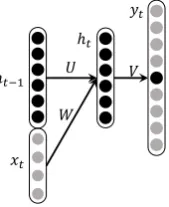
Recurrent neural network is usually used for sequence processing, such as language model (Mikolov et al., 2010). Commonly used sequence processing methods, such as Hidden Markov Model (HMM) and n-gram language model, only use a limited history for the prediction. In HMM, the previous state is used as the history, and for n-gram language model (for example n equals to 3), the history is the previous two words. Recur-rent neural network is proposed to use unbounded history information, and it has recurrent connec-tions on hidden states, so that history information can be used circularly inside the network for arbi-trarily long time.
𝑉 𝑈
𝑊 ℎ𝑡−1
𝑦𝑡
ℎ𝑡
[image:3.595.356.477.361.454.2]𝑥𝑡
Figure 1: Recurrent neural network
As shown in Figure 1, the network contains three layers, an input layer, a hidden layer, and an output layer. The input layer is a concatenation of ht−1 andxt, where ht−1 is a real-valued
vec-tor, which is the history information from time 0 to t−1.xtis the embedding of the input word at
time t. Word embedding xt is integrated with
previous history ht−1 to generate the current
hid-den layer, which is a new history vector ht. Based
on ht, we can predict the probability of the next
word, which forms the output layer yt. The new
history ht is used for the future prediction, and
updated with new information from word embed-ding xt recurrently.
3.2 Recursive Neural Network
In addition to the sequential structure above, tree structure is also usually constructed in various NLP tasks, such as parsing and SMT decoding. To generate a tree structure, recursive neural net-works are introduced for natural language parsing (Socher et al., 2011). Similar with recurrent neural networks, recursive neural networks can also use unbounded history information from the sub-tree rooted at the current node. The commonly used binary recursive neural networks generate the rep-resentation of the parent node, with the represen-tations of two child nodes as the input.
𝑠[𝑙,𝑚] 𝑠[𝑚,𝑛]
𝑠[𝑙,𝑛]
[image:3.595.140.225.524.628.2]𝑊 𝑦[𝑙,𝑛]
Figure 2: Recursive neural network
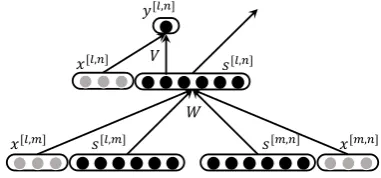
As shown in Figure 2, s[l,m] and s[m,n] are
the representations of the child nodes, and they are concatenated into one vector to be the input of the network. s[l,n] is the generated representation of
the parent node. y[l,n] is the confidence score of
how plausible the parent node should be created. l, m, n are the indexes of the string. For example, for nature language parsing, s[l,n] is the
represen-tation of the parent node, which could be a NP or V P node, and it is also the representation of the whole sub-tree covering from l to n.
3.3 Recursive Recurrent Neural Network
Word embedding xt is integrated as new input
for SMT performance, such as language model s-core and distortion model ss-core. So as to integrate such global information, and also keep the ability to generate tree structure, we combine the recur-rent neural network and the recursive neural net-work to be a recursive recurrent neural netnet-work (R2NN).
𝑠[𝑙,𝑚] 𝑠[𝑚,𝑛]
𝑠[𝑙,𝑛]
𝑥[𝑙,𝑚] 𝑥[𝑚,𝑛]
𝑊 𝑦[𝑙,𝑛]
[image:4.595.86.277.169.258.2]𝑉 𝑥[𝑙,𝑛]
Figure 3: Recursive recurrent neural network
As shown in Figure 3, based on the recursive network, we add three input vectors x[l,m] for
child node [l, m], x[m,n] for child node [m, n],
and x[l,n] for parent node [l, n]. We call them
recurrent input vectors, since they are borrowed from recurrent neural networks. The two recurrent input vectors x[l,m] and x[m,n] are
concatenat-ed as the input of the network, with the original child node representations s[l,m] and s[m,n]. The
recurrent input vector x[l,n] is concatenated with
parent node representation s[l,n] to compute the
confidence score y[l,n].
The input, hidden and output layers are calcu-lated as follows:
ˆ
x[l,n]=x[l,m]./ s[l,m]./ x[m,n]./ s[m,n] (1)
s[jl,n]=f(X
i
ˆ
x[il,n]wji) (2)
y[l,n]=X
j
(s[l,n]./ x[l,n])jvj (3)
where ./ is a concatenation operator in Equation 1 and Equation 3, and f is a non-linear function, here we use HT anh function, which is defined as:
HT anh(x) =
−1, x <−1
x, −1≤x≥1 1, x >1 (4)
Figure 4 illustrates the R2NN architecture for
SMT decoding. For a source sentence “laizi faguo
he eluosi de”, we first split it into phrases “laiz-i”, “faguo he eluosi” and “de”. We then check whether translation candidates can be found in the translation table for each span, together with the phrase pair embedding and recurrent input vec-tor (global features). We call it the rule match-ing phase. For a translation candidate of the s-pan node [l, m], the black dots stand for the node representation s[l,m], while the grey dots for
re-current input vector x[l,m] . Given s[l,m] and
x[l,m] for matched translation candidates,
conven-tional CKY decoding process is performed using R2NN. R2NN can combine the translation pairs
of child nodes, and generate the translation can-didates for parent nodes with their representations and plausible scores. Only the n-best translation candidates are kept for upper combination, accord-ing to their plausible scores.
来自 laizi
法国 和 俄罗斯 faguo he eluosi
的 de coming from France and Russia NULL
Rule Match Rule Match Rule Match coming from France and Russia
R2NN
coming from France and Russia
[image:4.595.314.520.317.479.2]R2NN
Figure 4: R2NN for SMT decoding
We extract phrase pairs using the conventional method (Och and Ney, 2004). The commonly used features, such as translation score, language mod-el score and distortion score, are used as the recur-rent input vector x . During decoding, recurrent input vectors x for internal nodes are calculat-ed accordingly. The difference between our model and the conventional log-linear model includes:
• R2NN is not linear, while the conventional
model is a linear combination.
• Representations of phrase pairs are automat-ically learnt to optimize the translation per-formance, while features used in convention-al model are hand-crafted.
[image:4.595.97.293.686.728.2]Liu et al. (2013) apply DNN to SMT decoding, but not in a recursive manner. A feature is learn-t via a one-hidden-layer neural nelearn-twork, and learn-the embedding of words in the phrase pairs are used as the input vector. Our model generates the rep-resentation of a translation pair based on its child nodes. Li et al. (2013) also generate the repre-sentation of phrase pairs in a recursive way. In their work, the representation is optimized to learn a distortion model using recursive neural network, only based on the representation of the child n-odes. Our R2NN is used to model the end-to-end
translation process, with recurrent global informa-tion added. We also explore phrase pair embed-ding method to model translation confidence di-rectly, which is introduced in Section 5.
In the next two sections, we will answer the fol-lowing questions: (a) how to train the model, and (b) how to generate the initial representations of translation pairs.
4 Model Training
In this section, we propose a three-step training method to train the parameters of our proposed R2NN, which includes unsupervised pre-training
using recursive auto-encoding, supervised local training on the derivation tree of forced decoding, and supervised global training using early update training strategy.
4.1 Unsupervised Pre-training
We adopt the Recursive Auto Encoding (RAE) (Socher et al., 2011) for our unsupervised pre-training. The main idea of auto encoding is to initialize the parameters of the neural network, by minimizing the information lost, which means, capturing as much information as possible in the hidden states from the input vector.
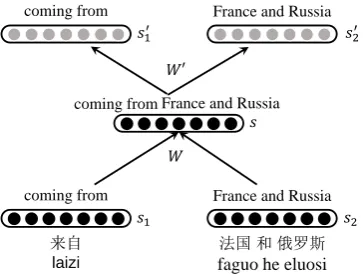
As shown in Figure 5, RAE contains two part-s, an encoder with parameter W , and a decoder with parameter W0. Given the representations of child nodes s1 and s2, the encoder generates the
representation of parent node s. With the parent node representation s as the input vector, the de-coder reconstructs the representation of two child nodes s0
1 and s02. The loss function is defined as
following so as to minimize the information lost:
LRAE(s1, s2) = 12(s1−s012+s2−s022)
(5) where k·k is the Euclidean norm.
coming from France and Russia
来自 laizi
法国 和 俄罗斯 faguo he eluosi coming from France and Russia coming from France and Russia
𝑠1 𝑠2
𝑠
𝑠1′ 𝑠
2′
[image:5.595.328.510.61.198.2]𝑊 𝑊′
Figure 5: Recursive auto encoding for unsuper-vised pre-training
The training samples for RAE are phrase pairs
{s1, s2} in translation table, where s1 and
s2 can form a continuous partial sentence pair in
the training data. When RAE training is done, on-ly the encoding model W will be fine tuned in the future training phases.
4.2 Supervised Local Training
We use contrastive divergence method to fine tune the parameters W and V . The loss function is the commonly used ranking loss with a margin, and it is defined as follows:
LSLT(W, V, s[l,n]) =max(0,1−yoracle[l,n] +yt[l,n])
(6) where s[l,n] is the source span. y[l,n]
oracle is
the plausible score of a oracle translation result. yt[l,n] is the plausible score for the best transla-tion candidate given the model parameters W and V . The loss function aims to learn a model which assigns the good translation candidate (the oracle candidate) higher score than the bad ones, with a margin 1.
4.3 Supervised Global Training
The supervised local training uses the n-odes/samples in the derivation tree of forced de-coding to update the model, and the trained model tends to over-fit to local decisions. In this subsec-tion, a supervised global training is proposed to tune the model according to the final translation performance of the whole source sentence.
Actually, we can update the model from the root of the decoding tree and perform back propaga-tion along the tree structure. Due to the inexac-t search nainexac-ture of SMT decoding, search errors may inevitably break theoretical properties, and the final translation results may be not suitable for model training. To handle this problem, we use early update strategy for the supervised glob-al training. Early update is testified to be useful for SMT training with large scale features (Yu et al., 2013). Instead of updating the model using the final translation results, early update approach optimizes the model, when the oracle translation candidate is pruned from the n-best list, meaning that, the model is updated once it performs a unre-coverable mistake. Back propagation is performed along the tree structure, and the phrase pair em-beddings of the leaf nodess are updated.
The loss function for supervised global training is defined as follows:
LSGT(W, V, s[l,n]) =−log(
P
yoracle[l,n] exp (y[oraclel,n] )
P
t∈nbestexp (y[tl,n])
)
(7) where yoracle[l,n] is the model score of a oracle trans-lation candidate for the span [l, n]. Oracle transla-tion candidates are candidates get from forced de-coding. If the span [l, n] is not the whole source sentence, there may be several oracle translation candidates, otherwise, there is only one, which is exactly the target sentence. There are much few-er training samples than those for supfew-ervised local training, and it is not suitable to use ranking loss for global training any longer. We use negative log-likelihood to penalize all the other translation candidates except the oracle ones, so as to leverage all the translation candidates as training samples. 5 Phrase Pair Embedding
The next question is how to initialize the phrase pair embedding in the translation table, so as to generate the leaf nodes of the derivation tree. There are more phrase pairs than mono-lingual
words, but bilingual corpus is much more difficult to acquire, compared with monolingual corpus.
Embedding #Data #Entry #Parameter
Word 1G 500K 20×500K
Word Pair 7M (500K)2 20×(500K)2
Phrase Pair 7M (500K)4 20×(500K)4
Table 1: The relationship between the size of train-ing data and the number of model parameters. The numbers for word embedding is calculated on En-glish Giga-Word corpus version 3. For word pair and phrase pair embedding, the numbers are cal-culated on IWSLT 2009 dialog training set. The word count of each side of phrase pairs is limited to be 2.
Table 1 shows the relationship between the size of training data and the number of model parame-ters. For word embedding, the training size is 1G bits, and we may have 500K terms. For each ter-m, we have a vector with length 20 as parameters, so there are 20 × 500K parameters totally. But for source-target word pair, we may only have 7M bilingual corpus for training (taking IWSLT data set as an example), and there are 20 ×(500K)2
parameters to be tuned. For phrase pairs, the sit-uation becomes even worse, especially when the limitation of word count in phrase pairs is relaxed. It is very difficult to learn the phrase pair embed-ding brute-forcedly as word embedembed-ding is learnt (Mikolov et al., 2010; Collobert et al., 2011), s-ince we may not have enough training data.
5.1 Translation Confidence with Sparse Features
Large scale feature training has drawn more at-tentions these years (Liang et al., 2006; Yu et al., 2013). Instead of integrating the sparse features directly into the log-linear model, we use them as the input to learn a phrase pair embedding. For the top 200,000 frequent translation pairs, each of them is a feature in itself, and a special feature is added for all the infrequent ones.
The one-hot representation vector is used as the input, and a one-hidden-layer network generates a confidence score. To train the neural network, we add the confidence scores to the convention-al log-linear model as features. Forced decoding is utilized to get positive samples, and contrastive divergence is used for model training. The neu-ral network is used to reduce the space dimension of sparse features, and the hidden layer of the net-work is used as the phrase pair embedding. The length of the hidden layer is empirically set to 20.
5.2 Translation Confidence with Recurrent Neural Network
𝑊e
𝑉 ℎ𝑖−1 𝑈
𝑝(𝑒𝑖)
𝑒𝑖−1
𝑊𝑓
𝑓𝑎𝑖
[image:7.595.137.226.402.529.2]ℎ𝑖
Figure 6: Recurrent neural network for translation confidence
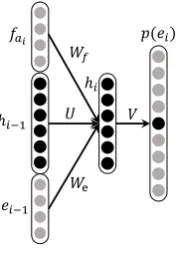
We use recurrent neural network to generate two smoothed translation confidence scores based on source and target word embeddings. One is source to target translation confidence score and the other is target to source. These two confidence scores are defined as:
TS2T(s, t) =
X
i
logp(ei|ei−1, fai, hi) (8)
TT2S(s, t) =
X
j
logp(fj|fj−1, eˆaj, hj) (9)
where, fai is the corresponding target word
aligned to ei , and it is similar for eaˆj .
p(ei|ei−1, fai, hi) is produced by a recurrent
net-work as shown in Figure 6. The recurrent neural network is trained with word aligned bilingual cor-pus, similar as (Auli et al., 2013).
6 Experiments and Results
In this section, we conduct experiments to test our method on a Chinese-to-English translation task. The evaluation method is the case insensitive IB-M BLEU-4 (Papineni et al., 2002). Significant testing is carried out using bootstrap re-sampling method proposed by (Koehn, 2004) with a 95% confidence level.
6.1 Data Setting and Baseline
The data is from the IWSLT 2009 dialog task. The training data includes the BTEC and SLDB training data. The training data contains 81k sen-tence pairs, 655K Chinese words and 806K En-glish words. The language model is a 5-gram lan-guage model trained with the target sentences in the training data. The test set is development set 9, and the development set comprises both devel-opment set 8 and the Chinese DIALOG set.
The training data for monolingual word embed-ding is Giga-Word corpus version 3 for both Chi-nese and English. ChiChi-nese training corpus con-tains 32M sentences and 1.1G words. English training data contains 8M sentences and 247M terms. We only train the embedding for the top 100,000 frequent words following (Collobert et al., 2011). With the trained monolingual word em-bedding, we follow (Yang et al., 2013) to get the bilingual word embedding using the IWSLT bilin-gual training data.
Our baseline decoder is an in-house implemen-tation of Bracketing Transduction Grammar (BT-G) (Wu, 1997) in CKY-style decoding with a lex-ical reordering model trained with maximum en-tropy (Xiong et al., 2006). The features of the baseline are commonly used features as standard BTG decoder, such as translation probabilities, lexical weights, language model, word penalty and distortion probabilities. All these commonly used features are used as recurrent input vector x in our R2NN.
6.2 Translation Results
ver-ify it. We first train the source and target word em-beddings separately using large monolingual data, following (Collobert et al., 2011). Using monolin-gual word embedding as the initialization, we fine tune them to get bilingual word embedding (Yang et al., 2013).
The word embedding based phrase pair embed-ding (WEPPE) is defined as:
Eppweb(s, t) =
X
i
Ewms(si)./X j
Ewbs(sj)
./X
k
Ewmt(tk)./
X
l
Ewbt(tl)(10)
where ./ is a concatenation operator. s and t are the source and target phrases. Ewms(si) and
Ewmt(tk) are the monolingual word embeddings,
and Ewbs(si) and Ewbt(tk) are the bilingual
word embeddings. Here the length of the word embedding is also set to 20. Therefore, the length of the phrase pair embedding is 20×4 = 80.
We compare our phrase pair embedding meth-ods and our proposed R2NN with baseline system,
in Table 2. We can see that, our R2NN models
with WEPPE and TCBPPE are both better than the baseline system. WEPPE cannot get significan-t improvemensignifican-t, while TCBPPE does, compared with the baseline result. TCBPPE is much better than WEPPE.
Setting Development Test
Baseline 46.81 39.29
WEPPE+R2NN 47.23 39.92
TCBPPE+R2NN 48.70↑ 40.81↑
Table 2: Translation results of our proposed R2NN
Model with two phrase embedding methods, com-pared with the baseline. Setting ”WEPPE+R2NN”
is the result with word embedding based phrase pair embedding and our R2NN Model, and
”TCBPPE+R2NN” is the result of translation
con-fidence based phrase pair embedding and our R2NN Model. The results with ↑ are significantly
better than the baseline.
Word embedding can model translation rela-tionship at word level, but it may not be power-ful to model the phrase pair respondents at phrasal level, since the meaning of some phrases cannot be decomposed into the meaning of words. And also, translation task is difference from other NLP tasks, that, it is more important to model the trans-lation confidence directly (the confidence of one
target phrase as a translation of the source phrase), and our TCBPPE is designed for such purpose.
6.3 Effects of Global Recurrent Input Vector
In order to compare R2NN with recursive network
for SMT decoding, we remove the recurrent input vector in R2NN to test its effect, and the results
are shown in Table 3. Without the recurrent input vectors, R2NN degenerates into recursive neural
network (RNN).
Setting Development Test
WEPPE+R2NN 47.23 40.81
WEPPE+RNN 37.62 33.29
TCBPPE+R2NN 48.70 40.81
TCBPPE+RNN 45.11 37.33
Table 3: Experimental results to test the effects of recurrent input vector. WEPPE /TCBPPE+RNN are the results removing recurrent input vectors with WEPPE /TCBPPE.
From Table 3 we can find that, the recurren-t inpurecurren-t vecrecurren-tor is essenrecurren-tial recurren-to SMT performance. When we remove it from R2NN, WEPPE based
method drops about 10 BLEU points on devel-opment data and more than 6 BLEU points on test data. TCBPPE based method drops about 3 BLEU points on both development and test data sets. When we remove the recurrent input vectors, the representations of recursive network are gener-ated with the child nodes, and it does not integrate global information, such as language model and distortion model, which are crucial to the perfor-mance of SMT.
6.4 Sparse Features and Recurrent Network Features
To test the contributions of sparse features and re-current network features, we first remove all the recurrent network features to train and test our R2NN model, and then remove all the sparse
fea-tures to test the contribution of recurrent network features.
Setting Development Test TCBPPE+R2NN 48.70 40.81
SF+R2NN 48.23 40.19
RNN+R2NN 47.89 40.01
The results are shown in Table 6.4. From the results, we can find that, sparse features are more effective than the recurrent network features a lit-tle bit. The sparse features can directly model the translation correspondence, and they may be more effective to rank the translation candidates, while recurrent neural network features are smoothed lexical translation confidence.
7 Conclusion and Future Work
In this paper, we propose a Recursive Recur-rent Neural Network(R2NN) to combine the
re-current neural network and recursive neural net-work. Our proposed R2NN cannot only
inte-grate global input information during each com-bination, but also can generate the tree struc-ture in a recursive way. We apply our model to SMT decoding, and propose a three-step semi-supervised training method. In addition, we ex-plore phrase pair embedding method, which mod-els translation confidence directly. We conduc-t experimenconduc-ts on a Chinese-conduc-to-English conduc-translaconduc-tion task, and our method outperforms a state-of-the-art baseline about 1.5 points BLEU.
From the experiments, we find that, phrase pair embedding is crucial to the performance of SMT. In the future, we will explore better methods for phrase pair embedding to model the translation e-quivalent between source and target phrases. We will apply our proposed R2NN to other tree
struc-ture learning tasks, such as natural language pars-ing.
References
Michael Auli, Michel Galley, Chris Quirk, and Geof-frey Zweig. 2013. Joint language and translation
modeling with recurrent neural networks. In
Pro-ceedings of the 2013 Conference on Empirical Meth-ods in Natural Language Processing, pages 1044– 1054, Seattle, Washington, USA, October. Associa-tion for ComputaAssocia-tional Linguistics.
Yoshua Bengio, Holger Schwenk, Jean-S´ebastien Sen´ecal, Fr´ederic Morin, and Jean-Luc Gauvain.
2006. Neural probabilistic language models.
Inno-vations in Machine Learning, pages 137–186. Ronan Collobert, Jason Weston, L´eon Bottou, Michael
Karlen, Koray Kavukcuoglu, and Pavel Kuksa. 2011. Natural language processing (almost) from
scratch. The Journal of Machine Learning
Re-search, 12:2493–2537.
George E Dahl, Dong Yu, Li Deng, and Alex Acero. 2012. Context-dependent pre-trained deep neural
networks for large-vocabulary speech recognition.
Audio, Speech, and Language Processing, IEEE Transactions on, 20(1):30–42.
Geoffrey E Hinton, Simon Osindero, and Yee-Whye Teh. 2006. A fast learning algorithm for deep
be-lief nets. Neural computation, 18(7):1527–1554.
Koray Kavukcuoglu, Pierre Sermanet, Y-Lan Boureau, Karol Gregor, Micha¨el Mathieu, and Yann LeCun. 2010. Learning convolutional feature hierarchies for
visual recognition. Advances in Neural Information
Processing Systems, pages 1090–1098.
Philipp Koehn. 2004. Statistical significance tests for
machine translation evaluation. In Proceedings of
the Conference on Empirical Methods in Natural Language Processing, pages 388–395.
Alex Krizhevsky, Ilya Sutskever, and Geoff Hinton. 2012. Imagenet classification with deep
convolu-tional neural networks. InAdvances in Neural
Infor-mation Processing Systems 25, pages 1106–1114.
Peng Li, Yang Liu, and Maosong Sun. 2013.
Recur-sive autoencoders for ITG-based translation. In
Pro-ceedings of the 2013 Conference on Empirical Meth-ods in Natural Language Processing, pages 567– 577, Seattle, Washington, USA, October. Associa-tion for ComputaAssocia-tional Linguistics.
Percy Liang, Alexandre Bouchard-Cˆot´e, Dan Klein, and Ben Taskar. 2006. An end-to-end
discrimina-tive approach to machine translation. In
Proceed-ings of the 21st International Conference on Com-putational Linguistics and the 44th annual meeting of the Association for Computational Linguistics, pages 761–768. Association for Computational Lin-guistics.
Lemao Liu, Taro Watanabe, Eiichiro Sumita, and Tiejun Zhao. 2013. Additive neural networks for
s-tatistical machine translation. InProceedings of the
51st Annual Meeting of the Association for Compu-tational Linguistics, pages 791–801, Sofia, Bulgaria, August. Association for Computational Linguistics.
Tomas Mikolov, Martin Karafi´at, Lukas Burget, Jan Cernock`y, and Sanjeev Khudanpur. 2010.
Recur-rent neural network based language model. In
Pro-ceedings of the Annual Conference of Internation-al Speech Communication Association, pages 1045– 1048.
Franz Josef Och and Hermann Ney. 2004. The align-ment template approach to statistical machine
trans-lation.Computational linguistics, 30(4):417–449.
Kishore Papineni, Salim Roukos, Todd Ward, and Wei-Jing Zhu. 2002. Bleu: a method for automatic
e-valuation of machine translation. InProceedings of
Richard Socher, Cliff C Lin, Andrew Y Ng, and Christopher D Manning. 2011. Parsing natural scenes and natural language with recursive neural
networks. In Proceedings of the 26th
Internation-al Conference on Machine Learning (ICML), vol-ume 2, page 7.
Richard Socher, John Bauer, and Christopher D Man-ning. 2013. Parsing with compositional vector
grammars. InProceedings of the 51st Annual
Meet-ing of the Association for Computational LMeet-inguistic-
Linguistic-s, volume 1, pages 455–465.
Dekai Wu. 1997. Stochastic inversion transduction grammars and bilingual parsing of parallel corpora.
Computational linguistics, 23(3):377–403.
Joern Wuebker, Arne Mauser, and Hermann Ney.
2010. Training phrase translation models with
leaving-one-out. InProceedings of the 48th Annual
Meeting of the Association for Computational Lin-guistics, pages 475–484. Association for Computa-tional Linguistics.
Deyi Xiong, Qun Liu, and Shouxun Lin. 2006. Max-imum entropy based phrase reordering model for
s-tatistical machine translation. InProceedings of the
43rd Annual Meeting of the Association for Compu-tational Linguistics, volume 44, page 521.
Nan Yang, Shujie Liu, Mu Li, Ming Zhou, and Nenghai Yu. 2013. Word alignment modeling with
contex-t dependencontex-t deep neural necontex-twork. In 51st Annual
Meeting of the Association for Computational Lin-guistics.
Heng Yu, Liang Huang, Haitao Mi, and Kai Zhao. 2013. Max-violation perceptron and forced
decod-ing for scalable MT traindecod-ing. In Proceedings of