Proceedings of the 52nd Annual Meeting of the Association for Computational Linguistics (Short Papers), pages 106–111,
Automatically constructing Wordnet synsets
Khang Nhut Lam, Feras Al Tarouti and Jugal Kalita
Computer Science department University of Colorado
1420 Austin Bluffs Pkwy, Colorado Springs, CO 80918, USA
{klam2,faltarou,jkalita}@uccs.edu
Abstract
Manually constructing a Wordnet is a dif-ficult task, needing years of experts’ time. As a first step to automatically construct full Wordnets, we propose approaches to generate Wordnet synsets for languages both resource-rich and resource-poor, us-ing publicly available Wordnets, a ma-chine translator and/or a single bilin-gual dictionary. Our algorithms translate synsets of existing Wordnets to a target languageT, then apply a ranking method on the translation candidates to find best translations inT. Our approaches are ap-plicable to any language which has at least one existing bilingual dictionary translat-ing from English to it.
1 Introduction
Wordnets are intricate and substantive reposito-ries of lexical knowledge and have become im-portant resources for computational processing of natural languages and for information retrieval. Good quality Wordnets are available only for a few "resource-rich" languages such as English and Japanese. Published approaches to automatically build new Wordnets are manual or semi-automatic and can be used only for languages that already possess some lexical resources.
The Princeton Wordnet (PWN) (Fellbaum, 1998) was painstakingly constructed manually over many decades. Wordnets, except the PWN, have been usually constructed by one of two ap-proaches. The first approach translates the PWN to T (Bilgin et al., 2004), (Barbu and Mititelu, 2005), (Kaji and Watanabe, 2006), (Sagot and Fišer, 2008), (Saveski and Trajkovsk, 2010) and (Oliver and Climent, 2012); while the second ap-proach builds a Wordnet in T, and then aligns it with the PWN by generating translations
(Gu-nawan and Saputra, 2010). In terms of popular-ity, the first approach dominates over the second approach. Wordnets generated using the second approach have different structures from the PWN; however, the complex agglutinative morphology, culture specific meanings and usages of words and phrases of target languages can be maintained. In contrast, Wordnets created using the first approach have the same structure as the PWN.
One of our goals is to automatically gener-ate high quality synsets, each of which is a set of cognitive synonyms, for Wordnets having the same structure as the PWN in several languages. Therefore, we use the first approach to construct Wordnets. This paper discusses the first step of a project to automatically build core Wordnets for languages with low amounts of resources (viz., Arabic and Vietnamese), resource-poor languages (viz., Assamese) or endangered languages (viz., Dimasa and Karbi)1. The sizes and the qualities of freely existing resources, if any, for these lan-guages vary, but are not usually high. Hence, our second goal is to use a limited number of freely available resources in the target languages as in-put to our algorithms to ensure that our methods can be felicitously used with languages that lack much resource. In addition, our approaches need to have a capability to reduce noise coming from the existing resources that we use. For transla-tion, we use a free machine translator (MT) and restrict ourselves to using it as the only "dictio-nary" we can have. For research purposes, we have obtained free access to the Microsoft Translator, which supports translations among 44 languages. In particular, given public Wordnets aligned to the PWN ( such as the FinnWordNet (FWN) (Lindén, 2010) and the JapaneseWordNet (JWN) (Isahara et al., 2008) ) and the Microsoft Translator, we build Wordnet synsets forarb, asm, dis, ajzandvie.
1ISO 693-3 codes of Arabic, Assamese, Dimasa, Karbi
and Vietnamese arearb, asm, dis, ajzandvie, respectively.
2 Proposed approaches
In this section, we propose approaches to create Wordnet synsets for a target languagesTusing ex-isting Wordnets and the MT and/or a single bilin-gual dictionary. We take advantage of the fact that every synset in PWN has a uniqueoffset-POS, referring to the offset for a synset with a partic-ular part-of-speech (POS) from the beginning of its data file. Each synset may have one or more words, each of which may be in one or more synsets. Words in a synset have the same sense. The basic idea is to extract corresponding synsets for eachoffset-POSfrom existing Wordnets linked to PWN, in several languages. Next, we translate extracted synsets in each language toTto produce so-called synset candidates using MT. Then, we apply a ranking method on these candidates to find the correct words for a specificoffset-POSinT.
2.1 Generating synset candidates
We propose three approaches to generate synset candidates for eachoffset-POSinT.
2.1.1 The direct translation (DR) approach
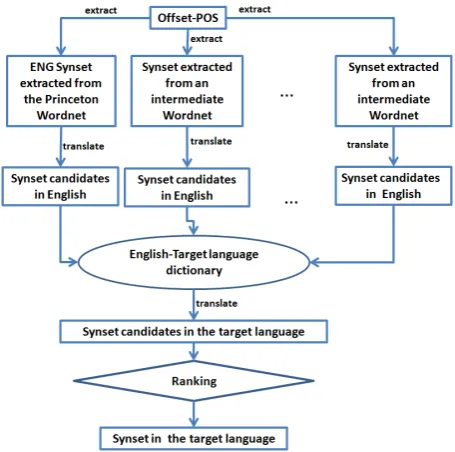
[image:2.595.309.536.62.230.2]The first approach directly translates synsets in PWN toT as in Figure 1.
Figure 1: The DR approach to construct Wordnet synsets in a target languageT.
For each offset-POS, we extract words in that synset from the PWN and translate them to the tar-get language to generate translation candidates.
2.1.2 Approach using intermediate Wordnets (IW)
To handle ambiguities in synset translation, we propose the IW approach as in Figure 2. Publicly available Wordnets in various languages, which we call intermediate Wordnets, are used as re-sources to create synsets for Wordnets. For each
offset-POS, we extract its corresponding synsets from intermediate Wordnets. Then, the extracted synsets, which are in different languages, are translated toTusing MT to generate synset candi-dates. Depending on which Wordnets are used and the number of intermediate Wordnets, the num-ber of candidates in each synset and the numnum-ber
Figure 2: The IW approach to construct Wordnet synsets in a target languageT
2.1.3 Approach using intermediate Wordnets and a dictionary (IWND)
The IW approach for creating Wordnet synsets de-creases ambiguities in translations. However, we need more than one bilingual dictionary from each intermediate languages toT. Such dictionaries are not always available for many languages, espe-cially the ones that are resource poor. The IWND approach is like the IW approach, but instead of translating immediately from the intermediate lan-guages to the target language, we translate synsets extracted from intermediate Wordnets to English (eng), then translate them to the target language. The IWND approach is presented in Figure 3.
[image:2.595.307.535.498.724.2]2.2 Ranking method
For each ofoffset-POS, we have many translation candidates. A translation candidate with a higher rank is more likely to become a word belonging to the correspondingoffset-POSof the new Wordnet in the target language. Candidates having the same ranks are treated similarly. The rank value in the range 0.00 to 1.00. The rank of a wordw, the so-calledrankw, is computed as below.
rankw = numCandidatesoccurw ∗ numDstW ordnetsnumW ordnets
where:
- numCandidatesis the total number of trans-lation candidates of anoffset-POS
- occurwis the occurrence count of the wordw
in thenumCandidates
- numWordnetsis the number of intermediate Wordnets used, and
- numDstWordnetsis the number of distinct in-termediate Wordnets that have words trans-lated to the wordwin the target language. Our motivation for this rank formula is the fol-lowing. If a candidate has a higher occurrence count, it has a greater chance to become a cor-rect translation. Therefore, the occurrence count of each candidate needs to be taken into account. We normalize the occurrence count of a word by dividing it by numCandidates. In addition, if a candidate is translated from different words hav-ing the same sense in different languages, this can-didate is more likely to be a correct translation. Hence, we multiply the first fraction by numDst-Wordnets. To normalize, we divide results by the number of intermediate Wordnet used.
For instance, in our experiments we use 4 in-termediate Wordnets, viz., PWN, FWN, JWN and WOLF Wordnet (WWN) (Sagot and Fišer, 2008). The words in the offset-POS "00006802-v" ob-tained from all 4 Wordnets, their translations to
arb, the occurrence count and the rank of each translation are presented in the second, the fourth and the fifth columns, respectively, of Figure 4.
2.3 Selecting candidates based on ranks
We separate candidates based on three cases as be-low.
[image:3.595.308.537.63.194.2]Case 1: A candidatewhas the highest chance to become a correct word belonging to a specific synset in the target language if its rank is 1.0. This means that all intermediate Wordnets contain the synset having a specificoffset-POSand all words belonging to these synsets are translated to the
Figure 4: Example of calculating the ranks of candidates translated from words belonging to the
offset-POS "00006802-v" in 4 Wordnets: PWN, FWN, JWN and WWN. ThewordA,wordB and wordC are obtained from PWN, FWN and WWN,
respectively. The JWN does not contain this offset-POS.TL presents transliterations of the words in
arb. The numWordnets is 4 and the numCandi-datesis 7. The rank of each candidate is shown in the last column of Figure 4.
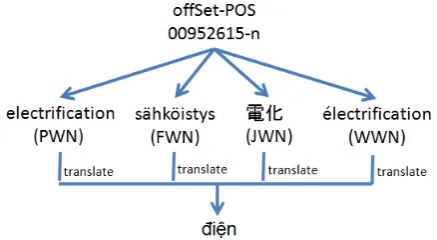
same wordw. The more the number of intermedi-ate Wordnets used, the higher the chance the can-didate with the rank of 1.0 has to become the cor-rect translation. Therefore, we accept all transla-tions that satisfy this criterion. An example of this scenario is presented in Figure 5.
Figure 5: Example of Case 1: Using the IW ap-proach with four intermediate Wordnets, PWN, FWN, JWN and WWN. All words belonging to theoffSet-POS"00952615-n" in all 4 Wordnets are translated to the same word "điện" in vie. The word "điện" is accepted as the correct word be-longing to the offSet-POS "00952615-n" in the Vietnamese Wordnet we create.
Case 2: If anoffSet-POS does not have dates having the rank of 1.0, we accept the candi-dates having the greatest rank. Figure 6 shows the example of the second scenario.
[image:3.595.311.530.446.566.2]Figure 6: Example of Case 2: Using the IW ap-proach with three intermediate Wordnets, PWN, FWN and WWN. For theoffSet-POS "01437254-v", there is no candidate with the rank of 1.0. The highest rank of the candidates in "vie" is 0.67 which is the wordgửi. We accept "gửi" as the cor-rect word in the offSet-POS "01437254-v" in the Vietnamese Wordnet we create.
skip these candidates. Table 1 gives an example of the last scenario.
Wordnet Words Cand. Rank
PWN act hành động 0.33
PWN behave hoạt động 0.33
[image:4.595.347.487.155.225.2]FWN do làm 0.33
Table 1: Example of Case 3: Using the DR ap-proach. For the offSet-POS "00010435-v", there is no candidate with the rank of 1.0. The highest rank of the candidates invieis 0.33. All of 3 can-didates have the rank as same as the highest rank. Therefore, we do not accept any candidate as the correct word in the offSet-POS "00010435-v" in the Vietnamese Wordnet we create.
3 Experiments
3.1 Publicly available Wordnets
The PWN is the oldest and the biggest available Wordnet. It is also free. Wordnets in many languages are being constructed and developed2. However, only a few of these Wordnets are of high quality and free for downloading. The EuroWord-net (Vossen, 1998) is a multilingual database with Wordnets in European languages (e.g., Dutch, Ital-ian and Spanish). The AsItal-ianWordnet3 provides a platform for building and sharing Wordnets for Asian languages (e.g., Mongolian, Thai and Viet-namese). Unfortunately, the progress in building most of these Wordnets is slow and they are far from being finished.
2http://www.globalWordnet.org/gwa/Wordnet_table.html 3http://www.asianWordnet.org/progress
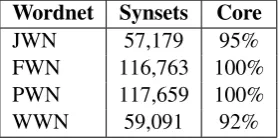
In our current experiments as mentioned ear-lier, we use the PWN and other Wordnets linked to the PWN 3.0 provided by the Open Multilingual Wordnet4project (Bond and Foster, 2013): WWN, FWN and JWN. Table 2 provides some details of the Wordnets used.
Wordnet Synsets Core
JWN 57,179 95%
FWN 116,763 100%
PWN 117,659 100%
[image:4.595.83.279.338.395.2]WWN 59,091 92%
Table 2: The number of synsets in the Wordnets linked to the PWN 3.0 are obtained from the Open Multilingual Wordnet, along with the percentage of synsets covered from the semi-automatically compiled list of 5,000 "core" word senses in PWN. Note that synsets which are not linked to the PWN are not taken into account.
For languages not supported by MT, we use three additional bilingual dictionaries: two dictio-nariesDict(eng,ajz) andDict(eng,dis)provided by Xobdo5; one Dict(eng,asm) created by integrat-ing two dictionaries Dict(eng,asm) provided by Xobdo and Panlex6. The dictionaries are of vary-ing qualities and sizes. The total number of entries inDict(eng,ajz), Dict(eng,asm)and Dict(eng,dis)
are 4682, 76634 and 6628, respectively.
3.2 Experimental results and discussion
As previously mentioned, our primary goal is to build high quality synsets for Wordnets in lan-guages with low amount of resources: ajz, asm, arb, disandvie. The number of Wordnet synsets we create forarbandvie using the DR approach and the coverage percentage compared to the PWN synsets are 4813 (4.10%) and 2983 (2.54%), respectively. The number of synsets for each Wordnet we create using the IW approach with different numbers of intermediate Wordnets and the coverage percentage compared to the PWN synsets are presented in Table 3.
For the IWND approach, we use all 4 Wordnets as intermediate resources. The number of Wordnet synsets we create using the IWND approach are presented in Table 4. We only construct Wordnet synsets forajz, asmanddis using the IWND
ap-4http://compling.hss.ntu.edu.sg/omw/ 5http://www.xobdo.org/
App. Lang. WNs Synsets % coverage
IW arb 2 48,245 41.00%
IW vie 2 42,938 36.49%
IW arb 3 61,354 52.15%
IW vie 3 57,439 48.82%
IW arb 4 75,234 63.94%
[image:5.595.71.295.62.159.2]IW vie 4 72,010 61.20%
Table 3: The number of Wordnet synsets we create using the IW approach. WNsis the number of in-termediate Wordnets used: 2: PWN and FWN, 3: PWN, FWN and JWN and 4: PWN, FWN, JWN and WWN.
proach because these languages are not supported by MT.
App. Lang. Synsets % coverage
IWND ajz 21,882 18.60%
IWND arb 70,536 59.95%
IWND asm 43,479 36.95%
IWND dis 24,131 20.51%
[image:5.595.80.280.280.364.2]IWND vie 42,592 36.20%
Table 4: The number of Wordnets synsets we cre-ate using the IWND approach.
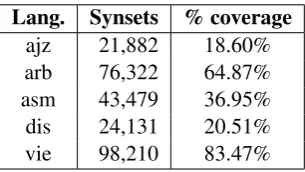
Finally, we combine all of the Wordnet synsets we create using different approaches to generate the final Wordnet synsets. Table 5 presents the fi-nal number of Wordnet synsets we create and their coverage percentage.
Lang. Synsets % coverage
ajz 21,882 18.60%
arb 76,322 64.87%
asm 43,479 36.95%
dis 24,131 20.51%
vie 98,210 83.47%
Table 5: The number and the average score of Wordnets synsets we create.
Evaluations were performed by volunteers who use the language of the Wordnet as mother tongue. To achieve reliable judgment, we use the same set of 500offSet-POSs, randomly chosen from the synsets we create. Each volunteer was requested to evaluate using a 5-point scale – 5: excellent, 4: good, 3: average, 2: fair and 1: bad. The aver-age score of Wordnet synsets forarb, asmandvie
are 3.82, 3.78 and 3.75, respectively. We notice that the Wordnet synsets generated using the IW approach with all 4 intermediate Wordnets have the highest average score: 4.16/5.00 for arb and
4.26/5.00 forvie. We are in the process of finding volunteers to evaluate the Wordnet synsets forajz
anddis.
It is difficult to compare Wordnets because the languages involved in different papers are differ-ent, the number and quality of input resources vary and the evaluation methods are not standard. How-ever, for the sake of completeness, we make an at-tempt at comparing our results with published pa-pers. Although our score is not in terms of percent-age, we obtain the average score of 3.78/5.00 (or informally and possibly incorrectly, 75.60% preci-sion) which we believe it is better than 55.30% ob-tained by (Bond et al., 2008) and 43.20% obob-tained by (Charoenporn et al., 2008). In addition, the av-erage covav-erage percentage of all Wordnet synsets we create is 44.85% which is better than 12% in (Charoenporn et al., 2008) and 33276 synsets ('
28.28%) in (Saveski and Trajkovsk, 2010) . The previous studies need more than one dic-tionary to translate between a target language and intermediate-helper languages. For exam-ple, to create the JWN, (Bond et al., 2008) needs the Multilingual dictionary, Japanese-English lexicon and Japanese-Japanese-English life sci-ence dictionary. For asm, there are a number of Dict(eng,asm); to the best of our knowledge only two online dictionaries, both between eng
andasm, are available. The IWND approach re-quires only one input dictionary between a pair of languages. This is a strength of our method.
4 Conclusion and future work
We present approaches to create Wordnet synsets for languages using available Wordnets, a public MT and a single bilingual dictionary. We create Wordnet synsets with good accuracy and high cov-erage for languages with low resources (arb and
vie), resource-poor (asm) and endangered (ajzand
[image:5.595.105.258.480.566.2]References
Antoni Oliver and Salvador Climent. 2012. Parallel corpora for Wordnet construction: Machine trans-lation vs. automatic sense tagging. In Proceed-ings of the 13th International Conference on Com-putational Linguistics and Intelligent Text Process-ing (CICLProcess-ing), volume part II, pages 110-121, New Delhi, India, March.
Benoît Sagot and Darja Fišer. 2008. Building a free French Wordnet from multilingual resources. In
Proceedings of the Ontolex 2008 Workshop, Mar-rakech, Morocco, May.
Fellbaum, Christiane. 1998. Wordnet: An electronic lexical database. MIT Press, Cambridge, Mas-sachusetts, USA.
Francis Bond and Ryan Foster. 2013. Linking and ex-tending an open multilingual Wordnet. In Proceed-ings of the 51st Annual Meeting of the Association for Computational Linguistics (ACL), pages 1352– 1362, Sofia, Bulgaria, August.
Francis Bond, Hitoshi Isahara, Kyoko Kanzaki and Kiyotaka Uchimoto. 2008. Boot-strapping a Word-net using multiple existing WordWord-nets. In Proceed-ings of the 6th International Conference on Lan-guage Resources and Evaluation (LREC), pages 1619–1624, Genoa, Italy, May.
Eduard Barbu and Verginica Barbu Mititelu. 2005. Automatic building of Wordnets. InProceedings of the International Conference on Recent Advances in Natural Language Processing (RANLP), Borovets, Bulgaria, September.
Gunawan and Andy Saputra. 2010. Building synsets for Indonesian Wordnet with monolingual lexical re-sources. InProceedings of the International Confer-ence on Asian Language Processing (IALP), pages 297–300, Harbin, China, December.
Hiroyuki Kaji and Mariko Watanabe. 2006. Auto-matic construction of Japanese Wordnet. In Pro-ceedings of the 5th International Conference on Language Resources and Evaluation (LREC), pages 1262–1267, Genoa, Italy, May.
Hitoshi Isahara, Francis Bond, Kiyotaka Uchimoto, Masao Utiyama and Kyoko Kanzaki. 2008. De-velopment of Japanese Wordnet. InProceedings of the 6th International Conference on Language Re-sources and Evaluation (LREC), pages 2420–2423, Marrakech, Morocco, May.
Krister Lindén and Laur Carlson. 2010. FinnWordnet -WordNet påfinska via översättning, LexicoNordica.
Nordic Journal of Lexicography, 17:119–140. Martin Saveski and Igor Trajkovsk. 2010. Automatic
construction of Wordnets by using machine transla-tion and language modeling. InProceedings of the 13th Multiconference Information Society, Ljubl-jana, Slovenia.
Orhan Bilgin, Özlem Çentinoˇglu and Kemal Oflazer. 2004. Building a Wordnet for Turkish. Romanian Journal of Information Science and Technology, 7(1-2): 163–172.
Piek Vossen. 1998. A multilingual database with lex-ical semantic networks. Kluwer Academic Publish-ers, Dordrecht, Netherlands.