Proceedings of the ACL Student Research Workshop, pages 31–36,
Automatic Discovery of Intentions in Text and its Application to Question
Answering
Marta Tatu
Human Language Technology Research Institute Department of Computer Science
University of Texas at Dallas Richardson, TX 75080, USA
Abstract
Semantic relations between text concepts denote the core elements of lexical se-mantics. This paper presents a model for the automatic detection ofINTENTION se-mantic relation. Our approach first identi-fies the syntactic patterns that encode in-tentions, then we select syntactic and se-mantic features for aSVMlearning classi-fier. In conclusion, we discuss the appli-cation ofINTENTIONrelations to Q&A.
1 Introduction
1.1 Problem description
Intentions comprise of semantic relationships that
express a human’s goal-oriented private states of mind, including intents, objectives, aims, and pur-poses. As a relation, it encodes information that might not be explicitly stated in text and its detec-tion might require inferences and human judgment. The answer to the question What was Putin trying
to achieve by increasing military cooperation with North Korea? is found in the sentence Putin is at-tempting to restore Russia’s influence in the East Asian region. Extracting the exact answer to restore Russia’s influence in the East Asian region becomes
easier if this is recognized as Putin’s intention which matches the question’s expected answer.
In this paper, we describe a method that identi-fies intentions in domain independent texts. We em-ployed two machine learning algorithms to create models that locate intentions in a given paragraph using a set of six syntactic and semantic features.
1.2 Motivation
The current state-of-the-art NLPsystems cannot ex-tract intentions from open text and, as we saw in the example, their detection benefits Question Answer-ing. An intention is the answer to general questions like What is the goal of X?, What does X plan to do?, or What does X aim for? The INTENTION seman-tic relation is one of the most challenging relations because text fragments may convey unstated inten-tions. These are most pervasive in dialogues, com-munication specific to humans. For example, in the following conversation, the vendor infers the client’s unstated intention of buying the cups.
Customer: Where do you have the$1 cups? Salesman: How many do you want?
Intentions are closely related to other semantic re-lations such as beliefs, motives, desires, or plans. In the above example, the context tells us that this takes place in a superstore, well-known as a place where people buy things from. The clerk’s an-swer emerges from our common beliefs and back-ground knowledge as well as from his desire to help a customer. Intentions are the framework for plans. Many philosophers and artificial intelligence researchers studied the intentions as parts of coor-dinating plans (Bratman, 1987; Pollack, 1990) be-cause people establish plans for future times.
In this paper, we regard intentions as expres-sions of a particular action that shall take place in the future, in which the speaker is some sort of agent (Anscombe, 1957). For example, the sentence
Mary is going to buy a TV set shows Mary’s
in-tention. Anscombe (1957) considers intentions as a subclass of predictions, besides commands and
prophecies. John is going to be sick is usually a prophecy, John, go for a walk! is an order, and John
plans to take a walk expresses an intention.
1.3 Previous work
Various methodologies have been proposed and used over the years for the task of extracting semantic relations from text. Purely probabilistic models, empirical methods, or hand-coded constraints were some of the approaches that do not use machine learning algorithms. Later on, methods that use de-cision tree, neural networks, memory-based learn-ing, or support vector machines were introduced. Currently, there is also a increased interest in shal-low semantic parsing of open texts and automatic la-beling of semantic roles. Wiebe et al. (2004) focused on the detection of subjective language such as opin-ions, evaluatopin-ions, or emotions in text. Using clues of subjectivity (low-frequency words, collocations), they identify opinion piece texts such as editorials, letters to the editor, or arts and leisure reviews.
There exists an immense literature in philoso-phy about the different types of intentions and their characteristics. Bratman (1987) tries to find the re-lationship between the two distinct phenomena of
doing something intentionally and intending to do something. Numerous philosophical studies dis-cuss how intentions relate to other psychological concepts, such as, beliefs, desires, hopes, or ex-pectations (Audi, 1973; Bratman, 1981; Bratman, 1987). Intentions are consistent with the person’s beliefs, and, unlike ordinary desires, require con-sistency (Bratman, 1987). They can generate rea-sons for or against future intentions (Bratman, 1981; Bratman, 1987). As plan elements, intentions re-quire a certain stability. Their side effects need not be intended, even if they were taken into considera-tion in the first place1(Bratman, 1990).
2 Syntax and Semantics of Intention
2.1 Syntactic patterns
Because, in all the cases that we encountered, inten-tions were conveyed by phrases, we took a closer look at how intentions can be expressed in the writ-ten text. For our investigations, we chose the
Sem-1
Due to space limitations, we couldn’t include detailed ex-amples. Please see the cited articles for exex-amples.
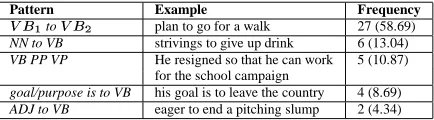
Cor text collection (Miller et al., 1993), a subset of the Brown corpus manually tagged with WordNet senses (37,176 sentences in 352 newspaper articles). After manually classifying the first 2,700 sentences from SemCor into sentences that contain or not in-tentions, only 46 examples were identified. The syntactic patterns listed in Table 1 cover 95.65% of them. Because the first pattern comprises more than half of the studied examples, our algorithm focuses on detecting intentions encoded by
to
. We note that this pattern is ambiguous and may con-vey other semantics. For instance, Mary began to
play with the dog, He told her to meet you are
en-coded by our pattern, but do not express intentions.
Pattern Example Frequency
to plan to go for a walk 27 (58.69)
NN to VB strivings to give up drink 6 (13.04)
VB PP VP He resigned so that he can work 5 (10.87) for the school campaign
goal/purpose is to VB his goal is to leave the country 4 (8.69)
[image:2.612.319.536.264.324.2]ADJ to VB eager to end a pitching slump 2 (4.34)
Table 1: INTENTION syntactic patterns
2.2 Semantics of intentions
From the semantic point of view, an intention may be very specific, it may contain a future time or a location (John intends to meet Mary today), but ev-ery intention must specify a future action. Hence, we propose the following representation for theIN
-TENTION semantic relation: INT(
) where
is the event denoting the intention,
denotes the person that has the intention and
is the intended action or event. If the intention is more specific then we will identify instances of other semantic re-lations2.
!
INT" #
! %$
&'" #
)(+*-,/.
0
&1/2 *3.
540
THEME"
6
TIME"
54
represents a more specific intention. The semantics of the INTENTION relation allows the derivation of inference rules which show thatIN
-TENTIONdominates other semantic relations such as
PURPOSE,ENTAIL, orISA. For example, if a person
intends to perform action
and this action has a purpose
4
, then we can say that
intends to do
4
3. Formally, we can express the above relations
2
The list of semantic relations that can specialize anINT
includesTHEME,LOCATION,TEMPORAL,MANNER,INSTRU
-MENT, SOURCE,MEANS, andFREQUENCY. Their arguments are798, the intention verb, and a corresponding:<;.
3
with the following set of implications4:
INT 7":"7 8 PURPOSE 798 7 INT 7":"7
INT 7 ": "7 8 ENTAIL7 8 7 INT 7 ": 7
INT 7
":
"7
8 IS-A
7
8
7
INT 7
:
7
INT 7":"7 8 PURPOSE 7 798 INT 7":"7
INT 7 ": "7 8 CAUSE 7 8 7 INT 7 : 7
The first three implications formalize the above inference rules. If John intends to start his car to
go to the park, then John intends to go to the park.
Similarly, if John intends to buy a car, then we can say that he intends to pay for it. The sentences John
intends to go to the park. He’s starting his car right now express John’s intention to go to the park (
). The purpose of starting the car (
4
) is to go to the park. We cannot say that John intends to start his car. This is just an intentional action done to achieve his objective. The fifth rule tries to eliminate the ef-fects (
4
) of an intention (
) from being considered as intentions or objectives. If John intends to swim
in the pool (
) even if he knows that he is going to
catch a cold (
4
) because the water is too cold, we cannot say that John intends to catch a cold.5 The traditional relational properties (reflexivity,
symme-try, or transitivity) do not hold for the INTENTION
semantic relation.
3 Learning Model
3.1 Experimental data
We applied the most frequent syntactic pattern that expresses intentions in text (
to
) on the first 10,000 sentences of the SemCor2.0 collection and we extracted 1,873 sentences. These sentences contain 115 intentions (manually identified by a graduate student, not the author). The data consist-ing of these positives and 258 arbitrarily selected negative examples, was randomly divided into a training set that contains 80% of the examples and a test set with the remaining 20% instances. The statistics are shown in Table 2.
Intentions Non-Intentions Total
Training 92 208 300
Testing 23 50 73
Table 2: Experiments Data Division
semantic relations.
4
7 and7 represent different intentions of the same person.
5
A more detailed example can be found in (Bratman, 1990).
3.2 Features for intention
After analyzing our training data, we pinpointed a set of features to help us identify the intentions en-coded by the pattern
to
. The WordNet senses needed to extract the semantic features were taken from SemCor. We will use Mary intends to
revise the paper to show each feature’s value. The semantic class of the the
verb’s agent
or specializations of it. Intentions and objectives are specific to humans. Thus, the semantic class of the
agent bears a high importance. We used an in-house semantic parser to retrieve the AGENT
of the
verb. The feature’s value is its WordNet semantic class. Mary names a person. Thus, the semantic class that we are seeking is entity#1.
We chose this semantic generalization because nouns and verbs belong to open part-of-speech classes. There can be an enormous number of pos-sibilities and any models built using them as fea-ture values will not be able to generalize beyond the training examples. Therefore, we introduce a bias in our learning framework based on the assumption: noun and verb concepts will semantically behave as the concepts that subsume them in the WordNet structures. But, by generalizing concepts, we lose some of their semantic properties. Hence, we spe-cialize the semantic class of a concept by
re-placing it with its immediate hyponym ( ) that
sub-sumes . We can further increase the semantic level
by specializing . We note that the number of values
is still finite even though we specialized the general concepts. As the specialization level increases, there will be words that cannot be further specialized
(entity#1 cannot be specialized even once). In such cases, we add to the set of feature values.
The semantic class of the
verb or its spe-cializations. The intention phrase is subordinated
to a verb (
). The semantic class of this verb is the system’s second feature. In our example,
(intend#1) semantic class is wish#3.
The semantic class of the
verb’s agent, if
this agent differs from the
verb’s agent; other-wise, a common value (equal) is given. We identify
theAGENTof the
Semantic Semantic class of the verb (%) class of no specialization
level of specialization
level of specialization the
’s Semantic class of the5
verb Semantic class of the
verb Semantic class of the
verb agent no spec.
level
level no spec.
level
level no spec.
level
level no spec. 87.67 80.82 87.67 90.41 87.67 87.67 86.30 83.56 84.93
level 89.04 82.19 87.67 87.67 89.04 87.67 87.67 86.30 84.93
[image:4.612.110.502.62.128.2]
level 87.67 83.56 87.67 90.41 90.41 89.04 89.04 87.67 86.30
Table 3: Accuracy of models using the specialization level for the
agent semantic class
the
verb (Mary intends John to revise the
pa-per). Let’s assume that Mary is John’s supervisor
and she can make him revise the document. The sen-tence expresses Mary’s intention of persuading John to revise the paper, but this objective is not encoded by the pattern we considered.
The semantic class of the
verb or its spe-cializations. The
verb expresses the future ac-tion or behavior that the agent intends. We extract this feature using WordNet hierarchies. Revise#1 be-longs to the act#1 semantic class.
A flag indicating if the
verb has an affir-mative or a negative form. We want to
differen-tiate between sentences like John wants to go for a
walk and John doesn’t want to go for a walk. The
first sentence expresses John’s intention, while, in the second one, no intention can be identified.
The type of the analyzed sentence. This feature
is primarily concerned with questions. A question like Where do you plan to go for a walk? indicates the intention of going for a walk, unlike the question
Do you plan to go for a walk? which might express
an intention if the answer is “yes”. This feature’s values are the wh-words that begin a question or n/a for the other types of English sentences.
We did not analyze the affirmative versus the neg-ative form of the
verb because it does not affect the objective attribute of the intention. The sentence
John intends not to go for a walk expresses a
nega-tive intention. This sentence is much stronger than
John doesn’t intend to go for a walk. In the former
context, John has set a goal for himself , while in the second sentence, the objective does not exist.
4 Experimental Results
4.1 Impact of specialization
The first experiment was performed using the LIB
-SVM package6 and the WordNet semantic classes.
6
http://www.csie.ntu.edu.tw/˜cjlin/libsvm/index.html
These features yield an accuracy of 87.67%. Try-ing to improve the performance, we specialized the semantic classes. When the
’s agent semantic class was specialized, the accuracy remained con-stant. If we replace the
’s semantic class with its direct hyponyms, the accuracy drops 5.48%. But, the specialization of the
agent’s semantic class brings an improvement of 1.37% and the special-ization of the
’s class produces an increase in accuracy of 2.74%. Given this fluctuation in per-formance, we performed 81 different experiments which create SVM models using the same training
data annotated with more general or more specific feature values. For each feature, we analyzed the first two semantic specialization levels.
From our experiments, we noticed that the spe-cialization of the !
’s agent semantic class does not influence the performance. Out of the 27 ex-periment triplets in which this specialization level changes, in only 4, it influences the result and, in 3 of them, the accuracy increases with the special-ization level. Thus, our third feature is the second specialization level of the
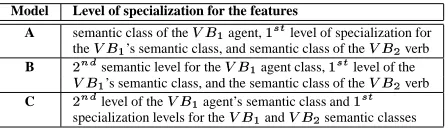
’s agent class. Ta-ble 3 shows the results obtained when the values of the radial kernel parameters were chosen to optimize the 5-fold-cross-validation on the training data. The best models are described in Table 4.
Model Level of specialization for the features A semantic class of the
5
agent,
level of specialization for the
’s semantic class, and semantic class of the
verb
B
semantic level for the5 5
agent class,
level of the
5
’s semantic class, and the semantic class of the
verb
C
level of the
agent’s semantic class and
specialization levels for the 5
and semantic classes
Table 4: The best three intention classifiers
4.2 Learning curves
[image:4.612.316.540.546.611.2]Semantic class of the Semantic class of the Semantic class of the Semantic class of the verb Sentence
’s agent
verb
’s agent
verb form type
Model A 2.74 16.44 1.37 0 2.74 4.11
Model B 2.74 15.07 1.37 0 4.11 2.74
[image:5.612.99.515.63.110.2]Model C 1.37 16.44 4.11 0 4.11 2.74
Table 5: The improvement (%) brought by each feature to the three bestSVMmodels
size and validated the new models using our previ-ous test set. Figure 1 shows the performance varia-tion of three models that use feature sets identical in terms of specialization levels to the ones of the A, B, and C classifiers. All three models exhibit a similar behavior with respect to the change in the training set size. Therefore, our features create a stable al-gorithm. The highest accuracy models use all 300 training examples. Thus, we did not reach the satu-ration point, but, considering the performance curve, this point is not very far.
30 40 50 60 70 80 90 100
50 100 150 200 250 300
SVM model accuracy
Number of training examples
Model A Model B Model C
Figure 1: Testing set is constant
4.3 Feature impact on theSVMmodels
All our previous experiments used the entire set of features. Now, we investigate the relative contribu-tion of each feature. We performed experiments that use only five out of the six features. In Table 5, we list the accuracy increase that is gained by the inclu-sion of each feature. The most influential attribute is the
verb’s semantic class or its specializations. The intention’s description verb does not influence the classification result. Because intentions consist of a future action and verbs express actions, there are very few verbs, such as dream or snore (invol-untary actions) that cannot occupy the
verb’s position. The syntactic features bring an average in-crease in accuracy of 3.50%.
4.4 Impact of word sense disambiguation
Perfect word sense disambiguation might be a too strong assumption. In this section, we examine the effects of weaker disambiguation. Table 6 shows the accuracies of the best three models when each con-cept is tagged with its first WordNet sense (NoWSD) and when the senses are given by an in-houseWSD
system with an accuracy of 69% computed on the SemCor data (AutomaticWSD).
NoWSD AutomaticWSD GoldWSD
Model A 72.60 79.45 90.41
Model B 73.97 79.45 90.41
[image:5.612.319.531.287.335.2]Model C 72.60 80.82 90.41
Table 6: Best models performance (%)
4.5 C5 results
After examining theSVMresults, we applied the C5 machine learning algorithm (Quinlan, 2004) to the same training data annotated with the same feature set, in a similar manner. Again, we specialized the four semantic classes, independently, and tested the decision trees against the testing data. Table 7 shows their accuracy. The highest values were obtained for the first level of specialization of the
verb se-mantic class. The specialization levels of the other semantic classes do not influence the accuracy of the decision trees. The most tested attribute is the
verb. This further substantiates our observa-tion, made during ourSVMmodels analysis, that this feature has the greatest importance in the intention classification process. Our error analysis of the C5 results indicates that, because of the relatively small numbers of training instances, C5 ignores some of the features and makes wrong decisions.
5 Application to Question Answering
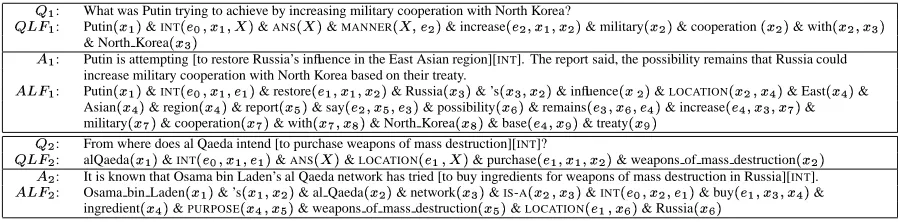
[image:5.612.82.290.314.462.2]: What was Putin trying to achieve by increasing military cooperation with North Korea?
: Putin &INT
&ANS &MANNER & increase & military & cooperation & with
& North Korea
: Putin is attempting [to restore Russia’s influence in the East Asian region][INT]. The report said, the possibility remains that Russia could increase military cooperation with North Korea based on their treaty.
: Putin &INT
& restore & Russia & ’s & influence &LOCATION & East & Asian & region & report & say
& possibility!
& remains!
& increase"#
& military #
& cooperation #
& with # $
& North Korea$
& base %
& treaty%
: From where does al Qaeda intend [to purchase weapons of mass destruction][INT]?
: alQaeda &INT&'
&ANS
&LOCATION&
& purchase
& weapons of mass destruction
: It is known that Osama bin Laden’s al Qaeda network has tried [to buy ingredients for weapons of mass destruction in Russia][INT].
: Osama bin Laden
& ’s
& al Qaeda & network
&IS-A
&INT & buy " & ingredient &PURPOSE
& weapons of mass destruction
&LOCATION
!
& Russia !
Table 8: Question and answer pair examples
Semantic class of Semantic class of the(*)
verb
the(*) ’s agent no spec. +,- level ./0 level
no spec. 79.45 87.67 84.93
+, - level 68.49 87.67 84.93
[image:6.612.81.530.62.173.2]. /0 level 79.45 87.67 84.93
Table 7: C5 models accuracy (%)
which finding the correct answer primarily depends on the discovery of theINTENTIONrelation.
The answer type for the question 1
is the IN
-TENTION argument itself. The question processing
module will detect that the answer being sought is Putin’s intention. The semantic relations module processes 2
’s text and discovers the INTENTION
relation. The question is searching for the intent of Putin with regards to North Korea and the answer text reveals Putin’s intention to restore Russia’s in-fluence in the area. Question 1
is searching for a location as its answer type and the correct answer is one which involves al Qaeda intending to purchase weapons of mass destruction. The candidate answer text (2
) reveals the organization’s past intent to buy (synonym with purchase) weapons in Russia. Be-cause the two intentions have the same agent, future action and theme, the two semantically enhanced logic forms can now be unified and we can pin down the location of the intent (Russia).
6 Conclusions
We proposed a method to detect the INTENT rela-tion encoded by the sentence-level pattern
to
with a 90.41% accuracy. We plan to investi-gate the otherINTENTION patterns as well as other semantic relations such asMOTIVE, IMPLICATION,
or MEANING which, currently, cannot be identified
by the state-of-the-art NLP systems. These
relation-ships need to be analyzed to provide a complete cov-erage of the underlying semantics of text documents. We intend to incorporate our INTENTION detection module into a Question Answering system and show its impact.
References
Anscombe, G.E.M. 1957. Intention. Cornell University Press, Ithaca, New York.
Audi, Robert. 1973. Intending. The Journal of Philoso-phy, 70(13):387–403.
Bratman, Michael E. 1981. Intention and means-end reasoning. The Philosophical Review, 90(2):252–265.
Bratman, Michael E. 1987. Intention, Plans, and Prac-tical Reason. Harvard University Press, Cambridge, Massachusetts.
Bratman, Michael E. 1990. What is intention? In Inten-tions in Communication. MIT Press.
Miller, George A., Claudia Leacock, Randee Tengi, and Ross T. Bunker. 1993. A semantic concordance. In Proceedings of the ARPA Human Language Technol-ogy Workshop
Miller, George A. 1995. Wordnet: A lexical database. Communication of the ACM, 38(11):39–41.
Pollack, Martha E. 1990. Plans as complex mental atti-tudes. In Intentions in Communication. MIT Press.
Quinlan, Ross. 2004. Data Mining Tools See5 and C5.0. http://www.rulequest.com/see5-info.html