R E S E A R C H A R T I C L E
Open Access
Additional qualifications of trainees in
specialist training programs in Australia
Daniel Thompson
1*, Colin Thompson
2, Natasha Nassar
3and Annette Katelaris
4Abstract
Background: In Australia, the number of medical graduates per year has increased at a greater rate than the increase in the number of specialist training places. Consequently, competition for training positions is intensifying. There is anecdotal evidence to suggest that medical graduates are acquiring additional qualifications to compete with their peers Stevenson 2017 (https://insightplus.mja.com.au/2017/36/specialty-training-places-the-other-looming-crisis/). Our study investigates this phenomenon of additional credentialing and demonstrates the number and type of
postgraduate and research qualifications obtained by specialists in training in Australia. This is the first study to assess the number and type of credentials acquired by registrars in each specialty and to provide insight into differences between specialities.
Methods: Information on specialists in training was obtained through the Medicine in Australia: Balancing Employment and Life (MABEL) survey conducted between 2008 and 2014. The number of any additional qualifications and specific PhD, Master’s degree, postgraduate diploma/certificate and research degrees from medical school were assessed for each specialist training scheme in the database.
Results: Overall, 995 registrars representing 13 specialties were included. Just under a third (30.4%) completed a research-based degree during their medical degree and almost half (46.7%) of specialist registrars obtained further qualifications after completing medicine. A significantly higher proportion of ophthalmology (78.6%) and paediatric (67.5%) registrars, and a lower percentage of emergency medicine (36.7%) registrars, held postgraduate qualifications. Overall, 2.4% of registrars held a PhD and 10.1% held a Master’s degree. A higher percentage of either PhD or Master’s was held by ophthalmology (64.3%) and surgical (30.6%) trainees and a lower percentage by anaesthetics (6.3%) and physician trainees (7.9%). Postgraduate diplomas or certificates were most common among paediatric (41.2%) and obstetrics and gynaecology (25.6%) registrars.
Conclusion: This is the first study to investigate the additional qualifications of specialists in training in Australia. Almost half of specialists in training surveyed (46.7%) have completed some form of additional study, whether it is a PhD, Master’s, postgraduate diploma/certificate or research degree from medical school. Trainees of specialist training schemes are more qualified than specialists who trained in the past Aust Fam Physician 32:92-4, 2003.
Keywords: Postgraduate education, Medical education, Specialist training, Surgical training, Registrar Background
Specialist training in Australia is conducted through the 15 specialist medical colleges [1]. The specialist colleges set the number of training positions they will provide each year and the selection criteria for trainees [2]. Each college has their own application process with the positions usu-ally determined on the basis of an interview, referee’s
assessment, and curriculum vitae [3]. The minimum eligi-bility is a completed medical degree. Given the dispropor-tionate number of increasing medical graduates and unmatched number of training positions, there is anec-dotal evidence that many potential trainees are undertak-ing additional activities such as pre-specialisation work and pursuing further qualifications, research and other skills courses in order to increase their competitiveness for selection. There is clear motivation for candidates to obtain further qualifications to better their chances for © The Author(s). 2019 Open Access This article is distributed under the terms of the Creative Commons Attribution 4.0
International License (http://creativecommons.org/licenses/by/4.0/), which permits unrestricted use, distribution, and reproduction in any medium, provided you give appropriate credit to the original author(s) and the source, provide a link to the Creative Commons license, and indicate if changes were made. The Creative Commons Public Domain Dedication waiver (http://creativecommons.org/publicdomain/zero/1.0/) applies to the data made available in this article, unless otherwise stated.
* Correspondence:[email protected]
1St. Vincent’s Hospital Melbourne, 41 Victoria Parade, Fitzroy, Melbourne, Victoria 3065, Australia
selection, the colleges make CV scoring guides available for candidates and most give points for additional qualifi-cations. The weighting of points to qualifications varies from speciality to speciality and may be a reason for vari-ation in types of qualificvari-ations obtained by speciality trainees of different craft groups [4]. Pre-specialisation work, especially additional qualifications which are not mandatory for clinical practice, increase the cost of, and frequently the time required to complete specialist train-ing, and may come at the cost of gaining clinical or surgi-cal experience.
In Australia, the number of domestic medical
gradu-ates has increased by 230% from 2005 to 2015 [5]
out-stripping the 206% increase in total number of advanced training positions (other than general practice) over the same period [6,7]. The increase in the number of train-ing places has been inconsistent across specialities and may partly account for the differences in extra creden-tials obtained between specialty registrars. For example, the number of training places in surgery over this time-frame has only increased by 130% [6,7].
The rationale of this study was to investigate the na-ture and extent of qualifications obtained by current Australian speciality trainees. It is the first study to
examine this characteristic of trainees, and the
phenomenon of over-credentialing with qualifications not specifically required for clinical practice.
Methods
Data were ascertained for both new and continuing spe-cialist registrars completing surveys in Waves 5–7 of the MABEL study, a longitudinal survey of Australian doc-tors [8]. Every practicing clinician in Australia was in-vited to participate in the first wave of the study in 2008, and yearly all new doctors in the workforce are invited to participate. The study includes a cohort of specialists in training, and the response rate from the initial cohort was 20.6% with further waves of the study showing simi-lar response rates.
The proportion of registrars with postgraduate qualifi-cations in each specialty, as well as the type of qualifica-tion (PhD, Master’s degree, postgraduate diploma/ certificate, research degree) was compared to overall rates and assessed using one sample z-test for propor-tions with continuity correction.
MABEL was approved by the University of Mel-bourne’s Faculty of Business and Economics Human Ethics Advisory Group and the Monash University Standing Committee on Ethics in Research Involving Humans.
Results
Overall, 995 registrars representing 13 specialties (ex-cluding general practice) were included. A total of 46.7%
(95% CI 43.4–49.6) of surveyed trainees held at least one qualification in addition to their basic medical degree. There was no statistically significant difference between the proportion of male or female trainees with extra qualifications (44 and 49% of the sample respectively).
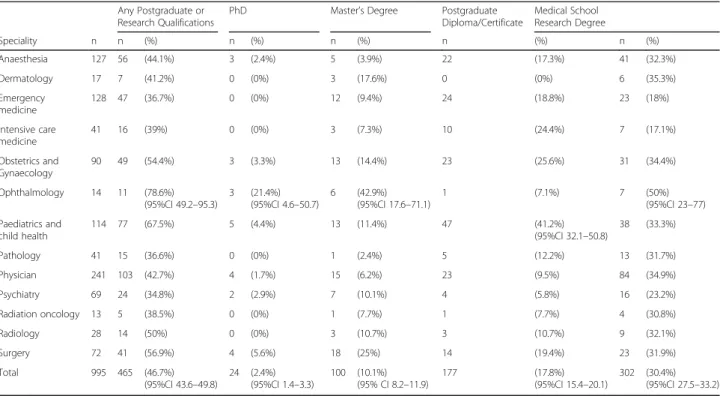
Table 1 presents the proportion of specialist trainees
having completed extra training in addition to their medical degree. This ranged from up to three quarters (78.6%) for ophthalmology and 67.5% of paediatric trainees to one third (34.8%) of psychiatric trainees.
On average, 2.4% of all trainees held a PhD (95% CI 1.4–3.3%), the highest proportion among ophthalmology trainees (21.4%). One in 10 trainees completed a Mas-ter’s degree with ophthalmology (42.9%) and surgical (25.1%) trainees most likely to hold this degree.
Postgraduate diplomas/ certificates were most com-mon for paediatric trainees (41.2%) (95% CI 32.1–50.8).
Of surgical trainees, 57% (95% CI 44.7–68.6) held add-itional postgraduate or research qualifications. Master’s degrees and medical school research degrees were the most common postgraduate qualifications attained by surgeons.
Discussion
This study sought to investigate the additional qualifica-tions obtained by specialist registrars in Australia and reveals that almost half of trainees (46.7%) surveyed have completed at least one post graduate qualification in addition to their basic medical degree, the highest being among ophthalmology, paediatric and surgical trainees. Anecdotally there has been evidence that medical gradu-ates were completing additional qualifications to better their chances of speciality selection, however there was no evidence to suggest the magnitude of proportion of speciality registrars undertaking additional credentialing [9]. It is now clear that Australian specialists in training are highly qualified, with degrees that are not strictly re-quired for clinical practice. Candidates are incentivised to complete these degrees however, as they are scored when assessing CVs for selection.
The differing rates of additional qualifications and type of qualifications may reflect availability of courses, com-petition for training program entry and apparent special-ist college preference for candidates with certain qualifications. For example, the Diploma of Obstetrics and Gynaecology offered by the Royal Australian and New Zealand College of Obstetricians and Gynaecolo-gists (RANZCOG), is commonly undertaken by pro-spective trainees to demonstrate their interest in the specialty. Similarly, Diplomas of Child Health are fre-quently undertaken by potential paediatric trainees. This type of diploma qualification does not exist for most other specialities.
The Master of Medicine (Ophthalmic Science) is a long-established degree designed to prepare potential candidates for Royal Australian and New Zealand Col-lege Ophthalmology primary examinations and to dem-onstrate a candidate’s interest in the specialty. Indeed, the course outcomes include‘to assist primarily medical graduates applying for a position in a Royal Australian
and New Zealand College of Ophthalmologists
(RANZCO) recognised training program’ [10]. Again,
while not unique, few other specialties have University coursework tailored to selection for specialty training and primary examinations.
Our study highlights the number of additional qualifi-cations held by medical specialists has markedly in-creased. In 2003 2.8% of fully qualified specialists
surveyed by McGrath et al. held a PhD or Master’s
de-gree [11] compared to the 12.5% of specialist registrars in training in 2010 to 2014. Whilst not directly compar-able, as the 2003 data focused on fully qualified rather than training specialists, this data shows that the num-ber of additional qualifications held by new trainees has increased when compared to their fully qualified peers. This may be explained by factors such as the develop-ment of specific pathways to training positions, changes to the selection criteria of candidates and the scoring of postgraduate degrees in CV assessment and increased competition for training positions.
This study shows 30% of specialist trainees have med-ical school research degrees which are designed to give
students the opportunity to gain research experience in preparation for academic or clinical careers. These de-grees, such as the BMedSci (Hons) are widely available at many Australian medical schools [12]. The move away from Bachelor of Medicine degrees to the MD in Australia, is likely to reduce the number of these degrees in the future, as they are not offered in MD programs which include a research project.
Obtaining postgraduate qualifications prior to selec-tion for specialist training increases the costs of, and frequently the time required to complete, specialist training and may come at the cost of gaining general medical or surgical experience. Although, proponents argue that additional degrees improve the standard of trainees and accelerate knowledge acquisition, critical thinking skills and provide opportunities to improve non-technical skills such as research, communication and clinical teaching, these degrees are not pre-requisites for clinical practice, and indeed there is no research to suggest that they improve the clinical skills of candidates. The costs of obtaining these de-grees can be significant. The Master of Surgical Sci-ence course at Melbourne University requires 3 years
of part time study and costs $46,556 [13]. Courses
such as the Diploma in Child Health/International
Postgraduate Certificate (now the Sydney Child
Health Program) can be completed in 1-year part
time, and costs $3550 [14]. While many of these
pro-grams are offered online, most require some
Table 1 Postgraduate qualifications of Australian specialist trainees 2010, 2014 MABEL waves 5–7
Any Postgraduate or Research Qualifications
PhD Master’s Degree Postgraduate
Diploma/Certificate Medical School Research Degree Speciality n n (%) n (%) n (%) n (%) n (%) Anaesthesia 127 56 (44.1%) 3 (2.4%) 5 (3.9%) 22 (17.3%) 41 (32.3%) Dermatology 17 7 (41.2%) 0 (0%) 3 (17.6%) 0 (0%) 6 (35.3%) Emergency medicine 128 47 (36.7%) 0 (0%) 12 (9.4%) 24 (18.8%) 23 (18%) Intensive care medicine 41 16 (39%) 0 (0%) 3 (7.3%) 10 (24.4%) 7 (17.1%) Obstetrics and Gynaecology 90 49 (54.4%) 3 (3.3%) 13 (14.4%) 23 (25.6%) 31 (34.4%) Ophthalmology 14 11 (78.6%)
(95%CI 49.2–95.3) 3 (21.4%)(95%CI 4.6–50.7) 6 (42.9%)(95%CI 17.6–71.1) 1 (7.1%) 7 (50%)(95%CI 23–77) Paediatrics and child health 114 77 (67.5%) 5 (4.4%) 13 (11.4%) 47 (41.2%) (95%CI 32.1–50.8) 38 (33.3%) Pathology 41 15 (36.6%) 0 (0%) 1 (2.4%) 5 (12.2%) 13 (31.7%) Physician 241 103 (42.7%) 4 (1.7%) 15 (6.2%) 23 (9.5%) 84 (34.9%) Psychiatry 69 24 (34.8%) 2 (2.9%) 7 (10.1%) 4 (5.8%) 16 (23.2%) Radiation oncology 13 5 (38.5%) 0 (0%) 1 (7.7%) 1 (7.7%) 4 (30.8%) Radiology 28 14 (50%) 0 (0%) 3 (10.7%) 3 (10.7%) 9 (32.1%) Surgery 72 41 (56.9%) 4 (5.6%) 18 (25%) 14 (19.4%) 23 (31.9%) Total 995 465 (46.7%)
attendance, invariably in major cities which may dis-advantage rural candidate’s ability to undertake such study.
There are some limitations of our study, due to the small sample size of some specialist subgroups and the fact that data is based on survey respondents, who may not be representative of the profession. The initial co-hort of specialist registrars had a 20.6% response rate, and although this varied between waves, the total num-ber of assessed trainees in this study (995) represents ap-proximately 20% of the population of specialists in training [8]. A further limitation is a lack of data pertain-ing to when additional qualifications were obtained. Medical school research degrees must be completed prior to specialist training program commencement, and vocational Master programs such as those in Ophthal-mic Science and Paediatrics require a medical degree for entry. These courses are often designed to assist appli-cants to be selected for the program as discussed above and are likely completed pre-selection but it still unclear as to exactly when PhDs and some Master’s degrees were completed. This information is not available in the dataset. On balance, it is likely that most of the sample surveyed completed their additional qualifications prior to or during specialty training. The PhD data also re-flects local trends. Traditionally, physicians complete their PhD (in their area of interest), either after finishing, or towards completion of, physician training. In contrast, ophthalmology applicants benefitted from presenting with a completed PhD.
Entry into specialty training is gained by a combin-ation of interview, referees reports and qualificcombin-ations. Anecdotally medical graduates are undertaking qualifica-tions to increase chances of selection to speciality train-ing, and this study has revealed the highly qualified nature of Australian speciality graduates. This study only addresses the additional tertiary qualifications obtained by specialists in training and provides useful information for aspiring specialists. Further research would benefit from the inclusion of specific questions in future MABEL waves concerning the clinical experience of spe-cialists in training, including non-accredited training time and overseas training prior to the commencement of specialist training, and specific data as to the nature and timing of tertiary degrees obtained. Similar data is also required for general practice trainees.
Conclusion
This study provides information about the types of qual-ifications held by current specialists in training and shows the highly qualified nature of Australian specialist trainees. Australian specialist trainees are more qualified than specialists who trained in the past. It is likely that this is in part driven by increasing competition for
specialty training positions where these qualifications may improve the chances of gaining training program entry. Additional qualifications are both time consuming and costly, are not mandatory for clinical practice and it is unclear whether they confer any benefit to the quali-fied specialist in comparison to further surgical or med-ical experience.
Abbreviations
MABEL:Medicine in Australia: Balancing Employment and Life;
RANZCO: Royal Australian and New Zealand College of Ophthalmologists; RANZCOG: Royal Australian and New Zealand College of Obstetricians and Gynaecologists
Acknowledgements
This publication used data from the MABEL longitudinal survey of doctors. Funding for MABEL has been provided by the National Health and Medical Research Council (2007 to 2016: 454799 and 1019605); the Australian Department of Health and Ageing (2008); Health Workforce Australia (2013); and in 2017 The University of Melbourne, Medibank Better Health Foundation, the NSW Ministry of Health, and the Victorian Department of Health and Human Services. The study was approved by The University of Melbourne Faculty of Business and Economics Human Ethics Advisory Group (Ref. 0709559) and the Monash University Standing Committee on Ethics in Research Involving Humans (Ref. CF07/1102– 2007000291). The MABEL research team bears no responsibility for how the data has been analysed, used or summarised in this publication.
Consent to publication Not applicable.
Authors’ contributions
DT analysed and interpreted the data from the MABEL dataset and drafted the manuscript. CT conceived of the study and contributed to the manuscript. NN contributed to the analysis and rationale of the study. AK contributed to the manuscript and context of the findings. All authors have read and approved the manuscript.
Funding
This study is entirely self-funded. No funding was received.
Availability of data and materials
The data that support the findings of this study are available from Medicine in Australia: Balancing Employment and Life (MABEL) but restrictions apply to the availability of this data, which was used under license for the current study, and so are not publicly available. Data is available from the authors upon reasonable request and with permission of MABEL.
Ethics approval and consent to participate
MABEL was approved by the University of Melbourne Faculty of Business and Economics Human Ethics Advisory Group and the Monash University Standing Committee on Ethics in Research Involving Humans.
All participants on the MABEL survey gave informed consent to participate.
Competing interests
AK is the Director of Professional Medical Education at the University of Sydney and has overseen the development and delivery of 6 master programs, including Critical Care.
Author details
1St. Vincent’s Hospital Melbourne, 41 Victoria Parade, Fitzroy, Melbourne, Victoria 3065, Australia.2Port Macquarie Eye Centre, 35 Ackroyd Street, Port Macquarie, New South Wales 2444, Australia.3Children’s Hospital at Westmead Clinical School, University of Sydney, Level 2, Charles Perkins Centre D17, Camperdown, NSW 2006, Australia.4Sydney Medical School, University of Sydney, Rm 213B Edward Ford Building A27, Sydney, New South Wales 2006, Australia.
Received: 9 May 2018 Accepted: 25 June 2019
References
1. Medical Board of Australia. Specialist medical colleges list. 2016.http://www. medicalboard.gov.au/documents/default.aspx?record=WD14%2F14112%5 Bv3%5D&dbid=AP&chksum=R%2BmYuWGbYEVPc5ObmlZmjqO%2BNx4 Siv8a7foIWjo917U%3D&usg=AOvVaw2wPNocgHud_uwUEXZAysV4. Accessed 4 Mar 2018.
2. Jolly R. Medical practitioners: education and training in Australia. Parliamentary library background note. 2008.https://www.aph.gov.au/ About_Parliament/Parliamentary_Departments/Parliamentary_Library/pubs/ BN/~/link.aspx?_id=4FB58821DB2B49F58743E7802D1C4ED3&_z=z. Accessed 4 Mar 2018.
3. NSW JMO Forum. Sydney: Health Education and Training Institute. The Doctor’s GPS. 2012.https://www.heti.nsw.gov.au/__data/assets/pdf_file/ 0016/426103/doctors_gps.pdf. Accessed 3 July 2019.
4. McNamara S. Does it take too long to become a doctor. Med J Aust. 2012; 196(8):528–30.https://doi.org/10.5694/mja12.10619.
5. Medical Deans Australia and New Zealand. 2016. Medical Student Statistics 2016. https://medicaldeans.org.au/md/2018/07/2015-2016-Student-Statistics-Report.pdf. Accessed 3 July 2019.
6. Medical Training Review Panel Nineteenth Report. 2016.http://www.health. gov.au/internet/main/publishing.nsf/content/8795A75044FBB48CCA257F63 0070C2EE/$File/Medical%20Training%20Review%20Panel%20nineteenth%2 0report.pdf. Accessed 4 Mar 2018.
7. Medical Training Review Panel Sixteenth Report. 2013.http://www.health. gov.au/internet/main/publishing.nsf/content/38D69486D82F4A59CA25 7BF0001ACD8E/$File/Medical%20Training%20Review%20Panel%2016th%2 0Report.pdf. Accessed 4 Mar 2018.
8. Taylor T, Scott a, Leahy a. MABEL user manual: wave 7 release Melbourne Institute of Applied Economic and Social Research, University of Melbourne, Melbourne. 2015.http://mabel.org.au/__data/assets/pdf_file/0004/1564825/ MABEL-User-Manual-Wave-7.pdf. Accessed 6 Dec 2017.
9. Stevenson P. Speciality training places: the other looming crisis. MJA InSight. 2017. https://insightplus.mja.com.au/2017/36/specialty-training-places-the-other-looming-crisis/. Accessed 3 July 2019.
10. University of Sydney. Master of Medicine (Ophthalmic Science) Course Details. 2016. https://sydney.edu.au/courses/courses/pc/master-of-medicine-ophthalmic-science.html. Accessed 6 Dec 2017.
11. McGrath B, et al. Australian doctors and their postgraduate qualifications. Aust Fam Physician. 2003;32(1–2):92–4.
12. Park SJK, et al. Completing an intercalated research degree during medical undergraduate training: barriers, benefits and postgraduate career profiles. N Z Med J. 2010;123(1323):24–33.
13. University of Melbourne. Master of Surgical Science. 2018.https:// coursesearch.unimelb.edu.au/grad/2091-master-of-surgical-science. Accessed 8 Apr 2018.
14. Diploma in Child Health/ International Postgraduate Paediatric Certificate, The future of General Practice. 2016.https://gpsynergy.com.au/wp-content/ uploads/2018/04/SCHP_8-page-Quarterly_Jan_Mar-2018-web-version.pdf. Accessed 3 July 2019.
Publisher’s Note
Springer Nature remains neutral with regard to jurisdictional claims in published maps and institutional affiliations.