Munich Personal RePEc Archive
Constitution, Institutions and A Model
for Economic Development in Nepal
Bhattarai, Keshab
Business School, University of Hull, HU6 7RX, Hull
1 January 2015
Online at
https://mpra.ub.uni-muenchen.de/93261/
Constitution, Institutions and A Model
for Economic Development in Nepal
Keshab Bhattarai
University of Hull Business School, UK
Abstract
Nepal made signi…cant progress in removing monarchy and terrors of Maoists in the last decade. It however lacks a stable solution for speedier economic growth and development as the major political parties are still struggling to institutionalize the new political framework set up by the new constitution of Nepal that was promulgated by the Constitution Assembly of Nepal (CAN-II ) for the federal democratic republic of Nepal on 20 September 2015. Nepalese economy crippled by the terrible earthquake of April 2015 got further para-lyzed by the undeclared blockade from India that was afraid of separatist move-ments in southern Nepal. NC led government managed to conduct free and fair elections of central, provincial and local governments by the end of 2017 in which the NCP, a new allaince of communist CPN-UML and CPN-Maoist parties was able to secure the absolute majority based on radical manifesto promises relegating the NC to a weak opposition. The NCP government has however failed totally to implement its promises in practice bringing inclusive programmes suitable to multi-ethnic, multi-climatic and multi-cultural and multi-linguistic economy and society. Corruption has spread further from the top to the bottom. Quality of institutions, leadership and the governance has further deteriorated. Faster growth and economic growth and development is not possible unless the new system sticks to a dynamic model for a decentral-ized economy updating beliefs that can improve the wellbeing of people and transform Nepal into a modern, vibrant, and market oriented dynamic econ-omy. Nepal should avoid economically and topographically unrealistic
Himalayan trade-e¤orts with China and should improve mutual and natural understanding and cooperation with India to sustain growth in the long run.
Keywords: constitution, institution, Nepal, economic growth and develop-ment
1
Introduction
The Second Constituent Assembly of Nepal (CAN - II) promulgated a new consti-tution for the federal republic of Nepal on September 20, 2015. Six years had gone in negotiations without any agreements or consensus. A major earthquake on April 26, 2015 with loss of more than 8400 lives and massive collateral damages and out-pouring of supports from India, China and other countries and non-resident Nepalis proved to be a turning point.
New constitution was voted for by 507 members of the CAN-II and voted against by 25 members and abstained by 66 members from the Tarai-Madesh region who were in agitation already protesting the early draft of it that was circulated for public re-actions. This constitution proposes a multiparty federal decentralized parliamentary system with three levels of Governance in Nepal: a centre, seven provinces and lo-cal assemblies (460 villages, 276 municipalities, 11 sub-Metropolis, six Metropolitan cities and 77 districts). The lower house of parliament, the Pratinidhi Sabha is made of 275 members, of which 165 are directly elected from parliamentary constituencies on the FPTP basis and 110 members elected according to the proportional represen-tation. The upper house is made of 59 members, eight from each of seven provinces, another three nominated by the president from specialists in various …elds to repre-sent the national interest, at least one to be a female. The Prime Minister is elected by the parliament on the basis of majority voting, the council of ministers is jointly responsible to the parliament, the PM selects members of his cabinet.
to look after the special interest of women, ethnic groups including Madesh, Dalits, Muslims and Tharu communities.
Constitution with 37 sections, 297 clauses and 7 schedules - all in 128 pages provides more than 30 fundamental rights for individuals aiming to protect their political , economic, social and cultural interests. Preamble states commitment to overall welfare based on social justice for all citizens. The broad directive princi-ples of political, economic, cultural, dalits and marginal groups and females guide activities of the nation. Most important aspect of this constitution is that this is the …rst time when a modern constitution is written and promulgated by the delegates directly elected by people of Nepal. In this sense this should be considered as the end of feudalism and a beginning of the democratic socialism in Nepal. People were struggling for this moment continuously for seven decades since 1940.
The major political parties the Nepali Congress (NC), Communist Party of Nepal - United Marxist and Leninist (CPN-UML) and United Communist Party of Nepal-Moist (UCPN-M) were able to forge a consensus among the four major issues in July 2015. Lack of this had caused total failure of the CAN-I after four years’ of its tenure on May 28, 20121. Four issues that took so much attention were :
1. Restructuring of state: what should be the number of provinces and what should be their names in the federal democratic system of Nepal?
2. Form of the governance: should it be a presidential or parliamentary form of the polity?
3. Election system: should representatives of people be elected on the basis pro-portional representation system or on the basis of the …rst pass the post (FPTP) election system or a combination of both? What should be timings of elections?
4. Justice system: what should be its form and how to insure its independence?
1When the members of the Maoists led coalition of opposition parties protested violently in the
The deadlock created by "the mutual distrusts, lack of su¢cient home-works and over concentration on negative criticism to disrupt any good initiative" broke because of the urgent need for speedy economic recovery in the wake of outpouring of international assistance for the victims of the April 2015 earthquake. Thus a massive natural shock united most of the political forces towards a new constitution.
It must be noted that outright non-acceptance by the Madesh based parties raised fears of separatist movements which further led to a …ve month long undeclared em-bargo by India. This not only slowed down the process of demarcation of provinces, election of provincial assemblies and government, election of the national govern-ment in Nepal but shattered its con…dence in setting up strategies for growth and development in Nepal with the multiparty structure with focus on broader objec-tives of national development, alleviation of poverty and speedier economic growth. Nepal should avoid economically and topographically unrealistic trans-Himalayan trade-e¤orts with China and should improve mutual and natural understanding and cooperation with India to sustain growth in the long run.
1.1
Realities
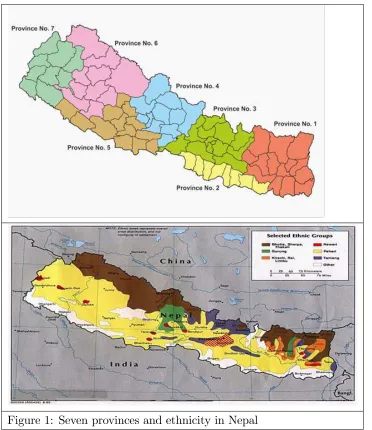
Nepal is a very heterogeneous country not only in terms of rugged topography and ethnographic landscape with Mountains, Hills, Valleys and Tarai regions but dif-ferent ethnic group settlements concentrated in di¤erent parts of the country. The current structure of uni…ed Nepal originated in "baise-chaubise rajya -(22 and 24 principalities)" before the uni…cation of modern Nepal around 1769. Ethnic groups such as Limbuwan, Bhojpuri-Mithila, Sherpa, Newa, Awadh, Magarat, Khas Arya, Tharuhat, Dotel retain their identity and culture in speci…c regions. Had the new federal Nepal, been divided in provinces on the basis of ethnicity, it would have created new problems or even led to civil wars as di¤erent groups could enter into con‡ict in sharing natural resources including rivers, forests and mountains.
Provinces Capital Districts Area (km²) Population 2011 Density (people/km²) Total LMP People per LMP People per CMP Federal Seats Province No. 1 Biratnagar 14 25,905 4,534,943 175 93 48,763 161,962 28 Province No. 2 Janakpur 8 9,661 5,404,145 559 107 50,506 168,880 32 Province No. 3 Hetauda 13 20,300 5,529,452 272 110 50,268 167,559 33 Gandaki Pokhara 11 21,504 2,403,757 112 60 40,063 133,542 18 Province No. 5 Butwal 12 22,288 4,499,272 219 87 51,716 173,049 26 Karnali Surkhet 10 27,984 1,570,418 41 40 39,260 130,868 12 Sudurpashchim Godawari 9 19,539 2,552,517 130 53 48,161 159,532 16
Figure 1: Seven provinces and ethnicity in Nepal
issue, among the political parties. Maoists party opting for ten to eleven provinces and others for …ve to seven. They were able to compromise on Seven. The bound-aries of provinces, metropolis, or town or village municipalities were determined by the Federal Commission eventually by June 2017 local elections. Names capital of provinces 1, 2, 3 and 5 are yet to be decided.
Compare the size of states in India and provinces in China. Total population of Nepal (now in about 30 million) is about 14.6 percent of the Uttar Pradesh (224.5 million), 29.1 percent of Bihar (104 million) and 32.2 percent of the West Bengal (91 million) in India. Similarly Guangdong (105.9 ml), Sandong (96.9 ml), Henan (94.1 ml) and Sinchuan (85 ml) provinces of China have population more than three times of entire Nepal. Size of population in Tibet of 3.1 ml is about 10 percent of Nepal. Dividing the markets for goods and services and factors of production in Nepal in less than four million people does not seem economically prudent.
1.1.1 Structure of the Parliament
As has been seen in the last two elections for CAN-I and CAN-II, electoral system remains combinations of the …rst pass the post (FPTP) and the proportional election system. No vote is wasted in such mixed election system; it is immune for the para-dox of median voters. The parliament now consists of the House of Representatives (lower house) and the National Assembly (upper house). Lower house is made of 275 members, of which 165 are directly elected from parliamentary constituencies on the FPTP basis and 110 members elected according to the proportional represen-tation. This number is about 35 percent above the 205 member parliament elected on May 12, 1991. Then the upper house has 59 members, eight from each of seven provinces, another three nominated by the president from specialists in various …elds to represent the national interest including at least one female nominee. This way each parliamentarian represents about 1.3 to 1.7 lakh people. This may be a very a¤ordable parliament that can focus on promulgating rules and regulations required to run the country particularly for the speedier economic growth. It also provides su¢cient numbers to the cabinet and committees in the parliament at the central level and for committees at the local bodies. In theory the parliament should elect the most capable person as the president on a non-partisan basis who is responsible for all people equally. He should have some emergency and contingency powers to defend the state. This sort of arrangement could work very well also in Nepal as it has worked so well in India.
1.1.2 Electoral system and Judiciary
There is little room for any controversy about the nature and functions of the election commission. Its main function is to arrange smooth and fair election and prepare list of voters and candidates. Its major duties include maintaining the accuracy of the voters’ list and checking the credentials of candidates claiming to represent the people, count votes and declare winners and losers on the basis of votes they are able to secure in the election.
of the Supreme Court have plaid very important roles in defending democracy in Nepal. From time to time since 1990 independent judiciary has protected democracy in Nepal when the political agreements were collapsing bringing the whole country in the darkness. Government of bureaucrats was much more e¢cient than the elected ones in conducting free and fair general election for CAN-II on November 19, 2013. The parliament of Nepal was reinstated in 2006 by a decision of the Supreme Court; the government led by the Chief Justice of the Supreme Court conducted successful election for CAN-II when the CAN-I was dissolved without drafting a constitution. There should be no doubt that judiciary should be independent and run by the professionals so that it can break deadlocks when the parliament is hung and the political parties cannot reach any decisions.
1.1.3 National Consensus
Each of the above four issues did not become very complicated to reach into a national agreement when the political parties became keen in promoting the welfare and development of common people. Apparently di¤erent ideological positions of these political parties that were behind controversies and the power struggle were set aside. Trust among each other and true will and sense of urgency for the national development from political parties after the earthquake was phenomenal. Every person thinks that had the …rst priority been to form a consensus of all parties for the new constitution, Nepal could already have moved many miles in process of growth and development. Major political parties NC and UML with 64.1 percent votes in the in CAN-II made compromises with the Maoists that had only 14.3 votes to bypass each other. Being in colation with an arch-enemy proved very costly to the NC in the …rst general election under the new constitution in 2017.
sign in the beginning but the new Oli government has failed to live up to the true spirit of democratic movement and performed far below the people’s expectation. Frustration has widened and trust has been broken from the ability of government to steer the growth process. Private sector is clueless or whole nation is operated by coterie of dons and phychofants. Quality of leadership is very low and its ability to make decisions is very much reduced because of internal con‡icts among the main personalities running the party. Lack of security and foot-dragging mentality is making the system more opaque devoid of transparency required for the successful functioning of the democracy. NC in the opposition is also very weak for similar reasons. Thus the dreams of Nepalese people are unful…lled and great dissatisfaction is around every sector or sections of the economy or public life. Such situation most be corrected to bring Nepal into track of speedier growth and development. This can be possible by adopting a more scienti…c way of decision making based on objective analysis of facts and …gures and with proper appreciation of alternative views before …nding an optimal strategy, programme or projects required for balanced development of the country. Theory and empirical sides should be analysed clearly.
2
A Theory of Disagreements
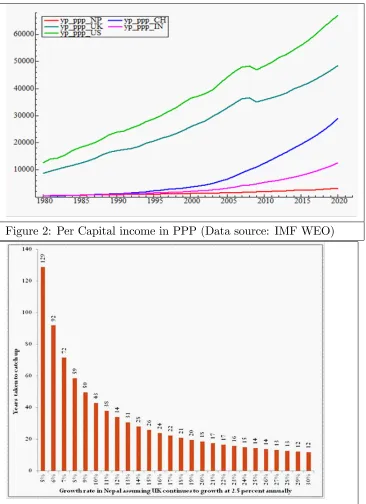
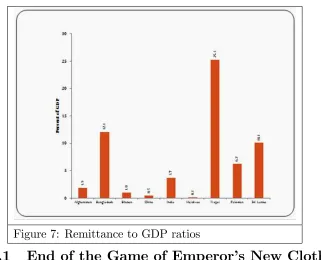
year as a share of GDP (Figure 5), this has created large current account de…cit and required continuos depreciation of Nepali Rupee against the US dollar and other international currencies (Figure 6). Private sector enterprises have not ‡ourished and are unable to increase the rate of investment despite plenty of opportunities in basic industries such as hydro-energy, tourism, education, health and communication. Nepal is among the least developed countries in the world not because she does not have enough resources but because these are not utilized properly. In the last three hundred years till 1950, it was completely feudalistic state cut o¤ from the world. Some incremental steps for modern growth started then but these were very minimal and beset by the political instability mainly due to con‡icts between the interest of the rulers and common people. After the dissolution of parliament in 1960 due to con‡ict of interest between then king and popularly elected BP Koirala, about 30 years till 1990 were under the direct rule by the king and his deputies under the extractive and extortionary system. Reinstatement of parliamentary system in 1990 re-established the process of inclusive growth that was terminated in 1960 but it could not be stable and was disrupted by Maoist con‡icts and wars along with the royal coup and take-over of people’s power by the King in 2002. He dissolved the parliament in 2002 and imposed direct rule till he was forced to relinquish all his power by 21 day popular revolution in April 2006. This was possible because of the joint alliance of NC, CPN-UML and CPN-Maoist parties in that glorious April 2006 revolution.2 Such agreement disappeared in the next eight years of intense
negotiations for peace and constitution. Nepal has entered into the new phase of federal republic after the promulgation of this new constitution in September 2015.
2The King relinquished all powers that he had snatched away from the people by reinstating
Figure 2: Per Capital income in PPP (Data source: IMF WEO)
Table 1: Di¤erence in per capita GDP in 2012 (in 2005 dollars) and corresponding percapita GDP in PPP dollars
Per capita GDP in 2012 US$ Per capita GDP in PPP $
EU 100 ($28748) 100 ($27818)
USA 157.7 163.0
UK 131.5 117.4
Australia 129.8 128.2
South Africa 20.9 35.4
Brazil 19.9 36.9
China 11.6 28.6
India 3.9 12.0
Nepal 1.4 4.6
Niger 1.0 2.4
Burundi 0.5 1.7
Figure 5: Import to GDP ration in percent
Figure 7: Remittance to GDP ratios
2.1
End of the Game of Emperor’s New Clothes
Politicians are playing a sort of emperor’s new cloth game with the people in Nepal; …rst while writing and promulgating the constitution and now by pretending to im-plement it3. First reason for a stalemate is the lack of trust and credibility among
members of the political parties. It is true that Nepal is a multi-ethnic, multi-lingual country with spread in Mountains, Hill and Tarai, surrounded by India in the East,
3As constitution sets the rules of formation of all political and economic institutions it is obvious
South and West and bordering to the Tibetan autonomous regions of China in the North. Historically it is said that Nepal is a country of 4 classes and 36 ethnic groups. This creates heterogeneity among population; for instance languages and cultural sys-tem are di¤erent among Rai, Limbu Sherpa, Bahun, Chhetri, Newar, Yadav, Tharu, Khas, Magar, Gurung and other ethnic groups. Then villages and valleys vary by geographic locations. Mountains, Hills and Tarai have di¤erent natural set-ups and di¤erent requirements. Then each of the political parties have created a clientele in each of these groups. No single solution applies to all these elements when the political and economic interests are di¤erent. Given this situation the constitution has set up a broad framework which is ‡exible enough to accommodate the need of each of these groups. Wasting time on the basis of pure ideological and unrealistic paradigms does not lead to any amicable and e¤ective solution. Unfortunately that is what happens in practice. Why have not Buddha’s teaching of peaceful coexistence been applied at the national level? A solution in such circumstances should build on good things from each party or groups. Some compromise is essential on the basis of coexistence and development of all within the given constraints. A commitment to create good institutions based on logics and rationality and more scienti…c methods of decision making for the growth and development of the whole nation only can bring one to such outcome.
2.2
Beliefs: What do they care about?
There are N parties in the country indexed by i = 1; ::::; N. Each party wants to represent a given constituency appealing voters to its own manifesto promises such as double digit growth, free up to secondary education, student loans for higher ed-ucation, safe drinking water, health services, ecological and environment protection, investment, capital accumulation, job creation, development of cultural and social harmony, development of tourism, creation of basic infrastructure for growth includ-ing uninterrupted electricity, opportunities for credit, productivity and marketinclud-ing. Each partyiis interested in its own pay-o¤xi (e.g the number of ministries it should
have under its command) which it computes using a payo¤ function Ui that depend
players:
xi =Ui(S1; S2; ::::; Sn;a0; a1; a2; ::::; an) (1)
where S1; S2; ::::; Sn denote the strategies available to players, a0 is common
knowl-edge, and a1; a2; ::::; an denote the unknown characteristic of player i. Each player
knows which strategy is better for it given the strategy space of other players but they have less information about the reactions of other players,aj. They make some
subjective estimates about other’s actions while calculating its payo¤xi. This value
gives their reservation or threat point in the bargaining. The agreement takes place when actual bargaining and negotiation ends up giving zi and when this value is
greater than or equal to what the partyihad expected,zi =xi. Negotiation breaks
down wheneverzi 6 xi.
Parties need to learn from each other to create a more realistic beliefs (bj) about
other players replacing unknown characteristics(a0; a1; a2; ::::; an) by more accurate
representation parameters(b0; b1; b2; ::::; bn)
xi =Li(S1; S2; ::::; Sn;b0; b1; b2; ::::; bn) (2)
Beliefs on these parameters could be formed on the basis of history, principles and values of parties and key personalities of the party and studying their relations to other players. Convergence on beliefs among all parties occurs when they understand and trust each other. This gives credibility to the outcome of the game. Equilibrium in such case is more certain and e¢cient and generates greater payo¤ for parties and welfare of the country.
max
1
X
t=0 tx
i;t =
1
X
t=0 tL
i(S1;t; S2;t; ::::; Sn;t;b0;t; b1;t; b2;t; ::::; bn;t) (3)
democratic system Nepal. No such e¤ort has been carried out before.
3
Dynamic model
Let us consider a model of Nepal with urban and rural households located in various economic regions of this country. Each of them allocate their life time income to maximize utility by choosing an optimal path of consumption and saving. These households provide factor services to producers of goods and services, who sell prod-ucts both in domestic and foreign markets. The capital stock, determined overtime by the volume of savings and investment, complements labor input. In central case, we assume that labor force grows exogenously. Output expands along with increase in labor and capital inputs, its level is consistent with the demand of consumers, investors, the government and foreign sectors.
3.1
Mechanism for Poverty Alleviation
There are three players in the poverty game -poor, rich and government; each has three strategies available to it to play,s,l, andk, cooperation, indi¤erence and non cooperation.
The outcome of the game is the strategy contingent income for poor and rich,
ytp(s; l; k) and ytR(s; l; k) with the probability of being in particular state like
this is given by pt(s; l; k) and Rt (s; l; k) respectively and tax and transfer
pro…les associated to them.
The state-space of the game rises exponentially with the length of time period
t.
The objective of these rich and poor households is to maximize the expected utility that is assumed to be concave in income.
The government can in‡uence this outcome by choices of taxes and transfers that can be liberal, normal or conservative.
s X s=1 l X l=1 k X k=1 T X t p
t(s; l; k) p tu(y
p
t(s; l; k))
< s X s=1 l X l=1 k X k=1 T X t R
t (s; l; k) R
tu y
R
t (s; l; k) (4)
where pt(s; l; k)gives the probability of choosing one of strategies by poor given that the rich and the government has chosen l and k strategies. Utility is derived from income as given byu(ytp(s; l; k))and
p
t =
1
(1+rpt) is the discount factors for poor
and Rt = 1
(1+rR t)
the discount factor for rich.
Proposition 2: Transfer raises money metric expected utility of poor and re-duces the utility of rich.
s X s=1 l X l=1 k X k=1 T X t " p
t(s; l; k) p tu(y
p
t(s; l; k)) + T X
t
Ttp(s; l; k) # < s X s=1 l X l=1 k X k=1 " T X t R
t (s; l; k) R
t u y
R
t (s; l; k) T X
t
TtR(s; l; k) #
(5)
Proposition 3: Incentive compatibility requires that
s X s=1 l X l=1 k X k=1 T X t " p
t(s; l; k) p tu(y
p
t(s; l; k)) + T X
t
Ttp(s; l; k) # > s X s=1 l X l=1 k X k=1 T X t p
t(s; l; k) p tu(y
p
t(s; l; k)) (6)
s X s=1 l X l=1 k X k=1 T X t R
t(s; l; k) R
tu ytR(s; l; k)
> s X s=1 l X l=1 k X k=1 " T X t R
t (s; l; k) R
t u y
R
t (s; l; k) + T X
t
TR
t (s; l; k) #
(7)
Proposition 4: Growth requires that income of both poor and rich are rising over time:
Ttp(s; l; k)< T p
t+1(s; l; k)< T p
t+1(s; l; k)< ::::: < T p
t+T(s; l; k) (8)
YR
t (s; l; k)< Y R
t+1(s; l; k)< Y R
t+1(s; l; k)< ::::: < Y R
t+T(s; l; k) (9)
Proposition 5: Termination of poverty requires that every poor individual (Ytp)
has at least the level of income equal to the poverty line determined by the society. When the poverty line is de…ned by one half of the average income (Yh
t ) this can be
stated as:
Ytp(s; l; k)>
1 2 1 N N X h=1 Yh
t (s; l; k) !
(10)
Above …ve propositions comprehensively incorporate all possible scenarios in the poverty game mentioned above. Propositions 2-5 present optimistic scenarios for a chosen horizonT.
Mechanism for Poverty Alleviation: Tests
Testing above propositions in a real world situation is very challenging exercise. It requires modelling of the entire state space of the economy.
Moreover in real situation consumers and producers are heterogeneous regard-ing their preferences, endowments and technology and economy is more com-plicated than depicted in the model above.
3.2
Consumers’ Intertemporal Problem
In the model representative households located in urban and rural areas of the econ-omy allocate lifetime income to maximize utility over an in…nite horizon; i.e.
max
1
X
t=0 t
U(Ch
t) (11)
where is the the discount factor, and it depends on the rate of time preference;
Ch
t is composite consumption; U is a time separable utility function. We choose a
constant relative risk aversion (CRRA) CES utility function to representU in (1).4
= 1,U(Ct) = logCt.
U(Ch t) =
Ch t
1
1
1 (12)
here 1= measures the elasticity of substitution between the present and future consumption. The smaller is the more slowly marginal utility falls as consumption rises, so households are more willing to allow changes in consumption over time. Thus smaller implies higher elasticity of substitution between current and future consumption or the higher degree of consumption smoothing and substitution over time.
Each type of households faces an inter-temporal budget constraint which implies that its the present value of consumption cannot exceed its present value of life time income (wealth).
1
X
t=0
R 1
t PtCth =W H
h (13)
where, R 1
t =
t 1
s=0 1
1+rs is a discount factor to convert future expenses in the
present value terms; rs represents the real interest on …nancial assets; Pt is vectors
of relative prices, and Ct is composite consumption goods, which is composed of
sectoral consumption goods,
Ct= i= 1nC
h i
i;t (14)
where h
i gives the share of spending on good iby household h. W Hh is the life
time wealth of household h and is de…ned as:
W Hh =
Jh 0
1 +rc 0
+ J
h 1
(1 +rc
0) (1 +rc1)
+::+ J
h 2 h
s(1 +rc0)
+:::= 1 X t=0 R 1 t J h t (15)
whereJh
t is disposable household income in periodt. It includes labor and capital
income plus transfers.
We combine equation (1) to (4) to form Lagrangian of consumers’ the inter-temporal allocation problem in (5).
=h =
1
X
t=0
( 1 1 + )
t(C h t
1
1
1 ) + :[
1
X
t=0
R 1
t PtCth W Hth] (16)
Here, is the shadow price of income in terms of present value of utility, and in (1) is replaced by 1
1+ ,where is the rate of time preference. We derive consumption
function by taking …rst order condition on (5):
Ct+1
Ct
= 1 +rt 1 +
Pt
Pt+1
1
(17)
or using a steady state assumption on the growth rate
Ct+1 =
1 +rt
1 +
Pt
Pt+1
1
C0(1 +g)t 1
(18)
Thus the consumption level at time t, in the steady state, is a function of growth rate, the rate of interest and intertemporal prices of commodities. Consistency of the intertemporal budget constraint implies that:
X
t
R 1
t [C0+ 1C0+ 2C0+:::::] =W Hh (19)
where
t= [ tR 1 t
Pt
P0
]1 (20)
Economy wide savings is total of household savings,Sh
t, which in turn is the portion
of income not consumed:
St= X
h
Sth = X
h
Jth X
h
The consumption saving decisions are two sides of the same coin. Once we know the level consumption we also know the level of savings. Saving like consumption is in‡uenced by the rate of interest prevailing in the economy and the time preference of individuals. The e¢ciency in the …nancial system can contribute to rise in the level of saving, depending upon the value of , by in‡uencing the decision between the current and future consumption and reducing the wedge between the cost of capital to investors and gains received by the savers.
Savings of households are intermediated through the …nancial institutions to in-vestors, who use those savings to purchase investment goods from di¤erent sectors. Like consumers investors in each of n production sectors solve an intertemporal pro…t maximization problem. They combine goods produced in a set of n sectors to deliver an unit of investment in sectorj. Therefore, the unit cost of investment in sectorj is a weighted average of the prices of components of sector n goods used for investment purpose. One unit of investment at period t produces once unit of capital stock in periodt+ 1:
I Y
j;t
=Pk j;t+1
X
i
Pi;taIi;j 0 (22)
Here QIj;t is pro…t from one unit of investment at period t, Pk
j;t+1 is the price of
capital in period t + 1, and aI
i;j is the investment coe¢cient matrix. One unit of
capital at the start of period 1 generates a rate of return ( rk
j;t) today and delivers
1 unit at the start of the subsequent period. The arbitrage condition in capital accumulation implies that:
k Y
j;t
= (1 )Pk j;t+1+r
k
j;t P
k
j;t 0 (23)
Entering capital (K0) stock is transferred into initial capital stock for the various
sectors,Ki;0, according to a …xed coe¢cient transformation process. Once the initial
capital is allocated among di¤erent sectors, Ki;t , the law of motion of capital in a
sector is explained by the following equation.
Kj;t+1 =Ij;t+ (1 K)Kj;t (24)
where,
Ij;t = J X
j=1
aI
Net investment demand, Ii;t , in each sector is the sum of investment by origin.
The relationship given by aI
i;j;t is called capital coe¢cient matrix of the economy.
We assume that in the terminal period the investment in each sector grows at the rate of the population so that economy can continue along the steady state growth path even after the terminal period as given by the following equation.
Ij;t = (g+ K;j)Kj;t (26)
g = growth rate of the economy, which equals the growth rate of the labor force in terms of e¢ciency units, and K = rate of depreciation.
Holding aggregate stock of capital …xed to the savings of households in the begin-ning of each period, the objective of …rms injth sector of the economy is to maximize the present value of pro…t subject to the constraints of production technology. Zero pro…t for sector j written in dual form in terms of composite prices of commodities and inputs is the following form (See appendix for details):
y j;t = [(
x jP X
1+ j;t + (1
x j)P D
1+ j;t )]
1 1+ v
jP V v j (1 v j) X j
ai;jPi;t 0 (27)
The exact meaning of the symbols of the above pro…t function are following:
y
j;t unit pro…t of activity in sector j
P Xj;t price of exports
P Dj;t price of domestic sales
P Vv
j price of value added per unit of output in activity j
Pi;t price of …nal goods used as intermediate goods x
j share parameter for exports in total production v
jshare of costs paid to labor and capital
ai;j input output coe¢cients.
This equation (27) is a unit pro…t function. The pro…t of operating these …rms are given by the di¤erences between the revenue from sales and the cost of supply. The unit revenue function is constant elasticity transformation (CET) composite of unit price of domestic sales and unit price of exports. The unit costs are divided between value-added, i.e. payments to labor and capital, and the unit intermediate input costs. In this model, the gross output in each sector is given by a nested production function between the value added and the intermediate inputs.
Yj;t = min(Vj;t; ai;jYj;t) (28)
ai;j is the intermediate inputs per unit of gross output produced in sector j.
We use Shephard’s lemma to derive the demand for labor and capital from (27). The demand for labor is:
Lj;t =Yj;t
@QVj;t @P Vj;t
@P Vj;t
@P Lj;t (29)
where Lj;tis a composite of rural (unskilled) and urban (skilled) labor.
Equi-librium in the labor market requires that demand for labor be equal to supply of labor:
X
j
Lj;t
@ L
@P LLC t
Lt (30)
Ltin the above equations is a composite of urban and rural labor. The ratio of urban to rural labor employed by …rms mainly depends upon the ratio of urban to rural wage rates.
The demand for capital in sector j, again by Shephard’s lemma is given by:
Kj;t =Yj;t
@QVj;t @P Vj;t
@P Vj;t
@P Kj;t (31)
where Yj;t is activity level; P Kj;tis price of capital P Vj;t is price of value added.
In equilibrium the demand for capital is equal to its supply:
X
j
Kj;t =Kt (32)
Kt is the aggregate capital stock in the economy, which grows according to the
low of motion of capital stock as given by equation 13. P
j
Kj;tis the total demand
for capital by various sectors of the economy.
When an economy is repressed, the arbitrage condition implied by (9)
Pk j;t+1 =
J X
j=1
Pj;taIi;j (33)
does not exactly hold. There is additional distortionary cost j;t on top of the
Pk
j;t+1 = (1 + j;t) J X
j=1
Pj;taIi;j (34)
where j;t = per unit wedge between the return to saving and the cost of
invest-ment. Pk
j;t+1=present value price of sectorj capital at the beginning of next period;
P = present value price of sector i commodity at periodt.
In repressionary situation certain portion of saving dissipates in the process of …nancial intermediation. Therefore the total investment in the economy less than the total savings i.e. the amount of savings net of intermediation costs. Moreover, additional resources may be available by liquidating the real unproductive assets ( RA) of the households and …rms.
c(St RAt) =It (35)
Here c is the proportion of saving available for investment purpose, or, 1 c being the cost of …nancial intermediation. In this model cost of …nancial intermediation is represented by the distortionary cost of repression.
3.3
Calibration to a Steady State
In the steady state all sectors of the economy grow at the same rate, g. The bench mark rate of return is calibrated assuming the non-distorted economy being in the steady state in the base year. Calibration of dynamic component follows the re-lationship between the current and future prices of capital and investment goods. Speci…cally, investment produces one unit of capital stock in period 2 ( Pk
2) from
one unit of output in the period one,PI
1. The present value of one unit of capital in
period2 is equal to(1 r)Pk 1.
PI
1 = 1 =P k
2 = (1 +r)P k
1 =)P
k
1 =
1 1 rP
k
2 (36)
Here1 r is the discount rate between two periods, and is approximation to 1 1+r
Pk t+1
Pk t
= (1 r) (37)
One unit of capital at the beginning of period one earns a rate of return today,rk 1and
delivers1 unit of capital for the start of the next period.
Pk 1 =r
k
1 + (1 ) (1 r)P
k
This relationship applies to all other periods included in the model. Using base year prices equal to 1 toPk
2 andP
k
1 by using relationship betweenP k
2 and P
k
1 we get:
1 1 r =r
k
1 + (1 ) (39)
which gives the cost of capital to be equal to the rate interest plus the rate of depreciation:
rk
1 =
r
1 r + (40)
. The base-year social accounting matrix (SAM) contains information on capital income V1 and it is related to rate of return and capital stock, V1 = r1kK1. Now
substituting forrk
1 between the steady state interest rate r and the parameters of the
model:
K1 =
V1 r 1 r +
(41)
Then substituting this value of K1 in I1 function the relationship between the
investment and capital earning component of value added may be expressed as:
I1
V1
= gr +
1 r +
(42)
If the ratio of investment and capital earning (I1
V1 = 1) is equal to one then
g = r
1 r or r = g
1+g. When I1
V1 6= 1, then the key parameter to calibrate is the rate
of depreciation, which can be calculated using the relationship between the interest rate, growth rate, depreciation and earning of capital as following :
j =g
Vj
Ij Vj
r 1 r
Ij
Ij Vj
(43)
In a repressionary regime the cost of capital is distorted by a repressionary com-ponent of intermediation, j. This can be expressed as:
here rk
1 is actual cost of capital, rkj is rate of interest in steady state, and j is
distortionary element in the …nancial market. The price of capital becomes
Pk 1 =r
k
1(1 j) + (1 ) (1 r)P2k (45)
or the cost of capital
r1k =
1 1 j
r
1 r + (46)
Now adjusting (26) to take account of distortions in the capital market :
I1
V1
= gr +
1 r+
(1 j) (47)
or
j = 1
rk j
+g Ij
Vj
(48)
Thus the spread between the true cost of capitalrk
j and the actual cost of capital
rk
1 depends upon the ratio of investment to capital and ratio of natural rate of interest
to depreciation plus the growth rate of the economy.
3.4
Government Budget and BOP Closures
In the core part of the model the government’s budget is balanced in every period, and, therefore government is not involved in intertemporal savings. This essentially implies all government expenditure is basically the government consumption.
The sources of revenue for the government are taxes on value added5, tari¤s
on imports, sales taxes, income taxes and capital taxes. Lump sum income taxes are collected from total household income, and such income taxes are assumed to grow at the rate of population growth rate. In addition there are other sources of government revenue such as export taxes, taxes on tourism, revenue generated from import-licensing and refund of excise taxes from India.
Government transfers its revenues to households and …rms in the form of
con-5From the …scal year 1996/97 the government is adopting a value-added tax (VAT) system
sumption and production subsidies, and it also serves domestic and foreign debt. In the core part of the model we assume all sorts of government non-transfer spending to public consumption.
This is an open economy model. We follow standard Armington speci…cation of international trade in this model. For each tradable sectors constant elasticity of transformation (CET) function de…nes relation between exports and domestic sup-ply, and constant elasticity of substitution (CES) function explains relation between domestic supply and imports in forming a composite good that goes to the utility function of the households. We use two level nests in trade to take account of dif-ferent natures of trade relations between India and rest of the world (ROW). More detailed discussion of trade speci…cation is available elsewhere (see Bhattarai (1997, 2007, 2017) and also the appendix of this paper).
We consider two rules of BOP closure. In the …rst case no foreign borrowing is allowed; imports need to be paid by exports6:In the second case intertemporal
bor-rowing and lending is permitted. It is presented in the form of CAPFLOW scenario in the next section:The elasticities of substitution between domestic and imported products in consumption and the elasticity of transformation between domestic sales and foreign sales are taken based on sensitivity analyses.
Finally, the market clearing condition for goods market is given by:
Aj;t =Cj;t+ 12 X
j=1
ai;jYj;t+Gj;t+ 12 X
j=1
aI
i;jIj;t+DSTj;t+T Dj;t (49)
here Aj;tis total supply in the economy in a sector j should be equal to sum
of various components of demand as given on the right hand side, i.e. the con-sumption of households: Cj;t = P
h
Cj;h;t, intermediate demands: 12 P
j=1
ai;jYj;t; ,
gov-ernment demand: Gj;t, investment demand: Ij;t = P
j
ai;jIj;;t, inventory demand:
DSTj;t = DST Rj;t Yj;t, and demand by tourists: T Dst; for simplicity we assume
that demand by tourists grows at the rate of growth of the economy.
3.5
De…nition of a competitive equilibrium
A competitive equilibrium is a set of sequences of prices of composite commodities,
Pi;t; prices of domestic goods sold in domestic markets, P Di;t; prices of exported
commodities, P Xi;t ; prices of capital goods , Pj;tk ; prices of terminal capital ,
6. In the model number of sectors trading with placecountry-regionIndia and rest of the world
P T Kj;t; wage rates for each categories of labor, wh;t; prices of government services,
P Gt; prices of provisions for tourism, P Tt; value of transfers to the households,
P Rt; prices of consumption, P Ut; welfare index, P Wt; rental rate of capital for each
sector,rk
1: R+ !R, and sequences of gross output,Yi;t; total supply of commodities,
Ai;t; sectoral capital stock, Ki;t; sectoral investment, Ii;t; exports, Xi;t; government
services, GOVt; level of household utility from consumption, Ut; and total welfare,
W such that given these prices and commodities
1. households solve intertemporal utility maximization problems subject to life time income constraints,
2. investors solve intertemporal pro…t maximization problem subject to arbitrage conditions in capital markets
3. producers solve their pro…t maximization problem subject to technology and resource constraints
4. markets for goods and services, labor , capital clear 5. government account constraints are satis…ed,
6. balance of payments condition is ful…lled 7. …nancial markets are in equilibrium
In this equilibrium, consumers have perfect foresight, capital accumulation is consistent with households optimization, income and expenditure balance over the life period. An agent is doing the best he can in light of actions taken by others and actions taken together are technically feasible. This ensures the compatibility of plans of individuals or correspondence between consumers’ preferences and …rms’ technology.
There are mainly two limitations of this model. First, analytical solution of this model is very complex and unrewarding. We rely on numerical methods that generate a set of relative prices consistent with the equilibrium. Absolute prices do not matter in general equilibrium models, it generates the same equilibrium even if all prices are multiplied by a constant. For analyses of model results we basically compare ratios of prices in terms of a numeraire in benchmark and counter-factual scenarios, not the absolute di¤erences in prices.
stock. The model is suitable to study the impact of a certain policy that changes the steady state of the model and thus the growth and welfare of the households over a model horizon.
In spite of these limitations the model is capable of generating results that are interesting from a point of view of a policy maker. We use a welfare index as the criterion for making the best policy choice from the various options available to a policy maker.
3.6
Measure of Welfare
General equilibrium solutions are used to compute equivalent or compensating vari-ations in consumer welfare from given changes in policy regimes. In this model the overall welfare is given by sum of utility over periods measured in terms of prices of composite consumption.
U Wh =
1
X
t
P UthU h
t (50)
HereU Wh is a measure of welfare to householdhfor the period of model horizon,
P Uh
t is the price of composite consumption in period t, and Uth is the utility to a
household from consumption of goods and services in the economy.
We use welfare measures in order to quantify the impacts of various policy measures. A policy experiment that has greater value of U Wh is more desirable than the one
with lower one.
4
Interactions of model with beliefs
The process of negotiations among various parties should be based objectively in an economic model as above as it is possible to compute the optimal level of saving, investment, capital formation and growth objectively in such a set up. There is little room for illusions, misunderstanding and distrust when the negotiations are based on such models:
max
1
X
t=0 tx
i;t =
1
X
t=0 tL
i(S1;t; S2;t; ::::; Sn;t;b0;t; b1;t; b2;t; ::::; bn;t;Mt) (51)
5
Parliament and Government 2018
NCP NC FSFN RJPN Others Vacant Total FPTP PR
House of Representatives 174 63 16 17 5 0 275 165 110
Upper House 42 13 2 2 0 0 59
Province 1 66 21 3 0 3 0 93 56 37
Province 2 32 19 29 25 2 0 107 64 43
Province 3 81 21 0 0 8 0 110 66 44
Gandaki 39 15 0 0 6 0 60 36 24
Province 5 61 19 5 1 1 0 87 52 35
Karnali 32 6 0 0 1 1 40 24 16
Sudurpashchim 39 12 0 2 0 0 53 32 21
Total 566 189 55 47 26 1 884 495 330
FPTP Proportional
Votes % Seats Votes % Seats Total CPN (Unified Marxist–Leninist) 3082277 30.68 80 3173494 33.25 41 121 Nepali Congress 3590793 35.75 23 3128389 32.78 40 63 CPN (Maoist Centre) 1510760 15.03 36 1303721 13.66 17 53 Rastriya Janata Party Nepal 458409 4.56 11 472254 4.95 6 17 Federal Socialist Forum, Nepal 527924 5.26 10 470201 4.93 6 16 Bibeksheel Sajha Party 96233 0.96 0 212366 2.22 0 0 Rastriya Prajatantra Party 118318 1.18 1 196782 2.06 0 1 Rastriya Prajatantra Party (Democratic) 123797 1.23 0 88377 0.93 0 0 Naya Shakti Party, Nepal 84037 0.84 1 81837 0.86 0 1
Rastriya Janamorcha 1 62133 0.65 0 1
Nepal Workers Peasants Party 1 56141 0.59 0
Total 165 9544744 100 110 275
least 3 percent of the popular vote. Nearly 100 party contested the election but only …ve of them could meet these two criteria; CPN-UML, NC, CPN-Maoists, Rastriya Janata Party Nepal and Federal Socialist Forum Nepal.
Election was contested vigorously. It would have been a hung parliament if the UML and CPN-Maoists had not aligned. Communist alliance was formed and they were able to earn nearly 64 percent of votes in the parliament (44% of NCP and 19.% of the CPN-Maoist followed by 22.9% of the NC). Popular vote however had placed NC (32.8%) right behind the UML. More important thing was the unity between the UML and the Maoist that created a Nepal Communist Party (NCP). With mergers of communists in one party and the NC on the other was considered a welcome development for Nepal. NCP clearly had an absolute majority and axpectations of people for economic development and growth were quite high from this government. The NCP with 174 out of 165 seats in the Upper house and party with majority in six out of seven provinces emerged as a dominant party in Nepal after the 2017 election. It had 566 out of 884 putting central and provicial constituencies. FSFN and RJPN hold just a simple majority in Province 2.
most people believe that anti-India stance of the communists during 2015-16 unde-clared embargo by India made them popular among people this time. NC was not as vocal as the UML to protest India at that time.
5.1
Constituent Assemblies 2013 and 2008 of Nepal
Table 2: Members of First Constituent Assembly by Political Parties in Nepal Total Maoist NC UML MPRF TMLP Others Total 601 229 116 108 53 21 74 FPTP 240 120 38 33 29 9 11 Proportional 335 100 73 70 22 11 59 Nomination 26 9 5 5 2 1 5 Percentage 100% 38.1% 19.3% 18.0% 8.8% 3.5% 12.3% Source: Constituent Assembly of Nepal (CAN-I, 2008-2012).
Table 3: Members of Second Constituent Assembly by Political Parties in Nepal Total NC UML Maoist MPRF RPP Others Total 601 204 183 84 15 11 103 FPTP 240 105 91 26 4 0 14 Proportional 335 91 84 54 10 10 86 Nomination 26 8 8 4 (0)1 1 (0)3 Percentage 100% 33.9% 30.4% 14.0% 2.5% 1.8% 17.1% Source: Constituent Assembly of Nepal (CAN-II, 2013-2017).
[image:36.612.110.510.248.360.2]6
Conclusion
Nepal made signi…cant progress in removing monarchy and terrors of Maoists in the last decade. It however lacks a stable solution of speedier economic growth and devel-opment as the major political parties are still struggling to institutionalize the new political framework set up by the new constitution of Nepal that was promulgated by the Constitution Assembly of Nepal (CAN-II ) for the federal democratic republic of Nepal on 20 September 2015. Madesh based parties did not accept the new con-stitution, this caused an undeclared embargo by India. Nepalese economy crippled by the mighty earthquake of April 2015 got further paralyzed due to this blockage. This has slowed down the process of demarcation of provinces, election of provincial assemblies and government, election of the national government. Setting up strat-egy for growth and development in Nepal with the multiparty structure with focus on broader objectives of national development, alleviation of poverty and speedier economic growth and design of programmes suitable to multi-ethnic, multi-climatic and multi-cultural and multi-linguistic inclusive frameworks would be possible only when the new set up is complete. Nepal should stick to a dynamic model of growth and development for a decentralized economy to update on beliefs that can transform the nation improving wellbeing of all people in Nepal. After the constitution was promulgated on 20 September 2015, the CAN-II became a parliament of Nepal. It is irony that the NC that struggled so much in promulgating the constitution was rooted out of the power by NCP, a coalition of former CPN-UML and CPN-Maoist, which not only formed the cabinet, but also elected their member to the president and deputy presidents of Nepal as well as to speaker and deputy speakers in the parliament.
References
[1] Acemoglu D, S Johnson, JA Robinson (2005) Institutions as a fundamental cause of long-run growth, Handbook of Economic Growth, 2005 - Elsevier [2] Alberto Alesina, Guido Tabellini. 2007. Bureaucrats or Politicians? Part I: A
[3] Araral E. 2014. Policy and regulatory design for developing countries: a mech-anism design and transaction cost approach. Policy Sciences 47, 289-303
[4] Baral L. R. (2017) Nepal: Trauma of Political Development and Stability, Adroit Publishers, New Delhi
[5] Bhattarai K. (2017) Welfare and Distributional Impacts of Financial Liberaliza-tion in an Open Economy: Lessons from a Multi-Sectoral Dynamic CGE Model for Nepal, International Business Research, 10, 1, 181-198
[6] Bhattarai K. (2013) Coalition for constitution and economic growth in Nepal, International Journal of Global Studies (IJGS), 1:1, February, 1-4
[7] Bhattarai K. (2011) Constitution and Economic Models for the Federal Republic of Nepal, Economic Journal of Nepal, Vol. 33, No.1, January_March, Issue No. 129, p. 1-15
[8] Bhattarai K. (2011) Empty Core in a Coalition: Why No Constitution in Nepal?, Indian Journal of Economics and Business, 10:1:119-126.
[9] Bhattarai K. (2010) Strategic and general equilibrium models of poverty, Ro-manian Jounral of Economic Forecasting, 13:1:137-150
[10] Bhattarai K. (2007) Models of Economic and Political Growth in Nepal, Serials Publication, New Delhi.
[11] Bhattarai K. (2006) Consequences of April 2006 Revolutionary Changes in Nepal: Continuation Nepalese Dilemma, Indian Journal of Economics and Busi-ness, 5:2:315-321.
[12] Bon…glioli A., G. Gancia. 2013. Uncertainty, Electoral Incentives and Political Myopia. The Economic Journal 123:568, 373-400.
[13] Borgeaud C (1982) The Origin and Development of Written Constitutions, Po-litical Science Quarterly, 7, 4, 613-632
[14] Breuillé ML, S. Zanaj (2013) Mergers in …scal federalism, Journal of Public Economics, 105, 11–22
[15] Chai, H.; Song, X. (2013) The Adaptive State–Understanding Political Reform in China, Policy Studies, 34, 1,73-88
[16] Che J, Kim-Sau Chung, X. Qiao. 2013. The Good, the Bad, and the Civil Society. Journal of Public Economics, 106, pp.68-76.
[17] Constituent Assembly of Nepal (2015) Constitution of Nepal 2015, CA Secre-tariat, Kathmandu, Nepal.
[18] Cripps, M.W.(1997) Bargaining and the Timing of Investment, International Economic Review, 38:3 :Aug.:527-546
[19] De Vanssay, X.; Spindler, Z. A. (1994) Freedom and Growth: Do Constitutions Matter? Public Choice, 78, 3-4, 359-72.
Dec., 77:5:891-898.
[21] Hug S. 2009. Some thoughts about referendums, representative democracy, and separation of powers. Constitutional Political Economy 20:3-4, 251-266.
[22] Janeba E, S. Osterloh (2013) Tax and the city: A theory of local tax competition, Journal of Public Economics, 106, 89–100
[23] Justin Fox, Kenneth W. Shotts. 2009. Delegates or Trustees? A Theory of Political Accountability,The Journal of Politics 71:04, 1225.
[24] Kuhn H. W. (1997) Classics in Game Theory, Princeton University Press. [25] Mailath G. J. and L. Samuelson (2006) Repeated Games and Reputations: Long
Run Relationship, Oxford.
[26] Maskin E, J. Moore (1999) Implementation and Renegotiation, Review of Eco-nomic Studies, 66,1, 39-56
[27] Maskin, Eric, and Jean Tirole. 2004. The Politician and the Judge: Account-ability in Government. American Economic Review, 94(4): 1034-1054.
[28] Muthoo A, K. A. Shepsle. 2010. Information, institutions and constitutional arrangements. Public Choice 144:1-2, 1-36.
[29] Monica, MB, 2014. The Role of Local O¢cials in New Democracies: Evidence from Indonesia. American Economic Review 104:4, 1244-1287
[30] Myerson R (1986) Multistage game with communication, Econometrica, 54:323-358.
[31] Pathak P and T Sönmez (2013) School Admissions Reform in Chicago and Eng-land: Comparing Mechanisms by Their Vulnerability to Manipulation. Ameri-can Economic Review, 103(1): 80-106.
[32] Persson, T. (2004) Consequences of Constitutions; Journal of the European Economic Association, 2, 2-3, 139-61.
[33] Riley J G (2001) Silver Singals: Twenty-Five Years of Screening and Signalling, Journal of Economic Literature, 39:2:432-478
[34] Roth A E. (2008) What have we learned from market design?, Economic Journal, 118 (March), 285–310.
[35] Rubinstein A (1982) Perfect equilibrium in a bargaining model, Econometrica, 50:1:97-109.
[36] Saleilles R (1895) The Development of the Present Constitution of France, An-nals of the American Academy of Political and social Sciene, 6, Jul., 1-78 [37] Shapley L (1953) A Value for n Person Games, Contributions to the Theory of
Games II, 307-317, Princeton.
[38] Shapley L. S. and M. Shubik (1969) Pure Competition, Coalitional Power, and Fair Division, International Economic Review, 10, 3, 337-362.
of Economic Studies, 53, 5., 709-724