Task-oriented Evaluation of Syntactic Parsers and Their Representations
Yusuke Miyao† Rune Sætre† Kenji Sagae† Takuya Matsuzaki† Jun’ichi Tsujii†‡∗
†Department of Computer Science, University of Tokyo, Japan ‡School of Computer Science, University of Manchester, UK
∗National Center for Text Mining, UK
{yusuke,rune.saetre,sagae,matuzaki,tsujii}@is.s.u-tokyo.ac.jp
Abstract
This paper presents a comparative evalua-tion of several state-of-the-art English parsers based on different frameworks. Our approach is to measure the impact of each parser when it is used as a component of an information ex-traction system that performs protein-protein interaction (PPI) identification in biomedical papers. We evaluate eight parsers (based on dependency parsing, phrase structure parsing, or deep parsing) using five different parse rep-resentations. We run a PPI system with several combinations of parser and parse representa-tion, and examine their impact on PPI identi-fication accuracy. Our experiments show that the levels of accuracy obtained with these dif-ferent parsers are similar, but that accuracy improvements vary when the parsers are re-trained with domain-specific data.
1 Introduction
Parsing technologies have improved considerably in the past few years, and high-performance syntactic parsers are no longer limited to PCFG-based frame-works (Charniak, 2000; Klein and Manning, 2003; Charniak and Johnson, 2005; Petrov and Klein, 2007), but also include dependency parsers (Mc-Donald and Pereira, 2006; Nivre and Nilsson, 2005; Sagae and Tsujii, 2007) and deep parsers (Kaplan et al., 2004; Clark and Curran, 2004; Miyao and Tsujii, 2008). However, efforts to perform extensive comparisons of syntactic parsers based on different frameworks have been limited. The most popular method for parser comparison involves the direct measurement of the parser output accuracy in terms of metrics such as bracketing precision and recall, or
dependency accuracy. This assumes the existence of a gold-standard test corpus, such as the Penn Tree-bank (Marcus et al., 1994). It is difficult to apply this method to compare parsers based on different frameworks, because parse representations are often framework-specific and differ from parser to parser (Ringger et al., 2004). The lack of such comparisons is a serious obstacle for NLP researchers in choosing an appropriate parser for their purposes.
In this paper, we present a comparative evalua-tion of syntactic parsers and their output represen-tations based on different frameworks: dependency parsing, phrase structure parsing, and deep pars-ing. Our approach to parser evaluation is to mea-sure accuracy improvement in the task of identify-ing protein-protein interaction (PPI) information in biomedical papers, by incorporating the output of different parsers as statistical features in a machine learning classifier (Yakushiji et al., 2005; Katrenko and Adriaans, 2006; Erkan et al., 2007; Sætre et al., 2007). PPI identification is a reasonable task for parser evaluation, because it is a typical information extraction (IE) application, and because recent stud-ies have shown the effectiveness of syntactic parsing in this task. Since our evaluation method is applica-ble to any parser output, and is grounded in a real application, it allows for a fair comparison of syn-tactic parsers based on different frameworks.
Parser evaluation in PPI extraction also illu-minates domain portability. Most state-of-the-art parsers for English were trained with the Wall Street Journal (WSJ) portion of the Penn Treebank, and high accuracy has been reported for WSJ text; how-ever, these parsers rely on lexical information to at-tain high accuracy, and it has been criticized that these parsers may overfit to WSJ text (Gildea, 2001;
Klein and Manning, 2003). Another issue for dis-cussion is the portability of training methods. When training data in the target domain is available, as is the case with the GENIA Treebank (Kim et al., 2003) for biomedical papers, a parser can be re-trained to adapt to the target domain, and larger ac-curacy improvements are expected, if the training method is sufficiently general. We will examine these two aspects of domain portability by compar-ing the original parsers with the retrained parsers.
2 Syntactic Parsers and Their Representations
This paper focuses on eight representative parsers that are classified into three parsing frameworks: dependency parsing, phrase structure parsing, and deep parsing. In general, our evaluation methodol-ogy can be applied to English parsers based on any framework; however, in this paper, we chose parsers that were originally developed and trained with the Penn Treebank or its variants, since such parsers can be re-trained with GENIA, thus allowing for us to investigate the effect of domain adaptation.
2.1 Dependency parsing
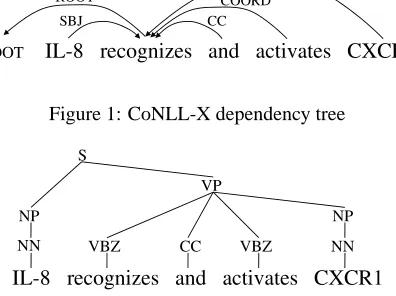
Because the shared tasks of CoNLL-2006 and CoNLL-2007 focused on data-driven dependency parsing, it has recently been extensively studied in parsing research. The aim of dependency pars-ing is to compute a tree structure of a sentence where nodes are words, and edges represent the re-lations among words. Figure 1 shows a dependency tree for the sentence “IL-8 recognizes and activates CXCR1.” An advantage of dependency parsing is that dependency trees are a reasonable approxima-tion of the semantics of sentences, and are readily usable in NLP applications. Furthermore, the effi-ciency of popular approaches to dependency pars-ing compare favorable with those of phrase struc-ture parsing or deep parsing. While a number of ap-proaches have been proposed for dependency pars-ing, this paper focuses on two typical methods.
MST McDonald and Pereira (2006)’s dependency parser,1based on the Eisner algorithm for projective dependency parsing (Eisner, 1996) with the second-order factorization.
[image:2.612.328.526.75.223.2]1http://sourceforge.net/projects/mstparser
Figure 1: CoNLL-X dependency tree
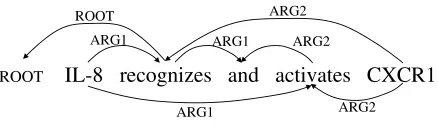
Figure 2: Penn Treebank-style phrase structure tree
KSDEP Sagae and Tsujii (2007)’s dependency parser,2 based on a probabilistic shift-reduce al-gorithm extended by the pseudo-projective parsing technique (Nivre and Nilsson, 2005).
2.2 Phrase structure parsing
Owing largely to the Penn Treebank, the mainstream of data-driven parsing research has been dedicated to the phrase structure parsing. These parsers output Penn Treebank-style phrase structure trees, although function tags and empty categories are stripped off (Figure 2). While most of the state-of-the-art parsers are based on probabilistic CFGs, the parameteriza-tion of the probabilistic model of each parser varies. In this work, we chose the following four parsers.
NO-RERANK Charniak (2000)’s parser, based on a lexicalized PCFG model of phrase structure trees.3 The probabilities of CFG rules are parameterized on carefully hand-tuned extensive information such as lexical heads and symbols of ancestor/sibling nodes.
RERANK Charniak and Johnson (2005)’s rerank-ing parser. The reranker of this parser receives n -best4 parse results from NO-RERANK, and selects the most likely result by using a maximum entropy model with manually engineered features.
BERKELEY Berkeley’s parser (Petrov and Klein, 2007).5 The parameterization of this parser is
op-2http://www.cs.cmu.edu/˜sagae/parser/
3http://bllip.cs.brown.edu/resources.shtml
4
We setn= 50in this paper.
Figure 3: Predicate argument structure
timized automatically by assigning latent variables to each nonterminal node and estimating the param-eters of the latent variables by the EM algorithm (Matsuzaki et al., 2005).
STANFORD Stanford’s unlexicalized parser (Klein and Manning, 2003).6 Unlike NO-RERANK, proba-bilities are not parameterized on lexical heads.
2.3 Deep parsing
Recent research developments have allowed for ef-ficient and robust deep parsing of real-world texts (Kaplan et al., 2004; Clark and Curran, 2004; Miyao and Tsujii, 2008). While deep parsers compute theory-specific syntactic/semantic structures, pred-icate argument structures (PAS) are often used in parser evaluation and applications. PAS is a graph structure that represents syntactic/semantic relations among words (Figure 3). The concept is therefore similar to CoNLL dependencies, though PAS ex-presses deeper relations, and may include reentrant structures. In this work, we chose the two versions of the Enju parser (Miyao and Tsujii, 2008).
ENJU The HPSG parser that consists of an HPSG grammar extracted from the Penn Treebank, and a maximum entropy model trained with an HPSG treebank derived from the Penn Treebank.7
ENJU-GENIA The HPSG parser adapted to biomedical texts, by the method of Hara et al. (2007). Because this parser is trained with both WSJ and GENIA, we compare it parsers that are retrained with GENIA (see section 3.3).
3 Evaluation Methodology
In our approach to parser evaluation, we measure the accuracy of a PPI extraction system, in which
6http://nlp.stanford.edu/software/lex-parser.
shtml
7http://www-tsujii.is.s.u-tokyo.ac.jp/enju/
This study demonstrates that IL-8 recognizes and activates CXCR1, CXCR2, and the Duffy antigen by distinct mechanisms.
The molar ratio of serum retinol-binding protein (RBP) to transthyretin (TTR) is not useful to as-sess vitamin A status during infection in hospi-talised children.
Figure 4: Sentences including protein names
ENTITY1(IL-8)−→SBJrecognizes←−OBJENTITY2(CXCR1)
Figure 5: Dependency path
the parser output is embedded as statistical features of a machine learning classifier. We run a classi-fier with features of every possible combination of a parser and a parse representation, by applying con-versions between representations when necessary. We also measure the accuracy improvements ob-tained by parser retraining with GENIA, to examine the domain portability, and to evaluate the effective-ness of domain adaptation.
3.1 PPI extraction
PPI extraction is an NLP task to identify protein pairs that are mentioned as interacting in biomedical papers. Because the number of biomedical papers is growing rapidly, it is impossible for biomedical re-searchers to read all papers relevant to their research; thus, there is an emerging need for reliable IE tech-nologies, such as PPI identification.
(dep_path (SBJ (ENTITY1 recognizes)) (rOBJ (recognizes ENTITY2)))
Figure 6: Tree representation of a dependency path
We follow the PPI extraction method of Sætre et al. (2007), which is based on SVMs with SubSet Tree Kernels (Collins and Duffy, 2002; Moschitti, 2006), while using different parsers and parse rep-resentations. Two types of features are incorporated in the classifier. The first is bag-of-words features, which are regarded as a strong baseline for IE sys-tems. Lemmas of words before, between and after the pair of target proteins are included, and the linear kernel is used for these features. These features are commonly included in all of the models. Filtering by a stop-word list is not applied because this setting made the scores higher than Sætre et al. (2007)’s set-ting. The other type of feature is syntactic features. For dependency-based parse representations, a de-pendency path is encoded as a flat tree as depicted in Figure 6 (prefix “r” denotes reverse relations). Be-cause a tree kernel measures the similarity of trees by counting common subtrees, it is expected that the system finds effective subsequences of dependency paths. For the PTB representation, we directly en-code phrase structure trees.
3.2 Conversion of parse representations
It is widely believed that the choice of representa-tion format for parser output may greatly affect the performance of applications, although this has not been extensively investigated. We should therefore evaluate the parser performance in multiple parse representations. In this paper, we create multiple parse representations by converting each parser’s de-fault output into other representations when possi-ble. This experiment can also be considered to be a comparative evaluation of parse representations, thus providing an indication for selecting an appro-priate parse representation for similar IE tasks.
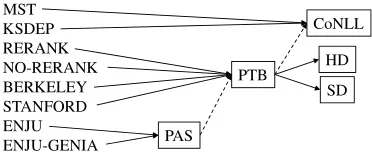
Figure 7 shows our scheme for representation conversion. This paper focuses on five representa-tions as described below.
CoNLL The dependency tree format used in the 2006 and 2007 CoNLL shared tasks on dependency parsing. This is a representation format supported by several data-driven dependency parsers. This
repre-Figure 7: Conversion of parse representations
Figure 8: Head dependencies
sentation is also obtained from Penn Treebank-style trees by applying constituent-to-dependency conver-sion8 (Johansson and Nugues, 2007). It should be noted, however, that this conversion cannot work perfectly with automatic parsing, because the con-version program relies on function tags and empty categories of the original Penn Treebank.
PTB Penn Treebank-style phrase structure trees without function tags and empty nodes. This is the default output format for phrase structure parsers. We also create this representation by converting
ENJU’s output by tree structure matching, although this conversion is not perfect because forms ofPTB
andENJU’s output are not necessarily compatible.
HD Dependency trees of syntactic heads (Fig-ure 8). This representation is obtained by convert-ing PTBtrees. We first determine lexical heads of nonterminal nodes by using Bikel’s implementation of Collins’ head detection algorithm9 (Bikel, 2004; Collins, 1997). We then convert lexicalized trees into dependencies between lexical heads.
SD The Stanford dependency format (Figure 9). This format was originally proposed for extracting dependency relations useful for practical applica-tions (de Marneffe et al., 2006). A program to con-vertPTBis attached to the Stanford parser. Although the concept looks similar toCoNLL, this
representa-8http://nlp.cs.lth.se/pennconverter/
9http://www.cis.upenn.edu/˜dbikel/software.
[image:4.612.333.519.59.135.2]Figure 9: Stanford dependencies
tion does not necessarily form a tree structure, and is designed to express more fine-grained relations such as apposition. Research groups for biomedical NLP recently adopted this representation for corpus anno-tation (Pyysalo et al., 2007a) and parser evaluation (Clegg and Shepherd, 2007; Pyysalo et al., 2007b).
PAS Predicate-argument structures. This is the de-fault output format forENJUandENJU-GENIA.
Although only CoNLL is available for depen-dency parsers, we can create four representations for the phrase structure parsers, and five for the deep parsers. Dotted arrows in Figure 7 indicate imper-fect conversion, in which the conversion inherently introduces errors, and may decrease the accuracy. We should therefore take caution when comparing the results obtained by imperfect conversion. We also measure the accuracy obtained by the ensem-ble of two parsers/representations. This experiment indicates the differences and overlaps of information conveyed by a parser or a parse representation.
3.3 Domain portability and parser retraining
Since the domain of our target text is different from WSJ, our experiments also highlight the domain portability of parsers. We run two versions of each parser in order to investigate the two types of domain portability. First, we run the original parsers trained with WSJ10 (39832 sentences). The results in this setting indicate the domain portability of the original parsers. Next, we run parsers re-trained with GE-NIA11(8127 sentences), which is a Penn Treebank-style treebank of biomedical paper abstracts. Accu-racy improvements in this setting indicate the pos-sibility of domain adaptation, and the portability of the training methods of the parsers. Since the parsers listed in Section 2 have programs for the training
10
Some of the parser packages include parsing models trained with extended data, but we used the models trained with WSJ section 2-21 of the Penn Treebank.
11The domains of GENIA and AImed are not exactly the
same, because they are collected independently.
with a Penn Treebank-style treebank, we use those programs as-is. Default parameter settings are used for this parser re-training.
In preliminary experiments, we found that de-pendency parsers attain higher dede-pendency accuracy when trained only with GENIA. We therefore only input GENIA as the training data for the retraining of dependency parsers. For the other parsers, we in-put the concatenation of WSJ and GENIA for the retraining, while the reranker ofRERANKwas not re-trained due to its cost. Since the parsers other than
NO-RERANK and RERANK require an external POS tagger, a trained POS tagger is used with WSJ-trained parsers, andgeniatagger(Tsuruoka et al., 2005) is used with GENIA-retrained parsers.
4 Experiments
4.1 Experiment settings
In the following experiments, we used AImed (Bunescu and Mooney, 2004), which is a popular corpus for the evaluation of PPI extraction systems. The corpus consists of 225 biomedical paper ab-stracts (1970 sentences), which are sentence-split, tokenized, and annotated with proteins and PPIs. We use gold protein annotations given in the cor-pus. Multi-word protein names are concatenated and treated as single words. The accuracy is mea-sured by abstract-wise 10-fold cross validation and the one-answer-per-occurrence criterion (Giuliano et al., 2006). A threshold for SVMs is moved to adjust the balance of precision and recall, and the maximum f-scores are reported for each setting.
4.2 Comparison of accuracy improvements
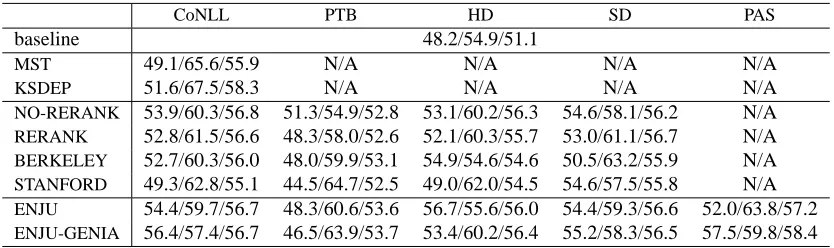
Tables 1 and 2 show the accuracy obtained by using the output of each parser in each parse representa-tion. The row “baseline” indicates the accuracy ob-tained with bag-of-words features. Table 3 shows the time for parsing the entire AImed corpus, and Table 4 shows the time required for 10-fold cross validation with GENIA-retrained parsers.
CoNLL PTB HD SD PAS
baseline 48.2/54.9/51.1
MST 53.2/56.5/54.6 N/A N/A N/A N/A
KSDEP 49.3/63.0/55.2 N/A N/A N/A N/A
NO-RERANK 50.7/60.9/55.2 45.9/60.5/52.0 50.6/60.9/55.1 49.9/58.2/53.5 N/A
RERANK 53.6/59.2/56.1 47.0/58.9/52.1 48.1/65.8/55.4 50.7/62.7/55.9 N/A
BERKELEY 45.8/67.6/54.5 50.5/57.6/53.7 52.3/58.8/55.1 48.7/62.4/54.5 N/A
STANFORD 50.4/60.6/54.9 50.9/56.1/53.0 50.7/60.7/55.1 51.8/58.1/54.5 N/A
[image:6.612.98.515.206.330.2]ENJU 52.6/58.0/55.0 48.7/58.8/53.1 57.2/51.9/54.2 52.2/58.1/54.8 48.9/64.1/55.3
Table 1: Accuracy on the PPI task with WSJ-trained parsers (precision/recall/f-score)
CoNLL PTB HD SD PAS
baseline 48.2/54.9/51.1
MST 49.1/65.6/55.9 N/A N/A N/A N/A
KSDEP 51.6/67.5/58.3 N/A N/A N/A N/A
NO-RERANK 53.9/60.3/56.8 51.3/54.9/52.8 53.1/60.2/56.3 54.6/58.1/56.2 N/A
RERANK 52.8/61.5/56.6 48.3/58.0/52.6 52.1/60.3/55.7 53.0/61.1/56.7 N/A
BERKELEY 52.7/60.3/56.0 48.0/59.9/53.1 54.9/54.6/54.6 50.5/63.2/55.9 N/A
STANFORD 49.3/62.8/55.1 44.5/64.7/52.5 49.0/62.0/54.5 54.6/57.5/55.8 N/A
ENJU 54.4/59.7/56.7 48.3/60.6/53.6 56.7/55.6/56.0 54.4/59.3/56.6 52.0/63.8/57.2
ENJU-GENIA 56.4/57.4/56.7 46.5/63.9/53.7 53.4/60.2/56.4 55.2/58.3/56.5 57.5/59.8/58.4
Table 2: Accuracy on the PPI task with GENIA-retrained parsers (precision/recall/f-score)
WSJ-trained GENIA-retrained
MST 613 425
KSDEP 136 111
NO-RERANK 2049 1372
RERANK 2806 2125
BERKELEY 1118 1198
STANFORD 1411 1645
ENJU 1447 727
ENJU-GENIA 821
Table 3: Parsing time (sec.)
equally well in a real application. Among these parsers, RERANK performed slightly better than the other parsers, although the difference in the f-score is small, while it requires much higher parsing cost. When the parsers are retrained with GENIA (Ta-ble 2), the accuracy increases significantly, demon-strating that the WSJ-trained parsers are not suffi-ciently domain-independent, and that domain adap-tation is effective. It is an important observation that the improvements by domain adaptation are larger than the differences among the parsers in the pre-vious experiment. Nevertheless, not all parsers had their performance improved upon retraining. Parser
CoNLL PTB HD SD PAS
baseline 424
MST 809 N/A N/A N/A N/A
KSDEP 864 N/A N/A N/A N/A
NO-RERANK 851 4772 882 795 N/A
RERANK 849 4676 881 778 N/A
BERKELEY 869 4665 895 804 N/A
STANFORD 847 4614 886 799 N/A
ENJU 832 4611 884 789 1005
ENJU-GENIA 874 4624 895 783 1020
Table 4: Evaluation time (sec.)
retraining yielded only slight improvements for
RERANK, BERKELEY, and STANFORD, while larger improvements were observed for MST, KSDEP, NO-RERANK, and ENJU. Such results indicate the dif-ferences in the portability of training methods. A large improvement fromENJUtoENJU-GENIAshows the effectiveness of the specifically designed do-main adaptation method, suggesting that the other parsers might also benefit from more sophisticated approaches for domain adaptation.
RERANK ENJU
CoNLL HD SD CoNLL HD SD PAS
KSDEP CoNLL 58.5 (+0.2) 57.1 (−1.2) 58.4 (+0.1) 58.5 (+0.2) 58.0 (−0.3) 59.1 (+0.8) 59.0 (+0.7) RERANK CoNLL 56.7 (+0.1) 57.1 (+0.4) 58.3 (+1.6) 57.3 (+0.7) 58.7 (+2.1) 59.5 (+2.3) HD 56.8 (+0.1) 57.2 (+0.5) 56.5 (+0.5) 56.8 (+0.2) 57.6 (+0.4)
SD 58.3 (+1.6) 58.3 (+1.6) 56.9 (+0.2) 58.6 (+1.4)
ENJU CoNLL 57.0 (+0.3) 57.2 (+0.5) 58.4 (+1.2)
HD 57.1 (+0.5) 58.1 (+0.9)
[image:7.612.78.537.59.163.2]SD 58.3 (+1.1)
Table 5: Results of parser/representation ensemble (f-score)
differs significantly. The dependency parsers are much faster than the other parsers, while the phrase structure parsers are relatively slower, and the deep parsers are in between. It is noteworthy that the dependency parsers achieved comparable accuracy with the other parsers, while they are more efficient. The experimental results also demonstrate that
PTB is significantly worse than the other represen-tations with respect to cost for training/testing and contributions to accuracy improvements. The con-version from PTBto dependency-based representa-tions is therefore desirable for this task, although it is possible that better results might be obtained with
PTB if a different feature extraction mechanism is used. Dependency-based representations are com-petitive, whileCoNLLseems superior toHD andSD
in spite of the imperfect conversion from PTB to
CoNLL. This might be a reason for the high per-formances of the dependency parsers that directly computeCoNLLdependencies. The results forENJU
-CoNLLandENJU-PAS show thatPAScontributes to a larger accuracy improvement, although this does not necessarily mean the superiority ofPAS, because two imperfect conversions, i.e.,PAS-to-PTBandPTB
-to-CoNLL, are applied for creatingCoNLL.
4.3 Parser ensemble results
Table 5 shows the accuracy obtained with ensembles of two parsers/representations (except thePTB for-mat). Bracketed figures denote improvements from the accuracy with a single parser/representation. The results show that the task accuracy significantly improves by parser/representation ensemble. Inter-estingly, the accuracy improvements are observed even for ensembles of different representations from the same parser. This indicates that a single parse representation is insufficient for expressing the true
Bag-of-words features 48.2/54.9/51.1 Yakushiji et al. (2005) 33.7/33.1/33.4 Mitsumori et al. (2006) 54.2/42.6/47.7 Giuliano et al. (2006) 60.9/57.2/59.0 Sætre et al. (2007) 64.3/44.1/52.0 This paper 54.9/65.5/59.5
Table 6: Comparison with previous results on PPI extrac-tion (precision/recall/f-score)
potential of a parser. Effectiveness of the parser en-semble is also attested by the fact that it resulted in larger improvements. Further investigation of the sources of these improvements will illustrate the ad-vantages and disadad-vantages of these parsers and rep-resentations, leading us to better parsing models and a better design for parse representations.
4.4 Comparison with previous results on PPI extraction
(2006), while Sætre et al. (2007) presented better re-sults than theirs in the same evaluation criterion.
5 Related Work
Though the evaluation of syntactic parsers has been a major concern in the parsing community, and a couple of works have recently presented the com-parison of parsers based on different frameworks, their methods were based on the comparison of the parsing accuracy in terms of a certain intermediate parse representation (Ringger et al., 2004; Kaplan et al., 2004; Briscoe and Carroll, 2006; Clark and Curran, 2007; Miyao et al., 2007; Clegg and Shep-herd, 2007; Pyysalo et al., 2007b; Pyysalo et al., 2007a; Sagae et al., 2008). Such evaluation requires gold standard data in an intermediate representation. However, it has been argued that the conversion of parsing results into an intermediate representation is difficult and far from perfect.
The relationship between parsing accuracy and task accuracy has been obscure for many years. Quirk and Corston-Oliver (2006) investigated the impact of parsing accuracy on statistical MT. How-ever, this work was only concerned with a single de-pendency parser, and did not focus on parsers based on different frameworks.
6 Conclusion and Future Work
We have presented our attempts to evaluate syntac-tic parsers and their representations that are based on different frameworks; dependency parsing, phrase structure parsing, or deep parsing. The basic idea is to measure the accuracy improvements of the PPI extraction task by incorporating the parser out-put as statistical features of a machine learning classifier. Experiments showed that state-of-the-art parsers attain accuracy levels that are on par with each other, while parsing speed differs sig-nificantly. We also found that accuracy improve-ments vary when parsers are retrained with domain-specific data, indicating the importance of domain adaptation and the differences in the portability of parser training methods.
Although we restricted ourselves to parsers trainable with Penn Treebank-style treebanks, our methodology can be applied to any English parsers. Candidates include RASP (Briscoe and Carroll,
2006), the C&C parser (Clark and Curran, 2004), the XLE parser (Kaplan et al., 2004), MINIPAR (Lin, 1998), and Link Parser (Sleator and Temperley, 1993; Pyysalo et al., 2006), but the domain adapta-tion of these parsers is not straightforward. It is also possible to evaluate unsupervised parsers, which is attractive since evaluation of such parsers with gold-standard data is extremely problematic.
A major drawback of our methodology is that the evaluation is indirect and the results depend on a selected task and its settings. This indicates that different results might be obtained with other tasks. Hence, we cannot conclude the superiority of parsers/representations only with our results. In or-der to obtain general ideas on parser performance, experiments on other tasks are indispensable.
Acknowledgments
This work was partially supported by Grant-in-Aid for Specially Promoted Research (MEXT, Japan), Genome Network Project (MEXT, Japan), and Grant-in-Aid for Young Scientists (MEXT, Japan).
References
D. M. Bikel. 2004. Intricacies of Collins’ parsing model. Computational Linguistics, 30(4):479–511.
T. Briscoe and J. Carroll. 2006. Evaluating the accu-racy of an unlexicalized statistical parser on the PARC DepBank. In COLING/ACL 2006 Poster Session. R. Bunescu and R. J. Mooney. 2004. Collective
infor-mation extraction with relational markov networks. In ACL 2004, pages 439–446.
R. C. Bunescu and R. J. Mooney. 2005. Subsequence kernels for relation extraction. In NIPS 2005.
E. Charniak and M. Johnson. 2005. Coarse-to-fine n-best parsing and MaxEnt discriminative reranking. In ACL 2005.
E. Charniak. 2000. A maximum-entropy-inspired parser. In NAACL-2000, pages 132–139.
S. Clark and J. R. Curran. 2004. Parsing the WSJ using CCG and log-linear models. In 42nd ACL.
S. Clark and J. R. Curran. 2007. Formalism-independent parser evaluation with CCG and DepBank. In ACL 2007.
M. Collins and N. Duffy. 2002. New ranking algorithms for parsing and tagging: Kernels over discrete struc-tures, and the voted perceptron. In ACL 2002. M. Collins. 1997. Three generative, lexicalised models
for statistical parsing. In 35th ACL.
M.-C. de Marneffe, B. MacCartney, and C. D. Man-ning. 2006. Generating typed dependency parses from phrase structure parses. In LREC 2006.
J. M. Eisner. 1996. Three new probabilistic models for dependency parsing: An exploration. In COLING 1996.
G. Erkan, A. Ozgur, and D. R. Radev. 2007. Semi-supervised classification for extracting protein interac-tion sentences using dependency parsing. In EMNLP 2007.
D. Gildea. 2001. Corpus variation and parser perfor-mance. In EMNLP 2001, pages 167–202.
C. Giuliano, A. Lavelli, and L. Romano. 2006. Exploit-ing shallow lExploit-inguistic information for relation extrac-tion from biomedical literature. In EACL 2006. T. Hara, Y. Miyao, and J. Tsujii. 2007. Evaluating
im-pact of re-training a lexical disambiguation model on domain adaptation of an HPSG parser. In IWPT 2007. R. Johansson and P. Nugues. 2007. Extended constituent-to-dependency conversion for English. In NODALIDA 2007.
R. M. Kaplan, S. Riezler, T. H. King, J. T. Maxwell, and A. Vasserman. 2004. Speed and accuracy in shallow and deep stochastic parsing. In HLT/NAACL’04. S. Katrenko and P. Adriaans. 2006. Learning relations
from biomedical corpora using dependency trees. In KDECB, pages 61–80.
J.-D. Kim, T. Ohta, Y. Teteisi, and J. Tsujii. 2003. GE-NIA corpus — a semantically annotated corpus for bio-textmining. Bioinformatics, 19:i180–182.
D. Klein and C. D. Manning. 2003. Accurate unlexical-ized parsing. In ACL 2003.
D. Lin. 1998. Dependency-based evaluation of MINI-PAR. In LREC Workshop on the Evaluation of Parsing Systems.
M. Marcus, B. Santorini, and M. A. Marcinkiewicz. 1994. Building a large annotated corpus of En-glish: The Penn Treebank. Computational Linguistics, 19(2):313–330.
T. Matsuzaki, Y. Miyao, and J. Tsujii. 2005. Probabilis-tic CFG with latent annotations. In ACL 2005. R. McDonald and F. Pereira. 2006. Online learning of
approximate dependency parsing algorithms. In EACL 2006.
T. Mitsumori, M. Murata, Y. Fukuda, K. Doi, and H. Doi. 2006. Extracting protein-protein interaction informa-tion from biomedical text with SVM. IEICE - Trans. Inf. Syst., E89-D(8):2464–2466.
Y. Miyao and J. Tsujii. 2008. Feature forest models for probabilistic HPSG parsing. Computational Linguis-tics, 34(1):35–80.
Y. Miyao, K. Sagae, and J. Tsujii. 2007. Towards framework-independent evaluation of deep linguistic parsers. In Grammar Engineering across Frameworks 2007, pages 238–258.
A. Moschitti. 2006. Making tree kernels practical for natural language processing. In EACL 2006.
J. Nivre and J. Nilsson. 2005. Pseudo-projective depen-dency parsing. In ACL 2005.
S. Petrov and D. Klein. 2007. Improved inference for unlexicalized parsing. In HLT-NAACL 2007.
S. Pyysalo, T. Salakoski, S. Aubin, and A. Nazarenko. 2006. Lexical adaptation of link grammar to the biomedical sublanguage: a comparative evaluation of three approaches. BMC Bioinformatics, 7(Suppl. 3). S. Pyysalo, F. Ginter, J. Heimonen, J. Bj¨orne, J. Boberg,
J. J¨arvinen, and T. Salakoski. 2007a. BioInfer: a cor-pus for information extraction in the biomedical do-main. BMC Bioinformatics, 8(50).
S. Pyysalo, F. Ginter, V. Laippala, K. Haverinen, J. Hei-monen, and T. Salakoski. 2007b. On the unification of syntactic annotations under the Stanford dependency scheme: A case study on BioInfer and GENIA. In BioNLP 2007, pages 25–32.
C. Quirk and S. Corston-Oliver. 2006. The impact of parse quality on syntactically-informed statistical ma-chine translation. In EMNLP 2006.
E. K. Ringger, R. C. Moore, E. Charniak, L. Vander-wende, and H. Suzuki. 2004. Using the Penn Tree-bank to evaluate non-treeTree-bank parsers. In LREC 2004. R. Sætre, K. Sagae, and J. Tsujii. 2007. Syntactic features for protein-protein interaction extraction. In LBM 2007 short papers.
K. Sagae and J. Tsujii. 2007. Dependency parsing and domain adaptation with LR models and parser ensem-bles. In EMNLP-CoNLL 2007.
K. Sagae, Y. Miyao, T. Matsuzaki, and J. Tsujii. 2008. Challenges in mapping of syntactic representations for framework-independent parser evaluation. In the Workshop on Automated Syntatic Annotations for In-teroperable Language Resources.
D. D. Sleator and D. Temperley. 1993. Parsing English with a Link Grammar. In 3rd IWPT.
Y. Tsuruoka, Y. Tateishi, J.-D. Kim, T. Ohta, J. Mc-Naught, S. Ananiadou, and J. Tsujii. 2005. Develop-ing a robust part-of-speech tagger for biomedical text. In 10th Panhellenic Conference on Informatics. A. Yakushiji, Y. Miyao, Y. Tateisi, and J. Tsujii. 2005.