Dependence of Dendritic Side-branches on Parameters
in Phase-Field Simulations
Zhu Changsheng
1;2, Liu Baicheng
3, Jing Tao
3and Feng Wenfang
1 1Lanzhou University of Technology, Lanzhou 730050, P. R. China
2State Key Laboratory of Gansu New Non-Ferrous Metal Materials, Lanzhou 730050, P. R. China 3Department of Mechanical Engineering, Tsinghua University, Beijing 100084, P. R. China
The influence of phase-field parameters on dendritic side-branches is studied by using a phase-field model coupled with thermal noise. The result of calculation indicates that, the thermal diffusion layer collected around the dendrite tends to become thinner with the undercooling increasing, which is favorable to the growth of the side-branches and the dendrite takes on the morphology of developed side-branches; The less coupling coefficientis, the quicker the dendrite tip velocity converges on the Green function calculation, the more developed the side-branches are; The anisotropy coefficient"influences the steady state of the dendrite tip, the largeris, the greater the dendrite tip velocity is, the more developed the side-branches are and the smaller the DAS is; The magnitude of thermal noiseFuhas an obvious effect upon temperature field,
when appropriate value is assigned toFu, the noise can promote the emergence of side-branches, but it does not influence the tip operating state.
(Received July 22, 2004; Accepted November 1, 2004)
Keywords: phase-field, dendrite, thermal noise, side branches, undercooling
1. Introduction
Dendrites are intricate patterns that make up the micro-structure of many important commercial alloys. They develop a complex shape due to the emission of secondary branches behind the growing tips of primary branches.1)The side-branching mechanism requires some continuous source of noise at the tip. Therefore, thermal noise, originating from microscopic scale fluctuations inherent in bulk matter, is the most natural and quantifiable candidate to be considered.1)
Barber et al.2) studied the evolution of time-dependent
deformations of the needle crystal (Ivantsov) solution of the two-dimensional symmetric model of solidification in the limit of smallPe´cletnumber within a WKB approximation. The amplitude of a localized wave packet grows exponen-tially as z1=4, where z is measured from the tip along the
symmetry axis of the dendrite. Brener and Temkin3)
considered anisotropic needle crystals in three dimensions and concluded that experimentally observed side-branches could be explained by considering noise of a thermal origin. The growth of the side-branches amplitude was found to behave exponentially as a function of z2=5, which is faster than z1=4 dependence obtained in the axisymmetric case.4) The side-branches wavelength was found to be as a function ofz1=5, very similar to that obtained in the axisymmetric case.
Recently, few studies of side-branches with a phase-field model have been carried out,4–9) they obtained good
quantitative agreement between the computed side-branches amplitude as a function of distance to the tip and the prediction of the linear WKB theory for anisotropic crystals in two dimensions.1,5)In this paper, dendritic side-branches
during crystal growth is investigated by simulation of a phase-field model which incorporates thermal noise of microscopic origin.
2. Mathematical Model and Numerical Issues
Recently, methods to incorporate thermal noise in the
phase-field model have been developed by Karma and Rappel.1) Although some previous phase-field simulations
have obtained dendritic side-branches that resemble those observed in experiments,6–8) those side-branches were gen-erated by either numerical noise or randomly driving the tip. In the model of Karma and Rapple, thermal noise was incorporated in a thermodynamically consistent manner using the Langevid formalism. The nonconserved noise and conserved noise were added to the phase equation and the energy conservation equation respectively in the following manner:
ð~nnÞ@t¼ ½ð12Þð12Þ þ r½W2ðnn~Þr
þ X
m¼x;y
@m jrj2Wð~nnÞ
@Wð~nnÞ
@ð@xÞ
þð~rr;tÞ ð1Þ
@u
@t ¼Dr 2u
þ1
2
@pðÞ
@t r qq~ð~rr;tÞ ð2Þ
The dimensionless temperature u is defined as ðTTMÞ= ðL=CpÞ, where Tm, L and Cp are the melting temperature,
latent heat and specific heat at constant pressure, respective-ly.Dis the thermal diffusivity,is coupling constant, both
andW are functions of the interfacial normaln in order to account for anisotropic surface energy and kinetics, respec-tively:
ð~nnÞ ¼0 1þ 4"4 13"4
ð@xÞ4þ ð@yÞ4
jrj4
ð3Þ
Wð~nnÞ ¼W0ð13"4Þ 1þ 4"4 13"4
ð@xÞ4þ ð@yÞ4
jrj4
ð4Þ
~
andqq~stand for the thermal noise vector, obeying Gaussian distribution with variances respectively:
hð~rr;tÞðrr~00;tÞi ¼2F
mnð~rrrr~00Þðtt0Þ ð5Þ
hqmð~rr;tÞqnðrr~00;tÞi ¼2DkB
CpTM2
L2 mnð~rrr~ 0
where kB is the Boltzmann constant and is the delta
function. UsingW0as a length scale and0as a time scale, all
dimensional variables are cast into their dimensionless form asrr~=W0!rr~,t=!t,D0=W02 !D,!,qq~0=W0!qq~.
Then, the dimensionless variances of the thermal noise vector are given by:
hð~rr;tÞðrr~00;tÞi ¼2F
mnð~rrrr~00Þðtt0Þ ð7Þ
hqmð~rr;tÞqnðrr~00;tÞi ¼2DFumnð~rrrr~00Þðtt0Þ ð8Þ
Fu is the magnitude of the thermal noise and is defined as
Fu¼
kBTM2Cp
L2W2 0
¼kBT 2
MCp
L2d2 0
d0 W0
2
¼Fexp
d0 W0
2
ð9Þ
The phase field eq. (1) is solved by using the Euler algorithm, while ADI algorithm is applied to the heat eq. (2). The space step is selected as xW0, the time step is
specified by this way thatt0x2 5W2
0
for keeping stable under the time-step iterations. In order to save the computational costs, the computation region is extended according to the increasing dendritic scale.
For an initial nucleus of the radiusr0,
When x2þy2r2; ¼1;u¼0 ð10Þ
When x2þy2>r2; ¼ 1;u¼ ð11Þ
Where xand yare the coordinate axes, u is dimensionless temperature.
The Zero-Neumann boundary conditions for anduare imposed on the boundaries of the computational domain.
3. Numerical Results and Discussion
3.1 The effect of undercooling on side-branches
The undercooling has great effects on both dendritic nucleation and growth. The lower the undercooling is, the smaller the nucleation rate is, in other words, in the same volume of melt, each nucleus possesses more free space to grow. On the other hand, with the decrease of undercooling, the growth velocity slows down and the dendrite needs more time to grow. The simulation was performed by using relevant computational and material parameters as follows:
d0=W0¼0:277, 0 ¼1, x¼y¼0:8, t¼0:06, "¼ 0:05, Fu¼2104, ¼0:65, Fig. 1(a) shows the
equi-axed dendrite without side-branches obtained by simulation dimensionless temperature ¼0:2 and growth time
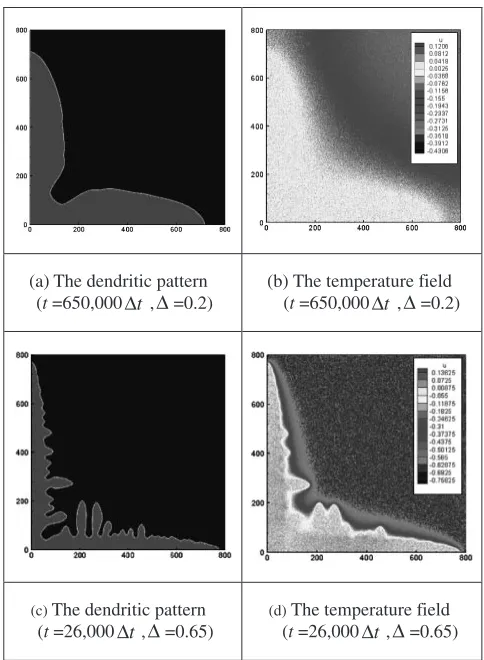
t¼650;000t, Fig. 1(c) presents the equiaxed dendrite with developed side-branches under high dimensionless under-cooling oof ¼0:65 and growth time t¼26;000t. The corresponding temperature distribution results near equiaxed dendrite (illustrated in Fig. 1(a), Fig. 1(c)) are presented in Fig. 1(b) and Fig. 1(d) respectively. From the figures, it can be found that under the low undercooling, the thermal diffusion layer surrounding equiaxed dendrite is thicker than that under the high undercooling. During the growing of equiaxed dendrite, the latent heat releases to the melt through the thermal diffusion layer, the thermal diffusion thickness is
DT=Vc. The growth velocity under low undercooling is
slower than that under high undercooling, so the thermal diffusion length under low undercooling melt is thicker than that under high undercooling melt, which causes equiaxed
dendrites surrounded by a thicker thermal diffusion layer. The thermal diffusion layer baffles the release of latent heat and restricts the perturbation of the interface, as a result, side-branches are suppressed, so equiaxed dendrites take on the morphology of no side-branches. Moreover, under high undercooling, the thin thermal diffusion layer avails the release of latent heat and promotes the development of the side-branches, therefore, the equiaxed dendrite shows a morphology of highly developed side-branches.
3.2 The effect of coupling coefficient on side-braches
The coupling coefficientof the temperature field and the phase field is a very important parameter to represent the relation between energy and solidification, and determine the dendrite growth pattern. The coupling coefficientshould be set according to the physical parameters, but the ideal value should be obtained by experimentation. However, the test for it has not be found yet. Certain relation between and dendrite tip velocity was showed in Fig. 2, when the coupling coefficient is less, the dendrite tip velocity converges quickly on the calculated value of the Green function (expressed with the dotted line). As the increment of coupling coefficient
continuously, the dendrite tip velocity reduces rapidly, thus, the stable state behavior of the dendrite tip is influenced. Karmaet al.1)studied the convergence of dimensionless tip velocity as a function ofW0=d0. In terms of the expression d0¼a1W0,11)wherea1 is a positive constant of order unity, a1¼I=J,I¼2
ffiffiffi 2
p
=3,J¼16=15,Fu¼2104, therefore,
(a)The dendritic pattern (t =650,000
(b) The temperature field
(c) The dendritic pattern (d) The temperature field ∆t ,∆ =0.2)
(t =26,000 ∆t,∆ =0.65) (t =26,000 ∆t,∆ =0.65) (t =650,000 ∆t ,∆ =0.2)
[image:2.595.305.547.70.400.2]the coupling coefficient can be expressed as ¼a1W0d 0. It
can be seen the relation ofd0=W0,W0=d0, andby the data as
shown in Table 1. The simulation was performed by using relevant computational and material parameters as follows:
x¼y¼0:8, t¼0:06, 0¼1, ¼0:65, Fu¼2
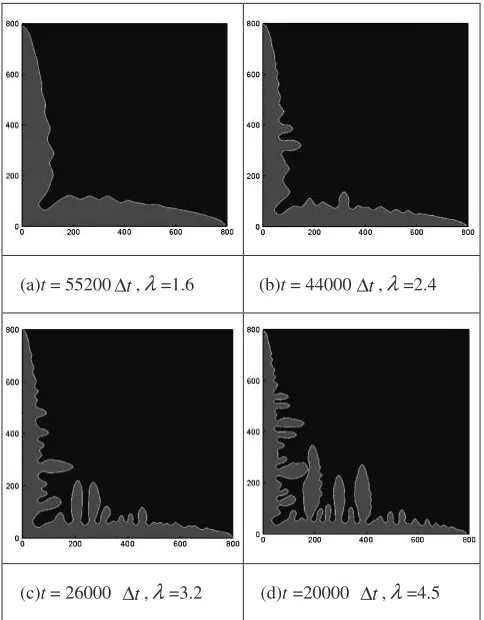
104, "¼0:05, Fig. 3 shows the dendritic pattern under a different coupling coefficient, it could be found that when
is relatively small, the main branches of grain are relatively
obese, and the side-branches are very undeveloped; but with the increase of coupling coefficient, both the main branches and side- branches attenuate gradually, the side-branches are more and more developed. It can be explained that the bigger coupling coefficien is, the more unstable the solid/liquid interface is, the easier the noise can be amplified.
3.3 The effect of the anisotropy coefficient on the side-branches
The anisotropy coefficient " represents the anisotropic intension of surface energy, interface thickness, and kinetics. It is not clear how to set exactly the value of the anisotropy coefficient and what its connection with real physical parameters is. However, during the simulation of micro-structure evolution, the coefficient is so important to the dendritic growth that it cannot be ignored. Anisotropy coefficient"has great effects on the dimensionless dendrite tip velocity, it can be seen from the Fig. 4 that with the increment of ", the dimensionless dendrite tip velocity increases accordingly, therefore,"influences the steady state behavior of the dendrite tip, which is consistent with microscopic solvability theory (MSC) conclusion about"is correlated with dendrite tip stable state behavior.10) The
operating state of the dendrite can be characterized by¼ 2Dd0
2
upVup and P¼
upVup 2D
11) where is the classic stability
parameter andPis the dendrite tipPe´cletnumber. It can be found that with the increase of coupling coefficient, the tip velocity increases accordingly, while the tip radius decreases gradually. Ivantsov theory and critical stability theory are only suitable for"’s lower situation because of neglecting"’s impact on dendrite tip. The simulation was performed by using relevant computational and material parameters as follows: d0=W0 ¼0:227, x¼y¼0:8, t¼0:06,0¼ 1, ¼0:65, Fig. 5 shows the dendritic pattern under different anisotropy coefficient ", it could be found that when the value of " is small, the main branches and side-branches are obese, and the DAS (Secondary Dendrite Arm Spacing) is small, with the increment of ", both the main branch and side-branches become slender, and the DAS becomes small, which indicates thathas a marked effect on the side-branches, because with the increment of", the noise can be amplified quickly, the surface energy cannot restrain effectively the amplification, and then the interface becomes unstable, which causes the side-branches to split constantly.
The coupling coefficientλ dimensionless dendrite tip velocity
Vtip d0
/D
[image:3.595.64.279.71.226.2]Fig. 2 The effects of the coupling coefficient on tip velocity.
Table 1 The relation ofd0=W0,W0=d0and.
d0=W0 0.555 0.416 0.277 0.185 0.139 0.111 W0=d0 1.8 2.4 3.6 5.4 7.2 9.0
1.6 2.1 3.2 4.8 6.4 8.0
(a)t = 55200∆t,
λ
=1.6 (b)t = 44000∆t,λ
=2.4(c)t = 26000 ∆ t,
λ
=3.2 (d)t =20000 ∆t,λ
=4.5Fig. 3 The effect of the coupling coefficienton side-branches.
The Grids along with x axis Dimensionless Dendrite Tip Velocity
Vtip d0
/D
[image:3.595.325.526.74.214.2] [image:3.595.44.293.278.322.2] [image:3.595.48.290.454.764.2]3.4 The effect of the magnitude of thermal noise on side-braches
The influence of thermal amplitude value on the simulation results is obvious. The simulation was performed by using relevant computational and material parameters as follows:
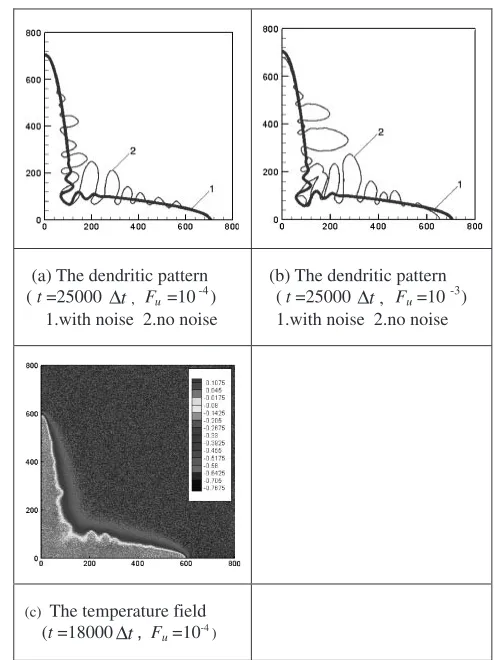
d0=W0¼0:227, 0 ¼1, x¼y¼0:8, t¼0:06, "¼ 0:05, Fig. 6(c) shows temperature field of dendrite growth at some time with noise amplitudeFu¼104. From the figure,
it could be found that the inclusion of thermal noise doesn’t change the law of temperature field distribution, but it makes the temperature field fluctuate randomly and the highest temperature is beyond 0, the lowest is under initial under-cooling, which disagrees with the actual law of temperature field distribution. With the increase of the noise levelFu, the
fluctuations of the temperature field are enhanced. The curves 1 and 2 shown in Fig. 6(a) represent dendrite patterns without noise and Fu¼104 at time Fu¼25;000t respectively.
From the figure, we can see that durative fluctuations are formed near the interface under the condition of the noise, and side-branches appear behind the dendrite tip from several wavelengths, but the phase fields of the dendritic tip in two cases superpose. This indicates that the noise promotes the emergence of side-branches, but it doesn’t influence the steady state of the dendrite tip. As shown in Fig. 6(b), the dendritic tip of pattern 1 without noise and the dendritic tip of pattern 2 with Fu¼103 at time t¼25;000t don’t
superpose, and the vertical branch velocity is greater than the horizontal branch velocity, which indicates that the greater value of noise will disturb the steady state. Therefore, the value ofFu must be tried time and again.
4. Conclusions
(1) In the phase-field simulations of dendritic side-branches, different phase-field parameters lead to different dendrite side-branch behaviors.
(2) With the increment of undercooling, the thermal diffusion layer around the equiaxed dendrite becomes thinner, which avails the morphology formation of the branches and the equiaxed dendrite with developed side-branches.
(3) The anisotropy coefficient"influences the steady state of the dendrite tip, the largeris, the greater the dendrite tip velocity is, the more developed the side-branches are, and the smaller the DAS is.
(4) The less the coupling coefficient is, the quicker the dendrite tip velocity converges on the Green function calculation, and the more developed the side-branches are.
(5) The side-branches can not be affected by the inclusion of the nonconserved noise, so the nonconserved noise can be negligible from the point of view of computational saving for long simulation runs.
(6) The magnitude of thermal noise has an obvious influence on the temperature field. When appropriate value is assigned toFu, the noise can promote the emergence of
side branches, but it does not influence the tip operating state.
(a) t = 72000∆t,
ε
=0.02(c) t =40000 ∆t,
ε
=0.04t
∆ ,
ε
=0.03 (b) t=52000t
∆ ,
ε
=0.05 (d) t =26000Fig. 5 The effect of anisotropy coefficient"on side-branches.
(a) The dendritic pattern ( t =25000 ∆t , Fu =10
-4
) 1.with noise 2.no noise
(b) The dendritic pattern (t =25000∆t , Fu =10 -3
) 1.with noise 2.no noise
(c) The temperature field (t =18000∆t , Fu =10-4 )
[image:4.595.300.547.70.400.2] [image:4.595.48.300.72.371.2]Acknowledgments
This work was supported by the National Science Foundation of China (No. 50005011 and No. 59990470).
REFERENCES
1) A. Karma and W.-J. Rappel: Phys. Rev. E60(1999) 3164–3624. 2) M. N. Barber, A. Barbieri and J. S. Langer: Phys. Rev. A39(1987)
5314–5320.
3) E. Brener and D. Temkin: Physica A263(1999) 338–344.
4) J. S. Langer: Phys. Rev. A36(1987) 3350–3358. 5) R. Kobayasi: Physica D63(1993) 410–423.
6) B. T. Murray, A. A. Wheeler and M. E. Glicksman: J. Cryst. Growth. 154(1995) 386–400.
7) X. Tong, C. Beckermann, A. Karma and Q. Li: Phys. Rev. E63(2001) 1–16.
8) R. Gonza´let-Cinca and L. Ramı´rez-Piscina: Phys. Rev. E63(2000) 1–9.