Time Period Identification of Events in Text
Taichi Noro
†Takashi Inui
††Hiroya Takamura
‡Manabu Okumura
‡†
Interdisciplinary Graduate School of Science and Engineering
Tokyo Institute of Technology
4259 Nagatsuta-cho, Midori-ku, Yokohama, Kanagawa, Japan
††Japan Society for the Promotion of Science
‡Precision and Intelligence Laboratory, Tokyo Institute of Technology
{norot, tinui}@lr.pi.titech.ac.jp,{takamura, oku}@pi.titech.ac.jpAbstract
This study aims at identifying when an event written in text occurs. In particular, we classify a sentence for an event into four time-slots; morning, daytime, eve-ning, and night. To realize our goal, we focus on expressions associated with time-slot (time-associated words). How-ever, listing up all the time-associated words is impractical, because there are numerous time-associated expressions. We therefore use a semi-supervised learning method, the Naïve Bayes classi-fier backed up with the Expectation Maximization algorithm, in order to it-eratively extract time-associated words while improving the classifier. We also propose to use Support Vector Machines to filter out noisy instances that indicates no specific time period. As a result of ex-periments, the proposed method achieved 0.864 of accuracy and outperformed other methods.
1
Introduction
In recent years, the spread of the internet has ac-celerated. The documents on the internet have increased their importance as targets of business marketing. Such circumstances have evoked many studies on information extraction from text especially on the internet, such as sentiment analysis and extraction of location information. In this paper, we focus on the extraction of tem-poral information. Many authors of documents on the web often write about events in their daily life. Identifying when the events occur provides us valuable information. For example, we can
use temporal information as a new axis in the information retrieval. From time-annotated text, companies can figure out when customers use their products. We can explore activities of users for marketing researches, such as “What do people eat in the morning?”, “What do people spend money for in daytime?”
Most of previous work on temporal processing of events in text dealt with only newswire text. In those researches, it is assumed that temporal ex-pressions indicating the time-period of events are often explicitly written in text. Some examples of explicit temporal expressions are as follows: “on March 23”, “at 7 p.m.”.
However, other types of text including web diaries and blogs contain few explicit temporal expressions. Therefore one cannot acquire suffi-cient temporal information using existing meth-ods. Although dealing with such text as web dia-ries and blogs is a hard problem, those types of text are excellent information sources due to their overwhelmingly huge amount.
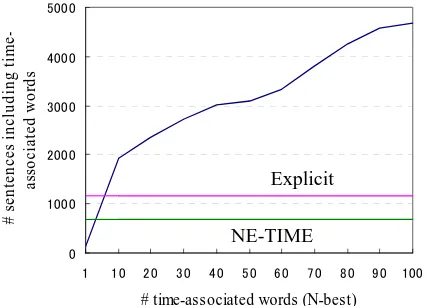
In this paper, we propose a method for estimat-ing occurrence time of events expressed in in-formal text. In particular, we classify sentences in text into one of four time-slots; morning, day-time, evening, and night. To realize our goal, we focus on expressions associated with time-slot (hereafter, called time-associated words), such as “commute (morning)”, “nap (daytime)” and “cocktail (night)”. Explicit temporal expressions have more certain information than the time-associated words. However, these expressions are rare in usual text. On the other hand, al-though the time-associated words provide us only indirect information for estimating occur-rence time of events, these words frequently ap-pear in usual text. Actually, Figure 2 (we will discuss the graph in Section 5.2, again) shows the number of sentences including explicit
poral expressions and time-associated words re-spectively in text. The numbers are obtained from a corpus we used in this paper. We can fig-ure out that there are much more time-associated words than explicit temporal expressions in blog text. In other words, we can deal with wide cov-erage of sentences in informal text by our method with time-associated words.
However, listing up all the time-associated words is impractical, because there are numerous time-associated expressions. Therefore, we use a semi-supervised method with a small amount of labeled data and a large amount of unlabeled data, because to prepare a large quantity of labeled data is costly, while unlabeled data is easy to ob-tain. Specifically, we adopt the Naïve Bayes classifier backed up with the Expectation Maxi-mization (EM) algorithm (Dempster et al., 1977) for semi-supervised learning. In addition, we propose to use Support Vector Machines to filter out noisy sentences that degrade the performance of the semi-supervised method.
In our experiments using blog data, we ob-tained 0.864 of accuracy, and we have shown effectiveness of the proposed method.
This paper is organized as follows. In Section 2 we briefly describe related work. In Section 3 we describe the details of our corpus. The pro-posed method is presented in Section 4. In Sec-tion 5, we describe experimental results and dis-cussions. We conclude the paper in Section 6.
2
Related Work
The task of time period identification is new and has not been explored much to date.
Setzer et al. (2001) and Mani et al. (2000) aimed at annotating newswire text for analyzing temporal information. However, these previous work are different from ours, because these work only dealt with newswire text including a lot of explicit temporal expressions.
Tsuchiya et al. (2005) pursued a similar goal as ours. They manually prepared a dictionary with temporal information. They use the hand-crafted dictionary and some inference rules to determine the time periods of events. In contrast, we do not resort to such a hand-crafted material, which requires much labor and cost. Our method automatically acquires temporal information from actual data of people's activities (blog). Henceforth, we can get temporal information associated with your daily life that would be not existed in a dictionary.
3
Corpus
In this section, we describe a corpus made from blog entries. The corpus is used for training and test data of machine learning methods mentioned in Section 4.
The blog entries we used are collected by the method of Nanno et al. (2004). All the entries are written in Japanese. All the entries are split into sentences automatically by some heuristic rules. In the next section, we are going to explain “time-slot” tag added at every sentence.
3.1 Time-Slot Tag
The “time-slot” tag represents when an event occurs in five classes; “morning”, “daytime”, “evening”, “night”, and “time-unknown”. “Time-unknown” means that there is no temporal in-formation. We set the criteria of time-slot tags as follows.
Morning: 04:00--10:59
from early morning till before noon, breakfast Daytime: 11:00--15:59
from noon till before dusk, lunch Evening: 16:00--17:59
from dusk till before sunset Night: 18:00--03:59
from sunset till dawn, dinner
Note that above criteria are just interpreted as rough standards. We think time-slot recognized by authors is more important. For example, in a case of “about 3 o'clock this morning” we judge the case as “morning” (not “night”) with the ex-pression written by the author “this morning”.
To annotate sentences in text, we used two dif-ferent clues. One is the explicit temporal expres-sions or time-associated words included in the sentence to be judged. The other is contextual information around the sentences to be judged. The examples corresponding to the former case are as follows:
Example 1
a. I went to post office by bicycle in the morning. b. I had spaghetti at restaurant at noon.
c. I cooked stew as dinner on that day.
4.2 Naïve Bayes Classifier Example 2
1. I went to X by bicycle in the morning.
In this section, we describe multinomial model that is a kind of Naïve Bayes classifiers.
2. I went to a shop on the way back from X.
A generative probability of example
x
given a category has the form:c
3.2 Corpus Statistics
We manually annotated the corpus. The number of the blog entries is 7,413. The number of tences is 70,775. Of 70,775, the number of sen-tences representing any events1 is 14,220. The frequency distribution of time-slot tags is shown in Table 1. We can figure out that the number of time-unknown sentences is much larger than the other sentences from this table. This bias would affect our classification process. Therefore, we propose a method for tackling the problem.
(
)
=( )
∏
(
( )
)
( )w
x w N
x w N
c w P x x P c x P
, | !
, |
,
θ (1)
where P
( )
x denotes the probability that asen-tence of length x occurs, denotes the
number of occurrences of
w
in text(
wx N ,)
x
. The oc-currence of a sentence is modeled as a set of tri-als, in which a word is drawn from the whole vocabulary.In time-slot classification, the
x
is correspond to each sentence, thec
is correspond to one of time-slots in {morning, daytime, evening, night}. Features are words in the sentence. A detailed description of features will be described in Sec-tion 4.5.morning 711 daytime 599 evening 207 night 1,035 time-unknown 11,668
Total 14,220
4.3 Incorporation of Unlabeled Data with the EM Algorithm
Table 1: The numbers of time-slot tags.
The EM algorithm (Dempster et al., 1977) is a method to estimate a model that has the maximal likelihood of the data when some variables can-not be observed (these variables are called latent variables). Nigam et al. (2000) proposed a com-bination of the Naïve Bayes classifiers and the EM algorithm.
4
Proposed Method
4.1 Basic Idea
Suppose, for example, “breakfast” is a strong clue for the morning class, i.e. the word is a time-associated word of morning. Thereby we can classify the sentence “I have cereal for breakfast.” into the morning class. Then “cereal” will be a time-associated word of morning. Therefore we can use “cereal” as a clue of time-slot classification. By iterating this process, we can obtain a lot of time-associated words with bootstrapping method, improving sentence clas-sification performance at the same time.
Ignoring the unrelated factors of Eq. (1), we obtain
(
)
∝∏
(
)
( )w
x w N c w P c
x
P | ,θ | , , (2)
(
)
∝∑
( )
∏
(
)
( )w
x w N
c
c w P c P x
P |θ | , . (3)
We express model parameters as θ.
If we regard
c
as a latent variable and intro-duce a Dirichlet distribution as the prior distribu-tion for the parameters, the Q-funcdistribu-tion (i.e., the expected log-likelihood) of this model is defined as:To realize the bootstrapping method, we use the EM algorithm. This algorithm has a theoreti-cal base of likelihood maximization of incom-plete data and can enhance supervised learning methods. We specifically adopted the combina-tion of the Naïve Bayes classifier and the EM algorithm. This combination has been proven to be effective in the text classification (Nigam et al., 2000).
( )
(
( )
)
(
)
( )
(
)
( ) , |log
, | log
|
,
⎟⎟ ⎠ ⎞ ⎜⎜
⎝ ⎛
× +
=
∏
∑ ∑
∈
w
x w N
D x c
c w P c P
c x P P
Qθ θ θ θ
(4)
where
( )
∝∏
(
( )
−∏
(
(
)
−)
)
cPc w Pw c
Pθ α 1 | α 1 .
α
is auser given parameter and D is the set of exam-ples used for model estimation.
1
The aim of this study is time-slot classification of
events. Therefore we treat only sentences expressing
an event.
Figure 1: The flow of 2-step classification. E-step:
(
)
( ) (
( ) (
)
)
, , | | , | | , |∑
=cPc Px c c x P c P x c P θ θ θ θ
θ (5)
M-step:
( )
(
(
)
)
(
)
, 1 , | 1 D C x c P cP x D
+ − + − =
∑
∈ α θ α (6)(
)
(
)
(
)
(
)
(
1)
(
| ,)
(
,)
,, , | 1 |
∑ ∑
∑
∈ ∈ + − + − =w x D D x x w N x c P W x w N x c P c w P θ α θ α (7)
where C denotes the number of categories, W
denotes the number of features variety. For la-beled example
x
, Eq. (5) is not used. Instead,(
c|x,θ)
P is set as 1.0 if
c
is the category ofx
,otherwise 0.
Instead of the usual EM algorithm, we use the tempered EM algorithm (Hofmann, 2001). This algorithm allows coordinating complexity of the model. We can realize this algorithm by substi-tuting the next equation for Eq. (5) at E-step:
(
)
{
{
( ) (
( ) (
)
}
)
}
, , | | , | | , |∑
=c Pc Px c
c x P c P x c P β β θ θ θ θ
θ (8)
where β denotes a hyper parameter for coordi-nating complexity of the model, and it is positive value. By decreasing this hyper-parameter β, we can reduce the influence of intermediate classifi-cation results if those results are unreliable.
Too much influence by unlabeled data some-times deteriorates the model estimation. There-fore, we introduce a new hyper-parameter
(
0≤λ≤1)
λ which acts as weight on unlabeled data. We exchange the second term in the right-hand-side of Eq. (4) for the next equation:
(
)
( )
(
)
( )(
)
( )
(
)
( ) , | log , | | log , | , ,∑
∑
∏
∑
∑
∏
∈ ∈ ⎟⎟ ⎠ ⎞ ⎜⎜ ⎝ ⎛ + ⎟⎟ ⎠ ⎞ ⎜⎜ ⎝ ⎛ u l D x w x w N c D x w x w N c c w P c P x c P c w P c P x c P θ λ θwhere l
D denotes labeled data, Du denotes unlabeled data. We can reduce the influence of unlabeled data by decreasing the value of λ.
We derived new update rules from this new Q-function. The EM computation stops when the difference in values of the Q-function is smaller than a threshold.
4.4 Class Imbalance Problem
We have two problems with respect to “time-unknown” tag.
The first problem is the class imbalance prob-lem (Japkowicz 2000). The number of time-unknown time-slot sentences is much larger than that of the other sentences as shown in Table 1. There are more than ten times as many time-unknown time-slot sentences as the other sen-tences.
Second, there are no time-associated words in the sentences categorized into “time-unknown”. Thus the feature distribution of time-unknown time-slot sentences is remarkably different from the others. It would be expected that they ad-versely affect proposed method.
There have been some methodologies in order to solve the class imbalance problem, such as Zhang and Mani (2003), Fan et al. (1999) and Abe et al. (2004). However, in our case, we have to resolve the latter problem in addition to the class imbalance problem. To deal with two prob-lems above simultaneously and precisely, we develop a cascaded classification procedure. SVM
NB + EM Time-Slot Step 2
Classifier time-slot = time-unknown
time-slot = morning, daytime, evening, night
time-slot = morning
time-slot = daytime
time-slot = morning, daytime, evening, night, time-unknown Step1
Time-Unknown Filter
4.5 Time-Slot Classification Method
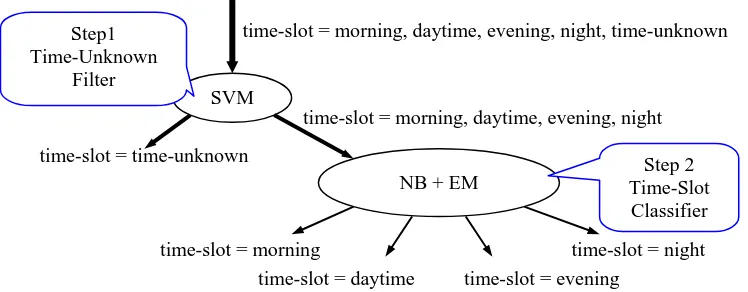
It’s desirable to treat only “time-known” sen-tences at NB+EM process to avoid the above-mentioned problems. We prepare another classi-fier for filtering time-unknown sentences before NB+EM process for that purpose. Thus, we pro-pose a classification method in 2 steps (Method A). The flow of the 2-step classification is shown in Figure 1. In this figure, ovals represent classi-fiers, and arrows represent flow of data.
The first classifier (hereafter, “time-unknown” filter) classifies sentences into two classes; unknown” and known”. The “time-known” class is a coarse class consisting of four time-slots (morning, daytime, evening, and night). We use Support Vector Machines as a classifier. The features we used are all words included in the sentence to be classified.
The second classifier (time-slot classifier) classifies “time-known” sentences into four classes. We use Naïve Bayes classifier backed up with the Expectation Maximization (EM) algo-rithm mentioned in Section 4.3.
The features for the time-slot classifier are words, whose part of speech is noun or verb. The set of these features are called NORMAL in the rest of this paper. In addition, we use information from the previous and the following sentences in the blog entry. The words included in such sen-tences are also used as features. The set of these features are called CONTEXT. The features in CONTEXT would be effective for estimating time-slot of the sentences as mentioned in Ex-ample2 in Section 3.1.
We also use a simple classifier (Method B) for comparison. The Method B classifies all time-slots (morning ~ night, time-unknown) sentences at just one step. We use Naïve Bayes classifier backed up with the Expectation Maximization (EM) algorithm at this learning. The features are words (whose part-of-speech is noun or verb) included in the sentence to be classified.
5
Experimental Results and Discussion
5.1 Slot Classifier with Time-Associated Words
5.1.1 Time-Unknown Filter
We used 11.668 positive (time-unknown) ples and 2,552 negative (morning ~ night) sam-ples. We conducted a classification experiment by Support Vector Machines with 10-fold cross
validation. We used TinySVM2 software pack-age for implementation. The soft margin parame-ter is automatically estimated by 10-fold cross validation with training data. The result is shown in Table 2.
Table 2 clarified that the “time-unknown” fil-ter achieved good performance; F-measure of 0.899. In addition, since we obtained a high re-call (0.969), many of the noisy sentences will be filtered out at this step and the classifier of the second step is likely to perform well.
Accuracy 0.878 Precision 0.838
Recall 0.969 F-measure 0.899
Table 2: Classification result of the time-unknown filter.
5.1.2 Time-Slot Classification
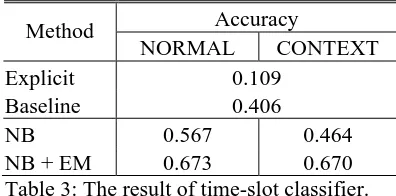
In step 2, we used “time-known” sentences clas-sified by the unknown filter as test data. We con-ducted a classification experiment by Naïve Bayes classifier + the EM algorithm with 10-fold cross validation. For unlabeled data, we used 64,782 sentences, which have no intersection with the labeled data. The parameters, λ and β, are automatically estimated by 10-fold cross validation with training data. The result is shown in Table 3.
Accuracy Method
NORMAL CONTEXT Explicit 0.109 Baseline 0.406
NB 0.567 0.464
[image:5.595.315.513.512.610.2]NB + EM 0.673 0.670
Table 3: The result of time-slot classifier.
2
Table 4: Confusion matrix of output.
morning daytime evening night
rank word p(c|w) word p(c|w) word p(c|w) word p(c|w)
1 this morning 0.729 noon 0.728 evening 0.750 last night 0.702 2 morning 0.673 early after noon 0.674 sunset 0.557 night 0.689 3 breakfast 0.659 afternoon 0.667 academy 0.448 fireworks 0.688 4 early morning 0.656 daytime 0.655 dusk 0.430 dinner 0.684 5 before noon 0.617 lunch 0.653 Hills 0.429 go to bed 0.664 6 compacted snow 0.603 lunch 0.636 run on 0.429 night 0.641 7 commute 0.561 lunch break 0.629 directions 0.429 bow 0.634
8 --- 0.541 lunch 0.607 pinecone 0.429 overtime 0.606
9 parade 0.540 noon 0.567 priest 0.428 year-end party 0.603 10 wake up 0.520 butterfly 0.558 sand beach 0.428 dinner 0.574 11 leave harbor 0.504 Chinese food 0.554 --- 0.413 beach 0.572 12 rise late 0.504 forenoon 0.541 Omori 0.413 cocktail 0.570 13 cargo work 0.504 breast-feeding 0.536 fan 0.413 me 0.562 14 alarm clock 0.497 nap 0.521 Haneda 0.412 Tomoyuki 0.560 15 --- 0.494 diaper 0.511 preview 0.402 return home 0.557 16 sunglow 0.490 Japanese food 0.502 cloud 0.396 close 0.555 17 wheel 0.479 star festival 0.502 Dominus 0.392 stay up late 0.551 18 wake up 0.477 hot noodle 0.502 slip 0.392 tonight 0.549
19 perm 0.474 pharmacy 0.477 tasting 0.391 night 0.534
20 morning paper 0.470 noodle 0.476 nest 0.386 every night 0.521 Table 5: Time-associated words examples.
In Table 3, “Explicit” indicates the result by a simple classifier based on regular expressions3 including explicit temporal expressions. The baseline method classifies all sentences into night because the number of night sentences is the largest. The “CONTEXT” column shows the results obtained by classifiers learned with the features in CONTEXT in addition to the features
3
For example, we classify sentences matching follow-ing regular expressions into mornfollow-ing class:
[(gozen)(gozen-no)(asa) (asa-no
)(am)(AM)(am-no)(AM-no)][456789(10)] ji, [(04)(05)(06)(07)(08)
[image:6.595.69.520.235.534.2](09)]ji, [(04)(05)(06)(07) (08) (09)]:[0-9]{2,2},
[456789(10)][(am)(AM)].
(“gozen”, “gozen‐no” means before noon. “asa”,
“asa-no” means morning. “ji” means o’clock.)
in NORMAL. The accuracy of the Explicit method is lower than the baseline. This means existing methods based on explicit temporal ex-pressions cannot work well in blog text. The ac-curacy of the method 'NB' exceeds that of the baseline by 16%. Furthermore, the accuracy of the proposed method 'NB+EM' exceeds that of the 'NB' by 11%. Thus, we figure out that using unlabeled data improves the performance of our time-slot classification.
In this experiment, unfortunately, CONTEXT only deteriorated the accuracy. The time-slot tags of the sentences preceding or following the target sentence may still provide information to im-prove the accuracy. Thus, we tried a sequential tagging method for sentences, in which tags are output of time-slot classifier
morning daytime evening night time-unknown sum
morning 332 14 1 37 327 711
daytime 30 212 1 44 312 599
evening 4 5 70 18 110 207
night 21 19 4 382 609 1035
time-slot tag
time-unknown 85 66 13 203 11301 11668
predicted in the order of their occurrence. The predicted tags are used as features in the predic-tion of the next tag. This type of sequential tag-ging method regard as a chunking procedure (Kudo and Matsumoto, 2000) at sentence level. We conducted time-slot (five classes) classifica-tion experiment, and tried forward tagging and backward tagging, with several window sizes. We used YamCha4, the multi-purpose text chun-ker using Support Vector Machines, as an ex-perimental tool. However, any tagging direction and window sizes did not improve the perform-ance of classification. Although a chunking method has possibility of correctly classifying a sequence of text units, it can be adversely biased by the preceding or the following tag. The sen-tences in blog used in our experiments would not have a very clear tendency in order of tags. This is why the chunking-method failed to improve the performance in this task. We would like to try other bias-free methods such as Conditional Random Fields (Lafferty et al., 2001) for future work.
5.1.3 2-step Classification
Finally, we show an accuracy of the 2-step clas-sifier (Method A) and compare it with those of other classifiers in Table 6. The accuracies are calculated with the equation:
.
In Table 6, the baseline method classifies all sentences into time-unknown because the num-ber of time-unknown sentences is the largest. Accuracy of Method A (proposed method) is higher than that of Method B (4.1% over). These results show that time-unknown sentences ad-versely affect the classifier learning, and 2-step classification is an effective method.
Table 4 shows the confusion matrix corre-sponding to the Method A (NORMAL). From this table, we can see Method A works well for classification of morning, daytime, evening, and night, but has some difficulty in
4
[image:7.595.309.525.67.159.2] [image:7.595.314.527.203.356.2]http://www.chasen.org/~taku/software/YamCha
Table 6: Comparison of the methods for five class classification
Figure 2: Change of # sentences that have time-associated words: “Explicit” indicates the num-ber of sentences including explicit temporal ex-pressions, “NE-TIME” indicates the number of sentences including NE-TIME tag.
classification of time-unknown. The 11.7% of samples were wrongly classified into “night” or “unknown”.
We briefly describe an error analysis. We found that our classifier tends to wrongly classify samples in which two or more events are written in a sentence. The followings are examples:
Example 3
a. I attended a party last night, and I got back on the first train in this morning because the party was running over.
b. I bought a cake this morning, and ate it after the dinner.
5.2 Examples of Time-Associated Words
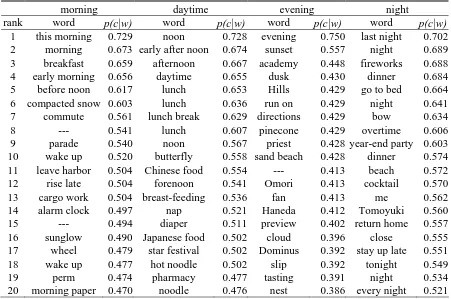
Table 5 shows some time-associated words ob-tained by the proposed method. The words are sorted in the descending order of the value of
(
c w)
P | . Although some consist of two or three words, their original forms in Japanese consist of one word. There are some expressions appearing more than once, such as “dinner”. Actually these expressions have different forms in Japanese. Meaningless (non-word) strings caused by
mor-Method Conclusive accuracy
Explicit 0.833 Baseline 0.821 Method A (NORMAL) 0.864
Method A (CONTEXT) 0.862
Method B 0.823
0 1000 2000 3000 4000 5000
1 10 20 30 40 50 60 70 80 90 100
# time-associated words (N-best)
# s
e
nt
e
nc
e
s i
nc
ludi
ng
ti
m
e
-as
so
ciat
ed
w
o
rd
s
Explicit
NE-TIME
# time-unknown sentences correctly classi-fied by the time-unknown filter
# known sentences correctly classi-fied by the time-slot classifier +
phological analysis error are presented as the symbol “---”. We obtained a lot of interesting time-associated words, such as “commute (morn-ing)”, “fireworks (night)”, and “cocktail (night)”. Most words obtained are significantly different from explicit temporal expressions and NE-TIME expressions.
Figure 2 shows the number of sentences in-cluding time-associated words in blog text. The horizontal axis represents the number of time-associated words. We sort the words in the de-scending order of and selected the top N words. The vertical axis represents the number of sentences including any N-best time-associated words. We also show the number of sentences including explicit temporal expressions, and the number of sentences including NE-TIME tag (Sekine and Isahara, 1999) for comparison. The set of explicit temporal expressions was ex-tracted by the method described in Section 5.1.2. We used a Japanese linguistic analyzer “Cabo-Cha
(
c w P |)
5
” to obtain NE-TIME information. From this graph, we can confirm that the number of target sentences of our proposed method is larger than that of existing methods.
6
Conclusion
In our study, we proposed a method for identify-ing when an event in text occurs. We succeeded in using a semi-supervised method, the Naïve Bayes Classifier enhanced by the EM algorithm, with a small amount of labeled data and a large amount of unlabeled data. In order to avoid the class imbalance problem, we used a 2-step classi-fier, which first filters out time-unknown tences and then classifies the remaining sen-tences into one of 4 classes. The proposed method outperformed the simple 1-step method. We obtained 86.4% of accuracy that exceeds the existing method and the baseline method.
References
Naoki Abe, Bianca Zadrozny, John Langford. 2004. An Iterative Method for Multi-class Cost-sensitive
Learning. In Proc. of the 10th. ACM SIGKDD,
pp.3–11.
Arthur P. Dempster, Nan M. laird, and Donald B. Rubin. 1977. Maximum likelihood from
incom-plete data via the EM algorithm. Journal of the
5
http://chasen.org/~taku/software/cabocha/
Royal Statistical Society Series B, Vol. 39, No. 1,
pp.1–38.
Wei Fan, Salvatore J. Stolfo, Junxin Zhang, Philip K. Chan. 1999. AdaCost: Misclassification
Cost-sensitive Boosting. In Proc. of ICML, pp.97–105.
Thomas Hofmann. 2001. Unsupervised learning by
probabilistic latent semantic analysis. Machine
Learning, 42:177–196.
Nathalie Japkowicz. 2000. Learning from Imbalanced Data Sets: A Comparison of Various Strategies. In
Proc. of the AAAI Workshop on Learning from Im-balanced Data Sets, pp.10 –15.
Taku Kudo, Yuji Matsumoto. 2000. Use of Support Vector Learning for Chunking Identification, In
Proc of the 4th CoNLL, pp.142–144.
John Lafferty, Andrew McCallum, and Fernando Pereira. 2001. Conditional random fields: Probabil-istic models for segmenting and labeling sequence
data, In Proc. of ICML, pp.282–289.
Inderjeet Mani, George Wilson 2000. Robust
Tempo-ral Processing of News. In Proc. of the 38th ACL,
pp.69–76.
Tomoyuki Nanno, Yasuhiro Suzuki, Toshiaki Fujiki, Manabu Okumura. 2004. Automatically Collecting
and Monitoring Japanese Weblogs. Journal for
Japanese Society for Artificial Intelligence ,
Vol.19, No.6, pp.511–520. (in Japanese)
Kamal Nigam, Andrew McCallum, Sebastian Thrun, and Tom Mitchell. 2000. Text classification from
labeled and unlabeled documents using EM.
Ma-chine Learning, Vol. 39, No.2/3, pp.103–134.
Satoshi Sekine, Hitoshi Isahara. 1999. IREX project
overview. Proceedings of the IREX Workshop.
Andrea Setzer, Robert Gaizauskas. 2001. A Pilot Study on Annotating Temporal Relations in Text. In Proc. of the ACL-2001 Workshop on Temporal and Spatial Information Processing, Toulose,
France, July, pp.88–95.
Seiji Tsuchiya, Hirokazu Watabe, Tsukasa Kawaoka. 2005. Evaluation of a Time Judgement Technique
Based on an Association Mechanism. IPSG SIG
Technical Reports,2005-NL-168, pp.113–118. (in Japanese)
Jianping Zhang, Inderjeet Mani. 2003. kNN Approach to Unbalanced Data Distributions: A Case Study
involving Information Extraction. In Proc. of