Transformation-based Interpretation of Implicit Parallel Structures:
Reconstructing the meaning of vice versa and similar linguistic operators
Helmut Horacek Fachrichtung Informatik Universit¨at des Saarlandes 66041 Saarbr¨ucken, Germany [email protected]
Magdalena Wolska
Fachrichtung Allgemeine Linguistik Universit¨at des Saarlandes 66041 Saarbr¨ucken, Germany [email protected]
Abstract
Successful participation in dialogue as well as understanding written text re-quires, among others, interpretation of specifications implicitly conveyed through parallel structures. While those whose re-construction requires insertion of a miss-ing element, such as gappmiss-ing and ellip-sis, have been addressed to a certain extent by computational approaches, there is vir-tually no work addressing parallel struc-tures headed byvice versa-like operators,
whose reconstruction requires transforma-tion. In this paper, we address the mean-ing reconstruction of such constructs by an informed reasoning process. The ap-plied techniques include building deep se-mantic representations, application of cat-egories of patterns underlying a formal reconstruction, and using pragmatically-motivated and empirically justified prefer-ences. We present an evaluation of our al-gorithm conducted on a uniform collection of texts containing the phrases in question.
1 Introduction
Specifications implicitly conveyed through paral-lel structures are an effective means of human communication. Handling these utterances ade-quately is, however, problematic for a machine since a formal reconstruction of the representation may be associated with ambiguities, typically re-quiring some degree of context understanding and domain knowledge in their interpretation. While parallel structures whose reconstruction mainly re-quires insertion, such as gapping and ellipsis, have been addressed to a certain extent by
computa-tional approaches, there is virtually no work ad-dressing parallel structures whose reconstruction requires transformation. Several linguistic opera-tors create specifications of this kind, including:
the other way (a)round, vice-versa, and analo-gously. Consider, for example, the following
state-ment made by a student in an experistate-ment with a simulated tutoring system for proving theorems in elementary set theory (Benzm¨uller et al., 2003): “If allAare contained inK(B)and this also holds
the other way round, these must be identical sets”
(K stands for set complement). The interpreta-tion of the the other way round operator is
am-biguous here in that it may operate on immediate dependents (“allK(B)are contained inA”) or on the embedded dependents (“allBare contained in K(A)”) of the verb “contain”. The fact that the
Containment relation is asymmetric and the
con-text of the task – proving that “IfA⊆K(B), then
B ⊆K(A)” holds – suggest that the second
inter-pretation is meant. Assuming this more plausible reading enables a more goal-oriented dialog: the tutorial system can focus on a response to the false conclusion made by the student about the identity of the sets in question, rather than starting a boring clarification subdialog.
The above example and several similar others motivated us to look more systematically at lexi-cal devices that create specifications of this kind. We address the interpretation of such structures by a well-informed reasoning process. Applied tech-niques include building deep semantic represen-tations, application of patterns underlying formal reconstruction, and using pragmatically-motivated and empirically justified preferences.
The outline of the paper is as follows: We de-scribe phenomena in question. Then we illustrate our natural language analysis techniques. We
gorize underlying interpretation patterns, describe the reconstruction algorithm, and evaluate it.
2 Data Collected From Corpora
In order to learn about cross-linguistic regularities in reconstructing the underlying form of propo-sitions specified by vice versa or similar
opera-tors, we first looked at several English and Ger-man corpora. These included, among others, the Negra, the Frankfurter Rundschau, the Europarl corpora and a corpus of tutorial dialogs on math-ematics (Wolska et al., 2004). We also performed several internet searches. We looked at the Ger-man phrasesandersrumand umgekehrt, and their
English equivalents vice versa and the other way (a)round. We only considered instances where the
parallel structure with a pair of items swapped is not stated explicitly. We excluded cases of the use ofumgekehrt as a discourse marker, cases in
which the transformation needed is of purely lex-ical nature, such as turning “augment” into “re-duce”, and instances ofandersrumas expressing a
purely physical change, such as altering the orien-tation of an object (cf. the Bielefeld corpus1).
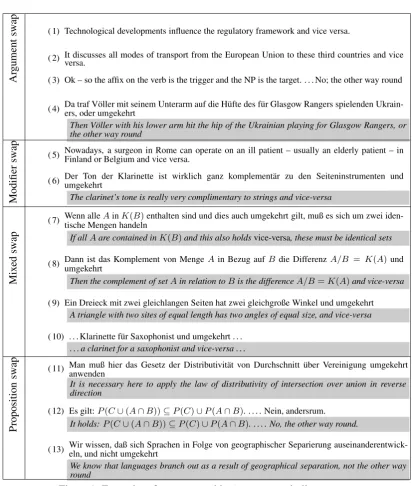
The classification ofvice versa utterances
pre-sented in Figure 1, reflects the role of the items that must be swapped to build the parallel propo-sition conveyed implicitly. The examples demon-strate that the task of reconstructing the proposi-tion left implicit in the text may be tricky.
The first category concerns swapping two case role fillers orArgumentsof a predicate head. This
may be applied to Agent and Patient dependents, as in (1), or to two directional roles as in (2). In the last example in this category, complications arise due to the fact that one of the arguments is missing on the surface and needs to be con-textually inserted prior to building the assertions with exchanged directional arguments. Moreover, the swap can also work across clauses as in (3). Complex interrelations may occur when the fillers themselves are composed structures, is in (4), which also makes swapping other pairs of items structurally possible. In this example, the need for exchanging the persons including their mentioned body parts rather than the mere body parts or just the persons requires world knowledge.
The second category comprises swapping ap-plied tomodifiersof two arguments rather than the
arguments themselves. An example is (5); the
ut-1http://www.sfb360.uni-bielefeld.de/
terance is ambiguous since, from a purely struc-tural point of view, it could also be categorized as an Argumentswap, however, given world
knowl-edge, this interpretation is rather infelicitous. Sim-ilarly to (3), a contextually-motivated enhance-ment prior to applying a swapping operation is re-quired in (6); here: a metonymic extension, i.e. expanding the “strings” to “the strings’ tones”.
The third category comprises occurrences of a “mixed” form of the first two with a modifier sub-stituted for an argument which, in turn, takes the role of the modifier in the reconstructed form. The first example, (7), has already been discussed in the Introduction. The next one, (8), illustrates re-peated occurrences of the items to be swapped. Moreover, swapping the items A and B must be propagated to the included formula. The next ex-ample, (9), is handled by applying the exchange on the basis of the surface structure: swapping the properties of a triangle for the reconstructed asser-tion. If a deeper structure of the sentence’s mean-ing is built, this would amount to an implication expressing the fact that a triangle with two sides of equal length is a triangle that has two equal angles. For such a structure, the reconstruction would fall into the next category, exchange of the order of two propositions: here, reversing the im-plication. In (10), the lexeme “Saxophonist” needs to be expanded into “Saxophone” and “Spieler” (“player”), prior to performing the exchange.
The fourth category involves a swap of entire
Propositions; in the domain of mathematics, this
may pertain to formulas. In (11), swapping applies to the sides of the equation descriptively referred to by the distributivity law. In (12), this applies to the arguments of the set inclusion relation, when the arguments are interpreted as propositions. The last example, (13), requires a structural recasting in order to apply the appropriate swapping oper-ation. When the utterance is rebuilt around the RESU LT relation, expressed as an optional case role on the surface, swapping the two propositions – “branching out of languages” and “geographical separation” – yields the desired result.
3 The Interpretation Procedure
Ar
gument
sw
ap
( 1) Technological developments influence the regulatory framework and vice versa.
( 2) It discusses all modes of transport from the European Union to these third countries and viceversa.
( 3) Ok – so the affix on the verb is the trigger and the NP is the target. . . . No; the other way round
( 4) Da traf V¨oller mit seinem Unterarm auf die H¨ufte des f¨ur Glasgow Rangers spielenden Ukrain-ers, oder umgekehrt
Then V¨oller with his lower arm hit the hip of the Ukrainian playing for Glasgow Rangers, or the other way round
Modifier
sw
ap
( 5) Nowadays, a surgeon in Rome can operate on an ill patient – usually an elderly patient – inFinland or Belgium and vice versa.
( 6) Der Ton der Klarinette ist wirklich ganz komplement¨ar zu den Seiteninstrumenten undumgekehrt
The clarinet’s tone is really very complimentary to strings and vice-versa
Mix
ed
sw
ap
( 7) Wenn alletische Mengen handelnAinK(B)enthalten sind und dies auch umgekehrt gilt, muß es sich um zwei
iden-If allAare contained inK(B)and this also holdsvice-versa, these must be identical sets
( 8) Dann ist das Komplement von MengeAin Bezug aufB die DifferenzA/B = K(A)und
umgekehrt
Then the complement of setAin relation toBis the differenceA/B=K(A)and vice-versa
( 9) Ein Dreieck mit zwei gleichlangen Seiten hat zwei gleichgroße Winkel und umgekehrt
A triangle with two sites of equal length has two angles of equal size, and vice-versa
( 10) . . . Klarinette f¨ur Saxophonist und umgekehrt . . .
. . . a clarinet for a saxophonist and vice-versa . . .
Proposition
sw
ap ( 11) Man muß hier das Gesetz der Distributivit¨at von Durchschnitt ¨uber Vereinigung umgekehrt
anwenden
It is necessary here to apply the law of distributivity of intersection over union in reverse direction
( 12) Es gilt:P(C∪(A∩B))⊆P(C)∪P(A∩B). . . Nein, andersrum.
It holds:P(C∪(A∩B))⊆P(C)∪P(A∩B). . . No, the other way round.
( 13) Wir wissen, daß sich Sprachen in Folge von geographischer Separierung auseinanderentwick-eln, und nicht umgekehrt
[image:3.595.89.502.158.645.2]We know that languages branch out as a result of geographical separation, not the other way round
contain.PRED:Containment→ ∈,⊆,⊂
[image:4.595.80.254.60.100.2]TERM:K(B).ACT:Container TERM:A.PAT:Containee
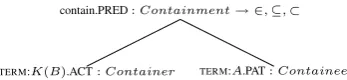
Figure 2: Interpreted representation of the utter-ance “allAare contained inK(B)”
3.1 Linguistic Analysis
The linguistic analysis consists of semantic pars-ing followed by contextually motivated embed-ding and enhancements. We assume a deep se-mantic dependency-based analysis of the source text. The input to our reconstruction algorithm is a relational structure representing a dependency-based deep semantics of the utterance, e.g. in the sense of Prague School sentence meaning, as em-ployed in the Functional Generative Description (FGD) at the tectogrammatical level (Sgall et al., 1986). In FGD, the central frame unit of a clause is the head verb which specifies the tectogram-matical relations(TRs) of its dependents ( partici-pants/modifications). Every valency frame
spec-ifies, moreover, which modifications are obliga-tory and whichoptional. For example, the
utter-ance (7) (see Figure 1.) obtains the interpretation presented in Figure 2.2 which, in the context of an informal verbalization of a step in a naive set theory proof, translates into the following formal statement: “∀x.x∈A⇒x∈K(B)”.
The meaning representations are embedded within discourse context and discourse relations between adjacent utterances are inferred where possible, based on the linguistic indicators (dis-course markers). The nodes (heads) and de-pendency relations of the interpreted dede-pendency structures as well as discourse-level relations serve as input to instantiate the reconstruction pat-terns. Contextual enhancements (e.g. lexical or metonymic extensions) driven by the reconstruc-tion requirements may be carried out.
Based on analysis of corpora, we have iden-tified combinations of dependency relations that commonly participate in the swapping operation called for by thevice versaphrases. Examples of
pairs of such relations at sentence level are shown in Figure 3.3 Similarly, in the discourse context, arguments in, for example,CAU SE,RESU LT, CON DIT ION,SEQU EN CE or LIST
rela-2We present a simplified schematic representation of the tectogrammatical representations. Where necessary, for space reasons, irrelevant parts are omitted.
3P RED is the immediate predicate head of the corre-sponding relation.
Exchangeable(ACTOR, PATIENT) Exchangeable(DIRECTION-WHERE-FROM,
DIRECTION-WHERE-TO)
Exchangeable(TIME-TILL-WHEN,
TIME-FROM-WHEN)
Exchangeable(CAUSE, PRED) Exchangeable(CONDITION, PRED)
Figure 3: Examples of exchangeable relations
tions are likely candidates for a swapping opera-tion. During processing, we use the association table as a preference criterion for selecting candi-date relations to instantiate patterns. If one of the elements of a candidate pair is anoptional argu-mentthat is not realized in the given sentence, we
look at the preceding context to find the first in-stance of the missing element. Additionally, utter-ance (10) would call for more complex procedures to identify the required metonymic expansion.
3.2 Interpretation Patterns
In order to accomplish the formal reconstruction task, we define rules that encapsulate specifica-tions for building the implicit parallel text on the basis of the corresponding co-text. The rules con-sist of a pattern and an action part. Patterns are matched against the output of a parser on a text portion in question, by identifying relevant case roles, and giving access to their fillers. Moreover, the patterns test constraints on compatibility of candidates for swapping operations. The actions apply recasting operations on the items identified by the patterns to build the implicit parallel text.
Within patterns, we perform category member-ship tests on the representation. Assuming x re-ferring to a semantic representation, P red(x) is
a logical function that checks if x has a P red -feature, i.e., it is an atomic proposition. Simi-larly,Conj(x)andSubord(x)perform more
spe-cific tests for complex propositions: coordina-tion or subordinacoordina-tion, respectively. Moreover, P red1(x, x1) accesses the first proposition and
binds it tox1, whileP red2(x, x2)does the same
for the second one. Within a proposition, argu-ments and modifiers are accessed byCase(x, y),
wherey specifies the filler of Caseinx, and in-dices express constraints on identity or distinc-tiveness of the relations. Case+ is a
1a.Argumentswap within the same clause
P red(x)∧Case1(x, y)∧Case2(x, z)∧
T ype−compatible(y, z)∧
Exchangeable(Case1, Case2)→
Swap(x, y, z, xp)
1b.Argumentswap across two clauses
Conj(x)∧Case1(x, y)∧Case(y, u)∧
Case2(x, z)∧Case(z, v)→Swap(x, u, v, xp)
2.Modifierswap
P red(x)∧Case1(x, y)∧Case+11(y, u)∧
Case2(x, z)∧Case +
21(z, v)∧
¬(Case1 =Case2)∧T ype−
compatible(u, v)→Swap(x, u, v, xp)
3.Mixedswap
P red(x)∧Case1(x, y)∧Case11(y, u)∧
Case2(x, z)∧
¬(Case1 =Case2)∧T ype−
compatible(u, z)→Swap(x, u, z, xp)
4.Propositionswap
Subord(x)∧Case1(x, y)∧Case2(x, z)∧
¬(Case1 =Case2)→Swap(x, y, z, xp)
Figure 4: Reconstruction patterns
identical. In addition to access predicates, there are test predicates that express constraints on the identified items. The most basic one is T ype -compatible(x, y), which tests whether the types
ofxandyare compatible according to an underly-ing domain ontology. A more specific test is per-formed byExchangeable(Case1, Case2)to
ac-cess the associations specified in the previous sec-tion. The action part of the patterns is realized by Swap(x, y, z, xp) which replaces all occurrences
ofxinzbyyand vice-versa, binding the result to xp. Different uses of this operation result in
dif-ferent instantiations ofyandzwith respect to the overarching structurex.
There are patterns for each category introduced in Section 2 (see Figure 4). All patterns are tested on a structure x and, if successful, the result is bound to xp. For Argument swap there are two
patterns. If the scope of the swap is a single clause (1a), two arguments (case roles) identified as exchangeable are picked. Their fillers must be compatible in types. If the swapping overarches two clauses (1b), the connecting relation must be a conjunction and subject to swapping are argu-ments in the same relations. For Modifier swap
(2), type compatible modifiers of distinct argu-ments are picked. For Mixed swap (3), a
depen-1.Lexical expansion
P red(x)∧Case1(x, y)∧Lex−
Expand(y, u, Case, v)∧
Case2(x, z)∧ ¬(Case1=
Case2)∧T ype−compatible(v, z)→
Swap(x, y, Case(u, v), xp)∧Swap(xp, z, v, xp)
2. Recast optional case as head of an obligatory
P red(x)∧Case1(x, u)∧Case2(x, v)∧
T ype(u, tu)∧T ype(v, tv)∧
Recastable(tv, Case2, tu, Case3)∧
Case3(x, w)∧T ype−compatible(v, w)∧
¬(Case1 =Case2)∧ ¬(Case1=
Case3)∧ ¬(Case2 =Case3)→
Swap(x, u, v, xp)∧Add(xp, Case3(v, u))∧
Remove(xp, Case2)
3.Recast an optional case as a discourse relation
P red(x)∧Case(x, y)∧
M ember(Case, Subords)→
Build(Case(xp, Case2(xp, y)∧
Case1(xp, Remove(x, y))
Figure 5: Recasting rules
dent is picked, as in (1a) and a type-compatible modifier of another argument, as in (2). Proposi-tionswap (4) inverts the order of the two clauses.
In addition to the the pattern matching tests, theArgumentand thePropositionswap operations
undergo a feasibility test if knowledge is avail-able about symmetry or asymmetry of the relation (theP redfeature) whose cases are subject to the swapping operation: if such a relation is known as asymmetric, the result is considered implausible due to semantic reasons, if it is symmetric, due to pragmatic reasons since the converse proposition conveys no new information; in both cases such a swapping operation is not carried out.
To extend the functionality of the patterns, we defined a set of recasting rules (Figure 5) invoked to reorganize the semantic representation prior to testing applicability of a suitable reconstruction rule. In contrast to inserting incomplete informa-tion contextually and expanding metonymic rela-tions the recasting operarela-tions are intended purely to accommodate semantic representations for this purpose. We have defined three recasting rules (numbered accordingly in Figure 5):
1. Lexical recasting
af-Build-Parallel-Structure (x)
1. Determine scopes for applying swap operations Structures←
ifP red(x)thenScopes← {x}else ifSubord(x)∨Conj(x)∧Case2(x, z)
thenScopes← {z, x} endif endif
2. Match patterns and build swapped structures
forallScope1inScopesdo
Structures←Structures∪
< X−swap(Scope1)>
< X−swap(Y −recast(Scope1))>
end forall
returnSort(Apply−priorities(Structures))
Figure 6: Reconstruction algorithm
fecting the other so closely related to it. The representation of such lexemes is expanded, provided there is a sister case with a filler that is type compatible.
2. Case recasting
The dependency among items may not be re-flected by the dependencies in the linguistic structure. Specifically, a dependent item may appear as a sister case in overarching case frame. The purpose of this operation is to build a uniform representation, by removing the dependent case role filler and inserting it as a modifier of the item it is dependent on. 3. Proposition recasting
Apart from expressing a discourse relation by a connective, a proposition filling a sub-ordinate relation may also be expressed as a case role (argument). Again, uniformity is obtained through lifting the argument (case filler) and expressing the discourse relation as a multiple clause construct.
Additional predicates are used to implement re-casting operations. For example, the predicate Lex−Expand(y, u, Case, v)re-expresses the
se-mantics of y by u, accompanied by aCase role filled by v. T ype(x, y) associates the type y with x. The type information is used to access Recastable(t1, C1, t2, C2)table to verify whether
caseC1with at1-type filler can also be expressed
as caseC2 with typet2. Build(x) creates a new
structure x. Remove(x, y) is realized as a
func-tion, deleting occurrences ofyinx, andAdd(x, y)
expandsxby an argumenty.
3.3 The Structure Building Algorithm
In this section, we describe how we build implic-itly conveyed parallel structures based on the def-initions of swapping operations with optional in-corporation of recasting operations if needed. The procedure consists of two main parts (see Fig-ure 6). In the first part, the scope for applying the swapping rules defined in Figure 4 is determined, and in the second part, the results obtained by ex-ecuting the rules are collected. Due to practical reasons, we introduce simplifications concerning the scope ofvice-versa in the current formulation
of the procedure. While the effect of this operator may range over entire paragraphs in some involved texts, we only consider single sentences with at most two coordinated clauses or one subordinated clause. We feel that this restriction is not severe for uses in application-oriented systems.
The procedure Build-Parallel-Structure takes
the last input sentence x, examines its clause structure, and binds potential scopes to vari-able Scopes. For composed sentences, the en-tire sentence (x) as well as the second clause (Case2(x, z)) is a potential scope for building
par-allel structures.
In the second part of the procedure, each swap-ping pattern is tested for the two potential scopes, and results are accumulated in Structures. The call < X − swap(Scope1) >, with X being
either Case, Argument, M ixed, or P rop ex-presses building a set of all possible instantiations of the pattern specified when applied to Scope1.
Some of these operations are additionally invoked with alternative parameters which are accommo-dated by a recasting operation fitting to the pat-tern used, that call being < X − swap(Y −
recast(Scope1)) >, where Y is Case, Lex, or
P rop. Finally, if multiple readings are generated, they are ranked according to the following priori-tized criteria:
1. The nearest scope is preferred;
2. Operations swapping “duals”, such as left-right, are given priority;
3. Candidate phrases are matched against the corpus; items with higher bigram frequencies are preferred.
semantic definitions required (e.g. for a saxophon-ist to capture example (10) in Figure 1) to define the tablesExchangeableandRecastable, and to enhance preference criteria.
4 Evaluation
We conducted an evaluation of the parallel struc-ture building algorithm on a sample of sentences from Europarl (Koehn, 2002), a parallel corpus of professionally translated proceedings of the Euro-pean Parliament aligned at the document and sen-tence level. At this point, we were able to conduct only manual evaluation. This is mainly due to the fact that we did not have access to a wide-coverage semantic dependency parser for English and Ger-man.4 In this section, we present our corpus sam-ple and the evaluation results.
Evaluation sample To build the evaluation
sam-ple, we used sentence- and word-tokenized En-glish German part of Europarl. Using regular ex-pressions, we extracted sentences with the follow-ing patterns: (i) for English, phrasesthe other way a*round or vice versa(ii) for German: (ii-1) the
word umgekehrt preceded by a sequence of und
(“and”),oder(“or”),sondern(“but”),aber(“but”)
or comma, optional one or two tokens and op-tionalnicht(“not”), (ii-2) the wordumgekehrt
pre-ceded by a sequencegilt(“holds”) and one or two
optional tokens, (ii-3): the wordanders(he)*rum.
We obtained 137 sentences.
Next, given the present limitation of our algo-rithm (see Section 3.3), we manually excluded those whose interpretation involved the preceding sentence or paragraph,5 as well as those in which the interpretation was explicitly spelled out. There were 27 such instances. Our final evaluation sam-ple consisted of 110 sentences: 82 sentences in English–German pairs and 28 German-only.6
4In the future, we are planning an automated evaluation in which as input to the implemented algorithm we would pass manually built dependency structures.
5For example, sentences such as: “Mr President , concern-ing Amendment No 25 , I think the text needs to be looked at because in the original it is the other way round to how it appears in the English text .”
6The reason for this split is that the English equivalents of the German sentences containing the wordumgekehrtmay
contain phrases other thanthe other way roundorvice versa.
Depending on context, phrases such asconversely,inorthe reverse,the opposite,on the contrarymay be used. Here, we
targeted onlythe other way roundandvice versaphrases. If
the German translation contained the word umgekehrt, and
the English source one of the alternatives to our target, in the evaluation we included only the German sentence.
Category No. of instances
Arg 64
Modifier 5
Arg/Mod 3
Mixed 6
Arg/Mixed 2
Prop 1
Arg/Prop 1
Lex 18
Other 10
[image:7.595.355.481.62.196.2]Total 110
Table 1: Distribution of patterns
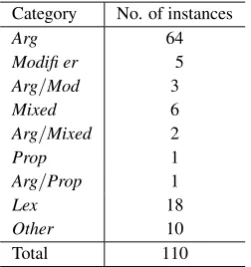
Distribution of categories We manually
cate-gorized the structures in our sample and marked the elements of the dependency structures that par-ticipate in the transformation. Table 1. presents the distribution of structure categories. We ex-plicitly included counts for alternative interpreta-tions. For example Arg/Mod means that either
the Argument or Modifier transformation can be
applied with the same effect, as in the sentence “External policy has become internal policy, and vice versa”: either the words “external” and “in-ternal” may be swapped (Modifier), or the whole
NPs “external policy” and “internal policy” ( Ar-gument). Lexmeans that none of the patterns was
applicable and a lexical paraphrase (such as use of an antonym) needed to be performed in order to re-construct the underlying semantics (i.e. no paral-lel structure was involved).Othermeans that there
was a parallel structure involved, however, none of our patterns covered the intended transformation.
Evaluation results The evaluation results are
presented in Tables 2. and 3. Table 2. shows an overview of the results. The interpretation of the result categories is as follows:
Correct: the algorithm returned the intended reading as
a unique interpretation (this includes correct identi-fication of “lexical paraphrases” (theLexcategory
in Table 1.);
Ambig.: multiple results were returned with the intended
reading among them;
Wrong: the algorithm returned a wrong result (if
multi-ple results, then the intended one was not included);
Failed: the algorithm failed to recognize a parallel
struc-ture where one existed because no known pattern matched.
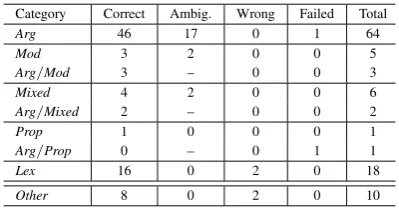
Table 3. shows within-category results. Here, Cor-rect result forOthermeans that the algorithm
Result No. of instances
Correct 75
Ambig. 21
Wrong 4
Failed 10
[image:8.595.125.239.61.137.2]Total 110
Table 2: Evaluation results
Category Correct Ambig. Wrong Failed Total
Arg 46 17 0 1 64
Mod 3 2 0 0 5
Arg/Mod 3 – 0 0 3
Mixed 4 2 0 0 6
Arg/Mixed 2 – 0 0 2
Prop 1 0 0 0 1
Arg/Prop 0 – 0 1 1
Lex 16 0 2 0 18
Other 8 0 2 0 10
Table 3: Within-category results
mean that a pattern was identified, however, this pattern was not the intended one. In two cases (false-negatives), the algorithm failed to identify a pattern even though it fell into one of the known categories (ArgumentandProp).
Discussion The most frequently occurring
pat-tern in our sample is Argument. This is often a
plausible reading. However, in 3 of the 4 false-positives (Wrong results), the resolved incorrect structure wasArg. If we were to takeArgas
base-line, aside from missing the other categories (al-together 12 instances), we would obtain the final result of 63 Correct (as opposed to 96; after col-lapsing the Correct and Ambig. categories) and 15 (as opposed to 4) Wrong results.
Let us take a closer look at the false-negative cases and the missed patterns. Two missed known categories involved multiple arguments of the main head: a modal modifier (modal verb) and an additive particles (“also”) in one case, and in the other, rephrasing after transformation. To improve performance on cases such as the former, we could incorporate an exclusion list of dependents that the transformation should disregard.
Among the patterns currently unknown to the algorithm, we found four types (one instance of each in the sample) that we can anticipate as fre-quently recurring: aim and recipient constructs involving a head and its Aim- and Beneficiary-dependent respectively, a temporal-sequence in which the order of the sequence elements is re-versed, and a comparative structure with swapped
relata. The remaining 6 structures require a more involved procedure: either the target dependent is deeply embedded or paraphrasing and/or morpho-logical transformation of the lexemes is required.
5 Conclusions and Future Research In this paper, we presented techniques of for-mal reconstruction of parallel structures implicitly specified by vice versa or similar operators. We
addressed the problem by a domain-independent analysis method that uses deep semantics and con-textually enhanced representations, exploits re-casting rules to accommodate linguistic variations into uniform expressions, and makes use of pat-terns to match parallel structure categories.
Although we dedicated a lot of effort to building a principled method, the success is limited with respect to the generality of the problem: in some cases, the scope of reconstruction overarches en-tire paragraphs and deciding about the form re-quires considerable inferencing (cf. collection at http://www.chiasmus.com/). For our purposes, we are interested in expanding our method to other kinds of implicit structures in the tutorial context, for example, interpretations of references to analo-gies, in the case of which structure accommoda-tion and swapping related items should also be prominent parts.
References
C. Benzm¨uller, A. Fiedler, M. Gabsdil, H. Horacek, I. Kruijff-Korbayov´a, M. Pinkal, J. Siekmann, D. Tsovaltzi, B.Q. Vo, and M. Wolska. 2003. A Wizard-of-Oz experiment for tutorial dialogues in mathematics. InSupplementary Proceedings of the 11th Conference on Artificial Intelli-gence in Education (AIED-03); Vol. VIII. Workshop on Advanced Technologies for Mathematics Education, pages
471–481, Sydney, Australia.
P. Koehn. 2002. Europarl: A multilingual corpus for evalua-tion of machine translaevalua-tion, Draft, Unpublished.
P. Sgall, E. Hajiˇcov´a, and J. Panevov´a. 1986.The meaning of the sentence in its semantic and pragmatic aspects. Reidel
Publishing Company, Dordrecht, The Netherlands. M. Wolska, B.Q. Vo, D. Tsovaltzi, I. Kruijff-Korbayov´a,
E. Karagjosova, H. Horacek, M. Gabsdil, A. Fiedler, and C. Benzm¨uller. 2004. An annotated corpus of tutorial dialogs on mathematical theorem proving. In Proceed-ings of the 4th International Conference on Language Resources and Evaluation (LREC-04), pages 1007–1010,
[image:8.595.78.278.177.283.2]