Proceedings of the 49th Annual Meeting of the Association for Computational Linguistics:shortpapers, pages 496–501,
Putting it Simply: a Context-Aware Approach to Lexical Simplification
Or Biran Computer Science Columbia University New York, NY 10027 [email protected]
Samuel Brody
Communication & Information Rutgers University New Brunswick, NJ 08901
No´emie Elhadad Biomedical Informatics
Columbia University New York, NY 10032 [email protected]
Abstract
We present a method for lexical simplifica-tion. Simplification rules are learned from a comparable corpus, and the rules are applied in a context-aware fashion to input sentences. Our method is unsupervised. Furthermore, it does not require any alignment or correspon-dence among the complex and simple corpora. We evaluate the simplification according to three criteria: preservation of grammaticality, preservation of meaning, and degree of sim-plification. Results show that our method out-performs an established simplification base-line for both meaning preservation and sim-plification, while maintaining a high level of grammaticality.
1 Introduction
The task of simplification consists of editing an in-put text into a version that is less complex linguisti-cally or more readable. Automated sentence sim-plification has been investigated mostly as a pre-processing step with the goal of improving NLP tasks, such as parsing (Chandrasekar et al., 1996; Siddharthan, 2004; Jonnalagadda et al., 2009), se-mantic role labeling (Vickrey and Koller, 2008) and summarization (Blake et al., 2007). Automated sim-plification can also be considered as a way to help end users access relevant information, which would be too complex to understand if left unedited. As such, it was proposed as a tool for adults with aphasia (Carroll et al., 1998; Devlin and Unthank, 2006), hearing-impaired people (Daelemans et al., 2004), readers with low-literacy skills (Williams and Reiter, 2005), individuals with intellectual disabil-ities (Huenerfauth et al., 2009), as well as health
INPUT: In 1900, Omaha was the center of a national uproar over the kidnapping of Edward Cudahy, Jr., the son of a local meatpackingmagnate.
CANDIDATE RULES:
{magnate→king} {magnate→businessman}
OUTPUT:In 1900, Omaha was the center of a national uproar over the kidnapping of Edward Cudahy, Jr., the son of a local meatpackingbusinessman.
Figure 1: Input sentence, candidate simplification rules, and output sentence.
consumers looking for medical information (El-hadad and Sutaria, 2007; Del´eger and Zweigen-baum, 2009).
Simplification can take place at different levels of a text – its overall document structure, the syntax of its sentences, and the individual phrases or words in a sentence. In this paper, we present a sentence simplification approach, which focuses on lexical simplification.1 The key contributions of our work are (i) an unsupervised method for learning pairs of complex and simpler synonyms; and (ii) a context-aware method for substituting one for the other.
Figure 1 shows an example input sentence. The wordmagnateis determined as a candidate for sim-plification. Two learned rules are available to the simplification system (substitutemagnatewithking or with businessman). In the context of this sen-tence, the second rule is selected, resulting in the simpler output sentence.
Our method contributes to research on lexical simplification (both learning of rules and actual sen-tence simplification), a topic little investigated thus far. From a technical perspective, the task of lexi-cal simplification bears similarity with that of
para-1
Our resulting system is available for download at http://www.cs.columbia.edu/ ob2008/
phrase identification (Androutsopoulos and Malaka-siotis, 2010) and the SemEval-2007 English Lexi-cal Substitution Task (McCarthy and Navigli, 2007). However, these do not consider issues of readabil-ity and linguistic complexreadabil-ity. Our methods lever-age a large comparable collection of texts: En-glish Wikipedia2 and Simple English Wikipedia3. Napoles and Dredze (2010) examined Wikipedia Simple articles looking for features that characterize a simple text, with the hope of informing research in automatic simplification methods. Yatskar et al. (2010) learn lexical simplification rules from the edit histories of Wikipedia Simple articles. Our method differs from theirs, as we rely on the two corpora as a whole, and do not require any aligned or designated simple/complex sentences when learning simplifica-tion rules.4
2 Data
We rely on two collections – English Wikipedia (EW) and Simple English Wikipedia (SEW). SEW is a Wikipedia project providing articles in Sim-ple English, a version of English which uses fewer words and easier grammar, and which aims to be easier to read for children, people who are learning English and people with learning difficulties. Due to the labor involved in simplifying Wikipedia articles, only about 2% of the EW articles have been simpli-fied.
Our method does not assume any specific align-ment or correspondance between individual EW and SEW articles. Rather, we leverage SEW only as an example of an in-domain simple corpus, in or-der to extract word frequency estimates. Further-more, we do not make use of any special properties of Wikipedia (e.g., edit histories). In practice, this means that our method is suitable for other cases where there exists a simplified corpus in the same domain.
The corpora are a snapshot as of April 23, 2010. EW contains 3,266,245 articles, and SEW contains 60,100 articles. The articles were preprocessed as follows: all comments, HTML tags, and Wiki links were removed. Text contained in tables and figures
2http://en.wikipedia.org 3
http://simple.wikipedia.org 4
Aligning sentences in monolingual comparable corpora has been investigated (Barzilay and Elhadad, 2003; Nelken and Shieber, 2006), but is not a focus for this work.
was excluded, leaving only the main body text of the article. Further preprocessing was carried out with the Stanford NLP Package5to tokenize the text, transform all words to lower case, and identify sen-tence boundaries.
3 Method
Our sentence simplification system consists of two main stages: rule extraction and simplification. In the first stage, simplification rules are extracted from the corpora. Each rule consists of an ordered word pair{original→simplified}along with a score indi-cating the similarity between the words. In the sec-ond stage, the system decides whether to apply a rule (i.e., transform the original word into the simplified one), based on the contextual information.
3.1 Stage 1: Learning Simplification Rules
3.1.1 Obtaining Word Pairs
All content words in the English Wikipedia Cor-pus (excluding stop words, numbers, and punctua-tion) were considered as candidates for simplifica-tion. For each candidate wordw, we constructed a context vectorCVw, containing co-occurrence
infor-mation within a 10-token window. Each dimension iin the vector corresponds to a single word wi in
the vocabulary, and a single dimension was added to represent any number token. The value in each di-mensionCVw[i]of the vector was the number of
oc-currences of the corresponding wordwiwithin a
ten-token window surrounding an instance of the candi-date wordw. Values below a cutoff (2 in our exper-iments) were discarded to reduce noise and increase performance.
Next, we consider candidates for substitution. From all possible word pairs (the Cartesian product of all words in the corpus vocabulary), we first re-move pairs of morphological variants. For this pur-pose, we use MorphAdorner6for lemmatization, re-moving words which share a common lemma. We also prune pairs where one word is a prefix of the other and the suffix is in{s, es, ed, ly, er, ing}. This handles some cases which are not covered by Mor-phAdorner. We use WordNet (Fellbaum, 1998) as a primary semantic filter. From all remaining word pairs, we select those in which the second word, in
5http://nlp.stanford.edu/software/index.shtml 6
its first sense (as listed in WordNet)7 is a synonym or hypernym of the first.
Finally, we compute the cosine similarity scores for the remaining pairs using their context vectors.
3.1.2 Ensuring Simplification
From among our remaining candidate word pairs, we want to identify those that represent a complex word which can be replaced by a simpler one. Our definition of the complexity of a word is based on two measures: thecorpus complexityand thelexical complexity. Specifically, we define thecorpus com-plexityof a word as
Cw =
fw,English
fw,Simple
wherefw,c is the frequency of wordw in corpusc,
and thelexical complexityasLw = |w|, the length
of the word. The final complexityχw for the word
is given by the product of the two.
χw=Cw×Lw
After calculating the complexity of all words par-ticipating in the word pairs, we discard the pairs for which the first word’s complexity is lower than that of the second. The remaining pairs constitute the final list of substitution candidates.
3.1.3 Ensuring Grammaticality
To ensure that our simplification substitutions maintain the grammaticality of the original sentence, we generate grammatically consistent rules from the substitution candidate list. For each candidate pair (original, simplified), we generate all consis-tent forms(fi(original), fi(substitute))of the two
words using MorphAdorner. For verbs, we create the forms for all possible combinations of tenses and persons, and for nouns we create forms for both sin-gular and plural.
For example, the word pair(stride, walk)will gen-erate the form pairs (stride, walk), (striding, walk-ing), (strode, walked)and(strides, walks). Signifi-cantly, the word pair(stride, walked) will generate
7Senses in WordNet are listed in order of frequency. Rather than attempting explicit disambiguation and adding complex-ity to the model, we rely on the first sense heuristic, which is know to be very strong, along with contextual information, as described in Section 3.2.
exactly the same list of form pairs, eliminating the original ungrammatical pair.
Finally, each pair(fi(original),fi(substitute))
be-comes a rule {fi(original) → fi(substitute)},
with weightSimilarity(original, substitute).
3.2 Stage 2: Sentence Simplification
Given an input sentence and the set of rules learned in the first stage, this stage determines which words in the sentence should be simplified, and applies the corresponding rules. The rules are not applied blindly, however; the context of the input sentence influences the simplification in two ways:
Word-Sentence Similarity First, we want to en-sure that the more complex word, which we are at-tempting to simplify, was not used precisely because of its complexity - to emphasize a nuance or for its specific shade of meaning. For example, suppose we have a rule{Han→Chinese}. We would want to apply it to a sentence such as“In 1368 Han rebels drove out the Mongols”, but to avoid applying it to a sentence like“The history of the Han ethnic group is closely tied to that of China”. The existence of related words like ethnic and China are clues that the latter sentence is in a specific, rather than gen-eral, context and therefore a more general and sim-pler hypernym is unsuitable. To identify such cases, we calculate the similarity between the target word (the candidate for replacement) and the input sen-tence as a whole. If this similarity is too high, it might be better not to simplify the original word.
Context Similarity The second factor has to do with ambiguity. We wish to detect and avoid cases where a word appears in the sentence with a differ-ent sense than the one originally considered when creating the simplification rule. For this purpose, we examine the similarity between the rule as a whole (including both the original and the substitute words, and their associated context vectors) and the context of the input sentence. If the similarity is high, it is likely the original word in the sentence and the rule are about the same sense.
3.2.1 Simplification Procedure
Type Gram. Mean. Simp. Baseline 70.23(+13.10)% 55.95% 46.43% System 77.91(+8.14)% 62.79% 75.58%
Table 1: Average scores in three categories: grammatical-ity (Gram.), meaning preservation (Mean.) and simplifi-cation (Simp.). For grammaticality, we show percent of examples judged asgood, withokpercent in parentheses.
For all other sentences, each content word is ex-amined in order, ignoring words inside quotation marks or parentheses. For each word w, the set of relevant simplification rules {w → x}is retrieved. For each rule {w → x}, unless the replacement wordxalready appears in the sentence, our system does the following:
• Build the vector of sentence contextSCVs,win a
similar manner to that described in Section 3.1, using the words in a 10-token window surround-ingwin the input sentence.
• Calculate the cosine similarity of CVw and
SCVs,w. If this value is larger than a manually
specified threshold (0.1 in our experiments), do notuse this rule.
• Create a common context vectorCCVw,xfor the
rule {w → x}. The vector contains all fea-tures common to both words, with the feature values that are the minimum between them. In other words,CCVw,x[i] =min(CVw[i], CVx[i]).
We calculate the cosine similarity of the common context vector and the sentence context vector:
ContextSim=cosine(CCVw,x, SCVs,w)
If the context similarity is larger than a threshold (0.01), weusethis rule to simplify.
If multiple rules apply for the same word, we use the one with the highest context similarity.
4 Experimental Setup
Baseline We employ the method of Devlin and Unthank (2006) which replaces a word with its most frequent synonym (presumed to be the simplest) as our baseline. To provide a fairer comparison to our system, we add the restriction that the synonyms should not share a prefix of four or more letters (a baseline version of lemmatization) and use Mor-phAdorner to produce a form that agrees with that of the original word.
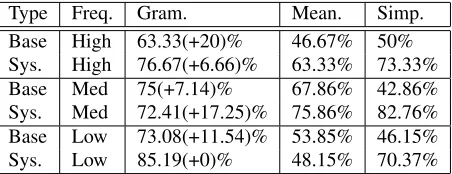
Type Freq. Gram. Mean. Simp. Base High 63.33(+20)% 46.67% 50% Sys. High 76.67(+6.66)% 63.33% 73.33% Base Med 75(+7.14)% 67.86% 42.86% Sys. Med 72.41(+17.25)% 75.86% 82.76% Base Low 73.08(+11.54)% 53.85% 46.15% Sys. Low 85.19(+0)% 48.15% 70.37%
Table 2: Average scores by frequency band
Evaluation Dataset We sampled simplification examples for manual evaluation with the following criteria. Among all sentences in English Wikipedia, we first extracted those where our system chose to simplify exactly one word, to provide a straightfor-ward example for the human judges. Of these, we chose the sentences where the baseline could also be used to simplify the target word (i.e., the word had a more frequent synonym), and the baseline re-placement was different from the system choice. We included only a single example (simplified sentence) for each rule.
The evaluation dataset contained 65 sentences. Each was simplified by our system and the baseline, resulting in 130 simplification examples (consisting of anoriginaland asimplifiedsentence).
Frequency Bands Although we included only a single example of each rule, some rules could be applied much more frequently than others, as the words and associated contexts were common in the dataset. Since this factor strongly influences the utility of the system, we examined the performance along different frequency bands. We split the eval-uation dataset into three frequency bands of roughly equal size, resulting in 46high, 44medand 40low.
Judgment Guidelines We divided the simplifica-tion examples among three annotators8and ensured that no annotator saw both the system and baseline examples for the same sentence. Each simplification example was rated on three scales:Grammaticality - bad, ok, orgood; Meaning- did the transforma-tion preserve the original meaning of the sentence; andSimplification- did the transformation result in
[image:4.612.315.541.72.159.2]a simpler sentence.
5 Results and Discussion
Table 1 shows the overall results for the experiment. Our method is quantitatively better than the base-line at both grammaticality and meaning preserva-tion, although the difference is not statistically sig-nificant. For our main goal of simplification, our method significantly (p < 0.001) outperforms the baseline, which represents the established simplifi-cation strategy of substituting a word with its most frequent WordNet synonym. The results demon-strate the value of correctly representing and ad-dressing content when attempting automatic simpli-fication.
Table 2 contains the results for each of the fre-quency bands. Grammaticality is not strongly influ-enced by frequency, and remains between 80-85% for both the baseline and our system (considering the ok judgment as positive). This is not surpris-ing, since the method for ensuring grammaticality is largely independent of context, and relies mostly on a morphological engine. Simplification varies some-what with frequency, with the best results for the medium frequency band. In all bands, our system is significantly better than the baseline. The most no-ticeable effect is for preservation of meaning. Here, the performance of the system (and the baseline) is the best for the medium frequency group. However, the performance drops significantly for the low fre-quency band. This is most likely due to sparsity of data. Since there are few examples from which to learn, the system is unable to effectively distinguish between different contexts and meanings of the word being simplified, and applies the simplification rule incorrectly.
These results indicate our system can be effec-tively used for simplification of words that occur frequently in the domain. In many scenarios, these are precisely the cases where simplification is most desirable. For rare words, it may be advisable to maintain the more complex form, to ensure that the meaning is preserved.
Future Work Because the method does not place any restrictions on the complex and simple corpora, we plan to validate it on different domains and ex-pect it to be easily portable. We also plan to extend
our method to larger spans of texts, beyond individ-ual words.
References
Androutsopoulos, Ion and Prodromos Malakasiotis. 2010. A survey of paraphrasing and textual entail-ment methods. Journal of Artificial Intelligence Research38:135–187.
Barzilay, Regina and Noemie Elhadad. 2003. Sen-tence alignment for monolingual comparable cor-pora. InProc. EMNLP. pages 25–32.
Blake, Catherine, Julia Kampov, Andreas Or-phanides, David West, and Cory Lown. 2007. Query expansion, lexical simplification, and sen-tence selection strategies for multi-document summarization. InProc. DUC.
Carroll, John, Guido Minnen, Yvonne Canning, Siobhan Devlin, and John Tait. 1998. Practical simplication of english newspaper text to assist aphasic readers. InProc. AAAI Workshop on Inte-grating Artificial Intelligence and Assistive Tech-nology.
Chandrasekar, R., Christine Doran, and B. Srinivas. 1996. Motivations and methods for text simplifi-cation. InProc. COLING.
Daelemans, Walter, Anja Hthker, and Erik Tjong Kim Sang. 2004. Automatic sentence simplification for subtitling in Dutch and English. InProc. LREC. pages 1045–1048.
Del´eger, Louise and Pierre Zweigenbaum. 2009. Extracting lay paraphrases of specialized expres-sions from monolingual comparable medical cor-pora. In Proc. Workshop on Building and Using Comparable Corpora. pages 2–10.
Devlin, Siobhan and Gary Unthank. 2006. Help-ing aphasic people process online information. In Proc. ASSETS. pages 225–226.
Elhadad, Noemie and Komal Sutaria. 2007. Mining a lexicon of technical terms and lay equivalents. InProc. ACL BioNLP Workshop. pages 49–56.
Fellbaum, Christiane, editor. 1998. WordNet: An Electronic Database. MIT Press, Cambridge, MA.
for text readability software for adults with intel-lectual disabilities. InProc. ASSETS. pages 3–10.
Jonnalagadda, Siddhartha, Luis Tari, J¨org Haken-berg, Chitta Baral, and Graciela Gonzalez. 2009. Towards effective sentence simplification for au-tomatic processing of biomedical text. In Proc. NAACL-HLT. pages 177–180.
McCarthy, Diana and Roberto Navigli. 2007. Semeval-2007 task 10: English lexical substitu-tion task. InProc. SemEval. pages 48–53.
Napoles, Courtney and Mark Dredze. 2010. Learn-ing simple wikipedia: a cogitation in ascertainLearn-ing abecedarian language. In Proc. of the NAACL-HLT Workshop on Computational Linguistics and Writing. pages 42–50.
Nelken, Rani and Stuart Shieber. 2006. Towards robust context-sensitive sentence alignment for monolingual corpora. InProc. EACL. pages 161– 166.
Siddharthan, Advaith. 2004. Syntactic simplifica-tion and text cohesion. Technical Report UCAM-CL-TR-597, University of Cambridge, Computer Laboratory.
Vickrey, David and Daphne Koller. 2008. Apply-ing sentence simplification to the CoNLL-2008 shared task. InProc. CoNLL. pages 268–272.
Williams, Sandra and Ehud Reiter. 2005. Generating readable texts for readers with low basic skills. In Proc. ENLG. pages 127–132.