Proceedings of the 49th Annual Meeting of the Association for Computational Linguistics:shortpapers, pages 445–449,
On-line Language Model Biasing for Statistical Machine Translation
Sankaranarayanan Ananthakrishnan, Rohit Prasad and Prem Natarajan Raytheon BBN Technologies
Cambridge, MA 02138, U.S.A.
{sanantha,rprasad,pnataraj}@bbn.com
Abstract
The language model (LM) is a critical com-ponent in most statistical machine translation (SMT) systems, serving to establish a proba-bility distribution over the hypothesis space. Most SMT systems use a static LM, inde-pendent of the source language input. While previous work has shown that adapting LMs based on the input improves SMT perfor-mance, none of the techniques has thus far been shown to be feasible for on-line sys-tems. In this paper, we develop a novel mea-sure of cross-lingual similarity for biasing the LM based on the test input. We also illustrate an efficient on-line implementation that sup-ports integration with on-line SMT systems by transferring much of the computational load off-line. Our approach yields significant re-ductions in target perplexity compared to the static LM, as well as consistent improvements in SMT performance across language pairs (English-Dari and English-Pashto).
1 Introduction
While much of the focus in developing a statistical machine translation (SMT) system revolves around the translation model (TM), most systems do not emphasize the role of the language model (LM). The latter generally follows an-gram structure and is es-timated from a large, monolingual corpus of target sentences. In most systems, the LM is independent of the test input, i.e. fixedn-gram probabilities de-termine the likelihood of all translation hypotheses, regardless of the source input.
The views expressed are those of the author and do not reflect the official policy or position of the Department of Defense or the U.S. Government.
Some previous work exists in LM adaptation for SMT. Snover et al. (2008) used a cross-lingual infor-mation retrieval (CLIR) system to select a subset of target documents “comparable” to the source docu-ment; bias LMs estimated from these subsets were interpolated with a static background LM. Zhao et al. (2004) converted initial SMT hypotheses to queries and retrieved similar sentences from a large monolingual collection. The latter were used to build source-specific LMs that were then interpo-lated with a background model. A similar approach was proposed by Kim (2005). While feasible in off-line evaluations where the test set is relatively static, the above techniques are computationally expensive and therefore not suitable for low-latency, interac-tive applications of SMT. Examples include speech-to-speech and web-based interactive translation sys-tems, where test inputs are user-generated and pre-clude off-line LM adaptation.
In this paper, we present a novel technique for weighting a LM corpus at the sentence level based on the source language input. The weighting scheme relies on a measure of cross-lingual similarity evalu-ated by projecting sparse vector representations of the target sentences into the space of source sen-tences using a transformation matrix computed from the bilingual parallel data. The LM estimated from this weighted corpus boosts the probability of rele-vant targetn-grams, while attenuating unrelated tar-get segments. Our formulation, based on simple ideas in linear algebra, alleviates run-time complex-ity by pre-computing the majorcomplex-ity of intermediate products off-line.
Distribution Statement “A” (Approved for Public Release, Distribution Unlimited)
2 Cross-Lingual Similarity
We propose a novel measure of cross-lingual simi-larity that evaluates the likeness between an arbitrary pair of source and target language sentences. The proposed approach represents the source and target sentences in sparse vector spaces defined by their corresponding vocabularies, and relies on a bilingual projection matrix to transform vectors in the target language space to the source language space.
LetS ={s1, . . . , sM}andT ={t1, . . . , tN}
rep-resent the source and target language vocabularies. Let u represent the candidate source sentence in a M-dimensional vector space, whosemthdimension
umrepresents the count of vocabulary itemsmin the
sentence. Similarly, vrepresents the candidate
tar-get sentence in aN-dimensional vector space. Thus,
u and v are sparse term-frequency vectors.
Tra-ditionally, the cosine similarity measure is used to evaluate the likeness of two term-frequency repre-sentations. However,uandvlie in different vector
spaces. Thus, it is necessary to find a projection of
vin the source vocabulary vector space before
sim-ilarity can be evaluated.
Assuming we are able to compute a M × N -dimensional bilingual word co-occurrence matrixΣ
from the SMT parallel corpus, the matrix-vector product ˆu = Σvis a projection of the target
sen-tence in the source vector space. Those source terms of theM-dimensional vectorˆuwill be emphasized
that most frequently co-occur with the target terms inv. In other words,uˆcan be interpreted as a
“bag-of-words” translation ofv.
The cross-lingual similarity between the candi-date source and target sentences then reduces to the cosine similarity between the source term-frequency vector u and the projected target term-frequency
vectorˆu, as shown in Equation 2.1:
S(u,v) = 1 kukkuˆku
Tuˆ
= 1
kukkΣvku
TΣv (2.1)
In the above equation, we ensure that bothu and ˆ
u are normalized to unit L
2-norm. This prevents
over- or under-estimation of cross-lingual similarity due to sentence length mismatch.
We estimate the bilingual word co-occurrence matrix Σ from an unsupervised, automatic word
alignment induced over the parallel training corpus
P. We use the GIZA++ toolkit (Al-Onaizan et al., 1999) to estimate the parameters of IBM Model 4 (Brown et al., 1993), and combine the forward and backward Viterbi alignments to obtain many-to-many word alignments as described in Koehn et al. (2003). The (m, n)th entry Σm,n of this matrix is
the number of times source wordsmaligns to target
wordtninP.
3 Language Model Biasing
In traditional LM training,n-gram counts are evalu-ated assuming unit weight for each sentence. Our approach to LM biasing involves re-distributing these weights to favor target sentences that are “sim-ilar” to the candidate source sentence according to the measure of cross-lingual similarity developed in Section 2. Thus, n-grams that appear in the trans-lation hypothesis for the candidate input will be as-signed high probability by the biased LM, and vice-versa.
Letube the term-frequency representation of the
candidate source sentence for which the LM must be biased. The set of vectors {v
1, . . . ,vK} similarly
represent theK target LM training sentences. We compute the similarity of the source sentence u to
each target sentencevj according to Equation 3.1:
ωj =S(u,vj)
= 1
kukkΣvjk
uTΣvj (3.1)
The biased LM is estimated by weightingn-gram counts collected from the jth target sentence with the corresponding cross-lingual similarityωj.
How-ever, this is computationally intensive because: (a) LM corpora usually consist of hundreds of thou-sands or millions of sentences; ωj must be
eval-uated at run-time for each of them, and (b) the entire LM must be re-estimated at run-time from
n-gram counts weighted by sentence-level cross-lingual similarity.
n-gram t. We define ct = c1
t, . . . , cKt T
to be the indicator-count vector where cjt is the unbi-ased count of t in target sentence j. Let ω = [ω1, . . . , ωK]T be the vector representing
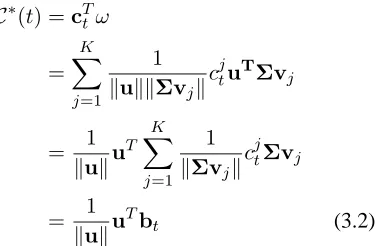
cross-lingual similarity between the candidate source sen-tence and each of theK target sentences. Then, the biased count of this n-gram, denoted by C∗(t), is
given by Equation 3.2:
C∗(t) =cT tω
= K X
j=1 1 kukkΣvjkc
j
tuTΣvj
= 1 kuk
uT K X
j=1 1 kΣvjkc
j tΣvj
= 1 kuku
Tb
t (3.2)
The vectorbtcan be interpreted as the projection
of targetn-gramtin the source space. Note thatbtis
independent of the source inputu, and can therefore
be pre-computed off-line. At run-time, the biased count of any n-gram can be obtained via a simple dot product. This adds very little on-line time com-plexity becauseuis a sparse vector. Sincebtis
tech-nically a dense vector, the space complexity of this approach may seem very high. In practice, the mass ofbtis concentrated around a very small number of
source words that frequently co-occur with targetn -gram t; thus, it can be “sparsified” with little or no loss of information by simply establishing a cutoff threshold on its elements. Biased counts and proba-bilities can be computed on demand for specificn -grams without re-estimating the entire LM.
4 Experimental Results
We measure the utility of the proposed LM bias-ing technique in two ways: (a) given a parallel test corpus, by comparing source-conditional target per-plexity with biased LMs to target perper-plexity with the static LM, and (b) by comparing SMT performance with static and biased LMs. We conduct experi-ments on two resource-poor language pairs commis-sioned under the DARPA Transtac speech-to-speech translation initiative, viz. English-Dari (E2D) and English-Pashto (E2P), on test sets with single as well as multiple references.
Data set E2D E2P
TM Training 138k pairs 168k pairs LM Training 179k sentences 302k sentences Development 3,280 pairs 2,385 pairs Test (1-ref) 2,819 pairs 1,113 pairs
[image:3.612.111.299.201.324.2]Test (4-ref) - 564 samples
Table 1: Data configuration for perplexity/SMT experi-ments. Multi-reference test set is not available for E2D. LM training data in words: 2.4M (Dari), 3.4M (Pashto)
4.1 Data Configuration
Parallel data were made available under the Transtac program for both language pairs evaluated in this pa-per. We divided these into training, held-out devel-opment, and test sets for building, tuning, and evalu-ating the SMT system, respectively. These develop-ment and test sets provide only one reference trans-lation for each source sentence. For E2P, DARPA has made available to all program participants an additional evaluation set with multiple (four) refer-ences for each test input. The Dari and Pashto mono-lingual corpora for LM training are a superset of tar-get sentences from the parallel training corpus, con-sisting of additional untranslated sentences, as well as data derived from other sources, such as the web. Table 1 lists the corpora used in our experiments.
4.2 Perplexity Analysis
For both Dari and Pashto, we estimated a static trigram LM with unit sentence level weights that served as a baseline. We tuned this LM by varying the bigram and trigram frequency cutoff thresholds to minimize perplexity on the held-out target sen-tences. Finally, we evaluated test target perplexity with the optimized baseline LM.
Eval set Static Biased Reduction E2D-1ref-dev 159.3 137.7 13.5% E2D-1ref-tst 178.3 156.3 12.3% E2P-1ref-dev 147.3 130.6 11.3% E2P-1ref-tst 122.7 108.8 11.3%
Table 2: Reduction in perplexity using biased LMs.
Witten-Bell discounting was used for smoothing all LMs. Table 2 summarizes the reduction in target perplexity using biased LMs; on the E2D and E2P single-reference test sets, we obtained perplexity re-ductions of 12.3% and 11.3%, respectively. This in-dicates that the biased models are significantly better predictors of the corresponding target sentences than the static baseline LM.
4.3 Translation Experiments
Having determined that target sentences of a parallel test corpus better fit biased LMs estimated from the corresponding source-weighted training corpus, we proceeded to conduct SMT experiments on both lan-guage pairs to demonstrate the utility of biased LMs in improving translation performance.
We used an internally developed phrase-based SMT system, similar to Moses (Koehn et al., 2007), as a test-bed for our translation experiments. We used GIZA++ to induce automatic word alignments from the parallel training corpus. Phrase translation rules (up to a maximum source span of 5 words) were extracted from a combination of forward and backward word alignments (Koehn et al., 2003). The SMT decoder uses a log-linear model that com-bines numerous features, including but not limited to phrase translation probability, LM probability, and distortion penalty, to estimate the posterior proba-bility of target hypotheses. We used minimum error rate training (MERT) (Och, 2003) to tune the feature weights for maximum BLEU (Papineni et al., 2001) on the development set. Finally, we evaluated SMT performance on the test set in terms of BLEU and TER (Snover et al., 2006).
The baseline SMT system used the static trigram LM with cutoff frequencies optimized for minimum perplexity on the development set. Biased LMs (withn-gram cutoffs tuned as above) were estimated for all source sentences in the development and test
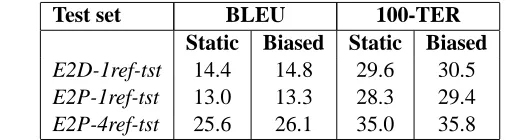
[image:4.612.293.546.72.142.2]Test set BLEU 100-TER Static Biased Static Biased E2D-1ref-tst 14.4 14.8 29.6 30.5 E2P-1ref-tst 13.0 13.3 28.3 29.4 E2P-4ref-tst 25.6 26.1 35.0 35.8
Table 3: SMT performance with static and biased LMs.
sets, and were used to decode the corresponding in-puts. Table 3 summarizes the consistent improve-ment in BLEU/TER across multiple test sets and language pairs.
5 Discussion and Future Work
Existing methods for target LM biasing for SMT rely on information retrieval to select a comparable subset from the training corpus. A foreground LM estimated from this subset is interpolated with the static background LM. However, given the large size of a typical LM corpus, these methods are unsuitable for on-line, interactive SMT applications.
In this paper, we proposed a novel LM biasing technique based on linear transformations of target sentences in a sparse vector space. We adopted a fine-grained approach, weighting individual target sentences based on the proposed measure of cross-lingual similarity, and by using the entire, weighted corpus to estimate a biased LM. We then sketched an implementation that improves the time and space ef-ficiency of our method by pre-computing and “spar-sifying”n-gram projections off-line during the train-ing phase. Thus, our approach can be integrated within on-line, low-latency SMT systems. Finally, we showed that biased LMs yield significant reduc-tions in target perplexity, and consistent improve-ments in SMT performance.
References
Yaser Al-Onaizan, Jan Curin, Michael Jahr, Kevin Knight, John Lafferty, Dan Melamed, Franz Josef Och, David Purdy, Noah A. Smith, and David Yarowsky. 1999. Statistical machine translation: Final report. Technical report, JHU Summer Workshop.
Peter E. Brown, Vincent J. Della Pietra, Stephen A. Della Pietra, and Robert L. Mercer. 1993. The math-ematics of statistical machine translation: parameter estimation. Computational Linguistics, 19:263–311. Woosung Kim. 2005. Language Model Adaptation for
Automatic Speech Recognition and Statistical Machine Translation. Ph.D. thesis, The Johns Hopkins Univer-sity, Baltimore, MD.
Philipp Koehn, Franz Josef Och, and Daniel Marcu. 2003. Statistical phrase-based translation. In NAACL ’03: Proceedings of the 2003 Conference of the North American Chapter of the Association for Computa-tional Linguistics on Human Language Technology, pages 48–54, Morristown, NJ, USA. Association for Computational Linguistics.
Philipp Koehn, Hieu Hoang, Alexandra Birch, Chris Callison-Burch, Marcello Federico, Nicola Bertoldi, Brooke Cowan, Wade Shen, Christine Moran, Richard Zens, Chris Dyer, Ondˇrej Bojar, Alexandra Con-stantin, and Evan Herbst. 2007. Moses: open source toolkit for statistical machine translation. In Proceed-ings of the 45th Annual Meeting of the ACL on Inter-active Poster and Demonstration Sessions, ACL ’07, pages 177–180, Stroudsburg, PA, USA. Association for Computational Linguistics.
Franz Josef Och. 2003. Minimum error rate training in statistical machine translation. In ACL ’03: Pro-ceedings of the 41st Annual Meeting on Association for Computational Linguistics, pages 160–167, Mor-ristown, NJ, USA. Association for Computational Lin-guistics.
Kishore Papineni, Salim Roukos, Todd Ward, and Wei-Jing Zhu. 2001. BLEU: A method for automatic evaluation of machine translation. In ACL ’02: Pro-ceedings of the 40th Annual Meeting on Association for Computational Linguistics, pages 311–318, Mor-ristown, NJ, USA. Association for Computational Lin-guistics.
Matthew Snover, Bonnie Dorr, Richard Schwartz, Lin-nea Micciulla, and John Makhoul. 2006. A study of translation edit rate with targeted human annotation. In Proceedings AMTA, pages 223–231, August. Matthew Snover, Bonnie Dorr, and Richard Schwartz.
2008. Language and translation model adaptation us-ing comparable corpora. In Proceedus-ings of the Confer-ence on Empirical Methods in Natural Language
Pro-cessing, EMNLP ’08, pages 857–866, Stroudsburg, PA, USA. Association for Computational Linguistics. Bing Zhao, Matthias Eck, and Stephan Vogel. 2004.