Recognizing Partial Textual Entailment
Omer Levy† Torsten Zesch§ Ido Dagan† Iryna Gurevych§
†Natural Language Processing Lab §Ubiquitous Knowledge Processing Lab Computer Science Department Computer Science Department
Bar-Ilan University Technische Universit¨at Darmstadt
Abstract
Textual entailment is an asymmetric rela-tion between two text fragments that de-scribes whether one fragment can be in-ferred from the other. It thus cannot cap-ture the notion that the target fragment is “almost entailed” by the given text. The recently suggested idea ofpartial tex-tual entailmentmay remedy this problem. We investigate partial entailment under the faceted entailment model and the possibil-ity of adapting existing textual entailment methods to this setting. Indeed, our results show that these methods are useful for rec-ognizing partial entailment. We also pro-vide a preliminary assessment of how par-tial entailment may be used for recogniz-ing (complete) textual entailment.
1 Introduction
Approaches for applied semantic inference over texts gained growing attention in recent years, largely triggered by thetextual entailment frame-work (Dagan et al., 2009). Textual entailment is a generic paradigm for semantic inference, where the objective is to recognize whether a textual hy-pothesis (labeledH) can be inferred from another
given text (labeled T). The definition of textual
entailment is in some sense strict, in that it requires thatH’s meaning be implied byT in its entirety.
This means that from an entailment perspective, a text that contains the main ideas of a hypothesis, but lacks a minor detail, is indiscernible from an entirely unrelated text. For example, ifTis
“mus-cles move bones”, andH“the main job of muscles
is to move bones”, thenT doesnotentailH, and
we are left with no sense of howclose(T, H)were to entailment.
In the related problem of semantic text similar-ity, gradual measures are already in use. The se-mantic text similarity challenge in SemEval 2012
(Agirre et al., 2012) explicitly defined different levels of similarity from 5 (semantic equivalence) to 0 (no relation). For instance, 4 was defined as “the two sentences are mostly equivalent, but some unimportant details differ”, and 3 meant that “the two sentences are roughly equivalent, but some important information differs”. Though this modeling does indeed provide finer-grained no-tions of similarity, it is not appropriate for seman-tic inference for two reasons. First, the term “im-portant information” is vague; what makes one de-tail more important than another? Secondly, simi-larity is not sufficiently well-defined for sound se-mantic inference; for example, “snowdrops bloom in summer” and “snowdrops bloom in winter” may be similar, but have contradictory meanings. All in all, these measures of similarity do not quite capture the gradual relation needed for semantic inference.
An appealing approach to dealing with the rigidity of textual entailment, while preserving the more precise nature of the entailment definition, is by breaking down the hypothesis into components, and attempting to recognize whether each one is individually entailed byT. It is calledpartial
tex-tual entailment, because we are only interested in recognizing whether a single element of the hy-pothesis is entailed. To differentiate the two tasks, we will refer to the original textual entailment task ascomplete textual entailment.
Partial textual entailment was first introduced by Nielsen et al. (2009), who presented a ma-chine learning approach and showed significant improvement over baseline methods. Recently, a public benchmark has become available through the Joint Student Response Analysis and 8th Rec-ognizing Textual Entailment (RTE) Challenge in SemEval 2013 (Dzikovska et al., 2013), on which we focus in this paper.
Our goal in this paper is to investigate the idea of partial textual entailment, and assess whether
existing complete textual entailment methods can be used to recognize it. We assume the facet model presented in SemEval 2013, and adapt ex-isting technologies to the task of recognizing par-tial entailment (Section 3). Our work further ex-pands upon (Nielsen et al., 2009) by evaluating these adapted methods on the new RTE-8 bench-mark (Section 4). Partial entailment may also fa-cilitate an alternative divide and conquer approach to complete textual entailment. We provide an ini-tial investigation of this approach (Section 5).
2 Task Definition
In order to tackle partial entailment, we need to find a way to decompose a hypothesis. Nielsen et al. (2009) defined a model offacets, where each such facet is a pair of words in the hypothesis and the direct semantic relation connecting those two words. We assume the simplified model that was used in RTE-8, where the relation between the words is not explicitly stated. Instead, it remains unstated, but its interpreted meaning should corre-spond to the manner in which the words are related in the hypothesis. For example, in the sentence “the main job of muscles is to move bones”, the pair(muscles, move)represents a facet. While it is not explicitly stated, reading the original sentence indicates thatmusclesis the agent ofmove.
Formally, the task of recognizing faceted entail-ment is a binary classification task. Given a textT,
a hypothesisH, and a facet within the hypothesis
(w1, w2), determine whether the facet is either ex-pressed orunaddressedby the text. Nielsen et al included additional classes such ascontradicting, but in the scope of this paper we will only tend to the binary case, as was done in RTE-8.
Consider the following example:
T: Muscles generate movement in the body. H: The main job of muscles is to move bones. The facet(muscles, move)refers to the agent role inH, and is expressed byT. However, the facet
(move, bones), which refers to a theme or direct object relation inH, is unaddressed byT.
3 Recognizing Faceted Entailment
Our goal is to investigate whether existing entail-ment recognition approaches can be adapted to recognize faceted entailment. Hence, we speci-fied relatively simple decision mechanisms over a set of entailment detection modules. Given a text
and a facet, each module reports whether it rec-ognizes entailment, and the decision mechanism then determines the binary class (expressedor un-addressed) accordingly.
3.1 Entailment Modules
Current textual entailment systems operate across different linguistic levels, mainly on lexical infer-ence and syntax. We examined three representa-tive modules that reflect these levels:Exact Match,
Lexical Inference, andSyntactic Inference. Exact Match We representT as a bag-of-words
containing all tokens and lemmas appearing in the text. We then check whether both facet lemmas
w1, w2 appear in the text’s bag-of-words. Exact
matching was used as a baseline in previous rec-ognizing textual entailment challenges (Bentivogli et al., 2011), and similar methods of lemma-matching were used as a component in recogniz-ing textual entailment systems (Clark and Harri-son, 2010; Shnarch et al., 2011).
Lexical Inference This feature checks whether both facet words, or semantically related words, appear inT. We use WordNet (Fellbaum, 1998) with the Resnik similarity measure (Resnik, 1995) and count a facet term wi as matched if the sim-ilarity score exceeds a certain threshold (0.9, em-pirically determined on the training set). Bothw1
andw2 must match for this module’s entailment
decision to be positive.
Syntactic Inference This module builds upon the open source1 Bar-Ilan University Textual
En-tailment Engine (BIUTEE) (Stern and Dagan, 2011). BIUTEE operates on dependency trees by applying a sequence of knowledge-based transfor-mations that convertsT intoH. It determines
en-tailment according to the “cost” of generating the hypothesis from the text. The cost model can be automatically tuned with a relatively small train-ing set. BIUTEE has shown state-of-the-art per-formance on previous recognizing textual entail-ment challenges (Stern and Dagan, 2012).
Since BIUTEE processes dependency trees, bothT and the facet must be parsed. We therefore
extract a path inH’s dependency tree that
repre-sents the facet. This is done by first parsing H,
and then locating the two nodes whose words com-pose the facet. We then find their lowest common ancestor (LCA), and extract the pathP fromw1to
1
w2through the LCA. This path is in fact a
depen-dency tree. BIUTEE can now be givenT andP
(as the hypothesis), and try to recognize whether the former entails the latter.
3.2 Decision Mechanisms
We started our experimentation process by defin-ingExact Matchas a baseline. Though very sim-ple, this unsupervised baseline performed surpris-ingly well, with0.96precision and0.32recall on expressed facets of the training data. Given its very high precision, we decided to use this mod-ule as an initial filter, and employ the others for classifying the “harder” cases.
We present all the mechanisms that we tested: Baseline Exact
BaseLex Exact∨Lexical
BaseSyn Exact∨Syntactic
Disjunction Exact∨Lexical∨Syntactic Majority Exact∨(Lexical∧Syntactic)
Note that since every facet that Exact Match
classifies as expressed is alsoexpressed by Lexi-cal Inference,BaseLexis essentiallyLexical Infer-enceon its own, andMajorityis equivalent to the majority rule on all three modules.
4 Empirical Evaluation
4.1 Dataset: Student Response Analysis We evaluated our methods as part of RTE-8. The challenge focuses on the domain of scholastic quizzes, and attempts to emulate the meticulous marking process that teachers do on a daily basis. Given a question, a student’s response, and a refer-ence answer, the task ofstudent response analysis
is to determine whether the student answered cor-rectly. This task can be approximated as a special case of textual entailment; by assigning the stu-dent’s answer asT and the reference answer asH,
we are basically asking whether one can infer the correct (reference) answer from the student’s re-sponse.
Recall the example from Section 2. In this case,
His a reference answer to the question: Q: What is the main job of muscles?
T is essentially the student answer, though it is
also possible to defineT as the union of both the
question and the student answer. In this work, we chose to exclude the question.
There were two tracks in the challenge: com-plete textual entailment (the main task) and partial
Unseen Unseen Unseen Answers Questions Domains
Baseline .670 .688 .731
BaseLex .756 .710 .760
BaseSyn .744 .733 .770
Disjunction .695 .655 .703
Majority .782 .765 .816
Table 1: Micro-averaged F1 on the faceted
Sci-EntsBank test set.
entailment (the pilot task). Both tasks made use of the SciEntsBank corpus (Dzikovska et al., 2012), which is annotated at facet-level, and provides a convenient test-bed for evaluation of both partial and complete entailment. This dataset was split into train and test subsets. The test set has 16,263 facet-response pairs based on 5,106 student re-sponses over 15 domains (learning modules). Per-formance was measured using micro-averagedF1,
over three different scenarios:
Unseen Answers Classify new answers to ques-tions seen in training. Contains 464 student re-sponses.
Unseen Questions Classify new answers to questions that were not seen in training, but other questions from the same domain were. Contains 631 student responses.
Unseen Domains Classify new answers to un-seen questions from unun-seen domains. Contains 4,011 student responses.
4.2 Results
Table 1 shows the F1-measure of each
configu-ration in each scenario. There is some variance between the different scenarios; this may be at-tributed to the fact that there are much fewer Un-seen AnswersandUnseen Questionsinstances. In all cases,Majoritysignificantly outperformed the other configurations. WhileBaseLexandBaseSyn
improve upon the baseline, they seem to make dif-ferent mistakes, in particular false positives. Their conjunction is thus a more conservative indicator of entailment, and proves helpful in terms of F1.
Unfortunately, our system was the only submis-sion in the partial entailment pilot track of RTE-8, so we have no comparisons with other sys-tems. However, the absolute improvement from the exact-match baseline to the more sophisticated
Majorityis in the same ballpark as that of the best systems in previous recognizing textual entailment challenges. For instance, in the previous recogniz-ing textual entailment challenge (Bentivogli et al., 2011), the best system yielded anF1score of0.48,
while the baseline scored0.374. We can therefore
conclude that existing approaches for recognizing textual entailment can indeed be adapted for rec-ognizing partial entailment.
5 Utilizing Partial Entailment for Recognizing Complete Entailment Encouraged by our results, we ask whether the same algorithms that performed well on the faceted entailment task can be used for recogniz-ing complete textual entailment. We performed an initial experiment that examines this concept and sheds some light on the potential role of partial tailment as a possible facilitator for complete en-tailment.
We suggest the following 3-stage architecture:
1. Decompose the hypothesis into facets. 2. Determine whether each facet is entailed. 3. Aggregate the individual facet results and
de-cide on complete entailment accordingly.
Facet Decomposition For this initial investiga-tion, we use the facets provided in SciEntsBank; i.e. we assume that the step offacet decomposition
has already been carried out. When the dataset was created for RTE-8, many facets were extracted automatically, but only a subset was selected. The facet selection process was done manually, as part of the dataset’s annotation. For example, in “the main job of muscles is to move bones”, the facet
(job, muscles)was not selected, because it was not critical for answering the question. We refer to the issue of relying on manual input further below.
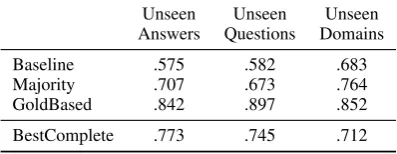
Recognizing Faceted Entailment This step was carried out as explained in the previous sections. We used theBaselineconfiguration andMajority, which performed best in our experiments above. In addition, we introduceGoldBasedthat uses the gold annotation of faceted entailment, and thus
Unseen Unseen Unseen Answers Questions Domains
Baseline .575 .582 .683
Majority .707 .673 .764
GoldBased .842 .897 .852
[image:4.595.317.516.64.141.2]BestComplete .773 .745 .712 Table 2: Micro-averaged F1 on the 2-way
com-plete entailment SciEntsBank test set.
provides a certain upper bound on the perfor-mance of determining complete entailment based on facets.
Aggregation We chose the simplest sensible ag-gregation rule to decide on overall entailment: a student answer is classified as correct(i.e. it en-tails the reference answer) if it expresses each of the reference answer’s facets. Although this heuristic is logical from a strict entailment per-spective, it might yield false negatives on this par-ticular dataset. This happens because tutors may sometimes grade answers as valid even if they omit some less important, or indirectly implied, facets.
Table 2 shows the experiment’s results. The first thing to notice is thatGoldBased is not per-fect. There are two reasons for this behavior. First, the task of student response analysis is only an approximation of textual entailment, albeit a good one. This discrepancy was also observed by the RTE-8 challenge organizers (Dzikovska et al., 2013). The second reason is because some of the original facets were filtered when creating the dataset. This caused both false positives (when important facets were filtered out) and false neg-atives (when unimportant facets were retained).
prospects of using faceted entailment for complete entailment recognition, suggesting it as an attrac-tive research direction.
6 Conclusion and Future Work
In this paper, we presented an empirical attempt to tackle the problem of partial textual entail-ment. We demonstrated that existing methods for recognizing (complete) textual entailment can be successfully adapted to this setting. Our experi-ments showed that boolean combinations of these methods yield good results. Future research may add additional features and more complex fea-ture combination methods, such as weighted sums tuned by machine learning. Furthermore, our work focused on a specific decomposition model – faceted entailment. Other flavors of partial en-tailment should be investigated as well. Finally, we examined the possibility of utilizing partial en-tailment for recognizing complete enen-tailment in a semi-automatic setting, which relied on the man-ual facet annotation in the RTE-8 dataset. Our preliminary results suggest that this approach is indeed feasible, and warrant further research on facet-based entailment methods that rely on fully-automatic facet extraction.
Acknowledgements
This work has been supported by the Volk-swagen Foundation as part of the Lichtenberg-Professorship Program under grant No. I/82806, and by the European Community’s Seventh Framework Programme (FP7/2007-2013) under grant agreement no. 287923 (EXCITEMENT). We would like to thank the Minerva Foundation for facilitating this cooperation with a short term research grant.
References
Eneko Agirre, Daniel Cer, Mona Diab, and Aitor Gonzalez-Agirre. 2012. SemEval-2012 Task 6: A pilot on semantic textual similarity. In Proceed-ings of the 6th International Workshop on Semantic Evaluation, in conjunction with the 1st Joint Con-ference on Lexical and Computational Semantics, pages 385–393, Montreal, Canada.
Luisa Bentivogli, Peter Clark, Ido Dagan, Hoa Dang, and Danilo Giampiccolo. 2011. The seventh pascal
recognizing textual entailment challenge.
Proceed-ings of TAC.
Peter Clark and Phil Harrison. 2010. Blue-lite: a knowledge-based lexical entailment system for rte6.
Proc. of TAC.
Ido Dagan, Bill Dolan, Bernardo Magnini, and Dan Roth. 2009. Recognizing textual entailment:
Ratio-nale, evaluation and approaches. Natural Language
Engineering, 15(4):i–xvii.
Myroslava O Dzikovska, Rodney D Nielsen, and Chris Brew. 2012. Towards effective tutorial feedback for explanation questions: A dataset and baselines. InProceedings of the 2012 Conference of the North American Chapter of the Association for Computa-tional Linguistics: Human Language Technologies, pages 200–210. Association for Computational Lin-guistics.
Myroslava O. Dzikovska, Rodney Nielsen, Chris Brew, Claudia Leacock, Danilo Giampiccolo, Luisa Ben-tivogli, Peter Clark, Ido Dagan, and Hoa Trang Dang. 2013. Semeval-2013 task 7: The joint stu-dent response analysis and 8th recognizing textual
entailment challenge. In *SEM 2013: The First
Joint Conference on Lexical and Computational Se-mantics, Atlanta, Georgia, USA, 13-14 June. Asso-ciation for Computational Linguistics.
Christiane Fellbaum, editor. 1998. WordNet: An
Elec-tronic Lexical Database. MIT Press, Cambridge, MA.
Rodney D Nielsen, Wayne Ward, and James H Mar-tin. 2009. Recognizing entailment in intelligent
tutoring systems. Natural Language Engineering,
15(4):479–501.
Philip Resnik. 1995. Using information content to evaluate semantic similarity in a taxonomy. In Pro-ceedings of the 14th International Joint Conference on Artificial Intelligence (IJCAI 1995), pages 448– 453.
Eyal Shnarch, Jacob Goldberger, and Ido Dagan. 2011. A probabilistic modeling framework for lexical
en-tailment. InProceedings of the 49th Annual
Meet-ing of the Association for Computational LMeet-inguis- Linguis-tics: Human Language Technologies, pages 558– 563, Portland, Oregon, USA, June. Association for Computational Linguistics.
Asher Stern and Ido Dagan. 2011. A confidence model for syntactically-motivated entailment proofs. InProceedings of the 8th International Conference on Recent Advances in Natural Language Process-ing (RANLP 2011), pages 455–462.
Asher Stern and Ido Dagan. 2012. Biutee: A mod-ular opsource system for recognizing textual
en-tailment. In Proceedings of the ACL 2012 System