Bilingual Lexical Cohesion Trigger Model for Document-Level
Machine Translation
Guosheng Ben† Deyi Xiong‡∗ Zhiyang Teng† Yajuan L ¨u† Qun Liu§† †Key Laboratory of Intelligent Information Processing
Institute of Computing Technology, Chinese Academy of Sciences {benguosheng,tengzhiyang,lvyajuan,liuqun}@ict.ac.cn
‡School of Computer Science and Technology,Soochow University {dyxiong}@suda.edu.cn
§Centre for Next Generation Localisation, Dublin City University {qliu}@computing.dcu.ie
Abstract
In this paper, we propose a bilingual lexi-cal cohesion trigger model to capture lex-ical cohesion for document-level machine translation. We integrate the model into hierarchical phrase-based machine trans-lation and achieve an absolute improve-ment of 0.85 BLEU points on average over the baseline on NIST Chinese-English test sets.
1 Introduction
Current statistical machine translation (SMT) sys-tems are mostly sentence-based. The major draw-back of such a sentence-based translation fash-ion is the neglect of inter-sentential dependencies. As a linguistic means to establish inter-sentential links, lexical cohesion ties sentences together in-to a meaningfully interwoven structure through words with the same or related meanings (Wong and Kit, 2012).
This paper studies lexical cohesion devices and incorporate them into document-level machine translation. We propose a bilingual lexical
cohe-sion trigger model to capture lexical cohecohe-sion for
document-level SMT. We consider a lexical co-hesion item in the source language and its corre-sponding counterpart in the target language as a trigger pair, in which we treat the source language lexical cohesion item as the trigger and its target language counterpart as the triggered item. Then we use mutual information to measure the strength of the dependency between the trigger and trig-gered item.
We integrate this model into a hierarchical phrase-based SMT system. Experiment results
∗Corresponding author
show that it is able to achieve substantial improve-ments over the baseline.
The remainder of this paper proceeds as fol-lows: Section 2 introduces the related work and highlights the differences between previous meth-ods and our model. Section 3 elaborates the pro-posed bilingual lexical cohesion trigger model, in-cluding the details of identifying lexical cohesion devices, measuring dependency strength of bilin-gual lexical cohesion triggers and integrating the model into SMT. Section 4 presents experiments to validate the effectiveness of our model. Finally, Section 5 concludes with future work.
2 Related Work
As a linguistic means to establish inter-sentential links, cohesion has been explored in the literature of both linguistics and computational linguistics. Cohesion is defined as relations of meaning that exist within the text and divided into grammatical cohesion that refers to the syntactic links between text items and lexical cohesion that is achieved through word choices in a text by Halliday and Hasan (1976). In order to improve the quality of machine translation output, cohesion has served as a high level quality criterion in post-editing (Vas-concellos, 1989). As a part of COMTIS project, grammatical cohesion is integrated into machine translation models to capture inter-sentential links (Cartoni et al., 2011). Wong and Kit (2012) in-corporate lexical cohesion to machine translation evaluation metrics to evaluate document-level ma-chine translation quality. Xiong et al. (2013) inte-grate various target-side lexical cohesion devices into document-level machine translation. Lexical cohesion is also partially explored in the cache-based translation models of Gong et al. (2011) and translation consistency constraints of Xiao et al.
(2011).
All previous methods on lexical cohesion for document-level machine translation as mentioned above have one thing in common, which is that they do not use any source language information. Our work is mostly related to the mutual infor-mation trigger based lexical cohesion model pro-posed by Xiong et al. (2013). However, we sig-nificantly extend their model to a bilingual lexical cohesion trigger model that captures both source and target-side lexical cohesion items to improve target word selection in document-level machine translation.
3 Bilingual Lexical Cohesion Trigger Model
3.1 Identification of Lexical Cohesion Devices
Lexical cohesion can be divided into reiteration and collocation (Wong and Kit, 2012). Reitera-tion is a form of lexical cohesion which involves the repetition of a lexical item. Collocation is a pair of lexical items that have semantic relation-s, such as synonym, near-synonym, superordinate, subordinate, antonym, meronym and so on. In the collocation, we focus on the synonym/near-synonym and super-subordinate semantic relation-s1. We define lexical cohesion devices as content words that have lexical cohesion relations, namely the reiteration, synonym/near-synonym and super-subordinate.
Reiteration is common in texts. Take the fol-lowing two sentences extracted from a document for example (Halliday and Hasan, 1976).
1. There is a boy climbing the old elm. 2. That elm is not very safe.
We see that word elm in the first sentence is re-peated in the second sentence. Such reiteration de-vices are easy to identify in texts. Synonym/near-synonym is a semantic relationship set. We can use WordNet (Fellbaum, 1998) to identify them. WordNet is a lexical resource that clusters words with the same sense into a semantic group called synset. Synsets in WordNet are organized ac-cording to their semantic relations. Let s(w) de-note a function that defines all synonym words of
w grouped in the same synset in WordNet. We
can use the function to compute all synonyms and near-synonyms for word w. In order to represen-t convenienrepresen-tly, s0 denotes the set of synonyms in
1Other collocations are not used frequently, such as
antonyms. So we we do not consider them in our study.
s(w). Near-synonym sets1is defined as the union of all synsets that are defined by the function s(w) where w∈s0. It can be formulated as follows.
s1 = [
w∈s0
s(w) (1)
s2 = [
w∈s1
s(w) (2)
s3 = [
w∈s2
s(w) (3)
Similarlysmcan be defined recursively as follows.
sm =
[
w∈sm−1
s(w) (4)
Obviously, We can find synonyms and near-synonyms for word w according to formula (4).
Superordinate and subordinate are formed by words with an is-a semantic relation in WordNet. As the super-subordinate relation is also encoded in WordNet, we can define a function that is simi-lar to s(w) identify hypernyms and hyponyms.
We use rep, syn and hyp to represent the lex-ical cohesion device reiteration, synonym/near-synonym and super-subordinate respectively here-after for convenience.
3.2 Bilingual Lexical Cohesion Trigger Model
In a bilingual text, lexical cohesion is present in the source and target language in a synchronous fashion. We use a trigger model capture such a bilingual lexical cohesion relation. We define xRy (R∈{rep, syn, hyp}) as a trigger pair where x is the trigger in the source language and y the trig-gered item in the target language. In order to cap-ture these synchronous relations between lexical cohesion items in the source language and their counterparts in the target language, we use word alignments. First, we identify a monolingual lexi-cal cohesion relation in the target language in the form of tRy where t is the trigger, y the triggered item that occurs in a sentence succeeding the sen-tence of t, and R∈{rep, syn, hyp}. Second, we find word x in the source language that is aligned to t in the target language. We may find multiple wordsxk
1 in the source language that are aligned to t. We use all of them xiRt(1≤i≤k) to define
The possibility that y will occur given x is equal to the chance that x triggers y. Therefore we mea-sure the strength of dependency between the trig-ger and trigtrig-gered item according to pointwise mu-tual information (PMI) (Church and Hanks, 1990; Xiong et al., 2011).
The PMI for the trigger pair xRy where x is the trigger, y the triggered item that occurs in a target sentence succeeding the target sentence that aligns to the source sentence of x, and R∈{rep, syn, hyp}
is calculated as follows.
P M I(xRy) =log( p(x, y, R)
p(x, R)p(y, R)) (5)
The joint probabilityp(x, y, R)is:
p(x, y, R) = PC(x, y, R)
x,yC(x, y, R)
(6)
where C(x, y, R) is the number of aligned bilin-gual documents where both x and y occur with the relation R in different sentences, and P
x,yC(x, y, R)is the number of bilingual
docu-ments where this relation R occurs. The marginal probabilities ofp(x, R)andp(y, R)can be calcu-lated as follows.
p(x, R) =X
y
C(x, y, R) (7)
p(y, R) =X
x
C(x, y, R) (8)
Given a target sentence y1m, our bilingual lexical cohesion trigger model is defined as follows.
M IR(ym1 ) = Y
yi
exp(P M I(·Ryi)) (9)
whereyiare content words in the sentenceym1 and PMI(·Ryi)is the maximum PMI value among all
trigger words xq1 from source sentences that have been recently translated, where trigger words xq1 have an R relation with wordyi.
P M I(·Ryi) =max1≤j≤qP M I(xjRyi) (10)
Three models M Irep(ym1 ), M Isyn(y1m), M Ihyp(ym1 ) for the reiteration device, the synonym/near-synonym device and the super-subordinate device can be formulated as above. They are integrated into the log-linear model of SMT as three different features.
3.3 Decoding
We incorporate our bilingual lexical cohesion trig-ger model into a hierarchical phrase-based system (Chiang, 2007). We add three features as follows.
• M Irep(y1m)
• M Isyn(y1m)
• M Ihyp(y1m)
In order to quickly calculate the score of each fea-ture, we calculate PMI for each trigger pair be-fore decoding. We translate document one by one. During translation, we maintain a cache to store source language sentences of recently translated target sentences and three sets Srep, Ssyn, Shyp
to store source language words that have the re-lation of{rep, syn, hyp}with content words gen-erated in target language. During decoding, we update scores according to formula (9). When one sentence is translated, we store the corresponding source sentence into the cache. When the whole document is translated, we clear the cache for the next document.
4 Experiments 4.1 Setup
Our experiments were conducted on the NIST Chinese-English translation tasks with large-scale training data. The bilingual training data contain-s 3.8M contain-sentence paircontain-s with 96.9M Chinecontain-se word-s and 109.5M Engliword-sh wordword-s from LDC2. The monolingual data for training data English lan-guage model includes the Xinhua portion of the Gigaword corpus. The development set is the NIST MT Evaluation test set of 2005 (MT05), which contains 100 documents. We used the sets of MT06 and MT08 as test sets. The numbers of documents in MT06, MT08 are 79 and 109 respec-tively. For the bilingual lexical cohesion trigger model, we collected data with document bound-aries explicitly provided. The corpora are select-ed from our bilingual training data and the whole Hong Kong parallel text corpus3, which contains 103,236 documents with 2.80M sentences.
2The corpora include LDC2002E18, LDC2003E07,
LD-C2003E14,LDC2004E12,LDC2004T07,LDC2004T08(Only Hong Kong News), LDC2005T06 and LDC2005T10.
3They are LDC2003E14, LDC2004T07, LDC2005T06,
We obtain the word alignments by running GIZA++ (Och and Ney, 2003) in both direction-s and applying “grow-diag-final-and” refinemen-t (Koehn erefinemen-t al., 2003). We apply SRI Language Modeling Toolkit (Stolcke, 2002) to train a 4-gram language model with Kneser-Ney smooth-ing. Case-insensitive NIST BLEU (Papineni et al., 2002) was used to measure translation per-formance. We used minimum error rate training MERT (Och, 2003) for tuning the feature weights.
4.2 Distribution of Lexical Cohesion Devices in the Target Language
Cohesion Device Percentage(%)
rep 30.85
syn 17.58
[image:4.595.91.271.246.308.2]hyp 18.04
Table 1: Distributions of lexical cohesion devices in the target language.
In this section we want to study how these lexical cohesion devices distribute in the train-ing data before conducttrain-ing our experiments on the bilingual lexical cohesion model. Here we study the distribution of lexical cohesion in the target language (English). Table 1 shows the distribution of percentages that are counted based on the content words in the training da-ta. From Table 1, we can see that the reitera-tion cohesion device is nearly a third of all con-tent words (30.85%), synonym/near-synonym and super-subordinate devices account for 17.58% and 18.04%. Obviously, lexical cohesion devices are frequently used in real-world texts. Therefore cap-turing lexical cohesion devices is very useful for document-level machine translation.
4.3 Results
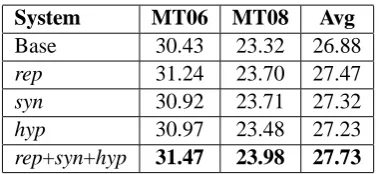
System MT06 MT08 Avg
Base 30.43 23.32 26.88
rep 31.24 23.70 27.47
syn 30.92 23.71 27.32
hyp 30.97 23.48 27.23
rep+syn+hyp 31.47 23.98 27.73
Table 2: BLEU scores with various lexical co-hesion devices on the test sets MT06 and MT08. “Base” is the traditonal hierarchical system, “Avg” is the average BLEU score on the two test sets.
Results are shown in Table 2. From the table, we can see that integrating a single lexical cohe-sion device into SMT, the model gains an improve-ment of up to 0.81 BLEU points on the MT06 test set. Combining all three features rep+syn+hyp to-gether, the model gains an improvement of up to 1.04 BLEU points on MT06 test set, and an av-erage improvement of 0.85 BLEU points on the two test sets of MT06 and MT08. These stable improvements strongly suggest that our bilingual lexical cohesion trigger model is able to substan-tially improve the translation quality.
5 Conclusions
In this paper we have presented a bilingual lex-ical cohesion trigger model to incorporate three classes of lexical cohesion devices, namely the reiteration, synonym/near-synonym and super-subordinate devices into a hierarchical phrase-based system. Our experimental results show that our model achieves a substantial improvement over the baseline. This displays the advantage of exploiting bilingual lexical cohesion.
Grammatical and lexical cohesion have often been studied together in discourse analysis. In the future, we plan to extend our model to cap-ture both grammatical and lexical cohesion in document-level machine translation.
Acknowledgments
This work was supported by 863 State Key Project (No.2011AA01A207) and National Key Technol-ogy R&D Program(No.2012BAH39B03). Qun Liu was also partially supported by Science Foun-dation Ireland (Grant No.07/CE/I1142) as part of the CNGL at Dublin City University. We would like to thank the anonymous reviewers for their in-sightful comments.
References
Bruno Cartoni, Andrea Gesmundo, James Hender-son, Cristina Grisot, Paola Merlo, Thomas Mey-er, Jacques MoeschlMey-er, Sandrine Zufferey, Andrei Popescu-Belis, et al. 2011. Improving mt coher-ence through text-level processing of input texts: the comtis project. http://webcast. in2p3. fr/videos-the comtis project.
David Chiang. 2007. Hierarchical phrase-based trans-lation. computational linguistics, 33(2):201–228.
[image:4.595.87.278.610.697.2]association norms, mutual information, and lexicog-raphy. Computational linguistics, 16(1):22–29.
Christine Fellbaum. 1998. Wordnet: An electronic lexical database.
Zhengxian Gong, Min Zhang, and Guodong Zhou. 2011. Cache-based document-level statistical ma-chine translation. In Proceedings of the 2011
Con-ference on Empirical Methods in Natural Language Processing, pages 909–919, Edinburgh, Scotland,
UK., July. Association for Computational Linguis-tics.
M.A.K Halliday and Ruqayia Hasan. 1976. Cohesion in english. English language series, 9.
Philipp Koehn, Franz Josef Och, and Daniel Mar-cu. 2003. Statistical phrase-based translation. In
Proceedings of the 2003 Conference of the North American Chapter of the Association for Computa-tional Linguistics on Human Language Technology-Volume 1, pages 48–54. Association for
Computa-tional Linguistics.
Franz Josef Och and Hermann Ney. 2003. A systemat-ic comparison of various statistsystemat-ical alignment mod-els. Computational linguistics, 29(1):19–51.
Franz Josef Och. 2003. Minimum error rate train-ing in statistical machine translation. In
Proceed-ings of the 41st Annual Meeting of the Association for Computational Linguistics, pages 160–167,
S-apporo, Japan, July. Association for Computational Linguistics.
Kishore Papineni, Salim Roukos, Todd Ward, and Wei-Jing Zhu. 2002. Bleu: a method for automatic e-valuation of machine translation. In Proceedings of
40th Annual Meeting of the Association for Com-putational Linguistics, pages 311–318, Philadelphia,
Pennsylvania, USA, July. Association for Computa-tional Linguistics.
Andreas Stolcke. 2002. Srilm-an extensible language modeling toolkit. In Proceedings of the
internation-al conference on spoken language processing,
vol-ume 2, pages 901–904.
Muriel Vasconcellos. 1989. Cohesion and coherence in the presentation of machine translation products.
Georgetown University Round Table on Languages and Linguistics, pages 89–105.
Billy T. M. Wong and Chunyu Kit. 2012. Extend-ing machine translation evaluation metrics with lex-ical cohesion to document level. In Proceedings of
the 2012 Joint Conference on Empirical Methods in Natural Language Processing and Computational Natural Language Learning, pages 1060–1068, Jeju
Island, Korea, July. Association for Computational Linguistics.
Tong Xiao, Jingbo Zhu, Shujie Yao, and Hao Zhang. 2011. Document-level consistency verification in machine translation. In Machine Translation
Sum-mit, volume 13, pages 131–138.
Deyi Xiong, Min Zhang, and Haizhou Li. 2011. Enhancing language models in statistical machine translation with backward n-grams and mutual in-formation triggers. In Proceedings of the 49th
An-nual Meeting of the Association for Computational Linguistics: Human Language Technologies, pages
1288–1297, Portland, Oregon, USA, June. Associa-tion for ComputaAssocia-tional Linguistics.
Deyi Xiong, Guosheng Ben, Min Zhang, Yajuan Lv, and Qun Liu. 2013. Modeling lexical cohesion for document-level machine translation. In Proceedings