Exploring, Reasoning with and Validating Directed Graphs
by Applying Formal Concept Analysis to Conceptual
Graphs
ANDREWS, Simon <http://orcid.org/0000-0003-2094-7456> and POLOVINA,
Simon <http://orcid.org/0000-0003-2961-6207>
Available from Sheffield Hallam University Research Archive (SHURA) at:
http://shura.shu.ac.uk/19112/
This document is the author deposited version. You are advised to consult the
publisher's version if you wish to cite from it.
Published version
ANDREWS, Simon and POLOVINA, Simon (2018). Exploring, Reasoning with and
Validating Directed Graphs by Applying Formal Concept Analysis to Conceptual
Graphs. In: CROITORU, Madalina, MARQUIS, Peter, RUDOLPH, Sebastian and
STAPLETON, Gem, (eds.) Graph Structures for Knowledge Representation and
Reasoning : 5th International Workshop, GKR 2017, Melbourne, VIC, Australia,
August 21, 2017, Revised Selected Papers. Lecture Notes in Artificial Intelligence
(10775). Springer, 3-28.
Copyright and re-use policy
See http://shura.shu.ac.uk/information.html
Metadata of the chapter that will be visualized in
SpringerLink
Book Title Graph Structures for Knowledge Representation and Reasoning Series Title
Chapter Title Exploring, Reasoning with and Validating Directed Graphs by Applying Formal Concept Analysis to Conceptual Graphs
Copyright Year 2018
Copyright HolderName Springer International Publishing AG, part of Springer Nature
Author Family Name Andrews
Particle
Given Name Simon
Prefix Suffix Role
Division Conceptual Structures Research Group, Department of Computing, Communication and Computing Research Centre
Organization Sheffield Hallam University
Address Sheffield, UK
Email [email protected]
ORCID http://orcid.org/0000-0003-2094-7456
Corresponding Author Family Name Polovina
Particle
Given Name Simon
Prefix Suffix Role
Division Conceptual Structures Research Group, Department of Computing, Communication and Computing Research Centre
Organization Sheffield Hallam University
Address Sheffield, UK
Email [email protected]
ORCID http://orcid.org/0000-0003-2961-6207
Abstract Although tools exist to aid practitioners in the construction of directed graphs typified by Conceptual
Directed Graphs by Applying Formal
Concept Analysis to Conceptual Graphs
Simon Andrews and Simon Polovina(B)
Conceptual Structures Research Group, Department of Computing, Communication and Computing Research Centre, Sheffield Hallam University, Sheffield, UK
{s.andrews,s.polovina}@shu.ac.uk
Abstract. Although tools exist to aid practitioners in the construction of directed graphs typified by Conceptual Graphs (CGs), it is still quite possible for them to draw the wrong model, mistakenly or otherwise. In larger or more complex CGs it is furthermore often difficult–without close inspection–to see clearly the key features of the model. This paper thereby presents a formal method, based on the exploitation of CGs as directed graphs and the application of Formal Concept Analysis (FCA). FCA elucidates key features of CGs such as pathways and dependencies, inputs and outputs, cycles, and joins. The practitioner is consequently empowered in exploring, reasoning with and validating their real-world
models. AQ1
1
Introduction
A directed graph–or “digraph”–is a graph whose edges have direction and are called arcs [9,11]. Arrows on the arcs are used to encode the directional infor-mation: an arc from vertex A to vertex B indicates that one may move from A to B but not from B to A. Such graphs for example are used in computer science as a representation of the paths that might be traversed through a program, or in higher-level conceptual models where concepts are related to each other by relations that gain additional semantics (i.e. meaning) by defining the direction between the source and target concepts. A classic illustration is a cat that sits on a mat [18]. In this simple example ‘sits-on’ is the semantic relation where the direction goes from cat to mat and not vice versa.
CGs (Conceptual Graphs) are digraphs that enable modellers to express meaning in a form that is logically precise whilst being humanly readable, and serve as an intermediate language for translating between computer-oriented formalisms and natural languages [14,19]. CGs graphical representation thereby serve as a readable, but formal specification language for systems design or other practitioners using this approach [10]. CGs are however drawn by hand. Tools such as CoGui and CharGer already exist to assist the practitioner in creating a well-formed CG (Conceptual Graph) that adheres to the prescribed grammar and syntax [1,2]. However there is no guarantee that a model created using CGs
c
Springer International Publishing AG, part of Springer Nature 2018 M. Croitoru et al. (Eds.): GKR 2017, LNAI 10775, pp. 1–26, 2018. https://doi.org/10.1007/978-3-319-78102-0_1
is correct in terms of its validity. The modeller may have a misconception of the system being modelled or may simply make mistakes in its construction–things that still conform to the syntax and grammar but result in an invalid model.
It can be difficult to explore and validate a large and complex CG by inspec-tion. It is this problem that this paper addresses by providing an automated method whereby key features of CGs are captured, reported and visualised. The modeller would thus be assisted in exploring and validating their CGs. The method makes use of the inherent direction of Concept-relation-Concept triples in CGs to transform these triples into binary relations and thus expose them to Formal Concept Analysis (FCA) [8]. The process is automated in a tool called
CGFCAand has two stages; firstly parsing a CG file (in the ISO common logic
cgif format [19]) to extract the CG triples and secondly, converting these triples into corresponding binary relations that accentuate the directed pathways in the original CG, as described next in Sect.2. The triples-to-binaries function is car-ried out using an implementation of theTriples2Binariesalgorithm, specifically described in Subsect.2.2.
2
Transforming CG Digraphs: Triples into Binary
Relations
If triples are extracted from a CG in the form Source Concept → relation → Target Concept, each such triple can easily be represented as a corresponding binary relation i.e. Source Concept-relation, Target Concept. Where the Tar-get Concept then becomes a Source Concept for a following relation, this can be captured in additional binary relations, where the original Source Concept-relation is paired with subsequent Target Concepts. To illustrate the source-target structure, Fig.1shows a simple CG with the CG Concepts,[Cat],[Mat]
and[Colour: Grey].[Cat]and[Mat]are linked by the CG relation(sits-on)
and[Mat],[Colour: Grey]are linked by(has-attribute). (In simple English, the CG describes a cat that sits on a grey mat.) We can say that the
Fig. 1.Simple CG Fig. 2.FCL for simple CG
target Concept [Mat]is dependent on thesource Concept-relation pair [Cat]→
(sits-on) and the target Concept [Colour:Grey] is dependent on its source
Concept-relation pair [Mat]→ (has-attribute) (or alternatively, the source
Concept-relation pair [Cat]→ (sits-on) results in the target Concept [Mat]
and thesource Concept-relation pair[Mat]→(hasattribute) results in the
tar-get Concept [Colour: Grey]). The CG triple ([Cat],(sits-on), [Mat]) can
be converted into the binary relation ([Cat]-(sits-on), [Mat]). Likewise the CG triple ([Mat],(hasattribute),[Colour: Grey]) can be converted into the binary relation ([Mat](has-attribute),[Colour: Grey]).
There is also a binary relation between[Cat]and[Colour: Grey]indirectly through[Cat]-(sits-on). Hence[Colour: Grey]also depends (indirectly) on
[Cat], which is of course sitting on that mat.
Simple CG Cat sits-on Mat has-attribute Cat
Mat ×
Colour:Grey × ×
Fig. 3.The simple CG as a cross-table
The set of binary relations can be simply represented in a cross-table and Fig.3 shows the corresponding cross-table for this simple example, with rows representing CG Concepts and columns CG Source Concept-relations. The cross-table is known as a Formal Context in FCA, so by converting CGs into these binary relations, FCA can then be applied. Figure2displays the resulting Formal Concept Lattice (FCL). This approach was derived after we compared it with Wille’s mapping of CGs to FCA (‘Concept Graphs’) in an earlier study [5,20]. Figures4, 5, and 6 show the CG, FCL and cross-table (Formal Context) for a larger CG using the same Cat on Mat example. Figures7,8, and9show the CG, FCL and cross-table for a further extended version of this example. This time it has two input CG Concepts,[Cat: Gwyn] and[Cat: Bumbles]thus depicting the specific cats Gwyn and Bumbles as the respective CG referent for each CG Concept as shown.
2.1 Obtaining Triples from a Conceptual Graph: A Parser for cgif
To automate this process, a parser was created that operates on the standard CG file format,cgif. To illustrate the format, below is the cgif for the ‘Cats on the Mat’ CG in Fig.7:
[Material: Fleece] [Cat: Gwyn] [Mat: *x1] [Cat: Bumbles] [Colour: Grey] (sits-on Bumbles Gwyn ?x1)(has-attribute Fleece Grey)(made-from ?x1 Fleece)
The first line in the cgif defines the CG Concepts and the second line defines the CG relations. In line with CGs theory where the referent is unknown, cgif
Fig. 4.CG with 4 concepts Fig. 5.FCL for CG with 4 concepts
With 4 Concepts Cat sits-on Mat made-from Material: Fleece has-attribute Cat
Mat ×
Material :Fleece × ×
Colour:Grey × × ×
Fig. 6.The 4 concept CG as a cross-table
Fig. 7.CG with 2 input concepts Fig. 8.FCL for 2 input concepts
2 Input Concepts Cat: B um bles sits-on Cat: Gwyn sits-on Mat made-from Material: Fleece has-attribute
Cat:Bumbles Cat:Gwyn
Mat × ×
Material:Fleece × × × Colour:Grey × × × ×
Fig. 9.The 2 input CG as a cross-table
uses generic referents such as x1andx2, with a preceding *(in CG Concepts) or?(in CG relations). Each relation is defined in thecgif with a list of referents comprising one or more source CG Concept referents and a target CG Concept referent. The final referent in the list is always the target referent. Thus, in the relationmade-from,x1is the source andFleeceis the target, and in the relation
sits-on,BumblesandGywn are sources andx1is the target.
The parser first extracts the CG Concepts from thecgif, creating an integer index for each CG Concept and separating the type labels and referents (see Table1a). The parser then extracts the CG relations from the cgif, creating an integer index for each CG relation and separating the type labels and lists of referents (see Table1b).
Table 1.Information extracted by parser from Cats on the Matcgif
No. Label Referent 1 Material Fleece
2 Cat Gwyn
3 Mat x1
4 Cat Bumbles 5 Colour Grey
(a) CG Concepts
No. Label Referents 1 sits-on Bumbles Gwyn x1 2 has-attribute Fleece Grey 3 made-from x1 Fleece
(b) CG relations
If there are co-referent CG Concepts or relations, the parser will form the corresponding joins. For CG Concepts, as each Concept label and referent is extracted from the cgif, the referent is compared to the list of Concept referents
already extracted. If a match is found, instead of adding a new Concept, the parser compares the two Concept labels. If they are different, it concatenates the new label with the existing label in the list, if not the parser simply moves on to the next Concept in thecgif. A similar process is carried when parsing the CG relations in the cgif, but here it is the list of referents associated with the relation that is compared: for two CG relations to be co-referent they must have the same sources and target. For examples of joining co-referents see Sect.4.8.
Once the CG Concepts and relations have been extracted (and any co-referent joins made), the parser then uses the referents for each relation to create cor-responding triples by looking up the index number of the relation’s source and target CG Concepts corresponding to the relation’s referents. Table2 contains the triples created from Table1. The triples thus created are now ready for the process of converting them to corresponding binary relations.
Table 2.Cats on the Mat triples
Source Relation Target
4 1 3
2 1 3
1 2 5
3 3 1
2.2 A Triples-to-Binaries Algorithm
Figure10 is an algorithm, Triples2Binaries, that along with its subroutine
AddBinary(Fig.11), converts a set of triples,T, into a corresponding set of
bina-ries,B, exploiting the direction in the triples as explained above. It is a gener-alised form of theCGtoFCAalgorithm previously presented [5]. Whilst its appli-cation to CGs is the focus of this paper, the more general form makes it applicable to directed triples obtained from any source, including UML, RDF, OWL, the Entity-Relation Diagram and linked data. Triples2Binaries also includes some refinements not present inCGtoFCA, namely; the ability to detect ‘direct path-ways’ and cycles in a CG. A direct pathway through a CG is a path from an input CG Concept to an output CG Concept, where an input CG Concept is one with no edges entering it and an output CG Concept is one with no edges leaving it. Features such as direct pathways and cycles often have significant meaning in a CG but are not always easily apparent (particularly in large CGs). The main algorithm,Triples2Binaries, simply iterates through the set of triples,T, send-ing each triple, (s,r,t) to the subroutine AddBinary. In (s,r,t), s denotes the
source, r denotes therelation andt denotes thetarget. Each triple enumerated
in Triples2Binaries will be the start of a new pathway. A pathway is recorded
byAddBinary as a set of (source,relation) pairs inpath.
AddBinary takes each triple (s,r,t), adds (s,r) to the current path (line
2) and then adds the corresponding binary ((s,r),t) to the set of binaries, B (line 3).
Line 4 is a test for detecting a direct pathway in the CG: if the current source, s, is an input CG Concept and the current target,t, is an output CG Concept, then there is a direct pathway fromstot. In which case, the current path along witht is recorded as a direct pathway.
Line 6 is the condition for detecting a cycle in the CG: if the current source, s, is the same as the current target,t, there is a cycle, recorded in line 7 as the current path along with the current target.
Line 8 defines the terminating condition for recursion (thus preventing infinite loops around cycles): if the current target,t, is already in the current path then
AddBinary terminates. Otherwise, line 9 iterates through the set of triples,T,
to test for links (line 10): if the current target, t, also appears as a source,i, in the set of triples, AddBinary is called recursively (line 11), passing the current source,s, the current relation,r, and the new target,k.
Note that the condition for a cycle (line 6) cannot be used as the terminating condition for recursion. This is because the starting point for a cycle can occur at any point in a pathway. A pathway begins with the source,s, and if the starting point of a cycle begins later thans, thens will never equaltand we would have an infinite loop around that cycle.
begin 1
path← ∅
2
foreach(s,r,t)∈T do 3
AddBinary(s,r,t,path) 4
end 5
Fig. 10.Triples2Binaries(T)
3
The CGFCA Tool
The cgif parser andTriples2Binaries algorithm were implemented together to form a software tool called CGFCA. The architecture of CGFCA is shown in Fig.12. The cgif parser inputs a CG in the form of a cgif file and creates a corresponding set of CG (source Concept, relation, target Concept) triples as described in Sect.2.1. The triples are then passed to Triples to Binaries which converts them into ((source Concept, relation), target Concept) binaries, includ-ing the computation of all binaries with indirect target Concepts, as described in Sect.2.2. Triples to Binaries also carries out an analysis of the CG and reports the following features: input Concepts, output Concepts, direct pathways (from an input Concept to an output Concept), cycles and pathways with multiple routes (these are multiple pathways from the same input Concept-relation to the same output Concept). These multiple routes were considered worth detecting and reporting as they may indicate redundant pathways in a CG. The ((source Concept, relation), target Concept) binaries computed by Triples to Binaries
begin 1
path←path∪ {(s,r)}
2
B←B∪ {((s,r),t)}
3
if IsInput(s)andIsOutput(t)then 4
RecordDirectPathway(path,t) 5
if s=t then 6
RecordCycle(path,t) 7
if ¬ ∃(x,y)∈path|t=x then 8
foreach(i,j,k)∈T do 9
if t=i then 10
AddBinary(s,r,k,path) 11
end 12
Fig. 11.AddBinary(s,r,t,path)
are then passed to a simple Formal Context Creator where the (source Concept, relation) in each binary is treated as a formal attribute and each target Concept is treated as a formal object. The formal context is output in the standardcxt format for FCA.
Fig. 12.CGFCA architecture
The formal context output by CGFCA can then be visualised as a Formal Concept Lattice (FCL) using an appropriate tool, such asConceptExplorer (Con-Exp)1 or as a Formal Concept Tree using In-Close [3,4]. Such visualisations clearly highlight further CG features such as cycles and co-referent joins.
1 http://conexp.sourceforge.net/.
4
Highlighting Key Features of a CG Using CGFCA
This Section uses simple CG examples to illustrate the use of the GCFCA tool in detecting and highlighting features of CGs and how corresponding FCLs allow a GC to be explored in a formal, hierarchical, visualisation.
4.1 Paths and Dependencies
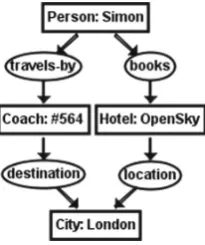
Figures13 and 14 respectively illustrate the CG and FCL for the dependen-cies described earlier in a larger example–as well as two paths–between the source Concept[Person: Simon]and the target Concept[City: London]. As well as the intermediate target Concepts that in turn become source Concepts (i.e.[Coach: #564]and[Hotel: OpenSky]), this example shows CG referents, namely Simon, #564, OpenSky and London. ([Colour: Grey]from Fig.2was also a CG Concept with a referent.) The referents are instances of their respec-tive type label in the CG Concept e.g. London is a referent of the type label City, and #564 the numeric identifier for a Coach that in the context of Fig.13 could be read as the number of the coach that goes to London. In addition to the direct dependencies such as[Hotel: OpenSky])on[Person: Simon]-(books)
[image:11.439.80.183.414.537.2]there are indirect dependencies detected in accordance with AddBinary line 4 described earlier in Subsect.2.2. These are: (a)[City: London])on[Person: Simon]-(books), and (b) [Person: Simon]-(travels-to) through the other path that has the intermediate Concept[Coach: #564]. The starting (or input) Concepts and ending (or output) Concepts are usefully reported by theCGFCA software i.e. Inputs: “Person: Simon”. Outputs: “City: London”. The output also states:Direct Pathway: Person: Simon - books - Hotel: OpenSky - location - City: London and Direct Pathway: Person: Simon - travels-by - Coach: #564 - destina-tion - City: London.
Fig. 13.Paths and dependencies CG Fig. 14.Paths and dependencies FCL
In simple terms, Simon’s trip to London depends on travelling there by coach and booking into the OpenSky hotel. Of course in this still-simple example this knowledge can be gleaned from the CG alone thereby obviating the need for CGFCA. However it is more likely that these patterns will appear in larger CGs where it is not so evident, perhaps unknowingly as they are drawn by hand and obfuscated by the size of the larger model. CGFCA and the consequent computer-generated FCL will highlight within such digraphs the ‘diamond’ look-ing patterns that represent multiple pathways thus alertlook-ing their existence–hence validity–to the modeller.
4.2 Cycles
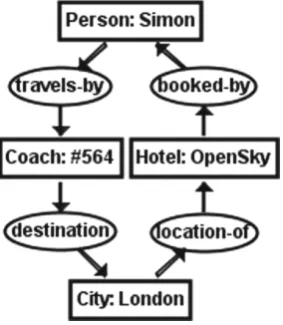
It is natural that digraphs may contain one or more cycles. Figures15 and 16 respectively illustrate an example of a CG and FCL that is a cycle. Note that this example is similar to the previous paths and dependencies example in Figs.13 and 14. This time the direction of the hotel booking path goes in the opposite direction, thus creating the cycle. The renaming of the relations i.e. location
tolocation-of andbooksto booked-bycorrectly reflect the new direction. It is common however to name or use relations that cause cycles to occur inad-vertently such as possibly in this example. A cycle may of course be desired, but the modeller will in any event be alerted to its validity by the FCL (here Fig.16) in accordance with AddBinary line 7 described earlier in Subsect.2.2.
TheCGFCAoutput highlights why the Fig.16lattice looks as it does:There are
[image:12.439.47.189.402.565.2]no inputs. There are no outputs. Cycle: City: London locationof Hotel: OpenSky -booked-by - Person: Simon - travels-by - Coach: #564 - destination - City: London. Every Concept is dependent on all the other Concepts with no hierarchy, thus they become grouped together in the FCL.
Fig. 15.CG that is a cycle Fig. 16.FCL of cycle
4.3 Joins
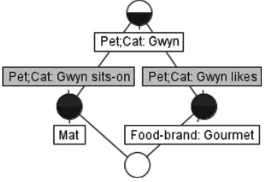
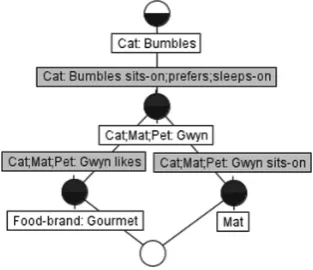
Figures17and18respectively illustrate the CG and FCL for Concepts that are co-referent. Co-referents occur when Concepts have the same referent, which in this case is Gywn in Pet and Cat. Where a source and target Concept are directly linked by more than one relation, the associated relations are in effect co-referent. This behaviour is highlighted by Figs.19and20.
Fig. 17.CG with co-referent concept Fig. 18.FCL with co-referent concept
Fig. 19.CG with co-referent relations Fig. 20.FCL with co-referent relations
Before theTriples2Binariesalgorithm in CGFCAis called, theCGFCA cgif parser detects co-referent CG Concepts and co-referent CG relations and because they refer to the same object or instance it joins the Concepts and relations automatically (see Sect.2.1). Furthermore it concatenates the Concept type or relation labels, using ‘;’ as the delimiter.
The outcome is evident in the FCL for Figs.18 (i.e. Pet;Cat) and 20 (i.e.
sleeps-on;sits-on;prefers). This approach is akin to the maximal common subtype in CGs (or intersection); thus Gywn is (a) a Pet Cat, and (b) sleeps, sits on, and likes the Mat2.
A common error (particularly in larger or more complex models) is to give different types the same referent by mistake. Take for example the CG Fig.19.
2 NoteMat here has a latent referent, in accordance with CGs theory; hence we can
simply refer to it through the definite article ‘the’.
[image:13.439.248.381.154.245.2]In that Figure let’s change [Mat: Gwyn’s] to [Mat: Gwyn], assuming that it was mistyped by the modeller in the first place. As a result, [Mat: Gwyn] will inadvertently join with the [Cat: Gwyn] and [Pet: Gwyn] CGs from Fig.17. Figure21 shows the CGs for this scenario including the mistake, and Fig.22 demonstrates the result. Now Gwyn is not only a Pet Cat but a Mat too! And Bumbles sleeps-on, sits-on and prefers Gwyn as a Mat (rather than Gwyn’s Mat) while Gwyn sits on another Mat, all of which is nonsensical as the FCL reveals. Like the previous pathways and cycles examples, the practitioner is immediately presented with a need to reason with and validate their models.
Fig. 21.CG with co-referents Fig. 22.Mistakenly joined CGs FCL
4.4 n-adic
Apart from Fig.7earlier, the CG relations so far have been2-adic i.e. only one source CG Concept pointing to the relation.2-adicCG relations are also known
asdyadicCG relations. A CG relation may however have more than one source
CG Concept; hence ann-adic CG relation hasn source CG Concepts. The CG relationsits-onin Fig.7 is3-adic, or triadic.
[image:14.439.218.375.184.319.2]Figures23 and 25 highlights the relation sits-on being stated as being dyadic or triadic respectively. CG relations may any number of source CG
Fig. 23.CG with 2-adic relation Fig. 24.FCL with 2-adic relation
[image:14.439.47.206.494.570.2]Fig. 25.CG with 3-adic relation Fig. 26.FCL with 3-adic relation
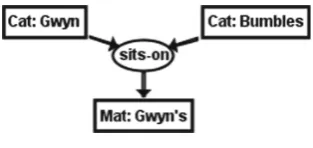
Concepts pointing to them3. Figures24and26reveal that the FCL for Figs.23 and 25turn out to be identical, thus two representations of the same meaning. Unsurprisingly, the CGFCA output is identical for both the 2-adic and the 3-adic:Inputs:“Cat: Gwyn” “Cat: Bumbles” Outputs: “Mat: Gwyn’s” Direct Pathway: Cat: Gwyn - sits-on - Mat: Gwyn’s Direct Pathway: Cat: Bumbles - sits-on - Mat: Gwyn’s.
Certain CG relations such as ‘(share)’ inherently can only have certain n-adic values. For the share case, there need to be two or more things to have something shared between them, hence share has to be at least triadic i.e.≥ 3-adic. AsCGFCAwould provide the same outcome even if theshareCG rela-tion was modelled as dyadic accidentally by the modeller, it would still be cor-rectly depicted in the FCL. For completeness, Figs.27,28,29and30respectively demonstrate this outcome.
[image:15.439.292.342.55.122.2]Fig. 27.CG, ‘wrong’ 2-adic share Fig. 28.FCL, ‘corrected’ share
Fig. 29.CG, ‘correct’ 3-adic share Fig. 30.FCL, ‘correct’ 3-adic share
3 CG relations may however have only one target CG Concept [17].
[image:15.439.56.364.348.577.2]4.5 Formal Concepts Without Their Own Attributes or Objects
Unlike the examples shown thus far where it has only occurred at the bottommost
(or infimum) Formal Concept in an FCL, CGs may generate an FCL that has
Formal Concepts without their own attributes (i.e.Source Concept-relation) or objects (i.e.Target Concept) in the middle of the FCL. Figure31has generated such a formal concept as evident in Fig.32.
Essentially this is because [Cat: Bumbles]and [Cat: Gywn] both sit-on
the [Mat: Gwyn’s] and have the heritage of [Pedigree: British Blue]. This pattern can be gleaned from the correspondingCGFCAoutput for Figs.31 and32:
Inputs: “Cat: Bessie” Outputs: “Mat” “Pedigree: British Blue”
Direct Pathway: Cat: Bessie - offspring-of - Cat: Bumbles - heritage - Pedigree: British Blue
Direct Pathway: Cat: Bessie - offspring-of - Cat: Bumbles - sits-on - Mat Direct Pathway: Cat: Bessie - offspring-of - Cat: Gwyn - sits-on - Mat
[image:16.439.233.371.285.406.2]Direct Pathway: Cat: Bessie - offspring-of - Cat: Gwyn - heritage - Pedigree: British Blue
Fig. 31.CG leading to unlabelled FC Fig. 32.FCL with unlabelled FC
Fig. 33.Larger CG, unlabelled FC Fig. 34.Larger FCL, unlabelled FC
[image:16.439.48.202.286.410.2] [image:16.439.50.201.453.578.2] [image:16.439.228.383.453.574.2]The only way to traverse the FCL to capture these relations is through the unlabelled Formal Concept in between.
Figures33 and 34 evidence the pattern in a larger example where, essen-tially,[Cat: Bumbles]and[Cat: Gywn] both sit-onthe[Mat: Gwyn’s]and have theheritageof [Pedigree: British Blue],andhave as theirownerthe
[Person: Simon]. TheCGFCAoutput underpins the pattern:
Inputs: “Cat: Bessie” Outputs: “Person: Simon” “Mat: Gwyn’s” “Pedigree: British Blue”
Direct Pathway: Cat: Bessie - offspring-of - Cat: Bumbles - owner - Person: Simon Direct Pathway: Cat: Bessie - offspring-of - Cat: Bumbles - heritage - Pedigree: British Blue
Direct Pathway: Cat: Bessie - offspring-of - Cat: Bumbles - sits-on - Mat: Gwyn’s Direct Pathway: Cat: Bessie - offspring-of - Cat: Gwyn - heritage - Pedigree: British Blue
Direct Pathway: Cat: Bessie - offspring-of - Cat: Gwyn - owner - Person: Simon Direct Pathway: Cat: Bessie - offspring-of - Cat: Gwyn - sits-on - Mat: Gwyn’s.
4.6 Further Exploring n-adity
For Fig.33we can also identify the presence of 3-adic (triadic) relations, as CG Fig.35reveals. Note once more that the FCL Fig.36is identical to Fig.34.
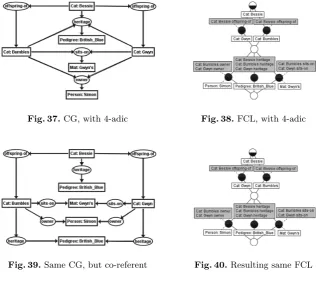
Figure37 has a CG with heritage as a 4-adic relation, essentially adding that [Cat: Bessie] has the heritage of [Pedigree: British Blue] too, along with[Cat: Bumbles]and[Cat: Gywn]. Through the unlabelled Formal Concept the 4th adic is highlighted by Fig.38.
4.7 Further Exploring Co-Referent Links
[image:17.439.60.220.450.562.2]Figure37’s CG can be restated using a co-referent link as shown by Fig.39. In this Figure, the CG Concept [Pedigree: British Blue]appears twice. Note also that the 4-adic heritagerelation has disappeared, or so it would appear?
Fig. 35.Same CG, 3-adic Fig. 36.Resulting same FCL
[image:17.439.245.389.452.562.2]Fig. 37.CG, with 4-adic Fig. 38.FCL, with 4-adic
Fig. 39.Same CG, but co-referent Fig. 40.Resulting same FCL
Note that Fig.40, which is the FCL for Fig.39 is identical to the FCL Fig.38.
The CGFCA parser applies the CG join operation as before thus causing the
co-referents–as they are the same CG referent–to be joined [14,17,19]. The sig-nificance of this example is that it reminds us that CGs may be hand-drawn in different ways (e.g. different adity, or using co-referents advertently–or inad-vertently as we saw with [Mat: Gwyn] in CG Fig.21 and the corresponding FCL Fig.22). However the FCL will represent them inoneway, thus potentially removing multiple, and potentially confusing ways of stating the same thing differently.
4.8 Larger Joins
Lastly to illustrate the wider behaviour of digraphs through CGs the above-discussed examples are essentially joined into one CG. Figure41shows the result of joining the other CGs (except Fig.15) with Fig.13, which showed the depen-dency from [Person: Simon] to [City: London] without the cycle, whereas Fig.42 shows the result of joining the other CGs (except Fig.13) to Fig.15, which showed[Person: Simon]to (and from)[City: London]with the cycle.
[image:18.439.47.206.54.158.2]Fig. 41.Joined FCL no cycle Fig. 42.Joined FCL with cycle
5
A Realistic Example
The simple but expressive examples presented thus far demonstrate how digraphs can be explored and validated through Triples2Binaries as exemplified by
CGFCA. Previous work has indicated CGFCA’s value in the business
[image:19.439.233.394.56.171.2]infor-mation systems modelling domain [15]. Based on an example from that work, a more comprehensive example is now presented from that real-world domain. Whilst the example uses the terminology of that domain, this example will be explained such that it can be more widely understood.
Fig. 43.Application module CG
[image:19.439.55.396.361.571.2]Fig. 44.Application module FCL
5.1 The Current Situation
As explained from the outset, human modellers draw diagrams to elicit the dimensions of some problem that becomes too difficult to understand through discursive narrative alone. We have seen that through CGs, the directed graph (digraph) offers the significant advantage of capturing the directional informa-tion i.e. an arc from vertex A to vertex B indicates that one may move from A to B but not from B to A. As well as their use in computer science as a repre-sentation of the paths that might be traversed through a program, the examples demonstrate digraphs’ applicability in higher-level conceptual models where con-cepts are related to each other by relations that gain additional semantics (i.e. meaning) by defining the direction between the source and target concepts.
CGs (Conceptual Graphs) are an expressive form of digraphs that enable modellers to express meaning in a form that is logically precise whilst being humanly readable. As such, they provide a conceptual structure that can for-mally describe the given problem being modelled. CGs, in common with many other forms of diagraphs are however drawn by hand, even with the assistance
of software tools such as CoGui suggested earlier [2]. Currently, the modeller enters the digraphs–in this case CGs–into the tool manually and relies on the tool to work with the potentially erroneous CGs entered into it. In effect the tool is as only as good as the fool that uses it, so “a fool with a tool is still a fool”–a common criticism from industry [12]. While a business (or other) mod-eller may be no fool, there is no guarantee that a model created using CGs is correct in terms of its validity. In their exploration of the given problem using CGs, the modeller may have a misconception of the system being modelled or may simply make mistakes in its construction–things that still conform to the syntax and grammar but result in an invalid model. The current situation is too complicated, and presents an unwarranted burden on the modeller.
Formal Concept Analysis (FCA) claims to add mathematical rigour to the logical rigour captured in CGs [10]. CGFCA reveals FCA’s effectiveness in this respect, thereby moving away from the current situation with its unnecessary complications as described above. We now further test this effectiveness using business modelling as the more comprehensive illustration.
5.2 Understanding the Complications
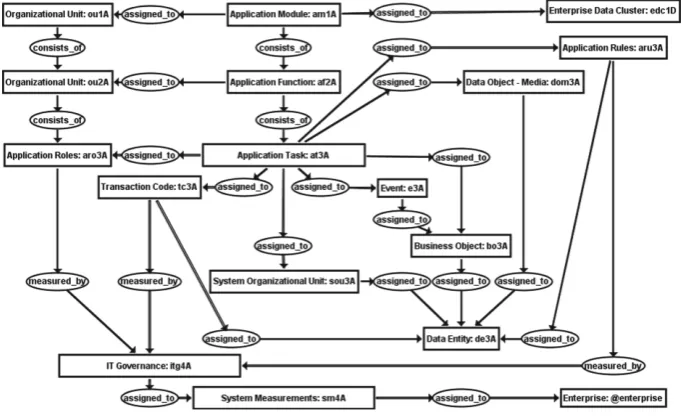
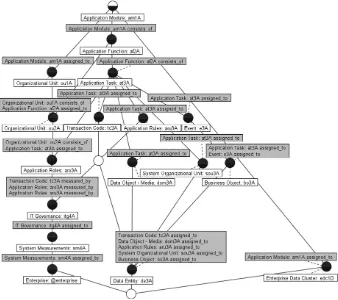
The CG Fig.43describes the components of a software application module that is part of an information system in an organisation. ApplyingCGFCAas above, Fig.44is the corresponding FCL for this CG Figure. The human business mod-eller draws this CG to capture the entities as CG Concepts and the CG relations between them. The detailed meaning of each entity and relation is discussed else-where [15], but for the purposes of our understanding the application module is denoted by the CG Concept: [Application Module: am1A]. The referent ‘am1A’ uniquely identifies the application module. The remaining CG Concepts and relations flow down from [Application Module: am1A]. This is validated byApplication Module: am1Abeing at the supremum (topmost) Formal Con-cept of the lattice, Fig.44. The modeller requires each referent throughout this CG to be unique and have no cycles in it. Figure44evidences that the Applica-tion Module as a CG is accurately captured. In practice this is unlikely to be the case. What are the complications in drawing the model that can undermine its validity, and how are these complications revealed byCGFCAand the lattice?
Arrow Direction. A common mistake or misconception that a modeller can make is to draw the arrows the wrong way round. This is a complication that may seem obvious on close inspection of the CG but nonetheless easily occurs even in introductory CGs despite proof-checking [14]. The syntax of the CG is correct–i.e. it is still a digraph (directed graph)–but this act results a semantic error. Figure46, which is an extract of the lattice for the CG Fig.45 shows that Application Module: am1A is not at the supremum; its place is taken by Organizational Unit: ou1A. This change of input is also shown by the CGFCA report: Inputs:“Organizational Unit: ou1A”. The modeller is alerted to this deficiency because the arrows between [Application Module: am1A]and
Fig. 45.Application module CG, wrong arrow direction
Fig. 46.Application module FCL extract, wrong arrow direction
[Organizational Unit: ou1A]in CG Fig.45were accidentally drawn the other way, unlike in the correctly-drawn previous CG Fig.43. The modeller can then correct the model. The modeller may want to manually record the mistake for future reference, by shading the ‘offending’(assigned to)CG relation as shown in Fig.45.
Mispointed Arrows. The CG Fig.47highlights another common mistake (or misconception) where a CG relation is pointed to the wrong CG Concept. In this case it’s [Transaction Code: tc3A] →(assigned to) →[IT Governance: itg4A]. It should be[Transaction Code: tc3A]→(assigned to)→[Data Entity: de3A]. For convenience the offending relation is highlighted in Fig.47. In practice the modeller would run CGFCA then generate the FCL (of which Fig.48 is an extract) before highlighting the incorrect CG. From FCL Fig.47 the modeller notices that assigned to;measured by is incor-rectly concatenated in Transaction Code: tc3A assigned to;measured by.
[image:22.439.151.273.298.379.2]Fig. 47.Application module CG extract, assigned to mispointed
Fig. 48.Application module FCL extract, assigned to mispointed
Such concatenations were demonstrated earlier by the FCL Fig.20 (i.e. Cat: Bumbles sleeps-on;sits-on;prefers), which was correct in CG Fig.19 but incorrect in CG Fig.47. Again a close inspection of CG Fig.47would reveal this complication, but it can easily happen in practice.
Unwanted Cycles. While cycles may be deliberate, in many cases including this business modelling scenario they point to a mistake or misconception. That is the case of the CG Fig.49 that emerges in the FCL of which Fig.50 is an extract. The cycle is still rather subtle however as the FCA attributesBusiness Object: bo3A assigned to,Event: e3A assigned toandApplication Task: at3A assigned toare spread across two Formal Concepts before the FCA objects
[image:23.439.115.339.293.417.2]Fig. 49.Application module CG, cycle
Fig. 50.Application module FCL extract, cycle
Business Object: bo3A,Event: e3A assigned toandApplication Task: at3A
are reached showing that the CG Concepts in the attributes (eventually) point to themselves as the CG Concept denoted by the FCA object. TheCGFCAreport brings it most easily to light:
Cycle: Application Task: at3A assigned to Event: e3A -assigned to - Business Object: bo3A - -assigned to - Application Task: at3A.
The FCL is nonetheless of value as the Formal Concept that has the three attributes listed above (i.e. Business Object: bo3A assigned to, Event: e3A assigned to and Application Task: at3A assigned to) doesn’t have its own object (i.e. target CG Concept). This is highlighted by the bottom half of this Formal Concept’s circle being transparent due to the other dependencies in the FCL. The modeller sets those other dependencies aside, as (s)he has iden-tified that the unwanted cycle is the issue and its correction may also resolve any other suspect dependencies (which it does). The cause? That common error of a relation with the arrows pointing the wrong way i.e. the(assigned to) CG relation that points to [Application Task: at3A] from [Business Object: bo3A]when the CG relation should be the other way round. This time it causes a cycle as a revisit to the CG Fig.49and following this CG relation–using the
CGFCAreport as our guide–brings the cycle to light. For the record, the
offend-ing(assigned to)is shaded in the CG Fig.49. The cycle in the FCL Fig.50is also highlighted by the rectangles with thick black borders.
[image:25.439.54.397.370.579.2]Invalid CG Referents. Remember in Fig.22i.e.Cat;Mat;Pet: Gwyn, Gwyn became not only a Pet Cat but a Mat too! This common error appears in the CG Fig.51and becomes evident in FCL Fig.52, where [Application Roles: ar3A] and [Application Rules: ar3A] accidentally share the same referent (ar3A); an easy error to make especially as the CG Type Labels Application
Fig. 51.Application module CG, ar3A referent
Fig. 52.Application module FCL, ar3A referent
Rules and Application Roles look so similar too! In the FCL Fig.52 they are shown asApplication Rules;Application Rolesand, for emphasis, high-lighted in thick black border rectangles. Likewise, and as before, the modeller in CG Fig.51shades these offending CG Concepts.
5.3 Resolving the Complications
While the above complications are not exhaustive, and not accounting for com-binations of complications that could be further highlighted by the approach described, we have evidenced through the real-world scenario of business mod-elling how the human modeller as a practitioner (business or otherwise) is empowered by CGFCA and the FCL. In the course of this approach the mod-eller was able to explore the CG models, apply his/her reasoning from identifying issues in the models, thus leading to their correction. Through resolving the com-plications, the modeller acts as a human co-creator with the computer-generated
CGFCAreports and FCLs (Formal Concept Lattices) thereby being empowered
to produce useful, validated models.
6
Related Work
CGFCA originated with a comparative study to Wille’s Concept Graphs as
stated earlier, revealing the comparative advantages ofCGFCA[5,20].CGFCA– henceTriples2Binaries–is however now at a level of maturity that it can play a useful role whilst recognising the existence of other FCA approaches to triple-based structures, such as Relational Concept Analysis (RCA), EL-Implications and Graph-FCA [6,7,16]. Extensive comparative studies in this arena already exist, pre-CGFCA [13]. While CGFCA fulfills the scope of our study, there is value in a up-to-date comparative study that includesCGFCA. Such work may help to identify how all the approaches may best work together for directed graphs and FCA.
7
Concluding Remarks and Further Work
As well as providing the capability to explore, reason with and validate directed graphs (digraphs), the FCL representation of CGs are arguably more readable. As we have seen, the arcs (the arrows) in a CG can lead in any direction. In a large, complex CG it can be difficult to trace and compare pathways through it, even more so where there are co-referent links. All FCL pathways are aligned in a top-to-bottom (inputs to outputs), hierarchical manner and co-referents can be automatically joined to make more apparent their connections and place in the graph.
Future work will continue to develop representative exemplars; a worthwhile endeavour given the value demonstrated by this paper. Furthermore since we have set the context as exploring and validating digraphs through triples to binaries rather than just CGs, the further work intends to include directed triples modelled by practitioners in UML, RDF, OWL, the Entity-Relation Diagram and linked data as alluded to earlier.
Meanwhile we have demonstrated that CGFCA–hence Triples2Binaries– presents a formal method that exploits CGs as digraphs through the application of Formal Concept Analysis (FCA). FCA elucidates key features of CGs such as pathways and dependencies, inputs and outputs, cycles, and joins. Given the prevalence of digraphs, the practitioner is consequently empowered in explor-ing, reasoning with and validating their models in understanding real-world phenomena.
References
1. Charger - a conceptual graph editor.http://charger.sourceforge.net/. Accessed 02 Jan 2018
2. Cogui.http://www.lirmm.fr/cogui/. Accessed 02 Jan 2018
3. Andrews, S.: In-Close2, a high performance formal concept miner. In: Andrews, S., Polovina, S., Hill, R., Akhgar, B. (eds.) ICCS 2011. LNCS (LNAI), vol. 6828, pp. 50–62. Springer, Heidelberg (2011).https://doi.org/10.1007/978-3-642-22688-5 4
4. Andrews, S., Hirsch, L.: A tool for creating and visualising formal concept trees. In: CEUR Workshop Proceedings, vol. 1637, pp. 1–9 (2016)
5. Andrews, S., Polovina, S.: A mapping from conceptual graphs to formal concept analysis. In: Andrews, S., Polovina, S., Hill, R., Akhgar, B. (eds.) ICCS 2011. LNCS (LNAI), vol. 6828, pp. 63–76. Springer, Heidelberg (2011).https://doi.org/ 10.1007/978-3-642-22688-5 5
6. Baader, F., Distel, F.: A finite basis for the set of EL-implications holding in a finite model. In: Medina, R., Obiedkov, S. (eds.) ICFCA 2008. LNCS (LNAI), vol. 4933, pp. 46–61. Springer, Heidelberg (2008). https://doi.org/10.1007/978-3-540-78137-0 4
7. Ferr´e, S., Cellier, P.: Graph-FCA in practice. In: Haemmerl´e, O., Stapleton, G., Faron Zucker, C. (eds.) ICCS 2016. LNCS (LNAI), vol. 9717, pp. 107–121. Springer, Cham (2016).https://doi.org/10.1007/978-3-319-40985-6 9
8. Ganter, B., Wille, R.: Formal Concept Analysis: Mathematical Foundations. Springer, Heidelberg (2012).https://doi.org/10.1007/978-3-642-59830-2
9. Harary, F.: Structural Models: An Introduction to the Theory of Directed Graphs. Wiley, New York (1965)
10. Hitzler, P., Scharfe, H.: Conceptual Structures in Practice. CRC Press, Boca Raton (2009)
11. Koehler, K.R.: Directed graphs (2012).http://kias.dyndns.org/comath/33.html
12. Parker, L., HP OpenView Business Unit: A fool with a tool is still a fool! HP Open View (2001)
13. Poelmans, J., Ignatov, D.I., Kuznetsov, S.O., Dedene, G.: Review: formal concept analysis in knowledge processing: a survey on applications. Expert Syst. Appl.
40(16), 6538–6560 (2013)
14. Polovina, S.: An introduction to conceptual graphs. In: Priss, U., Polovina, S., Hill, R. (eds.) ICCS-ConceptStruct 2007. LNCS (LNAI), vol. 4604, pp. 1–14. Springer, Heidelberg (2007).https://doi.org/10.1007/978-3-540-73681-3 1
15. Polovina, S., Scheruhn, H.-J., von Rosing, M.: Modularising the complex meta-models in enterprise systems using conceptual structures. In: Developments and Trends in Intelligent Technologies and Smart Systems, pp. 261–283. IGI Global, Hershey (2018). ID: 189437
16. Rouane-Hacene, M., Huchard, M., Napoli, A., Valtchev, P.: Relational concept analysis: mining concept lattices from multi-relational data. Ann. Math. Artif. Intell.67(1), 81–108 (2013)
17. Sowa, J.F.: Conceptual Structures: Information Processing in Mind and Machine. Addison-Wesley Publishing, Reading (1983)
18. Sowa, J.F.: Conceptual graph examples. http://www.jfsowa.com/cg/cgexampw. htm
19. Sowa, J.F.: Conceptual graphs. In: Handbook of Knowledge Representation, Foun-dations of Artificial Intelligence, vol. 3, pp. 213–237. Elsevier, Amsterdam (2008) 20. Wille, R.: Conceptual graphs and formal concept analysis. In: Lukose, D.,
Del-ugach, H., Keeler, M., Searle, L., Sowa, J. (eds.) ICCS-ConceptStruct 1997. LNCS, vol. 1257, pp. 290–303. Springer, Heidelberg (1997). https://doi.org/10. 1007/BFb0027878
Chapter 1
Query Refs.
Details Required Author’s response
AQ1 This is to inform you that corresponding author has been identified as per the information available in the Copy-right form.