The dynamical zeta function for commuting
automorphisms of zero-dimensional groups
MILES, Richard <http://orcid.org/0000-0002-9805-1628> and WARD, Thomas
Available from Sheffield Hallam University Research Archive (SHURA) at:
http://shura.shu.ac.uk/17216/
This document is the author deposited version. You are advised to consult the
publisher's version if you wish to cite from it.
Published version
MILES, Richard and WARD, Thomas (2018). The dynamical zeta function for
commuting automorphisms of zero-dimensional groups. Ergodic Theory and
Dynamical Systems, 38 (4), 1564-1587.
Copyright and re-use policy
See
http://shura.shu.ac.uk/information.html
Sheffield Hallam University Research Archive
RICHARD MILES
Abstract. This article introduces and investigates the basic features of
a dynamical zeta function for group actions, motivated by the classical dynamical zeta function of a single transformation. A product formula for the dynamical zeta function is established that highlights a crucial link between this function and the zeta function of the acting group. A variety of examples are explored, with a particular focus on full shifts and closely related variants. Amongst the examples, it is shown that there are infinitely many non-isomorphic virtually cyclic groups for which the full shift has a rational zeta function. In contrast, it is shown that when the acting group has Hirsch length at least 2, a dynamical zeta function with a natural boundary is more typical. The relevance of the dynamical zeta function in questions of orbit growth is also considered.
1. Introduction
The zeta function of a dynamical system is a fundamental invariant that has warranted considerable attention since the definitive work of Artin and Mazur [1]. Ruelle [29] provides an introduction to various guises of this function, and a comprehensive survey by Sharp in the context of periodic orbits of hyperbolic flows may be found in [21]. For a discrete time dynamical system given by a transformation T : X → X of a state space X, the dynamical zeta function is defined formally by
ζT(z) = exp
X
n>1
FT(n)
n z
n,
where FT(n) = |{x ∈ X : Tnx = x}|. As well as being an important
invariant in its own right, ζT is often related to other dynamical
invari-ants, especially if the dynamical system (X, T) is framed in a topological or measurable context [5], [1], [33]. For example, if T is a hyperbolic toral automorphism, then the radius of convergence of ζT is exp(−h), where h is
the topological entropy. Natural applications involving ζT may be found in
studies of orbit growth [26], [27], [36].
2010 Mathematics Subject Classification. 37A45, 11M41, 37A35, 37C30 (primary), 37C25, 37C35, 37C85, 22F05 (secondary).
Key words and phrases. Dynamical zeta function, group action, periodic orbit, product formula, natural boundary, full shift.
This work was initiated with the support of the London Mathematical Society Scheme IV grant number 41352, which the author gratefully acknowledges.
In this article, we introduce and investigate the basic features of a dynam-ical zeta function for group actions, motivated by the classdynam-ical dynamdynam-ical zeta function described above. This programme can be traced back to the pioneering work of Lind [18], who introduced a dynamical zeta function for a Zd-action by homeomorphisms of a compact metric space. A compatible definition has been introduced for actions of the infinite dihedral groupD∞,
by Kim, Lee and Park [13], and the definition given here generalizes both these, and the definition used by Artin and Mazur. Notably, Kimoto [14] has also considered alternative definitions of zeta functions associated with finite group actions.
Let G be a finitely generated group and let LG denote the collection of finite index subgroups ofG. We tacitly assume throughout thatGis infinite. For any L∈ LG, write [L] = [G:L] when the supergroup is clear. Since G
is finitely generated, for all n > 1, the collection of subgroups of index n
in Gis finite. Denote this collection by LG(n) and write aG(n) = |LG(n)|.
Suppose that α is a G-action on a set X such that for all L ∈ LG the
cardinality Fα(L) of the set ofL-periodic points
Fixα(L) ={x∈X:gx=x for allg∈L} (1)
is finite. Thedynamical zeta function ofα is defined formally by
ζα(z) = exp
X
L∈LG
Fα(L)
[L] z
[L]. (2)
Note that for an invertible transformation T, the classical dynamical zeta function ζT agrees with the definition above, with α being the Z-action generated byT.
A central focus in the investigation here is the relationship between ζα
and the zeta function of the acting group [12] (see also [19] and [10]), defined by the formal Dirichlet series
ζG(z) =
X
n>1
aG(n)
nz .
In particular, a key tool will be the Dirichlet series
∆L(z) =
ζL(z+ 1)
ζ(z+ 1) = X
n>1
bL(n)
nz , (3)
where L ∈ LG, and ζ = ζZ denotes the Riemann zeta function. Note that ∆L has rational coefficients for all L ∈ LG. The relationship between
these Dirichlet series andζα arises via the development of product formulae
for ζα. The classical dynamical zeta function has the well known product
formula
ζα(z) =
Y
Y
(1−z|Y|)−1, (4)
zeta function. In analogy with the Ihara zeta function for a finite connected graph (for example, see [35]), one could begin with a product formula as the definition of a dynamical zeta function for a group action. However, (4) does not correspond to (2) in general nor, in particular, with the existing studies [18] and [13], except in the cased= 1 in [18].
When deriving a product formula formally equivalent to (2), one needs to take into account the various isomorphism classes of stabilizers inG, and this introduces a significant level of complexity. Before stating the main product formula for ζα, first note that for any finite orbitY, all stabilizers
of elements ofY lie in the same isomorphism class, for which we may choose an appropriate representative inL(Y)∈ LG. Note also that our hypotheses ensure that there are only finitely many orbits of a given cardinality (see Lemma 2.3), so the product given below is properly defined.
Theorem 1.1. Let G be a finitely generated group and let α be an action of G on a setX such thatFα(L)<∞, for all L∈ LG. Then the dynamical zeta function ζα(z) is given by the product
ζα(z) =
Y
Y
Y
n>1
(1−z|Y|n)−bL(Y)(n), (5)
whereY runs over all finite orbits inX,L(Y)is the stabilizer of any element of Y and the exponents bL(Y)(n) ∈ Q, n > 1, are the coefficients of the Dirichlet series ∆L(Y) given by (3). Hence, if ∆L has integer coefficients for all L∈ LG, then the formal power series for ζα has integer coefficients.
The concluding sentence of the theorem highlights part of the motivation for obtaining a product formula forζα. The presence of integer coefficients
in the formal power series for ζα has has proved to be important when
studying the analytic behaviour of both the classical dynamical zeta tion [3], random dynamical zeta functions [6] and Lind’s dynamical func-tion [18], [22], [25], since the celebrated P´olya-Carlson theorem [7], [28] may then be brought to bear. It is also worth noting that product formulae for Lind’s dynamical zeta function feature prominently in certain studies of higher-dimensional shifts of finite type [2].
The second main result concerns full shifts of groups having polynomial subgroup growth (PSG groups) and Hirsch length at least 2 (for a definition of Hirsch length, see Section 2). This is obtained using a simplified form of (5) that we deduce for full shifts (Theorem 4.1) coupled with conclusions that we draw (Proposition 2.6) from Shalev’s classification of groups with bounded subgroup growth [32] and the P´olya-Carlson theorem.
We also include a related result (Corollary 2.7) for actions generated by automorphisms of compact connected abelian groups, obtained by applying the author’s previous work [22], that further motivates Theorem 1.1.
The examples explored emphasize the role ofζGand the importance of
ex-plicit formulae forζGthat have been obtained, as for example by Grunewald,
Segal and Smith [12] and du Sautoy, McDermott and Smith [9]. Note that the development of such formulae is now quite advanced [10], and we in-vestigate only a small fraction of the many possibilities available here. Our examples show that when the acting group is virtually cyclic, ζα may in
fact be rational and, in contrast with [18] and [13], we find that there are infinitely many non-isomorphic groups for which the full shift has a rational dynamical zeta function. Beyond full shifts, the subgroup conjugacy class structure inLG is seen to play a more significant role and this is illustrated
with the help of an actionαof the planar symmetry grouppm∼=Z2oC2 on a projected shift space. This group was chosen becauseLpmhas a non-trivial
partition into finitely many isomorphism classes, ∆Lhas integer coefficients
for all L ∈ LG, and pm has the advantage of being a fundamental
expo-sitional example treated in [9]. For this action, we find that ζα may be
calculated with the aid of shifted factorials.
The paper is structured as follows. Section 2 assembles some preliminaries concerning finite orbits of group actions and also develops some fundamental properties of the zeta function, including the consequences of the author’s earlier paper [22] and our deductions based on Shalev’s work and the P´ olya-Carlson theorem. Also in this section, in light of earlier studies by the author and Ward [24], [23], by using M¨obius inversion on the incidence algebra ofLG, we highlight how the dynamical zeta function may find further applications in studies of orbit growth. In Section 3, we develop product formulae for ζα, giving the proof of Theorem 1.1 in two natural stages.
Section 4 contains the more detailed investigation of full shifts and related examples. Finally, we conclude with a list of open problems.
2. Finite orbits and fundamental properties of ζα
We begin by recalling some important invariants of finitely generated groups. Let G be such a group. When G is polycyclic-by-finite, there is a finite index subgroup Gm6Gwith subnormal series
{1}=G0CG1CG2C· · ·CGm, (6)
whereGk/Gk−1 is infinite cyclic for all 16k6m. The Hirsch length of G is equal to mand this is an invariant of G. LetLG denote the collection of finite index subgroups ofG, and letLG(n) denote the collection of subgroups
of index n. If aG(n) = |LG(n)| grows at most polynomially in n, then G
for the sequence (aG(n)). For further details concerning groups and their
subgroup growth properties, see [19].
There is a natural partial order onLG given by subgroup inclusion and,
since aG(n) < ∞ for all n > 1, the poset LG is locally finite, that is each
interval
[L, K] ={M ∈ LG:L6M 6K}
is a finite set. This means that one may define a corresponding M¨obius functionµon the set of intervals by
µ(L, L) = 1 for allL∈ LG
and
µ(L, K) =− X
L6M <K
µ(L, M) for all L < K inLG.
Note that the classical M¨obius function on the group of integers coincides with the M¨obius function on the set of intervals in the lattice of finite in-dex subgroups of Z on writing µ(n) = µ(nZ,Z). For further background concerning this combinatorial framework, see Stanley’s book [34].
LetO(LG) denote the set of orbits that arise from the natural conjugation action of G on LG given by g·L=gLg−1, where g∈G and L∈ LG. This
action is clearly trivial if G is abelian. Note also that conjugate subgroups are isomorphic and have the same index. Since there are only finitely many subgroups of any given index in G, all orbits of this action are finite. The cardinality |Ω|of an orbit Ω∈ O(LG) containing a subgroup L is equal to the index of the normalizerNG(L) ={g∈ G:gLg−1 =L} of L, as this is
also the stabilizer of Lunder the action of subgroup conjugation.
Now suppose α is a G-action on a set X, with the property that the cardinality Fα(L) of the set of L-periodic points Fixα(L) given by (1) is
finite for all L∈ LG. We observe the following elementary properties.
Lemma 2.1. Let the group G and the G-action α be as above. Then
(i) x∈Fixα(L)⇔L6Stab(x)
(ii) gFixα(L) = Fixα(gLg−1)
(iii) Stab(gx) =gStab(x)g−1
for any L∈ LG,x∈X and g∈G.
By Lemma 2.1(iii), the equivalence relation defined by
x∼y ⇐⇒Stab(x) = Stab(y) also satisfies, for allg∈G,
x∼y⇒gx∼gy.
This defines a block system for the action of Gon X. A finite orbit Y ⊂X
is partitioned intoblocks of the form
for the subgroupsL∈ LG that occur as stabilizers of elements of Y. So, for
any blockB ⊂Y and anyg∈G, we have eithergB=BorgB∩B=∅. The blocks comprising Y have the same cardinality, which is |Y|divided by the number of distinct subgroups ofGoccurring as stabilizers of elements ofY. Therefore, if Y is an orbit containing an element with stabilizer L, since the action of G on Y is transitive, Lemma 2.1(iii) shows that the number of such distinct subgroups is given by |Ω(L)|, where Ω(L) ∈ O(LG) is the unique orbit containing L. Clearly L 6 NG(L) and Stab(L) = NG(L).
Therefore, |Ω(L)| = [NG(L)] and [G : NG(L)][NG(L) : L] = [G : L]. In
particular, |Ω(L)| divides the orbit length |Y| = [L], where this equality follows from the orbit-stabilizer theorem. Hence, each block forming part of the orbitY has cardinality
[L]/|Ω(L)|= [L]/[NG(L)]. (7)
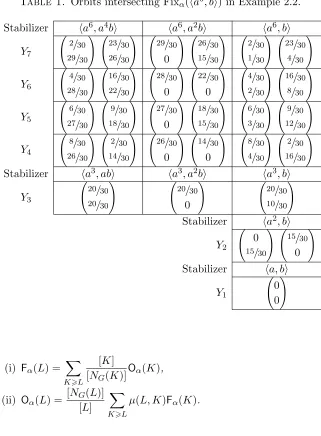
The following example illustrates how the block system functions for a dynamical system arising from an action of the infinite dihedral group D∞.
Example 2.2. Consider the group D∞ = ha, b : b2 = 1, ab = ba−1i. For
each odd index n, there are exactlyndistinct subgroups ofD∞ of index n,
han, bi,han, abi,han, a2bi, . . . ,han, an−1bi, (8) and for each even index n, in addition to the subgroups (8), there is one additional subgroup han/2i of index n. An action α of D∞ on the torus
T2 = (R/Z)2 is generated by multiplication by the matrices
A=
−2 3 1 −2
and B =
7 −12 4 −7
which satisfy B2 = 1 andAB =BA−1. A method for calculating periodic points for this example is explained in [23, Ex. 2.2]. Here, it is shown how the finite orbits of this action intersect Fixα(L) for the particular subgroupL=
ha6, bi, according to the block system just described. The subgroup L has conjugates ha6, a2bi and ha6, a4bi and supergroups ha3, bi,ha2, bi and ha, bi. Amongst the supergoups, onlyha3, bihas distinct conjugates, namelyha3, abi andha3, a2bi. All the subgroups just mentioned occur as stabilizers of points in the finite orbits ofαthat intersect Fixα(L). These 7 orbitsY1, . . . , Y7 are illustrated by the rows in Table 1. Stabilizers of points are shown above them, and the set Fixα(L) comprises the 12 points in the final column of the
table. Individual cells in the table containing the periodic points correspond to blocks in the block system forα.
Given anyL∈ LG, writeOα(L) for the number of orbits of the actionα
on X that contain at least one elementx with Stab(x) =L. The following lemma connectsOα(L) andFα(L).
Table 1. Orbits intersecting Fixα(ha6, bi) in Example 2.2.
Stabilizer ha6, a4bi ha6, a2bi ha6, bi
Y7
2/30
29/30 !
23/30
26/30 !
29/30
0 !
26/30
15/30 !
2/30
1/30 !
23/30
4/30 !
Y6
4/30
28/30 !
16/30
22/30 !
28/30
0 !
22/30
0 !
4/30
2/30 !
16/30
8/30 !
Y5
6/30
27/30 !
9/30
18/30 !
27/30
0 !
18/30
15/30 !
6/30
3/30 !
9/30
12/30 !
Y4
8/30
26/30 !
2/30
14/30 !
26/30
0 !
14/30
0 !
8/30
4/30 !
2/30
16/30 !
Stabilizer ha3, abi ha3, a2bi ha3, bi
Y3
20/30
20/30 !
20/30
0 !
20/30
10/30 !
Stabilizer ha2, bi
Y2 0 15/30
! 15/30
0 !
Stabilizer ha, bi
Y1
0 0
!
(i) Fα(L) =
X
K>L
[K] [NG(K)]
Oα(K),
(ii) Oα(L) =
[NG(L)]
[L] X
K>L
µ(L, K)Fα(K).
Proof. Orbits of theG-actionαonXintersect Fixα(L) in blocks, and (i)
fol-lows immediately from Lemma 2.1(i) and (7). Consequently, (ii) is obtained using the dual form of M¨obius inversion [34, Prop. 3.7.2].
Remark 2.4. Lemma 2.3 corrects an earlier oversight by the author and Ward in their work on orbit counting, specifically in [24, Eq. (2)] and [23, Eq. (2)], whereOα(L) is defined as it may be more simply whenGis abelian,
and the factor [NG(L)] is omitted. However, the main results in [24] and [23]
Recall the definition of ζα given by (2). It is also sometimes useful to
write
ζα(z) = exp
X
n>1 1
n
X
L∈LG(n)
Fα(L)zn.
Note that the formal power series forζα is thus obtained by composition of
generating functions in the usual way.
If α and β are actions of a finitely generated group G on sets X and Y
respectively and there is a bijection φ:X →Y such that for allg ∈G and all x∈X,
φ(gx) =gφ(x),
then, for all L∈ LG,Fβ(L) =Fα(L). Hence,ζα and ζβ are identical. Thus,
the dynamical zeta function is an invariant of bijective conjugacy.
Ifαis an action of a finitely generated PSG groupGon a setX, we define
g(α) = lim sup [L]→∞
1
[L]logFα(L) = limn→∞[supL]
>n
1
[L]logFα(L). (9) Since G has polynomial subgroup growth, if Fα(L) < ∞ for all L ∈ LG,
then the usual Hadamard formula shows that ζα has radius of
conver-gence exp(−g(α)).
A G-action on a compact metric space (X, ρ) is calledexpansive if there exists r > 0 such that supg∈Gρ(gx, gy) > r for all distinct x, y ∈ X. In
the classical setting of a topological dynamical system whereα is generated by a single expansive homeomorphism of a compact metric space, Bowen [4] shows that there exist constantsC1, C2 >0 such that for sufficiently largen,
C1exp(h(α)n)6Fα(hni)6C2exp(h(α)n), (10) where h(α) is the topological entropy. Hence, g(α) = h(α). For non-expansive Z-actions, periodic point counting estimates so closely tied to entropy should not be expected (for example, see [17]). Moreover, for more general group actions, even with the assumption of expansiveness, there is little reason to expect a direct relationship between g(α) and h(α). For instance, Lind [18] gives an example of an expansive Z2-action α by con-tinuous automorphisms of a compact abelian group such that g(α) = log 4 and h(α) = log 3. Another particular case for which g(α) = h(α), is that of an expansive action α of D∞ by continuous automorphisms of a
com-pact abelian group, considered by the author in [23]. This is achieved by obtaining bounds analogous to (10) for all subgroups of indexn. However, in Section 4, it will be seen that no such analogous result is possible for expansive actions of all other virtually cyclic groups (that is, those that are neither isomorphic toZ norD∞) whenh(α)>0.
Theorem 2.5. Letαbe a mixing action of a polycyclic-by-finite PSG groupG
by automorphisms of a compact connected finite dimensional abelian groupX. If G has Hirsch length at least 2, then g(α) = 0.
Proof. Firstly, since α is mixing, any non-trivial subaction is also mixing. Consider a subnormal series ofGof the form (6), so thatG2∼=Z o Z. Since Aut(Z)∼=C2, a standard argument shows that this semi-direct product con-tains a subgroup isomorphic toZ2, so Gcontains a subgroupH isomorphic to Z2, and the subaction β of H on X is also mixing. Furthermore, for any L∈ LG, [H:H∩L]6[G:L] and
Fα(L)6Fα(H∩L) =Fβ(H∩L).
Therefore,
1
[G:L]logFα(L)6
1
[H :H∩L]logFβ(H∩L)
and so g(α)6g(β). Moreover, since β is mixing, [22, Th. 1.1] shows that
g(β) = lim sup [H:K]→∞
1
[H :K]logFβ(K) = 0,
asK runs through finite index subgroups ofH.
When g(α) = 0, an application of the P´olya-Carlson theorem [31, Ch. 6, Th. 5.3] together with Shalev’s classification of groups with bounded sub-group growth [32] leads to the following results.
Proposition 2.6. Let α be an action of a polycyclic-by-finite PSG groupG
of Hirsch length at least2on a setX such thatFα(L) = 0for at most finitely many L ∈ LG. If g(α) = 0 and the formal power series for ζα has integer coefficients, then ζα has the unit circle as a natural boundary.
Proof. Since ζα has integer coefficients and radius of convergence 1, the
P´olya-Carlson theorem implies that ζα is a either a rational function or has
the unit circle as a natural boundary. As in [18, Ex. 3.4], suppose for a contradiction thatζα is rational, that is
ζα(z) =
λQk
i=1(1−ξiz) Q`
j=1(1−ηjz)
for someλ, ξ1, . . . , ξk, η1, . . . , η` ∈C. Elementary calculus then showsλ= 1 and
X
L∈LG(n)
Fα(L) = `
X
j=1
ηnj −
k
X
i=1
ξin, (11)
Sinceζαis analytic inside the unit disk,|ηj|61 for 16j6`. Furthermore,
asζαis the exponential of a convergent power series inside the unit disk, we
also have |ξi|61 for 16i6k. Hence,
an(G)6
X
L∈LG(n)
where the first inequality holds for all but finitely many n by hypothesis, and the second inequality holds for all n, by (11). However, Shalev [32, Th. 1.2] has shown thatan(G) = O(n) if and only ifGis virtually cyclic. In
particular, sinceGhas Hirsch length at least 2 by hypothesis, the bounded subgroup growth purported by (12) contradicts Shalev’s theorem.
Corollary 2.7. Let α be a mixing action of a polycyclic-by-finite PSG group G of Hirsch length at least 2 by automorphisms of a compact con-nected finite dimensional abelian groupX. If the formal power series for ζα has integer coefficients, then ζα has the unit circle as a natural boundary. Proof. This follows from Proposition 2.6 and Theorem 2.5.
We return to the appearance of a natural boundary for the dynamical zeta function for full shifts in Section 4. A more detailed investigation of dynamical systems for which the zeta function has a natural boundary is beyond the scope of this article, even for actions generated by automor-phisms of compact abelian groups. See [18] and [25] for some of the more subtle issues involved in the case G=Zd, withd>2. In this setting, Lind conjectures [18, Conj. 7.1] that ζα is meromorphic for |z| < exp(−g(α)),
whereg(α) is the limit obtained in (9) by replacing [L] with
min{||n||:n∈L\ {0}}.
Lind also conjectures that the circle|z|= exp(−g(α)) is a natural boundary for the function. Although some progress is made in addressing Lind’s con-jecture in [22] and [25], this remains open in the general context ofZd-actions by automorphisms of compact abelian groups.
To conclude this section, we consider the dynamical zeta function’s utility for counting finite orbits. For an action α of a finitely generated group G, denote the number of orbits ofα of cardinality at most N by πα(N).
Proposition 2.8. LetGbe a finitely generated group and letαbe aG-action on a set X such that for all L∈ LG, Fα(L)<∞. Then
πα(N) =
X
[L]6N
1 [L]
X
K>L
µ(K, L)Fα(K).
Proof. First note thatx∈Xlies in orbit of lengthnif and only if Stab(x)∈ LG(n). For any L∈ LG(n) and for any orbit of the action of α on X that contains a point with stabilizer L, the stabilizers of all the other elements in this orbit are of the form gLg−1, for some g ∈ G, by Lemma 2.1(iii). There are [NG(L)] such stabilizers, all of index n, as this is the length of
the orbit Ω of L under the action of G on LG(n) given by conjugation. Furthermore,Oα(L) gives the number of orbits inX with a stabilizer in Ω,
for any choice of L ∈ Ω. Letting Ω run over all orbits in LG(n), we may
express the number of orbits of length nfor the actionα as
X
Ω 1 |Ω|
X
L∈Ω
Oα(L) =
X
Ω X
L∈Ω
Oα(L)
[NG(L)]
= X
L∈LG(n)
Oα(L)
which, by Lemma 2.3, is equal to
X
L∈LG(n)
1 [L]
X
K>L
µ(L, K)Fα(K).
The formula for πα(N) now follows.
Following [19], write sG(N) =Pn6NaG(n). Define
fα(N) = sup
[L]6N
Fα(L) and mG(N) = sup
[L]6N,K>L
|µ(L, K)| [L] .
As a consequence of the orbit counting formula provided by Proposition 2.8, the following link betweenπα(N) and the coefficients of logζα is available if
the quantity fα(N/2)/fα(N) decays sufficiently rapidly.
Corollary 2.9. Let G be a finitely generated group and let α be aG-action on a set X such that for all L∈ LG, Fα(L)<∞ and
fα(N/2)mG(N)sG(N)N = o(fα(N)). (13) Then
πα(N)∼
X
[L]6N
Fα(L)
[L] .
Proof. By Proposition 2.8
πα(N) =
X
[L]6N
Fα(L)
[L] + X
[L]6N
1 [L]
X
K>L
µ(K, L)Fα(K)
| {z }
E(N)
.
For any L ∈ LG with [L] 6 N, any proper supergroup K > L satisfies
[K]6N/2, so
E(N) P
[L]6NFα(L)/[L] 6
N fα(N)
fα(N/2)mG(N)sG(N)
and the required result follows.
Corollary 2.9 is somewhat crude, and can be improved for more pre-cise orbit growth estimates, but it is intended to illustrate and generalize a key idea that has featured in earlier studies of orbit growth, for exam-ple, in [24] and [23]. For many dynamical systems of natural interest, such as the full shifts considered in Section 4, fα(N/2)/fα(N) decays
exponen-tially, whilst the other terms in (13), that depend only on G rather than onα, grow subexponentially. For example, ifGis a PSG group, thensG(N)
grows at most polynomially and, ifGis nilpotent, the results of Kratzer and Th´evenaz [15], together with an application of Crapo’s closure theorem [8], show that mG(N) is subexponential inN. Notably, these observations
Note that in the classical case of aZ-action,sZ(N) =N and|µ(·)|61, so
if such an action is generated by an expansive homeomorphism of a compact metric space, then (13) is satisfied due to the key estimate of Bowen (10), and Corollary 2.9 again applies.
Example 2.10. Consider the groupZ×(Z/pZ), wherepis a rational prime. We have the following straightforward description ofLZ×(Z/pZ). Ifp-n, then
there is precisely one subgroup of indexn, namely
L(n,0) =h(n,0),(0,1)i
and if p|n, then there arep subgroups of indexnof the form
L(n, k) =h(n,0),(kn/p,1)i,
where 06k6p−1, plus one further subgroupL(n) =h(n/p,0)iof indexn. Now consider the particular case of an action of G= Z×(Z/3Z). The matrices
A=
1 2 1 0 −2 3 0 1 1 0 0 0 0 1 0 0
and B =
0 −1 0 0 1 −1 0 0 0 0 0 −1 0 0 1 −1
satisfy AB = BA and B3 = I
4, and together generate a G-action α by automorphisms of the torusT4. The matrixAhas characteristic polynomial
x4−4x3+ 5x2+ 4x+ 1 with non-real roots ω1, ω1, ω2, ω2, for which|ω1| ≈ 2.764,|ω2| ≈0.362 and ω1ω2 =−1.
The set of fixed points Fixα(B) = {(j3,−3j,k3,−3k)T : j, k = 0,1,2} is a
closed A-invariant subgroup of T4. Since Fixα(L(n,0)) 6 Fixα(B) for all
n>1, a standard computation shows
Fα(L(n,0)) =
9 if 8|n,
1 if 8-n. (14)
So, if 3-n, then the number of periodic points for the sole subgroupL(n,0) in LG(n) is bounded. On the other hand, if 3 | n, in addition to the
sub-group L(n,0) ∈ LG(n) for which Fα(L(n,0)) ∈ {1,9}, the 3 subgroups
L(n), L(n,1), L(n,2) ∈ LG(n) have exponentially growing sets of periodic points, which are also closed finite subgroups of T4. As is standard for compact abelian group automorphisms, groups of periodic points can be calculated using the intersection of kernels of homomorphisms. Upon writ-ingj =n/3, we see Fα(L(n)) is given by
|ker(Aj−I4)| = |det(Aj−I4)|
= |ωj1−1||ωj1−1||ωj2−1||ωj2−1|.
Furthermore,Fα(L(n,2)) is given by
and sinceAn−I4= (Aj−B)(A2j+BAj+B2), ker(An−I4)⊂ker(Aj−B). Therefore, the right hand side of (15) is
|det(Aj−B)|=|ωj1−δ||ω1j −δ||ω2j−δ||ωj2−δ|,
whereδ = exp(2πi/3). A similar calculation shows Fα(L(n,1)) is given by
|det(Aj−B2)|=|ω1j−δ||ωj1−δ||ωj2−δ||ωj2−δ|.
Since ω1ω2 =−1, by expanding these products of absolute values, we find thatFα(L(n)) +Fα(L(n,1)) +Fα(L(n,2)) is equal to
3 X
k=1
|det(Aj−Bk)|= 3(λj1+λj2+λj3+λj4+ 2), (16)
where λ1 = ω1ω1, λ2 = ω1ω2, λ3 = ω2ω1 and λ4 = ω2ω2. Hence, com-bining (14) and (16), it follows that there exist constants C1, C2 > 0 such that
C1λ
bN/3c
1 6fα(N)6C2λ
bN/3c
1 .
By [15, Prop. 2.4], for any given finitely generated abelian group, there is a constant C3 >0 such that for anyK, L∈ LG withL6K,
|µ(L, K)|=|µ(K/L,0)|6C3(log[L])2,
so mG(N) 6 N1C(logN)
2
3 . In addition, sG(N) = 3bN/3c+N, and so our combined estimates show that (13) is satisfied. Hence, Corollary 2.9 implies thatπα(N)∼P[L]6NFα(L)/[L]. Thus,
πα(N)∼
X
n6N
1
n
X
L∈LG(n)
Fα(L)∼
X
n6bN/3c
λn1 n ∼
λb1N/3c+1
(λ1−1)bN/3c
.
With the aid of (14) and (16), ζα may be calculated as follows.
ζα(z) = exp
X
8|n
9
nz
n+X 8-n
1
nz
n+X 3|n
3
n 2 +
4 X
k=1
λn/k 3
!
zn
= (1−z)−1(1−z8)−1(1−z3)−2 4 Y
k=1
(1−λkz3)−1.
In particular, ζα is rational.
Remark 2.11. An important development in the history of dynamical zeta functions was the use of Tauberian theorems to derive orbit growth asymp-totics, as in the work of Parry and Pollicott [26], [27], for example. This avenue opens whenζαhas an analytic continuation beyond the circle of
3. Product formulae
For any finite orbit Y ⊂ X, Lemma 2.1(iii) shows that the stabilizers of elements of Y comprise a single orbit in O(LG), and since conjugate subgroups are isomorphic, we may choose a representative groupL(Y)∈ LG
for this isomorphism class and uniquely define thetrivial actionτ(Y) ofL(Y) on a single point, together with its associated dynamical zeta functionζτ(Y), which is clearly invariant under the isomorphism just described. This allows us to express our initial product formula for the dynamical zeta function.
Lemma 3.1. Let Gbe a finitely generated group and letα be aG-action on a set X such that for all L∈ LG, Fα(L)<∞. Then
ζα(z) =
Y
Y
ζτ(Y)(z|Y|),
where Y runs over all finite orbits in X.
Proof. Let Y denote the set of finite orbits in X and for eachL ∈ LG, let
Fα(Y, L) =|Y ∩Fixα(L)|. Let Ω(Y)∈ O(LG) comprise the set of stabilizers
of elements ofY, so that by Lemma 2.1(i) and (7)
Fα(Y, L) =
|Y| |Ω(Y)|
X
K∈Ω(Y)
χ(L, K)
whereχ(L, K) = 1 if L6K and χ(L, K) = 0 otherwise. Therefore,
ζα(z) = exp
X
L∈LG
X
Y∈Y
Fα(Y, L)
[L] z [L]
= Y
Y∈Y
exp X
L∈LG
Fα(Y, L)
[L] z [L]
= Y
Y∈Y
exp |Y| |Ω(Y)|
X
L∈LG
X
K∈Ω(Y)
χ(L, K) [L] z
[L].
Reversing the order of summation overL and K gives
ζα(z) =
Y
Y∈Y
exp |Y| |Ω(Y)|
X
K∈Ω(Y) X
L∈LK
1 [L]z
[L].
Furthermore, since allK ∈Ω(Y) satisfy [K] =|Y|, it follows that
ζα(z) =
Y
Y∈Y
exp 1 |Ω(Y)|
X
K∈Ω(Y) X
L∈LK
[K] [L]z
[L]
= Y
Y∈Y
exp X
K∈Ω(Y) 1 |Ω(Y)|
X
L∈LK
1 [K :L](z
[K])[K:L]
= Y
Y∈Y
X
K∈Ω(Y) 1
|Ω(Y)|ζτ(Y)(z
The required result follows by factoring ζτ(Y)(z|Y|) out from the sum. By now employing the Dirichlet series ∆L, defined for each subgroup
L∈ LG by (3), we are able to prove Theorem 1.1.
Proof of Theorem 1.1. First consider the case where τ is the trivial action of a group L ∈ LG on a singleton Y. By the definition of ∆L, we have
ζL(z) =ζ(z)∆L(z−1) and Dirichlet convolution gives
aL(n) =
X
d|n
d·bL(d). (17)
Furthermore, since Fτ(L) = 1 for all L∈ LG, using elementary operations
on formal power series, we obtain the functional equation,
zζ
0
τ(z)
ζτ(z)
=X
n>1
aL(n)zn.
Hence, (17) together with a standard application of Lambert series gives
zζ
0
τ(z)
ζτ(z)
=X
n>1 X
d|n
d·bL(d)zn=
X
n>1
n·bL(n)
zn
1−zn.
Dividing byz and solving the resulting differential equation, we obtain
logζτ(z) =−
X
n>1
bL(n) log(1−zn).
Thus,
ζτ(z) =
Y
n>1
(1−zn)−bL(n). (18)
In the general case, whereαis aG-action on a setXsuch thatFα(L)<∞,
for all L∈ LG, the required product formula (5) now follows from (18) and Lemma 3.1.
To see that the formal power series forζαhas integer coefficients when ∆L
has integer coefficients for all L∈ LG, we simply need to expand the
prod-uct (5) in terms of geometric series, as Lemma 2.3 shows there can be only finitely many orbits of a given cardinality.
Remark 3.2. For an action generated by a single invertible transformation, the acting group isG=Zand all subgroups inLG are isomorphic toZ. So, for all finite orbitsY, ∆L(Y)(z) =ζZ(z+1)/ζ(z+1) = 1, and sobL(Y)(1) = 1 andbL(Y)(n) = 0, for alln>2. Consequently, Theorem 1.1 gives the familiar product formula (4) in the case G=Z.
Examples of the following type have been considered in [13] and [23]. Such examples show that integrality of the coefficients in the formal power series expansion forζα cannot be expected in general. We also see how the
Example 3.3. The subgroups of the infinite dihedral group D∞ are
de-scribed in Example 2.2. This description givesζD∞(z) = 2
−zζ(z) +ζ(z−1)
and ∆D∞(z) = 2
−1−z +ζ(z)/ζ(z+ 1), which does not have integer
coeffi-cients. In principle, the rational exponents in Theorem 1.1 may be calculated using ∆D∞. However, for this example we appeal to Lemma 3.1 directly.
Supposeα is an action ofD∞ on a set X such that that Fα(L) <∞ for
allL∈ LD∞. There are just two isomorphism classes inLD∞ corresponding toD∞ and Zand these partition the orbits ofα into two sets YD∞ andYZ
respectively, depending on the isomorphism class of the stabilizers of the elements in the orbit. Therefore, upon calculating the individual dynamical zeta functions for the trivial actions of D∞ and Z on a point, Lemma 3.1 gives
ζα(z) =
Y
Y∈YD∞
1 p
1−z2|Y|exp
z|Y|
1−z|Y|
Y
Y∈YZ
1 1−z|Y|
,
precisely as in [13].
Notice that the trivial action τ(D∞) of the infinite dihedral group on a
point has dynamical zeta function
ζτ(D∞)(z) = expX
n>1
aD∞(n) n z
n= √ 1
1−z2exp
z
1−z, (19)
which can be written explicitly as the power series
1 +z+ 2z2+ 8 3z
3+25 6 z
4+169 30 z
5+361 45 z
6+3364 315 z
7+. . .
Remarks 3.4.
(i) More generally, orbits may be partitioned similarly to the example above, giving an alternative formulation of the product formula in Lemma 3.1. That is, if S(α)⊂ LGis a set of representatives for the
isomorphism classes of stabilizers inLGand if for eachL∈ S(α),YL denotes the set of orbits with stabilizers isomorphic to L, then
ζα(z) =
Y
L∈S(α),Y∈YL
ζτ(L)(z|Y|), (20)
where ζτ(L) denotes the trivial action ofL on a point.
(ii) The problem of determining if the Dirichlet series ∆Lhas integer
co-efficients for allL∈ LGappears to be highly non-trivial in general. On the surface, it requires explicit knowledge of the isomorphism classes in LG, although it seems to be a property enjoyed by
par-ticular classes of groups. For instance, as a result of the explicit formulae available for ζG, for each nilpotent group G considered
in Section 4, ∆G is seen to have integer coefficients. If this is the
case for all nilpotent groups, then Theorem 1.1 would show that the formal power series for ζα has integer coefficients for any
is nilpotent. This issue is discussed further in Section 5. Note that the subsequent examples involving planar symmetry groups show that ∆G may have integer coefficients for non-nilpotentG.
4. Full shifts and related examples
Let G be a finitely generated group, let A be a finite alphabet of cardi-nality A, and let X =AG. Thefull shift actionσ(G) ofG on X is defined
as follows. For eachx= (xg) and eachh∈G, let (hx)g =xhg. The full shift
σ(G) on AG is an expansive action with respect to any metric compatible
with the product topology on AG. Furthermore, for eachL∈ L
G, we have
Fσ(G)(L) =A[L].
To see this, choose a set of right coset representativesK for the subgroupL. Eachg∈Gcan be written uniquely in the form`k, where`∈Landk∈K, and x∈Fixσ(G)(L) if and only if for allh, `∈L and all k∈K,xh`k =x`k,
that is, if and only if for all h ∈ L and all k ∈ K, xhk = xk. So, the
points of Fixσ(G)(L) are determined by theA|K|=A[L] free choices for the coordinates xk, k ∈ K. Thus, if τ(G) denotes the trivial action of G on
a point, then using the same method as in the proof of Theorem 1.1, we obtain the following refinement for full shifts.
Theorem 4.1. Let G be a finitely generated group and let σ(G) be the full shift of Gon AG, where Ais a finite alphabet. Then
ζσ(G)(z) =ζτ(G)(Az) = Y
n>1
(1−Anzn)−bG(n),
where A = |A| and the exponents bG(n) ∈ Q, n > 1, are the coefficients of the Dirichlet series ∆G(z) given by (3). Hence, the formal power series forζσ(G)(z) has integer coefficients provided that the Dirichlet series∆G has integer coefficients.
In conjunction with Proposition 2.6, we thus obtain the proof of Theo-rem 1.2.
Proof of Theorem 1.2. Assuming that ∆Ghas integer coefficients, the
prod-uct formula of Theorem 4.1 shows that the formal power series for ζσ(G) has integer coefficients, as a consequence of the formal power series forζτ(G) having integer coefficients. In particular, Proposition 2.6 implies thatζτ(G) has the unit circle as a natural boundary, since g(τ(G)) = 0. Moreover, since ζσ(G)(z) =ζτ(G)(Az), it follows that the circle |z|=A−1 is a natural
boundary for ζσ(G).
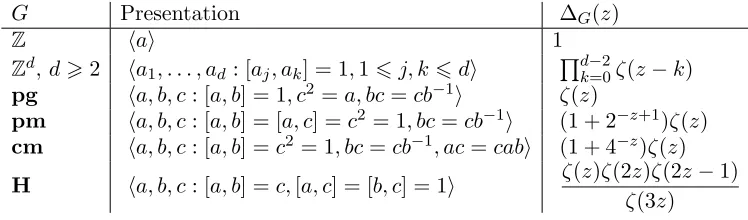
Table 2 gives some examples where the formulae available forζG(see [19,
Ch. 15] and [9, Sec. 4]) can be used in combination with Theorem 4.1 to find explicit formulae for ζσ(G). These examples are of particular interest because ∆G has integer coefficients in all cases, and hence so too does the
and we have used the Hermann–Mauguin notationpg,pm and cmfor the examples of planar symmetry groups, which are finite extensions ofZ2. The-orem 1.2 applies to all the examples in Table 2, with the obvious exception of G=Z.
Table 2. Examples of groups for which ∆G and the formal
power series forζσ(G)(z) have integer coefficients.
G Presentation ∆G(z)
Z hai 1
Zd,d>2 ha1, . . . , ad: [aj, ak] = 1,16j, k6di
Qd−2
k=0ζ(z−k)
pg ha, b, c: [a, b] = 1, c2 =a, bc=cb−1i ζ(z)
pm ha, b, c: [a, b] = [a, c] =c2= 1, bc=cb−1i (1 + 2−z+1)ζ(z)
cm ha, b, c: [a, b] =c2= 1, bc=cb−1, ac=cabi (1 + 4−z)ζ(z)
H ha, b, c: [a, b] =c,[a, c] = [b, c] = 1i ζ(z)ζ(2z)ζ(2z−1)
ζ(3z)
We may calculate dynamical zeta functions directly using the final column in Table 2 in combination with Theorem 4.1. For a full shift ofZ2, Lind [18] observed that the dynamical zeta function has the formP(Az), where
P(z) =Y
n>1
(1−zn)−1
is the additive partition function. It is also evident that the full shift of pg
has the same dynamical zeta function, since
ζpg(z) =ζZ2(z) =ζ(z)ζ(z−1)
by [9, Th. 1.3]. The formula for ∆pm in Table 2 gives
ζτ(pm)(z) = Y
n>1
(1−zn)−1(1−z2n)−2
= P(z)P(z2)2,
and a similar calculation shows ζτ(cm)(z) = P(z)P(z4). Finally, for the discrete Heisenberg group, by using ∆H, we find
ζτ(H)(z) = Y
`,m,n>1
P(z`2m2n3)mµ(n).
In all cases, ζσ(pm)(z) =ζτ(pm)(Az).
There is a rich source of examples closely related to full shifts available for groups given in the form of a semi-direct productG=KoH, whereH 6G andKCG. Since each element ofGcan be expressed uniquely as a pairkh, with k∈K and h ∈H, and sinceK is a normal subgroup, we may define an action ofGon the shift spaceX=AK via (khx)
j =xkhjh−1, wherex=
subgroup conjugacy class structure inLG features significantly in examples
only slightly more complicated than full shifts.
Example 4.2. Consider the shift spaceX =AZ2 and the action α of the
grouppm∼=Z2oC2 onX generated by
(ax)i,j =xi+1,j (bx)i,j =xi,j+1 (cx)i,j =xi,−j
wherex= (xi,j)∈X.
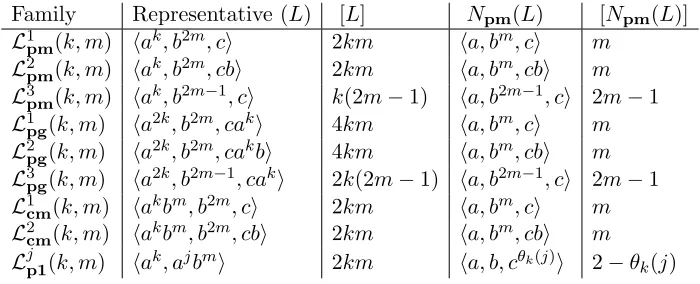
As shown in [9, Sec. 5], there are four isomorphism classes of subgroups inLpm corresponding topm,pg,cmand p1∼=Z2. Furthermore, the con-jugacy classes of subgroups can be split into families parameterized by these isomorphism classes and pairs of positive integers (k, m), as summarized in Table 3. The final family appearing in Table 3 corresponds to the isomor-phism class p1 and requires an additional parameter 0 6j 6 bk/2c. The functionθk:Z→ {0,1} appearing for these conjugacy classes is defined by
θk(j) =
1 ifj = 0,
1 if 2|k and j=k/2,
0 otherwise,
and is used to give the appropriate normalizer. For a given pair of posi-tive integers (k, m), there are precisely ksubgroups in Sbk/2c
j=0 L
j
p1(k, m), as
Ljp1(k, m) is comprised of a conjugate pair whenever θk(j) = 0, and is a
[image:20.612.131.481.483.625.2]singleton otherwise.
Table 3. Subgroup conjugacy classes inLpm for Example 4.2.
Family Representative (L) [L] Npm(L) [Npm(L)] L1
pm(k, m) hak, b2m, ci 2km ha, bm, ci m
L2
pm(k, m) hak, b2m, cbi 2km ha, bm, cbi m
L3
pm(k, m) hak, b2m−1, ci k(2m−1) ha, b2m−1, ci 2m−1
L1
pg(k, m) ha2k, b2m, caki 4km ha, bm, ci m
L2
pg(k, m) ha2k, b2m, cakbi 4km ha, bm, cbi m
L3
pg(k, m) ha2k, b2m−1, caki 2k(2m−1) ha, b2m−1, ci 2m−1
L1
cm(k, m) hakbm, b2m, ci 2km ha, bm, ci m
L2
cm(k, m) hakbm, b2m, cbi 2km ha, bm, cbi m
Ljp1(k, m) hak, ajbmi 2km ha, b, cθk(j)i 2−θ
k(j)
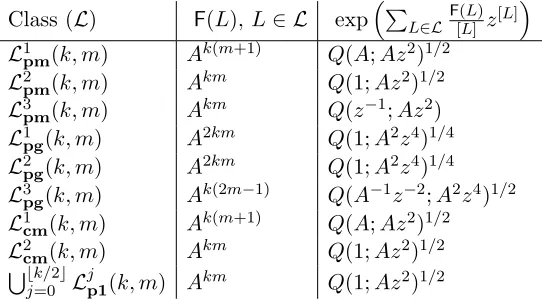
contributions to ζα(z). For example, the contribution from L1pm(k, m) is
exp X
k,m>1
m·Ak(m+1)
2km z
2km = expX
m>1 1
2log(1−A
m+1z2m)−1
= Q(A;Az2)1/2.
where A = |A| and Q(w;z) = Q
n>1(1−wzn)−1 (so, Q is the reciprocal of an infinite shifted factorial and Q(1;z) = P(z)). Notice that the com-bined contribution toζα(z) from the conjugacy classes corresponding to the
isomorphism class of pg is Q(1;Az2)1/2. Hence, the product of the contri-butions appearing in the final column of Table 4 gives
[image:21.612.171.442.319.470.2]ζα(z) =Q(z−1;Az2)Q(A;Az2)Q(1;Az2)2.
Table 4. Contributions toζα(z) for Example 4.2
Class (L) F(L), L∈ L exp
P
L∈L
F(L) [L] z
[L] L1
pm(k, m) Ak(m+1) Q(A;Az2)1/2
L2
pm(k, m) Akm Q(1;Az2)1/2
L3
pm(k, m) Akm Q(z−1;Az2)
L1
pg(k, m) A2km Q(1;A2z4)1/4
L2
pg(k, m) A2km Q(1;A2z4)1/4
L3
pg(k, m) Ak(2m−1) Q(A−1z−2;A2z4)1/2
L1
cm(k, m) Ak(m+1) Q(A;Az2)1/2
L2
cm(k, m) Akm Q(1;Az2)1/2
Sbk/2c
j=0 L
j
p1(k, m) Akm Q(1;Az2)1/2
It is worth noting that as a result of applying the formulae for ζG given
in [9], ζσ(G) appears not to have integer coefficients for all 13 remaining planar symmetry groups. For example, for
p2=ha, b, c: [a, b] =c2 = 1, ac=ca−1, bc=cb−1i,
we have ∆p2(z) =ζ(z)ζ(z−1)/ζ(z+ 1) + 2−1−zζ(z), from which we deduce ζτ(p2)(z) =P(z2)−1/2
Y
m,n>1
P(zmn)mµ(n)/n.
Hence,ζσ(p2)(z) =ζτ(p2)(Az) does not have integer coefficients.
For any action α of the group pm on a set X with |Fα(L)| < ∞ for
all L ∈ LG, the formulae in Table 2 may also be applied in conjunction with (20) to give a product formula forζα in terms of orbits. In particular,
ζα(z) =
Y
Y∈Y
P(z|Y|) Y
Y∈Ycm
P(z4|Y|) Y
Y∈Ypm
whereY denotes the set of all orbits inXandYpm,Ycm⊂ Y denote the sets
of orbits with associated stabilizers that belong to the isomorphism classes corresponding topm and cmrespectively.
To contrast with the examples considered thus far, we now consider full shifts and related actions of virtually cyclic groups. It is well known that for aZ-actionα generated by a hyperbolic toral automorphism or by a shift of finite type,ζα is a rational function [20], [5]. For aZ-action α generated by an ergodic automorphism of a compact abelian group, it is conjectured in [3] that if ζα fails to be rational, then this function is not analytically
continuable beyond the circle of convergence, and therefore has a natural boundary. However, this dichotomy is clearly not the case more generally. For example, ζσ(D∞)(z) = ζτ(D∞)(Az),where A is the cardinality of the alphabet andζτ(D∞) is given by (19). So,ζσ(D∞) is not rational but there is an analytic continuation ofζσ(D∞) beyond the circle|z|=A
−1, and ζ
σ(D∞)
is in fact holonomic.
The extent to which rational dynamical zeta functions are possible for actions of infinite virtually cyclic groups is not yet clear. Further to Ex-ample 2.10, some exEx-amples where ζσ(G) is rational are given in Table 5. In each case, G is the direct product of Z with a finite group and ζG may be
[image:22.612.132.494.488.543.2]calculated with aid of Goursat’s lemma and GAP [11]; this subsequently en-ables the calculation of ∆G, andζσ(G) is then obtained using Theorem 4.1. Here, D8 is the dihedral group with 8 elements, UT(3,3) is the group of unitriangular matrices over F3, and p is any rational prime (whereby, we obtain infinitely many virtually cyclic groups of the form G=Z×(Z/pZ) for which ζσ(G) is rational).
Table 5. Examples where ζσ(G)(z) =ζτ(Az) is rational.
G ∆G(z) ζτ(z)
Z×(Z/pZ) 1 +p1z (1−z)−1(1−zp)−1
Z×D8 1 +23z + 43z +81z (1−z)−1(1−z2)−3(1−z4)−3(1−z8)−1
Z×UT(3,3) 1 +34z + 95z +271z (1−z)−1(1−z3)−4(1−z9)−5(1−z27)−1
We conclude by using variations on full shifts to show that bounds analo-gous to those obtained by Bowen (10) should not be expected for expansive actions of virtually cyclic groups in general. In particular, there is no tight connection between the radius of convergence of ζα and the topological
en-tropy. Additionally, as well as giving a concrete instance of the the following proposition, the final example provides another rich source of actions related to full shifts for which ζα is rational.
expansive action α of G by continuous automorphisms of a compact abelian group such that g(α)>h(α)>0.
Proof. Since G is infinite and virtually cyclic, there exists a surjective ho-momorphism φ : G → H, where H is either infinite cyclic or isomorphic to D∞ (see, for example, [16, Ch. 2]). By assumption, K = ker(φ) is
non-trivial. Furthermore, we may define an expansive actionαofGon the shift space AH via
(gx)h =xφ(g)h, (21)
where A is a finite alphabet and x = (xh) ∈ AH. A standard entropy
cal-culation shows that this G-action has topological entropyh(α) = |K1|logA, whereA=|A|.
Now consider the sublattice K ⊂ LG comprised of finite index subgroups
of G containing K. Via the correspondence theorem, every element L∈ K satisfies [G:L] = [H :φ(L)]. Furthermore, for allL∈ K
Fα(L) =A[H:φ(L)] =A[G:L],
sog(α)>logA.
Example 4.4. LetG=Z×(Z/pZ), wherep is a rational prime. Since the full shift ofG has
ζσ(G)(z) = (1−Az)−1(1−Apzp)−1,
whereAis the cardinality of the alphabet, it follows thatg(σ(G)) = logA=
h(σ(G)).
The description of LG given in Example 2.10 allows us to calculate ζα
for the expansive action α of G defined by (21) with φ :G → Z being the natural coordinate projection. Notice that φ(L(n, k)) = hni when k = 0, and
φ(L(n, k)) =hgcd(n, kn/p)i=hn/pi
when 1 6 k 6 p −1. Furthermore, for all L ∈ Ld, Fα(L) = A[Z:φ(L)].
Therefore, if p-n,
X
L∈LG(n)
Fα(L) =Fα(L(n,0)) =An.
Whilst, if p|n,
X
L∈LG(n)
Fα(L) = Fα(L(n,0)) +Fα(L(n)) + p−1 X
k=1
Fα(L(n, k))
= An+An/p+
p−1 X
k=1
An/p
= An+pAn/p.
Hence,
and so ζα is once again rational. This time, however, g(α) = logA, yet
h(α) = 1plogA.
5. Concluding Questions
(i) It would be interesting to know if ∆Ghas integer coefficients
when-ever G is nilpotent. IfG is nilpotent, as shown in [19, Ch. 15], the arithmetic function aG is multiplicative and there is a product
for-mula of the form ζG = QpζG,p, where ζG,p(z) = P∞i=0aG(pi)p−iz,
and p runs through all rational primes. This means that the ques-tion of whether or not ∆G has integer coefficients may be
con-sidered locally, as the Euler product for 1/ζ enables us to write ∆G=Qp∆G,p, where
∆G,p= (1−p−1−z)ζG,p(z+ 1).
Consequently, ∆G has integer coefficients if pi |aG(pi)−aG(pi−1)
for all i>1 and all primesp.
(ii) For which groups G is the dynamical zeta function rational for all expansiveG-actions by automorphisms of compact abelian groups? Is it necessary for Gto be virtually cyclic? Note that the dynami-cal zeta function ζσ(D∞) shows that this condition is certainly not
sufficient.
(iii) For a fixed acting groupG, is it possible to have both rational and irrational zeta functions for expansiveG-actions by automorphisms of infinite compact abelian groups?
(iv) What dynamical information is encapsulated by the function
ζαC(z) = exp X
L∈LC
G
Fα(L)
[L] z [L],
where LC
G ⊂ LG is the sublattice of normal subgroups of finite
index? In light of the many available results for ζGC, this also seems to be a very natural object to study.
References
[1] M. Artin and B. Mazur. On periodic points.Ann. of Math. (2), 81:82–99, 1965. [2] J. Ban, W. Hu, S. Lin, and Y. Lin. Zeta functions for two-dimensional shifts of finite
type.Mem. Amer. Math. Soc., 221(1037):vi+60, 2013.
[3] J. Bell, R. Miles, and T. Ward. Towards a P´olya-Carlson dichotomy for algebraic dynamics.Indag. Math. (N.S.), 25(4):652–668, 2014.
[4] R. Bowen. Some systems with unique equilibrium states. Math. Systems Theory, 8(3):193–202, 1974/75.
[5] R. Bowen and O. Lanford. Zeta functions of restrictions of the shift transformation. In Global Analysis (Proc. Sympos. Pure Math., Vol. XIV, Berkeley, Calif., 1968), pages 43–49. Amer. Math. Soc., Providence, R.I., 1970.
[6] J. Buzzi. Some remarks on random zeta functions.Ergodic Theory Dynam. Systems, 22(4):1031–1040, 2002.
[8] H. Crapo. M¨obius inversion in lattices.Arch. Math., 19:595–607, 1968.
[9] M. du Sautoy, J. McDermott, and G. Smith. Zeta functions of crystallographic groups and analytic continuation.Proc. London Math. Soc. (3), 79(3):511–534, 1999. [10] M. du Sautoy and L. Woodward.Zeta functions of groups and rings, volume 1925 of
Lecture Notes in Mathematics. Springer-Verlag, Berlin, 2008.
[11] The GAP Group.GAP – Groups, Algorithms, and Programming, Version 4.7.8, 2015. [12] F. Grunewald, D. Segal, and G. Smith. Subgroups of finite index in nilpotent groups.
Invent. Math., 93(1):185–223, 1988.
[13] Y. Kim, J. Lee, and K. Park. A zeta function for flip systems. Pacific J. Math., 209(2):289–301, 2003.
[14] K. Kimoto. Zetas and moments of finite group actions. Proc. Japan Acad. Ser. A Math. Sci., 79(8):128–133, 2003.
[15] C. Kratzer and J. Th´evenaz. Fonction de M¨obius d’un groupe fini et anneau de Burnside.Comment. Math. Helv., 59(3):425–438, 1984.
[16] D. Lima Gon¸calves and J. Guaschi.The classification of the virtually cyclic subgroups of the sphere braid groups. Springer Briefs in Mathematics. Springer, Cham, 2013. [17] D. Lind. Dynamical properties of quasihyperbolic toral automorphisms.Ergodic
The-ory Dynamical Systems, 2(1):49–68, 1982.
[18] D. Lind. A zeta function forZd-actions. InErgodic theory of Zd-actions (Warwick,
1993–1994), volume 228 of London Math. Soc. Lecture Note Ser., pages 433–450. Cambridge Univ. Press, Cambridge, 1996.
[19] A. Lubotzky and D. Segal.Subgroup growth, volume 212 ofProgress in Mathematics. Birkh¨auser Verlag, Basel, 2003.
[20] A. Manning. Axiom A diffeomorphisms have rational zeta functions. Bull. London Math. Soc., 3:215–220, 1971.
[21] G. Margulis.On some aspects of the theory of Anosov systems. Springer Monographs in Mathematics. Springer-Verlag, Berlin, 2004. With a survey by R. Sharp: Periodic orbits of hyperbolic flows, Translated from the Russian by Valentina Vladimirovna Szulikowska.
[22] R. Miles. A natural boundary for the dynamical zeta function for commuting group automorphisms.Proc. Amer. Math. Soc., 143(7):2927–2933, 2015.
[23] R. Miles. Orbit growth for algebraic flip systems. Ergodic Theory and Dynamical Systems, FirstView:1–19, 4 2015.
[24] R. Miles and T. Ward. Orbit-counting for nilpotent group shifts.Proc. Amer. Math. Soc., 137(4):1499–1507, 2009.
[25] R. Miles and T. Ward. The dynamical zeta function for commuting automorphisms of zero-dimensional groups. preprint, 2015.
[26] W. Parry. An analogue of the prime number theorem for closed orbits of shifts of finite type and their suspensions.Israel J. Math., 45(1):41–52, 1983.
[27] W. Parry and M. Pollicott. An analogue of the prime number theorem for closed orbits of Axiom A flows.Ann. of Math. (2), 118(3):573–591, 1983.
[28] G. P´olya. ¨Uber gewisse notwendige Determinantenkriterien f¨ur die Fortsetzbarkeit einer Potenzreihe.Math. Ann., 99(1):687–706, 1928.
[29] D. Ruelle. Dynamical zeta functions and transfer operators. Notices Amer. Math. Soc., 49(8):887–895, 2002.
[30] K. Schmidt.Dynamical systems of algebraic origin, volume 128 ofProgress in Math-ematics. Birkh¨auser Verlag, Basel, 1995.
[31] S. L. Segal. Nine introductions in complex analysis, volume 208 of North-Holland Mathematics Studies. Elsevier Science B.V., Amsterdam, revised edition, 2008. [32] A. Shalev. On the degree of groups of polynomial subgroup growth. Trans. Amer.
Math. Soc., 351(9):3793–3822, 1999.
[34] R. P. Stanley. Enumerative combinatorics. Vol. 1, volume 49 of Cambridge Studies in Advanced Mathematics. Cambridge University Press, Cambridge, 1997. With a foreword by Gian-Carlo Rota, Corrected reprint of the 1986 original.
[35] A. Terras. Zeta functions of graphs, volume 128 ofCambridge Studies in Advanced Mathematics. Cambridge University Press, Cambridge, 2011. A stroll through the garden.
[36] S. Waddington. The prime orbit theorem for quasihyperbolic toral automorphisms.
Monatsh. Math., 112(3):235–248, 1991.