inorganic papers
Acta Cryst.(2006). E62, i7–i9 doi:10.1107/S1600536805040006 Xia and Bobev YbMn
6Sn6
i7
Acta Crystallographica Section E
Structure Reports Online
ISSN 1600-5368
YbMn
6Sn
6Sheng-Qing Xia and Svilen Bobev*
Department of Chemistry and Biochemistry, University of Delaware, Newark, DE 19716, USA
Correspondence e-mail: [email protected]
Key indicators
Single-crystal X-ray study
T= 120 K
Mean(Sn–Mn) = 0.004 A˚ Disorder in main residue
Rfactor = 0.041
wRfactor = 0.091 Data-to-parameter ratio = 9.0
For details of how these key indicators were automatically derived from the article, see http://journals.iucr.org/e.
#2006 International Union of Crystallography Printed in Great Britain – all rights reserved
Single crystals of the title compound, ytterbium hexa-manganese hexastannide, were serendipitously synthesized from a reaction of elemental Yb, Mn and Bi in an Sn flux. The structure was determined by single-crystal X-ray diffraction to be an intermediate ordered state of the HfFe6Ge6 and
YCo6Ge6 structures. This result confirms previous work on
the structure of YbMn6Sn6 from X-ray and neutron powder
diffraction data [Mazet et al.(1999). J. Magn. Magn. Mater.
204, 11–19], although the statistical distribution of Yb and Sn on the partially occupied sites is determined to be significantly different.
Comment
In the past decade, there have been several reports of inter-metallic phases that exhibit very large magnetoresistance in moderate magnetic fields. Among these, Mn-containing zintl compounds from theE14MnPn11family (Eis alkaline earth or
divalent rare earth metals, andPnare pnicogens,i.e.P, As, Sb or Bi) are the most frequently reccurring ones, and their crystal chemistry and physical properties have been exten-sively studied (Young et al., 1995; Webbet al., 1998). These discoveries have motivated many further studies and, to date, several new polar intermetallics, i.e.formed between metals with largely different electronegativities, have been reported (Holmet al., 2003; Kimet al., 2000; Nirmalaet al., 2005). All these new compounds feature condensed MnPn4 building
blocks and exhibit unusual physical properties due to direct or indirect Mn Mn interactions.
Intrigued by the rich phenomenology of these Mn-containing phases, we have undertaken systematic studies of the corresponding E–Mn–Bi systems, aimed primarily at synthesizing E9Mn4+xBi9, isostructural with the recently
revised Ca9Zn4+xSb9 (x = 0.5) (Bobev et al., 2004), and
examination of their physical properties. It was anticipated that, by employing metals with low melting points, such as Sn for instance, the target materials could be synthesized as large crystals and in high yield. However, Sn flux reactions in the system Yb–Mn–Bi have been found to produce small crystals of the desired Yb9Mn4+xBi9phase in very low yield.
Quanti-tative product formations from such reactions are the body-centred tetragonal Yb11Bi10, with the Ho11Ge10type structure
(Smithet al., 1967), and the title compound, YbMn6Sn6. The
latter is shown to be a room-temperature ferromagnet with strong coupling between the Mn spins, and its structure has been previously studied by means of powder diffraction (Mazet et al., 1999). This study also suggested that the hexa-gonal YbMn6Sn6 structure (Figs. 1 and 2) exhibits features
pertinent to both the HfFe6Ge6(Olenitchet al., 1981) and the
YCo6Ge6-types (Malamanet al., 1997). Both types are closely
related to the common CaCu5structure (Buschow & Van der
Goot, 1971).
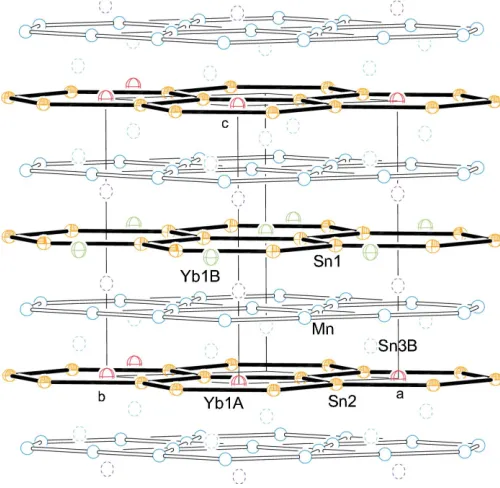
Using this formalism, the YbMn6Sn6 structure can be
viewed as a stacking of ordered graphite-like layers of Sn atoms (Sn1 atz=1
2and Sn2 atz= 0), and ordered
Kagome-type layers of Mn atoms [Mn at Wyckoff position 6iat (1 2, 0,
1 4)],
as shown in Fig. 2. Between these ordered hexagonal layers are the disordered Sn3Aand Sn3Bsheets. The Yb atoms also form layers perpendicular to thecaxis atz= 0 (Yb1A) andz=1 2
(Yb1B),i.e.within the Sn2 and Sn1 layers, respectively. The distances (Table 1) between the fully occupied posi-tions, as well as the anisotropic displacement parameters for all atoms, are very reasonable. However, the contacts between the partially occupied atoms Yb1Aand Sn3B, and Yb1Band Sn3A, respectively, are unrealistic (ca1.5 A˚ ). This means that whenever Yb1A or Yb1B are present, Sn3B and Sn3A are missing and vice versa. This model implies that a super-structure with a doubledcaxis could exist, but long-exposure images failed to provide evidence for such a supercell. Indi-cation for this structural disorder has also been found in the X-ray powder diffraction patterns of YbMn6Sn6(Mazetet al.,
1999). The presence of weaker hkl(l= 2n+ 1) Bragg reflec-tions than those observed in MgMn6Sn6has been interpreted
as a result of statistically disordered sites, as in the related SmMn6Sn6 (Malaman et al., 1997). Rietveld refinements of
these powder data (Mazetet al., 1999) support this model, with atomic arrangements giving a mixed distribution of 77 (1):23 (1) and 23 (1):77 (1) on four different sites, Yb1A/ Yb1B and Sn3A/Sn3B, respectively. The results from our single-crystal diffraction work show a different distribution of 52 (2):48 (2) and 56 (1):44 (1) for the two pairs of sites, respectively. This difference in the refinements is most likely due to the different synthetic routes, i.e. flux growth in the present caseversusarc melting and annealing in the previous work. Examples of various ordering transitions depending on the annealing temperatures are known already for some other
EMn6Sn6compounds (E= Mg, Sc, Y, Zr, Pr, Sm, Nd, Gd–Tm)
(Mazetet al., 1999).
Experimental
[image:2.610.47.296.71.342.2]All manipulations were carried out under argon orin vacuo. For the synthesis, pure elements were used as received: Yb (Ames Labora-tory, ingot, 99.99% metal basis), Mn (Alfa, pieces, 99.98%), Bi (Alfa, shot, 99.99%) and Sn (Alfa, shot, 99.99%). The reagents were loaded into an alumina crucible in the ratio Yb:Mn:Bi:Sn = 9:6:9:29, and were subsequently sealed in an evacuated fused silica ampoule. The following heating profile was employed for the reaction: heating from room temperature to 1223 K at a rate of 25 K h1, dwell at 1223 K for 10 h, then cooling to 1073 K at a rate of 5 K h1. At this temperature, the mixture was allowed to dwell again for 72 h. After cooling to 873 K over a period of 10 h, the excess flux was removed by centri-fugation. The products of the reaction consist of two kinds of crystals, namely Yb11Bi10 (main product, dark-to-black crystals of irregular shape) and hexagonal YbMn6Sn6(minor product, silver needle-like crystals).
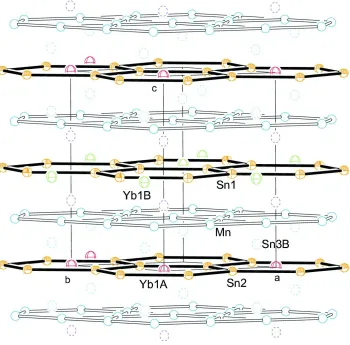
Figure 1
[image:2.610.314.564.73.317.2]A perspective view of the crystal structure of YbMn6Sn6, down the [001] direction, with the unit cell outlined. Displacement ellipsoids are drawn at the 92% probability level. Atoms Sn1 and Sn2 are shown with full yellow ellipsoids, Mn atoms are drawn as blue outline ellipsoids, and the partially occupied atoms Sn3A and Sn3B are shown as purple and light-blue dotted outline ellipsoids, respectively. Atoms Yb1A and Yb1B are represented by red and green crossed ellipsoids, respectively. Some of the 50% occupied positions have been left empty to exemplify the disorder.
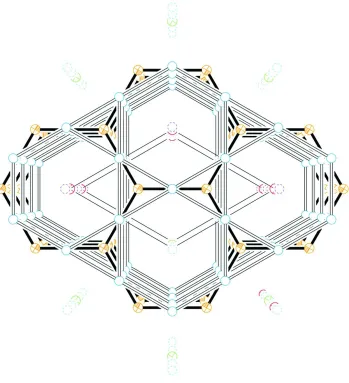
Figure 2
Crystal data
YbMn6Sn6
Mr= 1214.82
Hexagonal,P6=mmm a= 5.5117 (13) A˚
c= 8.989 (4) A˚
V= 236.49 (14) A˚3
Z= 1
Dx= 8.530 Mg m
3
MoKradiation Cell parameters from 1336
reflections = 2.3–27.0
= 32.93 mm1
T= 120 (2) K
Block cut from needle, grey 0.060.050.04 mm
Data collection
Bruker SMART APEX diffractometer !scans
Absorption correction: multi-scan (SADABS; Sheldrick, 2003)
Tmin= 0.142,Tmax= 0.268 1336 measured reflections
144 independent reflections 99 reflections withI> 2(I)
Rint= 0.023 max= 27.0
h=6!7
k=7!7
l=11!11
Refinement
Refinement onF2
R[F2> 2(F2)] = 0.041
wR(F2) = 0.091
S= 1.51 144 reflections 16 parameters
w= 1/[2
(Fo2) + 22.0394P] whereP= (Fo2+ 2Fc2)/3
(/)max= 0.010
max= 1.18 e A˚
3
min=1.49 e A˚
3
Extinction correction:SHELXTL
(Sheldrick, 2001)
Extinction coefficient: 0.021 (3)
Table 1
Selected bond lengths (A˚ ).
Yb1A—Sn3A 3.013 (7) Yb1A—Sn2 3.1822 (7) Yb1B—Sn3B 3.022 (7) Yb1B—Sn1 3.1822 (7)
Sn1—Mn1i
2.760 (4) Sn2—Mn1i
2.747 (4) Mn1—Sn3B 2.861 (2) Mn1—Sn3A 2.862 (2)
Symmetry code: (i)y;xy;z.
In the structure refinement, the full occupancies for all sites were verified by freeing the site occupation factor for an individual atom, while the remaining parameters were kept fixed. This proved that the Sn1, Sn2 and Mn positions are fully occupied with corresponding deviations from full occupancy within 3. Site occupation factors for
Yb1Aand Yb1B, and for Sn3Aand Sn3B, refined close to 50% and were finally modelled as a 50:50 statistical mixture. The maximum peak and deepest hole are located 0.11 A˚ from Sn3Band coincident with Yb1B, respectively.
Data collection:SMART(Bruker, 2002); cell refinement:SAINT (Bruker, 2002); data reduction:SAINT; program(s) used to solve structure: SHELXTL (Sheldrick, 2001); program(s) used to refine structure:SHELXTL (Sheldrick, 2001); molecular graphics:XP in SHELXTL; software used to prepare material for publication:
SHELXTL.
This work was funded in part by a University of Delaware start-up grant.
References
Bobev, S., Thompson, J. D., Sarrao, J. L., Olmstead, M. M., Hope, H. & Kauzlarich, S. M. (2004).Inorg. Chem.43, 5044–5052.
Bruker (2002).SMARTandSAINT. Bruker AXS Inc., Madison, Wisconsin, USA.
Buschow, K. H. J. & van der Goot, A. S. (1971).Acta Cryst.B27, 1085– 1088.
Holm, A. P., Olmstead, M. M. & Kauzlarich, S. M. (2003).Inorg. Chem.42, 1973–1981.
Kim, H., Condron, C. L., Holm, A. P. & Kauzlarich, S. M. (2000).J. Am. Chem. Soc.122, 10720–10721.
Malaman, B., Venturini, G., Chafik EI Idrissi, B. & Ressouche, E. (1997).J. Alloys Compnd252, 41–49.
Mazet, T., Welter, R. & Malaman, B. (1999).J. Magn. Magn. Mater.204, 11– 19.
Nirmala, R., Morozkin, A. V., Suresh, K. G., Kim, H.-D., Kim, J.-Y., Park, B.-G., Oh, S.-J. & Malik, S. K. (2005).J. Appl. Phys.97, 10M511–3. Olenitch, R. R., Aksel’rud, L. G. & Yarmolyuk, Ya. P. (1981).Dopov. Akad.
Nauk Ukrain. RSR Ser. A,43, 87–91. (In Ukrainian).
Sheldrick, G. M. (2001).SHELXTL. Bruker AXS Inc., Madison, Wisconsin, USA.
Sheldrick, G. M. (2003).SADABS. University of Go¨ttingen, Germany. Smith, G. S., Johnson, Q. & Tharp, A. G. (1967).Acta Cryst.23, 640–644. Webb, D. J., Cohen, R., Klavins, P., Shelton, R. N., Chan, J. Y. & Kauzlarich,
S. M. (1998).J. Appl. Phys.83, 7192–7194.
Young, D. M., Torardi, C. C., Olmstead, M. M. & Kauzlarich, S. M. (1995).
Chem. Mater.7, 93–101.
inorganic papers
Acta Cryst.(2006). E62, i7–i9 Xia and Bobev YbMn
supporting information
Acta Cryst. (2006). E62, i7–i9 [doi:10.1107/S1600536805040006]
YbMn6Sn6
Sheng-Qing Xia and Svilen Bobev
S1. Comment
In the past decade, there have been several reports of intermetallic phases that exhibit very large magnetoresistance in
moderate magnetic fields. Among these, Mn-containing zintl compounds from the E14MnPn11 family (E is alkaline earth
or divalent rare earth metals, and Pn are pnicogens, i.e. P, As, Sb or Bi) are the most frequently reccurring ones, and their
crystal chemistry and physical properties have been extensively studied (Young et al., 1995; Webb et al., 1998). These
discoveries have motivated many further studies and, to date, several new polar intermetallics, i.e. formed between metals
with largely different electronegativities, have been reported (Holm et al., 2003; Kim et al., 2000; Nirmala et al., 2005).
All these new compounds feature condensed MnPn4 building blocks and exhibit unusual physical properties due to direct
or indirect Mn···Mn interactions.
Intrigued by the rich phenomenology of these Mn-containing phases, we have undertaken systematic studies of the
corresponding E–Mn–Bi systems, aimed primarily at synthesizing E9Mn4 + xBi9, isostructural with the recently revised
Ca9Zn4 + xSb9 (x = 1/2) (Bobev et al., 2004), and examination of their physical properties. It was anticipated that, by
employing metals with low melting points, such as Sn for instance, the target materials could be synthesized as large
crystals and in high yield. However, Sn flux reactions in the system Yb–Mn–Bi have been found to produce small crystals
of the desired Yb9Mn4 + xBi9 phase in very low yield. Quantitative product formations from such reactions are the
body-centred tetragonal Yb11Bi10, with the Ho11Ge10 type structure (Smith et al., 1967), and the title compound, YbMn6Sn6. The
latter is shown to be a room-temperature ferromagnet with strong coupling between the Mn spins, and its structure has
been previously studied by means of powder diffraction (Mazet et al., 1999). This study also suggested that the hexagonal
YbMn6Sn6 structure (Figs. 1 and 2) exhibits features pertinent to both the HfFe6Ge6 (Olenitch et al., 1981) and the
YCo6Ge6-types (Malaman et al., 1997). Both types are closely related to the ubiquitous CaCu5 structure (Buschow & Van
der Goot, 1971).
Using this formalism, the YbMn6Sn6 structure can be viewed as a stacking of ordered graphite-like layers of Sn atoms
(Sn1 at z = 1/2 and Sn2 at z = 0), and ordered Kagome-type layers of Mn atoms [Mn at Wyckoff position 6i at
(1/2,0,1/4)], as shown in Fig. 2. Between these ordered hexagonal layers are the disordered Sn3A and Sn3B sheets. The
Yb atoms also form layers perpendicular to the c axis at z = 0 (Yb1A) and z = 1/2 (Yb1B), i.e. within the Sn2 and Sn1
layers, respectively.
The distances (Table 1) between the fully occupied positions, as well as the anisotropic displacement parameters for all
atoms, are very reasonable. However, the contacts between the partially occupied atoms Yb1A and Sn3B, and Yb1B and
Sn3A, respectively, are unrealistic (ca 1.5 Å). This means that whenever Yb1A or Yb1B are present, Sn3B and Sn3A are
missing and vice versa. This model implies that a superstructure with a doubled c axis could exist, but long-exposure
images failed to provide evidence for such a supercell. Indication for this structural disorder has also been found in the
X-ray powder diffraction patterns of YbMn6Sn6 (Mazet et al., 1999). The presence of weaker hkl (l = 2n + 1) Bragg
supporting information
sup-2
Acta Cryst. (2006). E62, i7–i9
related SmMn6Sn6 (Malaman et al., 1997). Rietveld refinements of these powder data (Mazet et al., 1999) support this
model, with atomic arrangements giving a mixed distribution of 77 (1):23 (1) and 23 (1):77 (1) on four different sites,
Yb1A/Yb1B and Sn3A/Sn3B, respectively. The results from our single-crystal diffraction work show a different
distribution of 52 (2):48 (2) and 56 (1):44 (1) for the two pairs of sites, respectively. This difference in the refinements is
most likely due to the different synthetic routes, i.e. flux growth in the present case versus arc melting and annealing in
the previous work. Examples of various ordering transitions depending on the annealing temperatures are known already
for some other EMn6Sn6 compounds (E = Mg, Sc, Y, Zr, Pr, Sm, Nd, Gd—Tm) (Mazet et al., 1999).
S2. Experimental
All manipulations were carried out under Argon or in vacuo. For the synthesis, pure elements were used as received: Yb
(Ames Laboratory, ingot, 99.99% metal basis), Mn (Alfa, pieces, 99.98%), Bi (Alfa, shot, 99.99%) and Sn (Alfa, shot,
99.99%). The reagents were loaded into an alumina crucible in the ratio Yb:Mn:Bi:Sn = 9:6:9:29, and were subsequently
sealed in an evacuated fused silica ampoule. The following heating profile was employed for the reaction: heating from
room temperature to 1223 K at a rate of 25 K h−1, dwell at 1223 K for 10 h, then cooling to 1073 K at a rate of 5 K h−1. At
this temperature, the mixture was allowed to dwell again for 72 h. After cooling to 873 K over a period of 10 h, the
excess flux was removed by centrifugation. The products of the reaction consist of two kinds of crystals, namely Yb11Bi10
(main product, dark-to-black [Grey below?] crystals of irregular shape) and hexagonal YbMn6Sn6 (minor product, silver
needle-like crystals).
S3. Refinement
In the structure refinement, the full occupancies for all sites were verified by freeing the site occupation factor for an
individual atom, while the remaining parameters were kept fixed. This proved that the Sn1, Sn2 and Mn positions are
fully occupied with corresponding deviations from full occupancy within 3σ. Site occupation factors for Yb1A and Yb1B,
and for Sn3A and Sn3B, refined close to 50% and were finally modelled as a 50:50 statistical mixture. The maximum
Figure 1
A perspective view of the crystal structure of YbMn6Sn6, down the [001] direction, with the unit cell outlined.
Displacement ellipsoids are drawn at the 92% probability level. Atoms Sn1 and Sn2 are shown with full yellow
ellipsoids, Mn atoms are drawn as blue outline ellipsoids, and the partially occupied atoms Sn3A and Sn3B are shown as
purple and light-blue dotted outline ellipsoids, respectively. Atoms Yb1A and Yb1B are represented by red and green
supporting information
sup-4
[image:7.610.132.482.72.417.2]Acta Cryst. (2006). E62, i7–i9 Figure 2
A perspective view of the crystal structure of YbMn6Sn6, approximately down the [110] direction. Colour code as in Fig.
1.
Ytterbium hexamanganese hexastannide
Crystal data
YbMn6Sn6
Mr = 1214.82 Hexagonal, P6/mmm
Hall symbol: -P 6 2
a = 5.5117 (13) Å
c = 8.989 (4) Å
V = 236.49 (14) Å3
Z = 1
F(000) = 520
Dx = 8.530 Mg m−3
Mo Kα radiation, λ = 0.71073 Å Cell parameters from 1336 reflections
θ = 2.3–27.0°
µ = 32.93 mm−1
T = 120 K Block, grey
0.06 × 0.05 × 0.04 mm
Data collection
Bruker SMART APEX diffractometer
Radiation source: fine-focus sealed tube Graphite monochromator
Detector resolution: 8.3 pixels mm-1
ω scans
Absorption correction: multi-scan (SADABS; Sheldrick, 2003)
Tmin = 0.142, Tmax = 0.268
Rint = 0.023
θmax = 27.0°, θmin = 2.3°
h = −6→7
k = −7→7
l = −11→11
Refinement
Refinement on F2
Least-squares matrix: full
R[F2 > 2σ(F2)] = 0.041
wR(F2) = 0.091
S = 1.51 144 reflections 16 parameters 0 restraints
Primary atom site location: structure-invariant direct methods
Secondary atom site location: difference Fourier map
w = 1/[σ2(F
o2) + 22.0394P]
where P = (Fo2 + 2Fc2)/3
(Δ/σ)max = 0.010
Δρmax = 1.18 e Å−3
Δρmin = −1.49 e Å−3
Extinction correction: SHELXTL (Sheldrick, 2001), Fc*=kFc[1+0.001xFc2λ3/sin(2θ)]-1/4
Extinction coefficient: 0.021 (3)
Special details
Experimental. Crystals were selected and cut to the desired dimensions in Exxon Paratone N oil. Then, a suitable one was chosen and it was mounted on the top of glass fiber. Data collection, reduction, absorption correction were handled routinely. Data collection is performed with four batch runs at φ = 0.00 ° (300 frames), at φ = 90.00 ° (300 frames), at φ = 180.00 ° (300 frames), and at φ = 270.00 (300 frames). Frame width = 0.60 \& in ω. Data is merged, corrected for decay, and treated with multi-scan absorption corrections.
Geometry. All e.s.d.'s (except the e.s.d. in the dihedral angle between two l.s. planes) are estimated using the full covariance matrix. The cell e.s.d.'s are taken into account individually in the estimation of e.s.d.'s in distances, angles and torsion angles; correlations between e.s.d.'s in cell parameters are only used when they are defined by crystal symmetry. An approximate (isotropic) treatment of cell e.s.d.'s is used for estimating e.s.d.'s involving l.s. planes.
Refinement. Refinement of F2 against ALL reflections. The weighted R-factor wR and goodness of fit S are based on F2,
conventional R-factors R are based on F, with F set to zero for negative F2. The threshold expression of F2 > σ(F2) is used
only for calculating R-factors(gt) etc. and is not relevant to the choice of reflections for refinement. R-factors based on F2
are statistically about twice as large as those based on F, and R- factors based on ALL data will be even larger.
Fractional atomic coordinates and isotropic or equivalent isotropic displacement parameters (Å2)
x y z Uiso*/Ueq Occ. (<1)
Yb1A 0.0000 0.0000 0.0000 0.0097 (11) 0.50
Yb1B 0.0000 0.0000 0.5000 0.0097 (11) 0.50
Sn1 0.3333 0.6667 0.5000 0.0074 (10)
Sn2 0.3333 0.6667 0.0000 0.0091 (10)
Mn1 0.5000 0.0000 0.2491 (5) 0.0075 (10)
Sn3A 0.0000 0.0000 0.3352 (8) 0.0080 (11) 0.50
Sn3B 0.0000 0.0000 0.1638 (8) 0.0080 (11) 0.50
Atomic displacement parameters (Å2)
U11 U22 U33 U12 U13 U23
Yb1A 0.0089 (13) 0.0089 (13) 0.011 (2) 0.0045 (7) 0.000 0.000
Yb1B 0.0089 (13) 0.0089 (13) 0.011 (2) 0.0045 (7) 0.000 0.000
Sn1 0.0054 (11) 0.0054 (11) 0.0115 (15) 0.0027 (6) 0.000 0.000
Sn2 0.0120 (12) 0.0120 (12) 0.0034 (14) 0.0060 (6) 0.000 0.000
Mn1 0.0074 (15) 0.0070 (18) 0.0079 (16) 0.0035 (9) 0.000 0.000
supporting information
sup-6
Acta Cryst. (2006). E62, i7–i9
Sn3B 0.0071 (13) 0.0071 (13) 0.010 (2) 0.0035 (7) 0.000 0.000
Geometric parameters (Å, º)
Yb1A—Sn3B 1.472 (7) Sn2—Mn1xv 2.747 (4)
Yb1A—Sn3Bi 1.472 (7) Sn2—Mn1xiii 2.747 (4)
Yb1A—Sn3A 3.013 (7) Sn2—Mn1ii 2.747 (4)
Yb1A—Sn3Ai 3.013 (7) Sn2—Mn1xix 2.747 (4)
Yb1A—Sn2ii 3.1822 (7) Sn2—Mn1vii 2.747 (4)
Yb1A—Sn2iii 3.1822 (7) Sn2—Sn2ii 3.1822 (7)
Yb1A—Sn2i 3.1822 (7) Sn2—Yb1Axv 3.1822 (8)
Yb1A—Sn2 3.1822 (7) Sn2—Yb1Axvi 3.1822 (7)
Yb1A—Sn2iv 3.1822 (7) Sn2—Sn2iv 3.1822 (7)
Yb1A—Sn2v 3.1822 (7) Sn2—Sn2xx 3.1822 (7)
Yb1A—Mn1vi 3.551 (3) Mn1—Sn2v 2.747 (4)
Yb1A—Mn1vii 3.551 (3) Mn1—Sn2ii 2.747 (4)
Yb1B—Sn3Aviii 1.481 (7) Mn1—Mn1xxi 2.7559 (6)
Yb1B—Sn3A 1.481 (7) Mn1—Mn1xxii 2.7559 (6)
Yb1B—Sn3Bviii 3.022 (7) Mn1—Mn1vii 2.7559 (6)
Yb1B—Sn3B 3.022 (7) Mn1—Mn1xxiii 2.7558 (7)
Yb1B—Sn1ix 3.1822 (7) Mn1—Sn1ix 2.760 (4)
Yb1B—Sn1iii 3.1822 (7) Mn1—Sn1v 2.760 (4)
Yb1B—Sn1viii 3.1822 (7) Mn1—Sn3Bxxiv 2.861 (2)
Yb1B—Sn1 3.1822 (7) Mn1—Sn3B 2.861 (2)
Yb1B—Sn1x 3.1822 (7) Mn1—Sn3A 2.862 (2)
Yb1B—Sn1v 3.1822 (7) Mn1—Sn3Axxiv 2.862 (2)
Yb1B—Mn1xi 3.561 (3) Sn3A—Sn3B 1.541 (8)
Yb1B—Mn1xii 3.561 (3) Sn3A—Mn1xii 2.862 (2)
Sn1—Mn1xiii 2.760 (4) Sn3A—Mn1vii 2.862 (2)
Sn1—Mn1ix 2.760 (4) Sn3A—Mn1xxv 2.862 (2)
Sn1—Mn1xiv 2.760 (4) Sn3A—Mn1xxii 2.862 (2)
Sn1—Mn1xv 2.760 (4) Sn3A—Mn1xiii 2.862 (2)
Sn1—Mn1xi 2.760 (4) Sn3A—Sn3Aviii 2.963 (14)
Sn1—Mn1vii 2.760 (4) Sn3B—Mn1vii 2.861 (2)
Sn1—Sn1ix 3.1822 (7) Sn3B—Mn1xii 2.861 (2)
Sn1—Yb1Bxv 3.1822 (7) Sn3B—Mn1xiii 2.861 (2)
Sn1—Yb1Bxvi 3.1822 (7) Sn3B—Mn1xxv 2.861 (2)
Sn1—Sn1x 3.1822 (7) Sn3B—Mn1xxii 2.861 (2)
Sn1—Sn1xvii 3.1822 (7) Sn3B—Sn3Bi 2.945 (14)
Sn2—Mn1xviii 2.747 (4)
Sn3B—Yb1A—Sn3Bi 180.0 Mn1xiii—Sn2—Mn1vii 60.21 (10)
Sn3B—Yb1A—Sn3A 0.0 Mn1ii—Sn2—Mn1vii 146.33 (5)
Sn3Bi—Yb1A—Sn3A 180.0 Mn1xix—Sn2—Mn1vii 109.21 (12)
Sn3B—Yb1A—Sn3Ai 180.0 Mn1xviii—Sn2—Sn2ii 106.83 (2)
Sn3Bi—Yb1A—Sn3Ai 0.0 Mn1xv—Sn2—Sn2ii 106.83 (3)
Sn3A—Yb1A—Sn3Ai 180.0 Mn1xiii—Sn2—Sn2ii 106.83 (3)
Sn3Bi—Yb1A—Sn2ii 90.0 Mn1xix—Sn2—Sn2ii 54.61 (6)
Sn3A—Yb1A—Sn2ii 90.0 Mn1vii—Sn2—Sn2ii 54.61 (6)
Sn3Ai—Yb1A—Sn2ii 90.0 Mn1xviii—Sn2—Yb1Axv 73.17 (2)
Sn3B—Yb1A—Sn2iii 90.0 Mn1xv—Sn2—Yb1Axv 73.17 (2)
Sn3Bi—Yb1A—Sn2iii 90.0 Mn1xiii—Sn2—Yb1Axv 73.17 (3)
Sn3A—Yb1A—Sn2iii 90.0 Mn1ii—Sn2—Yb1Axv 73.17 (3)
Sn3Ai—Yb1A—Sn2iii 90.0 Mn1xix—Sn2—Yb1Axv 125.39 (6)
Sn2ii—Yb1A—Sn2iii 180.0 Mn1vii—Sn2—Yb1Axv 125.39 (6)
Sn3B—Yb1A—Sn2i 90.0 Sn2ii—Sn2—Yb1Axv 180.0
Sn3Bi—Yb1A—Sn2i 90.0 Mn1xviii—Sn2—Yb1A 73.17 (3)
Sn3A—Yb1A—Sn2i 90.0 Mn1xv—Sn2—Yb1A 125.39 (6)
Sn3Ai—Yb1A—Sn2i 90.0 Mn1xiii—Sn2—Yb1A 73.17 (3)
Sn2ii—Yb1A—Sn2i 120.0 Mn1ii—Sn2—Yb1A 125.39 (6)
Sn2iii—Yb1A—Sn2i 60.0 Mn1xix—Sn2—Yb1A 73.17 (3)
Sn3B—Yb1A—Sn2 90.0 Mn1vii—Sn2—Yb1A 73.17 (2)
Sn3Bi—Yb1A—Sn2 90.0 Sn2ii—Sn2—Yb1A 60.0
Sn3A—Yb1A—Sn2 90.0 Yb1Axv—Sn2—Yb1A 120.0
Sn3Ai—Yb1A—Sn2 90.0 Mn1xviii—Sn2—Yb1Axvi 125.39 (6)
Sn2ii—Yb1A—Sn2 60.0 Mn1xv—Sn2—Yb1Axvi 73.17 (3)
Sn2iii—Yb1A—Sn2 120.0 Mn1xiii—Sn2—Yb1Axvi 125.39 (6)
Sn2i—Yb1A—Sn2 180.0 Mn1ii—Sn2—Yb1Axvi 73.17 (3)
Sn3B—Yb1A—Sn2iv 90.0 Mn1xix—Sn2—Yb1Axvi 73.17 (3)
Sn3Bi—Yb1A—Sn2iv 90.0 Mn1vii—Sn2—Yb1Axvi 73.17 (3)
Sn3A—Yb1A—Sn2iv 90.0 Sn2ii—Sn2—Yb1Axvi 60.0
Sn3Ai—Yb1A—Sn2iv 90.0 Yb1Axv—Sn2—Yb1Axvi 120.0
Sn2ii—Yb1A—Sn2iv 120.0 Yb1A—Sn2—Yb1Axvi 120.0
Sn2iii—Yb1A—Sn2iv 60.0 Mn1xviii—Sn2—Sn2iv 54.61 (6)
Sn2i—Yb1A—Sn2iv 120.0 Mn1xv—Sn2—Sn2iv 106.83 (3)
Sn2—Yb1A—Sn2iv 60.0 Mn1xiii—Sn2—Sn2iv 54.61 (6)
Sn3B—Yb1A—Sn2v 90.0 Mn1ii—Sn2—Sn2iv 106.83 (3)
Sn3Bi—Yb1A—Sn2v 90.0 Mn1xix—Sn2—Sn2iv 106.83 (3)
Sn3A—Yb1A—Sn2v 90.0 Mn1vii—Sn2—Sn2iv 106.83 (3)
Sn3Ai—Yb1A—Sn2v 90.0 Sn2ii—Sn2—Sn2iv 120.0
Sn2ii—Yb1A—Sn2v 60.0 Yb1Axv—Sn2—Sn2iv 60.0
Sn2iii—Yb1A—Sn2v 120.0 Yb1A—Sn2—Sn2iv 60.0
Sn2i—Yb1A—Sn2v 60.0 Yb1Axvi—Sn2—Sn2iv 180.0
Sn2—Yb1A—Sn2v 120.0 Mn1xviii—Sn2—Sn2xx 106.83 (2)
Sn2iv—Yb1A—Sn2v 180.0 Mn1xv—Sn2—Sn2xx 54.61 (6)
Sn3B—Yb1A—Mn1vi 129.10 (6) Mn1xiii—Sn2—Sn2xx 106.83 (3)
Sn3Bi—Yb1A—Mn1vi 50.90 (6) Mn1ii—Sn2—Sn2xx 54.61 (6)
Sn3A—Yb1A—Mn1vi 129.10 (6) Mn1xix—Sn2—Sn2xx 106.83 (2)
Sn3Ai—Yb1A—Mn1vi 50.90 (6) Mn1vii—Sn2—Sn2xx 106.83 (3)
Sn2ii—Yb1A—Mn1vi 132.23 (4) Sn2ii—Sn2—Sn2xx 120.0
Sn2iii—Yb1A—Mn1vi 47.77 (4) Yb1Axv—Sn2—Sn2xx 60.0
Sn2i—Yb1A—Mn1vi 47.77 (4) Yb1A—Sn2—Sn2xx 180.0
Sn2—Yb1A—Mn1vi 132.23 (4) Yb1Axvi—Sn2—Sn2xx 60.0
Sn2iv—Yb1A—Mn1vi 90.0 Sn2iv—Sn2—Sn2xx 120.0
supporting information
sup-8
Acta Cryst. (2006). E62, i7–i9
Sn3B—Yb1A—Mn1vii 50.90 (6) Sn2v—Mn1—Mn1xxi 120.10 (5)
Sn3Bi—Yb1A—Mn1vii 129.10 (6) Sn2ii—Mn1—Mn1xxi 59.90 (5)
Sn3A—Yb1A—Mn1vii 50.90 (6) Sn2v—Mn1—Mn1xxii 59.90 (5)
Sn3Ai—Yb1A—Mn1vii 129.10 (6) Sn2ii—Mn1—Mn1xxii 120.10 (5)
Sn2ii—Yb1A—Mn1vii 47.77 (4) Mn1xxi—Mn1—Mn1xxii 180.0
Sn2iii—Yb1A—Mn1vii 132.23 (4) Sn2v—Mn1—Mn1vii 120.11 (5)
Sn2i—Yb1A—Mn1vii 132.23 (4) Sn2ii—Mn1—Mn1vii 59.89 (5)
Sn2—Yb1A—Mn1vii 47.77 (4) Mn1xxi—Mn1—Mn1vii 60.0
Sn2iv—Yb1A—Mn1vii 90.0 Mn1xxii—Mn1—Mn1vii 120.0
Sn2v—Yb1A—Mn1vii 90.0 Sn2v—Mn1—Mn1xxiii 59.89 (5)
Mn1vi—Yb1A—Mn1vii 180.0 Sn2ii—Mn1—Mn1xxiii 120.11 (5)
Sn3Aviii—Yb1B—Sn3A 180.000 (1) Mn1xxi—Mn1—Mn1xxiii 120.0
Sn3Aviii—Yb1B—Sn3Bviii 0.000 (1) Mn1xxii—Mn1—Mn1xxiii 60.0
Sn3A—Yb1B—Sn3Bviii 180.000 (1) Mn1vii—Mn1—Mn1xxiii 180.0
Sn3Aviii—Yb1B—Sn3B 180.000 (1) Sn2v—Mn1—Sn1ix 179.81 (11)
Sn3A—Yb1B—Sn3B 0.000 (1) Sn2ii—Mn1—Sn1ix 109.40 (3)
Sn3Bviii—Yb1B—Sn3B 180.0 Mn1xxi—Mn1—Sn1ix 60.05 (5)
Sn3Aviii—Yb1B—Sn1ix 90.000 (1) Mn1xxii—Mn1—Sn1ix 119.95 (5)
Sn3A—Yb1B—Sn1ix 90.000 (1) Mn1vii—Mn1—Sn1ix 60.05 (5)
Sn3Bviii—Yb1B—Sn1ix 90.0 Mn1xxiii—Mn1—Sn1ix 119.95 (5)
Sn3B—Yb1B—Sn1ix 90.0 Sn2v—Mn1—Sn1v 109.40 (3)
Sn3Aviii—Yb1B—Sn1iii 90.000 (1) Sn2ii—Mn1—Sn1v 179.81 (11)
Sn3A—Yb1B—Sn1iii 90.000 (1) Mn1xxi—Mn1—Sn1v 119.95 (5)
Sn3Bviii—Yb1B—Sn1iii 90.0 Mn1xxii—Mn1—Sn1v 60.05 (5)
Sn3B—Yb1B—Sn1iii 90.0 Mn1vii—Mn1—Sn1v 119.95 (5)
Sn1ix—Yb1B—Sn1iii 180.0 Mn1xxiii—Mn1—Sn1v 60.05 (5)
Sn3Aviii—Yb1B—Sn1viii 90.000 (1) Sn1ix—Mn1—Sn1v 70.41 (12)
Sn3A—Yb1B—Sn1viii 90.000 (1) Sn2v—Mn1—Sn3Bxxiv 77.37 (13)
Sn3Bviii—Yb1B—Sn1viii 90.0 Sn2ii—Mn1—Sn3Bxxiv 77.37 (13)
Sn3B—Yb1B—Sn1viii 90.0 Mn1xxi—Mn1—Sn3Bxxiv 61.20 (2)
Sn1ix—Yb1B—Sn1viii 120.0 Mn1xxii—Mn1—Sn3Bxxiv 118.80 (2)
Sn1iii—Yb1B—Sn1viii 60.0 Mn1vii—Mn1—Sn3Bxxiv 118.80 (2)
Sn3Aviii—Yb1B—Sn1 90.000 (1) Mn1xxiii—Mn1—Sn3Bxxiv 61.20 (2)
Sn3A—Yb1B—Sn1 90.000 (1) Sn1ix—Mn1—Sn3Bxxiv 102.66 (12)
Sn3Bviii—Yb1B—Sn1 90.0 Sn1v—Mn1—Sn3Bxxiv 102.66 (12)
Sn3B—Yb1B—Sn1 90.0 Sn2v—Mn1—Sn3B 77.37 (13)
Sn1ix—Yb1B—Sn1 60.0 Sn2ii—Mn1—Sn3B 77.37 (13)
Sn1iii—Yb1B—Sn1 120.0 Mn1xxi—Mn1—Sn3B 118.80 (2)
Sn1viii—Yb1B—Sn1 180.0 Mn1xxii—Mn1—Sn3B 61.20 (2)
Sn3Aviii—Yb1B—Sn1x 90.0 Mn1vii—Mn1—Sn3B 61.20 (2)
Sn3A—Yb1B—Sn1x 90.0 Mn1xxiii—Mn1—Sn3B 118.80 (2)
Sn3Bviii—Yb1B—Sn1x 90.0 Sn1ix—Mn1—Sn3B 102.66 (12)
Sn3B—Yb1B—Sn1x 90.0 Sn1v—Mn1—Sn3B 102.66 (12)
Sn1ix—Yb1B—Sn1x 120.0 Sn3Bxxiv—Mn1—Sn3B 148.9 (3)
Sn1iii—Yb1B—Sn1x 60.0 Sn2v—Mn1—Sn3A 102.73 (12)
Sn1viii—Yb1B—Sn1x 120.0 Sn2ii—Mn1—Sn3A 102.73 (12)
Sn1—Yb1B—Sn1x 60.0 Mn1xxi—Mn1—Sn3A 118.78 (2)
Sn3A—Yb1B—Sn1v 90.0 Mn1vii—Mn1—Sn3A 61.22 (2)
Sn3Bviii—Yb1B—Sn1v 90.0 Mn1xxiii—Mn1—Sn3A 118.78 (2)
Sn3B—Yb1B—Sn1v 90.0 Sn1ix—Mn1—Sn3A 77.24 (13)
Sn1ix—Yb1B—Sn1v 60.0 Sn1v—Mn1—Sn3A 77.24 (13)
Sn1iii—Yb1B—Sn1v 120.0 Sn3Bxxiv—Mn1—Sn3A 179.9 (3)
Sn1viii—Yb1B—Sn1v 60.0 Sn3B—Mn1—Sn3A 31.23 (16)
Sn1—Yb1B—Sn1v 120.0 Sn2v—Mn1—Sn3Axxiv 102.73 (12)
Sn1x—Yb1B—Sn1v 180.0 Sn2ii—Mn1—Sn3Axxiv 102.73 (12)
Sn3Aviii—Yb1B—Mn1xi 50.71 (6) Mn1xxi—Mn1—Sn3Axxiv 61.22 (2)
Sn3A—Yb1B—Mn1xi 129.29 (6) Mn1xxii—Mn1—Sn3Axxiv 118.78 (2)
Sn3Bviii—Yb1B—Mn1xi 50.71 (6) Mn1vii—Mn1—Sn3Axxiv 118.78 (2)
Sn3B—Yb1B—Mn1xi 129.29 (6) Mn1xxiii—Mn1—Sn3Axxiv 61.22 (2)
Sn1ix—Yb1B—Mn1xi 47.91 (4) Sn1ix—Mn1—Sn3Axxiv 77.24 (13)
Sn1iii—Yb1B—Mn1xi 132.09 (4) Sn1v—Mn1—Sn3Axxiv 77.24 (13)
Sn1viii—Yb1B—Mn1xi 132.09 (4) Sn3Bxxiv—Mn1—Sn3Axxiv 31.23 (16)
Sn1—Yb1B—Mn1xi 47.91 (5) Sn3B—Mn1—Sn3Axxiv 179.9 (3)
Sn1x—Yb1B—Mn1xi 90.0 Sn3A—Mn1—Sn3Axxiv 148.6 (3)
Sn1v—Yb1B—Mn1xi 90.0 Yb1B—Sn3A—Sn3B 180.000 (1)
Sn3Aviii—Yb1B—Mn1xii 129.29 (6) Yb1B—Sn3A—Mn1xii 105.68 (15)
Sn3A—Yb1B—Mn1xii 50.71 (6) Sn3B—Sn3A—Mn1xii 74.32 (15)
Sn3Bviii—Yb1B—Mn1xii 129.29 (6) Yb1B—Sn3A—Mn1vii 105.68 (15)
Sn3B—Yb1B—Mn1xii 50.71 (6) Sn3B—Sn3A—Mn1vii 74.32 (15)
Sn1ix—Yb1B—Mn1xii 132.09 (4) Mn1xii—Sn3A—Mn1vii 148.6 (3)
Sn1iii—Yb1B—Mn1xii 47.91 (4) Yb1B—Sn3A—Mn1 105.68 (15)
Sn1viii—Yb1B—Mn1xii 47.91 (4) Sn3B—Sn3A—Mn1 74.32 (15)
Sn1—Yb1B—Mn1xii 132.09 (5) Mn1xii—Sn3A—Mn1 112.98 (13)
Sn1x—Yb1B—Mn1xii 90.0 Mn1vii—Sn3A—Mn1 57.55 (5)
Sn1v—Yb1B—Mn1xii 90.0 Yb1B—Sn3A—Mn1xxv 105.68 (15)
Mn1xi—Yb1B—Mn1xii 180.0 Sn3B—Sn3A—Mn1xxv 74.32 (15)
Mn1xiii—Sn1—Mn1ix 146.49 (5) Mn1xii—Sn3A—Mn1xxv 57.55 (5)
Mn1xiii—Sn1—Mn1xiv 109.59 (12) Mn1vii—Sn3A—Mn1xxv 112.98 (13)
Mn1ix—Sn1—Mn1xiv 59.91 (10) Mn1—Sn3A—Mn1xxv 148.6 (3)
Mn1xiii—Sn1—Mn1xv 59.91 (10) Yb1B—Sn3A—Mn1xxii 105.68 (15)
Mn1ix—Sn1—Mn1xv 109.59 (12) Sn3B—Sn3A—Mn1xxii 74.32 (15)
Mn1xiv—Sn1—Mn1xv 146.49 (5) Mn1xii—Sn3A—Mn1xxii 57.55 (5)
Mn1xiii—Sn1—Mn1xi 146.49 (5) Mn1vii—Sn3A—Mn1xxii 112.98 (13)
Mn1ix—Sn1—Mn1xi 59.91 (10) Mn1—Sn3A—Mn1xxii 57.55 (5)
Mn1xiv—Sn1—Mn1xi 59.91 (10) Mn1xxv—Sn3A—Mn1xxii 112.98 (13)
Mn1xv—Sn1—Mn1xi 146.49 (5) Yb1B—Sn3A—Mn1xiii 105.68 (15)
Mn1xiii—Sn1—Mn1vii 59.91 (10) Sn3B—Sn3A—Mn1xiii 74.32 (15)
Mn1ix—Sn1—Mn1vii 146.49 (5) Mn1xii—Sn3A—Mn1xiii 112.98 (13)
Mn1xiv—Sn1—Mn1vii 146.49 (5) Mn1vii—Sn3A—Mn1xiii 57.55 (5)
Mn1xv—Sn1—Mn1vii 59.91 (10) Mn1—Sn3A—Mn1xiii 112.98 (13)
Mn1xi—Sn1—Mn1vii 109.59 (12) Mn1xxv—Sn3A—Mn1xiii 57.55 (5)
Mn1xiii—Sn1—Sn1ix 106.75 (2) Mn1xxii—Sn3A—Mn1xiii 148.6 (3)
Mn1ix—Sn1—Sn1ix 106.75 (2) Yb1B—Sn3A—Sn3Aviii 0.0
Mn1xiv—Sn1—Sn1ix 106.75 (2) Sn3B—Sn3A—Sn3Aviii 180.000 (1)
supporting information
sup-10
Acta Cryst. (2006). E62, i7–i9
Mn1xi—Sn1—Sn1ix 54.79 (6) Mn1vii—Sn3A—Sn3Aviii 105.68 (15)
Mn1vii—Sn1—Sn1ix 54.79 (6) Mn1—Sn3A—Sn3Aviii 105.68 (15)
Mn1xiii—Sn1—Yb1Bxv 73.25 (2) Mn1xxv—Sn3A—Sn3Aviii 105.68 (15)
Mn1ix—Sn1—Yb1Bxv 73.25 (2) Mn1xxii—Sn3A—Sn3Aviii 105.68 (15)
Mn1xiv—Sn1—Yb1Bxv 73.25 (2) Mn1xiii—Sn3A—Sn3Aviii 105.68 (15)
Mn1xv—Sn1—Yb1Bxv 73.25 (2) Yb1B—Sn3A—Yb1A 180.0
Mn1xi—Sn1—Yb1Bxv 125.21 (6) Sn3B—Sn3A—Yb1A 0.0
Mn1vii—Sn1—Yb1Bxv 125.21 (6) Mn1xii—Sn3A—Yb1A 74.32 (15)
Sn1ix—Sn1—Yb1Bxv 180.0 Mn1vii—Sn3A—Yb1A 74.32 (15)
Mn1xiii—Sn1—Yb1Bxvi 125.21 (6) Mn1—Sn3A—Yb1A 74.32 (15)
Mn1ix—Sn1—Yb1Bxvi 73.25 (3) Mn1xxv—Sn3A—Yb1A 74.32 (15)
Mn1xiv—Sn1—Yb1Bxvi 125.21 (6) Mn1xxii—Sn3A—Yb1A 74.32 (15)
Mn1xv—Sn1—Yb1Bxvi 73.25 (3) Mn1xiii—Sn3A—Yb1A 74.32 (15)
Mn1xi—Sn1—Yb1Bxvi 73.25 (3) Sn3Aviii—Sn3A—Yb1A 180.000 (1)
Mn1vii—Sn1—Yb1Bxvi 73.25 (3) Yb1A—Sn3B—Sn3A 180.000 (1)
Sn1ix—Sn1—Yb1Bxvi 60.0 Yb1A—Sn3B—Mn1vii 105.56 (15)
Yb1Bxv—Sn1—Yb1Bxvi 120.0 Sn3A—Sn3B—Mn1vii 74.44 (15)
Mn1xiii—Sn1—Yb1B 73.25 (3) Yb1A—Sn3B—Mn1xii 105.56 (15)
Mn1ix—Sn1—Yb1B 125.21 (6) Sn3A—Sn3B—Mn1xii 74.44 (15)
Mn1xiv—Sn1—Yb1B 73.25 (2) Mn1vii—Sn3B—Mn1xii 148.9 (3)
Mn1xv—Sn1—Yb1B 125.21 (6) Yb1A—Sn3B—Mn1xiii 105.56 (15)
Mn1xi—Sn1—Yb1B 73.25 (3) Sn3A—Sn3B—Mn1xiii 74.44 (15)
Mn1vii—Sn1—Yb1B 73.25 (3) Mn1vii—Sn3B—Mn1xiii 57.59 (5)
Sn1ix—Sn1—Yb1B 60.0 Mn1xii—Sn3B—Mn1xiii 113.09 (13)
Yb1Bxv—Sn1—Yb1B 120.0 Yb1A—Sn3B—Mn1xxv 105.56 (15)
Yb1Bxvi—Sn1—Yb1B 120.0 Sn3A—Sn3B—Mn1xxv 74.44 (15)
Mn1xiii—Sn1—Sn1x 54.79 (6) Mn1vii—Sn3B—Mn1xxv 113.09 (13)
Mn1ix—Sn1—Sn1x 106.75 (3) Mn1xii—Sn3B—Mn1xxv 57.59 (5)
Mn1xiv—Sn1—Sn1x 54.79 (6) Mn1xiii—Sn3B—Mn1xxv 57.59 (5)
Mn1xv—Sn1—Sn1x 106.75 (3) Yb1A—Sn3B—Mn1xxii 105.56 (15)
Mn1xi—Sn1—Sn1x 106.75 (3) Sn3A—Sn3B—Mn1xxii 74.44 (15)
Mn1vii—Sn1—Sn1x 106.75 (3) Mn1vii—Sn3B—Mn1xxii 113.09 (13)
Sn1ix—Sn1—Sn1x 120.0 Mn1xii—Sn3B—Mn1xxii 57.59 (5)
Yb1Bxv—Sn1—Sn1x 60.0 Mn1xiii—Sn3B—Mn1xxii 148.9 (3)
Yb1Bxvi—Sn1—Sn1x 180.0 Mn1xxv—Sn3B—Mn1xxii 113.09 (13)
Yb1B—Sn1—Sn1x 60.0 Yb1A—Sn3B—Mn1 105.56 (15)
Mn1xiii—Sn1—Sn1xvii 106.75 (3) Sn3A—Sn3B—Mn1 74.44 (15)
Mn1ix—Sn1—Sn1xvii 54.79 (6) Mn1vii—Sn3B—Mn1 57.59 (5)
Mn1xiv—Sn1—Sn1xvii 106.75 (3) Mn1xii—Sn3B—Mn1 113.09 (13)
Mn1xv—Sn1—Sn1xvii 54.79 (6) Mn1xiii—Sn3B—Mn1 113.09 (13)
Mn1xi—Sn1—Sn1xvii 106.75 (3) Mn1xxv—Sn3B—Mn1 148.9 (3)
Mn1vii—Sn1—Sn1xvii 106.75 (2) Mn1xxii—Sn3B—Mn1 57.59 (5)
Sn1ix—Sn1—Sn1xvii 120.0 Yb1A—Sn3B—Sn3Bi 0.0
Yb1Bxv—Sn1—Sn1xvii 60.0 Sn3A—Sn3B—Sn3Bi 180.000 (1)
Yb1Bxvi—Sn1—Sn1xvii 60.0 Mn1vii—Sn3B—Sn3Bi 105.56 (15)
Yb1B—Sn1—Sn1xvii 180.0 Mn1xii—Sn3B—Sn3Bi 105.56 (15)
Sn1x—Sn1—Sn1xvii 120.0 Mn1xiii—Sn3B—Sn3Bi 105.56 (15)
Mn1xviii—Sn2—Mn1xiii 109.21 (12) Mn1xxii—Sn3B—Sn3Bi 105.56 (15)
Mn1xv—Sn2—Mn1xiii 60.21 (10) Mn1—Sn3B—Sn3Bi 105.56 (15)
Mn1xviii—Sn2—Mn1ii 60.21 (10) Yb1A—Sn3B—Yb1B 180.0
Mn1xv—Sn2—Mn1ii 109.21 (12) Sn3A—Sn3B—Yb1B 0.000 (1)
Mn1xiii—Sn2—Mn1ii 146.33 (5) Mn1vii—Sn3B—Yb1B 74.44 (15)
Mn1xviii—Sn2—Mn1xix 60.21 (10) Mn1xii—Sn3B—Yb1B 74.44 (15)
Mn1xv—Sn2—Mn1xix 146.33 (5) Mn1xiii—Sn3B—Yb1B 74.44 (15)
Mn1xiii—Sn2—Mn1xix 146.33 (5) Mn1xxv—Sn3B—Yb1B 74.44 (15)
Mn1ii—Sn2—Mn1xix 60.21 (10) Mn1xxii—Sn3B—Yb1B 74.44 (15)
Mn1xviii—Sn2—Mn1vii 146.33 (5) Mn1—Sn3B—Yb1B 74.44 (15)
Mn1xv—Sn2—Mn1vii 60.21 (10) Sn3Bi—Sn3B—Yb1B 180.0
Symmetry codes: (i) −x, −y, −z; (ii) −x+1, −y+1, −z; (iii) x−1, y−1, z; (iv) −x, −y+1, −z; (v) x, y−1, z; (vi) x−y−1, x−1, −z; (vii) −x+y+1, −x+1, z; (viii) −x, −y, −z+1; (ix) −x+1, −y+1, −z+1; (x) −x, −y+1, −z+1; (xi) x−y, x, −z+1; (xii) −x+y, −x, z; (xiii) −y, x−y, z; (xiv) y, −x+y+1, −z+1; (xv) x, y+1, z; (xvi) x+1,