Towards a cloud migration decision support system for
Small and Medium enterprises in Tamil Nadu
ROBERT WILSON, Berlin Mano, KHAZAEI, Babak and HIRSCH, Laurence
<http://orcid.org/0000-0002-3589-9816>
Available from Sheffield Hallam University Research Archive (SHURA) at:
http://shura.shu.ac.uk/14777/
This document is the author deposited version. You are advised to consult the
publisher's version if you wish to cite from it.
Published version
ROBERT WILSON, Berlin Mano, KHAZAEI, Babak and HIRSCH, Laurence (2017).
Towards a cloud migration decision support system for Small and Medium
enterprises in Tamil Nadu. In: IEEE 17th International Symposium on Computational
Intelligence and Informatics, Budapest, Hungary, 17-19 November 2016.
Copyright and re-use policy
See
http://shura.shu.ac.uk/information.html
Sheffield Hallam University Research Archive
Towards a cloud migration decision support system
for Small and Medium Enterprises in Tamil Nadu
Berlin Mano Robert Wilson, Babak Khazaei, Laurence Hirsch
Faculty of ACES
,
Sheffield Hallam University, Sheffield, United Kingdom
Abstract— Cloud computing is a promising computing paradigm which has the potential to speed up Information Technology adoption among SMEs in developing economies like India. The user friendly, pay per use cloud computing model offers SMEs access to highly scalable and reliable cloud infrastructure without having to invest on buying and maintaining expensive Information Technology resources. However, moving data and application to a cloud infrastructure is not straightforward and can be very challenging as decision makers need to consider numerous aspects before deciding to adopt cloud infrastructure. A review of the literature reveals that there are frameworks available to support cloud migration. However, there are no frameworks, models or tools available to support the whole cloud migration process. This research aims to fill that gap by proposing a conceptual framework for cloud migration decision support system targeted for SMEs in Tamil Nadu.
Keywords— —cloud computing; Small and Medium Enterprises( SMEs); decision support system (DSS);
I. INTRODUCTION
Cloud computing (CC) presents organisations with an opportunity to buy or rent precisely the Information and communication technology (ICT) services that is required for the business [11]. In a cloud environment, organisation pay only for what they use depending on the type of cloud service (Software as a Service (SaaS), Platform as a Service (PaaS) and Infrastructure as a Service (IaaS)) instead of purchasing and maintaining hardware and software in a traditional Information Technology (IT) environment. The pay-per-use feature of the services offered by the cloud makes it an attractive product for Small and Medium Enterprises (SMEs) sector as SMEs can have access to highly scalable technologies with less capital spent on the infrastructure [6].
The increased use of ICT services like e-mail, collaboration and Enterprise content management software's on mobile devices have opened the market for cloud based services as organisation have started to use cloud based services without realising they are on the cloud. Services such as dropbox and google drive have been accepted globally and are very good examples of SaaS offered in the cloud [11]. From a business's point of view, cloud offers flexibility, lowers IT costs and increases reliability of the services. Developed economies in Europe, Asia and America have embraced cloud computing and the adoption levels have increased considerably in the
recent years. However, in developing economies, growth of cloud adoption is still in its early stages and Chief Information Officers (CIO's) are very cautious in adopting the services offered in cloud [23].
Early research work in cloud computing were focusing on defining cloud computing and components of cloud computing. Some of the research studies were aimed at identifying the economic benefits of a cloud migration [19]. Literature review reveals there are frameworks available to understand the cost benefits of migrating data and application to a cloud environment [19] [15] [16]. Several studies have identified the benefits, barriers and risks involved in cloud migration and they are well documented through conference papers and journal articles [9] [14] [23]. Cloud computing as a technology has matured in the recent years and according to a recent survey, cost benefits are no longer a major driver for cloud adoption. Organisations have started to look beyond the economic aspect to fully leverage the benefits of the cloud platform.
Recent research studies in cloud adoption have moved towards developing a decision model for cloud adoption. The main aim of a decision support tool is to help and aid decision makers (DMs) make decisions for a particular problem effectively. Studies targeting SME population have identified lack of awareness of the benefits of cloud adoption, security and privacy issues, risks involved in cloud adoption as a major inhibitor for the adoption of cloud among SMEs in developing economies. From the cloud provider's perspective, larger organisations like CISCO, IBM, Microsoft, Amazon and Accenture have developed their own framework to support cloud adoption decisions to attract businesses to purchase their cloud product. In Academia, since 2013 several studies have been carried out to develop frameworks, models and tools to support cloud adoption. Decision makers want to know, where to start and how to plan a successful migration to fully leverage the benefits of cloud computing. This is the major driver for research toward developing a decision model for cloud adoption.
computing among SMEs in India and Tamil Nadu in particular and discusses related work. Section III presents the methodology for the proposed DSS. Section IV and V will discuss the future directions of the research and the conclusion
II. LITERATURE REVIEW
A. Tamil Nadu SMEs
India is a federal union consisting of 29 states and 7 union territories. Tamil Nadu lies in the southern part of Indian peninsula and has a population of 72 million. Tamil Nadu is the fourth largest economy in India and it is the first state in India to announce a comprehensive IT policy in 1997 even before the National IT policy which was released only in 2000 [12]. Due to provisions in Part XI of the Indian constitution, each state of the Indian union is entitled to have its own laws. Therefore, the legal requirements for running a business can vary for each state and a study focused on one state cannot be accurate for the whole union.
As this study is focused on SMEs in Tamil Nadu, we refer to SMEs based on the definition by Indian Ministry of Micro, Small and Medium Enterprise (MSME). According to MSME act of 2006, businesses are classified based of the initial investment made by the enterprise on plant, machinery and equipment's to run the business [34]. Only SMEs with established IT infrastructure will be considered for the main study. Tamil Nadu accounts for the largest number of SMEs units in the country producing over 8000 variety of products and has a total investment of more than 32,000 crore Indian Rupee (INR) (approximately £3 billion). The state government offers subsidies of up to 15 crore INR (approximately £1.5 million) for private businesses when setting up industrial estates and up to 10 crore INR (approximately£1 million) for setting up industrial parks. It is inferred from the statistics that Tamil Nadu is one of the most favourable destinations for investments and running a business. Anecdotal references suggest ROI to be primary focus within the Tamil society. Therefore, anything that is likely to increase the cost or reduce the profit in most cases will be ignored. Some of the issues that SMEs in Tamil Nadu are unstable power supply, high bandwidth cost, and low broadband penetration in rural areas.
In developed countries, SMEs are more agile and they are able to react to changes in technology which makes cloud a suitable and readily available solution [11]. Therefore, a decision support tool developed for a target population in UK, USA or other European countries may not be suitable for SMEs in Tamil Nadu. SMEs in India are cautious and very reluctant to change which presents the need for a decision support tool to support cloud migration decision.
B. Related Work
Since 2009, many research studies have been done to study about the suitability, benefits and risks of cloud adoption for businesses. Research work by [19] was one of the early attempts for designing a framework for cloud migration. Their cost based decision framework can be used to determine the benefits of cloud computing infrastructure instead of a traditional IT infrastructure and decisions can be made based
on cost analysis of using services offered by the cloud. A review of the literature reveals that the direction of research has changed toward supporting cloud adoption decisions. From reviewing the literature, a cloud migration DSS should include the following features:
• A user friendly interface which allows the decision maker to navigate the system [16] [30] [7].
• Existence of a knowledge base which contains information about the cloud service providers and their service offerings, risks and benefits of each particular type of cloud adoption [16] [7].
• Ability to complete a cloud suitability assessment for different SMEs (based on organisation type, size and their requirement) [11] [16].
• Provide decision support for different alternatives considering the relevant attributes [31].
• Ability to provide a ranking of services offered by different cloud service providers by considering factors like suitability, reliability, compatibility, geographic location of data center and security [7].
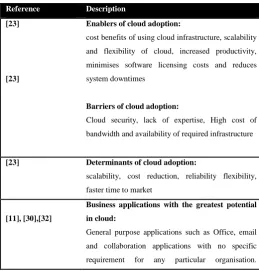
[image:3.595.301.561.447.718.2]Though the target population for some of the studies are very specific [11] [4] [30], the technological requirements for using cloud for the entire target are very similar. Therefore, useful lessons can be learnt to address the research objective. Currently there are no DSS available which covers the whole migration process starting from completing a cloud suitability assessment to identifying a suitable cloud provider. This study aims to fill that gap by developing a DSS for SMEs in Tamil Nadu. Table III shows the summary of literature review findings with regards to cloud adoption
TABLE I. SUMMARY OF LITERATURE REVIEW FINDINGS
Reference Description
[23]
[23]
Enablers of cloud adoption:
cost benefits of using cloud infrastructure, scalability
and flexibility of cloud, increased productivity,
minimises software licensing costs and reduces
system downtimes
Barriers of cloud adoption:
Cloud security, lack of expertise, High cost of
bandwidth and availability of required infrastructure
[23] Determinants of cloud adoption:
scalability, cost reduction, reliability flexibility,
faster time to market
[11], [30],[32]
Business applications with the greatest potential in cloud:
General purpose applications such as Office, email
and collaboration applications with no specific
Standalone applications such as CRM,
and applications for which capital expenditure needs
to be reduced
[32][11]
[32][11]
Where does the cloud make sense?
short-term need for software, applications for
start-up and SME
Where doesn’t the cloud make sense?
Legacy systems with complex integration
requirements, mission critical applications,
applications dealing with confidential data and
sensitive data
[31]
Criteria for cloud adoption decision:
Suitability of cloud application, Economic value
(capital cost, operating cost, Return of Investment),
Control (integration and manageability), Usability,
Reliability (Disaster recovery, availability and
compliance) and Security
[16] Risks of cloud adoption:
Organisational loss of control over data,
organisational change due to migration, Management
resistance to change, Portability and Interoperability
issues, Managing a system deployed on cloud can
take extra management effort, Data lock in
SaaS/PaaS and System lock in for IaaS, Private data
stored on the cloud can be accessed by foreign
governments due to difference in jurisdiction
[16] Cloud Journey:
Cloud management, training workforce, cloud audit
III. RESEARCH METHODOLOGY
As part of the literature review to identify the determinants of cloud adoption among SMEs in Tamil Nadu, a study has been conducted among SME decision makers in Tamil Nadu and the result of the study has been published in [23].
The proposed DSS will include a questionnaire based cloud suitability assessment and based on the assessment result, DMs can identify a suitable SaaS, PaaS or IaaS service for their requirement. Issues specific to Tamil Nadu have already been identified through a previous study [23] and will be included in the DSS
[image:4.595.305.547.57.256.2]The step by step process in the development of the DSS is shown is Fig. 1
Fig. 1. Research Plan
A. Cloud suitability assessment
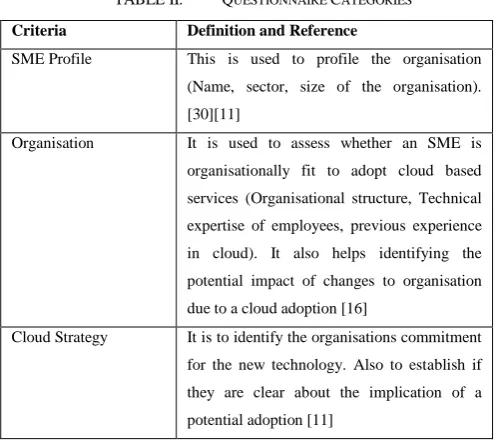
[image:4.595.301.549.487.708.2]The first step of the DSS is to conduct a cloud suitability assessment for the SME to identify if the organisation is cloud ready. By analysis the literature, we have identified nine question categories for this assessment. Each question category represents the readiness criteria that have to be evaluated to identify the suitability of cloud infrastructure for an organisation. These criteria are based on the categories used in similar suitability assessment on the models by [16] [11] [24]. The assessment will include a set of specific questions for each category that an organisation has to answer in order to identify its readiness in that particular category. The assessment criteria are shown in the table IV. Though these categories are derived from already existing decision support tools, the questions are designed to address the requirement of SMEs in Tamil Nadu
TABLE II. QUESTIONNAIRE CATEGORIES
Criteria Definition and Reference
SME Profile This is used to profile the organisation
(Name, sector, size of the organisation).
[30][11]
Organisation It is used to assess whether an SME is
organisationally fit to adopt cloud based
services (Organisational structure, Technical
expertise of employees, previous experience
in cloud). It also helps identifying the
potential impact of changes to organisation
due to a cloud adoption [16]
Cloud Strategy It is to identify the organisations commitment
for the new technology. Also to establish if
they are clear about the implication of a
Software It is used to assess whether the target
application is suitable for cloud.[11] [24]
Scalability It is used to access the growth potential of the
organisation and its impact on the selected
software [11] [16]
Data It is used to access the type of data to identify
any compliance or regulatory issues that
organisations will face due to outsourcing
data to a third party datacenter [24]
Compatibility It is used to evaluate the current IT staff,
infrastructure (internet connections, hardware
and software), and integration requirements
of an organisation regarding adoption of
cloud. [11] [16] [24]
Added Features This is used to indicate the mobility
requirements, new enhancement requirements
[31]
Cloud management It is used to indicate post migration strategy
of the organisation [16]
The format of the assessment question is shown in the Table V. This format has been adopted from the decision support tool used by [11] in their decision support tool.
TABLE III. ASSESSMENT QUESTION FORMAT
Question Number
Question Question Weight (CR)
Answer 1 9
Answer 2 7
Answer 3 3
Answer 4 1
Recommendation (Rec)
Recommendation 1
Recommendation 2
Recommendation 3
Reference Reference/ source for question, answers and recommendations
CR refers to the weight to a particular question. The weights will not be made visible to the user as it can impact the way they answer. If the answer to the question is 1, it will have a very negative impact of the overall cloud readiness and if CR is 9, it means that a cloud infrastructure is suitable for the SME. Rec refers to the recommendation that will be displayed when an answer is selected. Reference: the source of the question, answer and recommendation will be displayed on this section
Table VI shows a sample question from the cloud suitability assessment tool. The cloud suitability assessment tool will have a total of 40 questions grouped in 9 categories as shown in table. Questions for the first and second criteria are only to profile the SMEs; therefore the scores will only include the seven criteria's. Through this questionnaire tool,
the suitability of an organisation for a cloud infrastructure can be determined
TABLE IV. SAMPLE QUESTION
Do you have a defined goal for you cloud project?
Answer 1: We have a clearly defined goal that we have to achieve high
reliability, scalability, increased flexibility (pay-per-use) and introduce cost
reduction by implementing cloud based services.
Answer 2: We are still exploring our options in the cloud. We are still
defining the goals we needs. We lack the knowledge and expertise on cloud
computing
Answer 3: No, we don’t have a defined goal and we don’t know what we
want to achieve from the cloud
Recommendation: [1] Having a clear goal in mind is a good starting point for
the adoption of cloud services
Recommendation: [2] The definition of goal and setting objective is an
important factor and if you're lacking knowledge, you can take advice from
external experts or third party consultants
Recommendation: [3] The definition of goal and setting objective is an
important factor and if you're lacking knowledge, you can take advice from
external experts or third party consultants
Reference: [11]
B. Identifying suitable cloud service
The next step in the DSS is to identify the type of cloud service delivery model to deploy the target application. All three cloud service delivery models (SaaS, PaaS and IaaS) require users to either design, develop, build and deploy applications to cloud. SaaS offers user to buy an "off the shelf product" and configure it to their requirements. Therefore, the decision maker needs to make a decision whether to "build" or "buy" while deciding on the type of service delivery model for the target application. It makes more sense for SMEs to choose SaaS as the preferred service delivery model, if a suitable SaaS product is available as it does not require technical expertise to configure and implement a SaaS product [32]. However, if the user already has a legacy system or does not find a suitable SaaS service, PaaS or IaaS would be best alternative. For a given cloud adoption scenario where SaaS is not suitable or preferred, the first step is identifying the number of alternatives. The possible alternatives in such a scenario are listed below [31]:
1. Legacy IT (no action if a cloud adoption is identified as not beneficial) (A1)
2. Server consolidation/virtualisation (A2) 3. Server-colocation (A3)
4. PaaS implementation (A4) 5. IaaS implementation (A5)
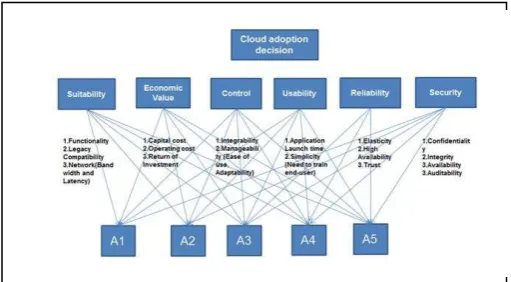
[image:5.595.303.562.96.349.2]and the principle of MADM is applied in developing decision support tools for various different fields [35]. Analytical Hierarchy Process (AHP) is one of the MADM methods and we have adoption AHP to identify the best alternative. The AHP hierarchy for the cloud migration decision problem is shown in Fig. 2. Level 1 is the goal of the system. Level 2 represents the different criteria for cloud adoption and Level 3 represents the five alternatives. The attributes used in Level 2 is based on Multi attribute decision making for cloud migration by Saripalli and Pingalli [31]. For example, if customer is considering improving the performance of a "Legacy web application" running from on premise data center. The decision maker has 5 alternatives to achieve the goal. To determine the best alternative, a benefit analysis can be performed according to AHP and the best alternative can be identified and can be suggested to the decision maker.
Fig. 2. AHP hierarchy for cloud adoption
C. Identifying suitable cloud provider
Once suitability of the cloud infrastructure is assessed and a suitable cloud service is identified for the target application, the next step is to identify a suitable cloud service provider. As the DSS focuses mainly on SMEs in Tamil Nadu, the vendor suggestion should include local cloud service providers in Tamil Nadu. The ranking of the services offered by the cloud will be based on 6 criteria's per SMI cloud; suitability, reputation, performance and accountability, cost, agility and security [13].
IV. FUTURE WORK
We are currently working on the technical implementation of the DSS. Through a thorough literature review and a study conducted among SME decision makers in Tamil Nadu, we have identified the requirements and the desired working of the DSS. We are planning to develop the DSS as a web application which incorporates the above mentioned steps to assess the suitability of cloud for SMEs in Tamil Nadu. If cloud is identified as a suitable option we aim to go further and identify a suitable cloud provider highlighting the benefits and risks of a prospective cloud adoption. Once the DSS is developed into a web application, it will be given to SME DM's for evaluation and feedback. The feedback gathered
from the users will help to make improvements to the DSS and make it more relevant to SMEs in Tamil Nadu.
V. CONCLUSION
In this research work, we have addressed our main research questions: How can we develop a DSS to support DM's in Tamil Nadu to make cloud adoption decisions effectively?
Through a thorough literature review and the proposed DSS we have properly addressed the research question. After reviewing the literature and reviewing previous research works, we have proposed a DSS for SMEs in Tamil Nadu. The research identifies 9 major criteria that are relevant to determine the suitability of cloud infrastructure for SMEs in Tamil Nadu; SME Profile, Cloud Strategy, Cloud Strategy, Software, Scalability, Data, Compatibility, Added Features and cloud management. We have AHP to support MADM.
This research is part of an ongoing research approved by Sheffield Hallam University
REFERENCES
[1] G. Acharya, '"India: Case Study on the Supreme Court Ruling on the 2G Spectrum Scam," Available at SSRN 2048719.
[2] I.O. Adam, '"Small and Medium Enterprises (SMEs) in the Cloud in Developing Countries: A Synthesis of the Literature and Future Research Directions." Available at SSRN 2513894.
[3] F. Alharbi, A. Atkins and C. Stanier, '"Strategic Framework for Cloud Computing Decision-Making in Healthcare Sector in Saudi Arabia,". [4] B. Al-Jebreen, A. Dahanayake and L. Syed, '"Requirements
Identification for Migration of Higher Educational Resources to Cloud," International Journal of Computer Applications, vol. 120, no. 16. [5] A. Alkhalil, R. Sahandi and D. John, '"Migration to Cloud Computing:
A Decision Process Model,", pp. 154.
[6] Y. Alshamaila, S. Papagiannidis and F. Li, '"Cloud computing adoption by SMEs in the north east of England: A multi-perspective framework," Journal of Enterprise Information Management, vol. 26, no. 3, pp. 250-275.
[7] V. Andrikopoulos, Z. Song and F. Leymann, '"Supporting the migration of applications to the cloud through a decision support system,", pp. 565-572.
[8] D. Asprey, '"Special Report: The State of Cloud Computing Security in Asia,".
[9] R. Awosan, '"Factor Analysis of the Adoption of Cloud Computing In Nigeria,".
[10] P.V. Beserra, A. Camara, R. Ximenes, A.B. Albuquerque and N.C. Mendonça, '"Cloudstep: A step-by-step decision process to support legacy application migration to the cloud,", pp. 7-16.
[11] C. Colicchio, C. Giovanoli and G.G. Stella, '"A Cloud Readiness Assessment Framework for Enterprise Content Management and Social Software (E-Collaboration) in Small and Medium Sized Enterprises,", pp. 177-183.
[12] V. DHEVIKA, '"A study on customer value of shampoo in tiruchirappalli district with special reference to college students,". [13] S.K. Garg, S. Versteeg and R. Buyya, '"A framework for ranking of
cloud computing services," Future Generation Comput.Syst., vol. 29, no. 4, pp. 1012-1023.
[14] E. Gide and R. Sandu, '"A Study to Explore the Key Factors Impacting on Cloud Based Service Adoption in Indian SMEs,", pp. 387-392. [15] A. Khajeh-Hosseini, D. Greenwood and I. Sommerville, '"Cloud
[16] A. Khajeh-Hosseini,"Supporting system deployment decisions in the public cloud".
[17] N. Khan and A. Al-Yasiri, '"Framework for cloud computing adoption: A road map for Smes to cloud migration," arXiv preprint arXiv:1601.01608.
[18] UN Broadband Commission, '"The state of broadband 2015: broadband for all. A report by the Broadband Commission
[19] M. Klems, J. Nimis and S. Tai, '"Do clouds compute? a framework for estimating the value of cloud computing,", pp. 110-123.
[20] M. Menzel, L. Wang, S.U. Khan and J. Chen, '"CloudGenius: a hybrid decision support method for automating the migration of web application clusters to public clouds," Computers, IEEE Transactions on, vol. 64, no. 5, pp. 1336-1348.
[21] K. Qiao, X. Wang and L. Wei, '"Determinants of high‐performance work systems in small and medium‐sized private enterprises in China," Asia Pacific Journal of Human Resources, vol. 53, no. 2, pp. 185-203. [22] M. Sharma, A. Mehra, H. Jola, A. Kumar, M. Misra and V. Tiwari,
'"Scope of cloud computing for SMEs in India," arXiv preprint arXiv:1005.4030.
[23] B.M.R. Wilson, B. Khazaei and L. Hirsch, '"Enablers and Barriers of Cloud Adoption among Small and Medium Enterprises in Tamil Nadu,", pp. 140-145.
[24] Oracle, '"Cloud candidate selectiontool: Guiding cloud adoption," Oracle, December 2011, pp. 15.
[25] E.K. Iye, A. Krishnan, G. Sareen and T. Panda, '"Sectorial Adoption Analysis of Cloud Computing by Examining the Dissatisfier Landscape," Electronic Journal of Information Systems Evaluation, vol. 16, no. 3, pp. 211-219.
[26] DAHERIA, Bhupesh,. "Broadband: The lifeline of Digital India". http://www2.deloitte.com/content/dam/Deloitte/in/Documents/technolog y-media-telecommunications/in-tmt-broadband-noexp.pdf
[27] Gowen, "Indias huge need for electricity is a problem for the planet" [online] https://www.washingtonpost.com/world/asia_pacific/indias-
huge-need-for-electricity-is-a-problem-for-the-planet/2015/11/06/a9e004e6-622d-11e5-8475-781cc9851652_story.html [28] Loginext, "3 REASONS WHY LOGISTICS IN INDIA IS UNRELIABLE" http://www.loginextsolutions.com/3-reasons-why-logistics-in-india-is-unreliable/
[29] ASAA, cloud readiness index
http://www.asiacloudcomputing.org/research/cri2016
[30] I. Bildosola, R. Río-Belver, E. Cilleruelo and G. Garechana, '"Design and Implementation of a Cloud Computing Adoption Decision Tool: Generating a Cloud Road," PloS one, vol. 10, no. 7, pp. e0134563.
[31] P. Saripalli and G. Pingali, "MADMAC: Multiple Attribute Decision Methodology for Adoption of Clouds," Cloud Computing (CLOUD), 2011 IEEE International Conference on, Washington, DC, 2011, pp. 316-323.
[32] R Weston and S Kaviani, " A systematic appproach to select a SaaS vendor". http://www.hyperoffice.com/saas-reviews-for-smbs/
[33] V. Doshi, '"Electrifying India: The day rural hotasar saw the light," Guardian, vol. Development, https://www.theguardian.com/global- development/2016/mar/21/electrifying-india-the-day-the-light-came-to-rural-hotasar
[34] DCMSME . Definitions of Micro, Small & Medium Enterprises. http://www.dcmsme.gov.in/ssiindia/defination_msme.htm
[35] G. Tzeng and J. Huang, '"Multiple attribute decision making: methods and applications,", 2011
![Table V. This format has been adopted from the decision The format of the assessment question is shown in the support tool used by [11] in their decision support tool](https://thumb-us.123doks.com/thumbv2/123dok_us/707164.574310/5.595.303.562.96.349/table-adopted-decision-assessment-question-support-decision-support.webp)