Exploring the aesthetics of tangible interaction :
experiments on the perception of hybrid objects
PETRELLI, Daniela, SORANZO, Alessandro
<http://orcid.org/0000-0002-4445-1968>, CIOLFI, Luigina <http://orcid.org/0000-0003-4637-8239> and
REIDY, John <http://orcid.org/0000-0002-6549-852X>
Available from Sheffield Hallam University Research Archive (SHURA) at:
http://shura.shu.ac.uk/11335/
This document is the author deposited version. You are advised to consult the
publisher's version if you wish to cite from it.
Published version
PETRELLI, Daniela, SORANZO, Alessandro, CIOLFI, Luigina and REIDY, John
(2016). Exploring the aesthetics of tangible interaction : experiments on the
perception of hybrid objects. In: TEI '16, February 14-17, 2016, Eindhoven,
Netherlands. ACM. (In Press)
Copyright and re-use policy
See http://shura.shu.ac.uk/information.html
Sheffield Hallam University Research Archive
Exploring the Aesthetics of Tangible Interaction:
Experiments on the Perception of Hybrid Objects
Daniela Petrelli
1Alessandro Soranzo
2Luigina Ciolfi
1John Reidy
2 1C3RI Cultural, Communication and Computing Research Institute
2
Department of Psychology
Sheffield Hallam University, Sheffield - UK
d.petrelli | a.soranzo | l.ciolfi | j.reidy @shu.ac.uk
ABSTRACT
We report the results of an extended empirical two-stage study on the aesthetics of hybrid objects that combine form and behaviour. By combining two shapes (spheres and cubes); two sizes (7.5cm and 15cm); two materials (fabric and plastic); and four behaviours (emitting light, emitting sound, vibrating or displaying no behaviour) we created 32 objects that differ for a single feature. In a between-participants study, 175 between-participants assessed and described the 32 objects. From this, seven dimensions were identified: pleasant; interesting; comfortable; playful; relaxing; special and surprising. In a second between-participants experiment 486 participants rated each object on the seven dimensions from the first study. Overall Spheres, Fabric, and Vibration were the preferred features, but for some of the dimensions specific combinations of features were rated more positively. This paper contribution is twofold: it provides a first study on the aesthetic of tangible interaction as a combination of form and behaviour outlining a potential instrument to measure it; and it provides empirical evidence of the value of experimenting with different forms (spheres) and material (fabric) even if they are difficult to create as they generate the strongest aesthetic effects.
Author Keywords
Hybrid objects; aesthetics; empirical study; form; material; behaviour; psychology; perception.
ACM Classification Keywords
H.5.m. Information interfaces and presentation (e.g., HCI): Miscellaneous.
INTRODUCTION
Recent work in HCI and ubiquitous computing has examined interaction within hybrid objects, where tangible artefacts respond to handling and other forms of interaction with a variety of behaviours. With tangible artefacts, these
behaviours either occur elsewhere (e.g. other devices, or screens), or are performed by the objects themselves through their physical form. In this paper we focus on the latter case, with the goal of systematically exploring the user reactions to hybrid objects that respond to handling with behaviours according to different modalities.
We refer to hybrid objects as physical artefacts for handling that are able to perform an embedded behaviour. Little work has been done thus far to explore how people perceive the various aspects of hybrid objects, how physical and tangible form factors such as shape, size and material relate to and interact with digital behaviour. As a matter of fact digital is shapeless and, as electricity, it needs a medium in order to be perceived [11]. Therefore there are endless possibilities on the physical form that can be given to the digital [17]. Design is a creative process and therefore is, to some extent, arbitrary [17]. A better understanding of how different form and behaviour features combine and their potential in affecting people’s perception is much needed. This is the goal of this research: we build upon work in haptic aesthetics [4] (the ability of an object to provide pleasure as opposed to the ability of being usable) to study form and behaviour embodied in hybrid objects and provide empirical evidence on which features are more pleasurable when an hybrid object is first encountered.
We review related research next before describing the purpose of the study and the objects. We then report the two studies in detail followed by a discussion of the findings. We conclude the paper reflecting on what contribution we offer to the research on tangible interaction.
RELATED WORK
The materiality and physicality of artefacts have been long recognised as a key aspect of tangible interaction [10], and the role of materiality in shaping the human experience of technology as well as a conceptual dimension for analysis of physical-digital interactions has gathered attention in recent years, both through theoretical explorations [7] and design experimentations and frameworks [24; 12].
Various aspects of the relationship between the physical characteristics of tangible artefacts and technology-enabled behaviours have been explored within Ubicomp and Tangible and Embedded Interaction. In a vast majority of cases, this has focused on using tangible objects as triggers
Permission to make digital or hard copies of all or part of this work for personal or classroom use is granted without fee provided that copies are not made or distributed for profit or commercial advantage and that copies bear this notice and the full citation on the first page. Copyrights for components of this work owned by others than ACM must be honored. Abstracting with credit is permitted. To copy otherwise, or republish, to post on servers or to redistribute to lists, requires prior specific permission and/or a fee. Request permissions from [email protected].
for behaviours occurring in a digital space [24; 20], rather than behaviours performed by the objects themselves. A subset of this research has explored human reactions to hybrid objects and has reflected on the interplay between material and form factor of tangible objects and user reactions and preferences [20]. Seo et al. [22] have examined the association between certain materials and meaning in a tangible interaction game linking physical manipulable objects made of wood, felt, silicone and plastic to an iPad drawing application. They found that children using the game attached meaning to materials through interaction preferences. Investigating the influence of tangible interactive artefacts’ physical attributes on the user experience is still a largely unexplored field, with few attempts to adopt a systematic approach to evaluation [25]. These examples of existing work show the need to investigate the relationship between physical attributes of hybrid objects and user experience, however the instances of formal, extensive studies of such relationship are few.
Systematic studies have been carried out in psychology to explore people’s reactions to different form factors via haptic and visual perception. There is a vast literature showing that the contour of an object plays a fundamental role: rounded contours and curved objects are preferred over sharp ones (e.g., [2; 13]) and expectations regarding simple geometrical forms influence haptic perception [8]. Given how quickly such impressions can be formed [1] these investigations must rely on primitives, something that can be extracted extremely quickly from the sensory stimulation. There have also been studies of the reaction to different stimuli (texture and shape), for example studying haptic perception combined with vision as complementary stimuli, and also the sound-shape congruency [18]. All these studies, however, have involved 2D representations of shapes rather than manipulable physical objects.
Findings from psychology have been applied to design and engineering [26] to provide guidelines for designing task-oriented interactions, e.g. haptic feedback used to carry out dangerous tasks in the safest way [9]. Carbon and Jakesch [4] analyse a set of existing results from haptic perception research to develop a model regarding aesthetic aspects of haptic and visual perception. They discuss how things we see often invite us to touch, and that increasingly a product’s success may be due to haptic and tactile features that overpower, in terms of pleasure, other senses. Touch is an exploratory sense, even if we used other senses at first, touch is what gives us a sense of the real thing, e.g. something may look rough or smooth but it is only by touch that we can be sure of the full extent of that property. Carbon and Jakesch argue that a model to describe affective and aesthetic responses to objects’ perception must take into account more than vision.
Overall, the examples of HCI and Ubicomp research exploring complex responses to hybrid objects are few and none looks at shape and behaviour systematically [25]. To
the best of our knowledge no studies exist on the interrelationship of various physical form-factors with technologically-enabled behaviours focusing on aesthetic. Therefore, we present here the first systematic experimental study on the interplay between hybrid objects’ form and behaviour and people’s reactions to it. In this study, we also extend the psychological investigation on the role of curvature to other senses beyond vision, and we investigate the role of material and size on object preference.
EXPLORING FORMS AND BEHAVIOUR Rationale
The large-scale studies reported in this paper examined the first reactions people have when interacting with objects that display behaviours. The nature of tangible interaction is complex as it engages multiple senses and affects the user at visceral as well as cognitive level. In HCI, research has been conducted on visual [19; 16], aural [13] and haptic aesthetics [4] separately, but no knowledge exists on the aesthetics of their combination. We intend aesthetics as the capacity (of an object or one of its components) to make us feel enjoyment. In particular we isolate aesthetic from functionality/usability as they have been demonstrated as separate to the point that they can be judged independently [4; 16]. We follow the 3-levels model of haptic aesthetics [4] that defines a hierarchy of exploration, assessment, and evaluation as the phases that lead to perception. The input to the model is an object that has been seen, but not analysed via tactile interaction yet. In the exploration phase simple elements such as hardness, depth, weight, size are analysed: tactile feedback is received for expectations derived from the first visual impression, e.g. a metal handle bar is expected to be hard and cold. In the second level, analyses of features from the lower level are grouped and integrated into a higher-level judgement of the object itself, e.g. harmony, balance. The third level pertains the cognitive and emotional aspect that splits the features into ‘utility’ (e.g., ergonomics, intuitiveness) and ‘aesthetic’ (e.g., arousal, fascination, seduction). It is at this level that the overall perception forms.
In our experiments we manipulate elementary features defined by Carbon and Jakesch as belonging to the lower level and collect participants judgement as the outcome of the evaluation of the object (third level). In other words, we combine features such as different sizes and shapes with different materials and different behaviours, and measure how participants perceive each combination of features. By comparing the data collected for each object and of features across objects we can empirically determine which feature (or combination of features) is more likely to generate positive responses in participants.
Objects
relationship between physical qualities and behaviours, we created hybrid objects where form factors of shape, size and material were combined with embedded behaviours, and we designed and ran a controlled experiment to measure how the different objects are perceived.
Form Behaviour
Shape Size Material
Sphere 7.5cm Plastic Emit a light
Cube 15cm Fabric Play a sound
Vibrate
[image:4.612.48.289.124.232.2]Quiescent
Table 1. Characteristics of the tangible hybrid objects.
As we aimed to find out how the different factors contributed to participants reactions to specific objects we incorporated only basic factors. More specifically, we defined four variables, each with multiple values, three of these for the form:
− Shape: rounded vs. angular was implemented as spheres and cubes;
− Material: natural-looking vs. man-made was implemented with cotton fabric and plastic;
− Size: small vs. big in the range of sizes that can be handled by humans was implemented as the minimum size that can contain the electronics (7.5 cm.) and a size that needs two hands to be picked up (15 cm.);
Other shapes and materials were considered initially, such as spiky objects or wood, but these options were abandoned as they proved impossible to manufacture, e.g. an empty shell in wood would be too big or break too easily.
The fourth variable defined the behaviour of the objects. The behaviour and its trigger were enabled by a core of sensors and electronics embedded in each object. As in the definition of the form factors, for the behaviour factor we also looked for basic elements in order to avoid any unintentional bias of the data. Specifically, to avoid potential confounding variables due to complexity, basic behaviours have been chosen. Furthermore, the different behaviours displayed by the objects were triggered by the same user action - that of being picked up and held. All the objects were inactive when stationary on a surface, and displayed a different behaviour (Table 1) when picked up. The behaviours the objects displayed were:
− Emit a light: the object gently glows when picked up;
− Play a sound: the object buzzes when picked up;
− Vibrate: the object vibrates when picked up;
− Quiescent: the object does not display any behaviour when picked up (baseline condition).
The behaviours were implemented using an Arduino Mini with a motion sensor to detect the objects being picked up
and put down (which switched the behaviour on and off) and an output of LED lights, buzzer, and motor vibration.
Behaviours were designed to occur as similarly as possible; all started when the object was picked up and stopped when put down. Light, sound and vibration were not continuous, but pulsating - giving a stronger impression of an active object. The vibration was created with a Pulse Width Modulator output from pin 9 of the Arduino Pro Mini. The intensity range of the vibration motor was set between 0-255. Once reached the maximum intensity, it dropped by 5 unit steps with 30 milliseconds delay in each drop. This loop continued until the object was put down. The light of the LED was set in a similar way as the vibration: the maximum light intensity level was 36 cd/m2. Finally, the sound was a melody consisting of two notes: a La-small (frequency 220 Hz) was played for 250 milliseconds followed by a Sol-small (frequency 196 Hz) for 250 milliseconds. The melody was repeated every 2 seconds. As for the shape and material, a more melodic sound generator was considered, but the size of this component would compromise the small size, so the buzz was chosen instead.
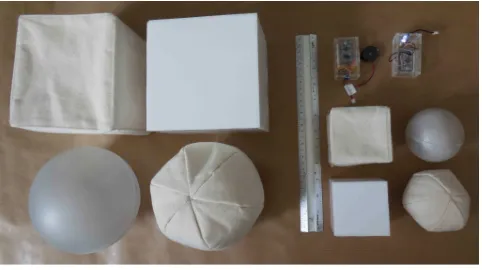
A rechargeable battery pack completed the electronics. The board, the battery and the sensor were encased in a clear plastic box fitted within the objects (Fig. 1). Padding was used to keep the electronics box in place and to prevent it from rattling when the objects were moved. The LED, the sound buzzer and the motor vibration were located close to the outside of the objects to assure the behaviour was clearly perceivable by the participants. We bought the spheres ready-made, while we laser-cut the plastic cubes and hand-sewed the fabric objects.
Implementing all combinations of shape, material, size and behaviour resulted in 32 objects that were each different from all the others for just one variable level. In this way we were able to control the effect of every value of every variable independently from the others as well as in combination with the others.
Figure 1. The hybrid objects and the boxes with the electronics (the right one has the LED switched on as in use).
Procedure
[image:4.612.318.559.516.651.2]characterising hybrid objects; in the second phase, we used these qualities to find out which features (pertaining the form or the behaviour) provoke which impression, how different features combine (e.g. if a specific feature dominates others) and correlate (e.g. if two or more features together always provoke the same impression).
We were interested in the first reaction, e.g. the initial perception people had of the different hybrid objects. Therefore both studies had a set up in which all objects were concealed (each object was covered by a box); participants removed the box; picked up the object thus triggering the behaviour; put the object down and covered it before moving to the next box and the next object (Fig. 2).
The number of hybrid objects created by combining the different features was 32, a large number for participants to evaluate. To avoid participants’ fatigue, we opted for a between-participants experimental setting where each participant was presented with 16 of the 32 hybrid objects. Size was kept constant for each participant: two rooms were used, each with 16 objects of the same size (Fig.2). In this way we were able to examine the impact of each factor on how the participants experienced the objects. Because of the large sample size the between-participants variable was deemed as appropriately generalizable. In addition the instructions to participants were not comparative in the sense that each object was judged in itself and not compared to other therefore the fact that participants were not exposed to both sizes has no effect on the result.
[image:5.612.55.296.401.553.2]
Figure 2. The experimental set up: 16 hybrid objects per room are placed on 3 lines of desks. A box covers the object.
In the pilot, we also tried out tablets to collect data on participants’ reactions automatically, but subsequently reverted to post-experiment paper questionnaires after observing many participants having difficulties with the tablets. We intended to collect data from a wide variety of participants and therefore issues of accessibility for all were paramount. A cross-section was needed to guarantee the collection of a data set that was as representative as possible of the general population. Therefore, as well as a wide email call across the university and social media shout-outs, flyers were distributed in the street and at Open Days (with
potential students and parents attending) inviting people to take part in the experiment. A USB memory stick was given to all participants as a token of gratitude. The data collection was done over several days in three different University buildings located in different parts of the city.
EXPERIMENT 1: DIMENSIONS OF IMPRESSION
The first experiment aimed to empirically establish the qualities people see in hybrid objects so as to inform the design of the second experiment. The 175 participants were split into two groups (of 88 and 87) and within each group, the size of the hybrid objects was constant. Hence, each participant was presented with 16 hybrid objects only combining material, shape and behaviour. Participants interacted with each object by revealing it and picking it up; they were then asked to select the most and least preferred objects and to explain why.
Adjectives were extracted from the 350 narratives collected: positive as well as negative terms were thematically analysed to determine the seven most common dimensions. For example, the narrative ‘The plastic box. It is hard and boring’ gave the adjectives ‘hard’ and ‘boring’, while ‘The texture of the material, comfort. The mobile vibration, curiosity, playful’ offered as explanation why the large vibrating cube in fabric was liked, and gave ‘comfortable’, ‘curious’, ‘playfulness’ as qualities. Synonyms and antonyms were then paired to define dimensions of qualities across those two extremes. For example ‘smooth’ / ‘soft’ and ‘hard’ / ‘unhandy’ are all adjectives used to define the quality ‘comfort’.
The seven dimensions that resulted from the thematic analysis were: Interesting, Comfortable, Playful, Surprising, Pleasant, Special and Relaxing. In defining the dimensions we made an effort to use terms that could be applied to both form and behaviour, as we aimed to capture the effect of the combination of the two. As a matter of fact most narratives mentioned both a form feature and a behaviour feature as motivations for the liking or disliking an object, for example ‘the smooth surface of the cube and the light made me smile’ and ‘too solid, did not like the beeping’ for the large plastic sphere cubes with light vs. sound. This seems to indicate that the material and digital properties of a hybrid object are equally important for the participants and the judgement was influenced by both.
EXPERIMENT 2: COLLECTING IMPRESSIONS
The second experiment aimed at empirically establishing: (i) the overall reaction to hybrid objects that combine form and behavioural features; (ii) if a specific feature (of form or of behaviour) dominates above others; (iii) whether specific combinations of features particularly influence perceptions of the hybrids.
with the object within, and then judge each object scoring it on a scale for each of the seven dimensions identified in Experiment 1. In other words, they had to indicate for each object how Interesting, Comfortable, Playful, Surprising, Pleasant, Special and Relaxing it was. Each dimension was measured using a 7-point Likert scale. After all the 16 objects had been assessed, participants were invited to indicate the three objects they liked the most and the three they liked the least and to say why. At the debriefing in conclusion of the experiment, participants provided personal information, namely age, gender and first language. In this way we were able to split the experimental variables as ‘user’ and ‘object’ and to see if results were specific to a user set, e.g. if the findings were, for example, age-dependent.
486 volunteers took part in this study (251 and 235 participants per room): 267 males and 219 females aged between 21 and 69. For 266 participants English was the first language, whilst for the remaining 220 English wasn’t their mother tongue.
The data from the Likert scales was statistically analysed using a four-way mixed-designs ANOVA with Shape (sphere vs cube), Material (fabric vs plastic) and Behaviour (vibration/light/sound/quiescent) as within-participant variables and Size (large vs small) as the between-participants variable. The dependent variables were each of the dimensions identified in Experiment 1 (Interesting, Comfortable, Playful, Surprising, Pleasant, Special and Relaxing); Each ANOVA examined main effects (which condition within a variable was more positively rated) as well as interactions between variables, i.e. if two, three or all four object variables together gave rise to judgements significantly different from any other combination of variables. In this way, we were able to isolate the magnitude of each effect according to the dependent variable in consideration.
Below we report the statistical analysis by dimension. We do not report all the tests we performed, but only those that were statistically significant. Following we look at how the statistic is confirmed in the qualitative data collected composed by the like/dislike statements. Overall, the quiescent objects consistently received low scores for all the dimensions showing that the hybrid objects with behaviours were preferred to quiescent objects, regardless of the added behaviour. Furthermore, the vibrating objects were always preferred over those emitting light, and light was preferred over sound. The fact that sound was the least preferred behaviour should be taken with caution: as discussed before, instead of a modulated sound we had to use a buzz to fit with the limited size of the small objects. As a consequence many participants found the sounding objects annoying and rated them as least liked in study 1.
Size had no effect on any of the dimensions, and neither had any of the participants’ variables - that is to say our results are consistent across age, gender and language. As
the results for the individual features were consistent across the dimensions, below we report only the statistical results for multi-way interactions.
Pleasant
Among the many combinations of variables, only the two-way interaction between Shape and Behaviour was statistically significant [F(1,487)= 19.43 ; p < 0.01; ηp2 0.4]: Sounding Spheres were significantly less pleasant than both Vibrating or Lighting Spheres (p < .001); whereas there was no significant difference among the behaviour of Cubes (p >0.01); i.e. cubes were equally pleasant, apart of course for the quiescent cube which was significantly less pleasant than any other cubes behaviours (p. < 0.001).
Interesting
A significant two-way interaction was found with Behaviour and Material: [F(3,1338) = 23.96, p< .001, ηp2 = 0.05]. Vibration is generally more interesting, but when the Material was Plastic, Light was more interesting than Vibration. This difference wasn't present when the Material was Fabric, i.e. Light and Vibration were scored as equally interesting.
A significant three-way interaction of Behaviour, Shape and Material was found [F(3,1338) = 6.19, p< .001, ηp2 = 0.01]. The three-way interaction is explained by the Vibrating Plastic Cube being significantly more interesting than the Vibrating Fabric Cube [t(468) = 2.60, p = 0.01], whereas for the Spheres, Fabric Vibrating Spheres were more interesting than the Plastic ones (although this was only significant at p < .05 and so should be treated with caution).
Comfortable
There was a significant two-way interaction between Behaviour and Shape (F(3,1320) = 5.98, p< .001, ηp2 =
0.02). For Cubes, Light was equally as comfortable as Vibration and these were more comfortable than both Sound and Quiescent. Whereas, for Spheres Light was more comfortable than all other behaviours (all p < .01).
A significant effect was found for a three-way interaction involving Behaviour, Shape and Material (F(3,1338) = 4.11, p= .007, ηp2 = 0.01): whereas there was no significant difference between the Vibrating Plastic Sphere and Cubes there was a significant difference between the Vibrating Fabric Sphere and Cubes with Spheres being more comfortable (t(463)=4.07, p < .001).
Playful
There were significant two way interactions involving Behaviour and Material (F(3, 1326) = 6.95, p< .001, ηp2 = 0.02), Behaviour and Size (F(3, 1326) = 5.08, p= .002, ηp2 =
significant three-way interaction of Behaviour, Material and Condition (F(3, 1326) = 3.90, p= .009, ηp2 = 0.01). This showed that, for small Quiescent objects, the Fabric objects were rated as more playful than Plastic ones (p < .001) but this was not the case for the large objects with Quiescent (p> .10).
Relaxing
Among the combinations of variables, the two way interaction between Shape and Behaviour was statistically significant [F(1,487)= 13.24 ; p < 0.01; ηp2 = 0.03]: Sounding Cubes were significantly more relaxing than Quiescent Cubes (p < .001) whereas this difference was not significant for Spheres (p >0.01).
The two way interaction between Shape and Material was also significant [F(1,487) = 14.47; p < 0.01; ηp2= 0.03]. The Plastic Cubes were much less relaxing than Fabric Cubes. Although Fabric Spheres were more relaxing than Plastic Spheres (p < 0.01), this difference was not as large as the one between Fabric and Plastic Cubes.
Special
The only significant two-way interaction was for Material and Behaviour [F(1,487)= 8.34 ; p < 0.01; ηp2 = 0.02]: For Fabric objects, Vibration was rated more special than Sound and Light which were then rated higher than Quiescent. It is worth pointing out that this is counter to the general findings for behaviour. Sound in Fabric was more Special than Light. Plastic objects instead follow the general ordering of Light as more special than Sound (all p < .001).
Surprising
There was a significant interaction for Material and Behaviour [F(1,487)= 8.34 ; p < 0.01; ηp2 = 0.02]: For both
Plastic Spheres and Plastic Cubes, they were more surprising when they were Vibrating rather than Lighting (p < .001) and, in turn, these latter were more surprising than Sounding Plastic Spheres and Cubes (p < .001).
The three-way interaction between Shape, Material and Behaviour was statistically significant [F(3,1461) = 9.38, p< .001, ηp2 = 0.02]: Vibrating Fabric Spheres were significantly more surprising than both Sounding and Lighting Fabric Spheres (p < .001); however, for Fabric Cubes, although they were also more surprising when they were Vibrating rather than Sounding (p < .001), there was no difference between Vibration and Light as there was instead for Fabric Spheres (p >.01).
DISCUSSION
In summary, it appears that spheres are rated more positively than cubes, fabric more positively than plastic and vibration more positively than the other behaviours. Also, light and sound tend to be rated more positively than no behaviour (quiescent objects). These appear to be very robust findings across dimensions in that vibration, fabric and spheres are always preferred, but subtleties arise in the comparisons with sound and light. Sometimes light and
sound are rated equally for example with the ratings for Special for fabric objects and sometimes vibration is rated as similar to light as is the case for Pleasant ratings for spheres. Also, sometimes there appear to be differences in the magnitude of the main differences between factors. For example the difference between Relaxing ratings for fabric versus plastic spheres is not as large as that for cubes. This can be explained by considering the combined effect of the material and shape: a cube made of relatively soft material (fabric) is less sharp to handle than the same shape make of rigid material (plastic).
A closer look at the variables which are significant for each dimension reveals that Behaviour seems to be the dominant factor influencing ratings in that it is in all significant multi-way interactions, except the interaction between shape and material for the Relaxing dimension. Shape appears to be of secondary importance for Pleasant, Interesting and Comfortable ratings whereas Material is of importance for Playful, Relaxing, Special and Surprising ratings. Size only appears to be of importance for ratings of Playfulness with smaller objects being seen as more playful. This result is inconsistent with the research of Silvera et al. [23]: when task involving choosing preferred images (abstract shapes and alphanumeric characters) adults and three year olds showed a bias for larger images. There are of course differences in the methodologies of the studies. Silvera et al. presented their stimuli pictorially rather than as physical objects. It might be therefore that the presentation modality is of fundamental importance in preference decisions or that objects that display some form of behaviour, e.g. the mobile phone, are expected to be small.
Our results confirm previous findings from the psychology literature that people tend to prefer rounded objects to sharp edged objects [e.g. see 2]. In our research there was a clear preference for the sphere over the cube; as this is the first study to assess this preference using real world 3D objects rather than pictorial representations of smooth and sharp objects, we can say that the preference for smooth objects is not limited to visual processing but it is a general feature that extends to other perceptual domains.
objects and then giving ratings after having handled them. The dominance of vibration supports the view of Carbon & Jakesch [4] that haptic exploration overpowers the other senses in terms of influencing our evaluation of objects.
It is of particular interest from the perspective of tangible interaction that digitally enhanced objects were preferred to those with no embedded behaviours. The precise reasons for this are unclear from the current findings and so this needs to be examined further in future research. We may speculate though that the digitally enhanced objects are preferred as we feel some psychological connection to them because of their immediate reaction to our touch. Carbon & Jakesch [4] argue that when we touch an object we are in turn touched: if our touch leads to a reaction from the object then this may lead to a stronger psychological connection to that object when the objects' reaction is not a threat to us.
The preference for fabric over plastic is concordant with previous research [15] and adds to the evidence of a preference bias for natural over manmade. The preference for the natural seems very strong and even extends to aversive phenomena: Rudski et al. [20] have shown that there is a preference for natural hazards (e.g. lightening) over manmade hazard (e.g. falling overhead power lines). In the context of interaction design, as the objects in our study were all clearly manmade, we can assume that the inclusion of more natural material used in the construction of the object has led to higher preference ratings. This has significant implications for the design of tangible as it suggests that the use of the natural material is likely to lead to more positive psychological reactions to such products.
SUMMARY AND CONCLUSIONS
The research is the first investigation on the aesthetic of tangible interactive objects, hybrid objects that combine factors of form such as size, shape and material, with digital behaviour when touched such as emitting light, emitting sound or vibrating. To this end we constructed large and small, fabric and plastic spheres and cubes and embedded within these a number of participant activated behaviours (vibration, light and sound).
In the first study, the 32 objects where assessed by 175 participants that expressed their like and dislike. Through a thematic analysis of participants’ responses to the objects we identified seven key psychological dimensions: pleasant, interesting, comfort, playful, relaxing, special, and surprising. In order to isolate aesthetic and utility, the objects did not have any function, and participants themselves used terms that capture aesthetic qualities such as Pleasant and Interesting. This is compatible with Carbon & Jakesch's high (evaluation) process in the haptic aesthetic model where the cognitive and emotional factors relating to an object are perceived and evaluated as separate [4]. The distinction between aesthetic and utility is important as recent research [6] has reported results suggesting that participants prefer rounded features when objects are considered from a hedonic perspective but prefer angular
features when considering functional aspects of the object. Digital enhancements may further stress this polarisation aesthetic/hedonic vs. utility/functional: participants used terms like ‘soothing’ and ‘tingling’ to describe vibrating objects whereas sounding objects were named as ‘abrasive’ and ‘scary’. To gain an empirically grounded understanding of how form and behaviour factors combine and contrast is essential for the design of tangibles. Our research is a first step in this direction: to provide a better understanding of the aesthetic of hybrid objects for informed design decisions. In particular the 7 dimensions identified could form a questionnaire to assess the aesthetic of tangibles although further research is needed to clarify the relative importance of these dimensions. Specifically, a factor analysis is needed to establish the minimum number of orthogonal (statistically independent) dimensions.
In a second study the 7 dimensions from study 1 were used by 486 participants to assess the same 32 hybrid objects. In short it appears that spheres are rated more positively than cubes, fabric more positively than plastic and vibration more positively than the other behaviours. Also, light and sound tend to be rated more positively than no behaviour (quiescent objects) thus highlighting the value of adding digital behaviour to physical objects. In the context of interaction design, it is important to underline that any behaviour, even the annoying sound, was preferred to quiescent objects. Results are consistent across dimensions but sometimes a single object overcomes the general trends. These variations can be explained by the amplified effect that a specific combination of form and behaviour creates. For example the Plastic Sphere emitting Light where more Interesting possibly because of external factors: using the words of a participant ‘it resembles the moon’.
We have shown how a certain form factor affects perception, e.g. Size affects playfulness; Material is important for Playful, Relaxing, Special and Surprising. These findings have implications for TEI and Ubicomp research as well as related Psychology research on the perception of aesthetic qualities of hybrid objects. When there is no prescription on the form, as it is often the case in interaction design [11;17], the findings reported in this paper can be used to direct the design. Thus, for example, a design that aims at playfulness should consider small objects made of material other than plastic. Indeed our findings show that the design space for experimenting in tangible interaction and ubiquitous computing is wider than the current focus on 3D printing and laser cutting may suggest. Objects that are not easy to make such as spheres made of fabric can lead to positive interactional outcomes. Seen in the perspective of interaction design, this paper therefore shows the importance of opening up to creative ways of combining material and digital.
ACKNOWLEDGMENTS
REFERENCES
1. Nalini Ambady, Frank J. Bernieri and Jennifer A. Richeson. 2000. Toward a Histology of Social Behaviour: Judgemental accuracy from thin slices of the behavioural stream. In Mark P. Zanna (Ed.),
Advances in Experimental Social Psychology Vol 32. Academic Press, San Diego. 201-272
2. Moshe Bar and Maital Neta. 2006. Humans Prefer Curved Visual Objects. Psychological Science, 17(8), 645-648.
3. Marco Bertamini, Letizia Palumbo, Tamara N. Gheorghes and Mai Galatsidas. 2015. Do observers like curvature or do they dislike angularity? British
Journal of Psychology. (April 2015)
doi: 10.1111/bjop.12132
4. Claus-Christian Carbon and Martina Jakesch. 2012. A Model for Haptic Aesthetic Processing and Its Implications for Design. Proceedings of the IEEE, 101, 9: 2123-2133.
5. Mario Enriquez, Karon MacLean and Christian Chita. 2006. Haptic Phonemes: Basic Building Blocks of Haptic Communication. Proceedings of International Conference on Multimodal Interaction ICMI. 302-309.
6. Tanuka Ghoshal, Peter Boatwright and Malika Malika. 2016. Curvature from All Angles. In The Psychology of
Design: Creating Consumer Appeal, R. Batra, C.
Seifert & D. Brei (eds). Routledge, London, 91-106.
7. Shad Gross, Jeffrey Bardzell and Shaowen Bardzell. 2014. Structures, Forms and Stuff: the materiality and medium of interaction. Personal and Ubiquitous Computing, 18, 3: 637-649.
8. Jonathan M Ehrich, Martha Flanders and John F. Soechting. 2008. Factors Influencing Haptic Perception of Complex Shapes. IEEE transactions on haptics. 2008; 1(1) : 19-26. doi:10.1109/ToH.2008.4.
9. Kelly S. Hale and Kay M. Stanney. 2004. Deriving Haptic Design Guidelines from Human Physiological, Psychophysical, and Neurological Foundations. IEEE Computer Graphics and Applications, 24:2 (March-April 2004). 33-39.
10. Eva Hornecker. 2006. Physicality in Tangible Interaction: Bodies and the world. First International
Workshop on Physicality, 6-7 Feb. 2006:
http://www.ehornecker.de/Papers/TangibleBodies.pdf
11. Mike Kuniavsky 2010. Smart Things: Ubiquitous Computing User Experience Design. Kaufmann. 12. Hyosun Kwon, Hwan Kim and Woohun Lee. 2014.
Intangibles Wear Materiality via Material Composition. Personal and Ubiquitous Computing, 18:3 (March 2014), 651-669.
13. Helmut Leder, Pablo P. Tinio and Moshe Bar. 2011. Emotional valence modulates the preference for curved objects. Perception, 40(6), 649-655.
14. Grégory Leplâtre and Iain McGregor. 2004. How to Tackle Auditory Interface Aesthetics? Discussion and Case Study. Proceedings of International Conference on Auditory Display (ICAD ’04).
15. Meng Li and Gretchen B. Chapman. 2012. Why Do People Like Natural? Instrumental and Ideational Bases for the Naturalness Preference. Journal of Applied Social Psychology, 42:12, 2859-2878.
16. Gitte Lindgaard and Cathy Dudek. 2003. What is this evasive beast we call user satisfaction? Interacting with Computers. 15, 3. 429-452.
17. Jonas Lowgren and Erik Stolterman. 2007. Thoughtful Interaction Design: A Design Perspective on Information Technology. MIT Press.
18. Elena Makovac and Walter Gerbino, 2010 Sound-shape congruency affects the multisensory response enhancement. Visual Cognition, 18, 133-137.
19. Morten Moshagen and Meinald T. Thielsch. 2010. Facets of Visual Aesthetics. International Journal of Human-Computer Studies, 68, 10, 689-709.
20. Jeffrey Rudski,William Osei,Ari Jacobson, Carl Lynch. 2011. Would you rather be injured by lightning or a downed power line? Preference for natural hazards.
Judgment and Decision Making, 6(4), 314-322.
21. Magdalena Schmid, Sonia Rümelin and Hendrick Richter. 2013. Empowering Materiality: inspiring the design of tangible interactions. Proceedings Tangible,
Embedded and Embodied Interaction (TEI’13). 91-98.
22. Jinsil Hwayoung Seo, Janelle Arita, Sharon Chu, Francis Quek and Stephen Aldriedge. 2015. Material Significance of Tangible for Young Children.
Proceedings Tangible, Embedded and Embodied Interaction (TEI’15). 53-56.
23. D. H. Silvera, R. A. Josephs and R. B. Giesler. 2002. Bigger is better: The influence of physical size on aesthetic preference judgments. Journal of Behavioral Decision Making, 15(3), 189-202.
24. Jouke Verlinden and Imre Horváth. 2009. Analyzing opportunities for using interactive augmented prototyping in design practice. Artificial Intelligence for Engineering Design, Analysis and Manufacturing, 23: 3, 289-303.
25. Jorick Vissers, David Geerts. 2015. TUIkit: Evaluating physical and functional experiences of Tangible User Interface prototypes. Proceedings of the SIGCHI Conference on Human Factors in Computing Systems (CHI '15). 1267-1276.