Travel behaviour considerations during the
process of residential relocation
Karen Stanbridge, University of the West of England, Bristol
Glenn Lyons, University of the West of England, Bristol
Conference paper
Session 1.7
The Expanding Sphere of Travel Behaviour
Research
11th International Conference on Travel Behaviour Research Kyoto, 16-20, August 2006
Add an image reflecting the content of your paper.
Travel behaviour considerations during the process of
residential relocation
Karen Stanbridge and Glenn Lyons Centre for Transport & Society Faculty of the Built Environment University of the West of England UK
Phone: +44 117 32 83667 Fax: +44 117 32 83899
E-mail: / [email protected] / [email protected]
Abstract
There has been an increasing focus in recent years in transport research, policy and practice on travel demand management as a means of addressing traffic congestion. In close association, the need to encourage travel behaviour change has grown in importance. A key impediment to behaviour change can be the lack of conscious consideration by an individual of the travel choices they make, i.e. habit. Breaking or weakening habits by bringing consideration of travel options back into an individual’s consciousness is an important precursor therefore to behaviour change. This can occur when an individual faces a change of circumstances. Life events such as getting married, changing jobs, having children or moving house are perhaps exemplars of such change. This paper focuses upon the last of these – residential relocation. Through qualitative and quantitative research with individuals who have recently moved home, the paper examines the extent of behaviour change brought about
and goes on to assess residential relocation as a process in order to establish when and to what
extent during that process conscious consideration of travel issues is prevalent. Given the diverse nature of relocation experiences at the individual level, cluster analysis allows some more generic interpretations of ‘consideration behaviour’ types to be revealed. The paper concludes with a commentary on what implications the insights from this research might have for transport policy. In particular it considers the targeting of behavioural interventions intended to encourage positive behaviour change in circumstances of broken or weakened habits.
Keywords
Behaviour change, habit, residential relocation, churn
Preferred Citation
Stanbridge, K. and Lyons, G. (2006). Travel behaviour considerations during the process of
residential relocation, paper presented at the 11th International Conference on Travel
1. Introduction
Daily travel behaviour, in particular mode choice, is frequently seen as habitual to the extent
that any (prospect of) change is inhibited or prevented (Verplanken et al. , 1997; Gärling,
1998; Kenyon and Lyons, 2003). Promotion of change in travel behaviour is necessary to achieve the aims of travel demand management. These being to pursue a more rational and effective use of the transport system by changing the extent and nature of travel in terms of when, where, how and how much people travel.
Recent research has examined the notion of events throughout the life course influencing
travel and potentially stimulating change in travel behaviour (van der Wearden et al., 2003;
Bamberg et al., 2003; Klöckner, 2004). Key life events such as changing jobs or passing the
driving test can provide both of the two criteria required for breaking habits as suggested by
Ouellette and Wood (1998): a change in the situational context of the habitual behaviour, and
an increase in consciousness of the behaviour (Stanbridge et al., 2004). Research to date has
largely focussed on examining the relative influences of a series of key events (e.g. gaining a driving license, moving home, moving work, purchasing a car) on travel behaviour (van der Wearden et al, 2003; Klöckner, 2004). Little examination of the processes involved in a single key event has occurred. Yet such examination could prove fruitful in improving understanding of precisely how a key event can impact upon travel behaviour and its associated habituality. This in turn may reveal opportunities for interventions to effect positive behaviour changes.
This paper considers a detailed examination of the process of residential relocation. It stems from a study which has used both qualitative and quantitative research methods to yield insights from individuals who have recently undergone a residential relocation. Such methods have allowed changes in behaviour arising from moving home associated with specific journey types to be identified as well as consideration of behaviour (and intentions for
behaviour change). Underlying this, a principal focus has become the process of residential
relocation as distinct from (only) the outcome. Qualitative research involved in-depth
interviews with 11 recent home-movers. This informed a larger scale postal survey targeted once again at those who have moved home in the recent past. The qualitative research is
described in detail in Stanbridge et al. (2004). This paper is principally concerned with the
larger scale survey and seeks to examine the following five key questions:
1. To what extent is mode of travel for particular journey purposes affected following a
2. Is there an identifiable process associated with residential relocation in which to situate closer examination of habit and consideration of travel options?
3. Given such a process, at what points during that process are travel issues considered and
to what extent?
4. Given the diversity of specific relocation experiences and the individuals involved, are
there identifiable typologies of home-movers?
5. What implications arise from the empirical evidence for transport policy?
2. Research
methodology
An initial qualitative phase was completed involving 11 interviews with recently moved households to gain information about their experiences. Topics discussed included reasons for the move, priorities during the search process and any changes to travel behaviour experienced. This was followed by, and informed, a survey developed to examine the issues raised across a wider cross-section of people moving home. A key feature of the survey was an effort to further explore and develop the conceptual framework which had arisen from analysis of the interviews (this is presented later). The survey also sought to probe for occurrences of mode switch associated with moving home as an indicator of travel behaviour change, and examine any related factors. Specific journey purposes were addressed by the survey in relation to household travel: commuting for all adults in the household (maximum of two adults in any eligible household); grocery shopping; travel to city centre; school run; and regular leisure journeys. These were selected as being the most frequently undertaken journeys, and therefore those likely to contribute substantially to (local) traffic levels and to be habitual in nature.
adults living in the household was two or less (intended to avoid inclusion of overly complicated household structures such as those including more than two generations of a family or those with offspring of adult age). The questionnaires were designed to be completed by one adult household member on behalf of any additional household members, although information regarding all household members was sought. The incentive for returning the survey was a single prize draw of £250.
A total of 229 useable responses that met the above criteria were received, giving an estimated response rate of 20 per cent (this can only be estimated given the limited information concerning the households receiving a questionnaire other than knowledge of change of ownership). This level of response was achieved without the sending of reminders which were deemed to entail too much invasion of privacy and therefore not permitted by the Land Registry. Of the 229 responding households, almost half were childless couples (49 per cent), 30 per cent were single adults living alone, 4 per cent were single parents and 17 per cent were couples with children. Two of the couples, and three single person households were retired. Of the remainder, almost all adults accounted for in the survey were working either full or part time (whether single or part of a couple). The age range for ‘adult 1’ (the responding household member) was 22-74 (mean 38 years), and 58 per cent were male. The age range of ‘adult 2’ was 18-74 (mean 34 years). 75 per cent of the sample had moved a distance of less than 10 miles; meanwhile 10 per cent of the sample had moved a distance of over 100 miles. The four most popular reasons for moving across the sample as a whole were: to get on the property ladder; to move to a bigger home; to move to a nicer area; and for investment purposes.
3. Survey
findings
This main section of the paper now presents an examination of the survey response data centred upon the key questions set out in the introduction.
3.1 To what extent is mode of travel for particular journey
purposes affected following a residential relocation?
commute is one of the most routinely undertaken journeys and arguably most associated with habitual behaviour. Additionally, external data on commute mode switches exists to allow comparison of the study sample of recent movers to a general population. Table 1 shows the main mode used for the commute both before and after relocation for all those adults in the sample households for whom a commute journey was reported both before and after moving.
Table 1 Main mode for the commute journey before and after the relocation (n=327) (shaded cells denote mode switch having occurred)
Mode after
car public transpo
rt
walk cycle Other
Total ‘before’
mode
Number changed mode
% changed
mode
car 174 4 11 9 3 201 27 13
public
transport 12 20 4 6 1 43 23 53
walk 15 5 16 8 1 45 29 64
cycle 4 0 3 25 0 32 7 22
other 0 0 0 2 4 6 2 33
Mode before
Total
‘after’ mode 205 29 34 50 9 327 88 27
the main mode used for at least one of the regular household journey purposes examined. However, to what extent is such a degree of behaviour change solely attributable to the home move?
Table 2 Extent of mode change by journey purpose following residential relocation (number of households undertaking journey both before and after moving shown in brackets)
Journey purpose % changed
mode
Work adult1 (n=208) 27.4
Work adult2 (n=119) 26.1
Children to school (n=40) 50.0
Grocery Shopping (n=193) 20.0
City centre (n=189) 33.3
Leisure (n=180) 22.8
In their analysis of the British Household Panel Survey (BHPS), Dargay and Hanly (2004) found that each year between 1991 and 2001, roughly 18 per cent of commuters changed their commute mode. (Such comparative data would presumably have included the occurrence of residential relocation for some households from one year to the next.) Comparison of this figure with the corresponding study sample figure underlines that residential relocation causes a greater degree of travel behaviour change than would ‘naturally’ occur in the general population. It should be further noted, however, that ‘naturally’ occurring behaviour change itself may be largely attributable to life events other than residential relocation and indeed that residential relocation may be associated with other life events such as having a child, changing jobs, retiring, etc.
3.2. Is there an identifiable process associated with residential
relocation in which to situate closer examination of habit and
consideration of travel options?
[image:7.595.189.412.224.367.2]Habits are by definition non-considered behaviours. Therefore consideration of travel issues implies an absence (however temporary) of habituality. 87 per cent of the survey sample reported considering travel issues at some point during their move though only 56 per cent changed mode for at least one journey purpose. As noted above, consideration may not lead to change in behaviour but a review of travel options has nevertheless taken place. This high level of consideration would seem of great significance to policy interests associated with demand management. One or two qualifying points should be made. Recording behaviour change has focused upon mode choice – meanwhile, consideration of travel may also include other choices such as journey routes and durations for a given mode. Nevertheless, open-response feedback from the survey confirms that the vast majority of consideration is related, directly or indirectly, to mode choice. The strength of consideration may vary. At one extreme it could entail, for example, a cursory assessment of parking availability and distance to work. At the other extreme it might involve more detailed examination of different travel options based upon time, price or other generalised cost elements.
Consideration and habit weakening appears to occur during the search for and selection of the new home. This suggests that it is not the ‘change in situational context’ (Ouellette and Wood, 1998) of the relocation itself which prompts the weakening of any travel habits, as much as
the ‘raising in consciousness’ (ibid) of travel behaviour due to the anticipated move and
change in context. While any effect of the weakened habit (such as travel mode consideration)
is unlikely to be evidenced (if at all) until after the physical relocation has taken place, it is at
some point earlier in a process that it occurs in the mind of the individual. This is not to
suggest that additional mode switches may not be prompted solely by the change in situational context, but it remains the case that many of the possibly more important journeys are likely to have been reviewed in advance.
This focus upon process rather than outcome in relation to habitual behaviour suggested a need to establish an outline of, or framework for, that process within which to examine more closely when and to what extent consideration of travel occurs.
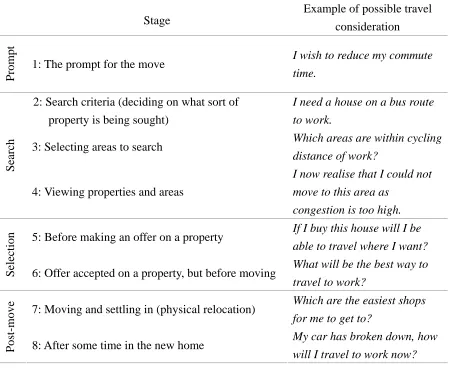
Based upon insights from the in-depth interviews, a conceptual framework of travel consideration, named the Residential Relocation Timeline (RRT), was developed. The RRT, shown as Table 3, indicates a series of stages during the process of moving home when travel
issues might be considered.
The RRT does not suggest that for any given household travel would be considered at any or
does not imply that consideration would occur at the following stages. The RRT does not attempt to imply that travel considerations are the only, or even the most important, factors under review during the process of a residential relocation. Indeed previous research suggests
that travel is largely not the main priority during a move (Hunt et al., 1994; Molin and
Timmermans, 2003). However, the interest in the context of the present study is not principally in the relative importance of travel issues in the resulting choice of new residential location but, other (non-transport) issues aside, in the potential for residential relocation to be an important juncture for bringing about travel behaviour change.
Table 3 The Residential Relocation Timeline (RRT) stages
Stage
Example of possible travel consideration
Prompt
1: The prompt for the move I wish to reduce my commute
time.
2: Search criteria (deciding on what sort of property is being sought)
I need a house on a bus route
to work.
3: Selecting areas to search Which areas are within cycling
distance of work?
Search
4: Viewing properties and areas
I now realise that I could not
move to this area as
congestion is too high.
5: Before making an offer on a property If I buy this house will I be
able to travel where I want?
Selection 6: Offer accepted on a property, but before moving What will be the best way to
travel to work?
7: Moving and settling in (physical relocation) Which are the easiest shops
for me to get to?
Post-move 8: After some time in the new home
My car has broken down, how
will I travel to work now?
[image:9.595.76.529.302.672.2]described in this questionnaire fitted with your experiences?” Responses were in the form of both a 1-5 rating scale (1 indicating not and all, and 5 indicating very well) and an open space for comments. 79 per cent of the respondents considered that the stages fitted their experiences at least moderately well (3 or greater on the scale). 43 per cent of respondents indicated that the stages fitted well or very well. Examination of feedback from those who considered that the RRT had fitted their experiences less well, revealed the main reason for this response was that the nature of their relocation process meant that a larger number of stages were either combined or skipped.
That the majority of respondents were comfortable with relating to the RRT stages was important because the RRT itself was used as a means of structuring the main element of the questionnaire which examined at what stages in the moving process consideration had occurred.
3.4. When does most consideration occur?
A number of different means of gauging at what point along the RRT consideration occurred were built into the questionnaire design. Firstly, respondents were asked to indicate for each of the stages whether travel was on their mind at that stage (see Figure 1). Respondents were
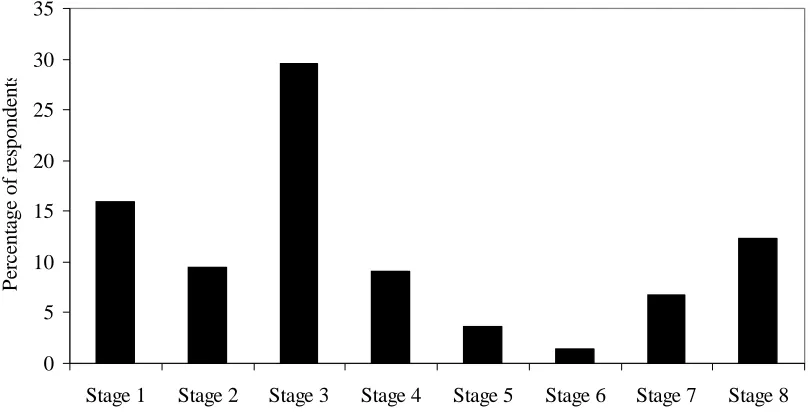
also asked to indicate for which of all the stages travel was most on their mind (see Figure 2).
Where travel issues were considered, free-text response was invited to provide further details.
Notable from Figures 1 and 2 is that Stage 3 (‘Selecting areas to search’) is the most prominent across relocating households in terms of when travel is considered to any extent and when it is likely to be most seriously considered. Open responses describing consideration at this stage highlight that it is characterised by accessibility concerns – ease of
reaching places of employment (e.g. “We wanted to be within a commutable distance to
work”), childminders (e.g. “Had to be near childminder and work”), shops, fitness centre (e.g.
“Wanted to be in walking distance of my gym and shops”) etc. Consideration of such issues
was not confined to Stage 3 but was most strongly associated with it. Different modes allow different distances to be travelled in a reasonable time (walk vs car vs cycle), and any reliance on public transport requires its availability to begin with. Accordingly, specific mode
preferences were frequently mentioned at Stage 3, e.g. “we had to ensure distance travelled to
school was walkable for a teenager”, “looked at areas on bus route”, or “I began to think
about travel distance to work, how far the property was from work and possible routes,
congestion etc., possibility of cycling to work”. Survey responses reveal that some
established strict preferences. Some individuals did not consider travel at this stage. What is clear is that travel choices can often be the subject of significant attention at a relatively early stage in the residential relocation process.
0 10 20 30 40 50 60 70 80 90
Stage 1 Stage 2 Stage 3 Stage 4 Stage 5 Stage 6 Stage 7 Stage 8
P
e
rc
e
n
ta
ge
o
f
re
spon
de
nt
[image:11.595.79.487.186.411.2]s
Figure 1 Proportion of respondents confirming ‘Yes, travel was on my mind at this stage’
It can be seen that Stage 6 (after selecting property, but prior to moving) is where least consideration of travel issues occurs (evident in both Figures 1 and 2). Many respondents reported having already planned all their travel by this stage so further consideration was not deemed necessary. Those who did consider travel issues at Stage 6 generally took the opportunity to seek public transport information and plan routes to work and to other
destinations as they had not already done so, e.g. “I began to think about possible cycle routes
to work and other areas of Bristol that I use” and “looked at map and worked out possible
route to work - realised would have to get up 5 minutes earlier each morning”.
Stages 2, 4 and 5 do not appear across the response sample as a whole to be as significant in relation to the strength of the consideration of travel issues (Figure 2), albeit that many people are considering travel to at least some extent at these stages (Figure 1). This may be as a consequence of the greater focus of attention associated with Stage 3.
relatively little attention across the sample as a whole. This is likely to relate to a number of cases where travel issues (amongst others) were themselves a prompt for the decision to relocate. The survey examined prompts for the move by means of a tick-box response question, with 'to be nearer work', 'to be nearer family', and 'to be near a school' the options related to travel issues. A total of 14 additional options (e.g. bigger house wanted), plus 'other' were available, and participants could select as many as they wished in response. 26 per cent of the study sample reported at least one of these travel options as prompting their move. However for the participants reporting Stage 1 as the stage where travel was most on their mind, this figure rose to 66 per cent.
0 5 10 15 20 25 30 35
Stage 1 Stage 2 Stage 3 Stage 4 Stage 5 Stage 6 Stage 7 Stage 8
P
er
ce
n
ta
ge of
r
es
p
on
d
en
[image:12.595.85.490.295.502.2]ts
Figure 2 Proportion of respondents selecting a given stage as being when travel issues were
‘most on my mind’
Perhaps of most significance, alongside Stage 3, is the final stage (Stage 8 – ‘After some time in the new home’). For 12 per cent of the survey respondents, Stage 8 was when travel issues were most on their mind. As expected, many of these households reported external changes, mainly changes in job locations that had, separately from the home move, prompted re-consideration of travel. Many others, however, experienced no such changes, instead reporting dissatisfaction over experienced post-relocation journeys not meeting with
expectations (especially in relation to journey duration) – e.g. “Realised didn't actually drive
routes to work from new house before moving in rush hour. Busier than expected”. In many
instances this prompted a change in mode as illustrated by the following quotes: “I began to
cycle to work in the centre to avoid traffic”; “Due to price, poor service, lateness, infrequency,
the bus was too expensive, unreliable and smelt”; and “Bus takes too long into town; partner
now drives in and gets an extra 40 minutes in bed”.
Such individuals might have benefited greatly from earlier (more in-depth) consideration of the likely travel impacts of their relocation decision. Issues such as traffic levels in rush hour and bus times and prices could arguably have been checked prior to the selection of the new property. Of course, for some individuals, travel would have remained a lower priority than other consideration in their residential relocation process prior to Stage 8. As such, greater knowledge about the travel implications of their relocation decision might not have altered that decision. For some, more in depth travel research prior to property selection did indeed prove
worthwhile - e.g. “I am very thankful I made the decision to live close to city centre. Traffic in
Bristol is very congested. I travel from [area close to centre] to city centre for work. It takes a
lot of strain off me as I absolutely LOATHE driving” (respondent’s emphasis).
As an aside, feedback concerning Stage 8 is rather illuminating in relation to public transport. There has been a tendency to see endeavours to attract people to use buses being hampered by the problem of non-users having ill-informed perspectives of what public transport is like thus perceiving the experience of bus use to be worse than it is in practice. Yet Stage 8 points towards a willingness amongst some people to try using public transport, only to find that
their perceptions or expectations exceed the quality of service that they encounter in practice
such that they revert to using other modes.
While Stage 3 stands out as a point in the process of residential relocation from which greatest potential for travel behaviour change may stem, Figure 2 provides a reminder of the diversity of home-moving experiences and priorities. The points where travel consideration occurs vary across the population of individuals who have relocated their homes. Analysis was therefore undertaken to establish whether meaningful typologies of home-movers in terms of travel consideration might nevertheless exist.
3.5. 4. Given the diversity of specific relocation experiences and the
individuals involved, are there identifiable typologies of
home-movers?
examine for typologies of travel consideration in home-movers1. A five-cluster solution was identified from the analysis and, in line with examining the makeup of each cluster, the clusters were given labels. Table 4 shows for each of the five clusters the percentage of respondents in that group considering travel at each stage. This Table frames the interpretation
of the clusters, as outlined below. In addition to this a series of Chi2 tests were performed to
examine relationships between the cluster division and additional variables in the study such as distance of move, number of areas viewed and impact of the move on availability of travel options. Only those variables demonstrating a significant relationship are remarked upon.
Cluster 1 – minimal considerers (n=66) - There was very little consideration of travel issues
within this cluster and any consideration that did occur was predominantly at Stages 2 and 3. 33 cluster members did not consider travel at any stage during their move. This cluster had collectively moved the shortest distance - 75 per cent of individuals having moved less than 3 miles and 33 per cent having moved less than one mile. This minimal distance of move was frequently cited in the open answer responses as an explanation for lack of consideration of travel issues. Another reason for little or no travel consideration was multiple or distant work location/s for which detailed planning would have little consequence. Additional comments included the focus on other priorities such as a nice house or good school. This cluster also indicated that the RRT stages fitted the relocation experience least well out of all of the clusters.
Cluster 2 - Maximal Considerers (n=50) - Cluster members are likely to consider travel issues at several stages through the process of relocation. This cluster contains members who have
1
moved further and viewed a higher number of areas. The RRT is found to fit well with their experiences. Though households in this cluster are inclined to be travelling more miles following their relocation, they are more likely to believe that their availability of travel options has improved.
Table 4 Cluster membership and percentage of respondents in each group considering travel
at each stage
1: Minimal Considerers 2:Maximal Considerers 3: Prompted
early p
lann
ers
4: Post move considerers 5: Early P
lanners not prompted
Stage 1 5 60 100 6 14
Stage 2 24 68 75 35 76
Stage 3 33 88 90 59 94
Stage 4 0 96 65 6 93
Stage 5 5 94 0 0 70
Stage 6 3 70 0 24 16
Stage 7 6 96 30 82 13
Stage 8 6 78 30 100 21
n 66 50 20 17 71
Cluster 3 - Prompted early planners (n=20) – This cluster is characterised by early considerers for whom travel issues have contributed to prompting the move. By Stage 5 future travel is planned and minimal further consideration is required. Cluster members tend to have viewed lots of different areas in search of their new home.
[image:15.595.155.433.240.567.2]travel. For cluster members, time to travel to work is seen to have increased but so too has the availability of travel options. Cluster members are inclined not to have been familiar with the area into which they moved.
Cluster 5 - Early planners not prompted (n=71) - Similar to Cluster 3, but travel issues have not prompted the move. Consideration of travel issues takes place at the earlier stages. By Stage 5 travel is planned and minimal further consideration is required. Cluster members tend to have moved a shorter distance and experienced no change in transport availability at their new location though their time for travelling to work has decreased. They consider the RRT to have fitted very well with their experiences.
Such typologies may prove instructive in seeking to better understand how to develop and target initiatives intended to (further) encourage consideration of travel issues and thus in turn encourage (positive) changes in travel behaviour itself. In moving now to the final part of the paper, attention turns to summarising what insights have emerged from the study and considering of what value they may be to transport policy endeavours to influence travel demand.
4. Concluding discussion with policy implications
In answer to the research questions posed at the start of this paper, the following can now be said, at least for the survey sample examined. A substantial amount of travel behaviour change (as evidenced by reported changes to travel mode for specific journey purposes) results following residential relocation (even though three-quarters of relocations are over a distance of less than ten miles). Behaviour change points to a likely even greater amount of consideration of travel behaviour (and possibly behavioural intentions). To examine this crucial stepping stone of conscious consideration that overcomes (temporarily) habituality, the significance of relocation as a process as distinct from only an outcome has been established. In turn the Residential Relocation Timeline (RRT) has been shown to be a helpful means of depicting that process and facilitating closer examination of it. It is found that extensive consideration of travel occurs throughout the stages of the timeline – a timeline which,
importantly, extends beyond the completion of the physical move itself. With regard to when
Notwithstanding the diversity of residential relocation circumstances, home-mover characteristics and experiences, it seems possible to identify reasonably meaningful
typologies of individuals and their associated relocation descriptors.
Where consideration of travel issues occurs the psychological barrier to behaviour change of habit is not present, since by definition behaviours that are considered are not habitual. This can lead to some behaviour change, but weakened habit does not guarantee behaviour change. The consideration may be too weak to have an impact, or alternatively continuation of the current behaviour could be positively re-selected as the preferred option. This said, weakened habit is a prerequisite to behaviour change. As such, residential relocation, and the substantial degree of conscious consideration of travel that surrounds it, should be of interest and relevance to policy agendas which seek to bring about change in order to reduce or redistribute travel. Such policy aims to encourage methods of travel (or lack of it) that are more sustainable or less economically, socially and environmentally harmful.
There has been substantial investment in transport in recent years in the UK with stated policy aims to encourage greater use of public transport, walking and cycling and in tandem reduce reliance on the car. Yet in theory the public can stay largely ignorant of improvements to travel alternatives resulting from investment if they remain embedded in habitual behaviours and lack the inclination or motivation for conscious consideration and reappraisal of their behaviours.
Alongside other countries, the UK has pursued for some while initiatives to promote behaviour change but these have often been quite general in nature taking the form of informational campaigns seeking to encourage the public to become more aware of their travel behaviour and to take action to consider changing it. These have often fallen on deaf ears. At the other extreme, targeted campaigns such as TravelSmart have enjoyed recognised success in providing ‘travel counselling’ to households and communities leading to small but significant changes in behaviour. However, such targeted campaigns can be expensive to implement. Somewhere in between these extremes are interventions such as those embodies in organisational travel plans where incentives may be offered to pursue certain behaviours.
more persuasive in seeking to actively promote the availability of attractive or acceptable travel alternatives. Alternatively, it may be more incentivised in nature – for example providing a relocating household with discounted travel on public transport for a period following their relocation (comparable with the discount on purchases for recent movers that a major DIY chain currently offers its customers in the UK). However, crucial to the success of any such interventions would be their timing.
The point of greatest consideration along the RRT has been identified as Stage 3 when households are selecting areas to search. It would seem appropriate that any intended interventions should be targeted at least at this stage.
A complementary aim of an intervention at Stage 3 could conceivably be to attempt to influence the final choice of relocation itself. In other words to encourage the selection of a location that enables much of the required routine travel to be completed without the use of a car or as much reliance on motorised modes in general. It would not be presumed that such an aim could necessarily render consideration of travel more important than other relocation considerations like an attractive house and garden. Instead the aim could be to encourage greater consideration of travel in situations where various locations otherwise satisfy the other considerations. Information and guidance would be required – possibly delivered via estate agents trained to provide such information. Advances in data availability and processing are making possible computer analysis facilities that could provide indications of suitable property locations based upon a household’s accessibility needs. Indeed in the UK, accessibility planning is now a key theme in shaping local authority transport planning and associated funding awards from Central Government. Software developed to support accessibility planning which is GIS-based may readily lend itself to the creation of information for residential relocation advice. Experimental work drawing upon the UK Government’s multi-modal door-to-door journey planner (Transport Direct) is also examining how isochrones of travel for a given postcode location in the UK can be produced.
The likely success of any of these measures is unpredictable. Given the already severely constrained choice in much of the UK housing market – limited largely by cost but also availability, the process is unlikely to be straightforward. Nevertheless, the following quote
from a survey respondent underlines the potential: “If I had known the traffic problems/ road
5. References
Bamberg, S., Rolle, D. and Weber, C. (2003). Does habitual car use not lead to more
resistance to change of travel mode? Transportation, 30(1), 97-108.
Cramer, D. (2003). Advanced Quantitative Data Analysis, Chapter 4: Cluster Analysis, Open
University Press, Buckingham.
Dargay, J. and Hanly, M. (2004). Volatility of Car Ownership, Commuting Mode and Time in
The UK. Proc. of the World Conference on Transport Research, Istanbul.
Garling, T. (1998). Behavioural assumptions overlooked in travel-choice modeling. In J.d.D.
Ortuzar, D. A. Hensher, & S. Jara-Diaz (Eds), Travel Behaviour Research: Updating the
State of Play, 3-18, Elsevier Science Ltd, The Netherlands.
Hunt, J.D., McMillan, J.D.P. and J.E. Abraham (1994). Stated preference investigation of
influences on attractiveness of residential locations. In Transportation Research Record
1466, TRB, National Research Counsel, Washington, D.C., 17-35.
Kenyon, S. and Lyons, G. (2003). The value of integrated multimodal traveler information and
its potential contribution to modal change. Transportation Research Part F: Traffic
Psychology and Behaviour, 6(1), 1-21.
Klökner, C. (2004). How single events change travel mode choice a life span perspective. Paper
presented at the 3rd International Conference of Traffic and Transport Psychology, 5-9
September, Nottingham, UK.
Molin, E. and Timmermans, H. (2003). Accessibility Considerations in Residential Choice Decisions: Accumulated Evidence from the Benelux. Paper presented at the Annual Transportation Research Board (TRB) Meeting, Washington D.C. January.
Ouellette, J. and Wood, W. (1998). Habit and intention in everyday life: The multiple
processes by which past behaviour predicts from future behaviour. Psychological
Bulletin, 124(1), 54-74.
Stanbridge, K., Lyons, G. and Farthing, S. (2004). Travel behaviour change and residential
relocation. Paper presented at the 3rd International Conference of Traffic and
Transport Psychology. 5th- 9th September, Nottingham, UK.
Van der Waerden, P., Timmermans, H. and Borgers, A. (2003). The influence of key events and critical incidents on transport mode choice switching behaviour: A descriptive
analysis. Paper presented at Moving through nets: The physical and social
dimensions of travel. 10th International Conference on Travel Behaviour Research.
Verplanken, B., Aarts, H., and van Knippenberg, A. (1997). Habit, information acquisition,
and the process of making travel mode choices. European Journal of Social Psychology,