A declarative approach to heterogeneous multi-mode
modelling languages.
CLARK, Tony <http://orcid.org/0000-0003-3167-0739>
Available from Sheffield Hallam University Research Archive (SHURA) at:
http://shura.shu.ac.uk/12069/
This document is the author deposited version. You are advised to consult the
publisher's version if you wish to cite from it.
Published version
CLARK, Tony (2014). A declarative approach to heterogeneous multi-mode
modelling languages. In: COMBEMALE, Benoit, DEANTONI, Julien and FRANCE,
Robert, (eds.) GEMOC 2014: globalization of modeling languages: proceedings of
the 2nd International Workshop on The Globalization of Modeling Languages
co-located with ACM/IEEE 17th International Conference on Model Driven Engineering
Languages and Systems (Models '14). CEUR Workshop Proceedings (1236). Tilburg
University, 33-42.
Copyright and re-use policy
See
http://shura.shu.ac.uk/information.html
A Declarative Approach to Heterogeneous
Multi-Mode Modelling Languages
Tony Clark
Department of Computer Science, Middlesex University, London, UK
Abstract. This paper proposes a declarative approach to multi-mode heterogeneous DSLs based on term rewriting. The paper presents a data model and algorithm for processing syntax structures. It has been val-idated by an implementation that supports a range of languages. The paper includes an example language that supports both game construc-tion and execuconstruc-tion.
1
Introduction
Domain Specific Languages (DSLs) [25, 17] are motivated by the need to define languages that match specific use-cases, as opposed to General Purpose Lan-guages (GPLs). Whilst GPLs are usually supported by standard text editors, DSLs, by their nature, often contain a range of more exotic syntax elements that are arguably better supported by syntax-aware editors. This has led to the development of a range of technologies to support DSL development and that generate tools for each DSL. Where the DSL is limited to text, languages such as EMFText [8], MontiCore [15, 16], TCS [10], and XText [6], MPS and Spoofax [11] allow a DSL to be quickly and conveniently defined and the associated tooling generated. These technologies are mainly based on grammarware [12] that inte-grate language parsers with editors in order to achieve a workbench. Many of the technologies integrate static and dynamic analysis of the resulting DSL. These technologies have become quite mature and the term Language Workbench [7] has been coined to describe this type of engineering tool.
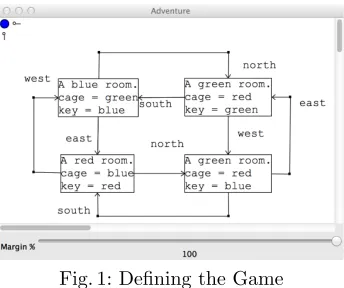
Fig. 1: Defining the Game
involve multiple modes, minimally definitionand subsequent use. Other modes include debuggingand using a language from the perspective of different stake-holders. Most DSL technologies do not support multi-mode interaction within the same tool-set.
This paper presents a novel declarative approach to the definition and associ-ated tooling for heterogeneous multi-mode DSLs. The contribution is to propose that simple term rewriting can be used as the basis of this approach. This paper describes an algorithm that is suitable for this purpose and demonstrates how the declarative approach can be used to define a multi-mode heterogeneous DSL for building and playing a game. The approach has been validated by implementing the algorithm and the associated tool can be downloaded with examples.
2
Example
Consider a game that involves a collection of rooms that are connected by corri-dors. A room is either empty or contains a locked cage. The cage is painted red, green or blue. Inside the cage is a painted key. A key can be used to unlock a cage of the same colour and get the key inside. The player starts off in a room with a red key. The aim of the game is to visit all the rooms and unlock all the cages. Figure 1 shows the definition of a dungeon using the language editor for game construction. Rooms are created as nodes and corridors as labelled edges. The text in a room-node shows the colour of the room, the colour of a cage and the colour of the key in the cage. The blue dot at the top-left corner of the tool is used to access a room-creation menu. Edges between room-nodes are created by dragging the mouse from a source node to the target (a menu is used to select a direction). When a room-node is created, its colour and contents are uninitialised: the mouse is used to select from pre-defined colours for the room, cage and key.
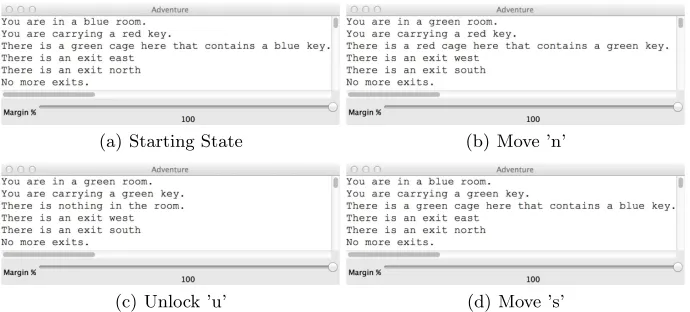
[image:3.612.222.394.114.258.2]player does not have a green key they must move from the starting room; they pressnto go north and arrive at a green room with a red cage. The player can open the cage since their key matches the cage colour. This is done by pressing
uon the keyboard. Finally, the player goes back south.
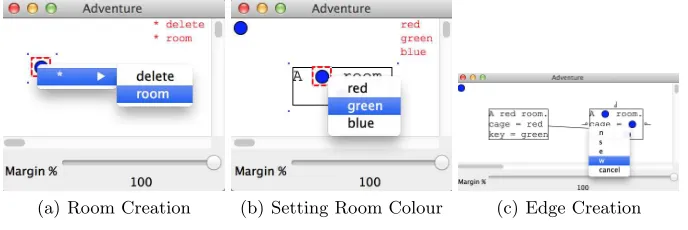
The game shows a number of features of the projectional editor. Interaction with the language can be moded; in this example there are two modes, but in general there can be any number. The abstract syntax can be projected on to graphs and text. In addition, language features can be created by menus made available as blue-dots. Figure 1 shows a blue dot that is used to create room-nodes, but in general a language may offer many different types of item. Figure 2 shows that the state of the game is projected to become formatted text. Figure 3 shows how the editor that is generated from the language definition supports creation of language elements: (a) creation of a new room element; (b) selection of a room colour; (c) selection of a type of edge between rooms.
3
Declarative Language Definition
The approach uses a simple term representation for both concrete and abstract syntax, and uses term rewriting as the technology to support all language modes. Section 3.1 describes the data representation and an rewriting algorithm, section 3.2 describes how concrete syntax is represented as trees in normal forms, and section 3.3 describes how rules are used to define the terms used to represent abstract syntax.
3.1 Syntax Trees and Transformations
The DSL editor manages a syntax tree. A tree is in one of a number of forms:
atomicin which case it is a string, number, char or boolean;termin which case it has the form f[i1,...im](t1,...,tn) where fis the term-functorwhich is a
(a) Starting State (b) Move ’n’
[image:4.612.136.481.500.656.2](c) Unlock ’u’ (d) Move ’s’
(a) Room Creation (b) Setting Room Colour (c) Edge Creation
Fig. 3: Editor Interactions
name,i1,...,imis the identity of the term, andtiare sub-trees. The identity of a term is used to associate a term with layout information. Where the identity of a term is not important it is omitted and assumed to be unique.
The editor works by creating an initial tree referred to asabstract syntax. The abstract syntax tree istransformedinto a concrete syntax tree by applying pattern directed transformation rules. Concrete syntax is a tree whose term-functors are pre-defined.
The editor displays a concrete syntax tree, and then waits for a user-event. The set of user-events is pre-defined; each event is mapped on to a term whose functor designates the type of event:key,selected,drag,etc. The abstract syntax treetand the new event-termeare combined into a new term whose functor is ←, written t ← e. The transformation process is repeated, allowing rules that processeto transformtappropriately.
Transformation rules have the formp → ewhere pis a pattern ande is an expression. A pattern is a tree that contains variables. A variable is just a name that starts with an upper-case letter. An environment E associates variables with either trees or lists of trees, and associates functors with functions. An environment that contains no lists is applied to a pattern to create a treeE(p)=t. For example,{X 7→ 10}(f[0](X))=f[0](10).
Patterns may be repeated. Such a pattern must be nested within a par-ent pattern and is followed by ... The informal meaning of such a pattern is ‘match as many elements as possible then continue’. For example, the pattern
f[0](p...,10)will match a term whose functor isf, whose identity is0and whose children end with10, providing that all other children each match patternp.
An environment that applies to a pattern containing repeated sub-patterns will contain mappings between variables and lists of trees. For example,
{X 7→[1,2,3]}(f(X...,10))=f(1,2,3,10). Repeated patterns need not be atomic as in the following example:{X 7→[1,2,3]}(f(g(X)...,10))=f(g(1),g(2),g(3),10).
Expressions are patterns that can refer to local variables and local function definitions. A local function definition is a collection of rules that are selectively applied to part of a tree. For example, ifL=10andf(A)=g(A)are local definitions then the term x(f(L))in the context of these definitions will be transformed to
1 proc transition(tree,locals,transformations,reductions,table) {
2 while(true) {
3 tree := transform(transformations,locals,tree);
4 let tree’ := transform(reductions,tree) such that tree’ ∈ N
5 table := display(tree’,table); 6 tree := get_event(tree’,tree,table); 7 }
8 }
9 fun transform(rules,locals,tree) {
10 while ∃p→ e∈ rulesand∃E∈ E such that I ⊆ EandE(p) = tree do{
11 tree := E(e)
12 }
13 let f[i1, . . . , in](t1, . . . , tn) = tree
14 tree’ = f[i1, . . . , in](t′1, . . . , t′n) wheret′i = transform(rules,locals,t′i)
15 if tree’ = tree
16 then return tree
17 else return transform(rules,locals,tree’)
18 }
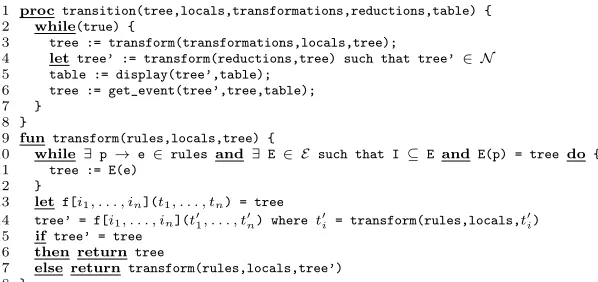
Fig. 4: Projectional Editor Algorithm
A rule r is a pattern and an expression p → e. Given a tree, t, and some local definitionsL,ris applicable when there is an environmentEthat contains
Lfor whichE(p)=t. The result of applying the rule to tis thenE(e).
The behaviour of the editor is defined in figure 4. The proceduretransition
performs a loop that transforms the abstract to the concrete syntax tree, displays the concrete syntax tree and then waits for a user event. The arguments of
transitionare: the abstract syntax tree, the local definitions, two sets of rules
transformationsandreductions, and a table that maps term identities to layout information.
Line 3 uses the transformation rules to change the current abstract syntax tree. This allows events to be change the state of the tree. Line 4 uses the reduction rules to transform the tree into a normal form, i.e., a member of the set of treesN that can be drawn by the editor. The resulting concrete syntax
tree’is displayed by the editor in line 5 using the table to remember the layout information on each loop within the proceduretransition.
Line 6 waits for a user event. Such an event will occur with respect to the concrete syntax, so the table is used to make the correspondence between ele-ments in tree’and intree, resulting in a new abstract syntax tree of the form
t ← e.
The procedure transformis used to apply rules to a tree in the context of some local definitions. Lines 11-13 continually select a rule that is applicable and updates the tree. Once there are no more applicable rules, line 15 transforms the children of the tree. If any children have changed then the process is repeated (line 18) otherwise no more rules are applicable to any part of the tree and it is returned (line 17).
3.2 Normal Forms
The set N of normal forms contains trees whose functors and structure
[image:6.612.125.424.120.261.2]can respond to user events. Different editors may define different sets of normal forms, for example a text-only editor may only support trees that correspond to string layout, whereas a graph editor may only support trees representing collections of nodes and edges.
This paper uses a game to explain the key features of the projectional editor approach to heterogeneous DSLs. The normal forms used by the game are:
atomAny atomic value is a normal form.
seq(t1,...,tn)The sub-tree normal forms are displayed in sequence.
nlProduce a new-line.
graph(etypes,nodes-and-edges)The graph is displayed on the screen and sup-ports selection, new edge, movement, resize, and mouse click events. The identities of the nodes and edges are used to ensure that the layout is con-sistent; therefore, a node with a fresh identity will cause a new node to appear on the screen. The etypes define the permissible edge types, and
nodes-and-edgesis a mixed sequence of nodes and edges.
edge-types(t1,...,tn)eachtiis of the formtype(source,target)wheretype
is the type designator for edges that can be drawn from nodes of typesource
to nodes of typetarget.
node(ntype,i,display)wherentypedesignates the type of node,iis the iden-tity of the abstract syntax element represented by the node (for passing back events on this node), anddisplay is a normal form that is displayed when this node is drawn.
edge(source,sdec,target,tdec,label)wheresourceandtargetare the source and target node identities,sdec and tdec are the edge-end decorations for the source and target, andlabel is a label on the edge.
vbox(pelements)A vertical box of elements that are all of the forml(e)where
lis one of the layout designators:centre; left;right.
3.3 Abstract Syntax
The editor must start with an initial abstract syntax structure. This is defined by an abstract clause in the language definition that corresponds roughly to a type definition for abstract syntax trees. The clause consists of a number of rules of the form name → element where element is one of: a term of the form
f(e1,...,en)where eacheiis an element;strin which case the element denotes an editable string in the concrete syntax; e* where e is an element in which case the abstract syntax denotes a sequence of e’s of arbitrary length, and is manifest in the concrete syntax in the form of a holethat can be selected and incrementally extended via a menu; a disjunction e1 | e2 which will manifest itself in the concrete syntax as a hole associated with a menu that allows the user to choose between filling the hole withe1ore2. For example:
1 abstract {
2 numbers →number*
3 number →zero | add(number)
represents an abstract syntax tree that is generated from the first rule (numbers). Since the first rule isnumber* we do not know how many instances ofnumber to generate, so a hole is displayed allowing the user to generate anumber followed by another hole, or to delete the hole (completing the sequence). Anumber also generates a hole allowing the user to choose between replacing the hole with a
zero or a tree containing another number. Although the display of the holes is fixed, the actual representation of terms of the formadd(add(zero))will depend on the reduction rules that map it into a normal form.
4
Game Implementation
This section describes the game implementation in terms of the abstract syn-tax definition, the locals, the transformation rules and the reduction rules. The abstract syntax for the game is:
1 abstract {
2 game → game(construct,map(rooms(room*),exits),player)
3 room → room(colour,empty | cage)
4 colour → red | green | blue
5 cage → cage(colour,colour) }
The game is initially in constructmode which means that it will be displayed as a graph and allow new rooms and exits to be added. The map contains an extensible sequence of rooms and emptyexitsandplayerterms. A room has a colour and is either empty or contains a cage. A cage term contains two colours, one for the cage-lock and the other for the key in the cage.
The locals defines the edge types used between room-nodes and a function called exits-fromthat is used to map a room id and a list of all exits from all rooms, to just the exits from the designated room:
1 locals{
2 E = edge-types(n(room,room),s(room,room),e(room,room),w(room,room)) 3 exits-from(I,Exits) =
4 case Exits { 5 exits →nil
6 exits(exit(D,I,_),Exit...) →cons(D,exits-from(I,exits(Exit...)))
7 exits(_,Exit...) →exits-from(I,exits(Exit...)) } }
The transformation rules are used to handle user events and use pattern match-ing to dispatch on the state of the game:
1 transform {
2 game(_,map(rooms(Room[I](Colour,Contents),R...),Exits),_) ← ↓p→
3 game(play,map(rooms(Room[I](Colour,Contents),R...),Exits),player(I,red)) 4 game(_,map(Rooms,Exits),Player) ← ↓c→game(construct,map(Rooms,Exits),Player)
5 game(play,map(Rooms,exits(X1...,exit(n,S,T),X2...)),player(S,Carrying))← ↓n→
6 game(play,map(Rooms,exits(X1...,exit(n,S,T),X2...)),player(T,Carrying)) 7 game(play,map(Rooms,exits(X1...,exit(s,S,T),X2...)),player(S,Carrying))← ↓s→
8 game(play,map(Rooms,exits(X1...,exit(s,S,T),X2...)),player(T,Carrying)) 9 game(play,map(Rooms,exits(X1...,exit(e,S,T),X2...)),player(S,Carrying))← ↓e→
10 game(play,map(Rooms,exits(X1...,exit(e,S,T),X2...)),player(T,Carrying))
11 game(play,map(Rooms,exits(X1...,exit(w,S,T),X2...)),player(S,Carrying))← ↓w→
12 game(play,map(Rooms,exits(X1...,exit(w,S,T),X2...)),player(T,Carrying))
13 game(play,map(rooms(R1...,Room[I](C,cage(C-Col,K-Col)),R2...),X),player(I,C-Col)) ← ↓u→
14 game(play,map(rooms(R1...,Room[I](C,empty),R2...),X),player(I,K-Col)) 15 game(construct,map(R,exits(E...)),Player) ←new-edge(Type,S,T) →
If the user presses the p key at any time (line 2) then the game changes state to play. If the user presses n when the game is in play (line 5), and if there is an exit north from the player’s current locationSthen the abstract syntax tree transforms into a new state where the player’s current location isT. The player can unlock a cage using key u (line 13). Finally, if the game is in construct
mode and the user drags an edge between two graph nodes, then the message
new-edge(t,s,t)is send to the tree causing a new exit to be added to the map (lines 15,16). The reduction rules transform the current state of the game into a normal-form ready for display by the editor:
1 reduce {
2 game(play,map(rooms(R1...,Room[I](Col,Contents),R2...),exits(Exit...)),player(I,Carry)) →
3 player2str(Carry,Col,Contents,exits-from(I,exits(Exit...)))
4 game(construct,map(rooms(R...),exits(X...)),_)→ graph(E,room2n(R)...,exit2e(X)...)
5 player2str(Carry,Col,Contents,X) →
6 seq(’You are in a ’,Col,’ room.’,nl,carry(Carry),contents(Contents),exits(X))
7 carry(Key-Colour) → seq(’You are carrying a ’,Key-Colour,’ key.’,nl)
8 contents(empty) → seq(’There is nothing in the room.’,nl)
9 contents(cage(C-Col,K-Col)) →
10 seq(’There is a ’,C-Col,’ cage here that contains a ’,K-Col,’ key.’,nl)
11 exits(nil)→ ’No more exits.’
12 exits(cons(Exit,Exits)) →seq(’There is an exit ’,Exit,nl,exits(Exits))
13 exit2e(Exit[I](Type,S,T)) →edge[I](S,none,T,arrow,label[’direction’,I](target,Type))
14 n→ ’north’
15 s→ ’south’
16 e→ ’east’
17 w→ ’west’
18 room2n(Hole[I](H)) →node[’new-room’,I](new-room,I,H)
19 room2n(Room[I](Col,Stuff)) →
20 node[’room’,I](room,I,vbox[’b’,I](centre(seq(’A ’,Col,’ room.’)),centre(Stuff)))
21 red →’red’
22 green →’green’
23 blue →’blue’
24 empty →’empty’
25 cage(Cage-Colour,Key-Colour)→ seq(’cage = ’,Cage-Colour,nl,’key = ’,Key-Colour)
26 }
Lines 1 - 4 show the two rules that detect whether the game is being constructed or played. If played, then the game state is translated into text. If constructed then the game state is translated to a graph.
5
Implementation
The editor described in this paper has been implemented in the programming language Racket and used to define a range of heterogeneous languages. An im-plementation pack accompanies this paper1
. The pack includes a Mac disk image
stand-alone-editor.dmg of the editor implementation, several saved languages (*.xml) and the source code of the language definitionslanguage-definitions.rkt. Once you have installed the editor, navigate to thebindirectory and start the tool before dragging any of the xml files onto the editor pane to load up the language definition. The pack includes the game language definition, an exam-ple adventure, a use-cases imexam-plementation of hotel booking and a library class diagram. See the language definitions for more details.
1 http://www.eis.mdx.ac.uk/staffpages/tonyclark/Software/projectional_
6
Conclusion and Future Directions
This paper has proposed a declarative approach to multi-mode heterogeneous DSLs. The approach freely mixes graphical and textual syntax and an algorithm has been presented to process the syntax structures. The algorithm has been validated by an implementation, but leaves room for future development. The approach is structural whilst other approaches integrate text parsing with pro-jectional editing (e.g., [4]); it may be possible to integrate both approaches. The meta-language described in this paper provides no support for error handling and will simply go wrong if the rules fail to produce a normal-form or if a lo-cal rule definition produces a tree of an unexpected type. One way to address this is to have a separate category of rules that are used for checking and er-ror reporting. Related to this, the language does not support static checking. For example, it should be possible to detect the use of unbound identifiers and undefined functors. Some aspects of static checking should be easy to achieve, however it would also be desirable to define a type system so that the use of syn-tax structures can be checked before use. There is interest in the modularity and composition of languages and DSLs in particular [24, 3, 18, 19]. A key challenge to achieving engineered integration is posed by concrete syntax. By inverting the focus of attention to abstract-syntax, a projectional editor does not suffer from such problems. However, there are still significant issues to be addressed and this could be a fruitful area for future work.
References
1. Francisco P´erez Andr´es, Juan de Lara, and Esther Guerra. Domain specific lan-guages with graphical and textual views. InApplications of Graph Transformations with Industrial Relevance, pages 82–97. Springer, 2008.
2. Colin Atkinson and Ralph Gerbig. Harmonizing textual and graphical visual-izations of domain specific models. In Proceedings of the Second Workshop on Graphical Modeling Language Development, pages 32–41. ACM, 2013.
3. Walter Cazzola and Ivan Speziale. Sectional domain specific languages. In Pro-ceedings of the 4th workshop on Domain-specific aspect languages. ACM, 2009. 4. Lukas Diekmann and Laurence Tratt. Parsing composed grammars with language
boxes. Workshop on Scalable Language Specifications, 2013.
5. Luc Engelen and Mark van den Brand. Integrating textual and graphical modelling languages. Electronic Notes in Theoretical Computer Science, 253(7), 2010. 6. Moritz Eysholdt and Heiko Behrens. Xtext: implement your language faster than
the quick and dirty way. In Proceedings of the ACM international conference companion on Object oriented programming systems languages and applications companion, pages 307–309. ACM, 2010.
7. Martin Fowler. Language workbenches: The killer-app for domain specific lan-guages. 2005.
9. Markus Herrmannsdoerfer, Daniel Ratiu, and Guido Wachsmuth. Language evo-lution in practice: The history of gmf. In Software Language Engineering, pages 3–22. Springer, 2010.
10. Fr´ed´eric Jouault, Jean B´ezivin, and Ivan Kurtev. Tcs:: a dsl for the specification of textual concrete syntaxes in model engineering. InProceedings of the 5th inter-national conference on Generative programming and component engineering, pages 249–254. ACM, 2006.
11. Lennart CL Kats and Eelco Visser. The spoofax language workbench: rules for declarative specification of languages and ides. InACM Sigplan Notices, volume 45, pages 444–463. ACM, 2010.
12. Paul Klint, Ralf L¨ammel, and Chris Verhoef. Toward an engineering discipline for grammarware. ACM Transactions on Software Engineering and Methodology (TOSEM), 14(3):331–380, 2005.
13. Dimitrios S Kolovos, Louis M Rose, Saad Bin Abid, Richard F Paige, Fiona AC Polack, and Goetz Botterweck. Taming emf and gmf using model transformation. InModel Driven Engineering Languages and Systems. Springer, 2010.
14. Dimitrios S Kolovos, Louis M Rose, Richard F Paige, and Fiona AC Polack. Raising the level of abstraction in the development of gmf-based graphical model editors. InProceedings of the 2009 ICSE Workshop on Modeling in Software Engineering, pages 13–19. IEEE Computer Society, 2009.
15. Holger Krahn, Bernhard Rumpe, and Steven V¨olkel. Monticore: Modular develop-ment of textual domain specific languages. In Objects, Components, Models and Patterns, pages 297–315. Springer, 2008.
16. Holger Krahn, Bernhard Rumpe, and Steven V¨olkel. Monticore: a framework for compositional development of domain specific languages. International journal on software tools for technology transfer, 12(5):353–372, 2010.
17. Marjan Mernik, Jan Heering, and Anthony M Sloane. When and how to develop domain-specific languages.ACM computing surveys (CSUR), 37(4):316–344, 2005. 18. Lukas Renggli, Marcus Denker, and Oscar Nierstrasz. Language boxes. InSoftware
Language Engineering, pages 274–293. Springer, 2010.
19. Bernhard Rumpe. Towards model and language composition. InProceedings of the First Workshop on the Globalization of Domain Specific Languages. ACM, 2013. 20. Markus Scheidgen. Textual modelling embedded into graphical modelling. InModel
Driven Architecture–Foundations and Applications, pages 153–168. Springer, 2008. 21. Christian Schneider. On integrating graphical and textual modeling. Real-Time
and Embedded Systems Group, Christian-Albrechts-Universit¨at zu Kiel, 2011. 22. Charles Simonyi, Magnus Christerson, and Shane Clifford. Intentional software. In
Peri L. Tarr and William R. Cook, editors,Proceedings of the 21th Annual ACM SIGPLAN Conference on Object-Oriented Programming, Systems, Languages, and Applications, OOPSLA 2006, October 22-26, 2006, Portland, Oregon, USA, pages 451–464. ACM, 2006.
23. Juha-Pekka Tolvanen and Steven Kelly. Metaedit+: defining and using integrated domain-specific modeling languages. InProceedings of the 24th ACM SIGPLAN conference companion on Object oriented programming systems languages and ap-plications, pages 819–820. ACM, 2009.
24. Federico Tomassetti, Antonio Vetr´o, Marco Torchiano, Markus Voelter, and Bernd Kolb. A model-based approach to language integration. InModeling in Software Engineering (MiSE), 2013 5th International Workshop on. IEEE, 2013.